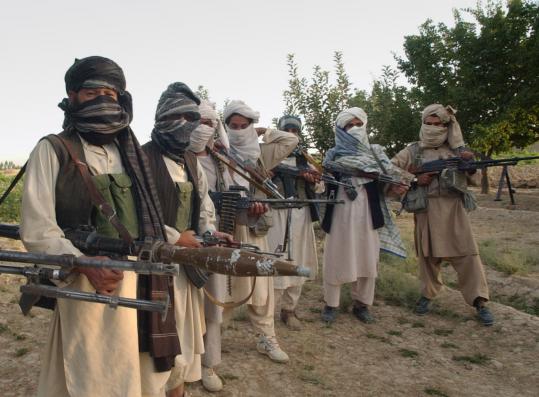
April 19, 2010

Quote of the Day

“Bringing him to justice, capturing or killing him, obviously, remains a priority. If you examine the tempo with which this administration has prosecuted the war on terror, in rooting out ... high-value targets, we have – we’ve done so in a way, I think, that by all accounts has greatly damaged the capabilities of al-Qaeda.”

- White House spokesman Robert Gibbs, explaining that the Obama administration has "deliberately stepped up the number of targeted assassinations."

Al-Masri and al-Baghdadi: Real or Shadows?


In 2006 The Washington Post touched off a quiet controversy when it reported the US military was actively engaged in psychological manipulation against the American people. The idea is that al-Zarqawi, leader of al-Qaeda in Iraq at the time, was exaggerated in order to link 9/11 to Iraq and create a foreign lightning rod opposite US forces.

“Leaks to reporters from U.S. officials in Iraq are common, but official evidence of a propaganda operation using an American reporter is rare,” the Post reported.

Denial was swift in the face of such conclusive evidence: “For the past two years, U.S. military leaders have been using Iraqi media and other outlets in Baghdad to publicize Zarqawi's role in the insurgency. The documents explicitly list the "U.S. Home Audience" as one of the targets of a broader propaganda campaign.”

Of course al-Zarqaqwi was real and committed many acts of war and terrorism. His Jordanian status ended up mattering less than blowing up countless Iraqis and the Al ‘Askarī Mosque’s luminous Golden Dome.

The point is that al-Zarqaqwi became a tool of the US military. This could be a good strategy to further an end of the war, but al-Zarqaqwi was primarily manipulated through the US and international media to conceal strategic errors and outright lies from Washington.

Why fix the least broken part of the system?

Fast forward to today. Abu Ayub al-Masri, leader of al-Qaeda in Iraq, and Abu Omar al-Baghdadi, the purported leader of al-Qaeda's local affiliate, the Islamic State of Iraq, are supposedly dead by drone. If they’re really dead then this is big deal - for the few months before they’re replaced.

A point does exists where a guerrilla group is operationally degraded, and there is no reason not to “remove them from the battlefield,” as they say. Now should al-Masri and al-Baghdadi have been killed? Capture, considering the information to raid them came from a capture, seems to be a wiser choice. Maybe they were too dangerous to capture.

But what if al-Baghdadi didn’t exist at all?

Mustafa al-Ani, a security advisor at Gulf Research Centre, told Al Jazeera, "Last year the government showed Baghdadi captured on official TV and then this was denied by the insurgents. I believe Maliki lost credibility as a result. So I don't think Maliki is going to risk losing his credibility a second time without verifying the identity.”

"At the same time we must ask whether Baghdadi is real. It is a possibility that he is a fictitious character used by al-Qaeda. Al-Masri is different - we have photos and a video dating back three years and so his identity is much easier to match."

While al-Ani could be launching his own propaganda through al-Jazeera, the mere speculation of his existence combines with an even more improbable “coincidence,” real evidence of manipulation. If al-Masri and al-Baghdadi weren’t killed today the main headline out of Iraq would be Prime Minister Nori Al-Maliki ordering a recount of Baghdad’s election count.

Definitely not as appealing as, “Top al-Qaida leaders killed in Iraq.”

Look how quickly US officials flanked out despite false alarms in the past. They knew the recount was coming and that they had to run ahead of the story.

"Their deaths are potentially devastating blows to al-Qaida Iraq," Vice President Joe Biden said in Washington. "But equally important in my view is this action demonstrates the improved security, strength and capacity of Iraqi security forces. The Iraqis led this operation, and it was based on intelligence the Iraqi security forces themselves developed."

He didn't mention Iraq's election.

U.S. forces commander Gen. Raymond Odierno thinks, "The death of these terrorists is potentially the most significant blow to al-Qaida in Iraq since the beginning of the insurgency. There is still work to do but this is a significant step forward in ridding Iraq of terrorists."

We’ve seen a few analysts claim General David Petraeus toned the rhetoric down, but it doesn’t sound that way: “These two extremist leaders were responsible for barbaric attacks that killed thousands of innocent Iraqi citizens and Iraqi and Coalition Security Force members. Their deaths constitute another major milestone in the effort to defeat extremism in Iraq.”

Though they may all be correct in their assessment of al-Qaeda’s capabilities, their fixation on military operations sloppily masks a twisted political reality in Iraq. Reports have Shiite cleric Muqtada al-Sadr aligning with Ayad Allawi, leader of the Iraqi National Movement (INM), then al-Maliki, then neither. Above is Maliki and Allawi’s direct struggle, while the Kurds prepare to counter any move outside themselves.

"The recount is expected to take at least a week, reports The New York Times. Officials said the three-member court that ruled on Monday was still considering other complaints of fraud and could order recounts in other regions as well. The main Kurdish alliance also objected and asked the court to review votes in two northern provinces, Nineveh and Kirkuk."

Allawi and Sunni blocs are likely to react with their own recount demands.

A Iraqi government will be lucky to form by August, when all US combat forces are supposed to withdraw from Iraq, and if luck fails the possibly remains that its political system jams beyond August. All sides are refusing to take less than the others, logical but not conducive to compromise. The risk of new security, economic, and social weaknesses will continue to increase, creating more triggers for politico-military strife.

We've been told for years that a political solution is the military solution, but perhaps this truism is also laced with propaganda. Now when Allawi warns, “If this happens [the Baghdad recount], there will be very big problems in the country,” the US media’s message is a “potentially devastating blow to al-Qaeda.”

Al-Masri and Baghdadi are probably real, but there is no doubt that America is making them dance. The same disguise of using al-Qaeda to mask Iraq’s sectarian divisions in 2006 is being applied to post-election 2010. Makes the shadows easier to spot at least. What does this fusillade from the White House and Pentagon really say?

They’re worried too.

Reality Trumping Obama

The White House will need a few days to clean up the stink bomb the Pew Research Center just dropped on President Barack Obama. He’s only one year and four months into his presidency so he has time to turn it around, but therein lies the problem - he has to turn it around.

Never likely to become the president he portrayed in his campaign, now the Pew Research Center concluded after extensive polling that distrust of the US government has fallen to a 50 year low - 22%.

While we predicted those around Obama would exploit him, a fear sadly proven, a certain fascination also took hold when we realized two bodies were about to collide. Obama’s soaring rhetoric form a comet, with the destabilizing world awaiting him like a red giant.

Obama is no realist. He represents the pinnacle of idealism versus realism and reality is winning.

“Rather than an activist government to deal with the nation's top problems, the public now wants government reformed and growing numbers want its power curtailed. With the exception of greater regulation of major financial institutions, there is less of an appetite for government solutions to the nation's problems - including more government control over the economy - than there was when Barack Obama first took office.”

The report, while significant in its authority, reveals few unknown truths.

“The current survey and previous research have found that there is no single factor that drives general public distrust in government. Instead, there are several factors - and all are currently present. First, there is considerable evidence that distrust of government is strongly connected to how people feel about the overall state of the nation. Distrust of government soars when the public is unhappy with the way things are going in the country.”

What a shock.

Part of these findings are skewed by an extreme Republican backlash. If even 20% of conservatives found Obama more appealing this story wouldn’t exist, but his ratings are in the low teens. Some of their criticisms - and all of the ad-hominems - are unjustified. However, conservatives also have legitimate concerns to how the Obama administration is reforming the US government and economy.

In such a pivotal time it was critical for all political sections of America to contribute, but Obama soon dropped his bipartisan promise in order to steamroll health care. A withering economic recovery combined to turn off Independents in the process.

“A particular subgroup of independents, who are financially pressed, chronically distrustful of government and who typically lean to the Republican Party, appears to be especially angry today,” reports Pew.

Limiting special interests is also proving too daunting.

“When asked about a series of criticisms of elected officials in Washington - that they care only about their careers, are influenced by special interests, are unwilling to compromise, and are profligate and out-of-touch - large majorities (no fewer than 76%) agree with each of the statements.”

And though the report stays silent as usual on foreign policy, the main source of distrust from Democrats must be the continuation of Bush’s militarism in the Middle East. For starters the majority of Obama’s support in Afghanistan and Israel comes from the GOP. Human rights activists are losing what’s left of their hope in Darfur and Guantanamo.

While none of these factors are surprising they still deal an assault to the Obama administration. His problems would be minimized if he simply hadn’t promised so much, but that was the price for becoming elected, a gamble evident from the beginning. That burden is his alone.

Apparently believing Americans would settle for a decent term, Obama faces the reality that Americans and the world’s people truly expected a great performance - because one was necessary. It may never come.

Even if Obama grows into the job he’s still surrounded by the same people who sowed distrust for decades.

Drawing on a full deck of Clinton hands and mixing in a few Bush 1s and 2s, Obama is surrounded by the failure of yesterday. Clinton’s 29% trust undoubtedly had to do with Monica Lewinsky, but his administration’s financial and foreign policy errors exploded in George Bush’s hands. Meanwhile Bush’s disastrous foreign policy marches on under the blatant disguise of Gates, Petraeus, and crew.

Separating what is and isn’t Obama’s fault isn’t easy, and some of his domestic policies may succeed in the long term, but his personal promises and the company he keeps is on him. America wouldn’t be where it is today if he were as transformative as advertised. "Change" isn't coming.

This reality is weighing down Obama, Washington, Americans, and to a degree the world.

April 18, 2010

AP Exclusive: Taliban say buildup under way

Right on cue.

By KATHY GANNON (AP)

KANDAHAR, Afghanistan — The Taliban are moving fighters into Kandahar, planting bombs and plotting attacks as NATO and Afghan forces prepare for a summer showdown with insurgents, according to a Taliban commander with close ties to senior insurgent leaders.

NATO and Afghan forces are stepping up operations to push Taliban fighters out of the city, which was the Islamist movement's headquarters during the years it ruled most of Afghanistan. The goal is to bolster the capability of the local government so that it can keep the Taliban from coming back.

The Taliban commander, who uses the pseudonym Mubeen, told The Associated Press that if military pressure on the insurgents becomes too great "we will just leave and come back after" the foreign forces leave.

Despite nightly raids by NATO and Afghan troops, Mubeen said his movements have not been restricted. He was interviewed last week in the center of Kandahar, seated with his legs crossed on a cushion in a room. His only concession to security was to lock the door.

He made no attempt to hide his face and said he felt comfortable because of widespread support among Kandahar's 500,000 residents, who like the Taliban are mostly Pashtuns, Afghanistan's biggest ethnic community.

"Because of the American attitude to the people, they are sympathetic to us," Mubeen said. "Every day we are getting more support. We are not strangers. We are not foreigners. We are from the people."

It is difficult to measure the depth of support for the Taliban among Kandahar's people, many of whom say they are disgusted by the presence of both the foreign troops and the insurgents. Many of them say they are afraid NATO's summer offensive will accomplish little other than trigger more violence..."

Early Warning Signs From Kandahar

The Taliban’s momentum hasn’t been halted.

Maybe it’s ebbing as the Taliban reacts to President Barack Obama’s surge, but they’re watching with delight as Karzai fails to respond to the White House’s demands. Still a growing army that controls large amounts of territory and has diversified beyond opium, the Taliban is inflicting double the death upon US and coalition soldiers in 2010.

Every month has seen twice the number of US fatalities as 2009, a trend that held all of last year and will likely increase over the coming years.

Obviously part of the explanation is America deploying an additional 40,000 troops, but they haven’t definitively halted Afghanistan’s slide either. This doesn’t mean America hasn’t gained a few inches on the ground, but material gains are spoiling in the poisonous atmosphere spewing from Kabul and Washington.

The only real chance of putting the clamp on the Taliban is taking Kandahar, where half of Obama’s surged is headed.

It was evident from the beginning how important President Hamid Karzai’s shura between US military commanders and Kandahar’s tribal leaders would be. Kandahar is the heart of the Taliban and although it may be able to survive the loss, controlling the city and its surrounding territory is America’s only hope of “defeating” the insurgency.

That’s the ideal scenario though.

The most pragmatic prediction is military stalemate, which should be considered the best case scenario in Washington. While US officials speak of stemming the Taliban’s tide, the Taliban still believes it’s winning, a feeling that corresponds to the chances of political negotiation.

The Obama administration’s big gamble was that the Taliban will come to the table if they’re collapsing in the field. The other was that Afghans would accept America’s massive presence if the Taliban was the other choice. The Kandahar shura revealed these to be fatal miscalculations.

"I can't find one employee in the municipality who has got the job on merit, because they have education or are qualified, not one," complained Mayor Ghulam Haider Hamidi, who lived for two decades in the United States. "Instead it is because he is from this tribe or that tribe. This is our biggest problem."

"Ten percent of the people are with the Taliban, 10 percent are with the government and 80 percent of the people are angry at the Taliban, the government and the foreigners," said Mohammed Ishaq Khan, a leader of the powerful Achakzai tribe which dominates an area that has seen heavy fighting.

Thus Obama’s bets haven’t payed off as expected due to Kabul’s slow political process and agitation with Washington, combined with continual Afghan civilian casualties by ISAF forces. And now, the feeble momentum America has generated with its surge is already under threat from the gradually unfolding Kandahar campaign.

Though the White House and Pentagon tell us they understand the need for a political solution they don’t have one in Kandahar - and slipping there will take the whole war down with it.

US military commanders have always been aware of their dilemma in southern Afghanistan, they’ve just never had the militarily or politically means to change it. The Kandahar shura was supposed to be the tipping point, as Commander in Chief Karzai and thousands of local Afghan leaders unlocked the door for two courteous generals, Stanley McChrystal and David Petraeus.

They were going to do this the right way.

Perhaps this theory sounded logical initially, but not much thinking seems to be involved. Karzai has confused his own people and the West with his behavior, so expecting him to rally Kandahar for America was a stretch. Nor was it surprising that tribal leaders went beyond criticism of the Karzai government, hiding behind ambiguous ties to the Taliban as they demanded America’s operation to be postponed.

The London Times reported, “As he was heckled at a shura of 1,500 tribal leaders and elders, he appeared to offer them a veto over military action. ‘Are you happy or unhappy for the operation to be carried out?’ he asked. The elders shouted back: ‘We are not happy.’

“‘Then until the time you say you are happy, the operation will not happen,’ Karzai replied.

General Stanley McChrystal, the Nato commander, who was sitting behind him, looked distinctly apprehensive.”

Karzai has also left his brother alone despite US pressure to “change his behavior.” These events were warning sirens, evidence running contrary to America’s “better government.” When Karzai’s brother, Ahmed Wali, found himself in the US military’s sights, this precluded how America would treat its push-back in Kandahar.

First a report leaked of doubling US Special Forces, already under fresh command of General McChrystal. No doubt they are destined for Kandahar. Then McChrystal gave up his pretense altogether, consigning to ignore local leaders and possibly Karzai himself.

US and NATO commanders will take local considerations into account but won't be controlled by them.

Gareth Porter writes in The Asian Times, “At a March 29 briefing in Kabul on plans for the Kandahar operation, however, an unnamed senior US military official told reporters that one of the elements of the strategy for gaining control over the Taliban stronghold was to ‘shura our way to success’ - referring to the Islamic concept of consultative bodies. In those conferences with local tribal elders, the officials said, ‘The people have to ask for the operation ... We're going to have to have a situation where they invite us in.’”

Now, “Asked whether the International Security Assistance Force (ISAF) was committed to getting local approval before introducing more troops into Kandahar and surrounding districts, the McChrystal spokesman [Lieutenant Colonel Tadd Sholtis] said, "We're not talking about something as simple as a referendum."

Sholtis said the three elders who expressed concerns about the operation had been supported by, “’probably about a third of the more than 1,000 who attended.’ But published accounts of the meeting show that the elders were not calling for expelling the Taliban from the city and its environs.”

While the chance remains that a few outspoken critics hijacked the shura, as US officials claim, opposition to what will be the largest operation of the war is more logical. Yes, the majority of Afghans might want the Taliban out of their lives, but not if foreign forces destroy their lives in the process.

They’ve seen how long Marjah is taking for one village complex. The Kandahar campaign could easily take a year, probably more.

Nor are they as opposed to the Taliban as the US was hoping for. Nowhere is ideological commitment higher, and much of the local anger is directed at the national government after decades of neglect and corrupt officials.

US commanders have no real means of fixing their challenges except for threats, triggering multiple alarms before the coming invasion. If Karzai continues to conflict with Washington, and without a local political framework to work within or reform of government positions, a successful conclusion to the Kandahar military campaign is unlikely.

It'll just be one big fight.

Afterward America, out of time, will either have to deploy even more troops or slowly crawl out of Afghanistan, using every trick possible to stave off the perception of defeat.

Gates Strikes Iran, Forgets Palestine

Business as usual from Defense Secretary Robert Gates. First a “classified” memo is leaked, “warning that the Obama administration lacks a long-term plan for dealing with the Iranian nuclear threat.”

The headlines soon morph to “US has no strategy to block Iran.”

Then swift denial. “White House officials Saturday night strongly disagreed with the comments that the memo caused a reconsideration of the administration's approach to Iran.”

"It is absolutely false that any memo touched off a reassessment of our options," said National Security Council spokesman Benjamin Rhodes. "This administration has been planning for all contingencies regarding Iran for many months."

General Jones refused to address the memo during an interview Friday, reports Ynet News.

"On Iran, we are doing what we said we were going to do. The fact that we don’t announce publicly our entire strategy for the world to see doesn’t mean we don’t have a strategy that anticipates the full range of contingencies — we do."

So they’re scaring us by claiming Iran will build nuclear weapons without military action, then assuring us a military plan is being designed, but also that Iran will be at fault for any war. This is all part of the psychological campaign to condition the American people for an attack on Iran.

Gates' memo was written in January, before another round of sanctions were even attempted. He and his backers have no regard for diplomatic engagement with Iran, only military.

Meanwhile the West Bank has been sealed off again until Tuesday. Gates, as far as we know, doesn’t see any problems with Obama’s plan here. War drums on the Iranian front, silence on the Palestinian front.

A normal weekend in the White House.

April 17, 2010

The Petraeus Saga - Pandora's Escape

It’s show-time for General David Petraeus, appearing in theaters across the globe. As expected, yet more confusion over a US-imposed peace plan has catapulted him on a whirlwind tour. A US general can speak most anywhere in Washington, but clearly his stage has been crafted by friends of Israel.

“Israel is - has been, is and will be a - an important strategic ally of the United States,” he recently told the Woodrow Wilson center, whose public board includes Secretary of State Hillary Clinton

Three days later Petraeus found himself the key note speaker at the US Holocaust Memorial Museum commemoration in the Capitol Rotunda.

“The men and women who walked or were carried out of the death camps, and their descendants, have enriched our world immeasurably in the sciences and in the arts, in literature and in philanthropy," he said.

"They have made extraordinary contributions in academia, in business, and in government. And, they have, of course, helped build a nation that stands as one of our great allies. The survivors have, in short, made our country and our world better, leaving lasting achievements wherever they settled."

We are no Holocaust deniers, but this is standard issue for covering Israel's less own destructive actions. Its deportation order drew no attention from Petraeus and neither has Gaza, which surely has a negative effect on US diplomacy and image. But the best defense is a good offense, right?

Maybe not.

What can be gleaned from Petraeus’s amount of force is how much flak he’s taken privately from the Israeli government, military, and lobby, in addition to the majority of the Washington establishment. Obama seems to get a new letter from Congress every week. Petraeus knows he’s in deep trouble and he’s spooked.

We observed how most reports continued to report Petraeus’s one-liner “Israel endangers US troops” rather than his backtracking. Now they’ve caught on, and the reports aren’t washing off no matter how hard he scrubs.

“Despite Petraeus' denials, this notion has reverberated among Washington officials,” reports Ynet News. “Ynet learned that even Christian supporters of Israel have recently been asking whether it could be possible if US ties with Israel endanger soldiers' lives.”

“In recent Congressional testimony, the general said that the lack of progress in the Middle East created a hostile environment for the United States," The New York Times echoed. “He has denied reports that he was suggesting that soldiers were being put in harm’s way by American support for Israel.”

“But the impasse in negotiations ‘does create an environment,’” he said Tuesday in a speech in Washington. ‘It does contribute, if you will, to the overall environment within which we operate.’”

Which is our argument: that Israel is one of many destabilizing forces in the Middle East, right along side America and al-Qaeda. So how does Israeli favoritism not factor into the overall threat against US troops in the Middle East if it “creates an environment?”

What if decent Israeli behavior and a fair two-state solution did reduce the threat to US troops by dampening anti-US sentiment in the region? The Israel-Palestinian conflict is at least one of several root causes of instability in the Middle East, and removing it would prove beneficial for all its people and the world.

If we really want to talk about keeping US troops safe, what about never using them to begin with?

Unfortunately America continues to willingly turn a blind eye towards Israel, negatively affecting its own operating environment. Petraeus’s backtracking in itself is taking another bite out of America credibility with the Palestinians and Arab states. He can’t escape whether he said or meant it or not - the truth is US-Israel absolutism has become a burden, not a blessing.

No amount of Israeli scientists and artists can shut Petraeus’s box now. Don’t expect him to stop trying though.

April 16, 2010

COIN 101: TTP Down, Not Out

Sometimes the TTP’s attacks on military targets leave government officials speechless as to how such a crude organization could be so sophisticated. And sometimes the TTP is as crude as advertised, using terrible tactics like bombing an internal displacement camp near Kohat in Pakistan.

Possessing the ability to strike military targets would deter real guerrillas these types of attacks. It’s getting harder to say what the TTP even wants anymore, besides US withdrawal from the region. In the Taliban’s grand scheme the TTP is likely no more than a diversion now, a trap sprung too soon by al-Qaeda corruption.

The TTP’s peak appears to be over as it loses the last of its local or national support. However, it’s still capable of making a comeback despite cruel attacks like today’s. Years will be necessary to destroy it piece by piece and no matter how low they are now, if the government doesn’t fill the void the TTP will make a come back.

Whether Islamabad ultimately comes through with economic development or not, delivery on time for Washington is looking doubtful.

Moon-Sized Hole in Obama's Space Vision

So close to a great plan, and yet so far away.

We don’t know the ins and outs of the space industry, but President Barack Obama’s speech at John F. Kennedy Space Center sounds good to us. The White House released its key points beforehand and we agree with every goal:

• Plan for a manned asteroid mission
• Development of a heavy lift rocket
• Goal of sending humans to Mars
• Restructuring the Orion vehicle
• Extend the life of the International Space Station

Doing is, of course, another story.

We recognize the Constellation program, like anything at NASA, was behind schedule. That may not be a valid enough reason to scrap it, but if Obama can create something better then go for it. As long as the US government provides sufficient oversight on private corporations, the partnership could flourish if a whole new industry is created.

Fail though and America will watch China, the EU, Russia, and India fly by.

But our focus lies elsewhere. Later on Obama correctly exposes a false choice: spending on America or space technology in a recession. We’re part of the same fight to breakdown NASA’s negative perception and hold an immeasurable value to space exploration. It’s one
of our main arguments.

“For me,” Obama says, “the space program has always captured an essential part of what it means to be an American - reaching for new heights, stretching beyond what previously did not seem possible. And so, as President, I believe that space exploration is not a luxury, it’s not an afterthought in America’s quest for a brighter future - it is an essential part of that quest.”

For that very reason we can’t avoid the massive hole in Obama’s space vision. Two fatal flaws: the Moon and money.

Does he really expect to explore the solar system and beyond from Earth, and without a major increase in funding? And why did he give the lamest excuse for not returning to the Moon? "I just have to say pretty bluntly - “we’ve been there before?

He knows this false choice isn’t the goal at all.

Ironically Neil Armstrong is working a counterproductive Moon campaign, allowing the conversation to devolve around a return trip rather than colonization and exploration. Armstrong was critical of Obama's new plan in a letter to combat his former co-pilot Buzz Aldrin. Aldrin won.

"The truth is that we have already been to the Moon – some 40 years ago," he wrote in his own letter published by the White House.

Both completely avoid the point. "There's a lot more of space to explore,” Obama argues. Obviously, so why does he say nothing is left to explore on the Moon?

All sorts of technology and resources await discovery and testing. Any sustainable habitat for Mars can be tested on the Moon at a closer and safer proximity to Earth. Early warning and defense systems can be constructed. Eventually lunar elevators could be constructed, the designs of which might be applied on Mars or back on Earth.

We can’t be making this up in our heads, Obama’s own statements correspond to lunar colonization.

“Fifty years after the creation of NASA, our goal is no longer just a destination to reach. Our goal is the capacity for people to work and learn and operate and live safely beyond the Earth for extended periods of time, ultimately in ways that are more sustainable and even indefinite. And in fulfilling this task, we will not only extend humanity’s reach in space - we will strengthen America’s leadership here on Earth.”

Exactly, the goal isn’t just to reach the Moon but to build sustainable and even indefinite habitats on it. Their construction must begin as soon as possible so that an advanced solar network is in place in 2110. Through habitats on the Moon and Mars, Earth’s space program can attempt to fulfill its ultimate potential.

To leave the Moon out of America’s space strategy is contradictory to the end. The goal isn’t to go to the Moon, but stay there and then go further.

“By 2025, we expect new spacecraft designed for long journeys to allow us to begin the first-ever crewed missions beyond the Moon into deep space. So we’ll start -- we’ll start by sending astronauts to an asteroid for the first time in history. By the mid-2030s, I believe we can send humans to orbit Mars and return them safely to Earth. And a landing on Mars will follow. And I expect to be around to see it.”

Lunar installations, several of which being spaceports, would make sure he does.

That leads to the second and deeper problem with Obama’s plan - funding - and nowhere did his attitude bite him harder. Ego should have been suppressed in a politically, scientifically and economically charged environment, but ego has always been one of Obama’s weaknesses.

“What I hope is,” Obama says, “is that everybody will take a look at what we are planning, consider the details of what we’ve laid out, and see the merits as I’ve described them. The bottom line is nobody is more committed to manned space flight, to human exploration of space than I am.”

We’ve analyzed his proposal impartially and, while believing in the need for several crucial additions, we support the rest of it. Obama’s proposal appears rational and he should have quit there. The line, “nobody is more committed to human exploration of space than I am,” is an irrational and desperate statement.

First, making such a distinction is impossible. Second, he’s putting himself ahead of people like Armstrong and Aldrin, who was committed enough to go to the Moon, and all those who make space travel possible. Third, he’s putting himself ahead of us, people throughout history and around the world who dream of space travel. And forth, though he believes otherwise, Obama isn’t putting his money where his mouth is.

Had he done so we might have let him slide.

“We’ll give you the resources to break through these barriers,” he tells us. “We’ll start by increasing NASA’s budget by $6 billion over the next five years, I want people to understand the context of this. This is happening even as we have instituted a freeze on discretionary spending and sought to make cuts elsewhere in the budget.”

Perhaps we’re being idealistic, but his “increase” is a joke. The person who cares more about space exploration than anyone else would put space exploration before everything else. Madness maybe, but suitable behavior for a die-hard. Obama just gambled an extra 40$ billion on top of 100$ billion for the war in Afghanistan.

That’s per year, not the next five, and just Afghanistan. There too Obama has declared no one is more concerned than he.

Can he be both? That person most committed to space exploration would give NASA a 50 or 100$ billion bonus to fund experiments and inventions yet to be imagined. Less than one year in Afghanistan to fund a century of discoveries. Real change would be a dramatic boom, not a gradual uptick.

America must prize discovery above warfare.

April 15, 2010

US Doubles Special Forces in Afghanistan

"You can't kill your way out of these things, but you can remove a lot of the negative influences," claims a senior Defense official. "A significant portion of the leadership has fled over the border, been captured or removed from the equation."

Too bad “killing your way out of these things” still looks like America's strategy in Afghanistan; neither side has any real intention of negotiating. These types of reports indicate that Washington, while championing a political solution, still puts the military first. Special Forces come off as window dressing, and risky.

Without killing Mullah Omar, America will have to annihilate the Taliban army to clear the way for good government. His political strategy in shreds, killing upwards of 20,000 Taliban will take more time than President Barack Obama - and America - have left in Afghanistan.

He must have decided that killing Omar is his last hope.

George H.W. Obama?

Might as well post this Foreign Policy round table while we're at it, though they should have contacted us.

What stands out from the nine responses is how loosely realism and idealism are defined, and also how everyone has their own focus in foreign policy. We concentrate on Israel, Afghanistan, and Yemen, on Sudan, Somalia, and China, but nuclear weapons were at times the only area of focus. The economy was pulled back into the picture.

Is President Barack Obama an idealist who hit the wall of reality, or is he a realist resigned to the status quo? All that should matter is that his foreign policy is crumbling. Avoiding an economic apocalypse (at least temporarily) and chasing non-proliferation certainly count for something, but he’s down everywhere else.

Country by country Obama is a would-be idealist trapped in a default-"realpolitik" body, pursuing Bush-style policies with an Obama smile.

The argument is that no other solutions exist, but he miscalculated both Israel and the Palestinians' attitudes and was caught off guard by Karzai in Afghanistan. Is it real or ideal to ignore Israel’s mass deportation order and the Palestinian’s plea to the international community, then encourage direct negotiations as soon as possible? Is it real or ideal to give a July 2011 deadline that he probably won’t meet?

How "real" will drones be if America is forced to withdraw in stalemate or defeat?

Obama is also headed for deeper trouble in Sudan because of his “realpolitik” pragmatism, and Yemen is terrifying strategy. Killing Anwar al-Awlaki isn’t “real” and communicating with the governor of Abyan isn’t “ideal”; killing al-Awlaki is ideal and operating with regional officials and local tribes is real.

Meanwhile immigration reform has been shelved and decriminalization opposed by the White House. More arms aren't a realist solution in Mexico.

If we had to choose, Obama is still an idealist who has his hands tied. He probably wishes he were a better realist since he admitted to believing Israel and Palestine wouldn't be so challenging, and has acted as such.

A few other conflicts belong on the list.

Yet beyond idealist or realist Obama doesn’t appear foreign policy and military oriented, beginning and ending at nonproliferation. This isn’t necessarily a fault as other fields are just as important, but it does leave him vulnerable to the multitude of strong hands grabbing at US foreign policy.

We think the real question is why the White House is emulating a former Bush, which never comes up in the discussion.

Friendly or not, this is a man who once said after 290 civilians were shot down by a US cruise missile, “I'll never apologize for the United States of America. Ever, I don't care what the facts are.”

That statement too is neither idealist or realistic, but merely ignorant.

Hypocrisy and the End of Empires

Hard truth by Mark LeVine. Excerpt:
Hypocrisy laid bare

Hypocrisy has always been an important denomination of political currency, but today it has seemingly become the coin of the realm.

One could easily ascribe it to the reascending of right-wing politics in the US and Europe, which is almost always accompanied by a politics of hypocrisy, since as a rule such politics involves the use of populist rhetoric to concentrate a country's wealth and resources in the hands of ever fewer people.

In the US, the vitriolic Republican-corporate attacks on healthcare and other much needed reforms in the name of protecting the rights of individual citizens, reflect an increasingly toxic political culture and the power of the right to manipulate deep-seated fears and prejudice for its own ends.

However, the continuities in US foreign policy between the Obama and Bush administrations reflect a more systemic hypocrisy whose negative consequences have global implications.

The US - like great powers before it - has long declared its intention to support freedom, democracy and progress while pursuing policies that encourage, or even demand, their opposite.

Not surprisingly, it has also turned a blind eye to its allies' or clients' hypocrisies: Israel declaring its desire for peace while intensifying occupation, Hamid Karzai, the president of Afghanistan, promising to fight corruption while rigging elections and placing family members in crucial positions.

Then you have this or that Arab leader pledging democratic reform while continuing to arrest and abuse citizens - until the disconnect between words and deeds threatens core American interests.

With enemies, such as Iraq (under Saddam Hussein) or Iran today, hypocrisy is assumed, even when evidence suggests that at crucial moments they might actually be telling the truth.

But who's looking?

Whether friend or foe, it is the people who suffer from a geopolitics grounded in hypocrisy.

The hardships of the present economic downturn in the US only hint at the pain caused to the peoples of the developing world, who bear the brunt of the full power of the economic and political interests lying beneath the hypocrisy of the global powers and their leaders alike.

And these consequences are often not just painful, but deadly.

Two generations ago in Southeast Asia the death toll reached into the millions, today in Iraq and Afghanistan the toll is in the hundreds of thousands of dead and injured. But the suffering rarely makes headlines, unless it can produce images that are too powerful to ignore.

The Abu Ghraib scandal produced one such moment, although its quick dissipation (perhaps owing to an innate sense among many Americans that the hypocrisy they revealed was ultimately not merely that of the Bush administration, but the country as a whole) ensured that the Bush administration and Republican-controlled Congress paid no price for the activities they revealed.

The most recent opening in the haze of media and political hypocrisy began with the near simultaneous revelations of civilian deaths at the hands of US forces in Iraq and Afghanistan.

The now ubiquitous Wikileaks video footage of soldiers firing on Reuter's photographer Namir Noor-Eldeen, his colleague Saeed Chmagh, and several other civilians in Baghdad in July 2007 was equalled in graphic power by the accusations that in February 2010, US special forces personnel had not only killed two pregnant women along with a teenage girl and two local officials in Khataba, Afghanistan, but carved the bullets out of the bodies to remove evidence of their responsibility for the deaths.

The hypocrisy of the official responses has been glaringly on display.

When asked whether the Wikileaks video would hurt America's image, Robert Gates, the US defence secretary, said it would not, precisely because what the video really showed was the fog of war.

"These people were operating in split-second situations .... And, you know, we've investigated it very thoroughly .... It should not have any lasting consequences...”

April 14, 2010

US Media Has Karzai's Back

What can be said of Ahmed Wali Karzai? How about irony? In an exclusive interview with the Associated Press, President Hamid Karzai’s infamous half-brother claims the Afghan government has lost its propaganda against the Taliban in the south.

"Our public relations is very weak,” he said. “The government doesn't get credit for what it does. How many roads are paved and clinics built and schools? It is a tremendous achievement."

That may or may not be the case, but his doubts are fascinating either way. If Kabul really has lost the propaganda battle in Kandahar and Helmand, the US media tries its best to fill the gap. Regardless of how many lumps Karzai takes the same predictable cycle always rescues him in the end. Afghanistan’s government could be losing the media battle at home and winning in America, courtesy of the US government.

Only the hard left and isolationist conservatives have broken ranks. Television networks like ABC, NBC, and CBS, news sources like the AP, CNN, New York Times, NPR, Washington Post, New Yorker, most conservative media, and many “non-partisan” think tanks all play a part in lowering the debate on Afghanistan so that Washington can work in relative silence.

Then they eagerly disseminate its message.

Karzai brother mends ties with US, reads the AP headline. Is that because he called Americans “my friends?” Or should we thank him for speaking the obvious: “You want us to achieve in eight years what you achieved in 100 years?”

More like 200, so twice as impossible.

A truly ironic headline when Karzai brushes off allegations of drug trafficking, CIA funding, and corruption as “misinformation.” He must be talking about a senior NATO military official who described him as "not the only problem" in Kandahar but someone with whom international representatives must have "a tremendous amount of dialogue" in order to "change his behavior."

Karzai has been threatened will death or imprisonment by at least one US military official.

Only through media manipulation could the AP actually carry this headline when Karzai said America’s general in 2002 was better. At least he’s mended ties with Tommy Franks.

Mexico's World Drug War

For years the Mexican government has battled drug cartels for sovereignty of the state. Finally a reprieve might be near. Not for the Mexican people, 23,000 dead and still exposed to the crossfire, but for police and military units on the front lines. Yet a general rule of politics and war is that a situation can always turn worse than it already is.

Mexico’s next cycle of violence could eclipse the last as quick math suggests 2015’s death-toll could breach 50,000.

The battlelines, reforming for months and possibly years, only recently become international headlines: Cartels Team Up to Destroy Hit Men Gang. Those hit men are Los Zetas, a paramilitary/drug cartel created for protection by the Gulf Cartel that eventually morphed into an enemy.

DEA officials laid out the reconfigured landscape last week in Texas, a distribution hub and primary battleground among the cartels.

"The Zetas have been trying to wage war on everybody for a while," said Will Glaspy, head of the DEA's office in the border town of McAllen. "It's been well-documented that the Gulf cartel has formed alliances with the Sinaloa cartel and [La Familia] to wage war against the Zetas."

While Los Zetas’ dominance, ruthlessness, and conquer-mentality are partial causes of this new alliance, the larger picture is fleshed out by high-ranking Gulf Cartel leader Jorge ‘El Coss’ Eduardo Costilla Sanchez. Sanchez had ordered the murder of Victor ‘Concord 3’ Pena Mendoza, a Zeta captain, back in January.

“After he died on 18 January, the Zetas' number two in command, Miguel ‘El Cuarenta’ Triveno, demanded that the Gulf Cartel hand over the killer. When that didn't happen, the event snapped tension that had built up since September 2008.”

Roughly when Los Zetas turned on its Gulf creators.

According to Salem News contributors Samuel Logan and John P Sullivan, “Concord 3 (Mendoza) was the linchpin that held together a shaky truce. His death on 18 January marked the end of the relationship held together by mutual necessity since Osiel Cardenas agreed to hire a group of highly trained mercenaries to watch his back. When the Gulf Cartel kidnapped Concord 3, it was marking a decision to separate from its former cadre of elite bodyguards. It was war.”

A recent report by Excélsior, one of Mexico’s oldest newspapers, claims the new bloc includes: the Sinaloa Cartel headed by Joaquín Guzmán Loera (‘El Chapo’), the Gulf Cartel, La Familia Michoacana, the remnants of the Milenio/Valencia Cartel, and with a separatist faction of the Arellano-Felix organization (Tijuana Cartel).

They call themselves The New Federation.

These combined forces present a staggering level of power arrayed against Los Zetas, and with the Sinaloa and Gulf Cartels being former rivals it’s hard to blame that angle of the story for attracting attention. The problem is that Los Zetas’s operations disappeared into the shadows - where the real story begins.

Alliances are often zero sum, interchanging allies and enemies as the environment demands. As cartels realign against Los Zetas, others must align in its favor. We aren’t witnessing one cartel supergroup teaming up on Los Zetas, but two supergroups lining up for a grand battle.

"We had six cartels, if you want to call them cartels, in Mexico,” said DEA agent Greg Thrash. “What we're seeing now is they're combining, and they're warring amongst one another.”

Los Zetas alone, as the most military sophisticated cartel, will be hard to destroy. One cartel clearly wasn’t enough and no tangible evidence exists that two are. The mission's improbability rises as Los Zetas equips and trains its own alliance: the Beltran Leyva organization, Vicente Carrillo-Fuentes organization (Juarez Cartel), and the Arellano-Felix organization (Tijuana Cartel).

The Beltran Leyva Cartel in particular switched sides from the Sinaloa Cartel in 2009.

While the cartels’ demand that the Mexican state stay out of their fight may relieve pressure on Mexican forces, a favorable long-term outcome is hard to imagine. There’s always a chance that the war, being so hot, could burn itself out, but we predict otherwise. In comparison to the storm already ravishing the state, Mexico is headed for a super-storm.

Our ultimate concern is Mexico becoming a lottery for the international crime syndicate. Its internal conflict has always been regional in nature, from the drug production fields in Colombia, Peru, and Bolivia, to Central American banks, to Mexico’s distribution routes and America’s streets.

But this regional conflict could swell to dangerously international proportions.

The pool of power - money, drugs, territory, weapons, political clout - is growing in proportion to the war. Before each cartel was competing four or five ways. Now the winner takes all and whoever comes out on top will hit an indescribable jackpot. Los Zetas would have plenty of spare billions to offer the world’s underbelly.

Both cartel groups would.

Reality must generate theory, which must leap back to reality. Los Zetas is comprised of former Mexican military commanders, who in turn recruited more commanders and soldiers. Its nature is to train up and Los Zetas’ has been raising an army since its formation: 1 to 10, 10 to 100, 100 to 1,000 and 1,000 to 10,000. That’s why its tactics are so advanced and uniform, why cartels copying Los Zetas operate in similar fashion.

Thus Los Zetas will require more recruits, and the first contacts have already been established by none other than Los Zetas itself. Originally the Gulf Cartel had cultivated ties with Ndrangheta, an ancient Italian crime syndicate, to open cocaine routes into Europe. Los Zetas took over the connection once it split with the Gulf.

Beltran Levya then brought in their connections to Norte del Valle Cartel, one of Colombia’s leading cocaine cartels.

Meanwhile Mexican cartels have already infiltrated most US street gangs, both Latin and African American. Sinaloa recruited MS-13 to counter the Gulf Cartel’s formation of Los Zetas. Since the Tijuana Cartel aligned with the Mexican Mafia, Los Zetas stands to absorb that organization into its army. Others are following.

Los Zetas also realized the need to replace itself by turning to ex-Kaibiles - Guatemalan Special Ops - to fill their previous role as special forces. It would seem unlikely for Los Zetas not to train its eyes on new government pipelines. After that a whole world of prospects await.

Why not another Italian crime syndicate, or the Russian mob? Reports have Los Zetas feeling around western Africa and its cocaine trade, home to al-Qaeda operatives and other militant groups allegedly involved in trafficking into Europe. Or what about the remnants of FARC, even the PKK or CIRA?

Any of these groups would be hard pressed to provide significant assistance to Los Zetas, but the intention may simply be to combine as many smaller parts as possible. This strategy would be no different than how the cartels already move drugs, money, and weapons across the US-Mexican border.

Agent Thrash compared the cartels to army ants. Well, army ants have spread globally.

Increasing the odds of this outcome further is US assistance to the Mexican military. As the war intensifies America will have no choice but to escalate own its military activity - equipping, training, and possibly fighting. The door then opens for PMCs like Blackwater, if they aren’t already in the state.

This would further invigorate Los Zetas’s own pursuit of foreign mercenaries.

Mexico, even with US assistance, cannot defeat the collective force opposing it, at least not in the next decade. The cartel’s total ranks number in the hundreds of thousands - over 100,000 drug suspects were arrested since 2006 alone - and they stand to swell as the jackpot rises.

This battle must erupt and Mexico has winner. The increasingly real question is whether it can survive the coming battle and the one after it.

April 13, 2010

Quote of the Day

"I think rightly, seized on was the inclusion of the comment about insignificant progress or insufficient progress toward a comprehensive Mideast peace process. It did not say anything about settlements, didn't say anything about putting our soldiers at risk or something like that."

- General David Petraeus, again retreating from Israel at
the Woodrow Wilson Center.

Foreign Policy NYT Style

A nice cover up of the Obama administration's withering foreign policy, courtesy of The New York Times. Oddly (or maybe not), the White House has taken to comparing itself to George Bush.

“Everybody always breaks it down between idealist and realist,” said Rahm Emanuel, the White House chief of staff. “If you had to put him in a category, he’s probably more realpolitik, like Bush 41."

Nothing like pragmatism to explain pseudo-pressure on Israel, supporting fraudulent elections in Afghanistan and Sudan, and shortsightedness in Yemen. Rather than develop new policies, the White House has resigned itself to the status quo and deemed this “realpolitik.”

Obama, the dreamer who believes in "change," never really existed, though those around him will keep trying to convince us otherwise.

America Striking Out in Yemen

“Awlaki is a proven threat,” a US official told Reuters news agency. “He’s being targeted.”

One storm came and went in January, and now, less than a week after that quote touched off a second storm, the winds have already subsided. Debate over the legality of assassinating a US citizen - specifically the al-Qaeda-linked Yemeni cleric Anwar al-Awlaki - remains inconclusive.

Not in the White House though. Announcing that Awlaki is a new target is, “probably good public relations in the war on terrorism,” the sourced added. “It sends a message to extremists that we are willing to play hardball.”

That extremists don’t realize America plays hardball is obviously nonsensical. The joke is on America, down 0-2 in the count, and looking like it won’t get another chance before it’s too late. Might won’t make right in Yemen.

The case of al-Awlaki is covered in legal, emotional, and counter-terrorism trappings that must be stripped away. The cleric has grown white hot as a political topic and while these aspects are valid considerations, they obscure the political and military ramifications of his death. A discussion of whether killing al-Awlaki is sound counterinsurgency has inexcusably failed to materialize.

Current policy in Yemen is almost guaranteed to compound the situation on the ground, increasing rather than reducing al-Qaeda’s position in the region.

Legality and morality have combined to create the primary diversion. While the “left” rushes to defend the constitution, the “right” evokes 9/11, terrorism, and evil. Left and right are used loosely since Republicans can be constitutionalists and some Democrats favor assassination programs, but the divide once again formed between those for and against the so called “War on Terror.”

Both sides missed the point in the process: will America continue to make poor military decisions - like Iraq - because it was the “right thing to do?”

Freeing ourselves of morals, if killing al-Awlaki or anyone of similar circumstances is illegal under US law, the action should be considered if it follows proper counterinsurgency. Conversely, legal authorization to kill should still be avoided unless the action is beneficial to the stabilizing the conflict.

A second debate, eschewing the legal emphasis, also misses the point. No one can argue that capturing al-Awlaki is more advantageous than killing him, but the principle would remain unchanged.

Right now the battlefield isn’t prepared for al-Awlaki’s removal and would not respond in America’s favor. US counterinsurgency is failing at the national and local level in Yemen, a red alert.

As part of the White House’s media roll-out, Jane Harman, the Democrat chairman of the House homeland security subcommittee, called al-Awlaki, “probably the person, the terrorist, who would be terrorist number one in terms of threats against us.”

“He very much in the sights of the Yemenis,” she told Reuters, “with us helping them.”

The next day Foreign Minister Abu Bakr al-Qirbi denied the US’s claim, saying, "Anwar al-Awlaki has to us been always looked at as a preacher rather than a terrorist and shouldn't be looked at as a terrorist unless the Americans have evidence that he has been involved in terrorism.”

Rampant anti-American sentiment in Yemen inhibits its officials from cooperating with Washington in public, sometimes in private, and the effects are no less evident at the local level, where America faces its greatest threat. We're confused by the CIA and US military’s high-tech means of gathering intelligence, and their inability to pick up a phone.

They would quickly learn from Ahmed al-Misri, governor of the southern province of Abyan, that killing al-Awlaki via airstrike or Special-Ops is the wrong road to take.

Abyan is the center of al-Qaeda in the Arabian Peninsula (AQAP). Misri and local chiefs describe Al Qaeda militants moving freely between Bedouin villages in the mountainous desert, territory that resembles Afghanistan. The name “Al Qaeda” doesn’t exists to many. Here it’s an innate piece of the social fabric.

Misri reveals just how backwards US policy is in Yemen. Non-military aid has been eclipsed by hundreds of millions in military assistance. Washington says it’s privately pressuring President Saleh to engage in political and economic reform, but so far America has no impact on the ground other than weapons and intelligence.

And death.

According to Misri, US-supported airstrikes in December targeting al-Awlaki wiped out an entire Bedouin village, saying 14 of the dead were Al-Qaeda operatives while another 45 were civilians. “If the government doesn’t give a clear apology for what happened, people will turn a blind eye to the presence of Al Qaeda members.” The Obama administration stayed silent throughout the air-strikes.

This is all flawed counterinsurgency.

On the other hand al-Qaeda appears to be running a solid insurgency. Misri describes the group making initial contact through religious dialog, then offering services to local community like distributing cash and AK-47s, building infrastructure, and sucking up the local economy in the process.

“Say the government is paying someone $50,” Misri said. “They will pay $100.”

Being native al-Qaeda doesn’t need to strong-arm its way into authority, and its soft hand allows them to reap protection from the tribes and recruit foot soldiers. Thus al-Qaeda has a secure hold on its territory in Abyan province, also home to al-Awlaki’s tribe. If America really wants al-Qaeda out of Yemen it must win the allegiance of the tribes and southern secessionists. That has been our message and Misri gives the same account.

The strength of resistance groups will grow, he warns, without a political solution and a spike in international humanitarian aid. “We need more help to get the tribes to kick them [Al Qaeda] out,” he said. “The government does not have the resources to do that.”

But killing al-Alwaki will solidify a war.

As word of Washington’s death kiss spread the Al-Awalik tribe held council on Saturday to debate the matter. In an official statement published after the meeting, the tribal elders announced they would, "not remain with arms crossed if a hair of Anwar al-Awlaki is touched, or if anyone plots or spies against him.”

"Whoever risks denouncing our son (Awlaki) will be the target of Al-Awalik weapons," the statement said in a warning "against cooperating with the Americans.”

The evidence is overwhelming that regardless of the “right” or "just" decision, might will not serve to accomplish the end of al-Qaeda in Yemen. Anwar al-Awlaki's tribe and others aligned with al-Qaeda are America’s only real solution in Aryan province, but their favor will be critically jeopardized in the event of al-Awlaki’s termination. Killing him will spread the AQAP virus.

Where is David Kilcullen?

April 12, 2010

Quotes of the Day

"There have been a lot of irregularities that we have noticed. Today was a wasted day. We are seriously sending a protest to the NEC [National election Commission]."

- Samson Kwaje, campaign manager for SPLM leader Salva Kiir, on Sudan's election

"The order targets thousands of Palestinians from Gaza who work and live in the West Bank and could lead to their forced deportation to the Gaza Strip."

- Israeli Prime Minister Salam Fayyad, on Israel's mass deportation order

"We reject such measures and we call on the international community to bear responsibility."

-
Arab League Secretary General Amr Moussa

"During these discussions, both agreed that Israeli-Palestinian proximity talks should begin as soon as possible, and transition quickly to direct negotiations."

- President Barack Obama, after meeting with King Abdullah II of Jordan

The Obama and Karzai Show

Our analysis is growing as stale as their behavior since Washington and Kabul won't stop giving their monthly performance until July 2011 at the earliest. So rather than waste any more time a single script should suffice for future showings.

Some perverse good comes of Washington’s worn act. One advantage to watching the same movie or play over and over is that the entire production can be broken down. We can deduce the market and target audiences, memorize the scenes and acts, how each actor feels and what they say, their intricacies.

Kabul would be one hell of a show if not so terrible to watch in reality.

A typical play has numerous ways of opening, but the story is usually the same: a tale of needs. Last week’s flare up is a prototypical copy. President Barack Obama had secretly traveled to Afghanistan needing to break his silence and politically pressure Karzai for the US public’s consumption.

Obama also needs him to speed up the political process; Parliament just gave Karzai 10 days to form his cabinet, nearly nine months after the election. Obama’s needs will frequently pop up with only 15 months until his July 2011 deadline.

But Karzai has his own needs - defending his image - and the resulting explosion tore through the international press, as usual.

At this point the US media activates with reports like the White House is looking to isolate Karzai. This train of thought is ridden by the mainstream liberal media, doubting Karzai’s ability but still holding to Obama line, as White House officials work anonymously to get the message out.

Sometimes, like Bruce Riedel, they reveal themselves.

Karzai bashing continues for several days, often spawning another rebuke from Kabul and creating a second wave, but the cycle usually halts itself and begins to reverse three to five days after the initial blast. First comes a defense from a GOP figurehead, in this specific case Liz Cheney, triggering a Republican backlash that rattles the White House.

Having exposed Karzai sufficiently the White House and Pentagon’s public walk-back commences.

The preemptive warning came before the weekend when National Security Adviser Jim Jones said of the latest feud with Karzai, "I think this is really behind us now.” Two weeks ago Jones complained that Karzai has ignored many US demands "almost since Day 1." After playing bad cop on the way to Kabul, he apparently encouraged Obama to send a “thank you letter” to Karzai.

Jones’ flipping flopping was a clear indicator of the finale in store, but he was echoed by an unlikely figure. US ambassador Karl Eikenberry is on record as one of Karzai’s biggest skeptics, so for him to play a minor role tipped off how large a presentation awaited.

“Of course, we're friends, we're allies, partners,” he said on Friday, “and there's going to be points of time when we have disagreements, and that's how it is between good friends.”

The curtains opened Sunday to a full stage. Two hammers came down as Secretary of State Hillary Clinton and Defense Secretary Robert Gates, side by side, killed multiple birds by ignoring Israel’s actions in the West Bank. Without reference to the Palestinians, both cast their gaze on Iran while defending Karzai as if he were Benjamin Netanyahu.

"This is a leader who is under enormous pressure,” Clinton said. “And I wonder sometimes how anybody can cope with the kind of relentless stress that you face after having been in some military activity or war footing for 30 years, which is what the reality is in Afghanistan."

Sometimes we wonder how US officials involved in said 30 year war can deny so effortlessly. Here is Clinton’s reality - she wants America not to overreact to Karzai’s behavior. To keep quiet.

"I think he sees himself as the embodiment of Afghan sovereignty,” Gates said on CBS’s Face the Nation. “And so he is sensitive to public statements that he thinks are not aimed not just at him, but at Afghanistan.”

Silence again, a frequent theme from Robert Gates, broadcast on the three major US television networks.

Clinton and Gates also seized on former UN official Peter Gailbrath’s unwise allegation that Karzai has been using opium. This was an easy slam dunk. Clinton began by dancing around the issue, saying, “Some of these outlandish claims that are being made and accusations that are being hurled are really unfortunate.”

Then Gates went in for the kill: "This statement about the drugs and so on is just stupid.”

For the most part their interviews, as is often the case, contained no real insight, their backtracking the normal reaction to any feud with Karzai. After all they have no other option, so Washington’s operating method has taken to temporarily boiling and cooling him off, a sort of reverse water boarding.

Meanwhile lies are fed to a US public distracted by the economy.

"The working relationship with him on a day-to-day basis is still going quite well,” Gates said, while Clinton added, “I think what you're hearing from Secretary Gates and me today is: we consider him a reliable partner.”

There goes Bruce Riedel’s statement that the White House had “no illusions of Karzai.” Only last week Karzai and Clinton had a “constructive conversation” after he blamed foreigners for his own election fraud. Two days later Karzai threatened, allegedly, to join the Taliban, spurring a second rebuke from the White House. Now everything is fine again.

Spokesman Robert Gibbs was being less than truthful when he said during the controversy, “on behalf of the American people, we're frustrated with these remarks.” No evidence of that.

But fortunately Gates managed to find a use in the end, necessary as it is to scavenge his statements.

"This is a man who's, first of all, a political leader,” he said referring to Karzai. “He has domestic audiences as well as foreign audiences. I think we frankly have to be sensitive in our own comments about President Karzai in terms of being mindful that he is the embodiment of sovereignty for Afghanistan also in the way we treat him."

Karzai is obviously playing the loyal ally to America and rebel to Afghans, but Gates is living his own words - US officials have a domestic and foreign audience to play to as well. And that is where so many plot holes lie.

A majority of Americans have always lacked faith in Karzai’s ability, and so the White House must appease those who doubt him while simultaneously trying to make friends with him. This situation is further complicated by the fact that Obama’s political support opposes the war while his opposition keeps him afloat. The White House’s sweeter tone for Karzai and the GOP, which he needs to keep his approval at 50%.

Gates in particular is a pill for the GOP.

But self interest sows the the seeds of chaos, and the White House’s latest show runs deeper than Karzai’s mental health or the Republicans. Gates stressed that Karzai and U.S. military continues to have a "very positive relationship,” a claim similarly issued by General McChrystal.

How truthful are they though?

It turns out that Clinton and Gates were pre-operations directed against the US people, battlefield preparation for US envoy Richard Holbrooke and senior general David Petraeus's meeting with Karzai in Kabul on Sunday. The three men sat together for a press conference as Holbrooke proclaimed, "We have a good relationship with this government.”

Clearly the White House went all out to persuade the American people and Karzai, deploying his greatest detractors to praise him. Something is going on here. What does Washington care about more than anything else? What is its greatest need? Perhaps the military campaign in Kandahar?

Sounds like a reason to blanket the world with Karzai-grams.

The US public has already been doused with reports of the gradual Kandahar campaign, a psychological rollout to both advertise and disguise the military one. Hyping their political component of the surge, Petraeus followed General McChrystal by playing up Karzai’s “commander in chief” status.

“President Karzai is the commander in chief," he said. "We are, at the end of the day, guests in this country.”

These generals will never show it, but their outer layers cannot suppress their subconsciousness. Reports of Kandahar also describe the cold welcome towards Karzai and a team of US military officials is widely circulated. To make matters worse Karzai promised to delay the operation until the tribal leaders were satisfied. The Times reports, “General Stanley McChrystal, the Nato commander, who was sitting behind him, looked distinctly apprehensive.”

His look is likely why Jones, Eikenberry, Clinton, Gates, Holbrooke, and Petraeus all hit the stage at once.

This sequence of events is likely to conform to any future outburst. Afghanistan will never progress as fast as Obama would like (16 months goes by in a hurry), thus the White House will always find it necessary to stoke Karzai. If he doesn’t independently target the West, Karzai will respond to any US pressure with an rebellious act for his domestic audience. The US public will further panic, fanning a news cycle. The White House, needing GOP support along with Karzai’s, will then start the walk down, and blame the media.

And often the retreat corresponds to a new demand.

The needs of these powers will never align and so their performance is doomed to repeat endlessly. We need some way to sticky this post. For now we’ll just post it during each future show.

April 10, 2010

IDF Orders Mass West Bank Deporation

We’re heard this rumor since day one of the Obama administration - U.S. considers offering Mideast peace proposal - message shaping in progress. We’ve watched numerous false starts, the White House’s lame attempt at “indirect talks” being the latest attempt to avoid releasing a full fledged two-state solution.

In one way reserving your final hand is smart. The obvious problem is that the White House and all those inside are running on their own clock, not the Middle East’s.

Unless Obama takes his own political risk, which he didn’t do with East Jerusalem, the Israeli-Palestinian conflict is likely to stagnant until his time runs out. He can’t wait until all else fails, until the two parties are entrenched and despise each other even more. A wait and see approach turns Gazans invisible.

Obama promised to engage the peace process from day one, but he’s really waiting until the end of his term. Meanwhile Israel continues to move unchecked.

The White House’s personal proposal isn’t likely to succeed based on its track record thus far. How can we expect an honest two-state solution when, if not for Israeli settlements, America’s irritation would be directed against the Palestinians? Settlements, or perhaps only the timing of settlements, have been the White House’s sole target.

Israel’s crackdown on the West Bank and Jerusalem, religious controversies and blockades, live bullets and protests, bans on Palestinian males - all under silence from Washington.

The entire last week State Department spokesman Philip Crowley briefly touched on proxy negotiations involving US envoy George Mitchell. He claimed they were ongoing. Keeping in mind America’s hollow promise to “hold Israel accountable,” Crowley scraped together time later in the week for one more visit to the Middle East:
“Regarding the Middle East, we are disturbed by comments of Palestinian Authority officials regarding reconstruction and refurbishing of Jewish sites in the Jewish quarter of Jerusalem’s Old City. Remarks by the Palestinian ministry of information denying Jewish heritage in and links to Jerusalem undermine the trust and confidence needed for substantive and productive Israeli-Palestinian negotiations. We also strongly condemn the glorification of terrorists honoring terrorists who have murdered innocent civilians either by official statements or by the dedication of public places hurts peace efforts and must end. We will continue to hold Palestinian leaders accountable for incitement.”
And now the IDF has ordered a mass deportation from the West Bank, a sweeping security measure that could criminalize tens of thousands of Palestinians. We’d set the odds of no response from Obama at 60%, a weak response at 40%. Lower for a fair two-state solution from the White House.

Conversely, the odds of open conflict continue to rise.