A top Tunisian opposition figure, Shokri Belaid, leader of the left-leaning opposition Democratic Patriots party, has been shot dead as he was leaving his home.
He was transported to a hospital in the suburbs of Tunis on Tuesday, where he died of his wounds, his bother confirmed.
"My brother was assassinated. I am desperate and depressed," Abdelmajid Belaid said. The wife of the opposition leader, speaking to Radio Mosaique, said he had been hit by two bullets.
Al Jazeera's Youssef Gaigi, reporting from Tunis, said the murder came as a shock for many in Tunisia.
"This was clearly a targeted killing of a high profile politician, the first of its kind in this country."
Ziad Lakhader, a leader of the Popular Front, an ally of the Democratic Patriots, said Belaid was killed by bullets to the head and chest; "Doctors told us that he has died. This is a sad day for Tunisia."
Vocal critic
Belaid had been critical of Tunisia's leadership, especially the Islamic party Ennahda that dominates the government.
He had accused authorities of not doing enough to stop violence by ultraconservatives who have targeted mausoleums, art exhibits and other things seen as out of keeping with their strict interpretation of Islam.
Government spokesman Samir Dilou called it an "odious crime".

Showing posts with label tunisia. Show all posts
Showing posts with label tunisia. Show all posts
February 5, 2013
Tunisia Opposition Leader Assassinated In Capital
A grave turn of events in Tunisia that will hopefully inspire renewed effort rather than new divisions:

September 27, 2012
Vintage Obama Whitewash At The UN
Although remixed around the patriotic beat of Ambassador Chris Stevens, President Barack Obama's latest foreign policy address provides no reason to edit a review of his Democratic nomination speech. Speaking to the UN General Assembly on Tuesday, Obama instead resorts to many of the fallacies and blatant lies that mark his overall foreign policy, especially his administration's duplicitous reaction to the Arab revolutions:
"It has been less than two years since a vendor in Tunisia set himself on fire to protest the oppressive corruption in his country, and sparked what became known as the Arab Spring. And since then, the world has been captivated by the transformation that’s taken place, and the United States has supported the forces of change.
We were inspired by the Tunisian protests that toppled a dictator, because we recognized our own beliefs in the aspiration of men and women who took to the streets.
We insisted on change in Egypt, because our support for democracy ultimately put us on the side of the people.
We supported a transition of leadership in Yemen, because the interests of the people were no longer being served by a corrupt status quo.
We intervened in Libya alongside a broad coalition, and with the mandate of the United Nations Security Council, because we had the ability to stop the slaughter of innocents, and because we believed that the aspirations of the people were more powerful than a tyrant.
And as we meet here, we again declare that the regime of Bashar al-Assad must come to an end so that the suffering of the Syrian people can stop and a new dawn can begin."
The first claims involving Tunisia, Egypt and Yemen demonstrate, without need of further proof, that Obama entered the UN chamber with the intention of rewriting history rather than making it. Tunisia's events occurred so quickly that Washington never had a chance to fully react, but the administration hesitated from ditching a U.S.-Saudi ally in Zine El Abidine Ben Ali. The administration was slightly more prepared when the first embers of revolution engulfed Egypt, resulting in an attempt to install the country's intelligence chief as Vice President. While the experiment predictably failed to prevent the collapse of Hosni Mubarak's regime, Washington's more viable contingency soon kicked in and supported the Egypt's Supreme Council of Armed Forces (SCAF) until its dissolution in June 2012.
During this time the SCAF waged a systemic harassment campaign against Egypt's revolution in order to disrupt their political organization and slander their credibility.
As for U.S. policy in Yemen, Washington had few problems with Ali Abdullah Saleh before the revolution started to threaten spheres of power. Despite his fair-weather friendship, the Obama administration decided that Saleh's corrupt regime needed to be fed if he was to cooperate against al-Qaeda in the Arabian Peninsula (AQAP). In fact a drones base was approved prior to January 2011 and accelerated after the revolution broke out across the country (a billion dollar aid package was put on hold). Had none of these revolutions occurred, the U.S. government would have stuck behind the exploitive and repressive governments that counted themselves as allies of America. Obama naturally presents an alternative version of this reality.
"Now, let me be clear: Just as we cannot solve every problem in the world, the United States has not and will not seek to dictate the outcome of democratic transitions abroad."
On February 21th, 2012, Washington and Riyadh watched the conclusion of their single-candidate referendum promote Saleh's compliant vice president, Abd Rabbuh Mansur Al-Hadi. Obama recently "dropped by" Hadi's UN side-meeting with counterterrorism czar John Brennan to reinforce America's hegemony in Yemen.
The relationship between Libya and Syria forms the second half of U.S. policy - the half that explicitly desires total regime change. U.S. officials argue that these two warzones far exceed the response of those governments intwined with Western capitals, a truism that obstructs a debate over America's notion of "selective democracy." When paired with the governments that Washington has attempted to preserve, U.S. policy in Libya and Syria appears less concerned with freedom than hegemony. Russia's behavior in Syria is particularly influenced by Libya's events and the general belief that Washington is manipulating revolutionary outcomes in its favor.
"These are not simply American values or Western values - they are universal values," Obama tries to convince his audience. "And even as there will be huge challenges to come with a transition to democracy, I am convinced that ultimately government of the people, by the people, and for the people is more likely to bring about the stability, prosperity, and individual opportunity that serve as a basis for peace in our world."
By frequently invoking Stevens' death as he counters an inflammatory film and its aftershocks, Obama spins the ambassador into another instrument of U.S. propaganda. Couched within his message of unity and tolerance is an unflinching counterrevolutionary message. Obama claims that, "the events of the last two weeks also speak to the need for all of us to honestly address the tensions between the West and the Arab world that is moving towards democracy." This tension is a product of the status quo that Washington is still pushing on the Middle East. After promoting his own administration's counterrevolution and "diplomatically" targeting Iran's nuclear program, Obama ignores the island of Bahrain entirely and puts in a hallow word of support for the Palestinians (who were dropped in favor of Israel during his nomination speech).
"Among Israelis and Palestinians, the future must not belong to those who turn their backs on a prospect of peace. Let us leave behind those who thrive on conflict, those who reject the right of Israel to exist. The road is hard, but the destination is clear -- a secure, Jewish state of Israel and an independent, prosperous Palestine. (Applause.) Understanding that such a peace must come through a just agreement between the parties, America will walk alongside all who are prepared to make that journey."
Obama has spent the majority of his term ignoring the Israeli-Palestinian conflict, and appeared to give up until his next potential term after George Mitchell resigned from his mediation role. Nor has he been dissuaded by Iraq's ongoing violence when declaring, "The war in Iraq is over. American troops have come home." Obama claims that "America and our allies will end our war in Afghanistan on schedule in 2014," seemingly ruling out the possibility of a long-term military presence. However the Taliban will continue fighting regardless of the presence of a residual force, meaning this war will also fail to end neatly in December 2014. Given that Obama is willing to lie about the end of war and Washington's involvement in democratic transitions, he's liable to distort the conditions in any area ofU.S. foreign policy.
"The United States of America will always stand up for these aspirations, for our own people and for people all across the world. That was our founding purpose. That is what our history shows. That is what Chris Stevens worked for throughout his life."
This isn't what recent history shows - only a history that is deep in the process of subjective revision.
September 17, 2012
Hezbollah's Nasrallah Sharpens Muslim Outrage
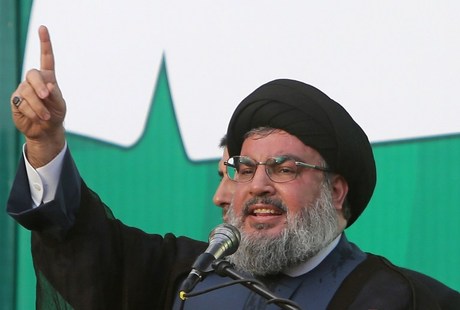
In Yemen, a large body of protesters rallied not to protest Nakoula Basseley Nakoula but Ambassador Gerald Feierstein, whose cooperation with former president Ali Abdullah Saleh and the new government has earned him widespread disapproval. They have every right and ample motivation to "take advantage of the situation." The Taliban slapped Nakoula's film onto their raid of Camp Bastion even though the assault was planned weeks (or longer) ahead of time, and intend to milk its propaganda for as long as possible. Now another bad nightmare has manifested in reality and jumped on the pile. Speaking to an estimated 500,000 Shia Lebanese on Monday, Hebzollah chief Hassan Nasrallah urged protesters to organize peaceful and sustained demonstrations against the film, the U.S. and Israel.
"The world should know that our anger is not a passing thing... This is the start of a serious campaign that must continue all over the Muslim world in defense of the prophet of God. As long as there's blood in us, we will not remain silent over insults against our prophet."
A credible voice in at least parts of the Arab world, including many anti-Western havens, Nasrallah's words could force the Obama administration into some form of direct response. Hezbollah's face and brains has conclusively lost Muslim support over the last five years, particularly in Egypt and Jordan, and risks a significant amount of popularity by standing behind Syria's Bashar al-Assad. Nasrallah would boldly call for more urgent action from the Arab League, a demand that provokes more ridicule than agreement. At the same time, Hezbollah is still viewed favorably in comparison to other Islamic militant groups and considered a legitimate resistance movement by millions of Arabs. While the group is suffering from a general trend against extremism, active social work and military restraint has kept the group from drifting into al-Qaeda territory.
Anti-Israeli opinion also remains a useful supplier of popularity.
Nasrallah's strategic mindset and flare for the dramatic further demonstrate why his charisma draws supporters from outside Shia Lebanon. Appearing in public for the first time since December 2011, an animated Nasrallah spent the majority of his 15 minutes painting lavish religious overtones and history lessons. He believes that the film is “more serious than burning Al-Aqsa Mosque," which was set aflame by Denis Michael Rohan in 1969 with the intention of spawning the return of Jesus Christ. Yet Nasrallah wisely appeals to peace rather than war, stressing peaceful rallies and unity with other religions in an apparent attempt to modernize Hezbollah's image.
“We should bear the historical responsibility of the whole Islamic Ummah (Nation) and of every honorable Christian believing in coexistence to work to issue an international resolution criminalizing the defamation of heavenly religions, and the prophets at least, especially Abraham, Moses, Jesus and Mohammad.“
In conjunction with his religious call to action, Nasrallah also sees an opportunity to lead the political counterattack against the U.S., Israeli and Arab governments - an offensive that has no central command. Holding Washington responsible for the film's availability, Nastallah called on the Obama administration to intervene and censor the film's release online. This unrealistic but seemingly reasonable demand casts Washington and allied Arab governments as accomplices to the film, “which offers another witness to its hypocrisy, deception and double standards in dealing with issues.”
"The ones who should be held accountable and boycotted are those who support and protect the producers, namely the U.S. administration," Nasrallah said. "We should not only express our anger at an American embassy here or there. We should tell our rulers in the Arab and Muslim world that it is 'your responsibility in the first place' and since you officially represent the governments and states of the Muslim world you should impose on the United States, Europe and the whole world that our prophet, our Quran and our holy places and honor of our Prophet be respected."
In effect, Nasrallah has designed an interdependent politico-religious narrative that, at times, neutralizes the religious in favor of the political. He would get nowhere by portraying the battle as Muslims versus Christians - especially in his own country - and instead posits another conflict between America, Israel and the Arab world. Announcing that, "Muslims released their anger on the U.S. and Israel, and not on Christians," highlights this shift from his perspective. He also dares to transfer blame onto Israel as a means of diffusing tensions with Christians: "Those who made the movie knew that the Muslims would be enraged by it, and attributed it to Christians to cause strife between Muslims and Christians. Israel wants to watch Muslims killing Christians and burning their Churches.”
Protests could wane over time as they tend to do; if not, Nasrallah might only play a limited role in mobilizing sustained demonstrations. Yet the Obama administration cannot afford to ignore the principle of his warning or underestimate his regional influence. Although Hezbollah's strongman will be unable to escape the title of propagandist and extremist, his speech currently represents the highest level of articulation from America's asymmetric opponents in the Middle East.
December 20, 2011
GCC Holds Counter-Revolutionary Summit
 The Gulf Cooperation Council’s (GCC) six leaders have convened for two days in Riyadh, fresh and ready for economic meetings, political strategy sessions and propagandizing. The council will hold its 32nd summit under the false impression of “boosting peace and security in a region, which is currently witnessing chaos," according to assistant secretary-general Saad A. Alammar.
Beyond highlighting the GCC’s political integration and economic progress (a diversionary measure), the council will expend the majority of its private time plotting next year’s counter-revolutionary offensive.
Bankrolled and directed by Saudi Arabia as a buffer zone against external hegemony, the GCC’s proxy campaign first struck Egypt after missing Tunisia entirely. Gulf states toed Riyadh’s line as the King fumed over America’s “betrayal” of Hosni Mubarak, and have since tried to fold Egypt into the GCC’s network. Secretary Genera Abdul Latif Al Zayani already clarified that the mechanism “to increase cooperation and strategic partnership with the Kingdoms of Morocco and Jordan” will be discussed.
The GCC is also synched with the Arab League’s attempt to minimize regime change in Syria, freeing up its attention for more pressing battlegrounds.
The GCC’s security presence hit Bahrain hardest after Saudi Arabia deployed its Peninsula Shield across the causeway. Riyadh summoned Jordanian police to fill its ranks, a political harbinger, as well as former Sunni soldiers from the UAE and Pakistan. As a purported self-defense force, the Shield escalated Bahrain’s situation by reinforcing the perception of internal tyranny. Speaking to Bahrain TV at the Kingdom’s embassy in Riyadh, Al Zayani marked King Hamad bin Isa Al Khalifa’s 12th year in power by commending his “landmark achievements.”
These “landmarks” include “democracy, supremacy of the law and respect of human rights.”
Al Zayani also praised Bahrain’s Independent Commission of Inquiry (BICI) as "unprecedented and bold,” along with the King’s “wisdom and adherence to transparency.” On a parallel track, Iran is being prepared as a centerpiece red herring in Bahrain.
These statements are difficult to exceed, but the GCC’s political counter-revolution struck with eager vigor in Yemen. In conjunction with U.S. and European officials, GCC diplomats negotiated a power-sharing deal between Ali Abdullah Saleh’s regime and the oppositional Joint Meeting Parties (JMP). As a result Foreign Minister Abu Bakr al-Qirbi arrived in Riyadh to take his place in the background. After defending Saleh throughout Yemen’s revolution, the GCC’s initiative rewarded al-Qirbi for his loyalty by renewing his term for another two years. He’s expected to brief the GCC’s Foreign Ministers on Yemen’s presidential election in February, an election that will see a consensus candidate (Abd Rabbuh Mansur al-Hadi, Saleh’s Vice President of 17 years) run unchallenged or against a handicapped populist.
The GCC’s proposal also granted Saleh’s family immunity from years of corruption charges and human rights abuses, generating widespread opposition at Yemen’s popular level. Although Western and UN officials praise the GCC’s leadership, both JMP and UN officials have actually admitted to freezing the youth out.
Further antagonizing Yemen’s situation, the GCC is so bold as to exploit its initiative as a main success. Arab media has already blanketed this angle and Western media (including Reuters, to no surprise) is quickly falling into the GCC’s narrative: “The six members of the Gulf Cooperation Council (GCC) opposed the popular protests that ousted the leaders of Egypt and Tunisia, but they helped negotiate a power transition in Yemen and backed measures against both Syria and Libya for their violent reaction to unrest.”
The GCC’s interference is fully exposed in the very next sentence when Reuters observes, “Of the GCC members, only Bahrain and Oman suffered major protests.” Yemen’s non-member status is one of its biggest non-stories: a non-member - and a state trying to become a functioning democracy - being overruled by kingdoms.
Geopolitically speaking, the U.S., EU, Arab League, Russia and China have converged on the GCC to amplify its counter-revolutionary effects. This development will continue to play a significant factor in the historical arch of the Arab revolutions. Wherever Western and Eastern powers align with the GCC’s interest - Egypt, Yemen, Syria, Bahrain, Jordan, Morocco - one is likely to find high traces of counter-revolutionary interference.
December 17, 2011
Mohamed Bouazizi: The Revolutionary Firepoint
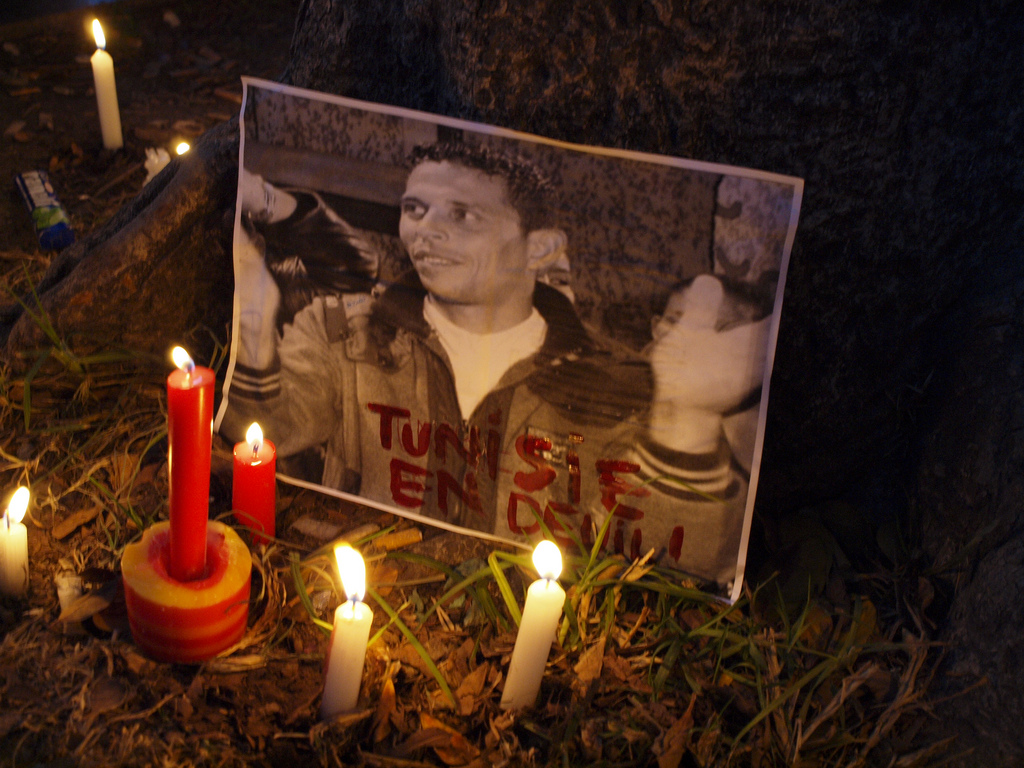 One year ago today, Tunisian vendor Mohammed Bouazizi decided that it was time to take his life back - if only for a day. After losing his father at an early age, Bouazizi worked hard as a child and began selling produce as a teenager to support his mother and six sisters. In addition to a harsh economic reality, his relatives and friends testified that Bouazizi had endured harassment from government officials.
The alleged slap from Faida Hamdi’s hand remains controversial, but Bouazizi nevertheless paid a visit to Sidi Bouzid’s governor. Promptly declined, he then set himself aflame.
Bouazizi never meant to change the world, but his rejection of a corrupt system inspired a non-violent army of millions to wage their own revolutions. Family members first jumped to his defense, followed by friends and random strangers. His resistance spread through the country and tossed Ben Ali out of power before he was martyred in Ben Arous hospital, before the majority of regional protesters started their own movements. Bouazizi’s defiance through death inspired a living hope in those who face similarly overwhelming conditions.
His very anonymity - the key to his universal appeal - has triggered one of the largest revolutionary waves in organized history.
December 11, 2011
Cyclical Black Hole of U.S. Foreign Policy
Trevor Thrall recently posted some interesting graphics at The National Interest. An associate professor of government and politics at George Mason University, Thrall has examined the general ignorance of and apathy towards U.S. foreign policy. Starting with the bottom to prove his point, Yemen is selected to demonstrate that its uprising “received relatively little attention in the U.S. media compared to other Arab Spring uprisings” - but relatively the same when compared to the U.S. economy.
“The broader and ultimately more painful truth is that the entire Arab Spring movement has already peaked in the U.S. media.”
We noticed this same effect taking over around May, after Libya and Syria’s outbursts subsided, but these graphics bring the downtrend to life and indicate an earlier drop-off. Barring an assassination or some other type of unexpected event, Egypt is unlikely to recover the initial boost of interest that accompanies anything new. The actual process of democracy in another country isn’t overly interesting to most Americans; many simply expect Egyptians to ally with America and Israel. Libya’s democracy-building is just as boring, whereas Yemen and Bahrain have been swept away in the U.S.-Saudi counterrevolution. Syria’s initial spike never came close to Egypt’s.
Compounding the shift in attention is the GOP’s launch party in July, when the trends intersect and permanently diverge. Thrall observes, “The U.S. media doesn’t pay much attention to foreign affairs in the best of times these days, but the Arab Spring’s timing could hardly be worse.” His conclusion leads to another disturbing trend: with U.S. policy in the Arab world thrown into upheaval, many American voters and policy-makers are ignoring foreign policy in favor of America’s dreary economic state. This dilemma blocks out a 21st century debate on the Middle East and reduces the Obama administration’s level of accountability.
“This year’s ritual inward turn may have especially unfortunate consequences for the U.S. foreign-policy agenda and for the world. During the most critical period of modern Middle Eastern history, the United States is taking its eyes off the ball and will play a less important role in helping shape positive outcomes there than it should.”
GOP candidates largely used U.S. foreign policy to attack President Barack Obama and each other, not fix the many problems at hand. Thrall remarks, “At this point it’s not just Yemen having a hard time making the news.” Equally important: GOP candidates support Egypt’s military council, Ali Abdullah Saleh’s regime and Bahrain’s monarchy with no consequence from their base.
Many of Thrall’s observations hit their mark. Despite the Internet’s growth and a host of independent actors probing America’s foreign policy, TV news remains the predominate source of external information for the American people. Al Jazeera’s potential offering is significant in this regard, otherwise U.S. network and cable news will continue to minimize a public debate on the Arab revolutions. One bias may be traded for another, but Al Jazeera’s introduction to U.S. cable lineups could spark an inherent debate on TV.
One cannot dodge the fact that “the American public cares little about foreign policy when the economy is in the dumper.” This reality can be expanded across a good or bad economy, although a good economy and bad foreign policy may create the highest level of external awareness. Thrall expects, “U.S. foreign-policy debate will thus go on hold until next fall, and a crucial period in Middle Eastern history will pass the American public by without raising many eyebrows.”
However Washington’s (and America’s) debate could skip fall 2012, or it could lurch ahead before the campaign’s finale. U.S. foreign policy is stuck on perpetual hold, a reactionary cycle that awaits the latest disaster and blows it away just as quickly. Unless any country is directly involved in a conflict, foreign events can only hold a populace’s attention for so long.
A natural feeling, ignorance of foreign affairs nevertheless generates an incomplete state in the long-term.
“The broader and ultimately more painful truth is that the entire Arab Spring movement has already peaked in the U.S. media.”
We noticed this same effect taking over around May, after Libya and Syria’s outbursts subsided, but these graphics bring the downtrend to life and indicate an earlier drop-off. Barring an assassination or some other type of unexpected event, Egypt is unlikely to recover the initial boost of interest that accompanies anything new. The actual process of democracy in another country isn’t overly interesting to most Americans; many simply expect Egyptians to ally with America and Israel. Libya’s democracy-building is just as boring, whereas Yemen and Bahrain have been swept away in the U.S.-Saudi counterrevolution. Syria’s initial spike never came close to Egypt’s.
Compounding the shift in attention is the GOP’s launch party in July, when the trends intersect and permanently diverge. Thrall observes, “The U.S. media doesn’t pay much attention to foreign affairs in the best of times these days, but the Arab Spring’s timing could hardly be worse.” His conclusion leads to another disturbing trend: with U.S. policy in the Arab world thrown into upheaval, many American voters and policy-makers are ignoring foreign policy in favor of America’s dreary economic state. This dilemma blocks out a 21st century debate on the Middle East and reduces the Obama administration’s level of accountability.
“This year’s ritual inward turn may have especially unfortunate consequences for the U.S. foreign-policy agenda and for the world. During the most critical period of modern Middle Eastern history, the United States is taking its eyes off the ball and will play a less important role in helping shape positive outcomes there than it should.”
GOP candidates largely used U.S. foreign policy to attack President Barack Obama and each other, not fix the many problems at hand. Thrall remarks, “At this point it’s not just Yemen having a hard time making the news.” Equally important: GOP candidates support Egypt’s military council, Ali Abdullah Saleh’s regime and Bahrain’s monarchy with no consequence from their base.
Many of Thrall’s observations hit their mark. Despite the Internet’s growth and a host of independent actors probing America’s foreign policy, TV news remains the predominate source of external information for the American people. Al Jazeera’s potential offering is significant in this regard, otherwise U.S. network and cable news will continue to minimize a public debate on the Arab revolutions. One bias may be traded for another, but Al Jazeera’s introduction to U.S. cable lineups could spark an inherent debate on TV.
One cannot dodge the fact that “the American public cares little about foreign policy when the economy is in the dumper.” This reality can be expanded across a good or bad economy, although a good economy and bad foreign policy may create the highest level of external awareness. Thrall expects, “U.S. foreign-policy debate will thus go on hold until next fall, and a crucial period in Middle Eastern history will pass the American public by without raising many eyebrows.”
However Washington’s (and America’s) debate could skip fall 2012, or it could lurch ahead before the campaign’s finale. U.S. foreign policy is stuck on perpetual hold, a reactionary cycle that awaits the latest disaster and blows it away just as quickly. Unless any country is directly involved in a conflict, foreign events can only hold a populace’s attention for so long.
A natural feeling, ignorance of foreign affairs nevertheless generates an incomplete state in the long-term.
December 7, 2011
What Next in Bahrain? More U.S. Silence
 After successfully delaying a proposed arms shipment until the release of Bahrain’s “Independent Commission of Inquiry” (BICI), Senator Ron Wyden has made sure to keep his low-wattage spotlight on the island nation. Speaking at the Paul H. Nitze School of Advanced International Studies (SAIS) in Washington D.C., the Senator articulated a red-line that few U.S. officials are willing to go near.
“Imagine if everyone in Congress had kept quiet and this arms sale had been completed,” Wyden asked his audience in Kenney Auditorium. “What kind of message would this have sent the world or to the people aspiring for freedom and democracy? America should NOT be rewarding brutal regimes with arms. It’s that simple.”
The Obama administration has yet to process Bahrain’s latest shipment of arms (joint-training with Oakland police is another story), but a reward-based media blockade remains in effect after the BICI’s release. Treated as an afterthought throughout the Arab revolutions, U.S. officials again turned their backs on Bahrain as they concentrated on Egypt, Syria and Pakistan’s latest blowup. The White House praised King Hamad’s inquiry and urged him to follow through on proposed reforms, a message designed to reduce U.S. culpability in Bahrain.
Little - if anything - has changed in the two weeks since King Hamad received his BICI in Manama’s Royal Occasions Hall. Confidence quickly dropped after the inquiry’s release, protesters continue to battle government forces in a running low-intensity conflict, and Shia opposition groups such as Al Wefaq and Waad remain marginalized in the political process.
Nabeel Rajab recently arrived in Washington to spread awareness of Bahrain’s environment. The head of Bahrain’s Human Rights Organization wasn’t invited to any State Department meeting and only spoke briefly to Gayle Smith, senior director for democracy in Obama’s National Security Council. Thus Rajab settled for media organs to disseminate his message, and Foreign Policy’s attempt to maintain neutrality - “Is US on Wrong Side of Bahrain?” - rapidly descends into redundancy.
“What I have realized is that there's a difference between the way the American government and the American people look at the Arab uprisings or the Arab revolution. I have received great support from American civil society, human rights groups, etc., in support of the Bahraini revolution. But that is totally different than the position of the United States government, which has disappointed many people in the Gulf region. And they have seen how the U.S. has acted differently and has different responses for different countries.”
Rajab’s interview offers a clear, sensible warning to U.S. policymakers attempting to navigate Bahrain’s uprising: support genuine democratic reform or risk total regime change. While many Sunni Bahrainis and external observers fear an Iranian takeover if the Shia opposition receives greater political representation, Rajab’s message is free of Tehran’s interference. He is genuinely trying to assist the Obama administration in diffusing Bahrain’s crisis and creating a stable democracy.
“There is full support for revolutions in countries where [the U.S. government] has a problem with their leadership,” Rajab observes, speaking the minds of many Arab protesters, “but when it comes to allied dictators in the Gulf countries, they have a much softer position and that was very upsetting to many people in Bahrain and the Gulf region. This will not serve your long strategic interest, to strengthen and continue your relations with dictators and repressive regimes.”
“Those dictators will not be there forever. Relationships should be maintained with people, not families.”
Rajab refutes the Obama administration's statements for what they are: lip service to Bahraini protesters and concealer for King Hamad. These statements (what few there are) “have no impact on the ground because the government was not really being forced to listen...” When asked whether he sees the administration's encouragement to reform as a positive sign, Rajab replies, “The U.S. is more influential in Bahrain than the United Nations. If they are serious about something, they could do it.”
“This government has to be told that their relationship with the United States is not a green light to commit crimes, because that's how it is understood by the government. And no one in the United States has told them, no, it's not like that.”
Rajab’s interpretation of the oppositional sentiment towards Washington is disturbing on a collective level. Despite losing their trust in the Obama administration’s declared altruism, Bahraini protesters remain on the milder side of the revolutionary spectrum. Popular calls for King Hamad’s downfall did erupt on February 14th, but the opposition movement as a whole has gradually progressed from political reform to regime change. Bahrain’s opposition has no plan to close America’s base in Manama. Other movements began with regime change and went from there - pushing Washington directly into their cross hairs. Rajab’s sentiments have been amplified throughout the Arab world, to a level beyond prerevolutionary anti-American sentiment.
“This is the image of the United States in our country: that this superpower supports dictators and doesn't want democracy in our region, because they [are] told that democracy would not serve their interests.”
The question posed by Rajab’s presence in Washington transcends Bahrain: America continues to dwell on the wrong side of history in Egypt, Yemen and Bahrain, and is treading dangerously close to Syria’s counter-revolution. A more cohesive response to Libya has only highlighted America’s double-standard. Rajab’s message is equally applicable on a regional level: “this is where the United States needs to speak, to tell them not to waste this opportunity to create real reform.”
America may be able to survive on the wrong side of the Arab revolutions, but its power in the region stands to increase by cooperating with pro-democracy movements.
December 5, 2011
Interviewing Rising Arab Leaders: Ghannouchi and Ghalioun
Full interview of Rached Ghannouchi, by Foreign Policy’s Marc Lynch:
The Wall Street Journal: Do you feel there is momentum, despite criticisms that the Syrian opposition didn't organize as quickly as the Libyans, building for international recognition of the Syrian National Council?
Burhan Ghalioun: The SNC today is a key player in forming world opinion and policy on how to deal with the Syria issue. We are in continuous discussions with our friends and they consult us and ask for our opinion on every decision they make with regard to Syria.
We've agreed with the Arab League on including additional strands of the opposition. I think the SNC has made some major achievements in the past two months. And its presence encouraged Arab and international countries to chart a serious policy to stop the killings going on in Syria and putting a limit to the regime.
I feel there is a serious acceleration of events towards Syria and the measures that were taken puts the Syrian regime in the position of a fallen regime, a regime that is impossible to sustain its existence. We were asking our friends in Europe and the world to get to a point that illustrates to the public in Syria that there is no intention whatsoever in keeping Assad in power.
WSJ: Why haven't any governments formally recognized the council as an alternate government to Damascus?
Mr. Ghalioun: There are complicated legal issues that need to be resolved. They tell us that the situation in Libya was different because the Libyans had territory, an army, governance. They can recognize us politically as the representative of the Syrian opposition but not as the legitimate alternative yet, or else they have cut off the path of any relations with the regime.
WSJ: Are you modeling yourselves on the Libyan rebels?
Mr. Ghalioun: We believe the Syrian situation is completely different than the Libyan. We still believe we can count on the state agencies and ministries and their functions, and our civil servants.
"I think the Muslim Brotherhood [in Egypt] should govern by coalition that includes the people from secular parties and the Copts." That was the advice which Rached Ghannouchi, President of Tunisia's el-Nahda Party, offered his Egyptian Islamist counterparts during an interview with the editors of the Middle East Channel last Thursday. He warned pointedly against repeating the mistakes of Algeria when, as he put it, "the Islamists won 80 percent of the vote but they completely ignored the influential minority of secularists, of the army, of the business community. So they did a coup d'etat against the democratic process and Algeria is still suffering from that." Avoiding a replay of that catastrophe weighs heavily on Ghannouchi and his party.Full interview of Burhan Ghalioun, leader of the Syrian National Council (SNC), Syria's main opposition group, with The Wall Street Journal:
Ghannouchi was in Washington at the invitation of Foreign Policy, after being named one of its Top 100 Global Thinkers. He took full advantage of the opportunity to visit the United States for the first time in twenty years, appearing at a wide range of think tanks including the Carnegie Endowment for International Peace and the Washington Institute for Near East Policy and meeting with a range of U.S. government officials, journalists, and policy analysts. He had warm praise for the Obama administration as "supportive of the Arab Spring," and described the new willingness in the United States to talk about a more positive relationship between democracy and Islam, and between Americans and the Islamic world, as a very important new development. His reception in Washington is a sign of the times, as the United States struggles to adapt to the reality of Islamist electoral success and Islamist parties struggle to reassure those who fear their ascent while delivering on their own programs.
The Wall Street Journal: Do you feel there is momentum, despite criticisms that the Syrian opposition didn't organize as quickly as the Libyans, building for international recognition of the Syrian National Council?
Burhan Ghalioun: The SNC today is a key player in forming world opinion and policy on how to deal with the Syria issue. We are in continuous discussions with our friends and they consult us and ask for our opinion on every decision they make with regard to Syria.
We've agreed with the Arab League on including additional strands of the opposition. I think the SNC has made some major achievements in the past two months. And its presence encouraged Arab and international countries to chart a serious policy to stop the killings going on in Syria and putting a limit to the regime.
I feel there is a serious acceleration of events towards Syria and the measures that were taken puts the Syrian regime in the position of a fallen regime, a regime that is impossible to sustain its existence. We were asking our friends in Europe and the world to get to a point that illustrates to the public in Syria that there is no intention whatsoever in keeping Assad in power.
WSJ: Why haven't any governments formally recognized the council as an alternate government to Damascus?
Mr. Ghalioun: There are complicated legal issues that need to be resolved. They tell us that the situation in Libya was different because the Libyans had territory, an army, governance. They can recognize us politically as the representative of the Syrian opposition but not as the legitimate alternative yet, or else they have cut off the path of any relations with the regime.
WSJ: Are you modeling yourselves on the Libyan rebels?
Mr. Ghalioun: We believe the Syrian situation is completely different than the Libyan. We still believe we can count on the state agencies and ministries and their functions, and our civil servants.
November 11, 2011
Obama's "Arab Problem"
By Abdullah Al-Arian, published by Al Jazeera:
Obama's "During the past few months, Barack Obama has come under increasing pressure from his would-be Republican opponents, not for secretly subscribing to the faith of the enemy (Obama Muslim-baiting is so 2010), but for his supposed culpability in the events engulfing the Arab world during the past year.
On September 29, presidential hopeful Michele Bachmann told supporters, "You want to know why we have Arab Spring? Barack Obama has laid the table for the Arab Spring by demonstrating weakness from the United States of America."
Just last week, another Republican presidential candidate, Newt Gingrich, pronounced the Arab Spring to be the result of the Obama foreign policy's "grotesque failure". Gingrich went so far as to call it an "anti-Christian spring", apparently believing that longstanding authoritarian rule was the only thing protecting religious minorities in the Arab world from unbridled persecution.
But before the narrative of Obama's "Arab Problem" conveniently replaces his "Muslim Problem" in the run-up to the 2012 presidential election, it is instructive to examine the actual posture of this administration toward Arab revolutions from Tunisia to Yemen...
November 7, 2011
Around the Revolutionary World
 The counter-revolution draws its energy from many fears, primarily the loss of Western/Gulf interests and the rise of Islamic radicalism in government. The first problem cannot be removed from the Arab world’s equation; the second, however, can be reduced in the near-term future. The face of “Islamic democracy” recently underwent a facelift in Tunisia, where the 70-year Rachid Ghannouchi has moved to the forefront of the country’s transition.
"There is some confusion in the West about Islamism," Ennahda's (Renaissance) leader told Reuters after his party’s results were finally tallied. "Some confuse it with fundamentalism and link it to violence, extremism and takfir... We are against trying to impose a particular way of life.”
Tunisia Builds a Lighthouse
Question marks still linger over Ghannouchi’s head. His Nahda party formed in the crucible of Iran’s revolution, resulting in an initial fascination with Egyptian Sayyid Qutb (whose writings inspired Osama bin Laden). Ghannouchi would amend his views around the synchronization of Islam and democracy while exiled under Ben Ali’s government, and returned by voicing full support for Tunisia’s revolutionaries. Ghannouchi and his officials are so concerned with Western opinion that his greater problem could be shifting too far away from Islamic conservatives.
Local suspicions aside, Nahda was rewarded with 41.7% of Tunisia’s assembly vote - 91 out of 217 - giving the party preeminent status within a coalition government. Rather than dramatically alter Tunisia’s political and social environment, Nahda is giving its people what they voted for: universal rights and normality. Unemployment and investigations into the revolution’s human rights abuses sit atop Nahda’s agenda. Paired with the oppositional CPR and Ettakatol, the three groups offer a broad platform of Islamic-infused democracy and secular guarantees. Coalition officials speak in relative unison and have agreed to keep the first article of Tunisia’s current constitution: the country’s language is Arabic and its religion is Islam.
"This is just a description of reality," Ghannouchi said. "It doesn't have any legal implications. There will be no other references to religion in the constitution. We want to provide freedom for the whole country.”
The new constitution is expected to take a year to ratify.
Tunisia’s model is unlikely to work for every active revolution, but it does provide evidence that each country can adapt its local features to a democratic structure. Tunisians believe that Islam and democracy can co-exist just as Western democracies founded themselves on Christianity. CPR and Ettakatol’s officials have both clarified their position to the international community (and Tunisians), explaining that their parties aren’t the “secular” opposite of Nahda’s “conservatism.” CPR leader Moncef Marzouki says he favors an Islamic national identity combined with universal (read:women’s) human rights.
"We can promote these rights without being in an ideological civil war with the conservative part of society."
Abdellatif Abid, an Ettakatol co-founder, added, "We're not secularists as the west conceives of it. We're for the separation of religion and politics, but not of religion and the state."
This relationship appears less likely to manifest in Egypt’s political system, where the Muslim Brotherhood won’t modernize to Nahda’s level. A snap election in Yemen could also allow its Islah party to out-organize the civil protesters. Yet the ongoing synthesis between Islam and democracy - essentially the mass realization that they can co-exist - should limit the influence of “Islamist” factors. New parties offer the ideal vehicle to rearrange a country’s political system without compromising national or religious identities.
"When we establish democracy, we see that it achieves many of these aims," Ghannouchi said of justice and compassion. "Anything that promotes these aims is Islamic, even if it is not called Islamic. That's why we say that Islam and democracy are compatible."
Egyptians Experiencing Déjà vu
Given the long-term trajectory of revolution, Egypt’s current situation doesn’t appear as dire as commonly assessed. Talk of a second revolution against the Supreme Council of the Armed Forces (SCAF) is certainly overblown: all of these events comprise a singular revolution against Hosni Mubarak’s regime. The SCAF “promised” to hand over power to a civilian government in six months, only to entrench itself for the possibility of two-year transitional period, and Egypt’s Emergency Law remains active. Resistance against these developments is a unified force.
The parliamentary battle to displace the SCAF will be fierce, but Egyptians stand a good chance of following Tunisia’s lead in the long-term. Its popular movement cannot be totally suppressed by brute force or political maneuvering, and the SCAF’s interference will endure sustained resistance so long as the council remains in power. Over 12,000 Egyptians have been arrested and tried before military tribulans since Mubarak’s fall, according to No Military Trials of Civilians.
“All the lawyers we’ve spoken to have said it’s a sham,” said Shahira Abouellail, an activist with in the campaign. “It’s not really a trial. You’re tried by the military. Most of the time you’re tried collectively so there’s like 30 people there and they all get prosecuted together and they all get the same sentence within like five minutes to half an hour.”
Try as it will, the SCAF cannot imprison every Egyptian who refuses to back down. Mubarak’s legacy may continue on the ground, but a new Egypt is rising up through the earth. When Alaa Abd El Fattah was arrested on October 30th, Egyptians rallied international attention to his cause and smuggled his letter to the outside world. His mother, Cairo University professor Laila Soueif, just informed Egypt's prosecutor-general that she is going on a hunger strike until her son is released "from his unjust imprisonment."
The SCAF’s ability to weather Alaa Abd El Fattah’s storm remains doubtful. After Sunday prayers in Tahrir Square, Syrian protesters joined with Egyptians are they chanted “down with Bashar Al-Assad’s rule” and “down with Ali Saleh’s rule.” Needless to say, Egyptians won’t give up on the future of their own country.
Syria’s Rising Tide of War
Unfortunately for those Syrians protesting al-Assad’s brutal regime, eight months of determined resistance have failed to produce Mubarak’s immediate fall or Gaddafi’s eventual demise. With the relatively young al-Assad overseeing a vast security apparatus, Syrians face an improbable uphill climb towards regime change and universal rights. Many remain upbeat despite the high loss of life; the turbulent city of Homs recorded 111 deaths in the last five days of fighting. Oppositional groups speak of food and energy shortages, paramilitaries and their refusal to surrender.
“It’s going to take unbelievable political and social efforts to restore normalcy again to the city after what it’s gone through,” said Fayez Sara, an opposition figure in Damascus. “It’s going to be very hard for us to reach a political solution after this.”
The possibility of an armed revolt is rising in proportion to these decreasing odds. The Arab League’s latest failure to broker a ceasefire surprised few protesters, seeing that the political bloc has applied its breaks to Syria’s revolution. Dialogue between the regime remains out of the question, says Syrian National Council chairman Burhan Ghalioun. With the international community unable to unify around al-Assad - Western capitals have erroneously latched onto the Arab League and Gulf Cooperation Council (GCC) to “Arabize” their response - the Free Syrian Army is positioning itself for an inevitable revolt.
"We are the future army of the new Syria,” Colonel Riad al-Assad, the SFA’s leading commander, declared from a secure base in Turkey. “We are not in league with any particular sect, religion or political party. We believe in protecting all elements of Syrian society.”
While the risks of armed insurrection pile up quickly, militarized rebellion will counter the risks of non-violent resistance or surrender. al-Assad will only capitulate when a mass of Syrians force him to. The SFA will attract al-Assad’s full wrath in the near-term as he attempts to demonize the opposition, a process similar to Gaddafi and Saleh’s schemes. After protesters are pounded by security forces, reactive oppositional elements are branded as “terrorists” and exploited to pollute the revolution. Fortunately Syrians appear to be traveling Libya’s route instead of Yemen’s; Riad al-Assad hopes to cooperate with the SNC rather than compete with it.
One SNC confirmed “off the table” discussions with the SFA, saying, "Our commitment is, and has always been, peaceful resolution, but our patience has a limit. It depends on the political developments among the Arab League, the Middle East and the International Community... In 10 days we will present a new plan that is to include a military and political strategy. Here the issue of the SFA may well be put on the table."
Foreign Powers Still Rowing Saleh’s Boat
Syrians are clearly aware that their struggle must advance to the next level, and soon. International pressure can only compliment internal pressure, not bring down a regime by itself, and protesters suffer no illusions otherwise. Daniel Glaser, the U.S. Treasury Department's assistant secretary, recently briefed officials in Beirut and Amman on al-Assad’s possible attempts to circumvent Western sanctions.
Western sanctions against Ali Abdullah Saleh are even less promising.
Much like her meeting with Secretary of State Hillary Clinton, the immediate takeaway from Tawakel Karman’s meeting with French Foreign Minister Alain Juppe left much to be desired. Paris’s position is considered more sympathetic than Washington and London’s, and Juppe did tell reporters, “I think asset freezes will be discussed as soon as possible.” However the operative word of “discuss” triggers immediate doubts in the West’s flimsy resolve. Financial and military sanctions against Saleh’s regime should have been implemented months ago, but were obstructed by foreign powers (U.S., Russia) aligned with Saleh’s regime.
Waiting until next week’s EU meeting may be practical, except the delay also highlights the West’s chronic lack of urgency in Yemen. Worse still, Juppe hoped that UN resolution 2014 would open an inquiry “to see if there were any crimes committed that could be taken to an international court.” He still believes the path towards stability starts with the GCC’s unpopular initiative - which grants Saleh’s family immunity from past crimes - and blamed the oppositional Joint Meeting Parties (JMP) for not uniting properly.
“I am ready to discuss with my European colleagues how to ensure the resolution is implemented, but our action would be more efficient if the (Yemen) opposition was more united.”
In reality Western and Gulf states have abused the JMP as a proxy in their political designs, forcing the group to negotiate with Saleh’s regime and cutting out Yemen’s revolutionaries in the process. Foreign powers have also ignored the autonomous causes of the northern Houthis and Southern Movement, contributing to their alienation from the JMP and its dominate arm, the Islah party. This disunity has aided foreign manipulation of Yemen’s revolution. Protesters wish to remain peaceful despite a saturation of violence, but the international community’s total failure to act in Yemen will partially explain a transition to armed resistance.
Global protesters are monitoring each other’s historical progress, and everyone is determined not to be left behind.
October 27, 2011
White House Reshuffles Bahrain’s Deck
Several weeks ago an oppositional bloc led by Al Wefaq and Waad issued the Manama Paper in response to the Bahraini government’s sustained resistance. Buried in its demands, a call “for retaining the royal family in terms of ruling and governing without powers, as a true constitutional monarchy.” Although Bahraini officials immediately denounced the document as a power grab, its limited demands jaded the more proactive protesters seeking total regime change.
Ceding to King Hamad’s monarchy under the slogan of “people want reform of the system,” the Manama Paper calls for direct dialogue between the ruling Al Khalifa family “based on the seven principles outlined by the crown prince on 13 March 2011.” These principles, including extensive judicial and electoral reform, are crowned by abolishing Bahrain’s bicameralism. Al Wefaq flooded the lower house in 2006 (Council of Representatives) to demonstrate the organ’s impotence under its appointed upper house (Consultive Council). Given the grisly or imprisoned fates of other Arab dictators, a lengthy reform process seems like a small price for King Hamad to keep his palaces.
The Manama Paper did have some harsher observations: "The reality in Bahrain is no different from any non-democratic state, a copy of Ben Ali's Tunisia, Mubarak's Egypt and Saleh's Yemen.”
The Manama Paper presumably caught the eyes of Western governments, but one must measure their concern in silence rather than a defined reaction. The Obama administration allowed the document to pass without responding, a slight surprise due to its joint-experience with King Hamad. Usually the White House has been the first international party to jump on a “dialogue” in order to slow regime change, and the Manama Paper offers similar terms as July’s failed “National Dialogue.” Sheikh Hussein Al-Deihi, Al Wefaq’s deputy Secretary-General, recently cautioned, “We say it out loud, there is no going back from our demands at all, and we say it in advice that you should start political reform now because delay is not for your advantage nor for the advantage of the country...”
Neither the White House nor State Department commented though, preferring to keep attention away from Bahrain whenever possible. Multiple U.S. officials instead spent their time defending an incomplete arms deal to the government.
Now the administration has a “new” ploy: Bahrain’s “independent investigation.” With the potential sale of arms causing a minor uproar in Congress and the U.S. media, the Obama administration is keen to rehabilitate Bahrain’s image before passing a “user agreement.” Only the White House, lacking good news to spin, has latched onto Bahrain’s delayed investigation into its own human rights abuses. Journalists grew visibly dissatisfied during Wednesday's State Department briefing with Victoria Nuland, who voiced repeated support for Bahrain’s ongoing “independent commission of inquiry.”
Who committed the majority of these crimes though? Protesters? Vandals? Iranians?
One reporter informs Nuland that her response “doesn’t address the underlying question, which is to say whether the U.S. Government believes that, based on its own information, that there were significant, severe human rights violations.” After voicing America’s “concern,” the spokeswoman applauds Bahrain’s internal investigation as “a very good signal.” Asked again whether “you trust Bahrain to do the right thing?” Nuland responds, “we supported the establishment of this commission. We are looking for a high-quality report.”
Reporters continued to hunt the issue - “We’re going back, not further” - to no avail. Asked directly whether the U.S. disagrees with Bahrain’s assertion that the protesters are an “external issue,” Nuland remarks that the inquiring journalists are “parsing this thing as finely as sausage here. I think I’ve covered where we are on this issue with Bahrain.” Never does she address the fundamental problem that Bahrain’s government is committing systematic human rights abuses against pro-democracy protesters.
The entire U.S. narrative - which will last until November 23rd at the earliest - is now shaped around the Pentagon’s arms deal and the Bahraini Independent Commission of Inquiry (BICI). If the government whitewashes its crimes or minimizes the damage, Congress is liable to pass the document with certain “conditions” of use, even though the arms package is unlikely to be deployed on protesters. In the rare event that Bahrain’s government criticizes itself, Washington stands ready to applaud the King’s “transparency” and construct legislation based on new terms of use. This double-charm offensive is already underway in the capital.
"I'm here to see our friends in the administration and Congress to try to explain what's happening in Bahrain," Bahraini Foreign Minister Shaikh Khalid bin Ahmed al-Khalifa told Foreign Policy. "We are just before the issuance of the commission of inquiry's report. I'm here to show our commitment to that, how we will accept it and do all that is necessary to implement it."
As for the weapons, "What worries us is that we don't need to delay any requirement for the necessary architecture to protect the region. Bahrain is a cornerstone of that. That's what I'm talking about here and I'm finding very listening ears."
This high-profile hoax diverts from Bahrain’s urgent need for broad-based reforms and the external military units that support its government. Shaikh Khalid would exchange pleasantries with Secretary of State Hillary Clinton, reaffirm U.S.-Bahraini relations, underscore the need for an “independent investigation” and generally act like an uprising isn’t happening. Khalid “outlined Bahrain’s efforts” of the “multiparty National Consensus Dialogue,” while Clinton stressed the importance of strategic dialogue between Washington and the Gulf Cooperation Council (GCC). The GCC has wrecked havoc on Bahrain and Yemen’s pro-democracy protesters.
"They had a full and frank exchange (on) all of the issues that we have in front of us, including the human rights issues," said one U.S. official who preferred to remain anonymous.
The Obama administration believes that it can fool people across the planet, whether they’re awakening or closing their eyes. Those regimes that Washington marks for elimination are called out in public, while those it shelters are “frankly” addressed in private. During an interview with Bahman Kalbasi of BBC Persia, Clinton was asked one of several hundred questions that targeted America’s double-standard. One speaker wonders, “Why was America so active about human rights violations in Libya and is now very vocal about human rights violations in Syria but was acting very differently when it came to Bahrain?”
Clinton only briefly addresses Bahrain’s uprising - “we have pushed the government to do more, and we support the independent investigation” - before calling on Iran to hold its own investigation into human rights abuses. She then says that every nation has its hypocritical moments, but that no country “she knows of” has been “more transparent, more self-corrective, more willing to say maybe we shouldn’t have done this...”
Maybe Clinton isn’t counting Bahrain. The Manama Paper specifically warned, “Whilst welcomed, international condemnation of human rights violation in Bahrain is certainly not sufficient. Sadly, Bahrain remains a police state.”
Wednesday night’s attack on Upper House member Samira Rajab was disconcerting regardless of the perpetrator. Having debated Al Wefaq’s deputy, Khalil Al Marzooq, on Al Jazeera’s Opposite Direction, Rajab’s house became a target through no coincidence. It seems doubtful that Al Wefaq would order a crude Molotov in the middle of a political debate. More plausible, a disenchanted individual or cell of protesters saw the broadcast and disagreed with her “conspiracy theory.” Considering the attack’s timing, relatively harmless choice of weapon, activity in Washington and swift condemnation from the government, another “conspiracy” also begins to take shape.
“Desperate attempts like this will not stop the country from moving forward," Prime Minister of Bahrain, Sheikh Khalifa bin Salman Al Khalia said in a statement, “noting that the government will continue to work to ensure security and stability in Bahrain.”
With one attack, Bahrain’s government could justify future crackdowns, blame the oppositional parties and toy with international allies. This haul exceeds any objective that anti-government protesters could envision. One thing is certain: Washington and Riyadh play into the traps set by their satellite. The Obama administration is taking the next month for granted, continually shifting Bahrain behind other uprisings until these dominos have also fallen.
The government should have more crimes to investigate between now and November 23rd.
October 26, 2011
“Rise of the Islamists” Overblown
On Sunday roughly four million Tunisians celebrated their first adult step towards representative democracy. At least that many voters had registered prior to the constituent assembly election, according to commission chief Mohamed Kamez Jendoubi, and 90% turned out to support their party. “Many unregistered voters - mostly youth and women” - also registered late Sunday night. Having participated in a vote deemed “well-organized” by Former Mauritius President Cassam Uteem, the co-chairman of a Carter Center’s observer team, Tunisians rejoiced in the prospect of an unwritten future.
"I have observed 59 elections in the last 15 years, many of them in old democracies... and never have I seen a country able to realize such an election in a fair, free and dignified way," said Andreas Gross, a Swiss parliamentarian and head of the observer delegation for the Council of Europe. "I was elected in Switzerland on the same day in elections that were not much better than here."
Another observer mission from the National Democratic Institute (NDI) predicted that women could win 30% of the 217 contested seats.
Some Tunisians aren’t so enthusiastic, but they appear to be grossly outnumbered by the external detractors fearing an Islamist takeover. Predicted at 20-30%, Tunisia’s Islamist Ennahda party (Arabic for renaissance) is expected to walk away from over 40% of the assembly. This Spiegal Online report is typical of the West’s counter-revolution: “Tunisians disappointed Western observers this week by giving Islamists a big majority in the country's historic first election.”
The results of Tunisia’s election admittedly hit the West with greater impact than its individual force. Across the border, Libya’s Transitional Federal Government (NTC) had just declared the country’s liberation after a nine-month revolt against Muammar Gaddafi. Speaking at the Benghazi rally on Sunday, NTC leader Mustafa Abdul Jalil spooked a variety of wary observers by announcing, "As a Muslim country, we have adopted the Islamic Sharia as the main source of law. Accordingly, any law that contradicts Islamic principles with the Islamic Sharia is ineffective legally."
Jalil would clarify that Libyans are moderate Muslims, but his comments fanned a Western fire than spreads rapidly.
Nahda’s success at the ballot box also sparked renewed concerns inside and outside of Egypt, where many are expecting big electoral gains from the Muslim Brotherhood. A chaotic campaign season is in full effect after the ruling Supreme Council of the Armed Forces (SCAF) amended the elections law to favor a list-based system, as demanded by the Muslim Brotherhood’s Freedom and Justice Party and the liberal Wafd Party. Secular Egyptians and opponents of the Brotherhood accuse the SCAF of exploiting the group, using it as a wedge against newer parties. Western states generally kept their distance from the Brotherhood during the first phase of Egypt’s uprising (although the U.S. remains in close contact with the SCAF).
Yemenis have been particularly victimized by prejudices of “Islamization.” Mislead to believe that the Obama administration is keeping “Islamists” from seizing power, not enough Americans realize that the White House is negotiating with the only “Islamist” bloc in Yemen. The majority of Yemen’s youth and popular protesters seek a civil state based on Islamist principles. However the White House has opted to negotiate with Ali Abdullah Saleh’s regime and the oppositional Joint Meeting Parties (JMP), an umbrella that includes the “Islamist” Islah party and Yemen’s branch of the Muslim Brotherhood. These groups aren’t necessarily urging an Islamist caliphate, but their traditional thinking and social ties have sidetracked Yemen’s democratic uprising.
For all of their faults Islamic groups shoulder an integral part of the Arab revolutions; Bahrain’s moderate Al Wefaq is merely one example. Tunisia’s election added a much-needed positive development to what is perceived as a stalled revolution. While Nahda garnered an estimated 90 seats out of 217, three times the seats as the second place Congress for the Republic (CRP), the group is already moving to establish a governing coalition with secular parties. Nahda, CPR and Ettakatol maintained friendly relations prior to the election and form a bulwark against the remnants of Ben Ali (Populist Petition), offering a complete package to Tunisians.
"Tunisians want centrist politics," says CPR leader Moncef Marzouki, a vocal Tunisian activist during Ben Ali’s regime. "They want an Arab-Muslim identity (Ennahda) and also democracy and human rights represented by the two parties CPR and Ettakatol."
Naturally Nahda has its share of doubters. What appears to be a small minority of Tunisians distrust the group, claiming the world is hearing another message from Nahda’s street message of Sharia law. Conversely, hardline elements accuse Nahda leader Rashid al-Ghannushi of being too liberal. The truth falls somewhere in between, but closer to al-Ghannushi’s secular label. Nahda rose out of the turbulent 1980’s and participated in a number of attacks on Tunisian government targets, before al-Ghannushi’s exile modernized his political thinking. Returning after Ben Ali’s fall, al-Ghannushi wasted no time backing Tunisia’s popular revolutionaries and revitalizing his party, which immediately garnered predictions of an election sweep.
Rashid al-Ghannushi could be talking out of two mouths, but his promise to maintain secular Islam is now locked into voters minds. Changing platforms will come with a price, as the interim government’s life-span could be severed by unhappy voters. This outcome, however, appears unlikely. al-Ghannushi has spoken and acted in sincere cooperation with the revolution: “We have long advocated democracy within the mainstream trend of political Islam, which we feel is the best system that protects against injustice and authoritarianism.”
His daughter, Soumaya, similarly promises, "I'm a Tunisian woman. I'd be the first concerned if there was a change. I'm a working woman, I'm active in civil society. I personally don't see any contradiction between Islam and... women's rights."
Ultimately Nadha’s coalition is the strongest network available to lead Tunisia’s transition, a positive influence capable of solidifying the fledgling government and plugging into the masses. Politically active Tunisians vow to stay vigilant through social networks, while Nadha campaign manager Abdelhamid Jlazzi said consultations will include all "political parties in the assembly and outside it, and civil society groups and unions.” al-Ghannushi himself provides leadership and strength in dealing with the international community, and rejected the job of interim prime minister by appointing his popular secretary-general, Hamadi Jebali. al-Ghannushi mentioned that he would like to see a younger candidate, but Jebali offers a steady hand through constitutional revision.
The 63-year old co-founder of the Islamic Tendency Movement, Nahda’s predecessor, impressed U.S. officials after he was sent to Washington to ease concerns of an Islamist takeover. Jebali told France’s Le Monde ahead of Sunday’s election, “if we win the elections, Tunisia will not become an Islamic country, it will be a democratic country.”
Future polls across the region may not unfold with the same euphoria as Tunisia’s. As hundreds of media reports warn, states such as Egypt, Yemen and Libya could break a different way from Tunisia’s “secular” society. Some Islamist parties may dominate the less organized competition, and stricter rules may be enforced in certain areas. Over time these newer parties may reverse the trend, given that organization can be developed and secular appeal is rising. Whether “Islamist” or secular parties assume an electoral majority, Islam is needed to guide a region of revolutionaries. It cannot be picked apart or shut out of the Middle East’s democratic upheaval - to deny Islam is to deny identity.
“Political Islam is a necessary gateway for democratic change in the Arab world,” Khattar Abou Diab, a professor of international relations at L’Universite Paris-Sud, told the AFP. “This is the most powerful political force in the Arab world today.”
Penning up this pressure would yield destabilizing results; although they come with downside, their suppression would generate far more damage than their participation. Islamist parties tend to know what they’re doing politically, injecting much-needed experience into the brand-new experience of open revolution. Few uprisings can be stopped when Islamic parties synchronize with the youth and civil movements.
At the least, Western fears shouldn’t exceed threatened dictators warning of an Islamist takeover.
August 28, 2011
Inside the U.S. Propaganda Machine
The Obama administration recently conjured another storm of verbal barrage against Bashar al-Assad, and with it came a volley of U.S. media reports applauding or criticizing the White House’s choice of words.
Only days before the August 18th assault, led by President Barack Obama and featuring several side-briefings, Secretary of State Hillary Clinton cautioned against rhetoric that cannot be backed up in reality. Her rational advice was negated when she joined a chorus that didn’t sound qualitatively different from before - except Saudi Arabia has suddenly become an American hero in Syria’s revolution. Considering how Ali Abdullah Saleh is pulling Yemen’s strings from Riyadh, “stepping aside” and “getting out of the way” are incomplete phrases without mentioning where al-Assad is supposed to go.
Many reports and editorial boards, including The New York Times, hedged their praise of Obama’s demand for al-Assad’s resignation: “It took too long, but President Obama has finally - and unequivocally - called for the Syrian dictator Bashar al-Assad to step down and end his murderous war against the Syrian people. In another belated but welcome move, Mr. Obama also ordered a stiff new array of sanctions, including freezing all Syrian government assets in the United States and banning American citizens and corporations from doing business with the Syrian government.”
Fortunately the U.S. media’s own silence and inaction during the Arab revolutions have helped lay bare its servile relationship with Washington’s establishment. Of course many Americans and non-Americans realized the media’s contribution to an unsustainable status quo before the 2010s, but accumulation of proof aids the scientific pursuit. A simple examination of the Times, Wall Street Journal and Washington Post reveals how little difference exists between these “different” organizations, and how coordinated their responses are in tone and frequency.
Syria and Libya’s revolutionaries are making history through their resistance and certainly must be covered. However America’s major papers are also over-reporting where the Obama administration points its collective finger, silencing national debate where U.S. policy plunges to its lowest depths.
For instance, the Times has allocated eight editorials for Syria’s revolution and 15 to Libya, all urging the administration to do more without dragging America into war. Conversely, minimal focus is allocated to the administration's diplomatic inaction or ongoing military action in Yemen. Although Libya and Syria’s uprisings started after Yemen’s, the latter revolution has received two mentions in seven months of peaceful protesting and a massive security crackdown. The first came on March 26th, when the Times cautioned that protesters “have little reason to trust him [Saleh]” - only to “talk of a deal... with Saudi Arabia, Yemen’s patron.”
Again mixing technically sound advice on April 4th - “Yemen needs to move ahead without President Saleh” - with government speak - “a swift, smooth transition is in everyone’s interest” - the Times has since turned its lights out.
The Times developed a clear, quiet pattern from the start of Yemen’s revolution. An April “shift” against Saleh and a “concerned Obama,” products of White House insider David Sanger, exposed total coordination with the White House, to be followed by shallow reporting on the popular revolutionaries and Gulf Cooperation Council (GCC), non-coverage of brutalities and promotion of terror “threats.” Washington and Riyadh continue to guard Saleh in relative peace, free to suppress Yemen’s revolutionaries through the GCC’s initiative. All the Times has to do is publish the White House’s occasional ricin bomb.
A similar skew against Bahrain’s uprising has been accompanied by an open admission of the administration’s double-standard. In a March 15th editorial on Yemen and Bahrain, the Times concedes that, “Bahrain and Yemen are both important to American strategic interests. The former is home to the United States Navy’s Fifth Fleet; the latter is battling, with Washington’s frequent participation, one of Al Qaeda’s stronger affiliates.” Then comes the double-speak: “For those reasons, the Obama administration has chosen quiet diplomacy to try to persuade their rulers to respond peacefully and credibly to popular demands for change. Rulers in both countries have chosen repression over reform. Washington needs another plan.”
Without any change to report three months later, the Times issued its usual “common sense” in warning, “Bahrain is home port to the United States Navy’s Fifth Fleet and the Obama administration has been too cautious in its criticism of the government. It must speak out more forcefully. If Bahrain continues to abuse its citizens, it will face more instability. And resentment of the United States will only grow.”
The Times has yet to respond since Bahrain’s “National Dialogue” collapsed in July.
The Times isn’t alone in its actions, but synchronized with the Wall Street Journal, Washington Post and network news to manipulate U.S. impressions of the Arab revolutions. When combined they provide a reliable barometer of control between the government and mainstream media. The Washington Post has run over 10 editorials involving Syria and an equal amount in Libya, many criticizing the administration’s lack of public effort and diplomatic ingenuity. In the first of two editorials on Yemen, dated May 23rd, the Post “sensibly” advises, “Any remaining U.S. aid and support to Mr. Saleh and his forces should be ended, and the strongman should be told that he will be subject to sanctions and criminal prosecution unless he immediately accepts the transition agreement.”
Hours earlier Saleh had aborted a third signing ceremony of the GCC’s unpopular proposal, besieging the UAE embassy with loyalists and "trapping" U.S. Ambassador Gerald Feierstein, who would leave by helicopter.
Despite rising bloodshed against peaceful protesters, the Post’s double-speak continued to advocate the GCC’s initiative in order to preserve influence with the former - and future - regime. On June 8th, days after a still-undisclosed attack on Saleh’s presidential mosque forced him to Riyadh, the Post explicitly comments, “The best available policy nevertheless appears to be that being pursued by the Obama administration, which is pressing for acceptance of the deal brokered this spring by the Saudi-led Gulf Cooperation Council.”
This is state policy, not the work of real journalism, and the Post doesn’t seem concerned that U.S. military support continues despite a total political breakdown. Worse still, the Post advises enslaving Yemenis economically: “Already dirt poor, Yemen will desperately need economic resuscitation when and if the current crisis can be overcome. That should provide the United States a means of leverage with a new regime.”
Because open security access isn’t enough control.
As an overriding matter, the Post published a February 2nd editorial warning against “the Arab reform dodge,” then dodged the U.S.-sponsored dictators that didn’t reform. Yet the art of the cover-up recommends a shaded profile over a full blackout. The Post’s three responses to Bahrain’s uprising appear to have come down hard on the administration, with titles like “The U.S. silence on Bahrain’s crackdown.”
Except double-speak is omnipresent: “The Obama administration opposes the crackdown; it has tried to strengthen the regime’s reformists and has pushed for a return to negotiations. But apart from an initial critique of the use of force by Secretary of State Hillary Rodham Clinton and one statement about the arrest of a blogger, the administration has remained silent.”
A month later and no progress to be seen, the Post again supplied an apparent voice of reason: “The administration clearly is trying to protect the strategic relationship with Bahrain. But by tolerating the repression it is endangering long-term U.S. interests, since the crackdown is likely to boomerang, sooner or later, against both the Bahraini and Saudi ruling families. The best way to protect American interests is to tell both regimes that a continued security relationship with the United States depends on an end to policies of sectarian repression and on the implementation of moderate reforms.”
Two months later the Post hailed Bahrain’s “National Dialogue” despite an ongoing crackdown, echoing the White House’s rhetorical footsteps. Like the administration and New York Times, the Washington Post has yet to comment on the dialogue's breakdown in July.
Demonstrating how the liberal, “neutral” and conservation media have aligned behind the Obama administration's response to the Arab revolution, the Wall Street Journal posted seven editorials on Syria since the end of May. Only a single editorial on Yemen surfaced in May, where the Wall Street Journal frames the entire revolution around al-Qaeda in the Arabian Peninsula (AQAP) and how to control Yemen’s next government. “The deal negotiated by the Gulf Cooperation Council (GCC) was flawed but worth a try,” the Journal argues in blatant double-speak.
“The best that the U.S., Saudi Arabia and the Gulf states can probably do is to help resolve the political deadlock and ensure that whatever follows Mr. Saleh doesn't see the country break up and turn into an even bigger terrorist haven."
As with the Times and Post, the Wall Street Journal carried its editorial imbalance into its general reporting on Yemen and Bahrain, the latter having received only one “outlook” since February. In vintage double-speak, the Journal warns that “Bahrain’s ruling family shouldn’t be given a pass,” but mainly because the Shia opposition’s gains could embolden Iran. The Journal has instead taken to publishing sponsored trips and direct statements from the Bahrain government.
Ultimately The Wall Street Journal is willing to say what the rest of mainstream media is thinking: “Since the beginning of the Arab Spring, we have argued that the Obama Administration needs to distinguish between its friends and enemies in the region, urging reforms on the former and encouraging regime change with the latter. By this measure, Bahrain falls into the camp of friends.”
The informal tally is some 50+ editorials devoted to Libya and Syria, with only 13 marked for Yemen and Bahrain. That some of these areas are difficult to cover is taken into consideration; Western media is technically banned in Syria, Yemen and Bahrain. U.S. officials aren’t giving the media much to report on either. However the press’s job (theoretically) is to speak out when the government doesn’t - to uncover the truth when its not being reported - and Yemen and Bahrain’s revolutionaries have been dimmed accordingly.
A trickle-down effect into the lower media and think tanks further erodes the possibility of accurate reporting during the Arab revolutions, and precise coordination can only be interpreted one of several ways. In addition to maintaining the status quo abroad, a lack of domestic political awareness has generated no pressure for the Obama administration to support Yemenis or Bahrainis (or Egyptians and Tunisians), concealing a militarily-dominated policy. It’s difficult to conclude whether mainstream media is partially or fully controlled by the government - whether news groups simply desire the best access or are taking direct orders - but neither outcome provides any comfort.
The entire machine appears to be working from one blueprint, programmed to minimize the revolutions’ effects and the loss of U.S. influence in the Eastern Hemisphere.
Subscribe to:
Posts (Atom)