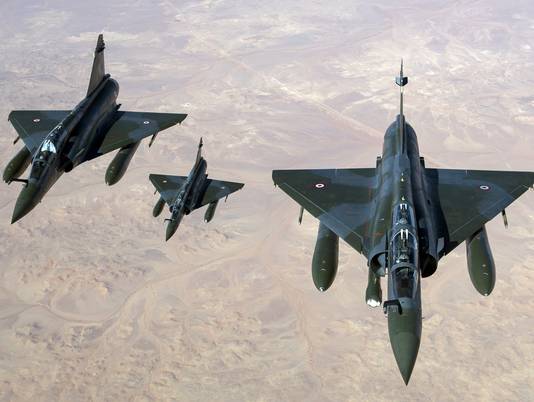
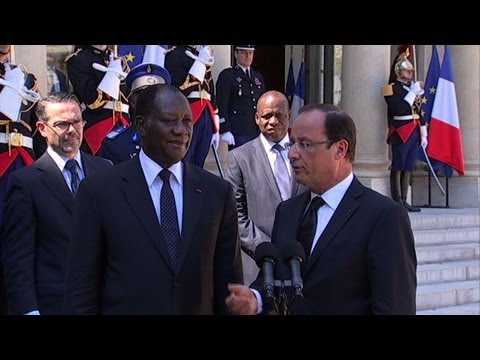
After months of speculation that concrete plans would begin to take shape, the theoretical is finally nearing reality in an undecided North African location.
For more than a decade U.S. military and intelligence officials have laid the groundwork of a "light" but vast network across the Sahel region, chasing al-Qaeda affiliates that have spun off their own franchises. In order to counter impressions of colonialism, utilize local forces and intelligence, and keep large numbers of U.S. troops off the continent, this process hinges on bi-lateral and multi-lateral relations with cooperative African states. Included are a series of joint forward operating bases constructed through the Sahel, and training programs between national and U.S. forces.
The same program that failed amid Mali's coup and left Washington to patch together a emergency response, as reported by The New York Times earlier this month: "American spy planes and surveillance drones have tried to make sense of the mess, but American officials and their allies are still scrambling even to get a detailed picture of who they are up against."
The next logical step of a bigger presence in North Africa is drone bases in friendly (and needy) countries, and that is where the Obama administration and its partners are headed. Neighboring Niger has been designated as the leading candidate - few African leaders have urged a quicker NATO intervention than President Mahamadou Issoufou - followed by Burkina Faso. The latter currently serves as the base for clandestine PC-12 surveillance aircraft.
The military necessities of a drone base or, more likely, a series of bases around Mali is clear enough. American military commanders and intelligence analysts have good reason to complain about “sorely lacking" information in northern Mali, a territory roughly the size of France and many times more extreme. This environment has already created hurdles for logistics and overflights, and plays into the hands of militants in control of mountainous desert until international air-power scales up (at which point guerrillas lose their advantage).
The task will increase in difficulty when Ansar Dine, al-Qaeda in the Islamic Maghreb (AQIM) and Movement for Oneness and Jihad in North Africa (MUJAO) fall back to their mountain bases along the Algerian border.
America is the only state capable of delivering the level of surveillance required to effectively coordinate African ground forces with Western air power; eliminate U.S. support and NATO's mission in Mali will collapse. However U.S. officials won't be as candid about the litany of questions and concerns that drones entail. Suffice to say, drone bases function as instruments of control and are never built without strings attached. This manipulation goes both ways too, especially when an unpopular government makes use of U.S. support to buttress its international standing (Yemen and Ethiopia being primary examples). Some observers suspect that Issoufou is operating along these lines.
Mali's conflict has now afforded the perfect opportunity to begin building the first of several "lily pads" in the desert, a plan that is designed to synchronize with greater numbers of U.S. Special Forces and intelligence operatives. U.S. officials say that the drones will fly unarmed over Mali, but Mali is bigger than Mali to both the international community and al-Qaeda's ideology. Each side is thinking in decades, not months or years, and U.S. drones will eventually be armed. Consider the force brought to bear in Yemen, a smaller and more accessible country that houses a similar number of al-Qaeda militants.
Everything is a matter of time in North Africa. A NATO intervention in Libya that, according to the opinion of U.S. intelligence, overwhelmed U.S. military planners in Mali is now being trailed by a spine of bases into the Sahara. Within the alleged chaos lies a chain reaction so precise and efficient that it belies the region's unpredictability.
Showing posts with label France. Show all posts
January 29, 2013
U.S. Drone Base Headed For North Africa
Labels:
4GW,
Ansar Dine,
AQIM,
Asymmetric Warfare,
COIN,
Drone warfare,
ECOWAS,
ethiopia,
France,
Guerrilla Warfare,
Mali,
MUJAO,
NATO,
Niger,
Nigeria,
Yemen
January 24, 2013
Ansar Dine Split Clouds Mali's Netwar
In their quest to create larger and more organized structures than their individual parts, non-state actors (both military and civilian) are driven by necessity to connect with like-minded groups and their own hierarchies. Unless commanded by strong central leadership at the network's hub, they generally assume flatter shapes that make them harder to kill but easier to divide - especially in insurgency environments where everyone has interests to pursue. The benefits of netwar can evaporate as quickly as one network breaks away from another, and time will soon tell how much Mali's Islamist alliance suffers from division.
Speaking to the Associated Press on Thursday, former Ansar Dine official Alghabass Ag Intalla has announced the creation of a new all-Malian Tuareg front: the Islamic Movement for Azawad (IMA). Ag Intalla had initially chosen Iyad Ag Ghaly's newly-established Ansar Dine over the National Movement for the Liberation of Azawad (MNLA) during their joint takeover of the north, locking down the Kidal region that both call home. The urgent question is whether Ag Intalla's intentions are sincere. Chafing under Ag Ghaly's authority would be natural for multiple reasons; Ag Intalla is considered a moderate Muslim and the heir to Kidal's tribal leadership. Just as the ambitious Ag Ghaly has involved himself in the Tuareg movement to the point of several failed takeovers, Ag Intalla doesn't want to take orders from someone else.
“We are neither AQIM or MUJAO,” he said, referring to al-Qaida in the Islamic Maghreb and the Movement for the Unity and Jihad in West Africa. “We are a group of people from the north of Mali who have a set of grievances that date back at least 50 years.”
Ag Intalla's actions are believed to be driven by French air-strikes in the Kidal region, the first phase of bombardment on AQIM's catacomb bases located along the Mali-Algerian border. This must be partially true if his loyalist forces reject fighting and dying for "al-Qaeda's war," but Ag Intalla is also working a deal with international mediators and seems to expect his terms to be considered. For months African and European diplomats had used him in their attempts to pry Ansar Dine away from AQIM and MUJAO, with the intention of jelling it back together with the MNLA. Except Ag Ghaly was never serious about negotiating - later deemed a "miscalculation" by foreign sources - and instead offered MNLA fighters an ultimatum to join or die before storming their last towns with AQIM and MUJAO's assistance.
Ag Intalla and his foreign handlers presumably reached out to each other when the French landed last week in Sevare, and the first details are now going public.
Accordingly, French officials say they are taking Ag Intalla at his word until his actions prove otherwise. They likely trust his immediate motivation to distance himself from al-Qaeda's flag, but they expect the type of rapid assistance that could shorten Mali's operation and win praise at home. Demanding that they "prove it on the ground," one anonymous diplomat said that Paris is looking for the IMA to "free up territory" and work with the Malian army in Kidal. Plugging into Ag Intalla's local network should ease the burden of fighting the Islamists' embedded positions in Mali's rugged north, so one can understand how eager the international community is to flip him.
For his part Ag Intalla claims his men are prepared to fight Ansar Dine and its allies. Less clear is his willingness to cooperate with the MNLA; forming a new group suggests a loose relationship, but they may be forced together by the circumstances. Also uncertain is the long-term effects on the Islamist alliance. Can Ag Ghaly afford to target Ag Intalla and risk provoking his own Tuareg base? Does Ag Intalla possess enough strength to confront Ag Ghaly and his allies head on? Will other groups splinter off and create a web of networks operating on competing agendas, and will this patchwork facilitate or obstruct a political resolution to the north's conflict?
And what if Ag Intalla wants what the international community isn't prepared to give any Tuareg: autonomy or independence? This current situation, like everything else in Mali, is shrouded in a fog of asymmetric warfare.
Speaking to the Associated Press on Thursday, former Ansar Dine official Alghabass Ag Intalla has announced the creation of a new all-Malian Tuareg front: the Islamic Movement for Azawad (IMA). Ag Intalla had initially chosen Iyad Ag Ghaly's newly-established Ansar Dine over the National Movement for the Liberation of Azawad (MNLA) during their joint takeover of the north, locking down the Kidal region that both call home. The urgent question is whether Ag Intalla's intentions are sincere. Chafing under Ag Ghaly's authority would be natural for multiple reasons; Ag Intalla is considered a moderate Muslim and the heir to Kidal's tribal leadership. Just as the ambitious Ag Ghaly has involved himself in the Tuareg movement to the point of several failed takeovers, Ag Intalla doesn't want to take orders from someone else.
“We are neither AQIM or MUJAO,” he said, referring to al-Qaida in the Islamic Maghreb and the Movement for the Unity and Jihad in West Africa. “We are a group of people from the north of Mali who have a set of grievances that date back at least 50 years.”
Ag Intalla's actions are believed to be driven by French air-strikes in the Kidal region, the first phase of bombardment on AQIM's catacomb bases located along the Mali-Algerian border. This must be partially true if his loyalist forces reject fighting and dying for "al-Qaeda's war," but Ag Intalla is also working a deal with international mediators and seems to expect his terms to be considered. For months African and European diplomats had used him in their attempts to pry Ansar Dine away from AQIM and MUJAO, with the intention of jelling it back together with the MNLA. Except Ag Ghaly was never serious about negotiating - later deemed a "miscalculation" by foreign sources - and instead offered MNLA fighters an ultimatum to join or die before storming their last towns with AQIM and MUJAO's assistance.
Ag Intalla and his foreign handlers presumably reached out to each other when the French landed last week in Sevare, and the first details are now going public.
Accordingly, French officials say they are taking Ag Intalla at his word until his actions prove otherwise. They likely trust his immediate motivation to distance himself from al-Qaeda's flag, but they expect the type of rapid assistance that could shorten Mali's operation and win praise at home. Demanding that they "prove it on the ground," one anonymous diplomat said that Paris is looking for the IMA to "free up territory" and work with the Malian army in Kidal. Plugging into Ag Intalla's local network should ease the burden of fighting the Islamists' embedded positions in Mali's rugged north, so one can understand how eager the international community is to flip him.
For his part Ag Intalla claims his men are prepared to fight Ansar Dine and its allies. Less clear is his willingness to cooperate with the MNLA; forming a new group suggests a loose relationship, but they may be forced together by the circumstances. Also uncertain is the long-term effects on the Islamist alliance. Can Ag Ghaly afford to target Ag Intalla and risk provoking his own Tuareg base? Does Ag Intalla possess enough strength to confront Ag Ghaly and his allies head on? Will other groups splinter off and create a web of networks operating on competing agendas, and will this patchwork facilitate or obstruct a political resolution to the north's conflict?
And what if Ag Intalla wants what the international community isn't prepared to give any Tuareg: autonomy or independence? This current situation, like everything else in Mali, is shrouded in a fog of asymmetric warfare.
Labels:
4GW,
African Union,
Algeria,
Ansar Dine,
AQIM,
COIN,
ECOWAS,
France,
IMA,
MNLA,
MUJAO,
NATO,
Netwar
January 20, 2013
Slow Treading In Mali's Asymmetric Fog
The gears of humanitarian intervention are rolling along smoothly if one takes the words of government and military officials at face value. Backed by over 2,000 French soldiers, their Malian counterparts have managed to establish the beginning of a defensive barrier and halt the Islamist coalition's movements in the country's inner delta. For several months Ansar Dine, the north's Tuareg-Islamist outfit, had leveraged its al-Qaeda contacts to encroach upon the country's mid-section, seizing positions on both sides of the Niger River before advancing on Konna. This move proved one step too close to Sevare's airport, the Islamists' likely target, and the town has now been fortified by French troops in less than a week.
VOA French to Africa correspondent Idrissa Fall described Sevare as being in a "state of war," overrun by French and Malian military forces, and empty of civilians. Its airbase will serve as a main international jump-point into the north.
The influx of French troops has allowed for the creation of a defensive line between Sevare and Diablay, a modest town that was overrun by militants shortly after France's initial air-strikes in Konna. Several hundred miles to the southwest and 50 miles below Diablay lies the town of Niono. Here French forces have entrenched themselves with Malian soldiers as they construct a forward operating base on the conflict's northwestern flank. French commanders are currently awaiting reinforcements and scouting reports from the north, and plan to take control of Diablay after the town is checked for disguised militants (who reportedly vacated on Saturday).
“The deployment towards the north... which began 24 hours ago, is on course with troops inside the towns of Niono and Sevare,” Lieutenant Colonel Emmanuel Dosseur told reporters on Sunday.
Accordingly, defensive lines should be stretched in the opposite direction of Sevare as more French troops and the first African contingents arrive. 50 Senegalese troops landed in the capital on Sunday and 200 have been cleared to deploy from Niger. National media is interpreting their activation as a possible second front on Mali's eastern border, where Ansar Dine and the Movement for Unity and Oneness in West Africa (MUJAO) are particularly entrenched. Neighboring Burkina Faso has also pledged to contribute a force inside Mali and to deploy a separate force along its border, theoretically connecting French and African troops along Mali's north-south divide.
In a potential boost, Chad recently offered to raise the total African force from 3,800 to 5,800.
So how long will the international community's wheels keep rolling in what they view as an uninterrupted state? Questioning over the conflict's anticipated schedule has yet to disperse, instead becoming less clear by the day. Every action and decision tends to run longer than expected in guerrilla warfare, as the style of warfare is designed to slow a larger army, and Mali's conflict is already headed in this direction. Less than 150 African soldiers have landed in Mali since French officials announced the beginning if their ground intervention; deploying the entire force will take weeks at best, months at worst.
“Step by step, I think it’s a question from what I heard this morning of some days, some weeks,” France's Foreign Minister, Laurent Fabius, said during a press conference in the Ivory Coast.
These troops are then scheduled to receive further combat training from NATO advisers, giving the Islamists more time to prepare and sliding the immediate brunt of combat onto Western forces.
To compensate for delays and soften northern Mali's ground targets, the French have begun bombing the Kidal region to the far north of Konna and Diablay. The ongoing assault is presumably intended to weaken the Islamists' material resources, not destroy their capabilities entirely, but "shock and awe" applies equally for the Western public. Such measures cannot be understand at the surface level. An extensive aerial campaign is insufficient by itself and requires a hard ground campaign against militants that have prepared underground since Mali's crisis began in early 2012. France's Defense Minister, Jean-Yves Le Drian, explains NATO's urgent dilemma: "The goal is to ensure that AFISMA, the African force, can take the baton from our own intervention."
Paris has continually measured its mission in weeks but, given the nature of asymmetric warfare and relative isolation of Mali, this number will hit double digits before the last African troops deploy and continue long afterward. For his part French President François Hollande has announced that France's mission will "last as long as necessary to win over terrorism in this part of Africa"; other officials, such as Prime Minister Jean-Marc Ayrault and Le Drian have issued more optimistic assessments. However Le Drian's latest statements, whether true or false, help understand Mali's vast proportions. Telling France 5, "The goal is the total reconquest of Mali. We will not leave any pockets of resistance," he was subsequently asked how far north Paris is willing to go.
"If necessary, the African forces can appeal for support from French forces when they arrive in Timbuktu," Le Drian answered.
Timbuktu rests at the edge of the war though. How long will African troops need to cross 500 miles of desert and recapture Kidal - six months to year? Holding the area until Mali's government can reassert authority could take even longer (elections are tentatively planned for April), and the Islamists are embedded in the city's mountainous surroundings. As with most of their urban holdings, the Islamists can afford to withdraw from Kidal and continue their guerrilla war along society's margins. French and possibly other Western forces thus stand a good chance of accompanying African troops throughout the initial phase of their campaign.
Timbuktu would just be the starting point.
With these issues come a variety of related problems that must be addressed in the near-term and long-term: the unstable status of Diablay and Konna, French calls for greater U.S. support, the uncertain depth of Washington's military commitment, African expectations of Western financial support. Descriptions of the Islamists in Diablay pile complications onto seizing any town, big or small; locals recount that they "generally kept their promise" to leave the people be, although their presence forced the town to shut down. Eyewitnesses said that every fighter masked his face, but they also reported a significant number of Algerians and Libyans in Ansar Dine's ranks, which are mostly composed of Tuaregs. Separating their legitimate grievances from the Islamist alliance's wider agenda presents a chronic challenge for the international community.
Only one factor appears concrete in Mali: the conflict will always move slower than described by government officials. Asked at Niomo whether a "long war" had finally begun, the commanding officer Colonel Frederic replied, "Maybe, yes."
VOA French to Africa correspondent Idrissa Fall described Sevare as being in a "state of war," overrun by French and Malian military forces, and empty of civilians. Its airbase will serve as a main international jump-point into the north.
The influx of French troops has allowed for the creation of a defensive line between Sevare and Diablay, a modest town that was overrun by militants shortly after France's initial air-strikes in Konna. Several hundred miles to the southwest and 50 miles below Diablay lies the town of Niono. Here French forces have entrenched themselves with Malian soldiers as they construct a forward operating base on the conflict's northwestern flank. French commanders are currently awaiting reinforcements and scouting reports from the north, and plan to take control of Diablay after the town is checked for disguised militants (who reportedly vacated on Saturday).
“The deployment towards the north... which began 24 hours ago, is on course with troops inside the towns of Niono and Sevare,” Lieutenant Colonel Emmanuel Dosseur told reporters on Sunday.
Accordingly, defensive lines should be stretched in the opposite direction of Sevare as more French troops and the first African contingents arrive. 50 Senegalese troops landed in the capital on Sunday and 200 have been cleared to deploy from Niger. National media is interpreting their activation as a possible second front on Mali's eastern border, where Ansar Dine and the Movement for Unity and Oneness in West Africa (MUJAO) are particularly entrenched. Neighboring Burkina Faso has also pledged to contribute a force inside Mali and to deploy a separate force along its border, theoretically connecting French and African troops along Mali's north-south divide.
In a potential boost, Chad recently offered to raise the total African force from 3,800 to 5,800.
So how long will the international community's wheels keep rolling in what they view as an uninterrupted state? Questioning over the conflict's anticipated schedule has yet to disperse, instead becoming less clear by the day. Every action and decision tends to run longer than expected in guerrilla warfare, as the style of warfare is designed to slow a larger army, and Mali's conflict is already headed in this direction. Less than 150 African soldiers have landed in Mali since French officials announced the beginning if their ground intervention; deploying the entire force will take weeks at best, months at worst.
“Step by step, I think it’s a question from what I heard this morning of some days, some weeks,” France's Foreign Minister, Laurent Fabius, said during a press conference in the Ivory Coast.
These troops are then scheduled to receive further combat training from NATO advisers, giving the Islamists more time to prepare and sliding the immediate brunt of combat onto Western forces.
To compensate for delays and soften northern Mali's ground targets, the French have begun bombing the Kidal region to the far north of Konna and Diablay. The ongoing assault is presumably intended to weaken the Islamists' material resources, not destroy their capabilities entirely, but "shock and awe" applies equally for the Western public. Such measures cannot be understand at the surface level. An extensive aerial campaign is insufficient by itself and requires a hard ground campaign against militants that have prepared underground since Mali's crisis began in early 2012. France's Defense Minister, Jean-Yves Le Drian, explains NATO's urgent dilemma: "The goal is to ensure that AFISMA, the African force, can take the baton from our own intervention."
Paris has continually measured its mission in weeks but, given the nature of asymmetric warfare and relative isolation of Mali, this number will hit double digits before the last African troops deploy and continue long afterward. For his part French President François Hollande has announced that France's mission will "last as long as necessary to win over terrorism in this part of Africa"; other officials, such as Prime Minister Jean-Marc Ayrault and Le Drian have issued more optimistic assessments. However Le Drian's latest statements, whether true or false, help understand Mali's vast proportions. Telling France 5, "The goal is the total reconquest of Mali. We will not leave any pockets of resistance," he was subsequently asked how far north Paris is willing to go.
"If necessary, the African forces can appeal for support from French forces when they arrive in Timbuktu," Le Drian answered.
Timbuktu rests at the edge of the war though. How long will African troops need to cross 500 miles of desert and recapture Kidal - six months to year? Holding the area until Mali's government can reassert authority could take even longer (elections are tentatively planned for April), and the Islamists are embedded in the city's mountainous surroundings. As with most of their urban holdings, the Islamists can afford to withdraw from Kidal and continue their guerrilla war along society's margins. French and possibly other Western forces thus stand a good chance of accompanying African troops throughout the initial phase of their campaign.
Timbuktu would just be the starting point.
With these issues come a variety of related problems that must be addressed in the near-term and long-term: the unstable status of Diablay and Konna, French calls for greater U.S. support, the uncertain depth of Washington's military commitment, African expectations of Western financial support. Descriptions of the Islamists in Diablay pile complications onto seizing any town, big or small; locals recount that they "generally kept their promise" to leave the people be, although their presence forced the town to shut down. Eyewitnesses said that every fighter masked his face, but they also reported a significant number of Algerians and Libyans in Ansar Dine's ranks, which are mostly composed of Tuaregs. Separating their legitimate grievances from the Islamist alliance's wider agenda presents a chronic challenge for the international community.
Only one factor appears concrete in Mali: the conflict will always move slower than described by government officials. Asked at Niomo whether a "long war" had finally begun, the commanding officer Colonel Frederic replied, "Maybe, yes."
Labels:
4GW,
African Union,
Ansar Dine,
AQIM,
COIN,
Drone warfare,
ECOWAS,
France,
MNLA,
MUJAO,
NATO,
UN
January 17, 2013
Hostages Become Easy Prey In Mali's Intervention
Tuesday's raid on an Algerian oil facility highlights the simplistic chaos of unconventional warfare. Known by many names - terrorism, guerrilla warfare, insurgency, rebellion, revolution - unconventional warfare encompasses all terms on the asymmetric side of warcraft, and has bedeviled countless sources of authority throughout human civilization. Even the predictable cannot be fully predicted and the unexpected happens enough to become expected.
Beyond the numerous strategic implications of the attack on Tigantourine, the raid is remarkable for two factors: the straightforward nature of the attack and its location. Despite the high alert of those European and African capitals contributing to Mali's intervention, none could anticipate where the Islamists eventually struck or how quickly they reacted to France's overflights through Algeria. Their "surprise" attack was also delivered exactly as promised. In early December Mokhtar Belmokhtar, a former commander of al-Qaeda in the Islamic Maghreb (AQIM), announced the creation of his El Moulethemine katibat ("Brigade of the Veiled Ones"), a unit dedicated to kidnapping foreigners in the Sahel region. Afterward followed an introductory video for the "Signers in Blood," a purported suicide squad.
The Algerian government, international media, and Belmokhtar's own men have attributed the attack to his second creation rather than the first, but both are loosely aligned with AQIM's strategic view. While Belmokhtar has splintered away from the core to be his own boss, he is particularly eager to assist his former deputy in Mali and has been regularly spotted in Gao since the Movement for Oneness and Jihad in West Africa (MUJAO) encamped in July 2012. Oumar Hamaha, a local Tuareg, doubles as a spokesman for Ansar Dine and a senior military official in MUJAO, and he would confirm Belmokhtar's cooperation with the two groups.
Accordingly, Hamaha was selected to inform The Associated Press of Belmokhtar's actions and the motivation behind them, namely Algeria's overflights and France's killing of Muslims.
"We have a struck a blow to the heart (of the international community),"he declared ominously. "It's the United Nations that gave the green light to this intervention and all Western countries are now going to pay a price. We are now globalizing our conflict."
What is startling is the depth of Belmokhtar's raid, allegedly conducted by 20 men in three "heavily-armed" vehicles deep inside Algerian territory - a distance that exceeds the space between Mali's capital and the Islamists' northern bases. One immediately wonders how they traveled so far in open terrain, over multiple days, without being discovered by any government. It's certainly possible that the attackers traveled discreetly and acquired their vehicles near the strike point, or entered directly from Libya, but their range is equally impressive.
Hundreds of Algerians were initially taken hostage before being released or escaping. At least 41 people (including Americans, French, British, Irish, Norwegian and Japanese) are believed to have been captured, several more killed, and recent accounts of AQIM's kidnappers have described how quickly and quietly the Islamists move their bargaining chips. They will likely be taken into the cave network constructed along the southeast end of the Algerian-Malian border, where underground bases have been built dozens of miles apart. If the attackers can escape into Libyan territory, that is.
Algerian forces have approached the complex where the hostages are being held (Westerns are reportedly being held in a separate wing) and reportedly fired shots in the area. Reached by telephone, one of the assailants was quoted as saying, "We will kill all the hostages if the Algerian army try to storm the area."
Even if the Algerian military cuts off their exits, NATO as a whole must factor the risk-reward of a major hostage situation into its plans as French troops mobilize for battle in Diablay, taken by the Islamists shortly after the French began landing en masse. They may need a week or two just to carefully dislodge the Islamists occupying the town - which, contrary to French claims of an offensive on the capital, appears to represent no more than a diversion tactic. Paris has repeatedly measured its ground campaign in weeks rather than months, but unless Special Forces and intelligence agencies can recover the new hostages, they will apply an immediate source of friction against NATO's campaign and further extend Mali's long war.
Another raid in Somalia recently failed to go as planned.
As for strategic planning in the international front, the pressing question is whether Algeria responds militarily on Mali's northern border or continues to take a passive-aggressive role in the conflict. Interior Minister Daho Ould Kabila told the official news agency APS, "The Algerian authorities will not respond to the demands of the terrorists and will not negotiate," suggesting that Belmokhtar has crossed a line that cannot be forgiven. The need for Algerian forces appeared inevitable from the start of Mali's insurgency, given that a hardened force must smash into the Islamists' mountain fortress and from multiple directions. Except Algeria's intelligence is also suspected of collaborating with elements of al-Qaeda in the Islamic Maghreb (AQIM) in order to enhance the government's regional influence, whether that means interfering with Tuareg separatists or securing Western favors without strings.
A vocal Algiers backed Ansar Dine's superficial dialogue with international mediators over the last five months, now termed a "miscalculation" but a suspicious one at that.
For its part the Algerian government hasn't looked forward to any uncontrollable disturbance, either from France and NATO or the Islamists and Tuaregs. Algiers prefers manageable instability and seeks to avoid entanglement on Mali's ground. Abdallah Baali, the country's ambassador to Washington, warned NATO less than two months ago, "You cannot really fight a conventional war there. Your enemy will vanish in the desert before your eyes."
Obviously Algeria would not fight conventionally inside or outside its territory; assault helicopters and Special Forces would coordinate with local intelligence to beat the Islamists at their own games - mobility and disguise. However the 1,000 mile Algerian-Malian border gives perspective to the enormity of the task at hand inside Mali, and the introduction of Algeria's hegemonic agenda creates yet another dimension to a rapidly evolving conflict.
Beyond the numerous strategic implications of the attack on Tigantourine, the raid is remarkable for two factors: the straightforward nature of the attack and its location. Despite the high alert of those European and African capitals contributing to Mali's intervention, none could anticipate where the Islamists eventually struck or how quickly they reacted to France's overflights through Algeria. Their "surprise" attack was also delivered exactly as promised. In early December Mokhtar Belmokhtar, a former commander of al-Qaeda in the Islamic Maghreb (AQIM), announced the creation of his El Moulethemine katibat ("Brigade of the Veiled Ones"), a unit dedicated to kidnapping foreigners in the Sahel region. Afterward followed an introductory video for the "Signers in Blood," a purported suicide squad.
The Algerian government, international media, and Belmokhtar's own men have attributed the attack to his second creation rather than the first, but both are loosely aligned with AQIM's strategic view. While Belmokhtar has splintered away from the core to be his own boss, he is particularly eager to assist his former deputy in Mali and has been regularly spotted in Gao since the Movement for Oneness and Jihad in West Africa (MUJAO) encamped in July 2012. Oumar Hamaha, a local Tuareg, doubles as a spokesman for Ansar Dine and a senior military official in MUJAO, and he would confirm Belmokhtar's cooperation with the two groups.
Accordingly, Hamaha was selected to inform The Associated Press of Belmokhtar's actions and the motivation behind them, namely Algeria's overflights and France's killing of Muslims.
"We have a struck a blow to the heart (of the international community),"he declared ominously. "It's the United Nations that gave the green light to this intervention and all Western countries are now going to pay a price. We are now globalizing our conflict."
What is startling is the depth of Belmokhtar's raid, allegedly conducted by 20 men in three "heavily-armed" vehicles deep inside Algerian territory - a distance that exceeds the space between Mali's capital and the Islamists' northern bases. One immediately wonders how they traveled so far in open terrain, over multiple days, without being discovered by any government. It's certainly possible that the attackers traveled discreetly and acquired their vehicles near the strike point, or entered directly from Libya, but their range is equally impressive.
Hundreds of Algerians were initially taken hostage before being released or escaping. At least 41 people (including Americans, French, British, Irish, Norwegian and Japanese) are believed to have been captured, several more killed, and recent accounts of AQIM's kidnappers have described how quickly and quietly the Islamists move their bargaining chips. They will likely be taken into the cave network constructed along the southeast end of the Algerian-Malian border, where underground bases have been built dozens of miles apart. If the attackers can escape into Libyan territory, that is.
Algerian forces have approached the complex where the hostages are being held (Westerns are reportedly being held in a separate wing) and reportedly fired shots in the area. Reached by telephone, one of the assailants was quoted as saying, "We will kill all the hostages if the Algerian army try to storm the area."
Even if the Algerian military cuts off their exits, NATO as a whole must factor the risk-reward of a major hostage situation into its plans as French troops mobilize for battle in Diablay, taken by the Islamists shortly after the French began landing en masse. They may need a week or two just to carefully dislodge the Islamists occupying the town - which, contrary to French claims of an offensive on the capital, appears to represent no more than a diversion tactic. Paris has repeatedly measured its ground campaign in weeks rather than months, but unless Special Forces and intelligence agencies can recover the new hostages, they will apply an immediate source of friction against NATO's campaign and further extend Mali's long war.
Another raid in Somalia recently failed to go as planned.
As for strategic planning in the international front, the pressing question is whether Algeria responds militarily on Mali's northern border or continues to take a passive-aggressive role in the conflict. Interior Minister Daho Ould Kabila told the official news agency APS, "The Algerian authorities will not respond to the demands of the terrorists and will not negotiate," suggesting that Belmokhtar has crossed a line that cannot be forgiven. The need for Algerian forces appeared inevitable from the start of Mali's insurgency, given that a hardened force must smash into the Islamists' mountain fortress and from multiple directions. Except Algeria's intelligence is also suspected of collaborating with elements of al-Qaeda in the Islamic Maghreb (AQIM) in order to enhance the government's regional influence, whether that means interfering with Tuareg separatists or securing Western favors without strings.
A vocal Algiers backed Ansar Dine's superficial dialogue with international mediators over the last five months, now termed a "miscalculation" but a suspicious one at that.
For its part the Algerian government hasn't looked forward to any uncontrollable disturbance, either from France and NATO or the Islamists and Tuaregs. Algiers prefers manageable instability and seeks to avoid entanglement on Mali's ground. Abdallah Baali, the country's ambassador to Washington, warned NATO less than two months ago, "You cannot really fight a conventional war there. Your enemy will vanish in the desert before your eyes."
Obviously Algeria would not fight conventionally inside or outside its territory; assault helicopters and Special Forces would coordinate with local intelligence to beat the Islamists at their own games - mobility and disguise. However the 1,000 mile Algerian-Malian border gives perspective to the enormity of the task at hand inside Mali, and the introduction of Algeria's hegemonic agenda creates yet another dimension to a rapidly evolving conflict.
Labels:
4GW,
African Union,
Algeria,
Ansar Dine,
AQIM,
Asymmetric Warfare,
COIN,
Drone warfare,
ECOWAS,
EU,
France,
Mali,
MUJAO,
NATO,
North Africa
January 15, 2013
Estimating Force Levels In Mali's Asymmetric War
The Trench has called attention to the reality that French officials have dramatically oversold the threat in Mali by claiming that its capital, Bamako, would have fallen by now without Paris's direct intervention. This observation isn't made in resistance to a well-planned and executed counterinsurgency, but to the raise awareness of a potential destabilizing factor in a mission with little margin for error.
As reported on Monday, the notion of an Islamist tsunami sweeping through the south and into the capital is militarily infeasible. Even gung-ho jihadists with minimal strategic skills would recognize the impossibility of Paris's narrative. Thousands of guerrillas would be needed to secure population centers on the way to the capital, located some 450 miles from their northern bases, and still possess enough forces to assert their authority in Bamako. A defensive force must also guard their northern and rear fronts, along with the cities under their control, further depleting the manpower available in the south. The best-case scenario of a fully-resource offensive would leave the Islamists with sporadic control inside and outside of the capital, and maintaining this authority on a permanent basis would require substantial reinforcements and supply lines.
The Islamists would be idiotic to believe they could take Bamako as easily as Paris predicted, and the French would be equally foolish to believe so. More likely, Paris has exaggerated the threat in order to justify a larger ground operation than any NATO member publicly announced in the run-up to Mali's intervention.
Based on Western estimates, the reported flow of jihadist recruits, the ability to conduct multiple operations in separate areas and the reserved tasked to defensive works, the Islamists' ranks appear to possess between 1,500 and 2,000 trained guerrillas. Washington, for its part, estimates a force of 800-1,200. Some African capitals have posited higher figures, but these are likely attributed to the hyperbole of their own frantic (albeit legitimate) calls for Western assistance. Reuters notes that independent estimates "on their numbers and their origin vary wildly."
"The numbers I have heard range from 100s to 1,000s, so it is clear that no one has much of a clue," a senior Western security official told Reuters.
A disturbing statement in itself, extreme estimates of 4,000-5,000 would still push the Islamists to their breaking point in the event that they storm Bamako. While measuring insurgent forces is never simple or completely accurate, one must obtain a reasonable estimate to predict their objectives. Interestingly, France's Foreign Minister Laurent Fabius believes that "the presence of French troops on the ground in Mali, an Islamic country, would not galvanize Al Qaeda recruitment in the region."
The latest reports have France pouring in 2,500 troops to secure the border until an equivalent number of forces arrive from the Economic Community of West African States (ECOWAS). Nearly 800 French troops have already landed in Mali to repel the militants' immediate counterattack and prep the ground for ECOWAS's campaign in the north. They expect to greet their African comrades in the next two weeks, the current breakdown being as follows: 144 troops from Guinea, 300 from Benin, 500 from Burkina Faso, 500 each from Niger, Senegal and Togo, 900 from mission leader Nigeria, and an unspecified number from Chad.
Supporting these forces is a robust logistics and intelligence network of American, British, French, German and Canadian personnel. Paris has also inquired into the availability of the Saudi-dominated Gulf Cooperation Council (GCC), whose reach in the Eastern Hemisphere continues to grow with every Western initiative (Yemen, Bahrain, Syria, Egypt).
This joint force, if left intact, is capable of retaking northern Mali's population belt and inflicting heavy losses on the Islamists. The overriding question, from a strategic and tactical level, is what ECOWAS can do after the Islamists go underground to emerge at a later time - or when they resist beyond foreign expectations. Clearing is always easier than holding and building, and uncertainty will immediately set in if NATO pulls back early into ECOWAS's campaign. As Al Jazeera notes, the incoming African task-force will undergo further combat training with French and other NATO personnel before launching a sustained offensive. The result: a holding pattern between the north-south divide near Konna until ECOWAS can head north. This period will be dominated by NATO air strikes and ground raids on the Islamists leadership.
What French forces plan to do after ECOWAS crosses north remains unstated, but they will likely participate in both offensive and defensive operations with African units. On Tuesday U.S. General Carter Ham, the head of AMISOM, told The Wall Street Journal that the French campaign "may prove to be decisive," but added that aerial operations will be necessary until then. His "sense" tells him that "the French are committed and understand this will not be a short-term campaign." On the other hand, Paris has committed a large measure of force with the apparent hope that it can quickly smash the Islamists and leave ECOWAS to mop up.
"France is today in the vanguard, but within a week African forces will start to deploy on the ground," Prime Ministr Jean-Marc Ayrault said on Tuesday, telling reporters that "French forces won't have to bear the. Burden of fighting in Mali for very long."
No, just part of the burden for an undetermined length of time.
As reported on Monday, the notion of an Islamist tsunami sweeping through the south and into the capital is militarily infeasible. Even gung-ho jihadists with minimal strategic skills would recognize the impossibility of Paris's narrative. Thousands of guerrillas would be needed to secure population centers on the way to the capital, located some 450 miles from their northern bases, and still possess enough forces to assert their authority in Bamako. A defensive force must also guard their northern and rear fronts, along with the cities under their control, further depleting the manpower available in the south. The best-case scenario of a fully-resource offensive would leave the Islamists with sporadic control inside and outside of the capital, and maintaining this authority on a permanent basis would require substantial reinforcements and supply lines.
The Islamists would be idiotic to believe they could take Bamako as easily as Paris predicted, and the French would be equally foolish to believe so. More likely, Paris has exaggerated the threat in order to justify a larger ground operation than any NATO member publicly announced in the run-up to Mali's intervention.
Based on Western estimates, the reported flow of jihadist recruits, the ability to conduct multiple operations in separate areas and the reserved tasked to defensive works, the Islamists' ranks appear to possess between 1,500 and 2,000 trained guerrillas. Washington, for its part, estimates a force of 800-1,200. Some African capitals have posited higher figures, but these are likely attributed to the hyperbole of their own frantic (albeit legitimate) calls for Western assistance. Reuters notes that independent estimates "on their numbers and their origin vary wildly."
"The numbers I have heard range from 100s to 1,000s, so it is clear that no one has much of a clue," a senior Western security official told Reuters.
A disturbing statement in itself, extreme estimates of 4,000-5,000 would still push the Islamists to their breaking point in the event that they storm Bamako. While measuring insurgent forces is never simple or completely accurate, one must obtain a reasonable estimate to predict their objectives. Interestingly, France's Foreign Minister Laurent Fabius believes that "the presence of French troops on the ground in Mali, an Islamic country, would not galvanize Al Qaeda recruitment in the region."
The latest reports have France pouring in 2,500 troops to secure the border until an equivalent number of forces arrive from the Economic Community of West African States (ECOWAS). Nearly 800 French troops have already landed in Mali to repel the militants' immediate counterattack and prep the ground for ECOWAS's campaign in the north. They expect to greet their African comrades in the next two weeks, the current breakdown being as follows: 144 troops from Guinea, 300 from Benin, 500 from Burkina Faso, 500 each from Niger, Senegal and Togo, 900 from mission leader Nigeria, and an unspecified number from Chad.
Supporting these forces is a robust logistics and intelligence network of American, British, French, German and Canadian personnel. Paris has also inquired into the availability of the Saudi-dominated Gulf Cooperation Council (GCC), whose reach in the Eastern Hemisphere continues to grow with every Western initiative (Yemen, Bahrain, Syria, Egypt).
This joint force, if left intact, is capable of retaking northern Mali's population belt and inflicting heavy losses on the Islamists. The overriding question, from a strategic and tactical level, is what ECOWAS can do after the Islamists go underground to emerge at a later time - or when they resist beyond foreign expectations. Clearing is always easier than holding and building, and uncertainty will immediately set in if NATO pulls back early into ECOWAS's campaign. As Al Jazeera notes, the incoming African task-force will undergo further combat training with French and other NATO personnel before launching a sustained offensive. The result: a holding pattern between the north-south divide near Konna until ECOWAS can head north. This period will be dominated by NATO air strikes and ground raids on the Islamists leadership.
What French forces plan to do after ECOWAS crosses north remains unstated, but they will likely participate in both offensive and defensive operations with African units. On Tuesday U.S. General Carter Ham, the head of AMISOM, told The Wall Street Journal that the French campaign "may prove to be decisive," but added that aerial operations will be necessary until then. His "sense" tells him that "the French are committed and understand this will not be a short-term campaign." On the other hand, Paris has committed a large measure of force with the apparent hope that it can quickly smash the Islamists and leave ECOWAS to mop up.
"France is today in the vanguard, but within a week African forces will start to deploy on the ground," Prime Ministr Jean-Marc Ayrault said on Tuesday, telling reporters that "French forces won't have to bear the. Burden of fighting in Mali for very long."
No, just part of the burden for an undetermined length of time.
Labels:
4GW,
African Union,
Ansar Dine,
AQIM,
Asymmetric Warfare,
COIN,
Drone warfare,
ECOWAS,
France,
Guerrilla Warfare,
Information Warfare,
Mali,
MUJAO,
NATO,
Netwar,
Niger,
Nigeria,
UN
French, NATO Oscillations Intensyfing In Mali
Tough talking and bombing aside, Paris's response in central and northern Mali has assumed a dangerously comical quality.
Over the weekend French officials repeatedly boasted that they had stopped the Islamists' advance southward at Konna and inflicted heavy casualties, along with substantial material losses, at their northern bases near Gao. Not long afterward, they also admitted that the militants' antiaircraft capabilities had "surprised" the war cabinet of President François Hollande, and the town of Diablay has now been seized after a "surprise" raid on its Malian garrison. French Defense Minister Jean-Yves Le Drian admitted (with obligatory embellishment) that the well-armed militants, "took Diabaly after fierce fighting and resistance from the Malian army, that couldn't hold them back."
The Associated Press was able to reach a local commander at nearby Niono before Diabaly fell. Once contacted after the battle, the AP reported that he sounded "almost desperate" in comparison to his previous confidence: "We feel truly threatened."
War is inherently complex, unpredictable and rapid; capabilities and intentions are often misestimated due to the fact that every side is trying to mask them. However French officials are publicly expressing the swings of a disturbing pattern. The beginning of NATO's long intervention in Mali has already launched as an emergency deployment rather than a coordinated assault with the Economic Community of West African States (ECOWAS) and an elected Malian government, which remains stricken by the effects of March 2012's coup. Two wide-ranging objectives - defense of the south and intervention in the north - have been floated by Paris, a divergence noted by many regional observers.
Marina Ottaway, of the Woodrow Wilson International Center for Scholars, warns, "The shortcoming of the French approach is that it's not clear what the next step is. They're just going in and stopping the advance of the rebel groups."
This assessment isn't entirely accurate since the bulk of French ground forces only need to remain operational until ECOWAS's task-force arrives (between 1-2 months) to secure Mali's middle region and push northward. The root problem is the insufficient size of ECOWAS's planned force, as 3,200 ground troops will need continual U.S. and French air support to cover Mali's northern territory - roughly the size of France. NATO's special forces will be needed to enable offensive and defensive operations, and are likely to increase their numbers unless other African states phase in reinforcements after the initial waves.
The fight will eventually be taken north by ECOWAS ground forces, and outside forces Mauritania and Algeria may decide to act from the west and north. NATO and the EU may be left off the official record as the U.S., U.K. France, Canada and other states respond with bilateral action. What remains unclear are NATO's force ratio and how long its contributors believe they have to stay in Mali, especially when they don't plan on informing the public for the time being.
“There has been no request, no discussion (within NATO) on the situation in Mali, the alliance as such is not involved in this crisis,” spokeswoman Oana Lungescu told reporters.
All available information suggests that NATO's muscle and expertise will be needed in greater quantities, and for a longer period of time, than its members are willing to publicly concede. The Islamist umbrella of Ansar Dine, al-Qaeda in the Arabian Peninsula (AQIM) and the Movement for Oneness and Jihad in West Africa (MUJAO) suffers from military and non-military weaknesses that can be exploited, but the groups are also well-funded by drug and kidnapping profits. On Saturday the Prime Ministers of Algeria, Libya and Tunisia pledged to begin sharing intelligence and jointly patrolling their borders in response to the networks being established by al-Qaeda's loose fronts; Tunisia’s President Moncef Marzouki described his country as "a corridor for Libyan weapons."
Trained with dependable arms by veteran jihadists looking for the next Afghanistan, these forces cannot be caught totally off guard because they expected a NATO invasion since taking control of northern Mali. Their response is likely to be twofold. On one hand, hard fighting will be delivered in the form of mountain warfare along the Algerian border. Here AQIM has recreated a Tora Tora scenario around Kidal, in the Adrar des Ifoghas, by drilling into the rocky desert and constructing bases inside. Whether saved for first or last, this mission alone requires extensive aerial bombardment and ground combat.
Conversely, these bases have likely been built in order to be abandoned in time. While Ansar Dine's spokesman, Oumar Ould Hamaha, has taunted the French by egging them to "attack on the ground if they are men," the Islamists would be foolish to "welcome them with open arms." Such a plan is presumably intended for jihadist consumption, as it goes against the grain of unconventional warfare. They have already begun to disperse, vacating MUJAO's base in Douentza before French planes struck and moving west on Diablay to draw attention away from Mopti's central position. Frontal maneuvers on French troops should be an infrequent development. Although the Islamists are eager to fight undisciplined Malian troops and can score quick propaganda victories with French casualties, they will likely drag the fight on as long as possible to disrupt NATO's operation schedule and raise the cost of intervention.
And as J. Peter Pham notes, "by planting their flag there, it's now become the latest place to go if you want to fight a Western army."
All of these factors add up to a longer and more intense intervention than France is currently telling its public, yet Paris is equally guilty of exaggerating the Islamists' advance. Following the events in Diablay, Le Drian speculated that if Paris hadn't intervened five days ago to stop the Islamists at Konna, "Bamako would be today in the hands of the terrorists." Unless the Islamists' ranks have been vastly underestimated by the thousands, the situation described by French defense officials isn't militarily feasible or strategically probable. Diabaly is a modest town of 36,000, and assaulting the city makes sense from a guerrilla's standpoint - they will attack wherever NATO isn't, then move to where NATO moves from. This pattern necessitates the force saturation that NATO is wary of committing.
Diabaly is located on the road to Bamako, as French officials remind us, and all possibilities must be considered in war. However several major cities stand in the way of the capital, some 300 miles south, and the Islamists need to garrison each population center in order for their offensive to be more than an exercise. That leaves few guerrillas - troops that usually wage urban warfare on the defensive - to storm a capital of 1.5 million. They could hold no territory along the way and still lack the necessary forces to assert control in Bamako, as the demand for weapons will be exceeded and supply lines will be severed deeper inside the south. Either option also reduces the men assigned to defend the north, which remains their prize due to the territory's inaccessibility.
Nothing adds up on this side of Mali's equation except for France and NATO's desire to justify all of their decisions and actions, whether sound or not.
"Our assessment was that they (the rebels) were actually able to take Bamako," Gerard Araud, French ambassador to the United Nations, said on Monday. "So we decided that what was at stake was the existence of the state of Mali, and beyond Mali was the stability of all west Africa.nWe had no other choice to launch this military intervention."
The main dilemma in Mali was never if, but how.
Over the weekend French officials repeatedly boasted that they had stopped the Islamists' advance southward at Konna and inflicted heavy casualties, along with substantial material losses, at their northern bases near Gao. Not long afterward, they also admitted that the militants' antiaircraft capabilities had "surprised" the war cabinet of President François Hollande, and the town of Diablay has now been seized after a "surprise" raid on its Malian garrison. French Defense Minister Jean-Yves Le Drian admitted (with obligatory embellishment) that the well-armed militants, "took Diabaly after fierce fighting and resistance from the Malian army, that couldn't hold them back."
The Associated Press was able to reach a local commander at nearby Niono before Diabaly fell. Once contacted after the battle, the AP reported that he sounded "almost desperate" in comparison to his previous confidence: "We feel truly threatened."
War is inherently complex, unpredictable and rapid; capabilities and intentions are often misestimated due to the fact that every side is trying to mask them. However French officials are publicly expressing the swings of a disturbing pattern. The beginning of NATO's long intervention in Mali has already launched as an emergency deployment rather than a coordinated assault with the Economic Community of West African States (ECOWAS) and an elected Malian government, which remains stricken by the effects of March 2012's coup. Two wide-ranging objectives - defense of the south and intervention in the north - have been floated by Paris, a divergence noted by many regional observers.
Marina Ottaway, of the Woodrow Wilson International Center for Scholars, warns, "The shortcoming of the French approach is that it's not clear what the next step is. They're just going in and stopping the advance of the rebel groups."
This assessment isn't entirely accurate since the bulk of French ground forces only need to remain operational until ECOWAS's task-force arrives (between 1-2 months) to secure Mali's middle region and push northward. The root problem is the insufficient size of ECOWAS's planned force, as 3,200 ground troops will need continual U.S. and French air support to cover Mali's northern territory - roughly the size of France. NATO's special forces will be needed to enable offensive and defensive operations, and are likely to increase their numbers unless other African states phase in reinforcements after the initial waves.
The fight will eventually be taken north by ECOWAS ground forces, and outside forces Mauritania and Algeria may decide to act from the west and north. NATO and the EU may be left off the official record as the U.S., U.K. France, Canada and other states respond with bilateral action. What remains unclear are NATO's force ratio and how long its contributors believe they have to stay in Mali, especially when they don't plan on informing the public for the time being.
“There has been no request, no discussion (within NATO) on the situation in Mali, the alliance as such is not involved in this crisis,” spokeswoman Oana Lungescu told reporters.
All available information suggests that NATO's muscle and expertise will be needed in greater quantities, and for a longer period of time, than its members are willing to publicly concede. The Islamist umbrella of Ansar Dine, al-Qaeda in the Arabian Peninsula (AQIM) and the Movement for Oneness and Jihad in West Africa (MUJAO) suffers from military and non-military weaknesses that can be exploited, but the groups are also well-funded by drug and kidnapping profits. On Saturday the Prime Ministers of Algeria, Libya and Tunisia pledged to begin sharing intelligence and jointly patrolling their borders in response to the networks being established by al-Qaeda's loose fronts; Tunisia’s President Moncef Marzouki described his country as "a corridor for Libyan weapons."
Trained with dependable arms by veteran jihadists looking for the next Afghanistan, these forces cannot be caught totally off guard because they expected a NATO invasion since taking control of northern Mali. Their response is likely to be twofold. On one hand, hard fighting will be delivered in the form of mountain warfare along the Algerian border. Here AQIM has recreated a Tora Tora scenario around Kidal, in the Adrar des Ifoghas, by drilling into the rocky desert and constructing bases inside. Whether saved for first or last, this mission alone requires extensive aerial bombardment and ground combat.
Conversely, these bases have likely been built in order to be abandoned in time. While Ansar Dine's spokesman, Oumar Ould Hamaha, has taunted the French by egging them to "attack on the ground if they are men," the Islamists would be foolish to "welcome them with open arms." Such a plan is presumably intended for jihadist consumption, as it goes against the grain of unconventional warfare. They have already begun to disperse, vacating MUJAO's base in Douentza before French planes struck and moving west on Diablay to draw attention away from Mopti's central position. Frontal maneuvers on French troops should be an infrequent development. Although the Islamists are eager to fight undisciplined Malian troops and can score quick propaganda victories with French casualties, they will likely drag the fight on as long as possible to disrupt NATO's operation schedule and raise the cost of intervention.
And as J. Peter Pham notes, "by planting their flag there, it's now become the latest place to go if you want to fight a Western army."
All of these factors add up to a longer and more intense intervention than France is currently telling its public, yet Paris is equally guilty of exaggerating the Islamists' advance. Following the events in Diablay, Le Drian speculated that if Paris hadn't intervened five days ago to stop the Islamists at Konna, "Bamako would be today in the hands of the terrorists." Unless the Islamists' ranks have been vastly underestimated by the thousands, the situation described by French defense officials isn't militarily feasible or strategically probable. Diabaly is a modest town of 36,000, and assaulting the city makes sense from a guerrilla's standpoint - they will attack wherever NATO isn't, then move to where NATO moves from. This pattern necessitates the force saturation that NATO is wary of committing.
Diabaly is located on the road to Bamako, as French officials remind us, and all possibilities must be considered in war. However several major cities stand in the way of the capital, some 300 miles south, and the Islamists need to garrison each population center in order for their offensive to be more than an exercise. That leaves few guerrillas - troops that usually wage urban warfare on the defensive - to storm a capital of 1.5 million. They could hold no territory along the way and still lack the necessary forces to assert control in Bamako, as the demand for weapons will be exceeded and supply lines will be severed deeper inside the south. Either option also reduces the men assigned to defend the north, which remains their prize due to the territory's inaccessibility.
Nothing adds up on this side of Mali's equation except for France and NATO's desire to justify all of their decisions and actions, whether sound or not.
"Our assessment was that they (the rebels) were actually able to take Bamako," Gerard Araud, French ambassador to the United Nations, said on Monday. "So we decided that what was at stake was the existence of the state of Mali, and beyond Mali was the stability of all west Africa.nWe had no other choice to launch this military intervention."
The main dilemma in Mali was never if, but how.
Labels:
4GW,
Afghanistan,
African Union,
Ansar Dine,
AQIM,
COIN,
Drone warfare,
ECOWAS,
France,
Guerrilla Warfare,
Mali,
Mauritania,
MNLA,
MUJAO,
NATO,
North Africa,
UN
January 14, 2013
Information Vortex Trailing French Actions In Mali
The acceleration of NATO intervention in Mali has left observers in a thick mass of war fog. Much like the water or air column that follows a body in motion, a wave of information has formed behind NATO's military activities as the Economic Community of West African States (ECOWAS) readies an emergency task-force. This wave is crushing everything outside its direct path, as is typical in warfare, and obscuring the ground situation in north-central Mali.
Further analysis will be posted as the information cycle allows.
For now a basic sketch of NATO's unfolding offensive must suffice, beginning in central Mali and expanding outward. At least 550 French air and ground troops have reportedly deployed inside the country as air strikes continue for the third day. A significant portion of these troops landed at the airport in Sevare, the predicted target of Islamist militants that had recently staged attacks on the nearby towns of Konna and Mopti. Malian forces regained Konna with the help of French Mirage and Rafale jets, working in conjunction with assault helicopters, but they would have needed French air-combat controllers in the ground. The war-zone around Sevare was quickly ringed by checkpoints and French ground forces have been deployed from Sevare's airport to Konna and Mopti.
Western sources are already "reporting" the unconfirmed death of Ansar Dine commander Iyad Ag Ghaly, a veteran Tuareg jihadist, but his loss is unlikely to imperil the group.
Using the Inner Niger as NATO and ECOWAS's forward operating position into northern Mali, French warplanes and helicopters have launched an air campaign to shock the Islamists across their territory. Mirages reportedly destroyed a government base that had been taken over in Lere, located on the delta's west side, while a series of strikes targeted bases in Timbuktu and Gao. The latter now serves as the headquarters of the Movement For Oneness and Jihad in West Africa (MUJAO). Air strikes are set to increase in the immediate future before tapering down in reaction to the Islamists' movements.
"Hundreds" of French troops have also been deployed to Bamako to "assess the capital," secure diplomatic personnel and aide French nationals.
Given the fast-moving uncertainty, these factors are worth monitoring in the run-up to Africa's next asymmetric land war.
Shifting Objectives
One set of determining factors is the multiple objectives offered by French officials as they attempt to convince their own voters of Mali's just cause. On Saturday President François Hollande announced that current operations in Mali are "limited to preparing for the deployment of an African intervention force." The Defense Ministry subsequently declared that Paris's goal "is to lead a relentless struggle against terrorist groups," including the prevention of "any new offensive of these groups to the south of Mali." These objectives ultimately intercept: France must provide the force to block the militants' offensive actions and defend the border between north and south until African reinforcements arrive. 2,000 of the planned 3,200 ECOWAS troops are expected to land by Monday - 500 each from Burkina Faso, Niger, Nigeria and Senegal - and NATO air operations will continue throughout their deployment.
How these strikes are interpreted by the local population - as the Islamists full responsibility or hostility towards the south and international community - has been decided for the immediate future. Residents have reportedly welcomed French flags in the sky and expect African ground forces to follow, sentiments that must be nurtured in order for NATO and ECOWAS's mission to succeed. NATO is currently operating without the support of a legitimate government or military.
A U.S. official also confirmed that Washington will deploy drones for surveillance purposes (easily armed at a moment's notice), and Britain has dispatched two C17 aircrafts to transport allied troops. Both powers prefer that France "take the lead" in what could be a long, messy war in Mali.
Underestimating Guerrillas' Capabilities
The joint NATO-ECOWAS force is rightfully viewed as vastly superior to the Islamist umbrella currently entrenching itself in northern Mali. However Western and African capitals should be wary of falling into a quintessential guerrilla trap: underestimating the opponent. Many negative things have been said of the Islamists' relative strength, how they only defeated a rag-tag Malian army, and how professionally trained armies will overpower them. This pattern represents the nature of insurgency; asymmetric forces are inherently weaker than conventional forces, and usually stronger in comparison to weak governments. Some insurgencies, such as Hezbollah and the Taliban, are more disciplined than others, which must evolve their capabilities or risk elimination from the actions of stronger governments.
A weaker insurgency is known to become stronger through the only school of war that is often available: direct combat. This phenomena was noted in U.S. observations of Iraq's insurgency and appears to be occurring in Mali.
After a great deal of talk concerning their weakness, French officials are either flattering Mali's militants or genuinely surprised by their abilities - which would be an inexcusable error and ominous sign of future events. How the Islamists fight NATO and ECOWAS soldiers on land remains to be seen, but the militants are putting their air defense weapons to immediate use. Western intelligence suspects that al-Qaeda in the Islamic Maghreb (AQIM) smuggled out a cache of Libya's surface-to-air missiles, potential fear-mongering that doubles as a real possibility. Heavy machine guns have also been mounted onto the Islamists' pickups.
"What has struck us markedly is how modern their equipment is and their ability to use it," said one of Hollande's aide, but another French official said that Paris expects a short campaign before ECOWAS takes over.
This reaction may come true - or suggests that NATO still has much to learn about the Islamists' overall forces and the non-military environment in Mali. Three different networks, operating with semi-independent agendas, have spent the last six months recruiting across Africa, the Middle East and South Asia in preparation for NATO's intervention.
Overselling Guerrillas' Capabilities
Taken together with this potential underestimate, politically overestimating the situation in Mali could generate more unexpected consequences in a country divided by its own government. French officials speak as though the capital was facing imminent danger, an assessment that The Trench disagrees with considering that thousands of well-trained militants would be needed to effectively sweep across the south. Building on Hollande's mixture of humanitarian and nationalist rhetoric, Foreign Minister Laurent Fabius boasted that, "The Islamist offensive has been stopped. Blocking the terrorists... we've done it."
The Islamists had launched an offensive into the central delta but no one knows how far - they could stopped at Mopti. Yet French intelligence services claim they "detected preparations for what they described as a 'major offensive' organized and coordinated by al-Qaida in the Islamic Maghreb."
Jean-Yves Le Drian, France's Defense Minister, unequivocally announced on Sunday, “There was a spectacular acceleration of these [jihadi] groups since Thursday. If no one intervened, Bamako would have fallen two or three days later. France is at war against terrorism.”
Instability and other uncertainties normally accompany the hype of war against terrorism.
Political Resolution Is Mali's Only Exit
Lastly, the concrete deployment of NATO forces will push a negotiated settlement even further away from reality. African capitals have invested months into pulling Ansar Dine away from AQIM and MUJAO, hoping at the least to sow division between networks. Now this possibility goes from implausible to impossible. Accordingly, NATO and ECOWAS must commit an even greater amount of time and energy to organizing a political-economic resolution with the north's diverse ethnic groups.
None of these challenges begin to address the present lack of government in Bamako.
Further analysis will be posted as the information cycle allows.
For now a basic sketch of NATO's unfolding offensive must suffice, beginning in central Mali and expanding outward. At least 550 French air and ground troops have reportedly deployed inside the country as air strikes continue for the third day. A significant portion of these troops landed at the airport in Sevare, the predicted target of Islamist militants that had recently staged attacks on the nearby towns of Konna and Mopti. Malian forces regained Konna with the help of French Mirage and Rafale jets, working in conjunction with assault helicopters, but they would have needed French air-combat controllers in the ground. The war-zone around Sevare was quickly ringed by checkpoints and French ground forces have been deployed from Sevare's airport to Konna and Mopti.
Western sources are already "reporting" the unconfirmed death of Ansar Dine commander Iyad Ag Ghaly, a veteran Tuareg jihadist, but his loss is unlikely to imperil the group.
Using the Inner Niger as NATO and ECOWAS's forward operating position into northern Mali, French warplanes and helicopters have launched an air campaign to shock the Islamists across their territory. Mirages reportedly destroyed a government base that had been taken over in Lere, located on the delta's west side, while a series of strikes targeted bases in Timbuktu and Gao. The latter now serves as the headquarters of the Movement For Oneness and Jihad in West Africa (MUJAO). Air strikes are set to increase in the immediate future before tapering down in reaction to the Islamists' movements.
"Hundreds" of French troops have also been deployed to Bamako to "assess the capital," secure diplomatic personnel and aide French nationals.
Given the fast-moving uncertainty, these factors are worth monitoring in the run-up to Africa's next asymmetric land war.
Shifting Objectives
One set of determining factors is the multiple objectives offered by French officials as they attempt to convince their own voters of Mali's just cause. On Saturday President François Hollande announced that current operations in Mali are "limited to preparing for the deployment of an African intervention force." The Defense Ministry subsequently declared that Paris's goal "is to lead a relentless struggle against terrorist groups," including the prevention of "any new offensive of these groups to the south of Mali." These objectives ultimately intercept: France must provide the force to block the militants' offensive actions and defend the border between north and south until African reinforcements arrive. 2,000 of the planned 3,200 ECOWAS troops are expected to land by Monday - 500 each from Burkina Faso, Niger, Nigeria and Senegal - and NATO air operations will continue throughout their deployment.
How these strikes are interpreted by the local population - as the Islamists full responsibility or hostility towards the south and international community - has been decided for the immediate future. Residents have reportedly welcomed French flags in the sky and expect African ground forces to follow, sentiments that must be nurtured in order for NATO and ECOWAS's mission to succeed. NATO is currently operating without the support of a legitimate government or military.
A U.S. official also confirmed that Washington will deploy drones for surveillance purposes (easily armed at a moment's notice), and Britain has dispatched two C17 aircrafts to transport allied troops. Both powers prefer that France "take the lead" in what could be a long, messy war in Mali.
Underestimating Guerrillas' Capabilities
The joint NATO-ECOWAS force is rightfully viewed as vastly superior to the Islamist umbrella currently entrenching itself in northern Mali. However Western and African capitals should be wary of falling into a quintessential guerrilla trap: underestimating the opponent. Many negative things have been said of the Islamists' relative strength, how they only defeated a rag-tag Malian army, and how professionally trained armies will overpower them. This pattern represents the nature of insurgency; asymmetric forces are inherently weaker than conventional forces, and usually stronger in comparison to weak governments. Some insurgencies, such as Hezbollah and the Taliban, are more disciplined than others, which must evolve their capabilities or risk elimination from the actions of stronger governments.
A weaker insurgency is known to become stronger through the only school of war that is often available: direct combat. This phenomena was noted in U.S. observations of Iraq's insurgency and appears to be occurring in Mali.
After a great deal of talk concerning their weakness, French officials are either flattering Mali's militants or genuinely surprised by their abilities - which would be an inexcusable error and ominous sign of future events. How the Islamists fight NATO and ECOWAS soldiers on land remains to be seen, but the militants are putting their air defense weapons to immediate use. Western intelligence suspects that al-Qaeda in the Islamic Maghreb (AQIM) smuggled out a cache of Libya's surface-to-air missiles, potential fear-mongering that doubles as a real possibility. Heavy machine guns have also been mounted onto the Islamists' pickups.
"What has struck us markedly is how modern their equipment is and their ability to use it," said one of Hollande's aide, but another French official said that Paris expects a short campaign before ECOWAS takes over.
This reaction may come true - or suggests that NATO still has much to learn about the Islamists' overall forces and the non-military environment in Mali. Three different networks, operating with semi-independent agendas, have spent the last six months recruiting across Africa, the Middle East and South Asia in preparation for NATO's intervention.
Overselling Guerrillas' Capabilities
Taken together with this potential underestimate, politically overestimating the situation in Mali could generate more unexpected consequences in a country divided by its own government. French officials speak as though the capital was facing imminent danger, an assessment that The Trench disagrees with considering that thousands of well-trained militants would be needed to effectively sweep across the south. Building on Hollande's mixture of humanitarian and nationalist rhetoric, Foreign Minister Laurent Fabius boasted that, "The Islamist offensive has been stopped. Blocking the terrorists... we've done it."
The Islamists had launched an offensive into the central delta but no one knows how far - they could stopped at Mopti. Yet French intelligence services claim they "detected preparations for what they described as a 'major offensive' organized and coordinated by al-Qaida in the Islamic Maghreb."
Jean-Yves Le Drian, France's Defense Minister, unequivocally announced on Sunday, “There was a spectacular acceleration of these [jihadi] groups since Thursday. If no one intervened, Bamako would have fallen two or three days later. France is at war against terrorism.”
Instability and other uncertainties normally accompany the hype of war against terrorism.
Political Resolution Is Mali's Only Exit
Lastly, the concrete deployment of NATO forces will push a negotiated settlement even further away from reality. African capitals have invested months into pulling Ansar Dine away from AQIM and MUJAO, hoping at the least to sow division between networks. Now this possibility goes from implausible to impossible. Accordingly, NATO and ECOWAS must commit an even greater amount of time and energy to organizing a political-economic resolution with the north's diverse ethnic groups.
None of these challenges begin to address the present lack of government in Bamako.
Labels:
4GW,
Ansar Dine,
AQIM,
Asymmetric Warfare,
COIN,
Drone warfare,
France,
Mauritania,
MNLA,
MUJAO,
NATO,
Niger,
Nigeria
January 11, 2013
Islamist Alliance Fortifying Mali's Natural Defenses
Fresh alarms have sounded inside and outside Mali as the Islamist militias currently ruling the northern territory continue to advance south. Their latest move on Konna follows a general culmination of activities into the Inner Niger Delta, the natural barrier between Mali's southern and northern regions, and positions them on both sides of the river. As has been the case with most urban takeovers in Mali's fledgling conflict, each side has disseminated opposing narratives to maintain the upper hand in a fast-paced information war.
"We have chased the army out of the city of Konna, which we have occupied since 11 a.m.," declared Sanda Abou Mohamed, a spokesman for the Ansar Dine militant group, speaking by telephone from Timbuktu.
Several Mali spokesmen have refused to comment on Konna's status. Other officials denied losing control of the town, which sits at the edge of government-controlled territory along the Islamists' front-lines. A third account from Malian soldiers suggests that they staged a tactical retreat with minimal losses, and they probably won't return until Mali's army and foreign allies launch an organized offensive into the Timbuktu region.
"We have deployed technical means and reinforcements to secure the front,"one military official told Reuters by telephone, asking not to be named. "We think (the Islamists) want to attack Sevare.”
Fears of a southerly invasion have injected renewed urgency into African leadership and the international apparatus that is attempting to reach a consensus of action: the African Union (AU), Economic Community of West African States (ECOWAS), United Nations (UN) and NATO. Responding to Tuesday's statements by Benin President and AU chairman Thomas Yayi Boni, who told reporters that "NATO should play a part and the African force would lead the way as was done by NATO in Afghanistan," an anonymous NATO official struck the idea down in public even though an intervention is likely to follow Boni's description.
Given that all involved African capitals expect some level of NATO assistance - from training and logistics to intelligence and air-power - this denial is explicitly false: “There has been no request or discussion on a possible role for NATO in Mali. NATO is not involved in this crisis but the situation in northern Mali is of course of grave concern to us all."
Nevertheless, NATO's total involvement is unlikely to accelerate until the UN approves the permanent guidelines of Resolutions 2071 and 2085, drafted in October and December to advance the international community's overall response to northern Mali. French support troops were allegedly scheduled to deploy in late January and may land shortly, but Paris and Washington are equally leery of diving in head first. The UN is currently in the process of holding a closed-doors meeting in response to the Islamists' ongoing movements and their impact on regional mediation. New efforts have been delayed to January 21st in order to give the Tuareg-Islamist faction, Ansar Dine, more time to comply with international demands.
Until then, the UN can merely repeat its futile request.
“We ask the Malian rebel groups to abide by Security Council resolutions 2071 and 2085 calling for them to cut off all ties with terrorist organizations,” Martin Nesirky said from UN headquarters in New York. "We urge adherence to the cessation of hostilities declared on 4 December 2012 in Ouagadougou and continue to call on the parties to engage in dialogue to address the situation."
The possibility of a southerly offensive towards Bamako, located 430 miles southwest of Konna, cannot be ruled out entirely; anticipating and planning for the worst scenarios is central to warfare and political science. In the event that the Islamists do push southward, NATO and the AU must be prepared to rapidly deploy a small number of solders as a front and last line of defense. These troops should assist in defending high-level human and structural targets, coordinating logistics, establishing communications, scouting and targeted raids. At the same time, Mali's own forces and civilian population must be tasked to the actual combat of Islamist militants in their local areas.
Direct foreign intervention is more necessary in the north than south, where the population should be and must be capable of mounting a formidable counterinsurgency.
These factors being duly considered, the Islamists appear to be working towards the alternative objective of reinforcing their perimeter. Rather than an organizing a sincere campaign into Mali's south, which would overtax their resources and commit a potentially fatal blunder, Ansar Dine and its allies are engaged in the strategic defense of their northern territory. Using the muscle imported by al-Qaeda in the Islamic Maghreb and its regional offshoot, the Movement for Oneness and Jihad in West Africa (MUJAO), Ansar Dine has gradually surrounded the Inner Niger for months in preparation for an international assault. Konna and the local center, Mopti, fit into a larger campaign to secure the entire delta, and thus obstruct the initial advance of Malian and foreign military units.
This plan includes the capture or destruction of Mopti's nearby airport at Sevare.
Having used the cover of dialogue with Ansar Dine to expand their area of operations, AQIM and MUJAO have also set about fortifying Mali's surrounding defenses. To the delta's north lies a desert of greater size than southern Afghanistan or Yemen, which doubles as the established territory between AQIM's network in Mauritania and Algeria. No surprise advance will occur through this terrain. Meanwhile, to the east, several groups operating under the command of AQIM and Ansar Dine have been tasked to fortify the mountains surrounding the Kidal region. These forces expect an Algerian assault at some point during an intervention, although Algiers has strongly backed negotiations with Ansar Dine, and evicting them from the Adrar des Ifoghas will be a challenge in itself.
Viewed as intentional strategic depth, the ongoing assault on Mopti's surrounding areas represents the creation of a buffer zone around northern Mali's population belt. The Islamists expect to be hit hard by foreign armor and air power, and thus expect to lose control of its front lines in the aftermath of "shock and awe" tactics. This inevitability forces them to push out as far as possible, in order to facilitate an organized withdrawal into the north and engage its opponent from multiple directions. Using a combination of ambushes, organized resistance and retreat, the Islamists will occupy a more solid position than if they were to let Malian and foreign forces smash into them at Timbuktu.
Mali's conflict must somehow reach a political agreement with the Tuaregs and other ethnic groups in order to create permanent stability, but the region won't see the light of resolution before a military confrontation.
[Note: This analysis was completed on Thursday night. Updates on France's emerging military involvement will be posted shortly.]
"We have chased the army out of the city of Konna, which we have occupied since 11 a.m.," declared Sanda Abou Mohamed, a spokesman for the Ansar Dine militant group, speaking by telephone from Timbuktu.
Several Mali spokesmen have refused to comment on Konna's status. Other officials denied losing control of the town, which sits at the edge of government-controlled territory along the Islamists' front-lines. A third account from Malian soldiers suggests that they staged a tactical retreat with minimal losses, and they probably won't return until Mali's army and foreign allies launch an organized offensive into the Timbuktu region.
"We have deployed technical means and reinforcements to secure the front,"one military official told Reuters by telephone, asking not to be named. "We think (the Islamists) want to attack Sevare.”
Fears of a southerly invasion have injected renewed urgency into African leadership and the international apparatus that is attempting to reach a consensus of action: the African Union (AU), Economic Community of West African States (ECOWAS), United Nations (UN) and NATO. Responding to Tuesday's statements by Benin President and AU chairman Thomas Yayi Boni, who told reporters that "NATO should play a part and the African force would lead the way as was done by NATO in Afghanistan," an anonymous NATO official struck the idea down in public even though an intervention is likely to follow Boni's description.
Given that all involved African capitals expect some level of NATO assistance - from training and logistics to intelligence and air-power - this denial is explicitly false: “There has been no request or discussion on a possible role for NATO in Mali. NATO is not involved in this crisis but the situation in northern Mali is of course of grave concern to us all."
Nevertheless, NATO's total involvement is unlikely to accelerate until the UN approves the permanent guidelines of Resolutions 2071 and 2085, drafted in October and December to advance the international community's overall response to northern Mali. French support troops were allegedly scheduled to deploy in late January and may land shortly, but Paris and Washington are equally leery of diving in head first. The UN is currently in the process of holding a closed-doors meeting in response to the Islamists' ongoing movements and their impact on regional mediation. New efforts have been delayed to January 21st in order to give the Tuareg-Islamist faction, Ansar Dine, more time to comply with international demands.
Until then, the UN can merely repeat its futile request.
“We ask the Malian rebel groups to abide by Security Council resolutions 2071 and 2085 calling for them to cut off all ties with terrorist organizations,” Martin Nesirky said from UN headquarters in New York. "We urge adherence to the cessation of hostilities declared on 4 December 2012 in Ouagadougou and continue to call on the parties to engage in dialogue to address the situation."
The possibility of a southerly offensive towards Bamako, located 430 miles southwest of Konna, cannot be ruled out entirely; anticipating and planning for the worst scenarios is central to warfare and political science. In the event that the Islamists do push southward, NATO and the AU must be prepared to rapidly deploy a small number of solders as a front and last line of defense. These troops should assist in defending high-level human and structural targets, coordinating logistics, establishing communications, scouting and targeted raids. At the same time, Mali's own forces and civilian population must be tasked to the actual combat of Islamist militants in their local areas.
Direct foreign intervention is more necessary in the north than south, where the population should be and must be capable of mounting a formidable counterinsurgency.
These factors being duly considered, the Islamists appear to be working towards the alternative objective of reinforcing their perimeter. Rather than an organizing a sincere campaign into Mali's south, which would overtax their resources and commit a potentially fatal blunder, Ansar Dine and its allies are engaged in the strategic defense of their northern territory. Using the muscle imported by al-Qaeda in the Islamic Maghreb and its regional offshoot, the Movement for Oneness and Jihad in West Africa (MUJAO), Ansar Dine has gradually surrounded the Inner Niger for months in preparation for an international assault. Konna and the local center, Mopti, fit into a larger campaign to secure the entire delta, and thus obstruct the initial advance of Malian and foreign military units.
This plan includes the capture or destruction of Mopti's nearby airport at Sevare.
Having used the cover of dialogue with Ansar Dine to expand their area of operations, AQIM and MUJAO have also set about fortifying Mali's surrounding defenses. To the delta's north lies a desert of greater size than southern Afghanistan or Yemen, which doubles as the established territory between AQIM's network in Mauritania and Algeria. No surprise advance will occur through this terrain. Meanwhile, to the east, several groups operating under the command of AQIM and Ansar Dine have been tasked to fortify the mountains surrounding the Kidal region. These forces expect an Algerian assault at some point during an intervention, although Algiers has strongly backed negotiations with Ansar Dine, and evicting them from the Adrar des Ifoghas will be a challenge in itself.
Viewed as intentional strategic depth, the ongoing assault on Mopti's surrounding areas represents the creation of a buffer zone around northern Mali's population belt. The Islamists expect to be hit hard by foreign armor and air power, and thus expect to lose control of its front lines in the aftermath of "shock and awe" tactics. This inevitability forces them to push out as far as possible, in order to facilitate an organized withdrawal into the north and engage its opponent from multiple directions. Using a combination of ambushes, organized resistance and retreat, the Islamists will occupy a more solid position than if they were to let Malian and foreign forces smash into them at Timbuktu.
Mali's conflict must somehow reach a political agreement with the Tuaregs and other ethnic groups in order to create permanent stability, but the region won't see the light of resolution before a military confrontation.
[Note: This analysis was completed on Thursday night. Updates on France's emerging military involvement will be posted shortly.]
Labels:
4GW,
African Union,
Algeria,
Ansar Dine,
AQIM,
COIN,
ECOWAS,
EU,
France,
Guerrilla Warfare,
Information Warfare,
Mali,
Mauritania,
UN
December 20, 2012
Mali News Travels Slow To Western Media
Nearly six days ago The Trench recorded the formation of a new Islamic militant group that had branched out from Mali's local tree, Ansar Dine (Defenders of the Faith). Christening themselves as the fourth Ansar al-Sharia (Partisans of Islamic Law) in the MENA (after Yemen, Tunisia and Libya), this group has allegedly recruited Barabiche tribesmen from Timbuktu's surrounding area and placed them under the authority of several Ansar Dine officials: Omar Ould Hamaha and Sanad Ould Bouamama.
In every manifestation Ansar al-Sharia operates either as a loose front for al-Qaeda's general ideology or a masking agent for the group itself, as in Yemen's case. However Mali's new group has reportedly received specific directions from al-Qaeda in the Islamic Maghreb (AQIM). On top of decentralizing the group's network and tapping into local human resources, Ansar al-Sharia has been tasked to build a logistics highway between eastern Libya and northern Mali - and, if AFRICOM is to be believed, establish a base in east Libya to strike the West.
"In return, AQIM is offering to provide Libyan Islamist groups with training and finance," The Telegraph reported earlier this month.
Somewhat oddly, this news created no initial splash in the U.S. media and is just now reaching American ears in the form of an ABC News report. New information is only presented in small portions, namely a welcoming statement from one of Ansar Dine's senior leaders. Although potential disinformation, no mention of the connection between Ansar al-Sharia and Libyan militants is made. Instead, speculation of the offshoot's cause revolves around Ansar Dine's leadership and the absorption of fighters from the Movement for Oneness and Jihad in West Africa (MUJAO).
In the latter case, ABC News claims that MUJAO has been losing fighters to Ansar Dine and Ansar al-Sharia due to their local reputations, which carry more weight inside and outside Mali.
Unnamed "analysts" attribute this trend to Ansar Dine's legitimacy at the negotiating table, but local credibility and momentum is the likeliest culprit of any established pattern. The network of AQIM, MUJAO and Ansar Dine acts as a jihadist funneling system, drawing fighters from across the MENA and shaking them down into appropriate roles. Both Ansar Dine and MUJAO fighters have joined Ansar al-Sharia because the group is allegedly involved in expanding eastward, where MUJAO hopes to go. MUJAO's military planner, Omar Hamaha, also doubles as an Ansar Dine official, reinforcing the connection between all three groups.
While decentralization can instigate personal feuds within a network of militant groups, Mali is big enough to necessitate a portfolio of groups tasked with specialized agendas. The inflation of open territory and density of local actors are determining factors in slicing up northern Mali's pie.
Coincidently, ABC News's reporting is equally sluggish as the international community's response to northern Mali's conflict. Today, almost a year after the National Movement for the Liberation of Azawad (MNLA) and Ansar Dine began to overrun Mali's military, the United Nations Security Council (UNSC) passed a resolution authorizing a two-track intervention in Mali. Except negotiations with Ansar Dine amount to a stalling tactic for AQIM and MUJAO, meaning that an ECOWAS force of 3,300 won't land in Mali until the second half of next year at the earliest. The Trench has frequently reported on the obstacles facing an international coalition, starting with Mali's fractured government and ending with the virtual certainty of guerrilla warfare.
"It is likely that [the MNLA and MUJWA] will avoid direct confrontation, in which case [the intervention force] would have no chance," a senior French officer told the AFP after the UNSC's vote. "If the force sent to deal with them is credible, [the MNLA and MUJWA] will certainly leave the towns and head for their sanctuaries in the mountain ranges close to the Algerian border... and that will become a different ball game to dislodge them."
One "former intelligence chief" states the problem in even blunter terms: "It's not 3,000 men that are needed, it's 100 times as many, and for a long time. We are far from what's required. Take Afghanistan as a reference and you'll understand."
This estimate, while excessively high, still offers a more realistic assessment than the international community (UN, NATO, AU, ECOWAS) has tabled. Roughly speaking, a minimum of 30,000 troops and 3-5 years (plus Western logistics) appear to be needed to control northern Mali's population belt and wage asymmetric warfare against the Islamists. Give Ansar Dine and its allies another 10 months and they will embed themselves that much deeper in northern Mali's terrain.
The international community is trapped between the dilemma of an immediate but reckless campaign, and waiting for Mali's government to put itself back together first.
Labels:
4GW,
African Union,
Ansar Dine,
AQIM,
Asymmetric Warfare,
COIN,
Drone warfare,
ECOWAS,
EU,
Foreign Policy,
France,
Mali,
MNLA,
MUJAO,
NATO
July 30, 2012
Long "Weeks" Ahead In Northern Mali
After staving off an intervention in his own country, with special thanks to previously deployed UN peacekeepers, Alassane Ouattara appears to have accelerated the Economic Community of West African States's campaign into northern Mali. Visiting Paris to discuss bilateral policies with President Francois Hollande, Côte d'Ivoire's newest President and current chairman of ECOWAS would lay political and military cables over the weekend before taking his plans public.
“If the situation doesn’t evolve favorably and rapidly, yes, there will be a military intervention in Mali,” he said in response to Le Journal du Dimanche's first question. “It seems inevitable.”
Besides the mounting anxiety in African and Western capitals, few conditions have changed since the United Nations ordered ECOWAS to clarify its initial request of force earlier this month. Ouattara begins by announcing the commonly-stated 3,300 troop level set by the bloc's Joint Chiefs of Staff, then partially elaborates that the force will be half Malian. Niger and Nigeria are expected to provide the majority of combat troops, and they in turn expect logistical and air support from Washington, Paris, London and possibly Madrid. Special Forces from the first three countries already operate inside and around Mali, but their numbers are expected to increase as demand for "counselors" rises.
Sticking to the U.S. script that seeks to eliminate "ground troops" from public perception, Ouattara said that he is "not considering the presence of ground troops who are not African."
With Hollande taking command of the UN Security Council on Wednesday, the diplomatic stars have aligned to green-light a pivotal intervention in northern Mali. Ouattara thinks that "we can talk in weeks, not in months," however his interview may produce a leap of inches rather than miles. First and foremost, 3,300 troops (including police and gendarmes) and a sizable contingent of Western military power cannot restore stability by themselves, and will require reinforcements in the near future. Many political considerations also remain unresolved, starting with the interim state of Mali's government; President Dioncounda Traore has finally returned from medical leave to announce a political overhaul, but a "government of national unity" is unlikely to be formed by the two week deadline that "regional mediators have requested." ECOWAS and the UN cannot launch an operation without a national government that is capable of restoring authority.
Even then, northern Malians may reject the legitimacy of any government formed without their input.
Traore also plans to establish a formal committee in a renewed effort to negotiate with "the armed groups in the north of Mali," a wise but complicated course of action. While some observers doubt that National Movement for the Liberation of Azawad (MNLA) will cooperate with African and Western capitals, failing to exhaust all means of negotiations would be equally rash. The group needs no coercion to move against the Islamic matrix that is al-Qaeda in the Islamic Maghreb (AQIM), Ansar Dine and the Movement For Oneness and Jihad in West Africa (MUJAO), and also provides the only oppositional channel to the Tuaregs. Problematically, the MNLA's secessionist agenda is treated on par with international jihad, and foreign powers are unlikely to reach a mutual agreement with the group. That void will force the international community to confront each power individually and collectively, as Ansar Dine and MUJAO have no intention of negotiating their vision of an Islamic state.
African and Western capitals have yet to reach a public consensus on the negotiating front, and the private situation may not be any different.
These factors necessarily undermine the completeness of ECOWAS's military proposal. While some political and military dominoes are being arranged with relative ease, other lie in a disheveled pile and expose large gaps in the overall strategy. Months are still needed to attempt a final sorting of northern Mali's puzzle, otherwise ECOWAS and the UN will increase the risk of entering a political quagmire in a territory that is nearly the size of France.
Labels:
4GW,
African Union,
AQIM,
COIN,
Côte d'Ivoire,
ECOWAS,
France,
Information Warfare,
Mali,
MUJAO,
Niger,
Nigeria,
North Africa,
UN
June 30, 2012
Northern Mali Awash In Questions
Unpredictability has reached a tangible level of predictability in northern Mali. Following weeks of tense negotiations between the Taureg-dominated National Movement for the Liberation of Azawad (MNLA) and Ansar Dine, an Islamic group with self-pronounced ties to al-Qaeda in the Islamic Maghreb (AQIM), another AQIM affiliate has staged a hostile takeover of the MNLA's position in Gao. A spokesman for the Movement for Oneness and Jihad in West Africa (MUJAO), AQIM's formal offshoot, told Al Jazeera that the group killed several dozen MNLA members, captured more than 40 prisoners and seized a group of tanks over the past week.
"Al Qaeda in the Islamic Maghreb and all the mujahidin are with us here in Gao, including Ansar al Din and all the al-Qaeda emirs," Abu Al Waleed al Sahraoui triumphantly announced on Thursday. "The entire city is happy and celebrating now that we have gotten rid of the MNLA."
Although the MNLA has refuted key elements of al Sahraoui's version of the battle, its members paint a picture with rough similarities to his account. They claim that two of AQIM's lieutenants, Mokhtar Belmokhtar and Hamid Abou Zeid, arrived in Gao to personally direct an offensive against the MNLA. Neither side disputes the fact that MUJAO attacked both the MNLA's headquarters in Gao's governors' building and the house of its secretary-general, Bilal Ag Acherif. Belmoktar, the commander of an AQIM "battalion" in Algeria, has since been reported killed in action by Algerian state media (Ennahar TV), while an MNLA official said that Ag Acherid was "accidentally shot" by friendly fire. He currently rests in a hospital bed in Ouagadougou, the capital of neighboring Burkina Faso.
Belmokhtar's ultimate fate remains unknown.
As for Gao itself, another MNLA source said that a military convoy had been dispatched from Kidal to regain total control of the town. Yet the MNLA is also minimizing its losses by exploiting Mali's information vacuum, just as MUJAO has exaggerated its victory and local support. Colonel Asaleth Ag Khabi, the MNLA's deputy chief of staff and commander of military operations in Gao, told the Associated Press, "I cannot confirm that the HQ of the NMLA, which is located inside the governor's building in Gao, has been taken by the Islamists from MUJAO.”
"But in any case this headquarters is just a political office, not a military building."
Despite Gao's confusion, the status between the MNLA and Ansar Dine is clearing with each passing battle. Both groups have validated the expectations of many analysts; incompatible with each other's ideology and political objectives, the competing insurgencies attempted to join forces due to their overlapping interests. However the MNLA seeks an own autonomous state based on ethnic factors, along with a system of governance that includes the moderate version of Sharia followed by most Tauregs. Ansar Dine and MUJAO are pursuing a strict Islamic state that would host international jihadists.
While the groups might have joined forces against an imminent intervention, the MNLA is now actively collaborating with foreign powers in order to negate Ansar Dine's influence.
Beyond this relative certainty, though, lies a host of unanswered dilemmas. Ansar Dine now claims over half of a territory the size of several American states, a measurement that the MNLA rejects, but residents and journalists have persistently alerted the outside world of Ansar Dine's expanding authority. Realistically, the group only needs to control a fraction of Mali to pursue its militaristic ends. Holding Azawad in its entirety - an area that exceeds all of al-Qaeda's territory in Pakistan, Afghanistan, Iraq, Somalia, Yemen and Mauritania - is almost too good to be true. One can begin to understand why Islamic militants believe that their "new state" fell from the heavens.
Equally clouded is the number of foreign fighters populating Ansar Dine and MUJAO's ranks. The latter is mostly composed of Mauritanians that publicly seek to expand AQIM across West Africa, though other sources allege that MUJAO subscribes to a leading conspiracy in the Sahel: Algerian intelligence founded or else infiltrated AQIM in order to suppress the Tuaregs, Polisario and other separatist groups in the area. Regardless, MUJAO is suspected of trafficking in fighters from Algeria and Libya, a stream that flows into Ansar Dine and AQIM's own recruitment. According local residents and an intelligence report from Nigerien President Mahamadou Issoufou, Pakistani gunmen are also busying themselves patrolling Timbuktu's streets and building training camps near Gao. AQIM officials have toured the process (if local journalists are to be believed).
On the other hand, one MNLA member warned, "We are dealing with Islamists that are from Gao, that are here from a long time ago. Who were born and raised here. And this combat is not over."
No concrete estimates are available on the MNLA, Ansar Dine or MUJAO's strength ratios. Figures on each group range between several hundred fighters to over a thousand, putting the likely total in between, but this number is rising with northern Mali's profile. Their arsenal has also been ambiguously boosted by the leftovers of Mali's fleeing army and Libya's revolution, adding to the many uncertainties that complicate the organization of an international counteroffensive. With Mali's interim government still struggling to stay afloat after March's coup, the (ECOWAS) has stepped in to apply the majority of political pressure on the MNLA. Threats of war have been issued and mobilization is inching forward. Just recently, Johnnie Carson admitted that "one has to take into account that the government in the south has no effective military now."
The Assistant U.S. Secretary of State for Africa said that Washington doesn't expect a presidential election until May 2013, a year-long delay, and cautioned, "Any effort to look at retake the north would be a significant undertaking for ECOWAS."
Problematically, the combination of northern Mali's size and a multi-layered enemy could exhaust all but the largest force. ECOWAS must commit several battalions (possibly more) and President still expects a healthy dose of Western airpower. The Obama administration has remained unusually quiet for an event of this magnitude, but northern Mali may be an outlier in Washington's grander plan for Africa. This is territory that didn't need to be openly defended a mere four months ago. Now a great deal of resources and time - more force than the U.S. has deployed in the area - must be devoted to the Sahel's center.
A large-scale counterinsurgency, even when "led" by African powers, is not what U.S. policy-makers have in mind for their "light" wars.
Given the current state of events inside and outside of Mali, urgent foreign capitals appear to have accepted the reality that a military campaign will be measured not in months but years. Many actors have appeared in the asymmetric environment and many hurdles obstruct a UN-approved mission carried about by ECOWAS and NATO powers. The sheer number of challenges could eventually yield a political resolution with the MNLA, but the odds of pacifying Tuareg grievances are low and al-Qaeda's roots still need to be dug up by force. Thus one more possibility must be considered: fomenting an internal rebellion.
Speaking through a communique issued after Ansar Dine's execution of a local Gao official, Communications Minister Hamadoun Touré promised that the interim government "hasn't forgotten" and "will not abandon" the citizens of northern Mali. He also praised the youth's demonstrations against Islamist rule, calling them "one facet of the Malian people's resistance."
Instead of directly confronting all parts of the insurgency's network at once, Mali's government and other powers may attempt to stage a preemptive rebellion before launching their assault. This strategy, if timed exactly, would disperse al-Qaeda's influence and produce a more effective sweep of the north. Such a possibility may have multiple angles too. According to the MNLA's Communication Minister Moussa, Ag al-Sarid, Algeria has deployed intelligence agents officers inside northern Mali to coordinate an "anti-Azawad rebellion alongside al-Qaeda operatives." If half true, operatives from Mauritania, Algeria, Niger and Western states could all find themselves tasked to the amplification of a local uprising.
All involved actors and observers have no choice except to keep watching, trust no information absolutely and expect the unexpected.
Labels:
4GW,
Afghanistan,
African Union,
Algeria,
AQIM,
Asymmetric Warfare,
COIN,
France,
Libya,
Mali,
Mauritania,
NATO,
Netwar,
Pakistan,
Propaganda,
UN,
Yemen
May 7, 2012
Measuring French Aftershocks In Afghanistan
The cause of President Barack Obama's recent speech in Afghanistan is found nowhere in its lines and everywhere in between.
After highlighting the death of Osama bin Laden, the erosion of al-Qaeda's Pakistani core and the Taliban's "broken" momentum, Obama laid out a persistently vague strategy intended to appease both the left and right electorates. NATO's plan will transfer control of all provinces to Afghan security forces in 2014, the keystone step to shrinking America's military footprint, while leaving an undisclosed number of U.S. troops and bases in the country through 2024. Just like his attempt to split the electorate with a lite surge, Obama hopes to win supporters on both sides by giving them half of what they want. This strategy has paid dividends since the American populace is evenly divided over his handling of the war, but oppositional sentiments cannot be concealed so easily during counterinsurgency.
The latest polls suggest that two thirds of Americans oppose the Obama administration's new 10-year pact with Afghanistan's government. 53% of respondents told the latest Rasmussen report that they favor an immediate withdrawal of U.S. forces.
After highlighting the death of Osama bin Laden, the erosion of al-Qaeda's Pakistani core and the Taliban's "broken" momentum, Obama laid out a persistently vague strategy intended to appease both the left and right electorates. NATO's plan will transfer control of all provinces to Afghan security forces in 2014, the keystone step to shrinking America's military footprint, while leaving an undisclosed number of U.S. troops and bases in the country through 2024. Just like his attempt to split the electorate with a lite surge, Obama hopes to win supporters on both sides by giving them half of what they want. This strategy has paid dividends since the American populace is evenly divided over his handling of the war, but oppositional sentiments cannot be concealed so easily during counterinsurgency.
The latest polls suggest that two thirds of Americans oppose the Obama administration's new 10-year pact with Afghanistan's government. 53% of respondents told the latest Rasmussen report that they favor an immediate withdrawal of U.S. forces.
Now Obama faces a subdued version of his optimistic Chicago summit as he confronts these figures on an international scale. With France in need of an economic correction, an electorate that largely opposes its involvement in Afghanistan voted Socialist François Hollande into office on Sunday. Hollande's promise to withdraw by December 2012, coupled with a high-profile "green on blue" incident against four French soldiers, would force outgoing president Nicolas Sarkozy to accelerate Paris's deadline from 2014 to 2013. Until further notice, Hollande's advisors believe that the withdrawal of 3,600 troops and 1,200 vehicles (including 500 armored vehicles and 14 helicopters) can be completed within eight months.
He's also standing on a platform that cannot be readily assailed by NATO.
"The first duty of the president of the Republic is to bring together and link all citizens to communal action so as to face up to the challenges awaiting us, and there are many and they are heavy: First of all, to increase production in order to get the country out of the crisis, reducing our deficit in order to control debt, the preservation of our social model to ensure to all the same, equal access to public services."
Hollande's language isn't so different from Obama's weekly address on Afghanistan and the U.S. economy: "As we look towards that future, we must also focus on the type of nation our troops return to. This is why the President called on Congress to take the money we are no longer spending at war, use half of it to pay down our debt, and use the other half to rebuild America. It’s time for America to make the choices that ensure a strong middle class where everyone a fair shot, everyone does their fair share, and everyone plays by the same rules.”
Not coincidentally, NATO's reaction to Sarkozy's course adjustment is markedly similar to the statements directed at Hollande. First comes the pressure to walk NATO's timeline, which U.S. officials relayed to Sarkozy after he started to veer out of bounds in January. France's national decisions must be respected, so the argument goes, but "the alliance as a whole is working on 2014." The Obama administration wasted no time sending this message to Hollande: "President Obama noted that he will welcome President-elect Hollande to Camp David for the G-8 Summit and to Chicago for the NATO Summit later this month, and proposed that they meet beforehand at the White House." One can easily guess what direction this conversation will travel; for his part, Hollande revealed that he "meticulously" prepared for NATO's summit during the election and expects resistance from the alliance.
Next comes an unsurprised attitude designed to minimize the public perception of a fraying alliance. Some U.S., NATO and Afghan officials have already expressed skepticism that Hollande can keep his campaign promise, while others are downplaying France's significance. One senior NATO official said that the alliance's military planners "are paying attention to various nations and political situations all the time" - an awareness that focuses on and ignores international opinion in one statement. He insisted that NATO had prepared for Hollande's victory and that France's withdrawal would create minimal disturbances in Afghanistan's transitional plans.
Due to these factors and many others, the ramifications of Hollande's election are difficult to gauge with certainty. NATO officials may correctly assume that France's exit, like Canada's in 2011, will leave Afghanistan's battlefield in the same condition. U.S. troops remain the predominate force and only their shrinking numbers will affecf NATO's military capacity. Or Hollande could retreat from his promise and stray into 2013, negating any permanent friction. However Sarkozy's initial plan to withdraw by 2013 generated its own troubles - U.S. Defense Secretary Leon Panetta played into oppositional demands by speculating on the end "combat operations" - and Hollande's campaign promise appears too big to fail.
The worst-scenario is unlikely to develop, but it starts with the present situation. NATO's four largest contributors after America - Britain, Germany, France and Italy - have deployed roughly 22,000 out of 42,000 troops stationed in Afghanistan. All four countries share high disapproval figures that have been chronically mismanaged by their governments. A run on their numbers would cripple NATO's fighting force and potentially impair training missions with Afghans. Spain and Australia, two other anti-war hotspots, could also leave with another 3,000 troops. At this point the resentment within NATO could overtake its military collateral.
Hollande has worked to assuage the Obama administration's concerns in Afghanistan and pledged to minimize the danger to NATO allies, efforts that should contain any immediate military fallout. The psychological damage of a middle option appears probable: France's decision will influence some NATO members to accelerate their exits and add uncertainty to the war's overall transition. The Taliban will manipulate NATO withdrawal to their own propaganda ends and exploit any potential gaps in the north. NATO itself could experience exit pains as its command reallocates the burden of forces. Hollande speaks with the same admiration as Obama, telling reporters that he will "assert France's independence without making things difficult for Barack Obama."
The outcome of this meeting, though, won't be as clean as the administration's friendly invitation
Subscribe to:
Posts (Atom)