Last month, the French army's rapid advance into northern Mali and the timely deployment of troops from the Economic Community of West African States (ECOWAS) seemed to result in a swift victory over Islamist and Tuareg militants there. Equally important, however, was the Islamist and Tuareg militants' hasty withdrawal into northeastern Mali. With France planning to pull its troops out of the country as soon as March, Mali will almost certainly be turned into an ECOWAS trusteeship. The most likely upshot is not a neat end to the conflict but, rather, a migration of the problem into neighboring Niger.Continue Reading
Parts of the Tuareg leadership, which signed a power-sharing agreement in March 2012 with three jihadist militias -- al Qaeda in the Islamic Maghreb, Ansar Dine, and the Movement for Oneness and Jihad in West Africa -- have already fled across the unguarded Nigerien border, where they will try to regroup. Given Niger's weak government structures, they also pose a serious security threat to the country as a whole.
Niger presents an appealingly easy target. For one, despite several attempts at reform by President Mahamadou Issoufou, who was elected in April 2011, Niger's secular political elite lacks legitimacy in the eyes of its largely illiterate, rural, and deeply religious population. Numerous failed attempts at democratization and rampant corruption by previous governments have plagued the country for over two decades. Among the population, this troubled legacy has fostered a general sense of alienation from the capital.
Large parts of the Nigerien army, meanwhile, are opposed to the notion of civilian rule. Ever since it was pushed out of power in 1991, the army leadership has cultivated a deep mistrust of the civilian elite among all military ranks. Consumed with hatred for the Tuareg following two major military campaigns against them (1990-1995 and 2007-2009, respectively), the Nigerien army has overthrown three civilian governments since 1993. Although recent coup attempts in 2011 and 2012 proved amateurish and lacked sufficient support among both the armed forces and the population, they indicate long-standing tensions between parts of the military and the civilian elites.

Showing posts with label Niger. Show all posts
Showing posts with label Niger. Show all posts
February 13, 2013
After Mali Comes Niger
This report on Niger makes no mention of a potential U.S. drone base in Niger, except in a negative context at the end, but also favors increased support to an admittedly corrupt government:

January 29, 2013
U.S. Drone Base Headed For North Africa

For more than a decade U.S. military and intelligence officials have laid the groundwork of a "light" but vast network across the Sahel region, chasing al-Qaeda affiliates that have spun off their own franchises. In order to counter impressions of colonialism, utilize local forces and intelligence, and keep large numbers of U.S. troops off the continent, this process hinges on bi-lateral and multi-lateral relations with cooperative African states. Included are a series of joint forward operating bases constructed through the Sahel, and training programs between national and U.S. forces.
The same program that failed amid Mali's coup and left Washington to patch together a emergency response, as reported by The New York Times earlier this month: "American spy planes and surveillance drones have tried to make sense of the mess, but American officials and their allies are still scrambling even to get a detailed picture of who they are up against."
The next logical step of a bigger presence in North Africa is drone bases in friendly (and needy) countries, and that is where the Obama administration and its partners are headed. Neighboring Niger has been designated as the leading candidate - few African leaders have urged a quicker NATO intervention than President Mahamadou Issoufou - followed by Burkina Faso. The latter currently serves as the base for clandestine PC-12 surveillance aircraft.
The military necessities of a drone base or, more likely, a series of bases around Mali is clear enough. American military commanders and intelligence analysts have good reason to complain about “sorely lacking" information in northern Mali, a territory roughly the size of France and many times more extreme. This environment has already created hurdles for logistics and overflights, and plays into the hands of militants in control of mountainous desert until international air-power scales up (at which point guerrillas lose their advantage).
The task will increase in difficulty when Ansar Dine, al-Qaeda in the Islamic Maghreb (AQIM) and Movement for Oneness and Jihad in North Africa (MUJAO) fall back to their mountain bases along the Algerian border.
America is the only state capable of delivering the level of surveillance required to effectively coordinate African ground forces with Western air power; eliminate U.S. support and NATO's mission in Mali will collapse. However U.S. officials won't be as candid about the litany of questions and concerns that drones entail. Suffice to say, drone bases function as instruments of control and are never built without strings attached. This manipulation goes both ways too, especially when an unpopular government makes use of U.S. support to buttress its international standing (Yemen and Ethiopia being primary examples). Some observers suspect that Issoufou is operating along these lines.
Mali's conflict has now afforded the perfect opportunity to begin building the first of several "lily pads" in the desert, a plan that is designed to synchronize with greater numbers of U.S. Special Forces and intelligence operatives. U.S. officials say that the drones will fly unarmed over Mali, but Mali is bigger than Mali to both the international community and al-Qaeda's ideology. Each side is thinking in decades, not months or years, and U.S. drones will eventually be armed. Consider the force brought to bear in Yemen, a smaller and more accessible country that houses a similar number of al-Qaeda militants.
Everything is a matter of time in North Africa. A NATO intervention in Libya that, according to the opinion of U.S. intelligence, overwhelmed U.S. military planners in Mali is now being trailed by a spine of bases into the Sahara. Within the alleged chaos lies a chain reaction so precise and efficient that it belies the region's unpredictability.
January 15, 2013
Estimating Force Levels In Mali's Asymmetric War
The Trench has called attention to the reality that French officials have dramatically oversold the threat in Mali by claiming that its capital, Bamako, would have fallen by now without Paris's direct intervention. This observation isn't made in resistance to a well-planned and executed counterinsurgency, but to the raise awareness of a potential destabilizing factor in a mission with little margin for error.
As reported on Monday, the notion of an Islamist tsunami sweeping through the south and into the capital is militarily infeasible. Even gung-ho jihadists with minimal strategic skills would recognize the impossibility of Paris's narrative. Thousands of guerrillas would be needed to secure population centers on the way to the capital, located some 450 miles from their northern bases, and still possess enough forces to assert their authority in Bamako. A defensive force must also guard their northern and rear fronts, along with the cities under their control, further depleting the manpower available in the south. The best-case scenario of a fully-resource offensive would leave the Islamists with sporadic control inside and outside of the capital, and maintaining this authority on a permanent basis would require substantial reinforcements and supply lines.
The Islamists would be idiotic to believe they could take Bamako as easily as Paris predicted, and the French would be equally foolish to believe so. More likely, Paris has exaggerated the threat in order to justify a larger ground operation than any NATO member publicly announced in the run-up to Mali's intervention.
Based on Western estimates, the reported flow of jihadist recruits, the ability to conduct multiple operations in separate areas and the reserved tasked to defensive works, the Islamists' ranks appear to possess between 1,500 and 2,000 trained guerrillas. Washington, for its part, estimates a force of 800-1,200. Some African capitals have posited higher figures, but these are likely attributed to the hyperbole of their own frantic (albeit legitimate) calls for Western assistance. Reuters notes that independent estimates "on their numbers and their origin vary wildly."
"The numbers I have heard range from 100s to 1,000s, so it is clear that no one has much of a clue," a senior Western security official told Reuters.
A disturbing statement in itself, extreme estimates of 4,000-5,000 would still push the Islamists to their breaking point in the event that they storm Bamako. While measuring insurgent forces is never simple or completely accurate, one must obtain a reasonable estimate to predict their objectives. Interestingly, France's Foreign Minister Laurent Fabius believes that "the presence of French troops on the ground in Mali, an Islamic country, would not galvanize Al Qaeda recruitment in the region."
The latest reports have France pouring in 2,500 troops to secure the border until an equivalent number of forces arrive from the Economic Community of West African States (ECOWAS). Nearly 800 French troops have already landed in Mali to repel the militants' immediate counterattack and prep the ground for ECOWAS's campaign in the north. They expect to greet their African comrades in the next two weeks, the current breakdown being as follows: 144 troops from Guinea, 300 from Benin, 500 from Burkina Faso, 500 each from Niger, Senegal and Togo, 900 from mission leader Nigeria, and an unspecified number from Chad.
Supporting these forces is a robust logistics and intelligence network of American, British, French, German and Canadian personnel. Paris has also inquired into the availability of the Saudi-dominated Gulf Cooperation Council (GCC), whose reach in the Eastern Hemisphere continues to grow with every Western initiative (Yemen, Bahrain, Syria, Egypt).
This joint force, if left intact, is capable of retaking northern Mali's population belt and inflicting heavy losses on the Islamists. The overriding question, from a strategic and tactical level, is what ECOWAS can do after the Islamists go underground to emerge at a later time - or when they resist beyond foreign expectations. Clearing is always easier than holding and building, and uncertainty will immediately set in if NATO pulls back early into ECOWAS's campaign. As Al Jazeera notes, the incoming African task-force will undergo further combat training with French and other NATO personnel before launching a sustained offensive. The result: a holding pattern between the north-south divide near Konna until ECOWAS can head north. This period will be dominated by NATO air strikes and ground raids on the Islamists leadership.
What French forces plan to do after ECOWAS crosses north remains unstated, but they will likely participate in both offensive and defensive operations with African units. On Tuesday U.S. General Carter Ham, the head of AMISOM, told The Wall Street Journal that the French campaign "may prove to be decisive," but added that aerial operations will be necessary until then. His "sense" tells him that "the French are committed and understand this will not be a short-term campaign." On the other hand, Paris has committed a large measure of force with the apparent hope that it can quickly smash the Islamists and leave ECOWAS to mop up.
"France is today in the vanguard, but within a week African forces will start to deploy on the ground," Prime Ministr Jean-Marc Ayrault said on Tuesday, telling reporters that "French forces won't have to bear the. Burden of fighting in Mali for very long."
No, just part of the burden for an undetermined length of time.
As reported on Monday, the notion of an Islamist tsunami sweeping through the south and into the capital is militarily infeasible. Even gung-ho jihadists with minimal strategic skills would recognize the impossibility of Paris's narrative. Thousands of guerrillas would be needed to secure population centers on the way to the capital, located some 450 miles from their northern bases, and still possess enough forces to assert their authority in Bamako. A defensive force must also guard their northern and rear fronts, along with the cities under their control, further depleting the manpower available in the south. The best-case scenario of a fully-resource offensive would leave the Islamists with sporadic control inside and outside of the capital, and maintaining this authority on a permanent basis would require substantial reinforcements and supply lines.
The Islamists would be idiotic to believe they could take Bamako as easily as Paris predicted, and the French would be equally foolish to believe so. More likely, Paris has exaggerated the threat in order to justify a larger ground operation than any NATO member publicly announced in the run-up to Mali's intervention.
Based on Western estimates, the reported flow of jihadist recruits, the ability to conduct multiple operations in separate areas and the reserved tasked to defensive works, the Islamists' ranks appear to possess between 1,500 and 2,000 trained guerrillas. Washington, for its part, estimates a force of 800-1,200. Some African capitals have posited higher figures, but these are likely attributed to the hyperbole of their own frantic (albeit legitimate) calls for Western assistance. Reuters notes that independent estimates "on their numbers and their origin vary wildly."
"The numbers I have heard range from 100s to 1,000s, so it is clear that no one has much of a clue," a senior Western security official told Reuters.
A disturbing statement in itself, extreme estimates of 4,000-5,000 would still push the Islamists to their breaking point in the event that they storm Bamako. While measuring insurgent forces is never simple or completely accurate, one must obtain a reasonable estimate to predict their objectives. Interestingly, France's Foreign Minister Laurent Fabius believes that "the presence of French troops on the ground in Mali, an Islamic country, would not galvanize Al Qaeda recruitment in the region."
The latest reports have France pouring in 2,500 troops to secure the border until an equivalent number of forces arrive from the Economic Community of West African States (ECOWAS). Nearly 800 French troops have already landed in Mali to repel the militants' immediate counterattack and prep the ground for ECOWAS's campaign in the north. They expect to greet their African comrades in the next two weeks, the current breakdown being as follows: 144 troops from Guinea, 300 from Benin, 500 from Burkina Faso, 500 each from Niger, Senegal and Togo, 900 from mission leader Nigeria, and an unspecified number from Chad.
Supporting these forces is a robust logistics and intelligence network of American, British, French, German and Canadian personnel. Paris has also inquired into the availability of the Saudi-dominated Gulf Cooperation Council (GCC), whose reach in the Eastern Hemisphere continues to grow with every Western initiative (Yemen, Bahrain, Syria, Egypt).
This joint force, if left intact, is capable of retaking northern Mali's population belt and inflicting heavy losses on the Islamists. The overriding question, from a strategic and tactical level, is what ECOWAS can do after the Islamists go underground to emerge at a later time - or when they resist beyond foreign expectations. Clearing is always easier than holding and building, and uncertainty will immediately set in if NATO pulls back early into ECOWAS's campaign. As Al Jazeera notes, the incoming African task-force will undergo further combat training with French and other NATO personnel before launching a sustained offensive. The result: a holding pattern between the north-south divide near Konna until ECOWAS can head north. This period will be dominated by NATO air strikes and ground raids on the Islamists leadership.
What French forces plan to do after ECOWAS crosses north remains unstated, but they will likely participate in both offensive and defensive operations with African units. On Tuesday U.S. General Carter Ham, the head of AMISOM, told The Wall Street Journal that the French campaign "may prove to be decisive," but added that aerial operations will be necessary until then. His "sense" tells him that "the French are committed and understand this will not be a short-term campaign." On the other hand, Paris has committed a large measure of force with the apparent hope that it can quickly smash the Islamists and leave ECOWAS to mop up.
"France is today in the vanguard, but within a week African forces will start to deploy on the ground," Prime Ministr Jean-Marc Ayrault said on Tuesday, telling reporters that "French forces won't have to bear the. Burden of fighting in Mali for very long."
No, just part of the burden for an undetermined length of time.
January 14, 2013
Information Vortex Trailing French Actions In Mali
Further analysis will be posted as the information cycle allows.
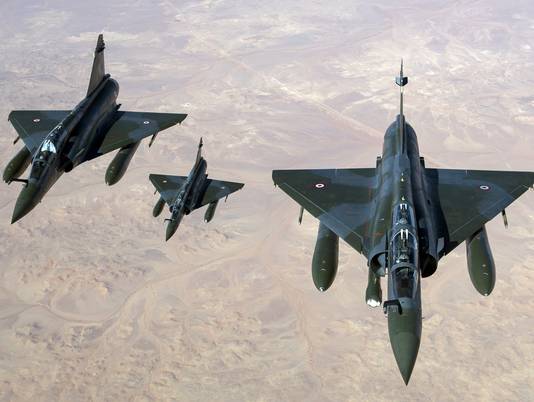
For now a basic sketch of NATO's unfolding offensive must suffice, beginning in central Mali and expanding outward. At least 550 French air and ground troops have reportedly deployed inside the country as air strikes continue for the third day. A significant portion of these troops landed at the airport in Sevare, the predicted target of Islamist militants that had recently staged attacks on the nearby towns of Konna and Mopti. Malian forces regained Konna with the help of French Mirage and Rafale jets, working in conjunction with assault helicopters, but they would have needed French air-combat controllers in the ground. The war-zone around Sevare was quickly ringed by checkpoints and French ground forces have been deployed from Sevare's airport to Konna and Mopti.
Western sources are already "reporting" the unconfirmed death of Ansar Dine commander Iyad Ag Ghaly, a veteran Tuareg jihadist, but his loss is unlikely to imperil the group.
Using the Inner Niger as NATO and ECOWAS's forward operating position into northern Mali, French warplanes and helicopters have launched an air campaign to shock the Islamists across their territory. Mirages reportedly destroyed a government base that had been taken over in Lere, located on the delta's west side, while a series of strikes targeted bases in Timbuktu and Gao. The latter now serves as the headquarters of the Movement For Oneness and Jihad in West Africa (MUJAO). Air strikes are set to increase in the immediate future before tapering down in reaction to the Islamists' movements.
"Hundreds" of French troops have also been deployed to Bamako to "assess the capital," secure diplomatic personnel and aide French nationals.
Given the fast-moving uncertainty, these factors are worth monitoring in the run-up to Africa's next asymmetric land war.
Shifting Objectives
One set of determining factors is the multiple objectives offered by French officials as they attempt to convince their own voters of Mali's just cause. On Saturday President François Hollande announced that current operations in Mali are "limited to preparing for the deployment of an African intervention force." The Defense Ministry subsequently declared that Paris's goal "is to lead a relentless struggle against terrorist groups," including the prevention of "any new offensive of these groups to the south of Mali." These objectives ultimately intercept: France must provide the force to block the militants' offensive actions and defend the border between north and south until African reinforcements arrive. 2,000 of the planned 3,200 ECOWAS troops are expected to land by Monday - 500 each from Burkina Faso, Niger, Nigeria and Senegal - and NATO air operations will continue throughout their deployment.
How these strikes are interpreted by the local population - as the Islamists full responsibility or hostility towards the south and international community - has been decided for the immediate future. Residents have reportedly welcomed French flags in the sky and expect African ground forces to follow, sentiments that must be nurtured in order for NATO and ECOWAS's mission to succeed. NATO is currently operating without the support of a legitimate government or military.
A U.S. official also confirmed that Washington will deploy drones for surveillance purposes (easily armed at a moment's notice), and Britain has dispatched two C17 aircrafts to transport allied troops. Both powers prefer that France "take the lead" in what could be a long, messy war in Mali.
Underestimating Guerrillas' Capabilities
The joint NATO-ECOWAS force is rightfully viewed as vastly superior to the Islamist umbrella currently entrenching itself in northern Mali. However Western and African capitals should be wary of falling into a quintessential guerrilla trap: underestimating the opponent. Many negative things have been said of the Islamists' relative strength, how they only defeated a rag-tag Malian army, and how professionally trained armies will overpower them. This pattern represents the nature of insurgency; asymmetric forces are inherently weaker than conventional forces, and usually stronger in comparison to weak governments. Some insurgencies, such as Hezbollah and the Taliban, are more disciplined than others, which must evolve their capabilities or risk elimination from the actions of stronger governments.
A weaker insurgency is known to become stronger through the only school of war that is often available: direct combat. This phenomena was noted in U.S. observations of Iraq's insurgency and appears to be occurring in Mali.
After a great deal of talk concerning their weakness, French officials are either flattering Mali's militants or genuinely surprised by their abilities - which would be an inexcusable error and ominous sign of future events. How the Islamists fight NATO and ECOWAS soldiers on land remains to be seen, but the militants are putting their air defense weapons to immediate use. Western intelligence suspects that al-Qaeda in the Islamic Maghreb (AQIM) smuggled out a cache of Libya's surface-to-air missiles, potential fear-mongering that doubles as a real possibility. Heavy machine guns have also been mounted onto the Islamists' pickups.
"What has struck us markedly is how modern their equipment is and their ability to use it," said one of Hollande's aide, but another French official said that Paris expects a short campaign before ECOWAS takes over.
This reaction may come true - or suggests that NATO still has much to learn about the Islamists' overall forces and the non-military environment in Mali. Three different networks, operating with semi-independent agendas, have spent the last six months recruiting across Africa, the Middle East and South Asia in preparation for NATO's intervention.
Overselling Guerrillas' Capabilities
Taken together with this potential underestimate, politically overestimating the situation in Mali could generate more unexpected consequences in a country divided by its own government. French officials speak as though the capital was facing imminent danger, an assessment that The Trench disagrees with considering that thousands of well-trained militants would be needed to effectively sweep across the south. Building on Hollande's mixture of humanitarian and nationalist rhetoric, Foreign Minister Laurent Fabius boasted that, "The Islamist offensive has been stopped. Blocking the terrorists... we've done it."
The Islamists had launched an offensive into the central delta but no one knows how far - they could stopped at Mopti. Yet French intelligence services claim they "detected preparations for what they described as a 'major offensive' organized and coordinated by al-Qaida in the Islamic Maghreb."
Jean-Yves Le Drian, France's Defense Minister, unequivocally announced on Sunday, “There was a spectacular acceleration of these [jihadi] groups since Thursday. If no one intervened, Bamako would have fallen two or three days later. France is at war against terrorism.”
Instability and other uncertainties normally accompany the hype of war against terrorism.
Political Resolution Is Mali's Only Exit
Lastly, the concrete deployment of NATO forces will push a negotiated settlement even further away from reality. African capitals have invested months into pulling Ansar Dine away from AQIM and MUJAO, hoping at the least to sow division between networks. Now this possibility goes from implausible to impossible. Accordingly, NATO and ECOWAS must commit an even greater amount of time and energy to organizing a political-economic resolution with the north's diverse ethnic groups.
None of these challenges begin to address the present lack of government in Bamako.
December 15, 2012
AFRICOM's Coverage of AQIM Mixes Fact, Fiction
Last week The Trench reported on the political and military movements of Mokhtar Belmokhtar, a former leader of al-Qaeda in the Islamic Maghreb (AQIM) and present commander of El Moulethemine katibat ("Brigade of the Veiled Ones"). A significant portion of this information was retrieved from Magharebia, a Pentagon-run site dedicated to covering events in North Africa, and independent information confirms the overall agenda of Belmokhtar. Now Magharebia has reported on a video statement from Belmokhtar announcing the "Signers in Blood," a suicide squad presumably designed to greet an international military coalition in northern Mali.
However the headlines of "breaking away from AQIM" appear to deliberately mislead an overview of the situation.
That Belmokhar has experienced a heavy share of confrontation with AQIM chief Abu Musab Abdel Wadoud (Abdelmalek Droukdel) is well-documented. Various explanations of AQIM's internal strife have been advanced over recent years: divisions between Algerian and Mauritanian leadership, personal rivalries, and the distribution of Western ransoms and drug profits. Leadership schisms are a natural product of regionally-networked militant groups, as the need to decentralize across borders and cultures often erodes a firm hierarchy. Those groups that enjoy permanence at the top usually function as symbols of national power: the Taliban's Mullah Omar or Hezbollah's Hassan Nasrallah.
At the same time, a foreign intervention of northern Mali stands a good chance of closing the Islamists' ranks, at least until the momentum swings against them and the alliance is forced to scatter across northern Mali.
Belmokhtar's recent announcements illustrate the dilemma facing Western and African capitals. While "One Eye" cannot be expected to obey every command of AQIM, he has pledged to abide by the decisions made collectively by AQIM, the local Ansar Dine outfit and the regionally-minded Movement for Oneness and Jihad in West Africa (MUJAO). His group will allegedly specialize in kidnapping Westerns and extorting ransoms to fund the Islamic alliance, thereby dividing their labors. Belmokhtar has relocated his base to Gao, where MUJAO has established its headquarters and oversees the Islamists' campaign in northern Mali.
Reinforcing the line of communication between groups is MUJAO's military planner and Bekmokhtar's deputy, local Tuareg Omar Ould Hamaha.
Abdalahi Ould Ahmed, editor-in-chief of the daily newspaper Chouhoud, gives a more comprehensive explanation for AQIM's proliferating offshoots: "As the organization has grown and incorporated fighters of different origins, conflicts of interests have become increasingly frequent.” This process carries its advantages and disadvantages. Given an increase in funds and territory, turf battles become inevitable in the war for jihadist hearts and minds. Purely commercial elements flock to West Africa's flow of cash and cocaine, undermining the Islamists' overall message and corrupting personalities from the lowest to highest ranks.
Militant groups must also network and decentralize to some degree in order to survive the short-term precision and long-term pressure of joint-government operations. In AQIM's particular case, the group is undergoing rapid expansion after northern Mali opened a huge amount of territory and influence to its sub-commanders. This fragmentation allowed AQIM personalities to establish their own local units under the mothership's flag, pursue their own interests and quickly seize all available power in the region. Accordingly, a group of Barabiche tribesmen from Timbuktu have formed a "new" faction at the urging of AQIM's leadership, with the intention of developing relations with Libya's self-styled Ansar al-Sharia.
The fourth manifestation flying the "Partisans of Islamic Law" banner (after Tunisia, Libya and Yemen), Ansar al-Sharia will now operate out of Gao as they attempt to build a logistics network through neighboring Niger. Their alleged objective: establish a base in eastern Libya to facilitate attacks on Western and African targets in response to Mali's planned intervention.
"Their aim is to establish a foothold in Libya from which to launch attacks against Western targets, as well as gaining access to the large stockpiles of weapons – including Russian-made anti-aircraft missiles – that were looted by Libyan rebels during the fall of Colonel Moamer Kadhafi's regime at the end of last year," The Telegraph reported on December 4th. "In return, AQIM is offering to provide Libyan Islamist groups with training and finance."
As Mauritania's al-Akhbar notes, Gao's branch of Ansar al-Sharia raises the number of Islamic militant groups in Mali to five: AQIM, MUJAO, Ansar Dine, Belmokhtar's "Masked Brigade" and Ansar al-Sharia. Pentagon intelligence and independent reporting has also collaborated the presence of Nigeria's Boko Harem in Gao. All of these groups operate as loose fronts for "the Base", waving the flag to attract recruits and acting semi or totally independent. The efficiency and inefficiency of this cooperation generates the double-edged sword of netwar.
So long as AQIM, Ansar Dine and MUJAO collectively wield influence in northern Mali, its splinter factions shouldn't cause an excessive amount of friction between the alliance. Scattering will become its own strategy if they are initially overrun, and division won't pose a fatal problem if Mali's internal woes and regional deficiencies in governance are left unresolved.
December 3, 2012
Belmokhtar Splinters From AQIM, Eyes Sahara
One of the latest development's in the fast-paced Sahel holds the potential to alter both sides of Mali's crisis.
Several days ago Mokhtar Belmokhtar, a former commander for al-Qaeda in the Islamic Maghreb (AQIM), emerged to warn the international community of "the impossibility of controlling the limits and results of a war in the region." His statements were clipped from a recent interview in Gao, where the Movement for Oneness and Jihad in West Africa (MUJAO) now commands its operations in northern Mali, and dovetail with AQIM and Ansar Dine's overarching narrative in the country (to be addressed in a future post). Essentially, the Islamic alliance that swept across northern Mali is feigning ignorance by entertaining the possibility of a negotiated settlement, and thus positioning itself as the defender rather than the aggressor. They know that an Islamic state leaves no room for compromise with Western capitals and their African allies, and they're playing with house money in Mali.
“We will help and support them - be it at war or during times of peace," Belmokhtar concluded.
Of course the veteran jihadist, a former leader in AQIM, has his own causes to support. Dubbed "Al-A'war" ("the one-eyed") and "the Uncatchable," Belmokhtar is obviously angling himself back into the picture by offering his "unconditional" help - surely with strings attached. He was reported dead during the fog of Gao's battle between MUJAO, Ansar Dine and the oppositional National Movement for the Liberation of Azawad (MNLA), only to emerge in another dispute with AQIM's leadership. After allegedly refusing to step down as commander of the offshoot Al-Mulathameen ("Masked Men Brigade"), Belmokhtar is now pledging to "respect any decision" made by MUJAO, Ansar Dine and the local Tuareg tribes they hope to woo in Mali. He said that his group, “will reveal more details and show his group’s clear position on the war and the methods that they will adopt to repel aggression.”
To this end, Belmokhtar's deputy has confirmed the regional agenda of his network.
“It’s true,” Oumar Ould Hamaha told reporters from northern Mali. “It’s so that we can better operate in the field that we have left this group which is tied to the ‘Maghreb’ appellation. We want to enlarge our zone of operation throughout the entire Sahara, going from Niger through to Chad and Burkina Faso.”
Hamaha is the ideal mediator between AQIM and northern Mali's environment. A native of the Timbuktu region, Hamaha has been involved with Belmokhtar since AQIM's formation in the early 2000s, and now serves as a spokesman for Ansar Dine and MUJAO. He claims that Belmokhtar and himself have technically left AQIM while remaining under the group's regional strategy. Their semi-independence mimics the activity of other AQIM offshoots, such as Mohammed Ghadir's ("Abdelhamid Abou Zeid") Tareq ibn Ziyad batallion, and further diversifies a nebulous collection of militant groups assembling in and around Mali. MUJAO has purportedly split from AQIM for the same reason offered by Hamaha: more independence in expanding regional operations.
Many groups are mobilizing under AQIM's loose control, using the umbrella's affiliation to boost their own profile as they pursue various objectives across West Africa. How these splinters cooperate in Mali will determine the effectiveness of their political cohesion and military defense against an international task force.
November 28, 2012
Islamic Network Outpacing International Blocs In North Mali
Mobility is the essence of guerrilla warfare for all sides of an asymmetric conflict. Those actors that move fastest - on the military and non-military battlefields - emerge on top of their foe. The general objective for a smaller force is to outmaneuver, disperse, confuse and sever a larger force, which has resulted in the advanced technologies designed to track insurgents and terrorists. This arms race cannot be extinguished as long as conventional and unconventional forces enter the same spheres of influences, and each side enjoys advantages over the other.
In the case of northern Mali's Islamic trio, who have no use for international legalities, foreign powers are gasping to catch up as they dodge obstacle after political obstacle.
Last week the Movement for Unity and Jihad in West Africa (MUJAO), with assistance from al-Qaeda in the Islamic Maghreb (AQIM), claimed victory over the National Movement for the Liberation of Azawad (MNLA), in the northeastern border-town of Malaka. The assault was staged as part of a wider campaign to drive the MNLA out of every position MUJAO and AQIM can locate, before the MNLA can assist the international force that is scheduled to arrive sometime next year. The MNLA has yet to concede defeat, instead countering that it killed many MUJAO fighters, because the loss of Menaka is a substantial blow.
This same process has now repeated in Lere, situated on the opposite side of northern Mali, after MUJAO and Ansar Dine encircled the camp for a week. MNLA spokesman Mohamed Ag Attaye admitted that the group's fighters had finally retreated to a base north of the town, similar to the MNLA's withdrawal from Menaka. Where the MNLA's parts will head next is uncertain; they will likely be forced north until they can regroup and stage an effective attack on the Islamists. Reports of their reinforcements have become semi-regular occurrences, as AQIM and MUJAO are drawing from Africa's regional jihadist network to secure northern Mali's population belt.
Holding Menaka and Lere also grants the Islamists control of northern Mali's entry points, in addition to Mali's section of the Niger River. This environment can be used for all sorts of guerrilla operations, from smuggling recruits to moving equipment to staging ambushes, and opens the possibly of river warfare.
Equally important is Ansar Dine's participation in Lere's siege. The group has entered into preliminary negotiations with the MNLA, arranged by Burkina Faso's President Blaise Compaoré on behalf of the United Nations and African Union, and even promised rid Mali of drug-trafficking, kidnapping "foreigners." However this outreach appeared hollow from the beginning, a basic guerrilla tactic to stall for time and influence Mali's overall narrative. To the point, AQIM commander Abu Mosaab Abdulwadood just released a videotape appealing to Malians and warning against intervention: "It can be solved internally, through reconciliation between Muslims, without having to shed a single drop of blood."
It's difficult to foresee any advance in negotiations after the simultaneous attacks on MNLA positions, meaning an international force likely to meet a three-headed hydra when it lands.
Western capitals are fortunate to enjoy relations with multiple political blocs in Africa. One wouldn't be totally wrong to speculate that the developing crisis in the Democratic Republic of Congo is beginning to suck oxygen from Mali's response time. The pace of Mali's international plans is already running sluggishly due to the country's internal disputes, and the external shortfalls created by Libya's intervention and Syria's contingency planning. Now the DRC is further splitting the UN and AU's attention. The resulting irony has limited America and Europe's capacity to act in the immediacy, contrary to their long-term political and military plans for North Africa. Washington in particular intends to build "training" relationships with governments in the Sahel, complete with support bases, but the scale of Mali's crisis exceeded U.S. expectations.
As the situations stand, Western capitals have tasked a member the Intergovernmental Authority on Development (IGAD) and the International Conference for the Great Lakes Region (ICGLR) to mediate between the DRC and M23. That leaves the Economic Community of West African States (ECOWAS) to remain focused on northern Mali, but doesn't necessary alleviate the brain-drain on Western capitals or AU, which must respond to both crises. Meanwhile the Islamist network in northern Mali continues to freely expand and entrench, and victory is the best recruiting tool available to a foreign force. The locally-minded MNLA has fallen to Mali's losing side, overwhelmed by the same momentum that attracts fighters from across Africa and the Middle East.
These moves further increases the pressure on the UN, AU, ECOWAS and NATO to rush an already risky intervention.
November 16, 2012
Negotiating Mashup In Northern Mali

Seven months ago the rebel group Ansar Dine, an Islamist-Tuareg outfit, rode its way across northern Mali with the assistance of the National Movement for the Liberation of Azawad (MNLA).
As the initial dust settled, observers began to credit part of the MNLA's military advances to Ansar Dine and the groups' ability to impose order/recruit. The two groups appeared to co-exist out of self-interest rather than mutual interests, telegraphing Ansar Dine's future mobilization and its division with the MNLA. Neither could find a compromise between their ultimate goal of a Taureg state or an Islamic state. After announcing a temporary pact in late May, Ansar Dine's partnership with al-Qaeda in the Islamic Magreb (AQIM) and Movement for Unity and Jihad in West Africa (MUJAO) evicted the MNLA from its Gao headquarters in July.
Mimicking the shifting sands of north Africa's dunes, northern Mali's politico-military equation has since swung back in the direction of MNLA-Ansar Dine negotiations. On Friday Burkina Faso's President, Blaise Compaore, welcomed a joint-delegation sent by the two groups.
"All the international instruments have been put in place (to deal
with this crisis)," Tieman Coulibaly, Mali's Minister of Foreign Affairs,
told reporters earlier this month. "And we are now weighing
the options - either negotiations or military intervention in order to
liberate northern Mali."
Entering into negotiations with the MNLA has been easy enough for African and Western capitals. Displaced by another Tuareg group and its foreign allies, the MNLA has little to lose by cutting a deal with the international community, which was never prepared to accept an independent Azawad. The group has yet to reverse its push for autonomy, but in most other ways is prepared to assist Mali's government in the overthrow of AQIM and MUJAO. This strategy is designed to recoup lost territory and sidestep any military operation conducted by the Economic Community of West African States (ECOWAS).
Fresh information suggest that the MNLA suffered another defeat on Friday night after trying to retake Gao.
The plan to lure Ansar Dine away from AQIM and MUJAO began as early as June, and is proceeding as one would expect of such negotiations. Throughout this period Ansar Dine and its allies have solidified their military positions and carried out strict Islamic punishments, suggesting that Ansar Dine is only toying with foreign mediators. The group has also made contact with Algerian diplomats, whose government seeks to avoid a large-scale intervention that would effect its borders. Thus Ansar Dine's actions could intend to delay a foreign intervention rather than cooperate with foreign powers.
For now spokesman Mohammad Ag Aharib claims that Ansar Dine is prepared to "get rid of terrorism, drug trafficking and foreign groups," telling the AFP that "we don’t agree with taking hostages and drug trafficking." These operations are believed to provide the bulk of AQIM and MUJAO's financing. Problematically, Ag Aharib rejects the possibility of renouncing Shariah law, saying "we insist that it be applied where we live." Ansar Dine's terms indicate that no compromise is available with foreign powers, and that each is feeling the other's capabilities before hostilities begin. How much control Ansar Dine can apply over northern Mali also remains uncertain. Considering its offer to expel "foreigners," meaning AQIM and MUJAO, the group may retain possession over less ground than its initial conquest.
If the group isn't feigning interest with the international community, Ansar Dine must hope to regain any national influence lost to AQIM and MUJAO's international agendas.
The dual track of negotiations and military action accompanies most wars, conventional or unconventional. Speaking to Mali's interim President, Diocounda Traore, on Thursday, French President Francois Hollande told his counterpart (and by extension ECOWAS), "The acceleration of this dialogue must accompany the progress in African military-planning efforts." Negotiating is generally superior to fighting during counterinsurgency, as it addresses non-military sources of friction, and foreign powers seek to fight as limited of an enemy as possible. For months the U.S. and NATO allies have hesitated to commit themselves militarily in northern Mali, realizing that Mali's interim government and a full network of militant groups equates to an unreasonably dangerous mission.
However Western forces are itching for some form of military engagement against AQIM and MUJAO, ruling out a non-violent resolution. Washington in particular doesn't want to miss this opportunity to strike directly at AQIM, and NATO as a whole views Mali as a profitable training ground. U.S. and French Special Forces operated in the country prior to March's coup as part of the Sahel's overall militarization; a large part of Mali's new mission is built around a Western-African training program. The Trench also speculates that a new drone base may find a home somewhere in the Sahel, given the long-term nature of Mali's mission and AQIM's lifespan.
These designs play a motivating role in General Carter Ham's statements from Paris, which linked the attack on the U.S. Embassy in Benghazi to AQIM. The outgoing commander of AFRICOM cautioned that the attack was not necessarily "an AQIM-planned or organized or led activity," but the direction of his message is clear enough. Former CIA Director David Petraeus gave a similar account on Friday to the House and Senate Intelligence Committees (not without its own controversy). Problematically, a military victory in northern Mali simply returns North Africa's environment to a pre-coup state, rather than permanently eliminate AQIM's presence.
Left in the militants’ vacuum: loose insurgents of all types, unresolved national grievances with a weak government, and the residue of Western imperialism.
July 30, 2012
Long "Weeks" Ahead In Northern Mali
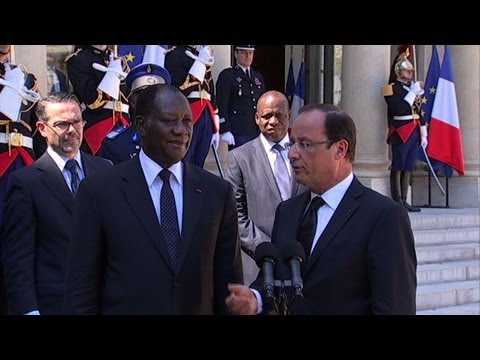
After staving off an intervention in his own country, with special thanks to previously deployed UN peacekeepers, Alassane Ouattara appears to have accelerated the Economic Community of West African States's campaign into northern Mali. Visiting Paris to discuss bilateral policies with President Francois Hollande, Côte d'Ivoire's newest President and current chairman of ECOWAS would lay political and military cables over the weekend before taking his plans public.
“If the situation doesn’t evolve favorably and rapidly, yes, there will be a military intervention in Mali,” he said in response to Le Journal du Dimanche's first question. “It seems inevitable.”
Besides the mounting anxiety in African and Western capitals, few conditions have changed since the United Nations ordered ECOWAS to clarify its initial request of force earlier this month. Ouattara begins by announcing the commonly-stated 3,300 troop level set by the bloc's Joint Chiefs of Staff, then partially elaborates that the force will be half Malian. Niger and Nigeria are expected to provide the majority of combat troops, and they in turn expect logistical and air support from Washington, Paris, London and possibly Madrid. Special Forces from the first three countries already operate inside and around Mali, but their numbers are expected to increase as demand for "counselors" rises.
Sticking to the U.S. script that seeks to eliminate "ground troops" from public perception, Ouattara said that he is "not considering the presence of ground troops who are not African."
With Hollande taking command of the UN Security Council on Wednesday, the diplomatic stars have aligned to green-light a pivotal intervention in northern Mali. Ouattara thinks that "we can talk in weeks, not in months," however his interview may produce a leap of inches rather than miles. First and foremost, 3,300 troops (including police and gendarmes) and a sizable contingent of Western military power cannot restore stability by themselves, and will require reinforcements in the near future. Many political considerations also remain unresolved, starting with the interim state of Mali's government; President Dioncounda Traore has finally returned from medical leave to announce a political overhaul, but a "government of national unity" is unlikely to be formed by the two week deadline that "regional mediators have requested." ECOWAS and the UN cannot launch an operation without a national government that is capable of restoring authority.
Even then, northern Malians may reject the legitimacy of any government formed without their input.
Traore also plans to establish a formal committee in a renewed effort to negotiate with "the armed groups in the north of Mali," a wise but complicated course of action. While some observers doubt that National Movement for the Liberation of Azawad (MNLA) will cooperate with African and Western capitals, failing to exhaust all means of negotiations would be equally rash. The group needs no coercion to move against the Islamic matrix that is al-Qaeda in the Islamic Maghreb (AQIM), Ansar Dine and the Movement For Oneness and Jihad in West Africa (MUJAO), and also provides the only oppositional channel to the Tuaregs. Problematically, the MNLA's secessionist agenda is treated on par with international jihad, and foreign powers are unlikely to reach a mutual agreement with the group. That void will force the international community to confront each power individually and collectively, as Ansar Dine and MUJAO have no intention of negotiating their vision of an Islamic state.
African and Western capitals have yet to reach a public consensus on the negotiating front, and the private situation may not be any different.
These factors necessarily undermine the completeness of ECOWAS's military proposal. While some political and military dominoes are being arranged with relative ease, other lie in a disheveled pile and expose large gaps in the overall strategy. Months are still needed to attempt a final sorting of northern Mali's puzzle, otherwise ECOWAS and the UN will increase the risk of entering a political quagmire in a territory that is nearly the size of France.
July 27, 2012
Thickening Fog of War Over Northern Mali
Despite a combination of factors that are working to generate al-Qaeda's largest sanctuary in its history, northern Mali remains a back-page story in most American media circles. The discrepancy is both easy and difficult to explain since U.S. military officials warn that al-Qaeda in the Islamic Maghreb (AQIM) and its allies, Ansar Dine and the Movement For Oneness and Jihad in West Africa (MUJAO), intend to strike American targets like the rest of al-Qaeda's branches. Except northern Mali has yet to receive the same official reaction bestowed on Pakistan, Somalia or Yemen, where U.S. counterterrorism operations accelerated from 15 to 100 MPH over the last 30 months. The Obama administration has chosen to respond to Mali with inactive silence, punctuated by dire but brief alarms of another terrorist haven.
This observation isn't made in demand a more public and weightier U.S. response to northern Mali. However the gap between Washington's reaction to northern Mali and al-Qaeda's other established sanctuaries is growing as fast as foreign fighters can enter the country.
This observation isn't made in demand a more public and weightier U.S. response to northern Mali. However the gap between Washington's reaction to northern Mali and al-Qaeda's other established sanctuaries is growing as fast as foreign fighters can enter the country.
Washington's quiet is partially explainable and understandable - events in northern Mali simply present an unfavorable situation for Western and African capitals alike. What's left of the national government remains in turmoil after a military coup threw the country into total disarray in late March. By then the Tuareg-dominated National Movement for the Liberation of Azawad (MNLA) and Ansar Dine had already seized most of the north, and Timbuktu would fall soon after the coup struck Bamako. Having missed one deadline to hold elections, the interim government is still struggling to survive multiple shakeups and might not be reestablished before 2013.
Failing to restore a legitimate government before launching a military campaign to retake the north, whether national or foreign-led, is risking disaster.
Other political considerations are sinking beneath the reality on the ground. Stated as a fact, many analysts point out that the final months of a presidential campaign offer a terrible window to jump into another asymmetric war. One could argue that domestic support is necessary to sustain any military campaign, but the Obama administration is equally unlikely to enjoy this support after a November victory. That leaves northern Malians and their neighbors at the whim of American (and European) politics. With President Barack Obama constantly promoting the demise of al-Qaeda, bringing up Mali and the "lighter style" of warfare that failed to contain its descent (Special Forces are imbedded in and around the country) doesn't make for smart campaigning either.
These factors are both ethically inexcusable and detrimental to organizing an efficient politico-military response.
Militarily speaking, U.S. air forces are already stretched thin across the region and Syria's potential is sapping most of Washington's contingency focus. Although the Pentagon and CIA are visibly expanding their networks in north Africa, it's not unreasonable to conclude that Mali's mission is "too big" for Washington's comfort. The Sahel's genie essentially escaped and the coverup will consume more resources than anticipated: a larger conflict impedes the "lighter," cheaper strategy of pairing Special Forces with African militaries, creating potential friction between governments and local populations.
Islamic militants have redirected into northern Mali for a variety of reasons, but they collectively realize that they outmaneuvered the West's presence in the Gulf.
Islamic militants have redirected into northern Mali for a variety of reasons, but they collectively realize that they outmaneuvered the West's presence in the Gulf.
Furthermore, bringing a U.S.-backed war to Mali could create a new quagmire in the heart of north Africa. The internal situations in the south and north are both incredibly complex, and the West would be walking nearly blind into the Tuareg's historic liberation movement. Many ethnic minorities are trapped in between and Mali's tribal politics are likely to be overlooked. On the militant side, it would be a mistake to believe that AQIM, Ansar Dine and MUJAO hope the West invades their newly christened Islamic state, as these groups would welcome an uninterrupted opportunity to grow roots. They know they would be initially routed from their urban strongpoints. At the same time, those in de facto control of northern Mali are vocally prepared to battle Americans and Europeans to the death, and they will retain many advantages in the north's vast expanse.
On a strategic level, Washington seems to be primarily interested in developing the military experience of the Economic Community of West African States (ECOWAS). This arrangement explains the West's hesitation and promotes internal solutions to African problems, while allowing Western capitals to exert their own military influence behind ECOWAS and the African Union's (AU) shields. Thus the likeliest possibility will send an ECOWAS force (presumably above the 3,000 awaiting deployment) to fight a ground war under Western air power, in order to defer costs and deter the impression of another American intervention in Africa.
Nevertheless, developments in northern Mali continue to evolve under ambiguous circumstances.
Enter General Carter Ham, commander of AFRICOM and vocal advocate of the Pentagon's "small footprints." For months the general has watched Islamic militants infiltrate the heart of his AO, only capable of mustering threats as he connects AQIM's dots with Nigeria's Boko Haram, Somalia's al-Shabaab and Yemen's al-Qaeda in the Arabian Peninsula (AQAP). Now he warns that the international community "missed an opportunity to deal with AQIM when they were weak," allowing the group to become "al-Qaeda's best funded, wealthiest affiliate.”
Unfortunately Ham's latest testimony adds more uncertainty to Mali's power equation. No other branch's origins and funding, not even AQAP, is so vigorously doubted as AQIM's, which is suspected of doubling as an Algerian proxy against the Tuaregs and other ethnic groups. While the infiltration of Algeria's Département du Renseignement et de la Sécurité (DRS) is likely exaggerated, the narrative is prevalent enough to warrant serious concerns over U.S.-Algerian relations. Both stand accused of using AQIM's threat to expand their security profile in north Africa at the cost of Algeria's democratic growth, as demonstrated by Washington's non-reaction to limited protests.
Dismantling AQIM's network is impossible without addressing the shadows hanging over Algiers and Washington.
Dismantling AQIM's network is impossible without addressing the shadows hanging over Algiers and Washington.
As the situation stands, General Ham admits that the dynamic between Mali's Islamist groups is "complex," and that "it was not clear if they were aligned on an ideological or a purely opportunistic basis." He claims that AQIM and its allies are determined to strike American targets, even though The Wall Street Journal reports, "U.S. counterterrorism officials said that for now, AQIM militants in Mali appear focused on local and regional issues, rather than on using the haven to plot attacks against the U.S." Elsewhere, anonymous "Western security officials" argue that Ansar Dine and MUJAO are operating as a front for AQIM, ultimately contaminating the Tuareg elements within Ansar Dine.
“They organize everything," one official is quoted as saying. "Food, military training, intelligence, ideological training. Let us not be mistaken, the hundreds of youths being recruited in the name of MUJAO or Ansar Dine are really AQIM fighters."
MUJAO allegedly broke away from AQIM due to its suspicions of Algerian influence.
Regardless of the veracity of these intertwining accounts, Western capitals have overextended their credibility in north Africa and cannot be trusted at face value. With military ambitions rising in the absence of a greater situational awareness, Mali's fog of war will continue to thicken as each actor pursues their own agenda.
July 21, 2012
MUJAO Expands Network In Northern Mali
Yesterday Adnan Abu Elwalid Sahraoui, a member of the Movement for Unity and Jihad in West Africa (MUJAO), announced that his group had freed three hostages in exchange for a reported $18.4 million and two imprisoned MUJAO members. The payoff culminates a 10-month test of endurance for two Spaniards and one Italian, captured from one of Algeria's Sahrawi refugee camps, and sowed new anxieties in African and Western capitals in the process. Repeated success has emboldened MUJAO to continue expanding its kidnapping operations across the Sahel region. According to Sahraoui, “We will take them as soon as they enter the territories of Mauritania, Mali, Algeria or Niger."
For now, MUJAO can use its new funds to amass weapons and supplies for incoming recruits in northern Mali.
If MUJAO's fortunes were traded in stock, the group's shares would have exploded between October 2011 and now. Less certain is the group's murky origins, which appear to be divided along two competing narratives: MUJAO emerged as a kidnapping outfit of al-Qaeda in the Islamic Maghreb (AQIM), or else broke off from AQIM after rejecting the influence of Algeria's government. In either case MUJAO has only needed a short span of months to deliver a rough jihadist paradise in Mali, a key step to establishing a haven in the wider Sahel. The group would belatedly pair with northern Mali's other Islamist network, Ansar Dine (Defenders of Faith), after the latter rode the National Movement for the Liberation of Azawad's (MNLA) military uprising and capitalized on Mali's March coup.
Once the government was displaced from Mali's vast northern territory, Ansar Dine and MUJAO then asserted their military and religious authority to supplant the MNLA's control of urban areas. Their rise to de facto power and open invitation to international jihadists has attracted hundreds of foreigners to Mali, triggering visions of Somalia circa 2006. Last month Nigerien President Mahamadou Issoufou claimed that Pakistani advisers had arrived to train recruits in Gao, the regional capital and garrison for both Islamic groups. The latest reports suggest that another foreign unit has just landed in Gao via neighboring Burkina Faso, possibly numbering in the 200s. The majority claim to possess citizenship from Senegal, the Ivory Coast and Niger, along with an average age of 16, and come for the two rewards of jihad - cash and promises of "the sun, moon and stars." A man by the name of Alioune, chief of Gao's Islamic police, added that the youths are separated onto two training camps "where they will undergo military and religious training."
He's "awaiting many more."
The prospect of youth soldiers won't yield the deterrence that MUJAO hopes to achieve against the international community, but they are symbolic of the group's efforts to effect a permanent takeover of northern Mali. Hundreds of trained fighters will do the immediate dirty work of policing territory and battling "invaders," keeping the youth recruits in reserve or training them for support missions. As time passes - an international intervention is unlikely to begin before 2013 - younger seeds will grow into more formidable fighters and augment the main force. They also form natural connectors to Africa's younger, technologically-savvy generations.
On a second strategic level, conflicting reports have yet to pin down estimates of MUJAO and Ansar Dine's populations; the percentage of national and foreign recruits cannot be underestimated from either direction. Although the international web spun by Pakistanis, Afghans, Jordanians, Somalis and Nigerians has triggered a large amount of regional and international concern, an African-led movement would produce a more sustainable threat to Western Africa. The friction between national and international jihadist agendas has generated tangible fallout in Afghanistan, Pakistan, Iraq and Somalia, weakening each network relative to its maximum potential. If MUJAO and Ansar Dine can load the majority of their ranks with Africans, they should be able to instill at least some sense of local community within their base. Non-African elements would then assist as needed, not as they desire.
Bilal Hicham, a Nigerien, styles himself as the first black leader of a "katiba" (fighting unit) and claims, "Here there are Malians, Somalis, Ivorians, Senegalese, Ghanaians, Gambians, Mauritanians, Algerians, Guineans, Nigeriens, all the Muslims are here."
"We are many Africans, come from all over to join the mujahideen in Gao," says one Ivorian recruit.
MUJAO is also thinking ahead, at least publicly, by reacting to Ansar Dine's strict punishments in Timbuktu tombs reprisals and its own actions in Gao. Residents report an easing of Sharia law in Gao after protesters demonstrating a ban on playing football and watching TV. Enforcing new laws and securing the people's consent presents a constantly shifting line for insurgents to walk, and MUJAO must continue its religious agenda or risk its internal credibility. At the same time, a change in behavior cannot be ruled out when MUJAO is putting so much thought into its expansion. At least some commanders should realize that a supportive population mounts a higher level of resistance to external threats.
The ongoing evolution of MUJAO injects another complicated dimension into a complex power equation.
While the majority of political questions seem to center around an alliance that never truly existed (MNLA-Ansar Dine), the relationship between Ansar Dine and MUJAO may be of greater consequence to Malians and the international community. The latest information suggests that MUJAO, which considers itself to be above the AQIM-affiliated Ansar Dine, is now calling the shots in northern Mali. Instead of confronting one well-armed and motivated force (the Tuareg-dominated MNLA), African and Western powers must now dispose of three entities that have fused into a loose guerrilla network.
Every last attempt to secure the MNLA's allegiance must made, but this possibility remains a longship despite extensive negotiations with African mediators; the group's liberation agenda is viewed as an equal threat to African stability. Worse still, Ansar Dine and MUJAO indicate no willingness to compromise their core objective of an Islamic state, instead ridiculing the UN's threat to punish the desecrators of Timbuktu tombs. And they could mount the most ferocious resistance if "invaders" do try to restore government rule in northern Mali.
"Yes, we have placed military devices which are defending the town [Gao] against attacks," warns spokesman Abou Walid Sahraoui." Our enemy is also all the countries who will send fighters here."
Subscribe to:
Posts (Atom)