Showing posts with label Pakistan. Show all posts

February 23, 2013

Ongoing Mystery of Afghanistan's Post-2014 Force

When Hamid Karzai visited the White House in early January to discuss all things Afghanistan, a peculiar piece of disinformation awaited him at the doors of America's capital. Karzai had arrived to sort out the details of many issues, from prisoner treatment to NATO training and air strikes, but most Americans only concern themselves with one topic in Afghanistan: when all U.S. soldiers are coming home for good. Thus the White House exploited this singular concern and deployed its communications director to leak the unrealistic possibility of a "zero option" during Karzai's visit.

Barring a veto from Afghanistan's parliament or Karzai himself (or his potential replacement after 2014's election), the only zero in this plan is the zero possibility of implementation.

That the Obama administration desires a post-2014 military presence (U.S. Defense Secretary Leon Panetta uses the phrase "enduring presence") in Afghanistan is no secret. Having watched Iraq regress into political deadlock and asymmetric warfare following the withdrawal of U.S. combat forces, the White House and Pentagon presumably realize that the scope of Afghanistan's challenges exceed its sister war and will not bow easily. They will push Karzai or his replacement to the limit of their political influence. Assuming they comply, the only certainty of a post-2014 force is a number higher than zero.

The mystery over President Barack Obama's final decision is fueling a repetitive cycle of media speculation, with no credible source venturing outside the 3,000-15,000 range. The latest estimate has emerged as NATO ministers meet in Brussels to discuss the war's options: between 8,000 and 12,000 NATO troops. This reasonable estimate was immediately struck down by the Pentagon as hearsay, suggesting that a force of similar proportions may be anticipated. Given the possibility of covert forces, though, the American and Afghan publics are unlikely to receive the full truth.

"First of all, that report is not correct..." Panetta told a press conference on Friday. "I don't want to go into particular numbers, because, frankly, we want - we want to be able to have the flexibility to look at a range of options that we ought to have for our enduring presence. But I want to make very clear that the range of options we were discussing was with regards to the NATO force."

Pentagon spokesman George Little added, "A range of 8,000 to 12,000 troops was discussed as the possible size of the overall NATO mission, not the U.S. contribution."

A "range of options," amongst other advantages on the battlefield, helps keep the Pentagon in control of policy rather than locked into a set exit. The DOD has privately and publicly resisted the White House's troop caps and deadlines, and the loss of a residual force would erode the Pentagon's grip on Afghanistan (as in Iraq). Whatever the relationship with NATO, whose participation is mostly due to appearances and politicking, Washington is certain to provide more troops than any other country.

The size of this force also nullifies any potential agreement between the U.S. and the Taliban, at least in theory. Rumors from within the insurgency's leadership have claimed that the Taliban's shura may be willing to accept a U.S. presence after 2014, but American troops will only stay to kill Taliban and train Afghan forces to kill Taliban. This policy will be sold as "counter-terrorism operations" against al-Qaeda "and its affiliates," largely meaning the Taliban itself and the elusive Haqqani network that serves as one branch of the movement. U.S. commanders were unable to conduct a planned operation in eastern Afghanistan and resorted to drone operations as a patch - they have yet to give up completely on a ground operation.

For this reason, a more plausible scenario will operate along Mullah Omar's lines and not accept the presence one U.S. soldier after 2014. Ongoing hostilities could then break down a political deal between Kabul and Islamabad, prolonging the war indefinitely.

U.S. forces plan to stay until 2020 and possibly beyond.

Lacking air power from NATO, how long will the fight continue between ANA troops, their U.S. trainers and the Taliban? Washington seems to expect a shorter time-line, and all U.S. officials shy away from the slightest negativity in Afghanistan (but not before cautioning against hard times ahead). Panetta told reporters that "expectations" set at last year's Chicago meetings were "truly exceeded": "The ANSF are now in the lead for nearly 90 percent of combat operations. And they are on track to step into the lead for all of these operations by this spring."

"Afghanization" offers the only hope for Washington's controlled withdrawal and has been highlighted over all other aspects of U.S. policy. To what degree desertion takes hold after 2014, and how often U.S. forces need to reinforce their Afghan counterparts, remains to be seen.

The Obama administration intends to leave 52,500 troops in the country until November, hoping to inflict more damage on the Taliban ahead of a political resolution. The insurgency has already survived the full brunt of Obama's surge and will not be significantly impacted by another summer of losses; while the group's foot soldiers may see a time of rest ahead, they are equally unlikely to surrender at this time. One final season (the last 34,000 troops will begin to withdraw after February 2014) may follow to keep the Taliban off-balance ahead of December 2014.


Yet two summers of fighting will simply reinforce Afghanistan's stalemate and leave a bad taste in both parties' mouths. Abruptly shutting off the conflict after more bloodshed is impossible. Considering the war's present conditions and future outlook, the U.S. and its NATO allies are preparing a recipe for ongoing low-intensity conflict that will stretch far past 2014 - when Obama will be tempted to replicate his policy in Iraq and declare an false end to the conflict. This lack of attention is feared by Afghans across the country, as evidenced by a question from Tolo TV Afghanistan.

"Sir, most of the Afghans believe that the U.S. will abandon Afghanistan again when the combat mission finishes in Afghanistan.  What type of guarantee you can give them, sir?  Because on one hand, Taliban still pose a serious threat to the Afghan government, and the peace process is also not going well."

"I want to make clear," Panetta answers, "that the United States and ISAF, the NATO -- the NATO countries that are involved in the ISAF effort, all of us are committed to supporting Afghanistan, not just now, but in the future. And that commitment is unwavering."

How these words translate into confidence amongst Afghans and Americans alike is much less certain.

February 12, 2013

Afghan peace plan in trouble as Pakistani clerics balk at proposed meeting in Kabul

Why anyone would propose a six-month deadline to an Afghan-Pakistan-US-Taliban peace agreement makes little sense, given that such a deadline is doomed to fail:
A portion of a peace plan intended to smooth the way for an exit from Afghanistan of U.S.-led military forces already is in trouble, before it has even gotten underway.

At issue is a conference between Pakistani and Afghan religious leaders scheduled for next month in Kabul, the Afghan capital, that was intended to provide religious support for efforts to resolve the war in Afghanistan. But the Pakistani clerics are refusing to participate unless the Taliban are included, something that would be impossible in Afghanistan. The Pakistanis also said they were unwilling to participate in any conference if it could be seen as an endorsement of Afghan President Hamid Karzai.

An emergency meeting Monday in Islamabad between Pakistani and Afghan delegations seemed to make no progress.

“How come people can talk to the Taliban all over the world but not in Kabul?” asked Tahir Ashrafi, chairman of the Pakistan Ulema Council, a leading organization of Pakistani clerics, who was seen as a possible leader of the Pakistani side of the conference. “We support peace talks. But if we are to discuss peace, then how can you leave out one of the parties to the war?”

The proposed conference was announced last month at a meeting in Great Britain between Karzai and Pakistani President Asif Zardari, hosted by British Prime Minister David Cameron.

With virtually no chance that the Taliban will be defeated on the battlefield, a peace deal with the insurgents is considered the most hopeful way of avoiding Afghanistan sinking into chaos as the American-led coalition force leaves next year. Washington is eagerly supporting the peace process. 
Continue Reading

Read more here: http://www.mcclatchydc.com/2013/02/11/182700/afghan-peace-plan-in-trouble-as.html#storylink=cpy

February 4, 2013

Al-Qaeda Rises, Falls According To U.S. Politics

Last Sunday, The Washington Post published a not-so-fascinating map of al-Qaeda's diversification and decentralization from its previous headquarters in Pakistan and Afghanistan (although Osama bin Laden began jihad in response to U.S. troops on Saudi territory and Israel's occupation of Palestinian lands). The simplistic map is mis-weighted by an inaccurate assessment of al-Qaeda in the Arabian Peninsula (AQAP), whose prospects in Yemen remain on an upward "trend" despite losing territory. The insurgency is, at the least, treading sideways rather than permanently falling, and swapping AQAP would give three "green arrows" to al-Qaeda's core.

In any event, measuring the protracted nature of insurgency and terrorism in dualistic terms of "up" and "down" is the realm of mainstream media.

The Washington Post offers few pieces of information that would catch the attention of international observers, but one startling figure is the high estimate of al-Qaeda in Iraq: 2,500. The largest operational count on the map (if roughly accurate) not only occurs within a country that al-Qaeda entered after American soldiers - al-Qaeda has maintained a presence in a war that was supposed to be over. Today the network allegedly struck again when a suicide bomber infiltrated the Sahwa - "Sons of Iraq" - headquarters in Taji, presumably as retaliation for the so-called Sunni Awakening. An estimated 340 civilians were killed and many hundreds wounded in January alone and, with Baghdad paralyzed by a power struggle between Prime Minister Nouri al-Maliki and the Sunni opposition, Iraq's violence stands to persist and possibly intensify.

While al-Qaeda's ideology may be on set on a long-term "path to defeat," as the Obama administration and U.S. mainstream media continue to assert, an entire war has been declared over when it is far from it. This broken "promise" became the third leg of President Barack Obama's re-election campaign, illustrating how al-Qaeda's estimated strength varies in relation to the administration's political needs at a given time. Taking Syria into account adds a new dimension to this dilemma. Now the same war that is supposedly "over" is fueling a new war across the border and new fears in Washington, where concerns of al-Noura's influence have overshadowed other aspects of Syria's revolution.

The administration clearly wants these situations to cut both ways - Syria is new news, Iraq is old news. Highlighting accomplishments and concealing failures is standard practice.

Add al-Qaeda's operations Iraq and Syria to AQAP and, to a lesser extent AQIM's activities in North Africa, and al-Qaeda's momentum doesn't feel as weak as the Obama administration claims. This isn't to lobby in favor of escalation, but to advise against an endless campaign of militarizing Muslim states and the undermining of their peoples. In order to truly counter al-Qaeda's ideology over the long-term, U.S. foreign policy must invest in the political energy needed to compliment military operations and establish genuine relations with local populations.

Such a multidimensional policy remains sorely missing in Yemen, Iraq, Mali and Pakistan.

February 1, 2013

Taliban "Rift" Conceals Similar U.S. Divisions

As some parts of the Obama administration explore safe passage out of Afghanistan and Pakistan's harsh battlefields, other parts must remain on the offensive in their campaign against the Taliban network. This asymmetric task naturally extends beyond the military battlefield to global media, where the battle for Afghanistan is waged just as fiercely by the Taliban and NATO forces.

Both sides follow the rule of Propaganda 101: lead with truth and end in falsity.

Speaking to Jim Michaels, USA TODAY's military editor, on the topic of Mullah Omar's "code of conduct," Pentagon official David Sedney says that Omar's order to avoid civilian casualties has agitated the foot soldiers that rely on IEDs and suicide vests to attack U.S. and Afghan convoys. This order was first given in response to the Obama administration incoming surge, as part of its own PSYOPS for Afghan "hearts and minds," but the operational side of Omar's tactic didn't fit with the Taliban's style of fighting. Unarmored guerrillas need explosives to counter NATO armor and penetrate security countdowns, and the constant nature of IEDs inevitably outpaces the civilian casualties from U.S. air-strikes and raids. 

Sedney, a deputy assistant Secretary of Defense, paraphrased the thought process of an average Taliban gunman: "'You're telling us to keep fighting and we have no choice but to use those methods.'"

"That's creating a lot of tension."

The Pentagon is obviously motivated to announce its interpretation through the U.S. mainstream (and in a brief report with no alternative viewpoint). Faced with a disbelieving, war-weary public and the sobering reality that the Taliban isn't near capitulation, the Obama administration must pry inside the insurgency in order to generate negotiating leverage in 2013 and 2014. Effectively spreading division amongst the Taliban's long-term strategists could be a quick means of bringing pragmatic individuals into Kabul's political fold, or at least driving some foot soldiers into reconciliation programs.

"It's already clear that some parts of the Taliban are interested in a political solution," Sedney explains.

However the Taliban are likely to unite against any Pentagon official, and Sedney's rhetoric appears to be aimed at Americans before Afghans. His points of friction are common knowledge to the Taliban and foreign observers alike; The Daily Beast and other U.S. media have covered the issue in relative detail by tracking down players in the Taliban's mid-level and senior leadership. The "very large losses" endured by foot soldiers is frequently cited as a main source of contention, and one can imagine the feelings of disgruntled or tired guerrillas as they question Mullah Omar's alleged home inside Pakistani territory. 

Sedney and the Pentagon may be correct to assume, "The contrast between that and the life of the leaders who are staying in Pakistan has become even greater." Yet the Taliban remains operational and potent to this day - U.S. officials are engaging in PSYOPS precisely because the insurgency has maintained a resilience beyond Washington's public expectations. Unless the Taliban's leadership makes an exceptionally rash decision, few guerrillas out of some 25,000 will ultimately choose Kabul's authority and the presence of American soldiers over "The Commander of the Faithful." Most soldiers fight far from their supreme commanders anyway, and managing to assassinate Omar wouldn't guarantee their surrender. 

Additionally, Omar's shura should be interested in a political solution because the Taliban lack the strength needed to openly defeat a conventional army. Stalemate is victory and political power the prize.

Omar's dilemma lies in the terms that Washington, at this point, refuses to give him: the withdrawal of every last American soldier, spy and war plane. Thus the Taliban is compelled to wage war until 2014 at the earliest, when its actions may force the U.S. into a smaller post-2014 role, and possibly beyond to secure control over its traditional territory. This policy could create the same political threat to U.S. influence that Muqtada al-Sadr and Hassan Nasrallah pose in their respective countries.

Nor is the U.S. position towards Afghanistan's hazardous negotiations any surer than the Taliban's. Three years after President Barack Obama's first surge troops landed in Kandahar and Helmand provinces - with the intention of "breaking the Taliban's momentum" and strong-arming Omar to the negotiating table - Ambassador James Cunningham recently told reporters that the “process that hasn’t even really begun.” Washington as a whole remains split over its options: negotiate soon or continue fighting until the Taliban's leadership softens its terms over a long-term U.S. presence.

The White House and Pentagon are also locked in disagreements over how many troops to leave, who to leave, how long to leave them, and the types of missions they will be assigned. This decision was initially expected in December 2012 and later discussed during President Hamid Karzai's stateside visit in mid-January, when an implausible "zero option" was floated for political purposes. A final decision on the extension of U.S. forces hinges on a wide variety of competing factors in Washington, Kabul and Islamabad. The result is two opposing scenarios of equal instability: the U.S. will lose its military presence in the end, as in Iraq's case, or keep a military-intelligence force and continue fighting indefinitely until one side concedes politically.

Iraq's ongoing insurgency suggests that Afghanistan's war won't be ending when Obama says it will.

January 28, 2013

Counting Down to 2014 in Afghanistan

By Ann Jones, published at Tom's Dispatch:
Kabul, Afghanistan -- Compromise, conflict, or collapse: ask an Afghan what to expect in 2014 and you’re likely to get a scenario that falls under one of those three headings. 2014, of course, is the year of the double whammy in Afghanistan: the next presidential election coupled with the departure of most American and other foreign forces. Many Afghans fear a turn for the worse, while others are no less afraid that everything will stay the same.  Some even think things will get better when the occupying forces leave.  Most predict a more conservative climate, but everyone is quick to say that it’s anybody’s guess.

Only one thing is certain in 2014: it will be a year of American military defeat.  For more than a decade, U.S. forces have fought many types of wars in Afghanistan, from a low-footprint invasion, to multiple surges, to a flirtation with Vietnam-style counterinsurgency, to a ramped-up, gloves-off air war.  And yet, despite all the experiments in styles of war-making, the American military and its coalition partners have ended up in the same place: stalemate, which in a battle with guerrillas means defeat.  For years, a modest-sized, generally unpopular, ragtag set of insurgents has fought the planet’s most heavily armed, technologically advanced military to a standstill, leaving the country shaken and its citizens anxiously imagining the outcome of unpalatable scenarios.


The first, compromise, suggests the possibility of reaching some sort of almost inconceivable power-sharing agreement with multiple insurgent militias.  While Washington presses for negotiations with its designated enemy, “the Taliban,” representatives of President Hamid Karzai’s High Peace Council, which includes 12 members of the former Taliban government and many sympathizers, are making the rounds to talk disarmament and reconciliation with all the armed insurgent groups that the Afghan intelligence service has identified across the country. There are 1,500 of them.


One member of the Council told me, “It will take a long time before we get to Mullah Omar [the Taliban’s titular leader].  Some of these militias can’t even remember what they’ve been fighting about.”


The second scenario, open conflict, would mean another dreaded round of civil war like the one in the 1990s, after the Soviet Union withdrew in defeat -- the one that destroyed the Afghan capital, Kabul, devastated parts of the country, and gave rise to the Taliban.


The third scenario, collapse, sounds so apocalyptic that it’s seldom brought up by Afghans, but it’s implied in the exodus already underway of those citizens who can afford to leave the country.  The departures aren’t dramatic.  There are no helicopters lifting off the roof of the U.S. Embassy with desperate Afghans clamoring to get on board; just a record number of asylum applications in 2011, a year in which, according to official figures, almost 36,000 Afghans were openly looking for a safe place to land, preferably in Europe.  That figure is likely to be at least matched, if not exceeded, when the U.N. releases the complete data for 2012.
Continue Reading

January 22, 2013

Info-Battle Over the Playstation Generation of War

That war is first taught as a game is no secret. For thousands of years young males have been introduced to war through figurines, wooden swords, wrestling, races and similar means developed by their fathers, whose own war games train themselves for the real thing. More recently, 20th century flight simulations and technological advances have blended with consumer electronics to transmit war onto a screen, both outside and inside the battlefield.

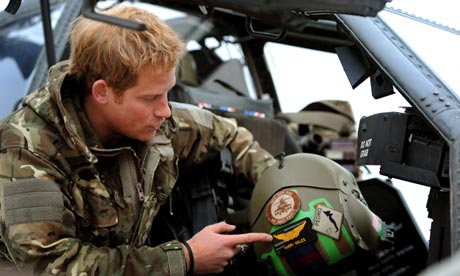
"It's a joy for me because I'm one of those people who loves playing PlayStation and Xbox, so with my thumbs I like to think I'm probably quite useful," Britain's Prince Harry said during interviews released upon his return from Afghanistan.

Explaining his four-month role as co-pilot of an Apache attack helicopter, Harry described the thrill of emergency response and the weapons systems he controlled in the gunship's two-man cockpit: Hellfire air-to-surface missiles, rockets and a 30-millimetre gun. Such statements are hardly surprising or shocking, but asymmetric warfare is fought along information lines and consumes anything in its path. Despite being cleared by the Ministry of Defense, Harry's comments quickly attracted negative press (targeting his princely qualities) and spurred a few grimaces on the MOD's own face.

"I'm not going to second guess whether he should or shouldn't have said it," spokesman Jim Murphy told the Guardian. "He's obviously a young and brave man. He was candid. Perhaps he may have been more candid than the Palace may have wished."

The Taliban naturally pounced on Harry's statements after failing to kill or capture him as promised. Spokesman Zabiullah Mujahid announced that, "49 countries with their powerful military failing in the fight against the mujahideen, and now this prince comes and compares this war with his games, PlayStation or whatever he calls it." Easily assailing the Prince for the flippant perception of his comments, Mujahid's counterattack appealed to any Afghan who loathes the notion of Afghanistan being treated as a game board for Westerners - from Britain and Russia's "Great Game" in the 1830s to the Soviet and NATO invasions nearly 200 years later. In this sense the disrespect of a "game" is very real in Afghanistan.

"This is a serious war, a historic war, resistance for us, for our people," Mujahid says.

However Harry's interviews are unlikely to make any immediate impact in Afghanistan. His testimony only confirms a new technological phase of an established pattern in war, and most Afghan civilians won't react as though he just murdered an innocent family or burned a Quran. Efforts to connect Harry's "mental problems" with the prolonged nature and brutality of Afghanistan's war may have more effect in Western countries than Afghan villages. Even Mujahid admits, "we don't take his comments very seriously, as we have all seen and heard that many foreign soldiers, occupiers who come to Afghanistan, develop some kind of mental problems on their way out."

More dangerous is the impetus to stage new Taliban attacks on Western targets in Kabul or elsewhere, which will be attributed to Harry's statements. Another factor to monitor outside Afghanistan is the public opposition of American video games set in foreign countries. These war games strike a cord with a variety of individuals, both the politically liberal and religiously conservative, who don't relate to the glamorous gamer side of war. The Trench has spoken with Yemenis who view Black Ops II's use of their country as gratuitous (try searching Yemen on YouTube), and some Pakistanis are beginning to organize a boycott against Call of Duty. Although the influence of these games on actual battlefields is minimal, public perceptions are crucial in counterinsurgency's wider scope and cannot be ignored at any size.

Any American force that generates anti-Americanism in a counterinsurgency environment is cause for concern.

Most disturbing are the long-term potentialities of advanced technological warfare: namely the gradual removal of humans from the killing process. Advocates of automated warfare argue that humans maintain control of the machine, a defense that is largely true for the moment but could break down over time. Drones may be more or less corruptible to enemy actors than humans; the process of this military experiment should be chaotic. Ultimately, whole fleets of drones could be concentrated in the hands of a small group or even one individual, further removing the human element from war. Drones could also be armed with weapons of mass destruction in the future.

Dehumanization is a constant theme of war - humanity might not be able to kill as it does without it. Problematically, all of these concerns and many others won't be eagerly addressed by Western governments or mainstream media.

January 9, 2013

Near-Zero Odds For Afghanistan's "Zero Option"

Keeping the enemy in the dark is a relatively straightforward task. Hiding information from a populace that has funded 12 years of seemingly endless warfare becomes murkier business, although governments have conducted their activities in such fashion for thousands of years.

Afghan President Hamid Karzai has arrived in Washington for three days of consultations with the Obama administration, and a hazy beginning portends a hazy end. Since the main reason for his arrival cannot be obscured - Karzai and President Barack Obama are both under pressure to make a decision on America's post-2014 operations - the inner workings of their summit have been fogged to create political breathing room. There's certainly something positive to be said about negotiating bilaterally, and privacy may be the only means of reaching a compromise between governments.

However the U.S. and Afghan governments have told so many lies, and manipulated so much information for so long, that neither enjoys credibility with either populace.

Rather than face Americans and Afghans honestly, both of their governments continue to dance behind private doors as they seek the best outcome for themselves. Karzai, for his part, wants and needs a continual U.S. military presence to stay on his terms. The White House likewise hopes to supplement America's political presence with military capabilities, while simultaneously tamping down its military profile as low as possible. At least 30,000 U.S. and NATO troops are expected to remain in the country after 2013's withdrawals, meaning at least two more years of hard combat. The longer Afghanistan's bloodshed continues with minimal results from the central government, the more Americans will oppose a long-term military presence in the country.

Problematically, a post-2014 Afghanistan needs U.S./NATO forces to continue training, overseeing, patrolling, raiding and generally providing a "visual presence" in the country. They, in turn, need the funds and attention that come with U.S. military operations; Iraq has already fallen down the list of priorities after U.S. combat troops withdrew in December 2011, a loss of focus that contributes to the present stalemate between Nouri al-Maliki and an oppositional alliance of Sunni, Shia and Kurd. The Obama administration also believes it needs a military presence to leverage during negotiations with the Taliban, whose leadership expects a share of Afghanistan's power regardless of Washington's plans. Hostilities will be difficult enough to stop with an agreement, let alone without one.

Despite the optimistic rhetoric employed by the Obama administration and Pentagon in particular, many Afghans expect their country to enter a new period of instability and uncertainty following the exit of U.S. troops.

“Let’s be honest,” Mohammed Omar Barakzai, a senior shura member in Helmand province, told The New York Times. “The Afghan government is like a generator. The foreigners have provided enough fuel so that it will run until 2014. If they don’t refill the fuel tank, it will stop working.”

Now, instead of simply owning up to this inevitability, the Obama administration has dropped a "zero option" into the media to temporarily relieve pressure around Karzai's visit and mislead the American public. Knocked down from the 20,000 troops that the Pentagon hoped to leave behind, the White House was reportedly considering force-level options of 3,000, 6,000 or 9,000 before Tuesday's leak polluted the waters. All of these figures represent more realistic assessments of Afghanistan's ground conditions than the Obama administration's present rumor.

"That would be an option that we would consider," deputy national-security adviser Ben Rhodes answered when questioned during a conference call on Tuesday. "The president does not view these negotiations as having a goal of keeping U.S. troops in Afghanistan."

Stripping away the "zero option's" political skin leaves a naked scam, one intended to placate U.S. opposition to an open-ended commitment and deflect the Taliban's recent claim that it will hold the U.S. responsible for the war's continuation. This conundrum runs to the heart of Afghanistan's war: the U.S. wants to maintain a politico-military presence past 2020, but cannot realistically expect to mediate a political agreement between the Taliban, Kabul and Islamabad if U.S. forces remain in the country indefinitely. The Taliban mean what they say when opposing a post-2014 presence - one U.S. soldier or a thousand will justify their position. Nevertheless, the Obama administration is certain to leave troops behind if a deal can be struck before Karzai's term expires. Thus the U.S. headlines accurately capture this scenario: White House "floats zero option."

Float, as in bait for guppies.

Afghanistan's "zero option" rests at the opposite end of the truth spectrum and shouldn't be swallowed whole as the White House intends. The administration seeks to avoid the overwhelming situation that it currently faces in Iraq, and surely anticipates the political fallout of a chaotic Afghanistan. The only reason that U.S. troops and air vehicles won't remain in the country after 2014 has already played out in Iraq: Karzai, as Nouri al-Maliki did before him, opposes the renewed immunity for U.S. soldiers. This factor is especially critical since the Washington expects to continue Special Forces raids on Afghan villages.

The Obama administration's "zero option" exists by default, not choice or design, and will be forced upon rather than decided by Washington.

January 3, 2013

U.S. Drones Target TTP's Maulvi Nazir, Pakistani Negotiations

A vivid contrast between the light shone on civilian casualties and militant commanders reflects off a MQ-9 Reaper's wing. In Pakistan's case, this light often comes from the numerous intelligence sources deployed to see and hear everything in the Federally Administered Tribal Areas (FATA).

Around 12:30 AM in Islamabad, a pair of U.S. drones fired four missiles at a compound located in South Waziristan's Angor Adda. The first international reports surfaced 4-5 hours afterward; less than 12 hours later, the target had been identified as Tehrik-i-Taliban Pakistan (TTP) commander Maulvi Nazir and his deputies, Atta Ullah and Rafey Kkan. The Hellfire missiles struck Nazir's convoy in the Sra Kanda area as it was traveling from Angor Adda to the local capital of Wana. One Pakistani official said Nazir and his fighters were caught swapping vehicles after their "double cabin pick-up encountered a mechanical fault."

Nazir's death has reportedly been announced over Wana and Angor Adda's mosque speakers, while the TPP has yet to issue a statement as of this moment. One will presumably be released shortly.

Nazir's death, if confirmed, will yield positives and negatives for Washington, along with a bundle of negatives for Islamabad. He's certainly a veteran player in the TPP and a name to throw at Americans, if that counts for anything 11 years into Afghanistan's war. He also keeps in line with al-Qaeda's general ideology despite chafing under Uzbek influence; the Long War Journal notes that "Ilyas Kashmiri, Abu Khabab al Masri, Osama al Kini, Sheikh Ahmed Salim Swedan, and Abu Zaid al Iraqi were killed while being sheltered by Nazir." Now these types of personalities will need somewhere else to live and train. Moreover, Nazir enjoys relations with the Haqqanis and facilitates their movement through his territory.

Eliminating Nazir rather than his rival, TTP chieftain Hakimullah Mehsud, is the correct strategy for instigating the group's self destruction. Mehsud's divisive leadership has kept its regional commanders split into factions since assuming power in August 2009, and targeting him first would be counterintuitive. Instead, Nazir and those TTP commanders focused on Afghanistan - namely South Waziristan's Waliur ul-Rehman and North Waziristan's Hafiz Gul Bahadur - should be targeted in place of Mehsud until the group collapses on itself. Problematically, this strategy runs contrary to Pakistan's containment policy towards both branches of the Taliban.

Nazir also remains a second or even third tier target and his absence won't alter the battlefield in Afghanistan or Pakistan. Although a leading advocate of concentrating TTP resources on NATO forces in Afghanistan, his death alone is insufficient for drying up TTP activity along the border and largely turns another COIN into whack-a-mole. As a result, the Obama administration's handling of Afghanistan will see a negligible bump in U.S. polls, and the war's trend will continue as is.

A second strike in North Waziristan reportedly targeted an Uzbek commander, however civilian casualties have been reported after villagers closed around the scene.

Unless more high-level targets soon experience Nazir's fate, his assassination brings more risk than reward to Washington and Islamabad's tables as they attempt to negotiate a more solid grip on the region. Nearly all of Nazir's details remain to be shaked out over the coming days (perhaps Islamabad ran out of use for him) but the timing appears extremely volatile. Nazir had allegedly made enemies with Hakimullah's camp for keeping open relations Islamabad, which theoretically needed his presence within the TTP's council.  Now the government must explain through backchannels why Nazir was targeted during a potentially new phase of interaction with Hakimullah and Rehman.

The Obama administration and its supporters in Afghanistan have invested a noticeable amount of energy reviving their prospects on the back of Islamabad's recent diplomacy - Thursday's drone strike runs against this grain.

December 17, 2012

No Rest For Bahrain's Duplicitous King

 Zainab Al-Khawaja being arrested at Salmaniya hospital on December 9th

Celebrating Bahrain's National Day on Sunday with the usual festivities, King Hamad bin Isa al-Khalifa delivered another of his patented rhetorical offensives to a divided nation. Hamad had arrived at the University of Bahrain in order to mask his intentions, employing his father's name to establish the Shaikh Isa bin Salman Al Khalifa Fund to "serve all citizens without distinguishing between religions, sects or cultures." A noble concept in theory, but those Shia facing government discrimination (largely carried out by Sunni police and mercenaries) don't have time to wait for future promises. Nor do they have time for the denial that has gripped Bahrain's tottering monarchy.

Hamad's circle has refuted any connection to the Arab revolutions throughout the island's 22-month uprising, and employs his speeches to ignore a fundamental political crisis rather than address it.

"In conclusion and on the great occasion of the National Day, we call on everyone to move forward, to be diligent for the sake of further accomplishments and to continue the nation-building process in various fields in order to achieve the well-being of our citizens... We commend our armed forces and the security and the National Guard forces who are always ready to provide the appropriate climate for development and progress through achieving security and stability and meeting all challenges for the sake of all people’s welfare and benefit.”

Protests naturally ensued before and after Hamad's speech. Disenchanted by anything their king in name only had to say - and he waisted no time vindicating their reaction - the youth-led February 14 coalition organized roadblocks and protests around Manama's surrounding villages. They were promptly met with the ubiquitous tear gas and rubber bullets that characterizes Bahrain's unique low-intensity situation. On Monday protesters attempted to march on the capital, now a strict no-go zone under de facto emergency law, resulting in a number of arrests. Among them, the acting head of the Bahrain Center for Human Rights (BCHR) and his wife, Yousef al-Muhafedha and Zainab al-Sairafi.

Al-Muhafedha currently oversees the BCHR's activities because its founders, Nabeel Rajab and Abdulhadi al-Khawaja, already occupy jail cells for "instigating unrest." Rajab's three-year sentence was reduced to two last week and legitimized in the process, a cheap scam to keep him unjustly imprisoned. Al-Khawaja's daughter Maryam has also been forced into exiled to avoid the fate of her sister Zainab, who was recently handed another month-long sentence for one of more than a dozen pending charges. Zainab has been verbally and physically on multiple occasions for staging one-woman protests and chanting for the King's resignation, treatment shared by her BCHR comrades and other political prisoners.

The systematic assault on Bahrain's leading human rights organization, by itself, demonstrates that the monarchy is far less concerned with substantive reform and more committed to terror tactics than the opposition. Concealing the truth and covering up Bahrain's political fissures is priority one. Dispatched by the monarchy as the fist inside Hamad's velvet glove, the King's official spokeswomen laid all responsibilities of violence on Bahrain's oppositional network as she established favorable terms for negotiations.

"Any national dialogue to overcome the crisis will not ignore any component of the Bahraini society and will not be with one side at the expense of the other," State Minister for Information Affairs Samira Ibrahim bin Rajab told al-Sharq al-Awsat. "It will, however, be complementary to the national consensus dialogue that took place in July 2011 and will commence as soon as the opposition stops violence and relinquishes conditions and restraints put to engage in that dialogue."

The egotistical notion of Bahrain's monarchy refusing to hold a second "National Dialogue," after the first failed so miserably, is no less absurd than staging one immediately. Government security forces and allied mercenaries from friendly governments (Saudi Arabia, Jordan, Kuwait, UAE, Pakistan) bear the majority of responsibility for applying disproportionate force, however non-lethal. Complaints of Molotovs lose legitimacy when the monarchy blows hard on the streets' flames; Shia communities are raided at night, gassed, beaten and tortured for the past and future actions, while no political measures have been arranged to mitigate the fallout. 

Rifts between loyalist and oppositional forces - and between their own ranks - continue to widen at a treacherous pace. This accumulation of events has pushed Bahrain's environment beyond the trust necessary to open a dialogue in the first place. An expanding section of Bahrain's opposition has lost all faith in the monarchy, and cannot be expected to participate until substantial goodwill offerings are secured: ending military raids and releasing political prisoners. And even these moves may fail to end one overriding demand.

"Down, Down Hamad."

December 12, 2012

Pentagon's General Counsel, Zakaria Falsely Suggest End of the War on Terror

Excellent counterattack by Bob Adelmann against Fareed Zakaria, a high-level media propagandist at CNN and Time:
A writer at the Washington Post took a snippet out of a speech by President Obama's Defense Department general counsel and concluded that he saw an end to the War on Terror. He was wrong.
Washington Post writer Fareed Zakaria characterized the speech by Jeh Johnson (shown on left) as “thoughtful,” and Zakaria was inordinately hopeful that it signaled the beginning of the end of Washington’s 12-year-old War on Terror. He wrote:

For the first time since Sept. 11, 2001, an administration official has sketched a possible endpoint…. 

Phasing out or modifying these emergency powers [given to the president by Congress to prosecute the war against al-Qaeda] should be something that would appeal to both left and right. 

Zakaria agreed with ending the war — to a point — and he invoked the warning James Madison gave about the dangers of unending eternal warfare:

Of all the enemies to public liberty, war is, perhaps, the most to be dreaded, because it comprises and develops the germ of every other. War is the parent of armies; from these proceed debts and taxes….

No nation could preserve its freedom in the midst of continual warfare.

Zakaria reviewed some of the impact that the war has had on America: bloated military budgets, new unconstitutional agencies (especially the Department of Homeland Security, which now employs a quarter of a million people), the building of 33 new intelligence facilities in the Washington, D.C. area alone (equivalent to three Pentagons), an Afghan war that has cost trillions of dollars, and nearly 60,000 American casualties.
Unfortunately he didn't read the rest of Johnson’s remarks. The essence of those remarks was that the War on Terror was going to continue indefinitely, but under a different name. This name change is merely in keeping with Obama's rhetoric on the war. Less than two months after his first inauguration, President Obama ordered the Defense Department to refrain from using the phrase “War on Terror” and instead start calling it the "Overseas Contingency Operation” (OCO).

Johnson’s credibility should have come into question within minutes of his opening remarks. After he noted that he favored a quote from the pro-war Brookings Institution that he said motivates his public service: “The Founding Fathers believed in a democracy" (they didn't), he celebrated the success the military has had in putting into effect that unconstitutional “blanket wartime authority”:

We ended the combat mission in Iraq.

We increased the number of combat forces in Afghanistan and have reversed much of the Taliban’s momentum in the country….

We banned “enhanced interrogation techniques,” consistent with the calls of many in our country, including our own military, that great nations simply do not treat other human beings that way….

And, finally, we have, in a manner consistent with our laws and values, taken the fight directly to the terrorist organization al Qaeda, the result of which is that the core of al Qaeda is today degraded, disorganized and on the run. Osama bin Laden is dead. Many other leaders and terrorist operatives of al Qaeda are dead or captured; those left in al Qaeda’s core struggle to communicate, issue orders, and recruit.

At this point in his speech, Johnson might have suggested that it was time to pack up and go home: Job One is done.

Not a chance.

The Many Faces of Afghanistan's Spy Chief

Overview of the shadowy side of Asadullah Khalid, head of Afghanistan's National Directorate of Security (NDS):
For those that know him best, Asadullah Khalid has always been "a man of action."

His reputation for "assertiveness" has ingratiated the head of the National Directorate of Security (NDS) - the Afghan intelligence agency - with some of the most powerful figures in the nation.
But Khalid's literally hands-on methods have also earned him powerful enemies abroad and a reputation for ruthlessness. He has been accused of assassinations, torture, and drug-dealing as governor of Ghazni and Kandahar provinces.

Despite the allegations, Khalid is a favourite among Afghan President Hamid Karzai's inner circle. So it came as little surprise when Karzai rushed to a Kabul hospital to visit his spy chief hours after a December 6 suicide attack wounded him.

The assailant pretended to be a "messenger of peace and negotation from the Taliban side" before detonating explosives hidden in his underwear at a government guesthouse, an intelligence agency spokesman said. Khalid survived and is now in a US-run military hospital, though the seriousness of his wounds remains unclear.

The Taliban claimed responsibility for the attack, the fifth attempt on Khalid's life in five years.
"Karzai was in shock. His reaction was the same as when he got the news about Ahmad Wali," a high-ranking cabinet official said, referring to the July 2011 assassination of the president's half-brother, who was close to Khalid.

That closeness earned Khalid the respect of the elder Karzai, who named him Afghanistan's intelligence chief in September.

Wahid Monawar, former permanent representative of Afghanistan to the United Nations in Vienna, described Khalid as genuinely loyal to the president, a rare trait that earned the 42-year-old many high-level posts, including governor of Kandahar province.

Karzai's man

Three high-level officials spoke to Al Jazeera on condition of anonymity, all citing a fear of offending Khalid and his powerful allies.
Continue reading

December 9, 2012

Khalid Bombing Opens Old Rabbit Hole In Afghanistan

Another complex scheme to get within range of a senior Afghan official has blown a sense of déjà vu through the international media.

Three days ago a Taliban suicide bomber slipped through Afghan security at a Kabul guesthouse and detonated his device, wounding the chief of Afghanistan's National Directorate of Security (NDS). The assassination attempt wasn't Asadullah Khalid's first brush with death, and the Taliban's peculiar methodology has been witnessed before. Khalid's assailant posed as a Taliban emissary tasked with discussing national reconciliation, gaining access into one of 20 safe-houses used by the NDS in Kabul, before triggering an explosive belt wrapped around his groin. The same plot (using  Turban) was used to penetrate Burhanuddin Rabbani's security bubble and kill the head of President Hamid Karzai's peace council.

Although assassination is nothing new in the Taliban's arsenal, the tactic/strategy became the insurgency's go-to counterattack against President Barack Obama's troop surge, in the same way that ANA infiltration is designed to counter NATO's training program. Assassinations can be planned outside the country, require no ground forces or battles, disrupt Kabul's mindset and pack an enormous psychological payload in the media - a perfect weapon to undermine America's military and non-military gains in Afghanistan. July 2011 sent shockwaves out of the country when Ahmed Wali Karzai's bodyguard executed his boss in the head; the latter allegedly made a trip to Quetta, suspected home of the Taliban's shura, prior to the hit.

Less than a week later, after gunmen stormed the compound of Karzai loyalist Jan Mohammad Khan, Afghan officials claimed that the attackers made calls to Pakistan before their lethal assault. Most similarly, a false emissary penetrated Rabbani's security bubble in September 2011. The Taliban have likely been concentrating on Khalid, a staunch Tajik ally, since Rabbani's assassination.

"The attack against Rabbani was formulated in Quetta," Karzai added on Saturday, "and now the attack on Asadullah Khan Khalid has also been organized in Pakistan."

Blaming Pakistan is a misleading truism though. Attacks of this nature are inherently coordinated in the Taliban's Pakistani sanctuaries, between Quetta and the Haqqanis' northern territory, where the network has always regrouped and planned its offensives. Pakistan's government may be aware of these plots and the location of Taliban leaders, but evidence of direct complicity remains absent. And underestimating the Taliban's ingenuity or deviousness is a chronic mistake.

"The reality is that such a complicated attack and a bomb that was hidden inside his body, this is not the work of the Taliban," Karzai told reporters, implying the hand of Pakistan's Inter-Services Intelligence (ISI). "It's a completely professional and thoroughly engineered type of attack. The Taliban are not capable of that, and therefore there are bigger and professional hands involved in this.”

The Daily Beast recently documented an ongoing Taliban plot to kill Karzai, including the use of an internal bomb, but such extremes weren't necessary to breach Khalid's security. "A very sophisticated and complicated act" defines the bombing by simplicity and patience, not true complications. NDS spokesman Shafiqullah Taheri stated matter-of-factly, “It is degrading and insulting to search anyone’s genital area, according to Shariah law.” Karzai even admitted that the bomber's security screening failed due to Afghan customs, which deter personal body searches; Khalid personally waved a thorough search out of respect for the imposter's emissary.

He only needed to wrap a bomb around his leg, not implant one in his stomach, a plot that doesn't require any medical assistance.

Elements of Pakistan's government will remain complicit with the Taliban so long as the group maintains its immovable position in Afghanistan's landscape, a dilemma that may not have an answer in its present form. At the same time, blaming Pakistan for another security lapse offers a deceptively easy way out - too easy - that leads the conflict in circles. That presumably accomplishes one of the Taliban's objectives. Islamabad, for its part, has pledged intelligence cooperation after being shown the evidence; Karzai separately announced, "Our efforts for the security and stability of Afghanistan will continue."

Karzai is scheduled to meet ISI Director Zaheerul Islam, and his decision to forge onward with a political resolution is the only logical move. The Taliban didn't bomb Khalid in order to disrupt peace negotiations, as they don't exist in the first place, and don't need ISI support to carry out its individual plots. Khalid's assassination attempt represents a focused attack on an old target, one that is trying his hardest to kill Taliban.

December 7, 2012

Pakistani Intel: Waliur Rehman Closing On TTP Leadership

That he's survived this long is a testament to his notorious intensity.

As the prototypical enforcer of Tehrik-i-Taliban Pakistan (TTP) chieftain Baitullah Mehsud, Hakimullah Mehsud was known to 4-wheel recklessly beneath U.S. drones, test his favorite weapons (the AK-47 RPG) in front of journalists and passionately orate al-Qaeda's cause. None doubted his courage or commitment to Nek Mohammad, the TTP's forerunning tribal chief and one of America's first drone victims. Except right-hand men don't always make the best leaders, due to their skill set, and Hakimulkah has experienced growing pains since taking hold of the group's reigns in August 2009. Falsely reported dead after an alleged shooting interrupted the TTP's shura to replace Baitullah, Hakimulkah emerged from a fierce leadership dispute with a tentative grip on his title as Emir.

The TTP's head has survived two more obituaries since August 2009. The first - and realist - occurred in January 2010 after Hakimullah took credit for organizing the double-agent bombing of Forward Operating Base Chapman, which oversees a large component of the CIA's intelligence and drone operations in Pakistan. The explosion claimed the lives of seven personnel, spawning a vendetta that seemingly ended with a drone strike on Hakimullah - only the strongman later resurfaced to taunt Washington by organizing a failed bombing attempt in Times Square. A 2012 strike yielded a similar game of information cat-and-mouse.

Throughout this time Hakimullah has endured the duress generated by the TTP's competing leadership. North Waziristan's Hafiz Gul Bahadar, who claimed his own piece of Baitullah's fallen crown, soon dropped out the Taliban-brokered Shura Ittehad-ul-Mujahideen and refuses to acknowledge Hakimullah's superiority. The TTP's de facto boss has also been permanently challenged by Waliur ul-Rehman, the TTP's foremost strategist and commander of South Waziristan. Rehman maintains ties with Islamabad and presents the opposite image of Hakimullah: mature, supportive of group cohesion and focused on attacking U.S. troops Afghanistan rather than Pakistan. And now, according to Pakistani security officials plugged into Waziristan, he's closer than ever to displacing the TTP's volatile head.

“Rehman is fast emerging as a consensus candidate to formally replace Hakimullah,” one army official told Reuters. “Now we may see the brutal commander replaced by a more pragmatic one for whom reconciliation with the Pakistani government has become a priority.”

“If a leader doesn’t behave like a leader, he loses support," said another source. "For the longest time now, Hakimullah has done the dirty work while Waliur Rehman is the thinker. Taliban fighters recognize this."

The combined interviews of three Pakistani officials and local actors paint a standard picture of Hakimullah: a "short-tempered" and "trigger-happy" man who shoots in a second. A naturally divisive personality, the veteran jihadist considers himself and al-Qaeda as one and the same, and thus views Islamabad as a traitorous state to the Muslim Umma. His attitude has resulted in an intense (and sometimes violent) debate over the selection of TTP targets, and whether the group should strategically focus on Afghanistan or Pakistan. Many of the group's sub-commanders would prefer to concentrate on Afghanistan's front, as this strategy draws less heat from Pakistan and tribal authorities, but the TTP has been unable to steer itself in one direction since its formation in December 2007.

Interestingly, Reuters completely leaves out a festering wound opened last July, around the same time that Islamabad would have received its field intelligence on Hakimullah. The TTP's besieged strongman also inherited his predecessor's dispute with Maulvi Nazir, an ally of Rehman and proponent of negotiations with the Pakistani government. Their long-standing conflict stems from Nazir's resistance to allowing Uzbek militants to operate in his territory, triggering several alleged confrontations with Baitullah (one of many reasons for Mullah Omar's Shura Ittehad-ul-Mujahideen). On July 5th, Hakimullah's associate Wali Mohammad (Baitullah's younger brother) was gunned down in South Waziristan's Kaloosha village. Hakimullah's circle suspected that Nazir ordered the assassination due to Wali's growing influence in the area.

In apparent retaliation, a "preliminary investigations conducted by the Ahmedzai Wazir tribesmen" (Nazir's tribe) believes that a November 29th suicide biker was dispatched to Wana's Ajab Noor Mosque by Hakimullah. Nazir narrowly survived the attack, but the TTP's hierarchy could become a casualty.

U.S. officials "caution about expecting an imminent transition," adding that Hakimullah still enjoys followers. True, Hakimullah has always commanded his own militia and will continue to operate on his terms if evicted from the TTP's throne. He could pose even a greater danger working under his own initiative, cooperating with rogue groups such as Lashkar-e-Taiba (LeT). However the implications of his demotion remain measurable: the TTP will be more useful to the Afghan Taliban and Islamabad with Rehman at its helm.

November 9, 2012

Petraeus Resigns Over Affair With Biographer, Gets Away Easy

Given the non-military circumstances, The Trench has little to say in reaction to David Petraeus's resignation from the CIA's Directorship. Jokes can be left to others - more unconventional thinking is better suited here.

That Petraeus's star will momentarily dip appears inevitable, and any political involvement in 2016's election is now remote, but his career arc has by no means collapsed. Shielded by thick political insulation, Petraeus is already riding off into Washington's sunset as an unquestioned American hero and genius of war. As a result, neutral examination of his policies while overseeing CENTCOM, NATO's alliance in Afghanistan and the CIA is being buried under greater amounts of dirt. Surely Petraeus did some personal good during his stints, but his geopolitical record contains major gaps that his bosses have an interest in concealing.

President Barack Obama's statement did not include the reason for termination: "By any measure, he was one of the outstanding General officers of his generation, helping our military adapt to new challenges, and leading our men and women in uniform through a remarkable period of service in Iraq and Afghanistan, where he helped our nation put those wars on a path to a responsible end."

Iraq's Long War

Petraeus broke no new ground in the study or application of counterinsurgency, so much as provide the willingness lacking in Washington's political and military circles. Himself a political-military hybrid, Petraeus employed his so-called "anaconda" during George Bush's surge to choke all military and non-military sources of an insurgency's energy. This strategy would manifest in temporary agreements between Baghdad and Iraq's sectarian actors, namely the Sunni tribes in the west and Shia cleric Muqtada al-Sadr's militia. At face value the surge did dramatically reduce Iraq's level of violence - however it did not end the war responsibly. Many factors of strife were left uncorrected by Petraeus, the Bush administration and eventually the Obama administration.

As of now U.S. policy remains trapped in Nouri al-Maliki's corner, usurped of its dominance by Tehran's influence and bleeding credibility with the Kurds. This unpopular alliance has wrecked any hope of repairing national relations with Sunni leadership, while al-Sadr is cooperating with the Sunnis and Kurds to contain al-Maliki's autocratic tendencies. al-Qaeda in Iraq revived itself amid this turmoil, killing thousands of Iraqis after U.S. troops exited in December 2011, and is now feeding off the backend of Syria's revolution.

"His inspirational leadership and his genius were directly responsible - after years of failure - for the success of the surge in Iraq," Sen. John McCain said Friday.

Implementing the surge itself differs from the war's endgame.

Afghanistan's Open, Bleeding end

Petraeus's failure to create permanent "momentum" in Afghanistan is easier to explain. Having told Obama in the final moments of his own surge's approval that he could complete the mission within its limits (as commander of CENTCOM), Petraeus soon discovered that he lacked the time and resources to do so. The 18-month time limit placed on Obama's surge, as approved by Petraeus, remains GOP fodder for anti-Obama rhetoric; a lower amount of troops than requested - between 40,000 and 60,000 - further crippled Obama's surge at its launch. Due to a lack of forces, Petraeus was forced to concentrate in the southern provinces and never implemented the second phase of Obama's surge in Afghanistan's eastern mountains. This dilemma allowed the Taliban to remain operational in both areas, and the insurgency's ranks continue to be estimated in the 20,000s.

Shortages of ground forces also contributed to an extraordinary amount of airstrikes and Special Operations raids, which became Washington's primary kinetic tools against the Taliban. Blowback from a relatively minor number of incidents (the alleged 2% that kill innocents) would severely impair Petraeus's public outreach to the Afghan people.

Meanwhile Afghanistan's political factors remain more stagnant than the battlefield's. Relations with Islamabad were never seriously repaired during Petraeus's run in Afghanistan and Pakistan. President Hamid Karzai has yet to reach a genuine relationship with Washington, and both capitals' negotiations with the Taliban are treading deep waters. The result: thousands upon thousands of dead Taliban and no sight of the war's "responsible" end.

As for Paula Broadwell, Petraeus's biographer and mistress, she found herself involved in the controversial razing of several Afghan villages. Fortunately this subject appears to be gaining new life.

Yemen's Rampage

In January 2010, six months before leaving CENTCOM to command ISAF, Petraeus intensified Washington's unseemly affair with Yemeni dictator Ali Abdullah Saleh. The resulting deal to target al-Qaeda in the Arabian Peninsula (AQAP) has killed many innocent Yemenis in the process, and contributed to Washington's general subversion of Yemen's national affairs. Director Petraeus later returned to negotiate a "secret" CIA base with Saleh, a project that the Obama administration accelerated once Yemen's revolution began in January 2011. Few men are more responsible for America's militarization in Yemen, a policy that runs contrary to COIN's non-military emphasis.

U.S. officials and loyal analysts argue that Saleh offered a necessary partnership against AQAP, but the notoriously wily dictator obstructed both governments' responses in order to continue receiving U.S. and Saudi support. Petraeus and the White House chose to play along with this scam, as it benefitted the self-interests of both parties, and Petraeus was duly rewarded for his personal efforts. Following his rise atop the CIA, the Obama administration managed to swap Saleh for his more obedient vice president, Abd Rabbuh Mansur Hadi, and proceeded with their original plans. Three weeks after Petraeus entered the CIA, U.S.-Yemeni citizen Anwar al-Alwaki was located by several drones and terminated in a flurry of Hellfire missiles.

His 16-year old son, Abdulrahman al-Aulaqi, was bombed two weeks later at a barbecue.

America generally cheered the first assassination and drowned out those protesting a constitutional breach. The U.S. mainstream media, which eagerly broadcast al-Alwaki's death, then buried his son's assassination. The Obama administration's policy marches onward and remains as unpopular as ever in Yemen - keeping AQAP alive. Naturally U.S. and Gulf operations must continue scaling up in response.

Washington's way of doing business has a more difficult time explaining an affair than the murder of innocent children. Unlike some other commentators, The Trench believes that Petraeus will bounce back and potentially reach greater heights in the future. Individuals and groups operating in Washington always have need for his type of services.

October 24, 2012

CIA Veteran John Brennan Transforms US Counterterrorism Policy

A propaganda feast provided by the White House and Pentagon. While this report does contain valuable information, it is also saturated with government disinformation and a false sense of Brennan's importance. The White House's counterterrorism czar is visibly being inflated as the mask of U.S. operations, a process designed to alleviate the culpability of President Barack Obama and less publicized national security officials. No information on Brennan should be trusted as is.

Other parts of The Washington Post's report describe the U.S. and Saudi governments' hegemonic relationship with Yemen's government - considered a "true model" by Washington and despised inside Yemen - along with the imperialist agenda headed for Mali:
In his windowless White House office, presidential counterterrorism adviser John O. Brennan is compiling the rules for a war the Obama administration believes will far outlast its own time in office, whether that is just a few more months or four more years.

The “playbook,” as Brennan calls it, will lay out the administration’s evolving procedures for the targeted killings that have come to define its fight against al-Qaeda and its affiliates. It will cover the selection and approval of targets from the “disposition matrix,” the designation of who should pull the trigger when a killing is warranted, and the legal authorities the administration thinks sanction its actions in Pakistan, Yemen, Somalia and beyond.

“What we’re trying to do right now is to have a set of standards, a set of criteria, and have a decision-making process that will govern our counterterrorism actions — we’re talking about direct action, lethal action — so that irrespective of the venue where they’re taking place, we have a high confidence that they’re being done for the right reasons in the right way,” Brennan said in a lengthy interview at the end of August.

A burly 25-year CIA veteran with a stern public demeanor, Brennan is the principal architect of a policy that has transformed counterterrorism from a conventional fight centered in Afghanistan to a high-tech global effort to track down and eliminate perceived enemies one by one.

What was once a disparate collection of tactics — drone strikes by the CIA and the military, overhead surveillance, deployment of small Special Forces ground units at far-flung bases, and distribution of military and economic aid to threatened governments — has become a White House-centered strategy with Brennan at its core. 

Four years ago, Brennan felt compelled to withdraw from consideration as President Obama’s first CIA director because of what he regarded as unfair criticism of his role in counterterrorism practices as an intelligence official during the George W. Bush administration. Instead, he stepped into a job in the Obama administration with greater responsibility and influence. 

Brennan is leading efforts to curtail the CIA’s primary responsibility for targeted killings. Over opposition from the agency, he has argued that it should focus on intelligence activities and leave lethal action to its more traditional home in the military, where the law requires greater transparency. Still, during Brennan’s tenure the CIA has carried out hundreds of drone strikes in Pakistan and opened a new base for armed drones in the Arabian Peninsula.

Although he insists that all agencies have the opportunity to weigh in on decisions, making differing perspectives available to the Oval Office, Brennan wields enormous power in shaping decisions on “kill” lists and the allocation of armed drones, the war’s signature weapon.

When operations are proposed in Yemen, Somalia or elsewhere, it is Brennan alone who takes the recommendations to Obama for a final sign-off.

As the war against al-Qaeda and related groups moves to new locations and new threats, Brennan and other senior officials describe the playbook as an effort to constrain the deployment of drones by future administrations as much as it provides a framework for their expanded use in what has become the United States’ permanent war.

“This needs to be sustainable,” one senior administration official said, “and we need to think of it in ways that contemplate other people sitting in all the chairs around the table.”

A critical player
 
There is widespread agreement that Obama and Brennan, one of his most trusted aides, are like-minded on counterterrorism policy. 

“Ever since the first couple of months, I felt there was a real similarity of views that gave me a sense of comfort,” Brennan said. “I don’t think we’ve had a disagreement.”

But the concentration of power in one person, who is unelected and unconfirmed by Congress, does not sit well with critics.
Continue Reading