Showing posts with label AQAP. Show all posts

March 8, 2013

With "Friends" Like Yemen's, No Enemies Needed

In early January 2011, former U.S. Secretary of State Hillary Clinton landed in Sana'a to manage the autocratic habits of a useful ally in the war against al-Qaeda.

Having warned other allies (Tunisia, Egypt, Jordan, Algeria) of a youth bulge prior to the Arab uprisings, the Secretary now found herself just above the surface of a volcano as she mingled with Yemeni president Ali Abdullah Saleh. U.S. policy needed his approval to facilitate an expansion of military and counter-terrorism platforms in the country, but that need required less antagonistic leadership atop the government. For Clinton, this meant walking Saleh away from a parliamentary proposal that would eliminate term limits and allow him to run indefinitely, which he eventually agreed to in return for Washington's political and military assistance.

“We support an inclusive government,” Clinton replied when asked how the Obama administration could support Saleh's government and human rights at the same time. “We see that Yemen is going through a transition. And you’re right: it could one way or the other. It could go the right way or the wrong way.”

Yemen's revolution would spark weeks after Clinton shook hands with Saleh and departed the capital, never to return. Despite her professed support for a representative government, the Obama administration first treated Yemen's uprising as an obstruction to be neutralized, fearing a loss of influence with the next government. During this time al-Qaeda in the Arabian Peninsula (AQAP) capitalized on Saleh's distraction in the cities to expand its ranks and territorial control in Yemen's southern governorates; Saleh's U.S.-trained counter-terrorism forces aided the process by fighting Yemen's revolutionaries and tribesmen rather than terrorists. However this chain of events ultimately created an opportunity for Washington and its allies, namely Saudi Arabia and European partners, to replace the duplicitous Saleh with his vice president and continue their policies unimpeded.

President Abd Rabbuh Mansur al-Hadi, "elected" through the UN's single-candidate referendum in February 2012, doubles as a leading proponent of U.S. drone strikes in Yemen.

This hegemonic policy was displayed again on Thursday when the Obama administration released a two-part press notice from the White House and State Department. Lying to the American people when talking Yemen, unfortunately, is simpler and easier than stealing candy from a baby. The American majority lives in ignorance of Yemen's troubles and their government's own interference in the country. Chronic fear of al-Qaeda and a high degree of hostility, reminiscent of American attitudes towards Pakistanis and Iraqis, contribute to this detachment, which in turn allows the Obama administration to interfere in Yemen's affairs without domestic cost.

Lack of political incentives to support the Yemeni people have endangered them in multiple ways: undermining their quest for representative government, damaging property and life without legal recourse, and ensuring that AQAP retains a presence in their country. Such a defeat in the war for "hearts and minds" is especially tragic when considering Yemenis' fondness for Americans themselves.

Current U.S. policy presents a view diametrically opposed to Yemen's streets, where the actions of Washington and its allies have obstructed a continuation of the revolution.

"Over the past 15 months,” U.S. Deputy Secretary of State William Burns told the latest "Friends of Yemen" Ministerial, "Yemen – with the support of all of its friends – has made important progress in implementing the Gulf Cooperation Council Initiative. Yemenis elected a new leader for the first time in three decades, launched a major reform of their armed forces, regained control of large areas of their national territory held by Al Qaeda in the Arabian Peninsula, and today stand on the cusp of an historic National Dialogue."

Burns' statements are constructed on the boundary of inaccuracy. Yemenis selected Hadi out of necessity and coercion rather than free will, while Hadi himself was tasked to clean up a mess made by Saleh and the foreign policies that supported him. The so-called GCC initiative also excluded the same youth that the White House claims to support. Instead, the power-sharing agreement granted immunity for Saleh's human rights abuses (some committed with U.S. equipment), as well as preserving military influence with the new government. That U.S. interests in Yemen have improved since Saleh's resignation is unquestionable, even as U.S. policy remains unpopular with everyone outside the GCC initiative: the independent revolutionaries, northern-based Houthi sect and secessionist-minded Southern Movement.

Yemen's youth received the least seats of all parties - nearly four times less than Saleh's General People's Congress (GPC) - in the heralded National Dialogue.

Further complicating the situation, the GCC's power-sharing agreement obstructs deeply-rooted political causes in the north and south, as their autonomous designs threaten the central government's authority and, by extension, involved foreign powers. In mid-February the United Nations Security Council (UNSC) released a statement warning against interference in Yemen's affairs, only this statement targeted Saleh to the extent that it isolated a former Vice President and current Southern activist, Ali Salim Al-Beidh. The statement had minimal effect on Saleh, who copied the UNSC's message (minus himself) during a speech to commemorate Hadi's promotion, but it did spark Southern protests that led to clashes with the government and oppositional Islah party.

Hadi eventually met with Southern leaders to ease tensions and coax them into the National Dialogue, but the movement's leaders and followers remain leery of participating under UN-GCC terms. While a national dialogue is needed to advance Yemen's revolution, the present environment could degenerate into political warfare between the ruling GPC, Islah and Hirak.

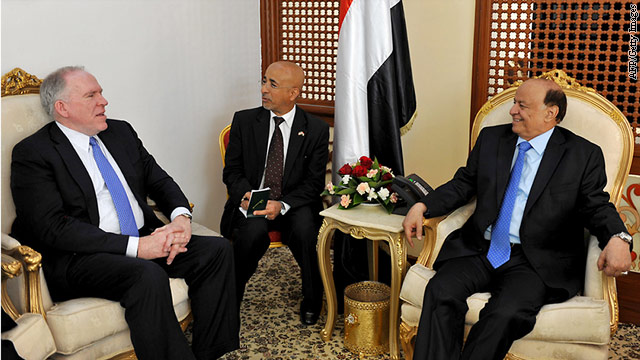
To some credit U.S. non-military assistance has increased since the revolution launched in January 2011. Problematically, the long-term reality in Yemen indicates that these measures serve as camouflage for widespread geopolitical interference. U.S. aid has risen above $100 million to keep pace with a similar figure in the military column, and this information is used to promote a comprehensive policy. Since military and counterterrorism spending is especially obscured in Yemen, one of Washington's biggest "small wars," State Department officials and CIA Director John Brennan can now claim with greater safety that non-military spending exceeds military spending.

However U.S. policy remains decisively oriented towards influencing Yemen's political and military spheres - economic development and humanitarian support furthers this goal.

Yemen's revolution is effectively over in the eyes of UN, EU and GCC powers, and they have stopped at nothing to control its "transition." In their world 2014's elections will continue the reforms started by Hadi and Yemen will be gradually integrated into the GCC with Western assistance. Far from genuinely helping its people, U.S. policy in Yemen currently amounts to a joint neocolonialist takeover with neighboring Saudi Arabia, whose government rivals Washington and Tehran in unpopularity. All have worked tirelessly to prevent a national revolution in Yemen, while at the same time claiming to advance it.

"The transition is about to enter a new, critical, phase," Burns told his audience in London. "While Yemenis courageously work to rebuild their country, extremists and their patrons are working hard to tear it down. The Co-Chairs called on all parties to commit to the principle of non-interference and the unity, sovereignty, independence, and territorial integrity of Yemen. This is an effort we endorse in the strongest terms."

Rampant foreign interference is no secret amongst Yemenis and concerned observers. Burns' own statements demonstrate the oxymoronic forces at work: supporting Yemen's unity and territorial integrity, for instance, directly contradicts the principles of sovereignty and independence. Washington, Riyadh and their allies are not looking to create a new future based on self-determination, but to recreate Yemen's old hegemonic model using new tactics and materials.

These "friends" will sell anything except the truth to Yemenis and Americans alike.

February 8, 2013

Foreign Insensitivity Showers Yemen's Crisis

Despite being publicized on several occasions during its multi-year operations, America's "secret" drone base in Saudi Arabia has flooded the international media cycle with recycled news and non-revelations. All that is being reported is the base's leading "architect," John Brennan, and the rationale behind concealing U.S. drones in Saudi Arabia. The location of the drone base itself - the only missing link - remains a mystery and doesn't alter the story greatly.

U.S. imperialism in the Gulf is no secret, and neither is the cycle of warfare perpetuated by U.S. and Saudi policies in the region.

Whether or not Washington accepts al-Qaeda's creation as a response to U.S. troops in the Holy Land, this grievance connects a loop of propaganda and violence that won't broke so long as U.S. troops and war machines remain inside Saudi Arabia. The Obama administration, at least on the surface, even acknowledges this dilemma while pursuing an uncompromising course of action on the Arabian Peninsula. Karen DeYoung, who covers national security for The Washington Post, told NPR's All Things Considered that the administration kept the base off record "because of sensitivities in Saudi Arabia itself." False sensitivity is the result - knowing something is offensive but doing it anyway.

"Because of their internal politics and because of what they see as their position in the Islamic world, they didn't want it published that they were allowing the CIA to actually occupy real estate inside Saudi Arabia."

Equally disturbing is the notion that Riyadh's interests, and not the average Yemeni's, dictates the information surrounding U.S. drone operations inside Yemen. Being bombed and monitored without recourse is frightening enough - opposing U.S.-Saudi air strikes and al-Qaeda in the Arabian Peninsula (AQAP) isn't mutually exclusive - without the internal threat. Flying drones out of Saudi Arabia, a popular enemy in Yemen, simply adds fuel to a long-standing fire and runs contrary to the essence of counterinsurgency. The base offers one example of why true COIN isn't being pursued in Yemen, as imperialism interferes with relating to the population.

Another insensitive act has also emerged on the horizon and, at this point, is less certain than the aforementioned injustice. On the positive side, Yemeni state media finally announced the participants and starting date for the country's National Dialogue after a four-month delay. The necessity of a conference is beyond doubt, but the same cannot be said for its prospects, and a tense situation could escalate further now that a new date has been assigned: March 18th.

This pivotal day rests at the heart of Yemen's ongoing revolution. Two years ago Saleh's security forces (including snipers) opened fire on Freedom Square in Sana'a, killing at least 52 protesters and wounding over a hundred. The massacre would bring the wealthy al-Ahmar brothers and their tribal militia into the streets, trigger the defection of Saleh's northern commander, General Ali Mohsen al-Ahmar, and squeeze the first statements out of President Barack Obama after two months of demonstrations. However no one was held accountable due to Yemen's gridlocked politics and the U.S.-sponsored GCC initiative, which granted Saleh and his family immunity from human rights abuses.

Now Yemen's National Dialogue is scheduled to open without any resolution to Saleh's crimes or restitution for the martyrs' families. While Ali Mohsen and Saleh's son, Ahmed, were reassigned by Transitional President Abd Rabbo Mansur Hadi in early January, they will also remain in their positions for up to six months and stand a good chance of receiving new commands. Thus the National Dialogue will unfold in the presence of Yemen's counterrevolutionary powers, reinforcing the obstructive influence that Saleh maintains in Sana'a. 

His General People's Congress (GPC) has even threatened to not participate in response to the oppositional Joint Meeting Parties (JMP), which in turn accuses the GPC of interfering with the Dialogue's formation.

"We say yes to Yemen National Dialogue but within the right framework, not as a parody," GPC member Ibrahim Sharaf was quoted as saying on Wednesday, despite the fact that Saleh's party received the most seats of any political bloc.

It's possible that the GCC and UNSC - meaning Riyadh and Washington - want more time to arrange a vacation for Saleh, as they did for Hadi's UN referendum in February 2012 (he returned to swear his VP in). However the likelihood of Saleh presiding over the National Dialogue's shadows remains too high for comfort. Only an exceedingly reckless move will turn UNSC threats of sanctions into reality, and sanctions aren't designed for accountability so much as control. As for the March 18th start date, The Trench is inquiring into the motivation behind this choice and hopes to obtain an answer soon.

One theory: Hadi intends to contrast the positives of his government with the negatives of Saleh's regime, possibly through a grand gesture to recognize Yemen's martyrs. However anything less than accountability lacks the power to satisfy revolutionaries who remain leery of the National Dialogue, and outright distrustful of the international community for favoring Saleh's regime.

“He has a lot of money that he uses to destroy Yemen, harm the political process and execute vengeance,” Nobel Laureate Tawwakol Karman recently told The Associated Press. “The political transition process is not going according to the mechanism set in the Gulf initiative, which was imposed on us and we accepted it only on the condition that it will be fully implemented."

She has suspended her participation in the National Dialogue until further notice.

The positions of various networks towards Yemen's dialogue underlines the geopolitical forces at work. Revolutionaries and tribal authorities disapprove of drones, believing that the immediate benefits of al-Qaeda casualties aren't worth the long-term risks to their sovereignty. They want the opportunity to combat AQAP themselves and have been marginalized instead due to their independence. The northern-based Houthis also want to join in theory but treat the process with entrenched skepticism. For years the sect waged an insurgency against Saleh's regime and Saudi forces (with U.S. assistance), pushing them to a stalemate, and Houthi leadership has trained their eyes on autonomy. Riyadh and Washington, however, reject this position and are extremely unpopular as a result.

The Southern Movement is idling in a similar position as the Houthis, looking to enter a dialogue with the central government as another state rather than a political party. UNSC powers also rejects this act of self-determination in favor of "unity" - the same word used by Saleh to justify his oppression of the south - to protect their own interests. The U.S. stands to lose control of its assets in South Yemen, including the drones parked at Al-Anad Air Base in Lahij province and the Special Forces training Yemeni personnel in the south, so unity is the only option available to the Southern Movement.

Washington and Riyadh prefer to stick a thorn in their side rather than aid their cause.

The U.S. media attention generated from civilian casualties misses the wider political interference transmitted by drones and their logistics in Yemen. Keeping drones operational and maintaining U.S. hegemony entails the alienation of the same populations that the Obama administration claims to support in their fight against AQAP.

February 6, 2013

No "Winning" In Yemen With Brennan

On Thursday, February 7th, a relatively quiet affair will unfold at the Hart Senate Office Building in Washington DC.

His path to the top finally cleared by marital scandal, John Brennan is set to assume the CIA's Directorship after what should be a smooth confirmation before the Senate Select Committee On Intelligence. President Barack Obama's counterterrorism coordinator has been lauded as a tireless model of integrity, portrayed by the U.S. media as one of the President's closest advisers, and delivers the cost-efficient counterterrorism favored by the majority of Congress. Some Senators promise hard questioning - particularly in regards to torture policies, foiled terror plots and the constitutional legality of killing U.S. citizens in foreign countries - but Brennan and the Obama administration expect minimal objections to his promotion.

"There's no indication of any trouble," National Security Council spokesman Tommy Vietor said Monday.

Accordingly, few Senators are likely to challenge Brennan too deeply on the future of U.S. counter-terrorism operations against al-Qaeda's remaining networks (dubbed al-Qaeda 2.0), and this outcome is especially probable in a country where Brennan's unpopularity rivals al-Qaeda's. Never mind that his confirmation hearing is scheduled to revolve around the targeted assassination of U.S. citizen Anwar al-Awlaki, whose case just resurfaced in the form of a Justice Department "white paper" that backs the use of lethal force. This topic, although highly relevant in general, skims right over al-Awlaki's Yemeni homeland and conceals the many gaps that prevent U.S. policy from establishing sustainable relations with its people.

This attention deficit will similarly disregard Brennan's personal approval in Yemen, a reckless way of overseeing an expanding "small" war that was never formally declared by Congress. The systematic bombing of Yemeni territory and any resulting civilian casualties - Brennan estimates few - has been attributed to his hands, and Yemenis rightfully expect the worst from his future actions. Speaking to The New York Times in August 2011, Brennan defended the accelerated use of drones by claiming, "for more than a year, due to our discretion and precision, the U.S. government has not found credible evidence of collateral deaths resulting from U.S. counterterrorism operations outside of Afghanistan or Iraq."

If this statement was accurate, and independence evidence suggests otherwise, the argument still functions as a temporal loophole in Yemen. Dozens of civilians (including women and children) were killed by the administration's initial Tomahawk and drone strikes following the attempted Christmas bombing in December 2009, christening the front against al-Qaeda in the Arabian Peninsula (AQAP) in disastrous fashion. Amnesty International later published evidence of U.S. cluster bombs and their lethal bomblets, and the Yemeni journalist investigating this event was jailed indefinitely under pressure from the Obama administration.

Brennan has repeatedly argued that U.S. counter-terror operations succeed when the U.S. "supports good governance that addresses people’s basic needs, when we stand up for universal human rights."

Human rights didn't make the agenda on October 14th, 2011, when al-Awlaki's 16-year old son Abdulrahman (a U.S. citizen with no proven involvement in terrorism) was assassinated following his father's execution on September 30th. Abdulrahman's death has never been fully acknowledged, investigated or explained beyond an "outrageous mistake." More civilian casualties would follow up to the present, including one high-profile bombing of a bus in Rada'a, and many Yemenis question the veracity of official statements announcing the deaths of "suspected militants." The New York Times recently published an account of the August 2012 strike that killed Ahmed bin Ali Jaber, a cleric that denounced terrorism only to be bombed when AQAP came looking for him.

Suffering from a total lack of credibility, the latest uptick in Yemen's drone strikes has created the impression that Brennan is padding his stats before confirmation, a charge he that surely denies but cannot erase. In coordination with Brennan's hearing, Yemenis are organizing a Twitter protest - #NoDrones - to express their advice and ignored feelings to the Obama administration.

Furthermore, Brennan played an integral role in negotiating David Petraeus's secret arrangement with dictator Ali Abdullah Saleh, which opened Yemen's skies to drones under corrupt and obscure terms. The unstable interchange between Saleh and the Obama administration manufactured numerous coverups (Saleh infamously promised Petraeus that he would take credit for U.S. air strikes, but exploited the collateral when things went wrong) and a "secret" drone base along the Yemeni-Saudi border, and seeded the ground for political hegemony during Yemen's revolution. Brennan was later deployed to assist the equally unpopular Gerald Feierstein, Obama's ambassador in Sana'a, in orchestrating the Gulf Cooperation Council's (GCC) power-sharing agreement between Saleh's ruling party and the oppositional Joint Meeting Parties (JMP).

This agreement, among other injustices, offered immunity to Saleh for the very crimes committed jointly with the Obama administration.

Perhaps worst of all is Brennan's public and egotistical indifference to these issues, as this attitude suggests a continuation of the present course. At first the Obama administration's counter-terrorism team would ignore the rancor bubbling up from inaccurate drone strikes and local resentment, whether in Yemen or Pakistan. Following the triumphant killing of Osama bin Laden, the administration elected to take the offensive and began a media rollout of its legal argument for targeted assassinations, led by Brennan and Attorney General Eric Holder. During this phase Brennan rejected a cautionary letter authored by Yemenis and foreign observers, demonstrating his inflexibility by arguing that drone strikes don't cause as much hostility as believed.

"Contrary to conventional wisdom," he told the Council on Foreign Relations in August 2012, "we see little evidence that these actions are generating widespread anti-American sentiment or recruits for AQAP."

Accompanying this statement were outlandish claims of a relationship that few Yemenis would recognize. Of course Brennan would never speak of his own role in the undermining of Yemen's revolution, and won't touch Abdulrahman al-Awlaki's death. He appears to have convinced himself that U.S. policy fully addresses Yemen's non-military needs, and supports the Yemeni people in their quest for political representation and universal rights. Flatly denied is the "suggestion that our policy toward Yemen is dominated by our security and counterterrorism efforts." Nor does Brennan acknowledge the widespread negativity directed towards Riyadh, Washington's partner in crime in Yemen.

"Whenever I go out to Yemen, I invariably will go to Saudi Arabia, sometimes before and as well as after my visits there, because what the Saudis and the Yemenis want to do is to make sure that we're working this together."

As a result, the Obama administration's public stance towards Yemen's people gives the impression that the White House is viewing an alternate reality, or else weighs political and military access with Yemen's transitional government above local sentiments. Left over is the pervasive feeling that U.S. economic support increased as a counterbalance to political interference and military operations; up to this point Brennan and the Obama administration remain unresponsive to Yemen's revolutionaries, activists, tribal authorities, common citizens and whole political blocs. Brennan and U.S. commanders of Special Forces go so far as to claim that "great progress" has been made in Yemen, and that "the corner" is finally being turned against AQAP.

Several questions immediately leap to mind, questions that won't be asked at the Senate's confirmation hearing. First, what happens if transitional President Abd Rabbo Mansur Hadi follows through on his public intention not to run for president in 2014? Will the U.S. lose operational access due to a less cooperative government, strong-arm this new government into submission or fly over its head? Will Hadi remain in power at the urging of Washington, and would another cooperative government pose the same threat to democracy as relations with Saleh's regime? More to the point, how can the solution to a problem be as problematic as the problem itself?

Brennan represents the antithesis of democracy in Yemen and offers an ideal villain for AQAP's propaganda - so how can his image or strategies defeat al-Qaeda's ideology?

February 4, 2013

Al-Qaeda Rises, Falls According To U.S. Politics

Last Sunday, The Washington Post published a not-so-fascinating map of al-Qaeda's diversification and decentralization from its previous headquarters in Pakistan and Afghanistan (although Osama bin Laden began jihad in response to U.S. troops on Saudi territory and Israel's occupation of Palestinian lands). The simplistic map is mis-weighted by an inaccurate assessment of al-Qaeda in the Arabian Peninsula (AQAP), whose prospects in Yemen remain on an upward "trend" despite losing territory. The insurgency is, at the least, treading sideways rather than permanently falling, and swapping AQAP would give three "green arrows" to al-Qaeda's core.

In any event, measuring the protracted nature of insurgency and terrorism in dualistic terms of "up" and "down" is the realm of mainstream media.

The Washington Post offers few pieces of information that would catch the attention of international observers, but one startling figure is the high estimate of al-Qaeda in Iraq: 2,500. The largest operational count on the map (if roughly accurate) not only occurs within a country that al-Qaeda entered after American soldiers - al-Qaeda has maintained a presence in a war that was supposed to be over. Today the network allegedly struck again when a suicide bomber infiltrated the Sahwa - "Sons of Iraq" - headquarters in Taji, presumably as retaliation for the so-called Sunni Awakening. An estimated 340 civilians were killed and many hundreds wounded in January alone and, with Baghdad paralyzed by a power struggle between Prime Minister Nouri al-Maliki and the Sunni opposition, Iraq's violence stands to persist and possibly intensify.

While al-Qaeda's ideology may be on set on a long-term "path to defeat," as the Obama administration and U.S. mainstream media continue to assert, an entire war has been declared over when it is far from it. This broken "promise" became the third leg of President Barack Obama's re-election campaign, illustrating how al-Qaeda's estimated strength varies in relation to the administration's political needs at a given time. Taking Syria into account adds a new dimension to this dilemma. Now the same war that is supposedly "over" is fueling a new war across the border and new fears in Washington, where concerns of al-Noura's influence have overshadowed other aspects of Syria's revolution.

The administration clearly wants these situations to cut both ways - Syria is new news, Iraq is old news. Highlighting accomplishments and concealing failures is standard practice.

Add al-Qaeda's operations Iraq and Syria to AQAP and, to a lesser extent AQIM's activities in North Africa, and al-Qaeda's momentum doesn't feel as weak as the Obama administration claims. This isn't to lobby in favor of escalation, but to advise against an endless campaign of militarizing Muslim states and the undermining of their peoples. In order to truly counter al-Qaeda's ideology over the long-term, U.S. foreign policy must invest in the political energy needed to compliment military operations and establish genuine relations with local populations.

Such a multidimensional policy remains sorely missing in Yemen, Iraq, Mali and Pakistan.

February 2, 2013

U.S. Accelerates Cycle of War In Yemen

Hopefully U.S. officials will demonstrate a greater understanding of low-intensity conflict 100 years from now.

With the tide of war seemingly turning for the better in Somalia and Yemen, two long-standing sources of concern for Washington, the National Defense Industrial Association’s 24th Annual Special Operations and Low-intensity Conflict Symposium provided a fitting venue to tout the effectiveness of U.S. counter-terrorism. Anchoring the event were two heavyweights of America's Special Forces - Navy Adm. William H. McRaven of the United States Special Operations Command (SOCOM) and Michael A. Sheehan, Assistant Secretary of Defense for special operations and low-intensity conflict - who reviewed the “innovative, low-cost approaches” being rolled out by the Obama administration.

This hybrid strategy of "small American footprints” and "building partner capacity" is widely praised by U.S. General Carter Ham, commander of AFRICOM, as the future of America's global counter-terrorism operations, and is currently being unveiled around Mali.

One assumes that the Pentagon expects eventual success against the militant alliance dug into northern Mali, given that Sheehan sees "good results" in Somalia and Yemen. Recent developments in Mogadishu are admittedly significant and, if nurtured, could present a genuine opportunity to decelerate the country's vicious mixture of clan warfare, insurgency, terrorism and foreign intervention. As for the evolution of U.S. policy, the aftermath of Black Hawk Down would necessitate adaption and serve as the mother of invention. Proxies needed to be applied instead of U.S. ground troops, inside and outside Somalia, and within the multilateral framework demanded by multinational insurgencies.

Once Ethiopia's U.S.-supported invasion failed to pacify the country on their terms, the African Union finally took over and scaled up its mission with Western financing.

Three years of hard fighting, punctuated by U.S. drone strikes and Special Forces raids, have now driven al-Shabaab out of its urban bases and into a weakened state. Despite numerous outstanding political issues, such as clan representation and the territorial status of southernly Jubaland, a new government is in the process of jumping from transitional to legitimate. Of course America's (and the European Union's) "small footprint" has been stamped on Somalia for years: Special Forces on the ground, CIA manning Mogadishu's "secret" interrogation center, PMCs training Somali soldiers, flotillas along the coast and drone bases at its corners.

This network also comes with the "small" price of Ethiopia and Uganda's heavy assistance, reinforcing the non-democratic elements of partner building. However these issues have escaped the American majority and pose no real threat to Somalia's portfolio, hence the general success.

Equally unconcerning to the majority of Americans (but no less frightening) is an opposing scenario across the Gulf of Aden. Here Shehaan appears to be even more bullish about the prospects of U.S. special operations, using phrases that few Yemenis outside the government would apply to their country's situation. For years they have watched U.S. policy in Yemen revolve single-mindedly around the presence of al-Qaeda in the Arabian Peninsula (AQAP), and seen the group's influence expand over the same period of time. Yet the Assistant Secretary of Defense claims that, after several years of interrupted operations, U.S. Special Forces and intelligence personnel have finally helped Yemen's government “turned the corner" against AQAP.

“A year ago in Yemen," Sheehan told his receptive audience, "al-Qaida had taken over vast swaths of territory... and was really threatening the state in Yemen, and also threatening to re-establish some capabilities that were very problematic. Over the past year, we’ve made great progress in Yemen.”

Denying the progress of intergovernmental relations between Washington and Sana'a is impossible. Until this past year, U.S. policy remained hitched to the corrupt and duplicitous behavior of strongman Ali Abdullah Saleh, who traded drone strikes for U.S. favoritism and shared intelligence only when his interests needed protecting (or his enemies needed bombing). He was even known to utilize local jihadists for his own ends, paying them or arresting (and later releasing) them in order to create artificial instability and secure U.S. funds/weapons. The Obama administration managed to replace Saleh with his vice president, Abd Mansur Rabbo Hadi, in response to a nation-wide revolution, and U.S. operations have smoothed since he assumed command in February 2012. 

The time between December 2009 and 2012 verged on calamity though, and Washington's “partner building” would have failed spectacularly if continued under Saleh's regime. The Obama administration, in the end, lucked out during Yemen's revolution, but a sustainable partnership with its people remains absent.

What McRaven and Sheehan didn't explain to their audiences is how U.S. policy contributed to AQAP's influence in the jihadist world and its local support with Yemen's tribes, brought on by unaccountable military operations in their lands. The Obama administration would ramp up vertically in response to Umar Farouk Abdulmutallab's failed bombing on Christmas 2009 and never look back. From the civilians killed by initial cruise missiles and drone strikes to Ma'rib's deputy governor Jabar al shabwani, to Anwar al-Awlaki's 16-year old son and younger civilians, the administration has struck with impunity during its hunt for AQAP leadership. All of these strikes were enabled by a secret agreement between Saleh and former CIA Director David Petraeus, then commander of CENTCOM, who passed along the arrangement to his nominated replacement, John Brennan. 

Amid Yemen's revolution, construction of a drone base along the Saudi border was also reportedly accelerated from two years to eight months.

McRaven says that all U.S. Special Forces are invited by foreign governments and don't operate without their permission - except this process can error militarily and trample over democracy along the way. The outbreak of Yemen's revolution would compel Saleh to distort the situation with AQAP, creating a false analogy that now serves as the driving rationale of U.S. policy. Beyond leveraging access to Yemen's air-space in return for political protection, Saleh relocated some of his U.S.-trained "counter-terrorism" forces to kill protesters and ordered others to stand down, which enabled AQAP's takeover of "vast swaths of territory" in Yemen's south.

Now the two governments must take back the same territory that they just lost due to incompetence, short-sightedness and greed.

While greater cooperation with Yemen's government has been attained in the aftermath of Saleh's resignation, U.S. policy has also reached the depths of unpopularity with Yemeni civilians, activists and tribes. How much these factors offset military achievements is difficult to gauge, but the chain reaction is visibly evident. Yemenis universally cringed as President Barack Obama promoted a public enemy to bomb their country. They reject foreign interference from Washington and nearby Riyadh, as does, coincidentally, AQAP. It's true that America is leaving smaller footprints in Muslim countries, only these boots are still relatively large and obtrusive, and they cannot defeat al-Qaeda's ideology without the help of Yemen's people. The Pentagon's argument is thus circular: U.S. counterterrorism is both poison and cure, but ultimately perpetual rather than remedial.

A recipe for low-intensity conflict in Yemen.

January 30, 2013

UN Face Masks US-Saudi Counterrevolution In Yemen

Yemenis march against Saleh's immunity agreement with the GCC and UNSC

The United Nations Security Council (UNSC) recently landed a team in Yemen to assess the country's political situation and lend support to a planned National Dialogue, which has been delayed several times since its scheduled opening in November 2012. The busy delegation would hold its own council with many of Yemen's political actors, including President Abd Mansur Rabbo Hadi's transitional government, the country's Military Committee and National Dialogue Technical Committee, and representatives of the ruling General People's Congress (GPC) and oppositional Joint Meeting Parties (JMP).

"We believe that President Hadi's leadership has been instrumental in driving forward the reforms necessary to make Yemen a more stable and prosperous country," British representative Mark Lyall Grant said as foreign sponsors met to discuss the progress of the Gulf Cooperation Council's (GCC) power-sharing agreement.

The UN's representatives surely arrived in Sana'a with good intentions to aide Yemenis during a time of crisis and hardship. Assisting their new president has become the pillar of international efforts to prevent civil strife between Yemen's array of political actors, re-energize the country's crippled economy, and roll back the influence of al-Qaeda in the Arabian Peninsula (AQAP). To his credit Hadi has performed beyond expectations in his quest to achieve independence from his former boss, Ali Abdullah Saleh, and is gradually nudging the dictator's relatives out of their political and military positions. Without Hadi's perceived neutrality, Yemen's diverse set of actors would struggle to find an individual capable of guiding the country through a National Dialogue.

However this same earnestness doesn't apply to the powers that these individuals represent, and rarely has a UN mission been dominated by so few powers. In reality the UNSC is minimally involved with Yemen's crisis. The political transition that its officials speak of originated in the back-channels of U.S.-Saudi relations, conceived with the intention of salvaging the useful remains of Saleh's regime and the influence they amassed within Yemen's government. The GCC's power-sharing deal was initially crafted by U.S. and Saudi diplomats in conjunction with Saleh's GPC and the equally unpopular JMP, as a means of splitting power amongst themselves.

Left out of the equation were the civil revolutionaries that forced Washington and Riyadh to intervene against their cause of a sovereign Yemen.

This private agreement was eventually passed along to the GCC itself and signed by Saleh in Riyadh, far from Yemen's street demonstrations, before undergoing final ratification in the UNSC. Unlike in Syria or Libya's geopolitical war zones, the UNSC's five permanent members had already unified around the U.S.-Saudi position in Yemen and approved the measure unanimously, adding the final veneer of international law to the GCC's "initiative." Among those conditions endorsed by the UNSC: immunity for Saleh and his family, the powers responsible for mismanaging Yemen and attempting to violently suppress the country's revolution.

UN officials have argued otherwise at infrequent points, claiming that those responsible for human rights abuses should face justice, but that argument invalidates itself. UNSC Resolution 2014 accepts the GCC initiative and all of its conditions as the basis of the UN-sponsored "political transition," a term used by foreign officials in lieu of revolution. While Resolution 2014 "stresses that all those responsible for violence, human rights violations and abuses should be held accountable," its legal wording is theoretical rather than practical - Saleh and his crew "should" or "must" be held accountable, but they won't be. Instead UN and U.S. officials surface on occasion to remind certain "spoilers" that sanctions could be levied on them, but only if they don't obey the powers in control of Yemen's transition. The strongman and his relatives possess too much information on U.S. and Saudi to see an international court or endure Western-Gulf sanctions.

Coordinating their actions with the UN's, Yemenis rallied over the weekend to hammer their objective into diplomatic minds and repeat their demands to prosecute Saleh for crimes against humanity.

A letter written by Yemen's Nobel Laureate, Tawakkol Karman, delivered the following message to the UNSC's delegation: "Though the GCC-brokered deal, its implementation mechanism and UN Security Council resolutions envisaged the departure of Saleh and his family from power and politics in general, and despite the fact the deal has granted him immunity from prosecution, Saleh is still leading the General People's Congress (GPC) to take revenge at the political and public life in Yemen. Our people and great youth are waiting for your resolutions to openly bind Saleh not only to step aside as the chairman of the GPC, but also to quit politics once and for all, or else the transition will either fail or stall at best."

To this end Karman has urged Hadi to quit Saleh's GPC and form an independent party.

The Saleh family's immunity isn't the GCC and UNSC's only transgression. These blocs conveniently arranged for Hadi to replace his boss after serving for nearly 18 years as his vice president, a suspect trade-off in itself. After being selected by foreign powers to maintain their relationships, Hadi was then "elected" by a single-candidate referendum and tasked to lead the country through a two-year political transition, culminating in true elections in 2014. This policy continues to carry its positives and negatives into the future, as Hadi has utilized every ounce of strength and intelligence to hold the country together. Problematically, he also serves as an obvious tool of Washington and Riyadh, and has opened the skies to U.S. drones in an effort to secure influence with the Obama administration.

The controlled transition that is supposed to prevent civil war serves a double purpose of maintaining Yemen's status quo.

Yemen's National Dialogue has also been delayed for multiple reasons and, in the best case scenario, won't be held until months after its original date. On one hand a conference of this magnitude cannot begin until positive conditions are established, but a handful of delays could impact future electoral time-lines and reform policies. The main cited problem is the exclusion (or inclusion, depending on the viewpoint) of Yemen's Southern Movement, whose split leadership cautiously approached the process and has yet to make a final decision. UN and GCC officials have spent most of their energy trying to secure the South's participation, and for good reason since a National Dialogue goes nowhere with half of a country. Except the UNSC's position is determined by powers that oppose South Yemen's secession and refuse to allow self-determination; among the motivating factors is a loss of control over al-Qaeda's sanctuaries in the south.

UNSC Resolution 2014 begins by, "Reaffirming its strong commitment to the unity, sovereignty, independence and territorial integrity of Yemen." Responding to the UNSC's delegation, protesters gathered in the southern port of Aden to reject its coercion and chant, "The decision is ours."

Additionally, the JMP has publicly refused to participate in the National Dialogue if Saleh represents his GPC party, and the JMP in turn has interfered with the youth's efforts to be represented. The most seats went to Saleh's party, Southerners and JMP - in that order - leaving the youth and women's movements with leftover crumbs (60 combined seats out of 565). As a result, Yemen's civil movement has encountered disagreements over how deeply to participate and receives little attention from the international community. The country's northern-based Houthi sect has remained similarly ambivalent about a National Dialogue; its thirst for autonomy mirrors the outright hunger in Yemen's south.

A national summit is badly needed and clearly preferable to violence, but its current state is likely to inflame tensions and divisions rather than alleviate them. Yemenis must also be left to their own choices rather than be forced by foreign hands.

Yemen's present situation combines the local dilemmas of sharing power with the international dilemma of hoarding influence, and cannot move forward until numerous preconditions are established. Otherwise a dialogue stands a high chance of collapsing or becoming irreparably corrupted by self-interests (think Bahrain), at which point Yemen will continue along a dangerous course until 2014's wildcard elections. According to UNSC Resolution 2014, the implementation of the GCC's power-sharing agreement "is essential for an inclusive, orderly, and Yemeni-led process of political transition." Unfortunately this statement fails to conform with reality or else the whole initiative would be altered - or it may not exist to begin with.

Until Washington, Riyadh and their proxies elevate sovereignty to the top of Yemen's agenda, long-term hegemony will cast a destabilizing shadow over the country's future.

January 22, 2013

Info-Battle Over the Playstation Generation of War

That war is first taught as a game is no secret. For thousands of years young males have been introduced to war through figurines, wooden swords, wrestling, races and similar means developed by their fathers, whose own war games train themselves for the real thing. More recently, 20th century flight simulations and technological advances have blended with consumer electronics to transmit war onto a screen, both outside and inside the battlefield.

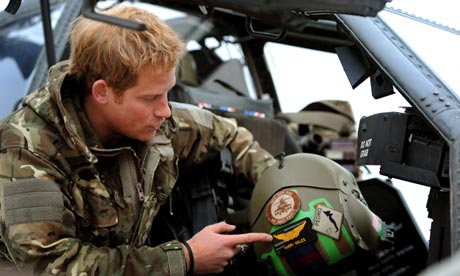
"It's a joy for me because I'm one of those people who loves playing PlayStation and Xbox, so with my thumbs I like to think I'm probably quite useful," Britain's Prince Harry said during interviews released upon his return from Afghanistan.

Explaining his four-month role as co-pilot of an Apache attack helicopter, Harry described the thrill of emergency response and the weapons systems he controlled in the gunship's two-man cockpit: Hellfire air-to-surface missiles, rockets and a 30-millimetre gun. Such statements are hardly surprising or shocking, but asymmetric warfare is fought along information lines and consumes anything in its path. Despite being cleared by the Ministry of Defense, Harry's comments quickly attracted negative press (targeting his princely qualities) and spurred a few grimaces on the MOD's own face.

"I'm not going to second guess whether he should or shouldn't have said it," spokesman Jim Murphy told the Guardian. "He's obviously a young and brave man. He was candid. Perhaps he may have been more candid than the Palace may have wished."

The Taliban naturally pounced on Harry's statements after failing to kill or capture him as promised. Spokesman Zabiullah Mujahid announced that, "49 countries with their powerful military failing in the fight against the mujahideen, and now this prince comes and compares this war with his games, PlayStation or whatever he calls it." Easily assailing the Prince for the flippant perception of his comments, Mujahid's counterattack appealed to any Afghan who loathes the notion of Afghanistan being treated as a game board for Westerners - from Britain and Russia's "Great Game" in the 1830s to the Soviet and NATO invasions nearly 200 years later. In this sense the disrespect of a "game" is very real in Afghanistan.

"This is a serious war, a historic war, resistance for us, for our people," Mujahid says.

However Harry's interviews are unlikely to make any immediate impact in Afghanistan. His testimony only confirms a new technological phase of an established pattern in war, and most Afghan civilians won't react as though he just murdered an innocent family or burned a Quran. Efforts to connect Harry's "mental problems" with the prolonged nature and brutality of Afghanistan's war may have more effect in Western countries than Afghan villages. Even Mujahid admits, "we don't take his comments very seriously, as we have all seen and heard that many foreign soldiers, occupiers who come to Afghanistan, develop some kind of mental problems on their way out."

More dangerous is the impetus to stage new Taliban attacks on Western targets in Kabul or elsewhere, which will be attributed to Harry's statements. Another factor to monitor outside Afghanistan is the public opposition of American video games set in foreign countries. These war games strike a cord with a variety of individuals, both the politically liberal and religiously conservative, who don't relate to the glamorous gamer side of war. The Trench has spoken with Yemenis who view Black Ops II's use of their country as gratuitous (try searching Yemen on YouTube), and some Pakistanis are beginning to organize a boycott against Call of Duty. Although the influence of these games on actual battlefields is minimal, public perceptions are crucial in counterinsurgency's wider scope and cannot be ignored at any size.

Any American force that generates anti-Americanism in a counterinsurgency environment is cause for concern.

Most disturbing are the long-term potentialities of advanced technological warfare: namely the gradual removal of humans from the killing process. Advocates of automated warfare argue that humans maintain control of the machine, a defense that is largely true for the moment but could break down over time. Drones may be more or less corruptible to enemy actors than humans; the process of this military experiment should be chaotic. Ultimately, whole fleets of drones could be concentrated in the hands of a small group or even one individual, further removing the human element from war. Drones could also be armed with weapons of mass destruction in the future.

Dehumanization is a constant theme of war - humanity might not be able to kill as it does without it. Problematically, all of these concerns and many others won't be eagerly addressed by Western governments or mainstream media.

January 19, 2013

AQAP, U.S. Drones Compete For Unpopularity In Yemen

As if to prove to any lingering doubters (few exist) that the Obama administration is going big into Yemen in pursuit of al-Qaeda in the Arabia (AQAP), between two and four drone strikes were conducted on Saturday night in Mareb governorate - the latter would be a 24-hour record. The bombings occurred in the Abedah valley near Wadi Abida, suggesting that a meeting was about to take place or had just taken place. A modest total of nine casualties have been reported, with varying accounts of their identification. Yemen's Defense Ministry recorded the destruction of two vehicles carrying AQAP suspects; local media has reported various AQAP-related deaths, at least one of them a Saudi national.

Estimating the total damage caused by drones is inherently challenging due to diverging local accounts, misreporting and media bias. Governments also cooperate or disagree with the U.S. (Pakistan, Yemen, Somalia) when denying civilian casualties or inflating militant kills. In short, every factor is preconditioned to obscure the truth.

Today's public outrage was immediate regardless of the collateral damage, hitting Yemen's local media and social networks hours before Marib's strikes reached the international press. Angry at their own government's inability to confront AQAP without foreign assistance, at the White House and House of Suad for interfering with their land, and at the lies told to cover up civilian casualties, Yemenis are stuck in a vicious catch 22: their current government and military lack the independent strength needed to reverse AQAP's influence, but the U.S. drones that temporarily fill this need are undermining the Yemeni government's own credibility with its people.

Wadi Abida is the same town that witnessed the droning of Jaber al-Shabwani, deputy governor of Marib. This episode opened a brief rift between Ali Abdullah Saleh, Yemen's former dictator, and the U.S. officials (David Petraeus and John Brennan) that received his approval to begin systematically bombing Yemen. Saleh's former vice president, Abd Rabbo Mansur Hadi, is now overseeing an escalation of this policy after the Obama administration and Saudi Arabia successfully installed Hadi as Yemen's transitional president.

The ongoing debate of whether drones bring more long-term risk than short-term reward  has yet to impede the Obama administration's escalation in Yemen, where the dual priorities of political and military hegemony overrule the immediate need for popular support. A large amount of today's condemnation was directed against John Brennan, President Barack Obama's nominee to replace Petraeus as CIA Director. This continuity is especially pronounced in Yemen, as Petraeus and Brennan handled Saleh's profile prior to the country's revolution and lobbied to fund the same "counter-terrorism" forces that have attacked Yemeni protesters, Southerners and Houthi members. 

The Obama administration continues to maintain ignorance of Brennan and U.S. Ambassador Gerald Feierstein's unpopularity - concrete evidence that U.S. policy has no intention of building sincere relations with Yemen's people.

How the U.S. and Yemeni governments are supposed to defeat AQAP's influence with this strategy has never been fully explained. Few U.S. officials are willing to address the specific effects of drones and U.S. policy in Yemen, and Washington's "commitment to supporting Yemen during its historic transition" hinges solely on self-interests, a policy that perpetuates guerrilla warfare. Luckily renewed focus is being driven onto this counter-productively as Brennan nears his confirmation hearing on February 7th, but popular appeals and collateral damage won't sway U.S. policymakers.

The final outcome will present a vivid contrast of reality - the Senate welcoming Brennan's rise and Yemenis wishing for his fall.

January 10, 2013

U.S. Interference Spoiling Yemen's Revolution

Yemen's new President, Abd Rabbuh Mansur Hadi, established working relations with John Brennan while serving as vice president to Ali Abdullah Saleh

The latest military restructuring announced by Yemeni President Abd Rabbuh Mansur Hadi brought much-needed relief to an anxious nation. Beyond establishing new regional commands to increase the Defense Ministry's centralization, Hadi's decrees finally terminated several high-ranking relatives of former president Ali Abdullah Saleh, namely his son Ahmed and nephew Yahya. Yemenis had demanded their dismissal from Saleh's personal "counter-terrorism" units since launching a revolution in January 2011, and both would assume instrumental roles in spearheading Saleh's vicious crackdown on peaceful demonstrators.

Gone, too, is the First Armored Division commanded by rogue general Ali Mohsen al-Ahmar, who defected from Saleh's government in March 2011 to escape punishment and pursue his own interests. His division and Ahmed Saleh's Republican Guard now count themselves as part of Yemen's Special Operations Command and Strategic Reserve Forces, and theoretically fall under Hadi's personal authority.

This news was lauded by John Brennan, the Obama administration's counter-terrorism coordinator (and current nominee for CIA Director): "Mr. Brennan extended President Obama’s congratulations to President Hadi for the decrees issued yesterday to further restructure the Yemeni armed forces, advancing the goal of a unified, professional military that serves the Yemeni people."

Unfortunately the jubilant air soon cleared and Yemen's situation has tumbled back downhill in the days since. Following their "removal," the normally resistant Salehs welcomed Hadi's announcement and pledged to cooperate fully, triggering immediate suspicion of their payoffs. Ali Mohsen greeted Hadi's orders as though they had nothing to do with him. Reports then surfaced to explain their reactions - new military appointments - and were half-confirmed by the spokesman of Yemen's embassy in Washington; Mohammed Albasha announced on December 23rd that “there are no restrictions to their reappointments in the Ministry of Defense."

Subsequent reports predict that Hadi's decrees could take six months to implement, and that Ahmed Saleh and Ali Mohsen will continue to oversee their positions until then. If they do receive new regional commands or advisory positions, they can thank their ongoing survival for the immunity granted by the Gulf Cooperation Council (GCC) and United Nations Security Council (UNSC).

These collective actions serve more private interests than Yemen's people, beginning with Hadi's interim government and the foreign powers that secured his promotion. Although he has admirably stepped up to fill Saleh's void after serving nearly two decades as his vice president, Hadi remains a controllable instrument of the GCC deal's true brokers, Riyadh and Washington. That leaves Yemen's revolutionaries - the country's future - at the bottom of national and international priorities, at a time when they have enough interference to deal with at home. Out-resourced by the oppositional Islah party, which dips its hands into most of Yemen's political movements, the country's civil parties have already been isolated in the UN-sponsored National Dialogue with few seats relative to the whole (the youth and women received 60 combined seats out of 565).

They could easily be squashed by Saleh's own General People's Congress (GPC) and the 112 delegates they plan to sit - the most of any bloc.

As of now the Islah-dominated Joint Meeting Parties (JMP), in addition to the youth, refuses to participate in the event that Saleh does represent his party (another "medical leave" is being planned by Riyadh and Washington, but both rumor and reality are fraught with uncertainties). Conversely, Islah has interfered with efforts to organize an independent youth conference, a phenomenal idea to advance a democratic Yemen, while Ali Mohsen's loyalists have "protected" the youth by militarizing their square at Sana'a University. The general recently agreed to withdraw his forces following persistent demonstrations against their presence, but only after months of physical altercations with the youth camps.

Yemen's youth and women are tragically viewed as groups to appease with scraps, not sources of national power to nurture and cooperate with. They have found few allies inside or outside the country due to their independent agenda, and cannot turn to the United States in their hour of need. The second incarnation of Yemen's Life March, a mobile demonstration traveling from the revolutionary hub of Ta'izz in December 2011 en route to Sana'a, recently arrived in the capital to remind Hadi and his foreign backers that they won't back down either. With no action taken by their transitional government or the UNSC, Yemenis once again marched to advocate their standing demands: "Dismissal of all military leaders who worked with Saleh, headed by Ahmad Ali Saleh, Ali Mohsen Saleh, Ghalib Algamesh and fully dismissing them and not reshuffling their positions in the new appointments, whatever the circumstances."

The march ended when government forces blocked its path and violently dispersed protesters with tear gas, eroding another piece of the goodwill initially earned by Hadi's military shakeup.

U.S. influence is hardly responsible for all of Yemen's politico-economic dilemmas and the tribal knots created by Saleh's nepotism. However the sheer gravity of America's counter-terrorism is warping Yemen's political and military reforms. The Obama administration no longer has practical use for Saleh and company, but they possess too much incriminating evidence on Saudi and U.S. actions in Yemen to be cast away completely. Instead Saleh has been kept close, traveling to America twice since the revolution began, and silent under the GCC's immunity package. Potential sanctions against "spoilers" - the always unnamed Saleh - remain a manipulative tool to avoid accountability.

In the meantime U.S. drones continue to strike at suspected targets of al-Qaeda in the Arabian Peninsula (AQAP), accumulating enough collateral damage to produce a bombshell report by The Washington Post. Hadi has opened a wider door than his predecessor in exchange for U.S. and Saudi support, approving the Obama administration's covert activities and moving to kill inquiries into civilian casualties. This relationship-building and the preservation of mutual interests is more responsible for Hadi's decrees than any genuine effort to uproot Saleh's regime from Yemen's political equation.

Ultimately, Ali Abdullah Saleh cannot be held accountable for decades of misrule because the U.S. and Yemen's power-sharing government are working outside the bounds of accountability. The fact that Washington and Riyadh have exhausted their operational need for his regime is far from stabilizing, and poses an enhanced threat to Yemen's democratic growth. One can reasonably assume that Washington will possess greater influence over Hadi's Special Operations Command than Saleh's U.S.-trained units. Counter-terrorism activities are being established in systematic fashion - land, sea and air forces surround the peninsula nation - but U.S. policy as a whole represents counterinsurgency at its worse: deep hostility and mistrust with the local population.

The Obama administration cannot realistically expect to defeat AQAP with its current strategy, and the same power that lifted Hadi to his current position is weighing him down with his own people.


"The main problem is not only with the US administration - extrajudicial killings in Yemen of 'suspected' targets, killing and terrorizing civilians and creating animosity towards the US - but rather with our government’s position, approving those drone strikes," says Noon Arabia, a Yemeni-Egyptian blogger who maintains her anonymity for personal and security reasons. "Former president Saleh with all his shortcomings tried to hide his role in allowing the US drones to strike in Yemen, before being exposed by Wikileaks. However his predecessor President Hadi not only publicly endorsed them, he even argued regarding their accuracy. Drone strikes in Pakistan decreased by 41% in 2011 and another 40% in 2012 because the Pakistani government publicly condemned and disapproved of them. Yet in Yemen they have increased by 240% in 2011, and another 250% in 2012 and most likely will increase further in 2013 thanks to our puppet government."

Yemen's revolutionaries are marching, bleeding and dying for a better future than what is currently being forced onto them. The U.S. would be wise to begin a new era of engagement and vanquish the same fear that is normally reserved for al-Qaeda.

January 8, 2013

Brennan Dons CIA's Death Mask In Yemen

Brennan maintained cordial relations with dictator Ali Saleh until he became less useful than his vice president 

As the majority of Washington's political and media establishment concentrate their firepower on Senator Chuck Hagel's nomination for Defense Secretary, John Brennan is doing what he does best and slipping through the shadows. Rumored since President Barack Obama secured his second term in office, Brennan has finally received a formal nomination to replace the scandalized David Petraeus and improve upon his work at the CIA. Disturbingly but not surprisingly, many American pundits have welcomed Brennan's promotion as a solid choice for the CIA's Directorship and expect a majority confirmation. 

They generally avoid real discussions over the areas of operations affected (and afflicted) by U.S. counter-terrorism, instead preferring the glamorous statistics of high-profile kills and Brennan's alleged construction of a "legal framework" for drones - as recently claimed by the United States District Court for the Southern District of New York (SDNY).

Brennan's positives are easy to list: "More al Qaeda leaders and commanders have been removed from the battlefield than at any time since 9/11." He has applied his extensive influence to “literally building" and leading the National Counterterrorism Center, which entailed the coordination of various military, intelligence and civilian departments across the globe. In the process Brennan has become one of Obama's most trusted advisors, so close that, “I don’t think we’ve had a disagreement.”

"For the last four years," Obama announced from the East Room, "as my Advisor for Counterterrorism and Homeland Security, John developed and has overseen our comprehensive counterterrorism strategy - a collaborative effort across the government, including intelligence and defense and homeland security, and law enforcement agencies."

However this fantasy hits a steel wall in Yemen, where Brennan and U.S. Ambassador Gerald Feierstein may be the most despised Americans to touch its soil. The immediate reaction to Brennan's promotion has been universally negative for good reason, as he reinforces the single-mindedness and unaccountability that drives an assortment of U.S. counterterrorism platforms being constructed around the nation. Brennan now picks up  Petraeus's "secret" agreement with Yemen's former dictator, Ali Abdullah Saleh, and was even deployed to Sana'a on multiple occasions during the country's ongoing revolution; he would assist Feierstein in facilitating the Gulf Cooperation Council's (GCC) unpopular power-sharing agreement when a drone strike didn't require overseeing.

Brennan told the Wilson Center in April 2012, "Yemen was fortunate that they do - did have a degree of political pluralism there, Ali Abdullah Saleh in fact allowed certain political institutions to develop, and we were very fortunate to have a peaceful transition from the previous regime to the government of President Hadi now."

A known intimate of Saudi Arabia's royal circle, Brennan's promotion also corresponds to recent investigative reporting on Saudi bombings in Yemen. Now he's promoted a week later, highlighting the obvious favoritism and imperialism that assisted his rise atop the CIA.

Given that Brennan has been nominated, in part, to embed the CIA deeper into Yemen, his presence is ultimately counterproductive to defeating al-Qaeda in the Arabian Peninsula (AQAP) and improving relations with Yemen's people. "Traveling through the Arabian Peninsula where he camped with tribesmen in the desert" has done little to promote their human rights and dignity, which are trampled on daily by the national government and its foreign partners. Victims of drone strikes have no recourse, and Yemen's revolution has been blocked by opportunistic relations with the ruling General People's Congress (GP) and oppositional Joint Meeting Parties (JMP).

Washington's Pakistani "model" has been improved by establishing better relations with the transitional government, led by Saleh's former VP Abd Rabbuh Mansur Hadi, but the exact same hostility is repeating within those who serve as the real front lines against AQAP.

A "keen understanding of a dynamic world" has also been absent from Yemen's counterterrorism operations. During a prolonged defense of the CIA's targeted killings, orchestrated throughout 2012 and Yemen's emerging bombardment, Brennan claimed that drones don't cause as much resentment as commonly believed. He never acknowledged a revolution amid the Obama administration's micromanaging of a "political crisis," and has no relationship with the people that are needed to stop AQAP at its roots. He's even been known to claim that drones don't kill any civilians, or else very few.

What Brennan will ensure is that AQAP's status remains healthy, and that Yemen remains under the firm grip of Washington and Riyadh.

To overrule these "results," as Obama calls them, flattery and hyperbole is piled onto Brennan's shoulders in an effort to democratize him, so to speak. Instead of a calculated killer that has taken his share of civilian life, Brennan is heralded as a "legendary, tireless patriot" and a model of American "integrity." Ethics and values are stressed as a counterweight to the perceived constitutional violations that drone warfare entails.

"There’s another reason I value John so much, and that is his integrity and his commitment to the values that define us as Americans. He has worked to embed our efforts in a strong legal framework. He understands we are a nation of laws. In moments of debate and decision, he asks the tough question and he insists on high and rigorous standards. Time and again, he’s spoken to the American people about our counterterrorism policies because he recognizes we have a responsibility to be [as] open and transparent as possible."

The SDNY recently refused to address the killing of 16-year old U.S. citizen Abdulahman al-Awlaki, son of Anwar al-Awlaki, on the grounds that the Obama administration never released any information on his killing. Unlike his father, whose droned body was held up as a trophy by Brennan and company, Abdulrahman's murder was first denied, then silenced and finally labeled an "outrageous mistake" by an anonymous official over a year later.

His or her statements occurred within a glowing profile of the CIA veteran.

Brennan was incapable of bringing a shred of peace to Yemen as Obama's counterterrorism advisor and remains helpless at the CIA - he can only deliver death and destruction. His tireless drone fleet will always kill civilians in between terrorists and the process will stay classified to Americans and Yemenis alike. The Predator and its sole purpose of killing serves as a permanent symbol of U.S. imperialism, and lacks the ability to build relationships at the local level. Mere flyovers cause terror. This policy violates America's morals, the spirit of the Nobel and the strategic essence of counterinsurgency all at once. A plan that fails to kill more militants than it creates doesn't qualify for counter-terrorism or counterinsurgency - expedient recklessness is a more accurate definition.

"What scares me about drone strikes is how they are perceived around the world," retired general Stanley McCrystal told Reuters in a new interview, coincidentally implicating Brennan himself. "The resentment created by American use of unmanned strikes ... is much greater than the average American appreciates. They are hated on a visceral level, even by people who've never seen one or seen the effects of one."

Until U.S. policy undergoes a radical shift in fundamentals, a change unlikely to occur under Brennan, America has already lost its small war in Yemen.