Showing posts with label Egypt. Show all posts

November 19, 2012

Where Does Sudan Fit Into Gaza's Endgame?

On Saturday The New York Times reported one of the primary objectives of Israeli military operations in the Gaza Strip: Fajr-5 rockets capable of hitting Jerusalem and Tel Aviv. These rockets are allegedly shipped into Gaza via a complex smuggling chain, imported to Sudan in pieces and transported through Egypt before being assembled in Gaza by Hamas and Iranian arms experts. Each is then assigned a "special operator" to man his rocket on the "day of judgment" at the orders of Hamas's political leadership.

Problematically for Hamas, its "tie-breaker" broke minutes after an Israeli air strike terminated its senior military strategist, Ahmed Jabari.

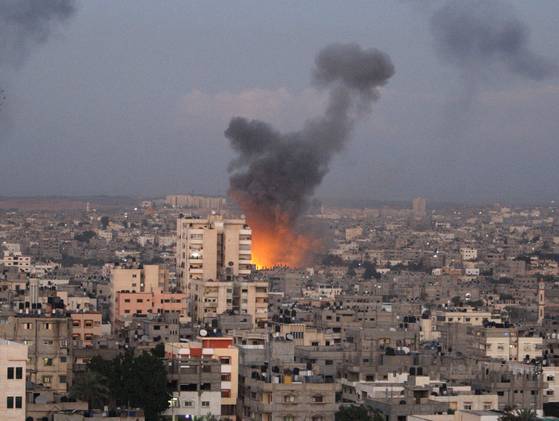
The pinpoint destruction of Hamas's Iranian-manufactured Fajr-5 rockets, which range to 50 miles, appears to be the greatest tactical blow suffered thus far by the group (Hamas also lost its internal UAV plant). According to the Times, "most" of an estimated 100 rockets were destroyed in the first bombing waves; anonymous Israeli officials place their figure at a modest 20, leaving the probable number somewhere in between. The means of destruction, though, count more than its end. Largely a creation of Jabari, each piece of Hamas's stockpile had been monitored and tagged over several years by IDF intelligence chief Maj. Gen. Aviv Kochavi.

"The innocent-looking launching sites, covered by soil, were supposed to go into action when the time came,” Al-Monitor reports. "However, the IDF was ahead of them: Just a few minutes following the targeting and killing of Jabari, the second wave of air strikes was already underway and within a quarter of an hour, virtually the entire lineup of Fajr-5 rockets was eliminated."

The upshot is that Hamas need more rockets and will almost certainly find a way to smuggle them in, taking into account Israel's sophisticated intelligence network. This development advances the question of what role, if any, Sudan's government plans to play in Gaza's renewed fighting.

Khartoum's likeliest immediate answer won't extend beyond political rancor. Shortly after Jabari's assassination, Sudanese President Omar Bashir called Israel the “Zionist enemy” that “will remain the enemy" of Sudan and Muslims. Sudan's Foreign Minister, Ali Karti, followed up his boss's rhetoric by calling for the Arab League's heads of state to hold an emergency summit. Raising more eyebrows, Hamas's Khalid Meshal popped up at Khartoum's Armed Forces Mosque after Friday Prayers, vowing retaliation for the Israeli strike on Yarmouk Ammunition Factory.

"You killed Jabari and you can go on and kill Mashaal and others," the defiant chairman told his audience, "but in the end it'll pave our way to Jerusalem… Assassinating our leaders will only make us more powerful."

Meshal boasted that the Sudanese people will "hear good news soon," and the emptiness of his promise is easily taken for granted. Yet the situation's terms do appear to be evolving and Israeli security observers believe that last month's attack on Yarmouk brought Sudan directly into the conflict. This preemptive raid and its warning shot now marks Israel's latest operation in Gaza, and is fortunately enjoying a large share of retrospective observation as a result. While Israel has targeted Sudanese interests throughout the last decade with minimal consequences, the accumulation of grievances and interconnectivity of Israel's relations with the Arab world cannot be underestimated either.

This is not to say that, in the event of an Israeli ground invasion, Sudan will assume any direct combat or support role for Hamas. What should be expected is renewed effort to outsmart the Israelis, improve the defenses of Hamas's armories and stock them with more advanced weaponry. Neither Iran nor Sudan's government will be deterred by Israeli military action, which also serves domestic interests, and Hamas isn't built to quit armed resistance. Rocket fire has yet to abate in the face of over 1,000 airstrikes. Both sides, in the end, are playing into each other's hands and maintaining a regional stalemate.

Gaza's current battle may burn out soon or rage for weeks, but one conclusion is already apparent: Hamas will re-up its weapons and replace Jalabi, leaving the region more hostile for all peoples. How the group refills its army is something to monitor until Gaza's next battle.

November 14, 2012

Reading The Omen Of Israel's Air Strike On Ahmed Jabari

The joint IDF-Shin Bet air strike that killed Ahmed Jabari, Hamas's senior military commander in Gaza, appears to present one of two scenarios: the decapitation strike heralds a finale to Israeli Prime Minister Benjamin Netanyahu's campaign against Gaza's elusive rocket-launchers, or the beginning of a new war that could exceed the last.


Current developments suggest that the first option remains an outside possibility. Having bagged a trophy for his voting public, Netanyahu may attempt to stay out of a longer, more costly intervention of the Gaza Strip and protect the gains he has secured. Or someone could manage to talk some sense into him, and convince him that a large-scale operation in or above Gaza is not the means to win votes in the UN General Assembly.

However Hamas and Gaza's militant offshoots have no choice except to deliver on their promised retaliation, a cycle that Israel is equally willing to perpetuate. Multiple "truces" have immediately broken down and both sides attribute responsibility to the other. This fire is likely to heat up before cooling down. On Monday the Islamic Jihad's Khaled al-Batsh explained his group's status: "The ball is in Israel's court. The resistance factions will observe Israel's behavior on the ground and will act accordingly."

Israeli Home Defense Minister Avi Dichter announced on Tuesday, "There is no precedent in history of destroying terror by air power alone. It hasn't happened and it won't happen. Thus it is necessary to reformat Gaza altogether."

The air strike on Jabari soon followed.

In the event of a large-scale conflict in Gaza, its fourth-generation waves will reach across oceans and could seriously threaten the region's stability. More political theater than war at this point, Netanyahu is visibly positioning his right-wing coalition with Foreign Minister Avigdor Lieberman for January 22d's election. He's also sending a twisted message to the UN General Assembly, as if to prove that Israel will do whatever it wants if it feels threatened. This message has been repeatedly delivered to and discarded by a sizable portion of the international community, which views Israel's disproportionate response as counterproductive to solving Gaza's dilemma. Its latest air strikes are on their way to killing more civilians than Palestinian rockets killed in the last 3 years.

The Israeli government is already floating the idea of withdrawing completely from the Oslo Accords if Mahmoud Abbas plays his hand for "advanced status" on November 29th.

And is there any coincidence to the fact that Ahmed Jabari was assassinated on the same day that President Barack Obama issued his first post-election address, remarks that focused on diplomacy with Iran? The attack on Gaza appears to be aimed equally at Hamas, Iran and Obama, who allowed 2008's invasion to pass in silence and appears unable to stop another. Obama could opt split the difference by opposing war in Gaza and the Palestinians's UN bid; Tehran, Damascus and Cairo's responses are less predictable. None of these options promise much for the people on the ground.

Many combustible factors are reacting to each other in the region, turning Gaza into a microcosm of its surroundings. Information and disinformation has spiked, and further advances in social media will infect the conflict. Only time will shakedown the possibilities into reality.

[Update - The U.S. State Department has just released the following statement voicing unequivocal support for Israel's actions:

STATEMENT BY MARK TONER, DEPUTY SPOKESPERSON
U.S. STATE DEPARTMENT

Gaza Rocket Attacks

We strongly condemn the barrage of rocket fire from Gaza into southern Israel, and we regret the death and injury of innocent Israeli and Palestinian civilians caused by the ensuing violence. There is no justification for the violence that Hamas and other terrorist organizations are employing against the people of Israel. We call on those responsible to stop these cowardly acts immediately. We support Israel’s right to defend itself, and we encourage Israel to continue to take every effort to avoid civilian casualties.


Hamas claims to have the best interests of the Palestinian people at heart, yet it continues to engage in violence that is counterproductive to the Palestinian cause. Attacking Israel on a near daily basis does nothing to help Palestinians in Gaza or to move the Palestinian people any closer to achieving self determination.

November 1, 2012

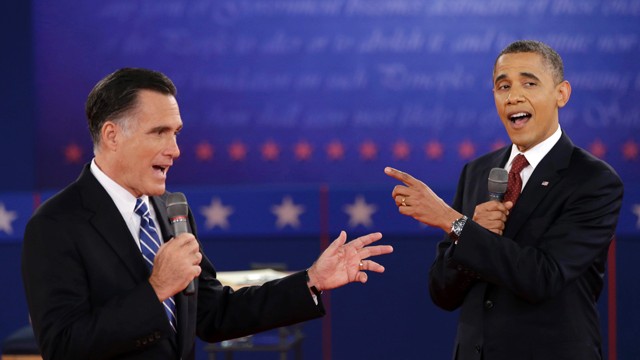
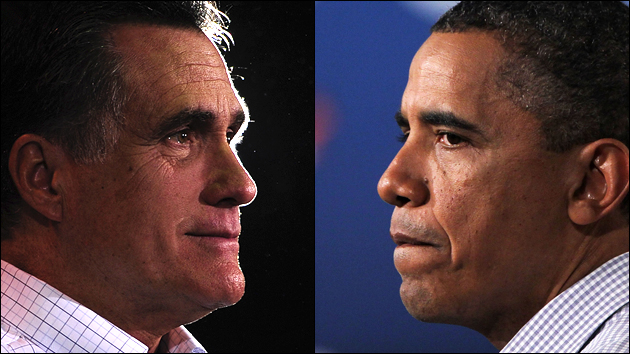
Obama, Romney Vie for Middle East Hegemony

Published by Muftah.org - Visit Muftah for independent analysis on events in North Africa, the Middle East and South Asia.

In the days following President Barack Obama’s speech at the Democratic National Convention in September 2012, administration officials and U.S. media seesawed over a post-convention “bump” that elevated his standing above Republican challenger, Mitt Romney. Numerous polls, including a recent Fox News surveymarked a widening gap between the candidates on a variety of issues, with Obama largely taking the lead: education (+14), Medicare (+11), terrorism (+8 points) and foreign policy, where Obama rated 15 points higher than Romney.

However, no matter who wins this November, people in the United States and Middle East will likely be stuck with largely the same U.S. policies toward the Middle East and North Africa that have held sway for decades.

Romney Runs on Traditional GOP Diesel

Although Romney’s policies in the Arab world are masked by ambiguity, scarecrows and red herrings designed to project a friendly aura toward the region, his administration runs on traditional GOP (Grand Old Party) diesel and exploits a widespread anti-Muslim trend in the mainstream Republican party.

While blaming Obama for “diminishing American leadership” is standard fare, and a valid point when it comes to the Middle East, Romney’s hawkish and insensitive tendencies toward local populations and fledgling pro-democracy movements in the region are undeniable. In his own words, Romney’s circle is staffed by pollsters who apparently are not “going to let our campaign be dictated by fact checkers.”

More importantly, however, in many areas outside Iran and Israel’s airspace, Romney’s proposals mirror Obama’s. In his October 2011 white paper, titled “American Century Strategy: secure America’s enduring interests and values,” Romney demonstrates the numerous points of mutual agreement between himself and Obama while exposing the toxicity beneath his sweet rhetoric.

According to this document, the “unfinished” project for an “American Century” is something his administration would complete, and the Arab revolutions something to be manipulated under the banner of democracy: "To protect our enduring national interests and to promote our ideals, a Romney administration will pursue a strategy of supporting groups and governments across the Middle East to advance the values of representative government, economic opportunity, and human rights, and opposing any extension of Iranian or jihadist influence. The Romney administration will strive to ensure that the Arab Spring is not followed by an Arab winter."

In a “dangerous, destructive, chaotic” world, Romney plans to “lead the free world” as the “free world leads the entire world.” This policy includes joining Israel’s crusade against Iran’s nuclear sites, a potential war that an estimated 60-70% of Americans disapprove of, as a means of projecting America’s strength.

Two Sides of the Same Imperialist Coin

Obama, on the other hand, has fashioned himself into an arbitrator of war and peace, wielding a Nobel Peace Prize in one fist and Osama bin Laden’s head in the other.

Four years removed from his promise of a new era of engagement between the U.S. government and Muslim world, negative perceptions that have accumulated between both sides as a result of decades of war, intervention, exploitation and continual strife continue to hold sway.

Obama is not personally responsible for this entrenched status quo, but he is to blame for overselling and under-delivering on his promise to repair relations with the ambiguously-defined Muslim world. Under Obama’s watch, U.S. policy in the Persian Gulf’s sphere of influence has continued to lack “American leadership.”

The race for bin Laden represented a triumph for whoever reached him first and Obama will likely reap the personal benefits of this success for the rest of his life. The glorified kill, along with an increase in drone warfare across the region and the strategic rise of U.S. Special Forces missions, has allowed Obama to continue his foreign policy of “less force” with minimal domestic resistance.

Obama’s case for non-military action against Iran, withdrawing from Iraq and Afghanistan, and promise to “disrupt terror plots wherever they form” became more convincing after bin Laden’s death on May 2nd, 2011. Well-meaning critics of America’s new military strategy find it difficult to attack a policy that costs less American lives and taxpayer dollars.

Iraq & Afghanistan

Obama and Romney have wrangled over their respective policy positions on Iraq and Afghanistan. Nevertheless, they share more common ground than differences and have both failed to present a realistic approach to U.S. engagement with these countries. The President has grown fond of bragging that he “ended the war in Iraq,” and has refused to unspin Romney’s own policy, as ongoing Iraqi casualties make for dangerous political ground.

With regard to Iraq, Romney claims that “a democratic Iraq allied to the United States is within our reach,” but that Obama has “threaten[ed] to snatch defeat from the jaws of victory.”

Promising to use a “broad array of foreign policy tools – diplomatic, economic, military” to bring Iraq within the U.S. sphere of influence, Romney focuses on Obama’s “failure” to install a residual military force. He ignores the political void that the administration has encouraged by supporting Prime Minister Nouri al-Maliki. To the extent that the Obama administration has responded to Romney’s attacks, it has described his approach to Iraq as “tragic.”

In reality, Obama and Romney have ended up in al-Maliki’s leaky boat, a circumstance that neither candidate likes to discuss. Both fail to acknowledge (at least publicly) that Washington’s deficiencies in Iraq stem from political inequalities, not military shortages. Prolonging the deployment of U.S. troops under the authority of the divisive al-Maliki would have added to the Iraqi prime minister’s leverage over Sunni, Shia, and Kurdish political opponents; an extension of American involvement would have generated as many security problems as it would have solved.

The incumbent and challenger find similar common ground in Afghanistan, where Romney agrees with the bulk of Obama’s strategy despite public feuding.  In line with Obama administration policy, Romney’s white paper approves of the 2014 transition to Afghan security forces and demands greater accountability from Afghanistan and Pakistan’s governments. Contrary to Obama’s DNC announcement that “in 2014, our longest war [Afghanistan] will be over,” his administration – like Romney’s – hopes to maintain a long-term security presence in the country after 2014.

Romney opposes negotiating with the Taliban and still intends to eliminate the group from Afghanistan, an unrealistic move that would ultimately extend the war. Much like Obama, Romney is liable to send air or ground troops across Pakistan’s border in search of the elusive Haqqani network, one of the Afghan Taliban’s most organized arms and a major thorn in U.S. strategy. Such a move would likely perpetuate Afghanistan’s war by causing new friction between Washington and Islamabad.

The Illusion of Choice

The greatest regional divergence between the candidates centers around U.S. policy toward Israel and Iran. On this front, Romney believes he can score fast points by portraying himself as the anti-Obama. For his part, Obama has remained focused on isolating Iran globally and has tread cautiously around talk of war, in response both to advice from America’s military leadership and public resistance to another “big” war in the Gulf.

While conceding that economic and diplomatic isolation is necessary, Romney insists that defusing Iran’s nuclear ambitions can only be achieved through the real threat of war – a plan that includes “repairing relations with Israel.” Unlike Obama, Romney would “never refuse a meeting” with Prime Minster Benjamin Netanyahu (a story that the White House denied), reject Israel’s insistence on a “red-line” for stopping Iran’s enrichment program, or throw Israel “under the bus.

Romney casts Obama as “pro-Palestinian,” reinforcing the twisted state of U.S. policy toward the Arab-Israeli conflict under either candidate. In reality, Obama has abandoned the Palestinians and spent far more energy confronting the Iranians, as the Israelis prefer.

Upon taking office, Obama announced that he would break from the Bush administration’s 11th-hour drive for peace between Israelis and Palestinians and pursue an equitable two-state solution  “from day one.” Sadly, Obama has fallen into the same trap of bias and inaction, even excluding the Palestinians from his acceptance speech at the DNC. If peace is harder to make than war, it stands to reason that greater energy must be applied.

As for Romney, he is far from eager to help the Palestinians and certainly more passionate about the Israeli cause. He claims that Iran, not the Israeli-Palestinian conflict, serves as the region’s central issue. Tehran’s regional policies admittedly run on a variety of unrelated interests, from Syria and Afghanistan to its hegemonic dispute with Saudi Arabia. Its nuclear ambitions may beyond compromise. Yet, at the same time, one cannot help observing that the Islamic Republic of Iran has never known a world with a sovereign Palestinian state. Should such a state come to be, one wonders how Iran’s regional ambitions and strategies might change.

Continuity on the Arabian Peninsula

In Yemen, the current administration has deployed Obama’s trusted counterterrorism adviser John Brennan as its lord of war and occasional senior “diplomat” in the country. Both he and U.S. Ambassador to Yemen, Gerald Feierstein, are extremely unpopular figures due to U.S. handling of Yemen’s ongoing revolution, its extensive drone program, and other covert U.S. activities in the country.

Romney would likely follow similar policies in Yemen by utilizing drones, Special Forces and CIA personnel to safeguard U.S. interests.

As Obama and Romney both operate their regional agendas on a steep Iranian tilt, U.S. policy toward Bahrain would also stay consistent between administrations – planted firmly on the side of Bahraini King Hamad bin Isa Al Khalifa’s crackdown against pro-democracy forces.

America’s counterrevolutionary actions in select regional states have reinforced the hypocrisy of U.S. foreign policy in the region, especially toward the Libya and Syria interventions. Rather than pointing to this inconsistency, Romney has instead accused Obama of encouraging an “Islamic winter,” while portraying himself as tougher on Iran and Islamists.

Conclusion: Marooned on Hope Island

Given his own positions, Romney is clearly incapable of fostering lasting stability and peace in the Middle East. Improving the trajectory of U.S. policy in the region requires the type of personality that Obama promised and never delivered, making his failures historically significant.

Poll after poll concludes that Obama fell into an enormous trust gap left by previous administrations. Too many Muslims still perceive America as a unilateral actor in the region and an outright threat to their national interests. Accordingly, in Egypt, Turkey, Jordan, Yemen, Pakistan, the Palestinian territories and other regional countries entangled within U.S. foreign policy, Obama’s popularity remains very low.

Romney is minimally concerned with public relations in these countries. He is, nevertheless, right one on account: Obama has failed to deliver the leadership that he promised in the Middle East. Romney would, however, offer no respite from Obama’s fox-like friendship with the Palestinians and pro-democracy actors in the region.

The dilemma of lesser evils may be an inherent problem of democracy, but the ranking of America’s presidential candidates cannot be pegged to the failures of past leaders, such as George W. Bush. Finding a truly excellent candidate is an ideal worth pursuing. As for the diverse peoples of the Middle East, nothing has changed since Obama entered the Oval Office and nothing will change if Romney evicts him: they must still free themselves of foreign interference on the path toward determining their own future.

October 22, 2012

Mainstream Media Hypes Foreign Policy Circus

A rudimentary display of U.S. foreign policy will take place tonight in Boca Raton, Florida between President Barack Obama and challenger Mitt Romney.

Interestingly, America's mainstream media has taken to hyping Monday's presidential debate with a common narrative: "How the Obama-Romney foreign policy debate could determine the election. With turmoil increasing in world hot spots, foreign policy and national security have become major presidential campaign issues. From China to Israel, Iran to Syria, stateless terrorists to struggling alliances, Mitt Romney and Barack Obama will have plenty to debate Monday night."

"If, at the start of the general election campaign, you told a seasoned political strategist in either party that the fate of the presidential race could well hinge on the foreign-policy-focused third debate, the reaction would have ranged from an eye roll to laughter," writes The Washington Post. "And yet, here we are. President Obama and former Massachusetts governor Mitt Romney head to Boca Raton, Fla., for their final debate Monday night with national polls suggesting that the race is tied and with the terrorist attack in Benghazi, Libya, dominating the headlines."

Where to start with this manufactured slant? Does one dead ambassador equal the difference between relevant and unimportant foreign policy in America?

There's no denying factual sections of the media's deceptive hyperbole. In terms of foreign policy, American voters are looking for a "tough" but "responsible" president to confront terrorist threats and international powers. They want someone that won't start a reckless war with Iran but will respond to terrorist pinpricks and plots that never fully develop. Essentially, Americans want their country to maintain global supremacy at an efficient cost. Most now seek limited military engagement abroad on the road to fiscal responsibility at home, a perfect combination for the rise of drone warfare and unconventional Special operations. However these matters address America's national security before its raw foreign policy.

Obama himself told reporters over the weekend, "Spoiler alert: we got Bin Laden." This talking point will make for an extra long debate.

National security understandably becomes more relevant when some visceral incident has just occurred. However foreign policy remains a low set of priorities - the mainstream agenda clearly believes that it needs to exaggerate Monday night's significance. Foreign policy areas themselves will be debated at the shallowest levels. Not even Libya's revolution, from the beginning to NATO's invasion to the country's future, will receive a thorough examination. Neither will seriously engage U.S. policy in Egypt, Yemen, Bahrain or other coverups that support U.S. interests over popular movements. Syria is more likely to descend into a brawl over semantics than hard policy.

Worst still, Romney has encouraged his base's anti-Americanism by blaming the Middle East's turmoil on Obama's "abdication of leadership." Obama has failed to uphold his own promise to engage the Arab world, instead consenting to a vast counterrevolution in the region, but Romney dangerously preaches the return to an "American Century."

Larger issues like China may not be movable by one or the other; Russia should cause equal trouble for both.

Each candidate brings a different set of problems to the same table, potentially resulting in similar outcomes. While Obama and Romney diverge widest on the possibility of war against Tehran, both of their regional agendas operate on a steep Iranian tilt. Both will try their hardest to convince the audience that they support Israel more than the other, and ultimately leave the Palestinians in the dust on their way to promising a hollow two-state solution. Their policies are nearly identical in Afghanistan - both want the majority of U.S. troops out by 2014 so long as they can deploy a residual force afterward. Obama publicly claims that Afghanistan's war will end in 2014, and he may prepare a surprise for Monday night, but Iraq's ending says otherwise.

The moderator is unlikely to fact check Obama's wayward policy in Iraq, which the President says he's looking forward to debating. Dozens of bombings and shootings continue to plague the country each month, often as Obama declares the war over from 9,000 miles away. Many large-scale attacks have been claimed by al-Qaeda in Iraq, a group that didn't exist before U.S. troops arrived in 2003 and could have 5-10 years of life in it. The response to these security incidents and Iraq's general reconstruction has also been obstructed by the poor leadership of Prime Minister Nouri al-Maliki. The Obama administration's passivity towards Baghdad's political crisis has resulted in a gradual loss of influence with the divisive al-Maliki, who retained his position in 2010 with U.S. assistance. Obama's policy in Iraq qualifies as one of his worst, but he will spin it into one of his highlights.

The brightest light, of course, will shine upon Osama bin Laden's dead body. Here Obama will hit Romney hardest to score as many points as possible, bludgeoning him on a topic that Romney has no real control over. He will mention his drone achievements and few to none of his failures. Obama could speak of his kills in Yemen but will certainly not mention how unpopular he has become in Yemen. He will rout al-Qaeda on more than one occasion, "from Pakistan to Somalia" before "staying alert" in new hotspots. He may go near Mali if he's feeling bold, to highlight the international coalition being put together by U.S. allies, but avoiding al-Qaeda's other hideouts makes for smarter politics. Obama won't mention that al-Qaeda cells in Iraq crossed into Syria.

Romney will take these punches and throw back as many as he can design. Both will do whatever they can to distract voters from actual issues, instead emphasizing terrorism and the type of American "leadership" that translates into hegemony. U.S. media has already responded in a similar fashion by placing terrorism at the top of their scorecard. "Voters finally get to know Obama and Romney's foreign policies" - when Monday is far too late to make informed decisions. Unfortunately those seeking a deeper conversation on foreign policy will leave empty handed, and those comforted by the shallows will move onto the next channel when the debate is over.

Only a major screw up, not any real wisdom, moves the political needle on election day.

September 27, 2012

Vintage Obama Whitewash At The UN


Although remixed around the patriotic beat of Ambassador Chris Stevens, President Barack Obama's latest foreign policy address provides no reason to edit a review of his Democratic nomination speech. Speaking to the UN General Assembly on Tuesday, Obama instead resorts to many of the fallacies and blatant lies that mark his overall foreign policy, especially his administration's duplicitous reaction to the Arab revolutions:
"It has been less than two years since a vendor in Tunisia set himself on fire to protest the oppressive corruption in his country, and sparked what became known as the Arab Spring.  And since then, the world has been captivated by the transformation that’s taken place, and the United States has supported the forces of change.

We were inspired by the Tunisian protests that toppled a dictator, because we recognized our own beliefs in the aspiration of men and women who took to the streets.

We insisted on change in Egypt, because our support for democracy ultimately put us on the side of the people.

We supported a transition of leadership in Yemen, because the interests of the people were no longer being served by a corrupt status quo.

We intervened in Libya alongside a broad coalition, and with the mandate of the United Nations Security Council, because we had the ability to stop the slaughter of innocents, and because we believed that the aspirations of the people were more powerful than a tyrant.

And as we meet here, we again declare that the regime of Bashar al-Assad must come to an end so that the suffering of the Syrian people can stop and a new dawn can begin."
The first claims involving Tunisia, Egypt and Yemen demonstrate, without need of further proof, that Obama entered the UN chamber with the intention of rewriting history rather than making it. Tunisia's events occurred so quickly that Washington never had a chance to fully react, but the administration hesitated from ditching a U.S.-Saudi ally in Zine El Abidine Ben Ali. The administration was slightly more prepared when the first embers of revolution engulfed Egypt, resulting in an attempt to install the country's intelligence chief as Vice President. While the experiment predictably failed to prevent the collapse of Hosni Mubarak's regime, Washington's more viable contingency soon kicked in and supported the Egypt's Supreme Council of Armed Forces (SCAF) until its dissolution in June 2012. 

During this time the SCAF waged a systemic harassment campaign against Egypt's revolution in order to disrupt their political organization and slander their credibility.

As for U.S. policy in Yemen, Washington had few problems with Ali Abdullah Saleh before the revolution started to threaten spheres of power. Despite his fair-weather friendship, the Obama administration decided that Saleh's corrupt regime needed to be fed if he was to cooperate against al-Qaeda in the Arabian Peninsula (AQAP). In fact a drones base was approved prior to January 2011 and accelerated after the revolution broke out across the country (a billion dollar aid package was put on hold). Had none of these revolutions occurred, the U.S. government would have stuck behind the exploitive and repressive governments that counted themselves as allies of America. Obama naturally presents an alternative version of this reality.

"Now, let me be clear: Just as we cannot solve every problem in the world, the United States has not and will not seek to dictate the outcome of democratic transitions abroad."

On February 21th, 2012, Washington and Riyadh watched the conclusion of their single-candidate referendum promote Saleh's compliant vice president, Abd Rabbuh Mansur Al-Hadi. Obama recently "dropped by" Hadi's UN side-meeting with counterterrorism czar John Brennan to reinforce America's hegemony in Yemen.

The relationship between Libya and Syria forms the second half of U.S. policy - the half that explicitly desires total regime change. U.S. officials argue that these two warzones far exceed the response of those governments intwined with Western capitals, a truism that obstructs a debate over America's notion of "selective democracy." When paired with the governments that Washington has attempted to preserve, U.S. policy in Libya and Syria appears less concerned with freedom than hegemony. Russia's behavior in Syria is particularly influenced by Libya's events and the general belief that Washington is manipulating revolutionary outcomes in its favor.

"These are not simply American values or Western values - they are universal values," Obama tries to convince his audience. "And even as there will be huge challenges to come with a transition to democracy, I am convinced that ultimately government of the people, by the people, and for the people is more likely to bring about the stability, prosperity, and individual opportunity that serve as a basis for peace in our world."

By frequently invoking Stevens' death as he counters an inflammatory film and its aftershocks, Obama spins the ambassador into another instrument of U.S. propaganda. Couched within his message of unity and tolerance is an unflinching counterrevolutionary message. Obama claims that, "the events of the last two weeks also speak to the need for all of us to honestly address the tensions between the West and the Arab world that is moving towards democracy." This tension is a product of the status quo that Washington is still pushing on the Middle East. After promoting his own administration's counterrevolution and "diplomatically" targeting Iran's nuclear program, Obama ignores the island of Bahrain entirely and puts in a hallow word of support for the Palestinians (who were dropped in favor of Israel during his nomination speech).

"Among Israelis and Palestinians, the future must not belong to those who turn their backs on a prospect of peace. Let us leave behind those who thrive on conflict, those who reject the right of Israel to exist. The road is hard, but the destination is clear -- a secure, Jewish state of Israel and an independent, prosperous Palestine. (Applause.)  Understanding that such a peace must come through a just agreement between the parties, America will walk alongside all who are prepared to make that journey."

Obama has spent the majority of his term ignoring the Israeli-Palestinian conflict, and appeared to give up until his next potential term after George Mitchell resigned from his mediation role. Nor has he been dissuaded by Iraq's ongoing violence when declaring, "The war in Iraq is over. American troops have come home." Obama claims that "America and our allies will end our war in Afghanistan on schedule in 2014," seemingly ruling out the possibility of a long-term military presence. However the Taliban will continue fighting regardless of the presence of a residual force, meaning this war will also fail to end neatly in December 2014. Given that Obama is willing to lie about the end of war and Washington's involvement in democratic transitions, he's liable to distort the conditions in any area ofU.S. foreign policy.

"The United States of America will always stand up for these aspirations, for our own people and for people all across the world. That was our founding purpose. That is what our history shows. That is what Chris Stevens worked for throughout his life."

This isn't what recent history shows - only a history that is deep in the process of subjective revision.

September 15, 2012

Obama's Hope Is the Middle East's Lesser Evil

In the days following President Barack Obama's speech at the Democratic National Convention, administration officials and U.S. media seesawed over a post-convention "bump" that reportedly elevated his values above Republican challenger Mitt Romney. Numerous polls, including a recent Fox News survey, have marked down a widening gap across the board: education (+14), Medicare (+11), terrorism (+8 points) and foreign policy, where Obama rated 15 points higher than Romney. Many Americans and the Middle East's populaces do share something in common after all.

They are stuck with the Obama administration's foreign policy by default.

Judging from the overall actions of his first term, Obama himself received no bump in the Middle East after delivering a one-sided and misleading acceptance speech in Charlotte, North Carolina. Four years removed from promising a new era of engagement between the U.S. government and Muslim world, both sides refuse to stray far from the negative perceptions that have accumulated over decades of war, intervention, exploitation and continual strife. Obama isn't personally responsible for this status quo, only for over-promising and under-delivering in order to cast a favorable political glow upon himself. Stagecraft would trump statecraft as the U.S. economy came first and now U.S. policy in the Persian Gulf's sphere of influence is, as Romney warns, lacking "American leadership." Unfortunately his proposals are both vaguer than Obama's and more hostile to the region's stability, and his circle is staffed by pollsters that apparently aren't "going to let our campaign be dictated by fact checkers."

"The worst part of this election is there are so many valid grounds to criticize Obama," The Guardian's Glenn Greenwald Tweeted the day after Obama's speech, "and the Right voices almost none of them."

Washington's
Shades of War

Although Romney's policies in the Arab world are masked by ambiguity, scarecrows, red herrings and other distractions, his potential administration runs on traditional GOP diesel and factors into account a widespread anti-Muslim trend in the mainstream Republican party. Blaming Obama for "diminishing American leadership" is standard fare, and a valid point in the Middle East if not for his own hawkish and insensitive tendencies. Inside his October 2011 white paper, titled "American Century Strategy: secure America's enduring interests and values," Romney meets Obama at numerous points of mutual interest while exposing the toxicity brewing beneath his sweet rhetoric. His circle of GOP veterans believes that the "unfinished" project for an "American Century" is something to be completed, and the Arab revolutions something to be manipulated under the banner of democracy.

"To protect our enduring national interests and to promote our ideals, a Romney administration will pursue a strategy of supporting groups and governments across the Middle East to advance the values of representative government, economic opportunity, and human rights, and opposing any extension of Iranian or jihadist influence. The Romney administration will strive to ensure that the Arab Spring is not followed by an Arab winter."

In a "dangerous, destructive, chaotic" world, Romney plans to "lead the free world" as the "free world leads the entire world." This policy includes joining Israel's crusade against Iran's nuclear sites, a potential war that an estimated 60-70% of Americans disapprove of, as a means of projecting America's strength. Obama, on the other hand, has fashioned himself into an arbitrator of war and peace, wielding a Nobel in one fist and Osama bin Laden's head in the other. The race for bin Laden offered a trophy to the winning administration and Obama will personally reap the benefits as long as he lives. The glorified kill, along with the advance in drone warfare and strategic rise in U.S. Special Forces, also allows him to continue his foreign policy of "less force" with minimal domestic resistance.

Obama's case for non-military action against Iran, withdrawing from Iraq and Afghanistan, and promising to "disrupt terror plots wherever they form" became more convincing after May 2nd, 2011. Well-meaning critics of America's newest version of war find difficulty in attacking a policy that costs less American lives and taxpayer dollars.

War Obama still brings, though, and leaves unfinished. The President has grown fond of bragging that he "ended the war in Iraq," and refuses to unspin Romney's own policy because ongoing Iraqi casualties make for dangerous political ground. Romney claims that "a democratic Iraq allied to the United States is within our reach," but Obama is "threatening to snatch defeat from the jaws of victory." After promising to use a "broad array of foreign policy tools - diplomatic, economic, military," Romney then zeroes on Obama's "failure" to install a residual military force and ignores the political void that the administration has encouraged by supporting Prime Minister Nouri al-Maliki. He fails to understand (at least in public) that Washington's problems in Iraq stem from political inequalities, not military shortages. Prolonging the deployment of U.S. troops would give the divisive al-Maliki more leverage over his opponents, not less, while an extension could generate as many security problems as it solves.

Obama, Romney and Tehran have all ended up in al-Maliki's leaky boat, a circumstance that neither candidate likes to talk about.

The incumbent and challenger find similar common ground in Afghanistan, where Romney seems to agree with the bulk of Obama's strategy despite their public feuding. He may keep a lower profile for this reason: Romney's white paper approves of the 2014 transition to Afghan security forces, demands greater accountability from Afghanistan and Pakistan's governments, and expects a residual force to be discussed in the future. The Obama administration also hopes to maintain a long-term security presence after 2014, contrary to his DNC announcement that "in 2014, our longest war will be over."

Nor does the absence of U.S. troops end an asymmetric war. Here the candidates share something else in common, because Romney opposes negotiating with the Taliban and plans to "rid" the group from Afghanistan - and extend the war in this unrealistic quest. He's also more likely to send ground troops across Pakistan's border in search of the elusive Haqqani network, another move that is liable to prolong the conflict.

At a wider strategic level, Romney would surely get the hang of drone warfare as fast as Obama.

A Pattern of Division and Unity

The greatest regional divergence between candidates centers around U.S. policy towards Israel and Iran, where Romney believes he can score fast points by portraying himself as the anti-Obama. For his part Obama has tread cautiously around Tehran at the direction of America's military leadership and public resistance to a "big" war in the Gulf, awaiting the final results of global isolation. Romney concedes the need for economic and diplomatic isolation before clarifying that a real threat of war offers the only possibility of defusing Iran's nuclear ambitions, a plan that includes "repairing relations with Israel." Unlike Obama, he would "never refuse a meeting" with Prime Minster Benjamin Netanyahu (a story that the White House denies), reject Israel's insistence on a "red-line" for stopping Iran's enrichment program, or throw Israel "under the bus."

Casting Obama as "pro-Palestinian" reinforces the twisted state of U.S. policy under either candidate. In reality he has abandoned the Palestinians to Israel's terms for a two-state solution - requesting a settlement pause distorted this policy in America and Israel alike - and spent far more energy confronting the Iranians. Upon taking office, Obama announced that he would break ranks from the Bush administration's 11th-hour drive for peace and pursue an equitable two-state solution "from day one." Sadly he has fallen into the same trap of bias and inaction, even excluding the Palestinians from his second acceptance speech, which harms Israelis in the process. If peace is harder to make than war, it stands to reason that greater energy must be applied.

Romney claims that Iran, not the Israeli-Palestinian conflict, serves as the region's central issue, and Tehran's external policies do run on a variety of unrelated interests. Yet one cannot help observing that the Islamic Republic of Iran has never known a world with a sovereign Palestinian state.

Aside from this divide Romney finds a good amount of common ground in the region, and Washington's transition-oriented counterrevolution to the Arab revolutions is no exception. Obama's absence on the Palestinian sideline has done its own local damage, but this conflict falls into an established struggle between the modern world's haves and have-nots. Romney is right one on account: Obama has failed to deliver the leadership that he promised in the Middle East. However the GOP's new face would offer no respite from Obama's pseudo friendship with the Palestinians and other democratic actors. In Egypt, Romney has consistently and falsely accused the administration of supporting the Muslim Brotherhood, finding no fault in supporting the authoritarian Supreme Council of Arms Forces (SCAF) or thwarting Egypt's popular revolutionary forces.

Obama recently countered this charge by urging the Brotherhood to maintain Egypt's peace treaty with Israel.

Elsewhere in Yemen, Obama has deployed his trusted counterterrorism adviser John Brennan as his lord of war and, on important occasions, as Washington's senior "diplomat" in the country. Both he and Ambassador Gerald Feierstein are extremely unpopular figures due to the administration's handling of an ongoing revolution, and Feierstein is currently being denounced at the U.S. Embassy in Sana'a. Romney would surely appreciate the same luxuries afforded by drones, Special Forces, CIA agents and a dominate geopolitical relationship with Saudi Arabia, and thus operate no differently in Yemen. Bahrain's policy would also experience a smooth transition between Obama and Romney's administrations, just not the Bahraini protesters who labor under state-sponsored oppression. Counterrevolutionary actions in select states have reinforced a hypocritical pall over U.S. foreign policy in the region, especially Libya's mission and Syria's intervention, but neither acknowledges this burden.

Instead, Romney accuses Obama of encouraging an "Islamic winter" while portraying himself as tougher on Iran and Islamists. He presumably sees nothing wrong with supporting authoritarian governments, opposing Islamic political groups or aiding an Israeli military operation in the name of America's "enduring interests," even if this policy damages them. Before becoming trapped in another battle over apologies, Obama enjoyed his time in Charlotte by ripping Romney for "taking us back to an era of blustering and blundering that cost America so dearly."

Marooned On Hope Island

Given his own statements and positions, Romney is clearly incapable of fostering lasting stability and peace in the Gulf region. Improving the trajectory of U.S. policy in the Middle East requires the type of personality that Obama promised and never delivered, making his disappointment historically significant. Poll after poll concludes that he fell into an enormous trust gap left by previous administrations. Too many Muslims still perceive America as a unilateralist actor in the region - whether cooperating with its allies or not  - and an outright threat to their national interests. 

Accordingly, Obama's popularity remains anchored near Bush's in Egypt, Turkey, Jordan, Yemen, Pakistan, the Palestinian territories and other areas entangled in U.S. foreign policy.

The dilemma of lesser evil may be an inherent problem of democracy, but rating America's presidential candidates cannot be jaded by the previous failures of George W. Bush's administration and past presidents. Finding a truly excellent candidate, rather than once again settling for the lesser of two negatives, is an ideal worth pursuing throughout history. As for the diverse peoples of the Middle East, nothing has changed since Obama entered the Oval Office: they must free themselves of foreign interference on the way to determining their future.

September 11, 2012

CNN's Tireless Propaganda Machine

A brief blog by a powerful media personality, employed by one of the world's largest news corporations, on 9/11, offers an simple example of information warfare in the modern world.

In a post titled "Al-Qaeda diminished, but not gone," Fareed Zakaria claims that the network began its downward trajectory soon after America and its allies' organized a global reaction, and now functions as a "shadow of its former self." The overall conclusion is reasonably argued: a combination of government actions and social factors depleted al-Qaeda's core of trained jihadists and stained its ideology. The Arab revolutions in particular have undercut al-Qaeda's "defense" of the Muslim Umma and further alienated the group from the Arab world's marginalized populations.

However the presence of overt propaganda reveals a wider agenda at work, one that thrives on Zakaria's personality and CNN's information warfare. None of his questionable statements can be conclusively proven or disproven, making them ideal fodder for propaganda. Although al-Qaeda's brand appears to be diminishing over time, an alternative scenario can be plausibly reasoned between the extremes of triumph and defeat. Al-Qaeda is no longer its former self, not just a shadow, and its branched structure has diversified in the decade after 9/11. Some states have been lost while others have been gained. Osama bin Laden never managed to bring down the American economy (his strategy only enriched the powerful) or secure an Islamic caliphate of his own, but northern Mali is starting to resemble his vision.

al-Qaeda is still fighting in Iraq and infecting Syria in the process.

As for U.S. policy in the Gulf, its Saudi-coordinated counterrevolution is feeding al-Qaeda's ideology rather than starving it; genuine support for self-determination in Egypt, Yemen, Bahrain and Syria would have dealt a more severe blow. Instead the Obama administration plans to destroy the group by facilitating a pro-US government in Yemen, creating an impression that will nourish AQAP through the government's U.S.-supported campaign. The Obama administration is also sluggish to respond to Libya's aftermath, which is partly responsible for Mali's situation, and bases its policy in the Sahel on the support of an totalitarian Algerian government.

The Trench is simply pointing out the difficulty of judging al-Qaeda's long-term objectives and lifespan. Zakaria does clarify that "these signs of life from al-Qaeda do not change the central reality of its diminished potency," only to concede "the danger of al-Qaeda was always about more than scattered violence in far off places across the globe."

Another questionable statement is admittedly subject to opinion, but a prime example of Washington's insular connectivity. Having concluded that al-Qaeda poses less of a threat to America's national security than ever before, he speculates "that there may now be a danger of complacency." No such complacency appears to exist, though, as U.S. drones and commandos hunt al-Qaeda behind a tuned chorus of political rhetoric. Zakaria then cites former CIA analyst and current Obama adviser Bruce Riedel as his "serious expert" when acknowledging the above observations: "al-Qaeda has been able to reconstitute itself in places like Yemen, Somalia, and even Mali. The Pakistani connection remains strong. And the growing chaos in Syria has presented the group with an opportunity to make inroads there as well."

Riedel is one the administration's louder al-Qaeda watch dogs, providing shallow commentary on Mali for The National Interest and supporting Washington's counterrevolution in Yemen. One insider appealing to another turns the gears of propaganda.

A final discrepancy, however, centers on a factual lie. With Yemen, Mali and other "worrying signs" in mind, Zakaria "naturally hopes that the U.S. government is battling al-Qaeda wherever it can." He sees hope in reports "that the second-in-command of al-Qaeda in Yemen was killed by government forces," when a U.S. drone strike is the more likely culprit. This information has yet to be verified but Zakaria makes no attempt to examine the situation, nor does he refer to the previous strike in Yemen that killed 14 civilians. al-Qaeda cannot be defeated so long as it trades injustices with America.

The aura of 9/11 isn't needed to cover these propaganda tracks from the majority of Americans. Any day will do.

September 6, 2012

Another Sad Night For U.S. Foreign Policy


 He came, he saw, he whitewashed.

Nothing less could be expected President Barack Obama's acceptance speech on Thursday, from the soaring (and at times egotistical) rhetoric to the overemphasis on America's domestic policy. Nor should independent observers of U.S. foreign policy be surprised by what was and wasn't said. Formulating a reaction would be pointless if not for the inclusion of slight variations to his campaign speech:
  • In Afghanistan, the Taliban's momentum is suddenly "blunted" instead of "broken," unintentionally suggesting that the insurgency has acquired momentum in a matter of days. Obama now appears to have concretely defined the war's end in 2014, rather than pull back from previous statements, but the war will continue past this date. Whether or not Washington leaves a residual force - and America's generals can't be happy with Obama's campaign rhetoric - the Taliban cannot be expected to lay down their arms at a specified time. The end of U.S. involvement and the end of an asymmetric war are two different events.
  • His jibes against Mitt Romney would also pack more punch if he didn't spend the last four years dodging Afghanistan's war.
  • Al-Qaeda's path to defeat includes a stopover in northern Mali, where the group has taken control of a swath of territory the size of France. The Obama administration has decided to publicly ignore the situation due to the absence of a contingency, but blowback on the campaign trail isn't welcome either.
  • Nowhere to be found next to his unwavering commitment to Israel’s security are the Palestinians, who have been treated as an afterthought throughout Obama's first term. He would take office promising to engage the Israel-Palestinian conflict "from day one" and proceed to demand a two-state solution by the end of 2010 (then 2011, and now 2012). Obama's administration has devoted an extraordinary amount of time defending itself as pro-Israeli, alienating both Israelis and Palestinians while leaving the peace process dead in the water.
  • At the same time, Obama expects a unified world to face down the Iranian government's pursuit of nuclear weapons. Although the two issues aren't wholly dependent, an equitable solution to the Israeli-Palestinian conflict would strengthen the U.S. position towards Tehran and the Middle East in general. Both outcomes should be pursued with equal determination, not lopsided focus.
  • Daring to near the Arab revolutions for a brief moment, Obama declares that the "historic change sweeping across the Arab World must be defined not by the iron fist of a dictator or the hate of extremists, but by the hopes and aspirations of ordinary people who are reaching for the same rights that we celebrate today." Unfortunately Washington and Riyadh have teamed up to organize a systematic counterrevolution in the region, fueled by billions of petro dollars, military equipment and training, and media manipulation. Except for Libya, Washington initially chose the authoritarian side in Egypt, Yemen, Bahrain, Algeria and other states, and remains aligned up to the present. As usual Obama ignored Yemen, where an errant drone strike recently killed 13 innocents, and Bahrain, where a large number of the opposition's leadership has been unjustly imprisoned. Syria has descended into a mass of competing foreign interests - Eastern, Western and Arab - thus inhibiting an effective response to a complex war.
  • The U.S. counterrevolution will only accelerate during Obama's second term.
The Trench doesn't expect foreign policy to comprise 100% of a national address, but 5% of a presidential nomination speech is absurd. Economic factors shouldn't negate the discussion of foreign policy; Americans must be informed in the event that they choose not to be. Instead the Obama administration has preyed on widespread disinterest in U.S. foreign policy to maintain a low profile, sacrificing the nation's education for political points. This reluctance to engage foreign policy belies the "successful" platform that the Obama administration is supposedly eager to promote.

August 13, 2012

Egypt's Revolution Still Defying Detractors

Some wondered if the revolution was over. Others questioned whether it had failed to achieve its objectives. Still others talked about launching a new revolution. The truth is that Egypt's revolution remains as active as yesterday and tomorrow.

After 21 years at the Defense Ministry and 17 months at the helm of an authoritarian transitional bloc, democratic convulsions have finally ousted General Hussein Tantawi from atop Egypt's defunct Supreme Council of Armed Forces (SCAF). Unanimity indicates that President Mohamed Morsi exploited a militant ambush on Egypt's security forces to strip Tantawi of his titles. No time in the foreseeable future would provide such an uncontested opportunity to cut down the SCAF's accumulated political power - even U.S. Secretaries Hillary Clinton and Leon Panetta reportedly pressured Tantawi to bring Sinai under control before something unfortunate occurred.

Morsi would reverse the SCAF's attempt to micromanage Egypt's national budget, legislation and the selection of a constituent assembly responsible for drafting a new constitution.

Both the ex-general and his allies are likely to play their hands calmly as they attempt to rewrite a favorable history. In Tantawi's case, he will likely grasp onto Egypt's first free elections in recent memory and not let go. His leave, he can easily argue, is the product of a fledgling democracy that he helped nourish through dangerous times. Most revolutionaries won't fall for his deception, instead viewing him as a primary counterrevolutionary force, but he has few alternative narratives to rally around. Bashing the Muslim Brotherhood only reaches so many ears when the mouth speaks from Mubarak's time.

Tantawi's defense, whether he uses it or not, is certain to be amended and proliferated by the Obama administration. On cue, the various departments responsible for crafting U.S. foreign policy are publicly eager to watch the democratic process unfold in Egypt - as if the Brotherhood's rise and Tantawi's fall are truly welcome events in Washington. Seeking to assure Americans that Washington maintains influence in Cairo, U.S. officials have deployed to articulate a standard script of counterrevolutionary platitudes. White House spokesman Jay Carney and Pentagon spokesman George Little both said that the administration expected "at some point there to be changes in the military leadership. Naturally, they expect "we’ll be able to maintain strong defense relations with Egypt."

"It’s important for the military and political leadership in Egypt to continue to work together to address both the economic and security challenges facing that country," they recited to reporters.

Significant portions of their statements were also directed towards the Sinai Peninsula and Israel, with Carney hoping that Morsi’s announcements "will serve the interests of the Egyptian people and maintain good relations with Egypt’s neighbors." He even dares to "commend General Tantawi for his service, especially during the extremely difficult transition from President Mubarak’s leadership through the elections." These types of statements strip Washington's skin bare and fully expose the skeleton of U.S. policy: foreign interests still place themselves ahead of the Egyptian people.

”I would also say,” added the State Department's Victoria Nuland, "as I think our colleagues at the Pentagon have already said, that these new appointees, the new leaders of the military, are all people that we have worked with before and who – many of whom have trained here in the United States as well.”

Nuland is clearly speaking to Americans and Israelis, not Egyptians.

Yet the administration's true reaction doesn't seem match the choreographed rhetoric sent out across its departments. Regardless of their support for Morsi (a diplomatic necessity) and feigned indifference for Tantawi's loss, the general was the last hope for Washington after Mubarak and Omar Suleiman collapsed into history. He served as the Obama administration's life-line and instrument of control during the revolution, receiving favorable coverage from Washington throughout repeated acts of violence and slander against the revolutionaries. Israel's government and media is also buzzing with "great concern" and "surprise," suggesting that Washington isn't as informed or collected as advertised.

Given the continual interference from Washington and the Brotherhood's own political interests, the rest of Morsi's decision is equally murky. His power move could yield substantial progress towards alleviating concerns within the revolutionary ranks, or lead to another cycle of revolutionary action at the conclusion of Ramadan. Pandering is inevitable but beneficial in this particular case, the opposite scenario being intolerable; in contrast to Yemen's replacement military officials, a decision made with substantial U.S. input, Tantawi's firing also appears more independent. Conversely, Egyptians on both sides of the revolution could view Egypt's new Defense Minister, General Abdel-Fattah El-Sisi, as a Brotherhood pawn within the military. Yasser Ali, Morsi's spokesman, also clarified that Tantawi had been given "the nation’s highest honors and appointed military adviser to the president."

As for the Brotherhood's own ambitions, Morsi is laying the foundation of a new Egypt - an Egypt where the group maintains a dominant political position. One cannot underestimate this sense of power after being deprived and suffering through decades of persecution, and curbing excessive ambitions won't be easy. Morsi's measures have now concentrated legislative and executive powers into his hands, and many Egyptian activists have reinforced the urgency of resolving this dilemma as soon as possible. After Tweeting, "Ending military rule is a step in the right direction," former IAEA chief Mohamed ElBaradei warned that Egypt's "transitional mess continues" so long as Morsi holds "imperial powers."

Similarly, the National Front demands that Morsi waste no time fulfilling the rest his promises: completing the "National Unity Project" (respect for all layers of society), establish a representative presidential cabinet, restructure the Constituent Assembly and draft a new constitution acceptable to all Egyptians, and hold new parliamentary elections. Composed of high-profile activists, writers and political figures, the National Front had previously agreed to support Morsi over Ahmed Shafiq on the condition that he follow through with their six-point plan. One point stipulates a "crisis-management group," including several National Front members, "to assist the president during the transition process until a complete handover of power is accomplished."

Their last demand: "abide by complete transparency with the people regarding any changes and developments."

For the most part Morsi's actions appears genuinely "sovereign" as described. He must realize that his group cannot ignore the revolutionaries any more than Mubarak or Tantawi, and that mass demonstrations await any misstep or abuse of power. External influence from Washington, Jerusalem, Riyadh and other capitals will continue seeping into Egypt's government - and the Brotherhood will cooperate out of national interests - but the group is also positioned to resist their motives. Whether the Muslim Brotherhood can continue delivering the fruits of revolution to civil and religious minds alike remains uncertain, but ending Tantawi's brief authoritarian reign is a big step in the right direction.