Showing posts with label Osama bin Laden. Show all posts

February 6, 2013

No "Winning" In Yemen With Brennan

On Thursday, February 7th, a relatively quiet affair will unfold at the Hart Senate Office Building in Washington DC.

His path to the top finally cleared by marital scandal, John Brennan is set to assume the CIA's Directorship after what should be a smooth confirmation before the Senate Select Committee On Intelligence. President Barack Obama's counterterrorism coordinator has been lauded as a tireless model of integrity, portrayed by the U.S. media as one of the President's closest advisers, and delivers the cost-efficient counterterrorism favored by the majority of Congress. Some Senators promise hard questioning - particularly in regards to torture policies, foiled terror plots and the constitutional legality of killing U.S. citizens in foreign countries - but Brennan and the Obama administration expect minimal objections to his promotion.

"There's no indication of any trouble," National Security Council spokesman Tommy Vietor said Monday.

Accordingly, few Senators are likely to challenge Brennan too deeply on the future of U.S. counter-terrorism operations against al-Qaeda's remaining networks (dubbed al-Qaeda 2.0), and this outcome is especially probable in a country where Brennan's unpopularity rivals al-Qaeda's. Never mind that his confirmation hearing is scheduled to revolve around the targeted assassination of U.S. citizen Anwar al-Awlaki, whose case just resurfaced in the form of a Justice Department "white paper" that backs the use of lethal force. This topic, although highly relevant in general, skims right over al-Awlaki's Yemeni homeland and conceals the many gaps that prevent U.S. policy from establishing sustainable relations with its people.

This attention deficit will similarly disregard Brennan's personal approval in Yemen, a reckless way of overseeing an expanding "small" war that was never formally declared by Congress. The systematic bombing of Yemeni territory and any resulting civilian casualties - Brennan estimates few - has been attributed to his hands, and Yemenis rightfully expect the worst from his future actions. Speaking to The New York Times in August 2011, Brennan defended the accelerated use of drones by claiming, "for more than a year, due to our discretion and precision, the U.S. government has not found credible evidence of collateral deaths resulting from U.S. counterterrorism operations outside of Afghanistan or Iraq."

If this statement was accurate, and independence evidence suggests otherwise, the argument still functions as a temporal loophole in Yemen. Dozens of civilians (including women and children) were killed by the administration's initial Tomahawk and drone strikes following the attempted Christmas bombing in December 2009, christening the front against al-Qaeda in the Arabian Peninsula (AQAP) in disastrous fashion. Amnesty International later published evidence of U.S. cluster bombs and their lethal bomblets, and the Yemeni journalist investigating this event was jailed indefinitely under pressure from the Obama administration.

Brennan has repeatedly argued that U.S. counter-terror operations succeed when the U.S. "supports good governance that addresses people’s basic needs, when we stand up for universal human rights."

Human rights didn't make the agenda on October 14th, 2011, when al-Awlaki's 16-year old son Abdulrahman (a U.S. citizen with no proven involvement in terrorism) was assassinated following his father's execution on September 30th. Abdulrahman's death has never been fully acknowledged, investigated or explained beyond an "outrageous mistake." More civilian casualties would follow up to the present, including one high-profile bombing of a bus in Rada'a, and many Yemenis question the veracity of official statements announcing the deaths of "suspected militants." The New York Times recently published an account of the August 2012 strike that killed Ahmed bin Ali Jaber, a cleric that denounced terrorism only to be bombed when AQAP came looking for him.

Suffering from a total lack of credibility, the latest uptick in Yemen's drone strikes has created the impression that Brennan is padding his stats before confirmation, a charge he that surely denies but cannot erase. In coordination with Brennan's hearing, Yemenis are organizing a Twitter protest - #NoDrones - to express their advice and ignored feelings to the Obama administration.

Furthermore, Brennan played an integral role in negotiating David Petraeus's secret arrangement with dictator Ali Abdullah Saleh, which opened Yemen's skies to drones under corrupt and obscure terms. The unstable interchange between Saleh and the Obama administration manufactured numerous coverups (Saleh infamously promised Petraeus that he would take credit for U.S. air strikes, but exploited the collateral when things went wrong) and a "secret" drone base along the Yemeni-Saudi border, and seeded the ground for political hegemony during Yemen's revolution. Brennan was later deployed to assist the equally unpopular Gerald Feierstein, Obama's ambassador in Sana'a, in orchestrating the Gulf Cooperation Council's (GCC) power-sharing agreement between Saleh's ruling party and the oppositional Joint Meeting Parties (JMP).

This agreement, among other injustices, offered immunity to Saleh for the very crimes committed jointly with the Obama administration.

Perhaps worst of all is Brennan's public and egotistical indifference to these issues, as this attitude suggests a continuation of the present course. At first the Obama administration's counter-terrorism team would ignore the rancor bubbling up from inaccurate drone strikes and local resentment, whether in Yemen or Pakistan. Following the triumphant killing of Osama bin Laden, the administration elected to take the offensive and began a media rollout of its legal argument for targeted assassinations, led by Brennan and Attorney General Eric Holder. During this phase Brennan rejected a cautionary letter authored by Yemenis and foreign observers, demonstrating his inflexibility by arguing that drone strikes don't cause as much hostility as believed.

"Contrary to conventional wisdom," he told the Council on Foreign Relations in August 2012, "we see little evidence that these actions are generating widespread anti-American sentiment or recruits for AQAP."

Accompanying this statement were outlandish claims of a relationship that few Yemenis would recognize. Of course Brennan would never speak of his own role in the undermining of Yemen's revolution, and won't touch Abdulrahman al-Awlaki's death. He appears to have convinced himself that U.S. policy fully addresses Yemen's non-military needs, and supports the Yemeni people in their quest for political representation and universal rights. Flatly denied is the "suggestion that our policy toward Yemen is dominated by our security and counterterrorism efforts." Nor does Brennan acknowledge the widespread negativity directed towards Riyadh, Washington's partner in crime in Yemen.

"Whenever I go out to Yemen, I invariably will go to Saudi Arabia, sometimes before and as well as after my visits there, because what the Saudis and the Yemenis want to do is to make sure that we're working this together."

As a result, the Obama administration's public stance towards Yemen's people gives the impression that the White House is viewing an alternate reality, or else weighs political and military access with Yemen's transitional government above local sentiments. Left over is the pervasive feeling that U.S. economic support increased as a counterbalance to political interference and military operations; up to this point Brennan and the Obama administration remain unresponsive to Yemen's revolutionaries, activists, tribal authorities, common citizens and whole political blocs. Brennan and U.S. commanders of Special Forces go so far as to claim that "great progress" has been made in Yemen, and that "the corner" is finally being turned against AQAP.

Several questions immediately leap to mind, questions that won't be asked at the Senate's confirmation hearing. First, what happens if transitional President Abd Rabbo Mansur Hadi follows through on his public intention not to run for president in 2014? Will the U.S. lose operational access due to a less cooperative government, strong-arm this new government into submission or fly over its head? Will Hadi remain in power at the urging of Washington, and would another cooperative government pose the same threat to democracy as relations with Saleh's regime? More to the point, how can the solution to a problem be as problematic as the problem itself?

Brennan represents the antithesis of democracy in Yemen and offers an ideal villain for AQAP's propaganda - so how can his image or strategies defeat al-Qaeda's ideology?

December 12, 2012

Pentagon's General Counsel, Zakaria Falsely Suggest End of the War on Terror

Excellent counterattack by Bob Adelmann against Fareed Zakaria, a high-level media propagandist at CNN and Time:
A writer at the Washington Post took a snippet out of a speech by President Obama's Defense Department general counsel and concluded that he saw an end to the War on Terror. He was wrong.
Washington Post writer Fareed Zakaria characterized the speech by Jeh Johnson (shown on left) as “thoughtful,” and Zakaria was inordinately hopeful that it signaled the beginning of the end of Washington’s 12-year-old War on Terror. He wrote:

For the first time since Sept. 11, 2001, an administration official has sketched a possible endpoint…. 

Phasing out or modifying these emergency powers [given to the president by Congress to prosecute the war against al-Qaeda] should be something that would appeal to both left and right. 

Zakaria agreed with ending the war — to a point — and he invoked the warning James Madison gave about the dangers of unending eternal warfare:

Of all the enemies to public liberty, war is, perhaps, the most to be dreaded, because it comprises and develops the germ of every other. War is the parent of armies; from these proceed debts and taxes….

No nation could preserve its freedom in the midst of continual warfare.

Zakaria reviewed some of the impact that the war has had on America: bloated military budgets, new unconstitutional agencies (especially the Department of Homeland Security, which now employs a quarter of a million people), the building of 33 new intelligence facilities in the Washington, D.C. area alone (equivalent to three Pentagons), an Afghan war that has cost trillions of dollars, and nearly 60,000 American casualties.
Unfortunately he didn't read the rest of Johnson’s remarks. The essence of those remarks was that the War on Terror was going to continue indefinitely, but under a different name. This name change is merely in keeping with Obama's rhetoric on the war. Less than two months after his first inauguration, President Obama ordered the Defense Department to refrain from using the phrase “War on Terror” and instead start calling it the "Overseas Contingency Operation” (OCO).

Johnson’s credibility should have come into question within minutes of his opening remarks. After he noted that he favored a quote from the pro-war Brookings Institution that he said motivates his public service: “The Founding Fathers believed in a democracy" (they didn't), he celebrated the success the military has had in putting into effect that unconstitutional “blanket wartime authority”:

We ended the combat mission in Iraq.

We increased the number of combat forces in Afghanistan and have reversed much of the Taliban’s momentum in the country….

We banned “enhanced interrogation techniques,” consistent with the calls of many in our country, including our own military, that great nations simply do not treat other human beings that way….

And, finally, we have, in a manner consistent with our laws and values, taken the fight directly to the terrorist organization al Qaeda, the result of which is that the core of al Qaeda is today degraded, disorganized and on the run. Osama bin Laden is dead. Many other leaders and terrorist operatives of al Qaeda are dead or captured; those left in al Qaeda’s core struggle to communicate, issue orders, and recruit.

At this point in his speech, Johnson might have suggested that it was time to pack up and go home: Job One is done.

Not a chance.

September 6, 2012

Another Sad Night For U.S. Foreign Policy


 He came, he saw, he whitewashed.

Nothing less could be expected President Barack Obama's acceptance speech on Thursday, from the soaring (and at times egotistical) rhetoric to the overemphasis on America's domestic policy. Nor should independent observers of U.S. foreign policy be surprised by what was and wasn't said. Formulating a reaction would be pointless if not for the inclusion of slight variations to his campaign speech:
  • In Afghanistan, the Taliban's momentum is suddenly "blunted" instead of "broken," unintentionally suggesting that the insurgency has acquired momentum in a matter of days. Obama now appears to have concretely defined the war's end in 2014, rather than pull back from previous statements, but the war will continue past this date. Whether or not Washington leaves a residual force - and America's generals can't be happy with Obama's campaign rhetoric - the Taliban cannot be expected to lay down their arms at a specified time. The end of U.S. involvement and the end of an asymmetric war are two different events.
  • His jibes against Mitt Romney would also pack more punch if he didn't spend the last four years dodging Afghanistan's war.
  • Al-Qaeda's path to defeat includes a stopover in northern Mali, where the group has taken control of a swath of territory the size of France. The Obama administration has decided to publicly ignore the situation due to the absence of a contingency, but blowback on the campaign trail isn't welcome either.
  • Nowhere to be found next to his unwavering commitment to Israel’s security are the Palestinians, who have been treated as an afterthought throughout Obama's first term. He would take office promising to engage the Israel-Palestinian conflict "from day one" and proceed to demand a two-state solution by the end of 2010 (then 2011, and now 2012). Obama's administration has devoted an extraordinary amount of time defending itself as pro-Israeli, alienating both Israelis and Palestinians while leaving the peace process dead in the water.
  • At the same time, Obama expects a unified world to face down the Iranian government's pursuit of nuclear weapons. Although the two issues aren't wholly dependent, an equitable solution to the Israeli-Palestinian conflict would strengthen the U.S. position towards Tehran and the Middle East in general. Both outcomes should be pursued with equal determination, not lopsided focus.
  • Daring to near the Arab revolutions for a brief moment, Obama declares that the "historic change sweeping across the Arab World must be defined not by the iron fist of a dictator or the hate of extremists, but by the hopes and aspirations of ordinary people who are reaching for the same rights that we celebrate today." Unfortunately Washington and Riyadh have teamed up to organize a systematic counterrevolution in the region, fueled by billions of petro dollars, military equipment and training, and media manipulation. Except for Libya, Washington initially chose the authoritarian side in Egypt, Yemen, Bahrain, Algeria and other states, and remains aligned up to the present. As usual Obama ignored Yemen, where an errant drone strike recently killed 13 innocents, and Bahrain, where a large number of the opposition's leadership has been unjustly imprisoned. Syria has descended into a mass of competing foreign interests - Eastern, Western and Arab - thus inhibiting an effective response to a complex war.
  • The U.S. counterrevolution will only accelerate during Obama's second term.
The Trench doesn't expect foreign policy to comprise 100% of a national address, but 5% of a presidential nomination speech is absurd. Economic factors shouldn't negate the discussion of foreign policy; Americans must be informed in the event that they choose not to be. Instead the Obama administration has preyed on widespread disinterest in U.S. foreign policy to maintain a low profile, sacrificing the nation's education for political points. This reluctance to engage foreign policy belies the "successful" platform that the Obama administration is supposedly eager to promote.

May 14, 2012

Propaganda Alert: The Gates & Rose Show

Various parts of the U.S. media cooked up a typical piece of non-news over the weekend when covering Robert's Gates's no-show at NBC's bin Laden special. Not to worry, the former Defense Secretary plans to tell (mostly) all of his side in a forthcoming book and sits down with friend Charlie Rose on Monday night. Gates's spin on the many facets of U.S. foreign policy and counterterrorism is not to be missed.

[Update: unless he cancels...]

May 1, 2012

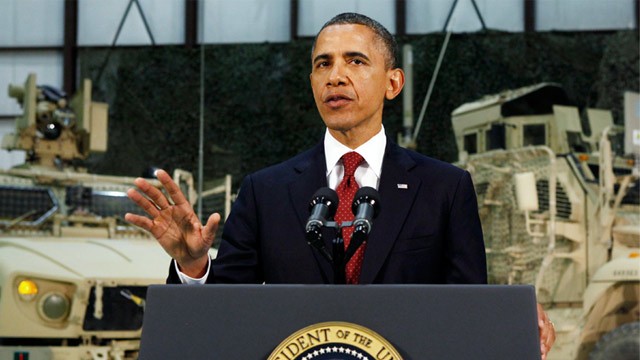
Obama Declares Undeclared Victory In Afghanistan

After going on the defensive for months, President Barack Obama has unleashed a comprehensive assault on the many opponents of the war in Afghanistan. One of his least discussed subjects, Obama was forced to surface in the aftermath of a Quran bonfire and a massacre committed by an over-deployed Army sergeant. He would sign a strategic agreement with President Hamid Karzai on Wednesday and use Osama bin Laden's death to launch this month's NATO summit in Chicago, where he will accelerate Washington's cautious victory lap.

Obama's "surprise" visit to Bagram is anything but surprising, and the same goes for the contents of his speech. Composed entirely of Pentagon talking points, Obama's speech is filled with questionable statements and outright fallacies designed to continue the war after it "ends" in 2014. Instead of offering a realistic and thus more believable assessment, he turned to the skill that has always afforded him the most inner confidence - glorious rhetoric.

"My fellow Americans, we have travelled through more than a decade under the dark cloud of war. Yet here, in the pre-dawn darkness of Afghanistan, we can see the light of a new day on the horizon."

Governments aren't in the business of apologizing or admitting mistakes, but Obama may come to regret portions of his speech when Afghanistan's war grinds towards 2014 and beyond.
Over the last three years, the tide has turned. We broke the Taliban’s momentum. We’ve built strong Afghan security forces. We devastated al Qaeda’s leadership, taking out over 20 of their top 30 leaders. And one year ago, from a base here in Afghanistan, our troops launched the operation that killed Osama bin Laden. The goal that I set - to defeat al Qaeda and deny it a chance to rebuild - is now within our reach.
The death of bin Laden and erosion of al-Qaeda's core in Pakistan's tribal territories is self-evident. Together, NATO and Afghan forces have also killed or captured thousands of Taliban soldiers and field commanders, impacting their ability to retake territory lost to the coalition's saturation. Government education and health programs are improving the lives of Afghans after decades of perpetual conflict. Far less clear is the Taliban's permanent state of health. Although the insurgency has regressed from its high point in 2009 and early 2010, its ranks are still estimated between 15,000 and 25,000 foot soldiers. NATO attempts to "flip" Taliban yielded limited results; Mullah Omar possesses enough strength to initiate a territorial counteroffensive, but this suicidal strategy offers a minimal reward compared to the group's "spectacular" attacks. Multiple networks also reduce the damage inflicted upon the whole, and Afghanistan's government remains unable to fulfill the needs of many of its citizens.

Obama's surge slowed Taliban's momentum without irreparably breaking the insurgency's long-term capabilities. While U.S. and NATO casualties are gradually declining (93 as of April 30th), the insurgency is still on pace to match 2009's figure of 317 and could near this level in 2013. Plenty of Taliban will be hunting U.S. soldiers in 2014.
Within this framework, we’ll work with the Afghans to determine what support they need to accomplish two narrow security missions beyond 2014 - counter-terrorism and continued training. But we will not build permanent bases in this country, nor will we be patrolling its cities and mountains. That will be the job of the Afghan people. 
Not only is counter-terrorism one of the Washington's widest security missions, the Obama administration expects to leave thousands of Special Forces to conduct operations against the Taliban "and its affiliates." These forces must "patrol" Afghanistan in some form out of necessity; aerial recon is insufficient by itself. Drones could also remain active in the skies of post-2014 Afghanistan.
Fourth, we’re pursuing a negotiated peace. In coordination with the Afghan government, my administration has been in direct discussions with the Taliban. We’ve made it clear that they can be a part of this future if they break with al Qaeda, renounce violence and abide by Afghan laws. Many members of the Taliban - from foot soldiers to leaders - have indicated an interest in reconciliation. The path to peace is now set before them. Those who refuse to walk it will face strong Afghan security forces, backed by the United States and our allies. 
This statement is particularly misleading. First, backchannel negotiations between Washington and select Taliban figures were conducted without Karzai's input. Both sides are motivated by their distrust of Kabul and Karzai was later brought into the process after complaining in public and private. The negotiations themselves have progressed inches because neither side is willing to accept the other's terms. The Obama administration is demanding a conditional surrender where the Taliban gets nothing; U.S. troops will remain in the country past 2014, a direct violation of the Taliban's primary demand. Conversely, the Taliban view Karzai's government as illegitimate and will not lay down their arms so long as NATO soldiers patrol Afghanistan.

The absence of a political agreement would add an enormous amount of volatility to an already uncertain transitional period.
As we move forward, some people will ask why we need a firm timeline. The answer is clear: Our goal is not to build a country in America’s image, or to eradicate every vestige of the Taliban. These objectives would require many more years, many more dollars, and most importantly, many more American lives. Our goal is to destroy al Qaeda, and we are on a path to do exactly that. Afghans want to assert their sovereignty and build a lasting peace. That requires a clear timeline to wind down the war.
When defending his exit time-line against GOP critics, Obama contradicts himself by arguing that America's goal isn't to "eradicate every vestige of the Taliban." The odds of this scenario increase in the mud of political stalemate, and Obama openly warns Mullah Omar that he will face a strong U.S.-Afghan campaign if he refuses to surrender. U.S. statements that America cannot kill its way out of Afghanistan remain superficial.
Still, there will be difficult days ahead. The enormous sacrifices of our men and women are not over. But tonight, I’d like to tell you how we will complete our mission and end the war in Afghanistan. 
In other words, America and its allies haven't reached victory but will in the future. Obama concludes with a similar line, promising, "This time of war began in Afghanistan and this is where it will end." Naturally he would ignore an expanding (and failing) war in Yemen, where U.S. forces could maintain a significant presence in 2014, and various hotspots around Africa (Mauritania, Mali, Nigeria, Somalia). New conflict zones could open in the future.

Lesson learned from 9/11: how to engage more battlefields at the same time with less forces, costs, transparency and public attention.

June 14, 2011

North Waziristan’s Phantom Invasion

One of the main reasons the White House is entertaining thoughts of a “significant” drawdown after July - between 10,000 and 30,000 U.S. troops could redeploy from Afghanistan over the next 18 months - lies in the mountains of Pakistan. Several weeks ago Islamabad had voiced its intention to launch a long-anticipated campaign into North Waziristan, a gesture to visiting Secretary of State Hillary Clinton and Michael Mullen, outgoing Chairman of the Joint Chiefs of Staff.

An air roll-out would soften the agency for some 40,000 Pakistani troops, just in time for mid-July. These forces would theoretically neutralize the Haqqani network, a well-trained arm of the Taliban estimated at 4,000 fighters.

Any immediate withdrawal over 5,000 U.S. combat troops stretches the limits of military plausibility. For starters these units take weeks and months to move, so a July decision won’t reach the ground until August or September. 10,000 appears preposterous given the “fragile” state of coalition gains, and U.S. troops have gone on record in expressing the need more troops. 30,000 only provides a rough estimate for the next 18 months and, if all goes as plans (which never happens in Afghanistan), 70,000 troops will continue the ground war as planned.

A “substantial” withdrawal, or whatever buzzword the White House gravitates around, loses further credibility as North Waziristan recedes into the shadows again.

There’s nothing coincidental about an operation during July; such a move aligned with President Barack Obama’s next major address. That the administration likely realized Islamabad had duped it again adds to the suspicion surrounding U.S. policy in Afghanistan and Pakistan. Speculation of an “invasion” into North Waziristan started on an unstable base and never looked back. Timed to please high-ranking U.S. dignitaries, Islamabad took advantage of a retaliatory string of bombings from Tehrik-i-Taliban Pakistan (TTP) to leak the operation’s pre-planning.

The announcement’s pattern immediately revealed a feint designed to placate U.S. pressure after Osama bin Laden’s fallout. Initial reports elaborated on how the Haqqanis would be spared for posing no declared threat against Pakistan. Last year the ISI tasked Sirajuddin, son of Jalaluddin, to retrieve the legendary Colonel Imam from rogue TTP chieftain Hakimullah Mehsud, who had taken the Colonel hostage and eventually executed him. Only the most extreme TTP elements, mainly Hakimullah and his suicide squad, would be targeted in North Waziristan, where his circle relocated to after the 2009 invasion of South Waziristan. Allies would be protected by negotiations through a tribal jirga.

If an operation is launched at all, that is. An invasion into North Waziristan, the one sanctuary that Islamabad has avoided at all costs, is always “in the works.” According to General Ashfaq Parvez Kayani, Pakistan’s military chief and a U.S. favorite, the army is, “following a well thought-out campaign plan and is under no pressure to carry out operations at a particular time."

Corps Commander Peshawar Lt-Gen Asif Yasin Malik, who oversees military operations in Khyber-Pakhtunkhwa and adjacent tribal regions, added, “There has been a lot of media hype about the operation... I have no such plans as far as I am concerned. We will undertake operations when we want to do it, when it is militarily and otherwise in the national interest to undertake such operations."

As if to head off these public doubts, U.S. and Pakistani officials released a joint-intelligence team supposedly planned for months. In addition to al-Qaeda’s new head, Ayman Al-Zawahiri, four other big fish were released on a kill or capture list, including Taliban chief Mullah Omar and the Haqqanis. Except this list diverts attention away from the cracks within U.S.-Pakistani relations, rather than patching them up. None of these figures (especially old-school jihadists like Omar and Jalaluddin) have targeted or support attacks against the Pakistani state and its people, and expecting Islamabad to compromise them is idealistic.

The U.S. and Pakistani versions of North Waziristan simply gaze in different directions, Washington at the Haqqani network and Islamabad at Hakimullah’s hostile cell. Normally strategic objectives cannot be forced to match up.

These doubts temporarily subsided after the termination of Ilyas Kashmiri, leader of the ISI-affiliated Harkat-ul-Jihad-al-Islami (HuJI). Kashmiri allegedly arrived in South Waziristan from Khyber Pakhtunkhwa only weeks before a Predator took out his meeting with Punjabi Taliban. Numerous Pakistani officials initially vouched for his death, evidence that Islamabad hoped to play up its intelligence sharing, but conflicting statements from government and militant sources left his outcome unverified.

Kashmiri’s status illustrates the ambiguity surrounding U.S.-Pakistani intelligence operations. Even if his death is ultimately confirmed, Kashmiri’s meeting with the Punjabi Taliban indicates that Islamabad was willing to get rid of him. The Punjabi Taliban operates semi-independently within Hakimullah’s network, and is believed to have either gone rogue from the ISI or received funding from a radical ISI faction. Islamabad seeks to remove this particular faction, not the Afghan Taliban or loyal elements of the TTP, including North Waziristan chieftain Hafiz Gul Bahadur.

A “disappointed” Robert Gates and his replacement, current CIA director Leon Panetta, recently chastised Islamabad for sharing intel of two militant compounds. Two soon-to-be-empty compounds.

The same course of action must be expected in regards to the Haqqanis, given that this strategy is already underway. Locals report that select army checkpoints were removed to let militants slip out of Miranshah. Nevertheless Islamabad’s own actions aren’t the sole factor involved. As Washington and Islamabad have plotted a campaign for months, so too has the Haqqani network. We were told by our sources as early as 2010 that the Haqqanis had already diversified into the neighboring agencies. In February 2011 a truce was worked out between the Haqqanis and local tribes, allowing them to start moving into neighboring Kurram agency en masse.

The Haqqanis are said to be long gone by now, relatively speaking; they will always maintain a presence. The ultimate takeaway is that they’ll move to wherever the Pakistani army isn’t, basic guerrilla strategy enabled by a friendly government and populace.

Not long ago the Pentagon insisted it couldn’t defeat the Taliban without shutting down North Waziristan - a political concession to extract an operation - only to reverse course after being shut down. Despite major efforts by U.S. regular and Special Forces to wear them down, the resilient Haqqani network remains a primary threat to U.S. forces in eastern Afghanistan. And despite frequent engagement with U.S. officials, both Pakistan’s government and people remain disconnected from America. Obama will surely exploit Osama bin Laden's death to portray success in Afghanistan.

He might want to think twice before stepping into North Waziristan.

May 9, 2011

Bin Laden Videos a Double-edged Sword


The “special federal task force” designated to comb the mountain of data seized from Osama bin Laden’s hideout expects long, sleepless nights ahead. As for the U.S. public, a controlled trickle is more likely to reveal advantageous glimpses of his final years. White House National Security Adviser Tom Donilon told NBC’s “Meet The Press” on Sunday, “This is the largest cache of intelligence derived from the scene of any single terrorist. It’s about the size, the CIA tells us, of a small college library.”

While the information spree is expected to yield actionable intelligence on al-Qaeda’s remaining senior commanders, the White House also believes it discovered a clever loophole to proving bin Laden’s death and dispelling his aura. Caught in the controversy over his body’s burial, the Obama administration subsequently declined to release photographic evidence of his grisly death. The graphic images of his face posed a threat to U.S. national security, Pentagon officials advised President Barack Obama, and held the possibility of inspiring his followers.

Rather than pop their bubble once and for all, Obama argued that bin Laden’s sudden drop in the ocean would provide a more draining closure.

The unsettled fate of bin Laden’s body continues to feed the skepticism and conspiracy theories of those already disinclined to believe the U.S. government. Only one version of bin Laden’s death has been told, they argue, and it doesn’t come from a reputable source. But the Obama administration clearly based its decision on the trove of data stripped from bin Laden’s compound. Thinking it held the footage to discredit bin Laden and validate his death at the same time, the White House released five videos on Saturday in order to, as CNN’s headline blared, “erase bin Laden’s mystique.”

Although the tapes do possess a chance at eroding bin Laden’s image, they’re liable to cut America’s hands in the process.

In revealing a graying, narcissistic man obsessed with his physical appearance and younger days, the Obama administration has painted a vain portrait of bin Laden’s final years as al-Qaeda chieftain. A worn bin Laden is shown watching footage of past travels through Afghanistan, rehearsing (and sometimes forgetting) the lines of his next propaganda videos, and dyeing his beard to conceal the aging process. News subsequently leaked that Pakistani authorities found “herbal Viagra” in his medicine chest, part of an orchestrated campaign to morally discredit bin Laden (after his “human shield” of a wife turned out to be a loyal assailant).

"The first image that we were talking about is trying to say, 'Look, this isn't the guy that you think he is. He isn't the leader. He doesn't look young. He doesn't look vibrant,’” says Jack Cloonan, who served on the FBI's Osama Bin Laden unit for 6 years. “And if we were trying to encourage recruitment, given what's happened in the so-called Arab Spring, I don't think that is the image that would entice people to join, frankly."

Except the Obama administration isn’t satisfied with this perception. Bent on manipulating bin Laden’s data for all of its worth, U.S. officials are countering their own message by swinging to the opposite extreme. Instead of an isolated figurehead that had lost control of al-Qaeda’s branches, National Security Adviser Tom Donilon and other intelligence officials stressed in a series of press interviews, "He was engaged, not just as a symbolic leader; he was engaged in operational leadership.”

"The materials reviewed over the past several days clearly show that bin Laden remained an active leader in al Qaeda, providing strategic, operational and tactical instructions to the group," added an anonymous intelligence official. "Though separated from many al Qaeda members who are located in more remote areas of the region, he was far from a figurehead. He was an active player making the recent operation even more essential for our nation's security."

This juxtaposition hasn’t gone unnoticed by those already on guard against propaganda and disinformation - and that was before bin Laden’s disorienting aftermath. The image of an active chief grinds against the Pakistani narrative that he died broke and irrelevant, marginalized by the larger faction of Ayman al-Zawahiri. But it reverberates both ways too. In flipping two sides of bin Laden, the Obama administration may be doubling up the possibilities of his followers.

An active but secluded bin Laden could empower his aura rather than dispel it.

Some Muslims willing to believe bin Laden’s death find common ground with certain Israeli officials: that U.S. forces took too long and missed too many opportunities. That he was found in Abottabad reinforced the opinion that he should have been taken down sooner; his location and length of surveillance spawned immediate questions of his death’s timing. Highlighting bin Laden’s capabilities plays into this narrative, one where he was able to cunningly evade U.S. forces for over five years.

Although bin Laden’s self-obsessed side may turn off some of his followers, the isolation he endured similarly builds upon his legend. Inspired by an radicalizing Muslim world and striving to distance himself from his wealth, bin Laden cultivated an image of moderation and restraint during his college years. ABC’s Christiane Amanpour traced over these experiences during a fictionalized account of bin Laden’s upbringing. In preparation for the wider war against the West, one that soon landed him in Afghanistan, bin Laden’s associates speak of him testing himself in the desert, both to harden a real ascetic lifestyle and cultivate the image of it.

Walling oneself up in a small compound suggests a relatively isolated and feeble commander, but also one who is willing to endure personal sacrifice for the greater good.

The Obama administration faces a dilemma in spinning bin Laden’s death in too many directions. One consistent story offers the quickest way to bury him; two or more and the story begins to rip apart, widening the information vacuum and keeping bin Laden’s myth alive. Others will continue to believe that Washington is twisting the facts, and possibly point to what has been labeled bin Laden’s last video: "America will not be able to dream of security until we live in security in Palestine. It is unfair that you live in peace while our brothers in Gaza live in insecurity."

It’s true that most Palestinians, in line with the general Muslim trend, have rejected bin Laden’s ideology. It’s also true that Palestine remains a crucial weakness in U.S. foreign policy.

Flipping bin Laden’s persona should further alarm those already suspecting the CIA of playing both sides - his creation and destruction. Washington likes to have its cake and eat it too, and the manipulation of bin Laden’s final years serves up the latest example. The Obama administration is speaking as though it wishes to simultaneously end and prolong the war against al-Qaeda, no coincidence given the circumstances.

While proving bin Laden’s death may have been a success, his ghost feels more alive than ever.