Showing posts with label China. Show all posts

November 6, 2012

America's "Choice": Many Votes, Few Winners

A nightmare scenario for Independent voters is unfolding across the United States today, allowing for reflection on the status of its government.

For those Americans who wouldn't vote for Barack Obama or Mitt Romney if they possessed a real choice in deciding this country's future - upwards of 30% - today symbolizes the perverse structure of a two-party system and its failure to serve the majority of Americans. We are more likely to be drowned out than decide 2012's election, and enjoy no refuge other than our minds, the company of like-minded individuals, and the virtues of patience and determination.

America's reoccurring dilemma of lesser evils, which spans decades at the minimum, has given birth to the two-horse autocracy now being covered by every media outlet in the world.

In terms of U.S. foreign policy, the die has already been cast and nothing save an extreme circumstance can alter its possibilities. Words cannot fully capture the nothingness that blanketed this election's time-line. The Trench sympathizes with America's economic plight and understands the heightened attention over related issues, as a country's economics and foreign policy determine each other's influence. For this very reason U.S. foreign policy shouldn't have been intentionally neglected by America's two presidential candidates. Barack Obama and Mitt Romney expended about 10% of their campaigning on foreign policy, if that. Each candidate's stump speech often devotes no more than one or two paragraphs out of several pages, or else foreign policy is dropped entirely in favor of jobs, health care, infrastructure and education.

The only superficial mention in Obama's final speech takes up a third of a paragraph: "In 2008, we were in the middle of two wars and the worst economic crisis since the Great Depression. And today, our businesses have created nearly five and a half million new jobs. The American auto industry is back.  Home values are on the rise.  We’re less dependent on foreign oil than any time in the last 20 years.  We’ve doubled the production of clean energy. Because of the service and sacrifice of our brave men and women in uniform, the war in Iraq is over. The war in Afghanistan is ending. Al Qaeda is on the run. Osama bin Laden is dead."

What, though, is educational about minimizing a country's relations with the world, or misinforming Americans about the wars fought in their names? Where was this alleged education at an alleged foreign policy debate - a debate so dull and inconsequential that the U.S. mainstream media conspired to hype its importance? The debate's ensuing analysis was dominated by one-liners, Obama's "look" and, to a lesser extent, the many similarities between each candidate's foreign policy. The fact that two candidates adopted parallel agendas has flown dangerously below the popular radar, and Americans are likely to pay a future price for this growing insulation. Meanwhile America's elite will continuing benefitting most at home and drones are coming to greet the many.

Romney didn't mention foreign policy during Friday's last "major" speech: "Real Change From Day One." Out of roughly 4,000 words in Obama's final speech on Monday, these words account for .005% of his focus: "The war in Iraq is over. The war in Afghanistan is ending. Al Qaeda is on the run. Osama bin Laden is dead."

Perhaps U.S. foreign policy should take a momentary backseat to America's broken economy, but the total imbalance of forces is clear to all who spend a few moments studying it.

October 22, 2012

Mainstream Media Hypes Foreign Policy Circus

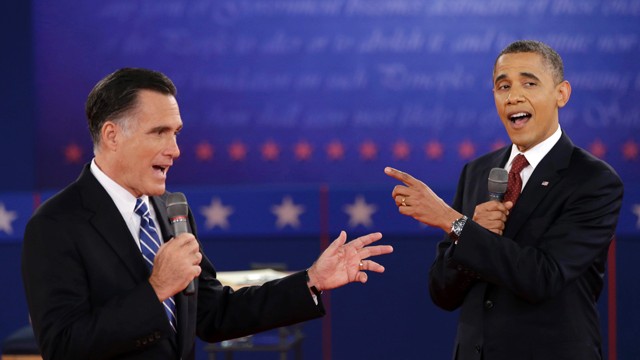
A rudimentary display of U.S. foreign policy will take place tonight in Boca Raton, Florida between President Barack Obama and challenger Mitt Romney.

Interestingly, America's mainstream media has taken to hyping Monday's presidential debate with a common narrative: "How the Obama-Romney foreign policy debate could determine the election. With turmoil increasing in world hot spots, foreign policy and national security have become major presidential campaign issues. From China to Israel, Iran to Syria, stateless terrorists to struggling alliances, Mitt Romney and Barack Obama will have plenty to debate Monday night."

"If, at the start of the general election campaign, you told a seasoned political strategist in either party that the fate of the presidential race could well hinge on the foreign-policy-focused third debate, the reaction would have ranged from an eye roll to laughter," writes The Washington Post. "And yet, here we are. President Obama and former Massachusetts governor Mitt Romney head to Boca Raton, Fla., for their final debate Monday night with national polls suggesting that the race is tied and with the terrorist attack in Benghazi, Libya, dominating the headlines."

Where to start with this manufactured slant? Does one dead ambassador equal the difference between relevant and unimportant foreign policy in America?

There's no denying factual sections of the media's deceptive hyperbole. In terms of foreign policy, American voters are looking for a "tough" but "responsible" president to confront terrorist threats and international powers. They want someone that won't start a reckless war with Iran but will respond to terrorist pinpricks and plots that never fully develop. Essentially, Americans want their country to maintain global supremacy at an efficient cost. Most now seek limited military engagement abroad on the road to fiscal responsibility at home, a perfect combination for the rise of drone warfare and unconventional Special operations. However these matters address America's national security before its raw foreign policy.

Obama himself told reporters over the weekend, "Spoiler alert: we got Bin Laden." This talking point will make for an extra long debate.

National security understandably becomes more relevant when some visceral incident has just occurred. However foreign policy remains a low set of priorities - the mainstream agenda clearly believes that it needs to exaggerate Monday night's significance. Foreign policy areas themselves will be debated at the shallowest levels. Not even Libya's revolution, from the beginning to NATO's invasion to the country's future, will receive a thorough examination. Neither will seriously engage U.S. policy in Egypt, Yemen, Bahrain or other coverups that support U.S. interests over popular movements. Syria is more likely to descend into a brawl over semantics than hard policy.

Worst still, Romney has encouraged his base's anti-Americanism by blaming the Middle East's turmoil on Obama's "abdication of leadership." Obama has failed to uphold his own promise to engage the Arab world, instead consenting to a vast counterrevolution in the region, but Romney dangerously preaches the return to an "American Century."

Larger issues like China may not be movable by one or the other; Russia should cause equal trouble for both.

Each candidate brings a different set of problems to the same table, potentially resulting in similar outcomes. While Obama and Romney diverge widest on the possibility of war against Tehran, both of their regional agendas operate on a steep Iranian tilt. Both will try their hardest to convince the audience that they support Israel more than the other, and ultimately leave the Palestinians in the dust on their way to promising a hollow two-state solution. Their policies are nearly identical in Afghanistan - both want the majority of U.S. troops out by 2014 so long as they can deploy a residual force afterward. Obama publicly claims that Afghanistan's war will end in 2014, and he may prepare a surprise for Monday night, but Iraq's ending says otherwise.

The moderator is unlikely to fact check Obama's wayward policy in Iraq, which the President says he's looking forward to debating. Dozens of bombings and shootings continue to plague the country each month, often as Obama declares the war over from 9,000 miles away. Many large-scale attacks have been claimed by al-Qaeda in Iraq, a group that didn't exist before U.S. troops arrived in 2003 and could have 5-10 years of life in it. The response to these security incidents and Iraq's general reconstruction has also been obstructed by the poor leadership of Prime Minister Nouri al-Maliki. The Obama administration's passivity towards Baghdad's political crisis has resulted in a gradual loss of influence with the divisive al-Maliki, who retained his position in 2010 with U.S. assistance. Obama's policy in Iraq qualifies as one of his worst, but he will spin it into one of his highlights.

The brightest light, of course, will shine upon Osama bin Laden's dead body. Here Obama will hit Romney hardest to score as many points as possible, bludgeoning him on a topic that Romney has no real control over. He will mention his drone achievements and few to none of his failures. Obama could speak of his kills in Yemen but will certainly not mention how unpopular he has become in Yemen. He will rout al-Qaeda on more than one occasion, "from Pakistan to Somalia" before "staying alert" in new hotspots. He may go near Mali if he's feeling bold, to highlight the international coalition being put together by U.S. allies, but avoiding al-Qaeda's other hideouts makes for smarter politics. Obama won't mention that al-Qaeda cells in Iraq crossed into Syria.

Romney will take these punches and throw back as many as he can design. Both will do whatever they can to distract voters from actual issues, instead emphasizing terrorism and the type of American "leadership" that translates into hegemony. U.S. media has already responded in a similar fashion by placing terrorism at the top of their scorecard. "Voters finally get to know Obama and Romney's foreign policies" - when Monday is far too late to make informed decisions. Unfortunately those seeking a deeper conversation on foreign policy will leave empty handed, and those comforted by the shallows will move onto the next channel when the debate is over.

Only a major screw up, not any real wisdom, moves the political needle on election day.

October 2, 2012

U.S.-Taliban Negotiations Need A Reality Check

Due to each side's posturing and their interrelations with external forces, gauging the real status of negotiations between the U.S. government and the Taliban's leadership is nearly impossible. Nevertheless, this New York Times report appears to be truer than false. Its contents conform to the present reality surrounding Afghanistan, and thus match The Trench's continual observation of one of the weakest links in U.S. policy.

According to several anonymous officials, the Obama administration has decided to "scale back plans" for a U.S.-negotiated political settlement with Mullah Omar's inner shura (along with other Taliban factions such as Gulbuddin Hekmatyar's Hezb-e-Islami Gulbuddin). Washington intends to distance itself through the proxy of a joint-committee with Pakistan, in order to vet potential new Taliban interlocutors, and pair this move with other incentives to "break the ice" with Kabul. This formula makes a degree of sense on one level. For years the Taliban has refused to negotiate with the Afghan government, encouraging Washington to cut out Hamid Karzai and generating a new source of friction in the process. With the U.S. backed away from the table, Afghanistan's power centers may be able to reach a more permanent agreement on national terms.

"Now American officials say they have reduced their goals further — to patiently laying the groundwork for eventual peace talks after they leave. American officials say they hope that the Taliban will find the Afghan Army a more formidable adversary than they expect and be compelled, in the years after NATO withdraws, to come to terms with what they now dismiss as a “puppet” government."

Mualavi Qalanmudin, a former Taliban minister who now sits on the High Peace Council, expects the Taliban to maintain its opposition against the Karzai administration until the bulk of U.S. troops have exited. This time would open an ideal window for cutting an agreement that yields territory and preserves their network. However the Taliban must be feeling more confident as the U.S. surge exits and NATO's alliance continues to shake, and the Obama administration's plan begins to roll downhill from here. Rather than a savvy political move, the administration is trying to salvage its strategy after the Taliban dodged the knockout blow of Obama and Petraeus's surge. Fresh Pentagon estimates still hover around 20,000 full and part-time fighters, while independent estimates push the number higher. The Taliban also find Afghanistan's security forces to be more penetrable and malleable than NATO soldiers.

Consider the damage that al-Qaeda's cells still inflict on Iraq's army and police, as well as the Taliban's superior strength and how far Iraq's security forces are ahead of Afghanistan's. Or consider how the Haqqanis view themselves as Afghan Taliban and how Washington just branded the group as a terrorist organization.

“I don’t see it happening in the next couple years,” said a senior coalition officer says of a peace settlement. “It’s a very resilient enemy, and I’m not going to tell you it’s not. It will be a constant battle, and it will be for years.”

This source utilizes the same propaganda that most Pentagon officials have memorized: the Taliban's momentum has been "blunted," "halted" or even "reversed," but the insurgency remains a "formidable" enemy. Translation: we're winning but we need to keep fighting. Obama similarly highlights the Taliban's losses and downplays its survival, however the insurgency's overall structure has been left intact. Why, then, would the Taliban unconditionally agree to Washington's terms when it still occupies a relative position of strength? In light of these factors, military insiders could be pushing back against Obama's new promise that "our war will be over in 2014.” The Pentagon surely hopes to keep a residual presence in Afghanistan after losing Iraq, and Obama's campaigning stands directly in the way.

This layer of friction between the White House and Pentagon, as well as GOP and mainstream opposition to "negotiating with extremists," stacks on top of Afghanistan's internal dilemmas.

Equally worrisome is the unrealistic settlement between Washington, Kabul and Afghanistan's neighbors: Iran, Russia, China, Pakistan and India. Opposing power politics often reach agreements over proxy territory, except this specific web continues to thicken instead of unravel. Bluntly speaking, Syria is now absorbing a higher percentage of the diplomatic energy released by Washington, Tehran, Moscow and Beijing. Pakistan and India are nowhere close to resolving their territorial disputes or ceasing their race for self-interests in Afghanistan. The odds of reaching a negotiated settlement cannot be raised much higher than 0% when division exists at the local, national, regional and international levels of Afghanistan's conflict. More than one factor needs to change significantly.

The Trench shares its observations with many others when suspecting that U.S. "negotiations" created a front for ongoing military operations. The Obama administration has yet to pursue a resolution on sincere terms, instead demanding unconditional surrender from the Taliban: renounce al-Qaeda, accept the Afghan constitution and lay down arms. Since the agreement of all three terms was unrealistic from the beginning, the negotiating process itself has shared in this futility. Washington needs to set a concrete agenda on realistic conditions, otherwise the messy end of Vietnam is not an unrealistic possibility; while the military aspect is unlikely to be as severe as Saigon's fall, the political side of a diplomatic failure will reverberate across the region.

Failure to produce an agreement equals a long-term, low-intensity conflict with no end in sight.

September 6, 2012

Another Sad Night For U.S. Foreign Policy


 He came, he saw, he whitewashed.

Nothing less could be expected President Barack Obama's acceptance speech on Thursday, from the soaring (and at times egotistical) rhetoric to the overemphasis on America's domestic policy. Nor should independent observers of U.S. foreign policy be surprised by what was and wasn't said. Formulating a reaction would be pointless if not for the inclusion of slight variations to his campaign speech:
  • In Afghanistan, the Taliban's momentum is suddenly "blunted" instead of "broken," unintentionally suggesting that the insurgency has acquired momentum in a matter of days. Obama now appears to have concretely defined the war's end in 2014, rather than pull back from previous statements, but the war will continue past this date. Whether or not Washington leaves a residual force - and America's generals can't be happy with Obama's campaign rhetoric - the Taliban cannot be expected to lay down their arms at a specified time. The end of U.S. involvement and the end of an asymmetric war are two different events.
  • His jibes against Mitt Romney would also pack more punch if he didn't spend the last four years dodging Afghanistan's war.
  • Al-Qaeda's path to defeat includes a stopover in northern Mali, where the group has taken control of a swath of territory the size of France. The Obama administration has decided to publicly ignore the situation due to the absence of a contingency, but blowback on the campaign trail isn't welcome either.
  • Nowhere to be found next to his unwavering commitment to Israel’s security are the Palestinians, who have been treated as an afterthought throughout Obama's first term. He would take office promising to engage the Israel-Palestinian conflict "from day one" and proceed to demand a two-state solution by the end of 2010 (then 2011, and now 2012). Obama's administration has devoted an extraordinary amount of time defending itself as pro-Israeli, alienating both Israelis and Palestinians while leaving the peace process dead in the water.
  • At the same time, Obama expects a unified world to face down the Iranian government's pursuit of nuclear weapons. Although the two issues aren't wholly dependent, an equitable solution to the Israeli-Palestinian conflict would strengthen the U.S. position towards Tehran and the Middle East in general. Both outcomes should be pursued with equal determination, not lopsided focus.
  • Daring to near the Arab revolutions for a brief moment, Obama declares that the "historic change sweeping across the Arab World must be defined not by the iron fist of a dictator or the hate of extremists, but by the hopes and aspirations of ordinary people who are reaching for the same rights that we celebrate today." Unfortunately Washington and Riyadh have teamed up to organize a systematic counterrevolution in the region, fueled by billions of petro dollars, military equipment and training, and media manipulation. Except for Libya, Washington initially chose the authoritarian side in Egypt, Yemen, Bahrain, Algeria and other states, and remains aligned up to the present. As usual Obama ignored Yemen, where an errant drone strike recently killed 13 innocents, and Bahrain, where a large number of the opposition's leadership has been unjustly imprisoned. Syria has descended into a mass of competing foreign interests - Eastern, Western and Arab - thus inhibiting an effective response to a complex war.
  • The U.S. counterrevolution will only accelerate during Obama's second term.
The Trench doesn't expect foreign policy to comprise 100% of a national address, but 5% of a presidential nomination speech is absurd. Economic factors shouldn't negate the discussion of foreign policy; Americans must be informed in the event that they choose not to be. Instead the Obama administration has preyed on widespread disinterest in U.S. foreign policy to maintain a low profile, sacrificing the nation's education for political points. This reluctance to engage foreign policy belies the "successful" platform that the Obama administration is supposedly eager to promote.

August 2, 2012

Stubborn Death of Syria's "Yemenskii Model"

At last, Kofi Annan has accepted the brutal reality of the United Nation's "political transition" in Syria, ending months of futile diplomacy.

Dead for months - possibly on arrival - the UN's plan is ironically forcing its previous secretary-general into submission while its intended target grinds onward. Annan himself deserves a limited amount of blame for this calamity, mainly for meeting so cordially with a murderously delusional Bashar al-Assad. Syria's "Mission Impossible," as he referred to it during Thursday's statements, was thrust upon him and required the engagement of all parties, regardless of their hostility. Maybe Annan will produce a hail mary agreement before his clock officially expires on August 30th. If not, he speculates that, in a world "full of crazy people like me," his replacement could step up and "do a better job."

U.S. officials also claim that "we’re going to continue full ahead with our strategy," however the UN's plan needs more than a facial lift to succeed. As long as foreign powers remain bent on controlling Syria's revolution and its aftermath, the entire situation is doomed to continue spiraling downward.

Before the UN Security Council had passed Resolution 2014 in October 2011, the White House and other allied governments were already busy copying the blueprints onto Syria's 4th generation battleground. Resolution 2014 would approve a single-candidate referendum in Yemen, replacing 33-year dictator Ali Abdullah Saleh with his 18-year vice president Abd Rabbuh Mansur al-Hadi, and grant Saleh immunity in return. A two-year transitional period, including a military restructure and "national dialogue," is scheduled to culminate with an open presidential election. This plan has yielded countless positives and negatives for Yemenis; although the threat of civil war has temporarily lifted and Hadi replaced many Saleh loyalists, fundamental divisions between the government, diverse political opposition, revolutionaries, tribal authorities and foreign powers remain outstanding.

Unfortunately, due to the ambitions of certain internal and external powers, the odds of these issues being bridged through November's dialogue are low. Once the Obama administration and King Abdullah's inner circle realized that they could drop Saleh for Hadi, thereby increasing their hegemony in the country, the Gulf Cooperation Council (GCC) was employed to maintain a controlled status quo in Yemen. The bulk of Washington and Riyadh's counterrevolution has rolled out under the specter of al-Qaeda in the Arabian Peninsula (AQAP), despite the fact that their own operations are contributing to its growth, and U.S. counterterrorism operations have further escalated since Hadi's ascendancy in February.

Many of Yemen's revolutionaries do not agree with Resolution 2014's terms.

One can easily understand (on top of the Iranian angle) why the two powers attempted to hoist "Yemen's model" onto Syria, and why al-Assad's allies saw the same opportunity to control Syria's transition. Russian Foreign Minister Sergey Lavrov wasted no time lobbying the exchange, telling a GCC ministerial in early November, "The Russian position has been embodied in the Security Council resolution on Yemen adopted a few days ago unanimously." Undeterred by this suspiciously mutual agreement, the White House held out an empty hope through multiple Russian statements of support and a UN proposal that didn't explicitly call for al-Assad's resignation.

As recently as May’s G-8 meetings, President Barack Obama himself lobbied the "Yemenskii Varient" to Prime Minister Dmitri Medvedev.

Leaving aside the vast situational differences between Yemen and Syria, along with the sputtering state of Yemen's transition, external conditions automatically torpedoed a cross-pollination of political designs. Unlike Yemen's agreement, which enjoyed unanimous approval in the UN Security Council, Syria's foreign matrix has been divided from the revolution's beginning. Each side is simply trying to outmaneuver the other through international blocs and their various proposals, whereas the other permanent members of the UN Security Council stood to profit in Yemen by obediently falling behind America's lead.

“Things fell apart in New York,” Annan concluded on Thursday. “The increasing militarization on the ground (in Syria) and the clear lack of unity in the Security Council have fundamentally changed the circumstances for the effective exercise of my role.”

This intensifying netwar between al-Bashar's international allies and enemies is once again manifesting in a tragically ridiculous war of rhetoric. Having defended Annan's mission in order to stall, a process that has enabled the deaths of thousands, Russian President Vladimir Putin called Annan "a very respectable person, a brilliant diplomat and a very decent man, so it's really a shame." White House officials chose similar language for Annan personally, but openly implied that Moscow and Beijing are responsible for Syria's political stalemate.

"Those vetoes," White House spokesman Jay Carney told reporters, "as we've said repeatedly, were highly regrettable, and place both Russia and China on the wrong side of history and on the wrong side of the Syrian people. Very unfortunate."

Thus Washington publicly expects Moscow to accept Yemen's "model" in Syria when both perceive a "transition" as manipulative. This strategy is far from the "realistic" plan that the Obama administration defends so righteously - a counterrevolution that no diplomat is able to conceal.

July 9, 2012

Annan's Syrian Plan Goes Zombie

Tragically doomed to fail since its inception, "Kofi Annan's" six-point plan for Syria's "transitory" finally appeared to keeled over this weekend after five months of stalemate. Annan admitted so himself on Saturday when he told France's Le Monde, "Clearly, we have not succeeded. And maybe there is no guarantee that we will succeed." Except his proposal, crafted by Western and Gulf powers, refuses to succumb to reality, a fact exposed by Annan's latest sit-down with Bashar al-Assad. His description of the meeting - "constructive and candid" - was taken straight from the Syrian Foreign Ministry: "constructive and good." 

"We discussed the need to end the violence and ways and means of doing so. We agreed on an approach which I will share with the armed opposition," Annan told reporters after the meeting. 

Unless the former secretary-general of the UN was threatened by Shabiha, Annan's comments are just as disconnected from Syria's revolution as the UN's plan. Openly modeled on Yemen's political transition, which blackballed the revolutionaries and solidified U.S.-GCC influence within the government, Syria's current proposal is counterrevolutionary to the core; Western and Gulf powers seek to control a democratic transition and alter Syria's position in the region. The document first emerged as a compromise under the Arab League banner and quickly crumbled into futility. The UN's political-monitoring mission followed the same rut to its theoretical end, taking thousands of Syrian lives in the process, and Annan's statements add insult to injury and death. After offering concessions both sides (such as replacing al-Assad with one of his vice presidents) and ultimately intensifying the country's stalemate, pushing ahead with al-Assad in tow represents a new level of fatal idealism. 

"I also stressed the importance of moving ahead with a political dialogue, which the president accepts." 

Annan will never manipulate al-Assad and his men by flattering them, but will instead remain a pawn in their own counterrevolution. Rather than create any benefits for the revolutionaries or even al-Assad's loyalists, Annan has further extended a brutal conflict by gifting a propaganda gold mine to al-Assad's regime and its allies. Some of his points are coated in a layer of truth to facilitate digestion in the West: “Russia has influence, but I don’t think that events will be determined by Russia alone. What strikes me is that there is so much talk about Russia and much less about Iran, and little is said about other countries that are sending money and weapons." 

Unfortunately Annan's entire performance benefits al-Assad more than any other party. These aren't the words of someone who is willing to resign or stop his war machine: "The United States is against me, the West is against me, many regional powers and countries [are] against me, so how could I stay in this position? The answer is, I still have public support." 

"We know that (Annan) is coming up against countless obstacles but his plan should not be allowed to fail, it is a very good plan," Assad told German television channel Das Erste on July 5th. "The biggest obstacle is that many countries do not even want this plan to succeed so they offer political support and continue to provide the terrorists in Syria with arms and money." 

He also slandered Syria's opposition with one of the oldest counterrevolutionary tactics, calling the revolutionaries a "mixture, an amalgam of Al Qaeda (and) other extremists." This is basic code for continuing his crackdown. 

The temporary breakdown of Annan's proposal has wasted no time wrecking fresh havoc between Washington, Moscow and Beijing. Far from broadening their coordination, each side continues to defy the other while attempting to marginalize the resulting friction - perpetually driving the hegemonic schism that haunts Syria's revolutionaries. On Friday, Secretary of State Hillary Clinton urged the UN Security Council to make Russia and China "pay a price" for supporting al-Assad. Chinese Foreign Ministry spokesman Liu Weimin responded, "Any words and deeds that slander China and sow discord between China and other countries will be in vain." 

Meanwhile Moscow has pledged to halt future arms shipments as existing contracts go through, and President Vladimir Putin is still clutching to al-Assad and his version of a democratic transition. Although peace is obviously preferable to civil war, all conceptions of a "political solution" aim to delegitimize Syria's revolution by reducing its internal fire. This criticisms aren't meant to excuse the organizational problems facing Syria's opposition, but the revolutionaries are battling the world's most powerful state actors (and blocs) to secure their self-determination. 

A deeper report will examine Syria's revolutionary-counterrevolutuonary balance once the international reaction assumes a more concrete shape.

May 14, 2012

Propaganda Alert: The Gates & Rose Show

Various parts of the U.S. media cooked up a typical piece of non-news over the weekend when covering Robert's Gates's no-show at NBC's bin Laden special. Not to worry, the former Defense Secretary plans to tell (mostly) all of his side in a forthcoming book and sits down with friend Charlie Rose on Monday night. Gates's spin on the many facets of U.S. foreign policy and counterterrorism is not to be missed.

[Update: unless he cancels...]

April 24, 2012

al-Bashir Dares World Powers In Heglig

On the list of "Things Nobody Needs Right Now," another open war in the middle of Sudan ranks high on the international community's agenda. Western and Eastern officials alike have scrambled to avert full scale hostilities between Sudan and the freshly-declared South Sudan. In one hemisphere, U.S.officials in Washington are nervously watching years of political negotiations play out on Heglig's disputed battlefield, a scenario laced with al-Qaeda's growth in Africa. They're joined by their counterparts in Beijing, who require stability to expand China's economic infrastructure across the region and through Heglig's oil fields. Of course the inhabitants of both countries and their neighbors don't need another war either.

"This is not the time for war," U.N. Secretary-General Ban Ki-moon told reporters last week. "This is a time for leadership, for engagement, for negotiation — in the name of humanity, and in the interests of the people of both countries and the region. The last thing the people of these two countries need is another war — a war that could claim countless lives, destroy hope and ruin the prospects of peace and stability and prosperity of all Sudanese people."

The problem is that Sudan and South Sudan's governments don't necessarily agree. After speaking to representatives from each side, U.S. Special Envoy for Sudan Princeton Lyman claimed, "virtually everyone I have talked to has said, 'Look, we don't want to go to all-out war with the other. We need to find a way." Lyman also admitted that "emotions are running very, very high," but his cautious statements conceal a major slight of hand in the word "all-out." Theoretically, the two governments do intend to avoid a war that would destroy each other's economy. Neither "wants" to go to war. They do, however, want what they believe is theirs and are willing to employ force to get it.

Sudanese President Omar al-Bashir in particular believes that Heglig is his to develop and cash in on. al-Bashir's words and actions speak for themselves; Sudanese artillery and air power has formed the crux of his response to Southern movements in the area. During his send-off ceremony for a "popular defense" brigade, al-Bashir declared that South Sudan's "capture" of Heglig "revived the spirit of jihad and martyrdom among the Sudanese people" and threatened to "cut off the hand that harms it" by toppling Juba. al-Bashir has patiently awaited an opportunity to strike after January 2011's referendum, when the Comprehensive Peace Agreement (CPA) left Heglig's status to be determined at a later date (the process was frozen after repeated clashes). The South's new movements in Heglig, which President Salva Kiir attributed to self-defense, finally offered the perfect scenario to "legally" retake the area.

al-Bashir may not seek a war now that he's done so, but he was looking for a battle with his new neighbor.

The international community must decide what to do based on these factors. Too little energy was applied to Heglig's negotiations over the last year and Western powers are suffering the consequences. President Barack Obama's calls to ceasefire and begin a dialogue have traveled straight through al-Bashir's ears, and the strongman appears convinced that America will shirk military action. Meanwhile China has nurtured both sides for its own benefit and ultimately encouraged al-Bashir to flex his muscles. Being the dominant international powers, Washington and Beijing must combine their own strength with the African Union and Intergovernmental Authority on Development (IGAD) to extinguish Heglig's fires. They must decide how much to confront al-Bashir and how much to cooperate with him.

For its part, the South Sudanese government also believes that no crime has been committed since Heglig's status is undefined (British colonial borders are similarly invoked). Juba has reportedly offered to withdraw from Heglig if the African Union can guarantee a ceasefire, evict Sudanese forces from the area and complete the deployment of Ethiopian forces to Abyei region. These terms are unlikely to satisfy al-Bashir after his forces displaced the South's from Heglig, leaving the international community to navigate through a stalemate in the middle of Africa.

Step one to averting total war is not assuming that one or two parties don't seek a near-war outcome. Although neither government has issued a formal declaration of war, each side claims that the other has declared war on them. Both governments are prepared to apply force at a relatively high scale and this mindset could spin out of control. The Obama administration and other Western governments seem to have been lulled to sleep by al-Bashir's long-term plots.

Ferocious urgency is critical to politically resolving the crisis in Sudan's stomach.

April 12, 2012

Unraveling al-Assad's Mind Games

Any silence is worth its own weight to people that have been shelled and shot at continuously for weeks. Syria's guns fell relatively silent on Thursday as 6 A.M. passed into uncertainty, with Bashar al-Assad's regime and the political opposition both taking credit for a nebulous ceasefire. The hazy situation has left everyone to anticipate what follows a rare moment of calm in Syria's revolutionary storm.

“A tentative or less than complete cease-fire is better than no cease-fire at all, but we could not call the current situation on the ground a full cease-fire,” White House spokesman Jay Carney told reporters in Washington.

Even a brief ceasefire is somewhat surprising given al-Assad's recent behavior and psychological makeup, but the strongman was motivated to stop shooting at the very last moment. Viewing April 12th's international deadline an opportunity to kill over 1,000 Syrians in a span of weeks, al-Assad's regime continues to stake its claim as the only party to abide by Kofi Annan's diplomatic mission. This duplicitous plan has contributed to the regime's survival throughout months of negotiations with the Arab League, but al-Assad's schemes will begin to erode if a UN monitoring team can inject itself into the conflict. Any obstruction of the mission will push a UN peacekeeping force closer to reality, a possibility that the Arab League couldn't deliver.

Unfortunately Annan's six-point initiative is ripe for exploitation and al-Assad hasn't exhausted his tactics or desire to cling to power. Adib al Shishakly, a member of the Syrian National Council (SNC), criticized the regime and international community for diluting "the whole initiative into one thing: into the cease-fire only. What happened to the other five?" One of these five remaining conditions is the right to peacefully protest, which the opposition will test to its limit on Friday.

“We call on the people to demonstrate and express themselves," SNC chairman Burhan Ghalioun told the AFP on Thursday morning, "because the right to demonstrate is a principle point of the plan."

According to Syria's Local Coordination Committees (LCC), anti-government protesters have already emerged in the hotspots Idlib, Homs, Hama, Deir Ezzor, Raqqa, Aleppo and Damascus. Some were greeted with gunfire, while tanks and snipers continue to assert their presence as a means of deterrence. Having cheated the idea of a ceasefire by maintaining his forces' positions, al-Assad is now awaiting any sporadic attack to justify a disproportionate response. Manufacturing a bombing on an army checkpoint, oil pipeline or government building could be a possibility. Whatever the case, Syrians expect al-Assad to use every tactic available to impede mass demonstrations against his rule.

"While we call on the Syrian people to protest strongly," Ghalioun added, "we ask them to be cautious because the regime will not respect the ceasefire and will shoot."

al-Assad can also renege on the other components of Annan's plan, including the release of political detainees, by tying the issue into a legal knot and maintaining the status quo. Access for the international media remains limited and the ultimate end of a "political transition" is a powder keg waiting to detonate. Bashar Jaafari, Syria's ambassador to the UN, highlighted these discrepancies when he spoke with PBS's Charlie Rose on Wednesday. Fixated on Turkey, Qatar, Saudi Arabia, France and the U.S. as the source of Syria's instigation, Jaafari's rhetoric offers one of many reasons to doubt the long-term prospects of Annan's plan. The fundamental dilemma is that al-Assad's regime, the opposition and foreign powers still express contradictory versions of a political transition.

"We're encouraged that we do now have a cessation of violence in Syria," Russia's U.N. Ambassador Vitaly Churkin said. "We hope it holds. Everybody needs to behave with maximum prudence for that to happen. Frankly, there is one thing which Mr. Annan, I hope, is going to accomplish very soon — clear-cut agreement by opposition leaders to enter into dialogue with the Syrian government. This so far has not happened."

Meanwhile Syria's opposition demands that al-Assad step down before any dialogue is initiated with the government, and U.S. Secretary of State Hillary Clinton mixed the two options following the G-8's latest ministerial in Washington. Telling al-Assad that Annan's plan "is not a menu of options," she placed "the burden of fully and visibly meeting all of these obligations" on the regime. For a ceasefire to be "meaningful," Clinton says, "this apparent halt in violence must lead to a credible political process and a peaceful, inclusive, democratic transition." She then concludes by declaring "Assad will have to go, and the Syrian people must be given the chance to chart their own future." Still hoping to avoid military intervention while simultaneously influencing the political process, Western and Gulf countries envision al-Assad stepping down into Yemen's two-year transition "model" (even though the Arab League's original condition to delegate power to a vice president was scrapped from Annan's plan).

Conversely, Jaafari told Rose that al-Assad will accept the people's decision if he is voted out of office in 2014's presidential election. "The credibility of the Syrian government has been confirmed," he told reporters on Thursday, offering a mere taste of the vicious political battle to come. In the event that a military ceasefire does hold, the next round of political warfare will intensify and offer al-Assad all the reason he needs to restart his crackdown. The regime still doesn't accept the fact (at least publicly) that a revolution is occurring and governments only negotiate to avoid a total collapse (as Yemen's revolution demonstrates). Jaafari repeatedly blamed Syria's "crisis" on external factors, a common counterrevolutionary error that underscores the regime's resistance to Annan's proposal.

The pervading skepticism of Syria's ceasefire is unlikely to free the international community from the military hook. Another waiting period will be unacceptable to Syria's revolutionaries and Ghalioun, who urged "the countries that back the Annan plan to monitor its implementation in full, mainly the right to demonstrate... and to provide the means to protect the people if the regime violates the plan."

The UNSC must be ready to act, not talk, if Syria's ceasefire shatters.

April 3, 2012

Countdown To Syria's Artificial Deadline

On Monday the "Friends of Syria" - more specifically, at this point, the friends of Syria's anti-government movement - tried to play hardball with a man that has slaughtered thousands of people over the 12 months. Foreign powers spent over half of those months calling for an immediate ceasefire of Bashar al-Assad's crackdown, and more than 150 days have been consumed by negotiations with his regime. Now, after repeatedly watching their diplomatic missions fail and undermine their credibility, Western and Gulf powers have given al-Assad 10 days to comply with an initiative first put forth in November.

"Kofi Annan has given us a plan to begin resolving this crisis," U.S. Secretary of State Hillary Clinton told her audience in Istanbul. "Bashar al-Assad has, so far, refused to honor his pledge. There is no more time for excuses or delays. This is a moment of truth. And the United States is committed to this effort. We think the communique coming out of the meeting today is a very important document, and we commend it to all of you. It represents a considerable advance forward by the international community as represented by the more than 80 nations that attended here today."

Because of the overall situation and this very pledge, the pressure to deliver rests on these 83 actors when al-Assad's forces ignore their deadline to withdraw. Syrian activist groups have reported a "normal" volume of military incidents in separate parts of the country, with the UK-based Syrian Observatory of Human Rights recording 34 casualties (including 16 unarmed civilians) on Monday. One activist who goes by the name of Fadi al-Yassin also reported an ominous trend: "The regime forces have pretty much stopped arresting people. They either kill them right away or keep them for one day to get information and then kill them."

Amid the disintegration of the Arab League's monitoring mission, a similar wave of death crashed into Syria's revolutionaries when Moscow and Beijing vetoed a UNSC proposal on February 3rd. They have watched in terror as the regime's forces island-hop through oppositional territory, unable stop the reality that al-Assad is racing against the UNSC's next moves. The death toll in Homs alone is estimated above 700. Syrians have good reason to suspect that the same process is underway again - the next nine days could bring all-out war - and Western officials are already confronting this reality as they try to salvage Annan's proposal.

"Let me say that from the US point of view," said Susan Rice, Washington's ambassador to the UN, "and I think the point of view of many member states, what we have seen since April 1 is not encouraging. Should the government of Syria use this window, rather than to de-escalate, to intensify the violence, it will be most unfortunate and it will be certainly our view that the Security Council will need to respond to that failure in a very urgent and serious way."

Moscow and Beijing are hoping to fit al-Assad with a silencer before another "response" from the UNSC, leading Russia's Foreign Minister to pressure al-Assad into complying with Annan's ceasefire. Sergey Lavrov's public insistence that "the Syrian government must take the first step" has been attributed to Moscow's increasing frustration with al-Assad, but Moscow remains a staunch ally. The Russians and Chinese are only irritated by his refusal to accept Annan's generous terms, which could savage the regime and allow the two capitals to manipulate a transitional period. This potential to avoid total war and expand influence also entices Western and Gulf powers into compromising with their Eastern counterparts. Although Clinton reiterated the Obama administration's claim that al-Assad has lost legitimacy - that he "must go" - the Arab League's proposal was weakened by the latest round of dialogue with Annan. The international community still prefers that Syria's revolutionaries negotiate al-Assad out of power after he has killed so many of them.

"No-one should allow this regime to feel at ease or to feel stronger by giving them a longer maneuvering area," SNC leader Burhan Ghalioun said during his Monday address. "It's enough that the international community has flirted with the regime in Syria. Something has to change."

U.S.-Russian "cooperation" enjoys low odds of paying off with al-Assad's compliance. He openly refuses to resign as of this moment, doesn't believe that he's lost legitimacy and is preparing to declare an end to Syria's rebellion. In conjunction with his ongoing military offensive, the regime also launched a new propaganda offensive to justify the looming collapse of Annan's six-point initiative. Speaking to reporters outside the Security Council on Monday, Syrian ambassador Bashar Jaafari said, "The Syrian government is committed but we are expecting Mr. Kofi Annan and some parties in the Security Council also to get the same kind of commitments from the (opposition). A plan wouldn't be successful unless everybody is committed."

On top of blaming the opposition for continuing their resistance in the face of government assaults, the "Friends of Syria" will function as al-Assad's second excuse to keep firing. Dubbing Istanbul's conference as a "violation and contradiction of Kofi Annan's mission," Jaafari turned the diplomat against his handlers by expecting the international community to "undermine his mission." He also singled out Saudi Arabia and Turkey for openly expressing the "duty" to arm Syria's revolutionaries, creating another excuse to void Annan's proposal. Lavrov would later joined Jaafari when he rejected a 10-day deadline to ceasefire, believing that "such an approach is dangerous and contradicts Kofi Annan's efforts." Russia's Foreign Minister claims to defend Syrians of all ethnicities and religious affiliation, but its blatant counterrevolution exposes the desire to protect a ruling minority.

Accordingly, Moscow and Beijing will continue to squeeze al-Assad in the likely event that his forces remain in the field, whether disguised or in the open. The real pressure, though, will fall on Western and Gulf powers to deliver on their ultimatum. al-Assad has leveraged a stated intent to avoid military intervention and feeds off any new diplomatic initiative to survive; an indecisive response to his obstructionism will further embolden his crackdown. For now some countries (U.S., EU states) will provide non-lethal equipment for the insurgents, while others (Saudi Arabia, Qatar) will bankroll the Free Syrian Army's (FSA) salaries and weaponized imports. However the international community has yet to unify around a course of action and Clinton punted the decision-making process to each capital.

"We are going to be supporting the SNC with direct assistance in areas such as communications, others are going to be supporting fighters associated with the SNC,” she said. “So countries are making their own decisions.”

While this ad hoc strategy is coordinated behind closed doors, the idea that each country should "make their own decisions" could add to Syria's friction. Leading powers will be soon be pressed for more of everything and a collective response outweighs the actions of isolated blocs. Ghalioun and Syria's revolutionaries are already preparing for a bigger, longer war, viewing conflict as the only possible means to trigger al-Assad downfall.

He's counting on the international community's hesitation to keep his escape hatch open.

March 27, 2012

Another Bloody Step Forward In Syria

After months of haggling with the Arab League and UN powers in the Security Council, former Secretary-General Kofi Annan announced on Tuesday that he finally extracted an agreement from Syria's Bashar al-Assad. This news verges on the redundant - al-Assad's regime conditionally accepted Annan's international offer last weekend - but his latest reply is perceived as the first step to halting Syria's bloodshed. With Moscow and Beijing encouraging the strongman to accept generous political terms from the UN, Annan met with Chinese Premier Wen Jiabao before telling reporters, "I indicated that I had received a response from the Syrian government and will be making it public today, which is positive, and we hope to work with them to translate it into action."

If one squints hard enough, al-Assad's "response" could begin to take the shape of real movement towards a ceasefire, especially in the absence of an alternative. On a positive note, media access has gradually improved from quarantine levels and a spokesman from the International Committee for the Red Cross (ICRC) reported some improvements on the ground. "We have much better access than ever before, not only to Homs but to other areas," says Saleh Dabbakeh. "It's easier to get authorization from the authorities than before."

Unfortunately Annan's proposal has yet to transform from a recipe for disaster. Even if al-Assad's security forces pull back in accordance with UN demands, expanding protests are likely to generate a repeat of January's aborted AL mission and the government's corresponding assaults in oppositional territory. Anticipating a potential breakdown, Western officials skeptically welcomed al-Assad's response to a proposal that the U.S., European and Gulf states have advocated for months. William Hague, Britain's Foreign Secretary, called al-Assad's overture "a significant first step towards bringing an end to the violence... if it is genuinely and seriously meant," but "that has not been the case with previous commitments the regime has made." Robert Ford, the US ambassador to Syria, added from Washington, "I have to tell you that my own experience with him is you want to see steps on the ground and not just take his word at face value."

Echoing these statements, Secretary of State Hillary Clinton highlighted, "the initial step that the Assad regime has written the United Nations to accept the Annan plan. Let me just pause here to say, however, that given Assad’s history of over-promising and under-delivering, that commitment must now be matched by immediate actions. We will judge Assad’s sincerity and seriousness by what he does, not by what he says. If he is ready to bring this dark chapter in Syria’s history to a close, he can prove it by immediately ordering regime forces to stop firing and begin withdrawing from populated areas."

al-Assad's regime maintained its assault throughout weeks of communication with Annan and continues to target oppositional elements in the present hour. "The old city of Homs has been under shelling for 18 days," said Saif Hurria, an anti-government activist. al-Assad also visited the decimated Hama neighborhood of Baba Amr to blame its conditions on the revolutionaries, pledging that "life will return to normal in Baba Amr, better than it was before." Annan's proposal was never mentioned.

Due to a combination of political and military factors, the odds of a permanent or temporarily ceasefire are too low to translate into reality. Syria's opposition remains open to exploring any avenue that interrupts a vicious cycle of violence, but the terms of Annan's proposal are heavily skewed in al-Assad's favor. Western powers have already ceded their demand that al-Assad resign in order to secure Russian and Chinese support, an arrangement that undercuts Syria's opposition. Annan claims that Moscow is "prepared... to work with me not only in supporting the approach and the plans I've put on the table but also in encouraging the parties to move in the same direction." Ongoing developments, though, indicate otherwise. Amid high-profile negotiations between President Barack Obama and his Russian counterpart, President Dmitry Medvedev rejected al-Assad's exit as a “shortsighted” and unrealistic plan to "resolve the country’s conflict."

While his removal by no means guarantees a stale outcome, al-Assad and his foreign allies expect the prospect of civil war to capitulate Western and Gulf powers. The regime's survival will be secured by utilizing cosmetic reforms.

The lack of consensus for dialogue within the opposition is equally problematic. Members of the Syrian National Council (SNC) have emphasized the overriding urgency to end the bloodshed, but the group is justifiably suspicious of al-Assad's intentions. Many public actors vocally expect another trap. One spokeswoman, Basma Kodmani, said the opposition's demand that al-Assad resign "will never change... What we are saying here is that if this can open the way for a peaceful transition of power, this is what we would like to see."

"A peaceful transition means that the regime needs to be changed," she said. "And that starts with the removal of the head of the state."

These types of statements will provide al-Assad with his latest political escape; international pressure is already shifting back to the opposition, giving him additional pretexts to renege on the League's initiative. Last weekend al-Assad demanded that the revolutionaries disarm before entering into a dialogue, establishing the conditions for a future spoiler. Clinton and other Western officials have chosen a similar path for divergent reasons, saying the opposition "must clearly demonstrate a commitment to including all Syrians and respecting the rights of all Syrians, and we are going to be pushing them very hard to present such a vision."

Although unity and coordination is vital during a revolution, foreign capitals on both sides of the power equation have set unrealistic demands for a varied opposition. They understandably seek a transparent party before offering full political and military support, but they should also accept the inherent principles of netwar. The State Department's Victoria Nuland confronted these difficulties on Tuesday, saying, "these groups are, for the first time, coming together and trying to work together. Many of them don’t know each other. They’re having to build trust, they’re having to build common ground. So it’s not surprising that it’s taking time." Nevertheless, Western powers remain guilty of seeking the quickest end to a protracted struggle, viewing the conflict through conventional eyes rather than a revolutionary mind.

UN powers demand that the opposition unify in the near future so that a dialogue can begin with the regime.

Moscow continues to exploit the opposition's disorganization for its own purposes. As Western and Gulf powers encourage the SNC to establish a common vision of Syria during their summit in Istanbul, Russia's Alexander Lukashevich condemned the meeting for not "looking for dialogue that could put an end to the conflict." According to the Foreign Ministry spokesman, "The participants in Istanbul meeting are preparing for foreign intervention and they are not seeking solution for national dialogue or a peaceful settlement to the crisis in Syria." His statements, which are displayed prominently on SANA state media, encompass both the opposition and international community. Russian Deputy Foreign Minister Gennady Gatilov overtly broadcast al-Assad's strategy to scapegoat the SNC: "this is a step forward…now it's the opposition's turn."

As if the strongman has offered anything to the opposition beyond bullets and shells.

Despite its international accolades, the AL/UN's proposal remains an inherently unequal and unstable plan to end Syria's revolution. Both al-Assad and the international community's interests are weighed above Syria's opposition, contributing to the disharmony between its layers. Past experiences aren't required to judge the future of al-Assad's latest political maneuver. The present is its own evidence that Syria just took another step towards a longer, costlier war.

March 21, 2012

More Russian Mind Games In Syria

Nearly five months have elapsed since Abu Dhabi hosted the first annual ministerial between Russia and the Gulf Cooperation Council (GCC). Billed as a stepping stone to greater integration with Gulf nations, the ministerial is already yielding mixed results amid the war between revolutionary and counterrevolutionary forces. Beyond supporting Bahrain's monarchy in anonymity, Moscow would approve Yemen's GCC deal in the UN Security Council (UNSC) shortly before Abu Dhabi's November summit.

Foreign Minister Sergey Lavrov is also partly responsible for attempting to duplicate the U.S. brokered power-sharing agreement in Syria, proliferating the "Yemeni model" into the media sphere.

At least one parallel of the GCC deal remains on track in Syria - a long waiting period. Western and Gulf officials needed eight months to extract a signature from Yemeni strongman Ali Abdullah Saleh, who viewed the deal as a last resort to preserving his authority. At one point Saleh's backtracking left Abdullatif bin Rashid Al-Zayani empty handed in Sana'a, forcing the infuriated GCC Secretary-General into an embarrassing retreat. A similar breakdown in Syria has added friction to Moscow's collaboration with the GCC; Russia's UNSC veto obstructed the Arab League's push for a Yemeni-inspired transition.

Led by Riyadh, the GCC has since suspended its embassy missions with Damascus and publicly toyed with the thought of arming Syrian revolutionaries.

Now Lavrov is attempting to shrink Syria's waiting period by returning to the "model" that he first promoted in November. Building of his previous critique of Bashar al-Assad's regime, the Minister told local radio station Kommersant-FM that, "the Syrian leadership reacted wrongly to the first appearance of peaceful protests and... is making very many mistakes. This, unfortunately, has in many ways led the conflict to reach such a severe stage." To this end Lavrov voiced his government's support for Kofi Annan's joint AL-UN proposal, which calls for a immediate ceasefire, humanitarian access, release of detainees, freedom of the press, freedom to protest peacefully and an "inclusive Syrian-led political dialogue."

Beneath this half-smile lurks a host of shadows. Rather than pressure al-Assad, Lavrov's has kept Moscow's weight behind the strongman by echoing his own "acceptance" of Annan's plan. Both continue to demand conditional "guarantees" to unconditional talks - starting with the disarming of Syria's rebels - a stalling tactic employed by none other than Ali Saleh. Lavrov is lobbying for a deal that he advocated nearly five months ago, minus the original clause to transfer executive power to a vice president. He now rejects calls for al-Assad's resignation as "unrealistic," while SANA state media reported the UNSC's statement as an affirmation of Syria's sovereignty.

Unfortunately for Syria's revolutionaries, Western and Gulf capitals are temporarily compromising to avoid what is perceived as a costlier and deadlier repeat of Libya's intervention. Secretary of State Hillary Clinton indirectly addressed al-Assad on Wednesday, telling reporters, "we say, along with the international community: Take this path, commit to it, or face increasing pressure and isolation." Her spokeswoman, Victoria Nuland, later explained, "since the Secretary had a chance to talk to Foreign Minister Lavrov in New York, that we felt that our positions were converging with regard to what needs to be done in Syria, and that we were hopeful that Kofi Annan could play a productive role in bringing the council together."

Washington's ultimate message: "do the right thing." Since when has that happened in the last year?

Moscow's policy may pay a future price for Lavrov's rhetoric, and a government can only walk back so far before it hits a wall. As for the other side of that wall, Western and Gulf powers are forced to take what they can get from Russia and China. This process is similar to mountain climbing: improving the international position through a series of elevating base camps until the summit is reached. However the Arab League's proposal stands a high chance of generating new instability. Despite expressing their desire to end their revolution as soon as possible, most parties within the Syrian opposition rejected Annan's conditions when he arrived in Damascus - a move that drew Lavrov's ire. They have no interest in negotiating with al-Assad's regime or giving up their weapons before his exit. Syrians have launched a revolution, not the "political crisis" that the UN keeps referring to (as it does in Yemen), and they intend to finish their mission.

Political leaders and regular activists only need to look south to glimpse a vision of the Arab League's proposal. Although open civil war had been temporarily averted in Yemen, people continue to die in the south's twisting conflicts involving the Southern Movement and al-Qaeda in the Arabian Peninsula (AQAP). Saleh remains in the country and is actively subverting the transitional government in preparation for a future re-takeover. Negligible dialogue has taken place between the new government, various political movements and the popular revolutionaries. The unstable arrangement is predictably absurd and conducive to indefinite hostilities, a price that Washington and the GCC are willing to pay in order to maintain influence.

This is the reality of the Arab League's mirage in Syria, and Western capitals are too knowledgeable to plead ignorance.

March 15, 2012

Syria Headed Towards A Long War

Kofi Annan pledged to bring peace when he recently landed in Damascus, but his baggage only delivered an ominous sense of deja vu to Syria's opposition.

Currently surviving and dying in no-man's land, pro-democracy protests find themselves trapped on the military and political battlefields. Six weeks of intense shelling and systematic torture in the Homs district of Baba Amr had killed an estimated 700 people by the time Annan met with Syria's strongman, Bashar al-Assad. With more casualties and many more injuries reported each day, Annan's presence generated inevitable comparisons to the Arab League's failed monitoring mission.

"Syria is ready to make a success of any honest effort to find a solution for the events it is witnessing," state media quoted al-Assad as telling Annan on Saturday.

The former UN Secretary-General, like all world powers, is understandably struggling to halt the flow of blood in Syria, and international actors are rightfully fearful of begetting more violence. Diplomacy also serves a natural function within warfare, but individuals have exploited political tactics throughout recorded history - as al-Assad is ruthlessly demonstrating. Annan attempted to leave Syria with an open mind even though al-Assad preempted the oppositional Syrian National Council (SNC) by declaring, "No political dialogue or political activity can succeed while there are armed terrorist groups operating and spreading chaos and instability."

"Negotiations can never take place between the victim and torturer: Assad and his entourage must step down as a condition before starting any serious negotiations," the SNC responded.

The international community must realize that al-Assad's regime has no interest in negotiating. His dual-track strategy of stalling and killing represents option A and B: crush the revolution before the state implodes, or else weaken the opposition and divide the country as much as possible. Only when he's completely out of options will he bargain for his family's life. Speaking from Geneva, Annan's spokesman informed reporters that he received al-Assad's reply and "was seeking answers" to various questions before addressing the Arab League on Friday. One Western diplomat in New York clarified, "We had always expected there would be obfuscation, there would be delay, there would be questions."

However multiple news sources have reported that the Obama administration considers al-Assad's latest response to be unacceptable. Even Sergey Lavrov, Russia's Foreign Minister, hedged his rhetoric by admitting, “Regrettably, he hasn’t always followed our advice in his activities. He has approved useful laws reviving the system and making it more pluralistic. But it has been done after a long delay, and the proposals about launching a dialogue also have been slow to come. Meanwhile, the armed confrontation is expanding and its inertia may sweep and engulf all."

Syrian military forces are currently speaking for their boss by waging a relentless battle against revolutionary cells. The northern hotbed of Idlib and the southern enclave of Deraa are facing down the same war machine that reduced Homs to rubble, and dozens of casualties have been reported since Annan left the country. This tragic narrative is repeating the Arab League's previous attempt to halt the violence; cooperating with al-Assad's regime buys time for his slaughter. On Thursday the UN's humanitarian chief, Valerie Amos, said that UN technical experts will soon join another "government-led" mission "to gather information on the overall humanitarian situation and observe first-hand the conditions in various towns and cities."

A Deraa activist going by the name Mohamed told Reuters, "We think that foreign powers are giving another period of grace to Assad that is allowing him to exterminate his people and their revolt."

Dreading the unintended consequences of military intervention (especially during an election year), the Obama administration has relied on several arguments to advance a political resolution: Syria's opposition is too weak and disorganized to arm, al-Qaeda elements may be crossing over from Iraq and Assad loyalists are becoming more confident in their entrenched position. France's Foreign Minister, Alain Juppe, recently told France-Culture radio, "The Syrian people are deeply divided, and if we give arms to a certain faction of the Syrian opposition, we would make a civil war among Christians, Alawites, Sunnis and Shiites." These valid concerns pose significant restraints on an intervention mission, but they have also spawned a vicious self-fulfilling prophesy that is likely to push Syria into open civil war. In order to prevent this scenario and contain any regional spillover, Washington and Moscow remain deceptively united behind an Arab League plan that would transfer power to one of al-Assad's vice presidents.

"We believe that now is the time for all nations, even those who have previously blocked our efforts, to stand behind the humanitarian and political approach spelled out by the Arab League," Secretary of State Hillary Clinton said on Monday. "The international community should say with one voice — without hesitation or caveat — that the killings of innocent Syrians must stop and a political transition must begin."

Except al-Assad and the bulk of Syria's opposition reject a dialogue with each other, perpetuating a bloody stalemate.

Syrians are confronting the likelihood that their country is veering towards a long war, whether semi-conventional or unconventional. Comparisons with Libya are, as many political an military figures warn, doomed to fail; Al-Assad's military far exceeds Gaddafi's and will mount an effective counterattack to any air raid or ground incursion. Syria's urban population of 23 million is a breeding ground for civilian casualties that would then be manipulated by al-Assad's media. Conventional warfare simply presents a high-risk outcome without the guarantee of his removal, and another strongman could still emerge in his place.

Going down the military spectrum, an insurgency will take years - possibly over a decade - to topple al-Assad's regime and seize control of the government. As the situation stands, the opposition's only genuine hope rests in guerrilla warfare and the completion of the revolutionary process. Self-defense is often unavoidable in urban warfare, but holding territory that can't be held and fighting battles against numerically and technologically forces has inflicted a heavy toll on the Free Syrian Army (FSA) and local resistance groups. Mobile warfare - hit and run, ambushes, sabotage, information warfare - should guide all of the opposition's military operations until the balance of power nears a tipping point.

‘‘We’re planning ambushes, which will be painful for Bashar’s army and its allies,’’ said Muneef Al-Zaeem, an FSA spokesman based in Jordan. ‘‘We promise Bashar it will be painful. He will see."

Problematically, guerrilla operations still need advanced arms and logistics equipment to progressively amplify their effectiveness. One FSA coordinator, Ahmad Kassem, pleaded for the international community to, ‘‘Send us money, we’re desperate. Send us weapons. We don’t need fighters. We have excess men who can fight, but we need weapons to protect our land and honor.’’

Arming Syria's opposition, even at moderate levels, chances many risks inherent to warfare. That said, employing political warfare without a complimenting military strategy is unlikely to capitulate al-Assad's regime - especially within weeks or months. The State Department's Victoria Nuland stepped waist deep into this dilemma while justifying the Obama administration's current strategy: "So what we don’t want to see is a prolonged situation that goes on for weeks and months and, perhaps, even longer. We want to see an end to the violence and we want to see a political discussion begin. He is going to go down. Whether it’s a matter of days or a matter of weeks, or whether it is longer, is going to be a question that is, unfortunately, largely a matter of whether he understands that the world is increasingly united against him and will continue to squeeze him until this ends."

The international community should play to the advantages of insurgency instead of choosing between conventional operations and a hollow settlement. This mode of warfare is specifically designed to defeat a superior opponent and should be promoted over Yemen's false "model," which is destabilizing by the day. The latter policy may appear to be the only available option to conventionally-minded capitals, but Western and Gulf states are killing Syrians with their politics and diplomacy.