On February 15th the United Nations Security Council (UNSC) issued a statement of support for Yemen's political transition and warned potential spoilers against interfering with the UN's diplomacy. Taken at face value, the UNSC's statement appears to spotlight former president Ali Abdullah Saleh and threaten him with financial sanctions. However Saleh's inclusion was primarily based on the art of concealment, as the UNSC couldn't aim at its real targets without first naming Yemen's duplicitous strongman. The other "spoilers" come next: former Vice-President Ali Salim Al-Beidh and the Iranian government.
Accordingly, Saleh has now attempted to blend in by pasting the UNSC's statement into his own rhetorical bag of tricks. Speaking to supporters at a rally organized to mark his transfer of power to Abd Rabbo Mansur Hadi, his vice president of nearly 18 years, Saleh demonstrated the notorious oratory and scheming mind that maintained his power for over three decades. Ignoring the hundreds of civilians killed by government forces during the first year of Yemen's revolution and his own refusal to resign, the former president claims that he "handed over power peacefully and willingly" to Hadi, and never turned to violence. He also called for "reconciliation, shaking hands and forgiveness of the past to build a new Yemen."
“Forget about the past and look at the future."
Saleh can afford to forget about the past because his crimes against the Yemeni people are insulated by the Gulf Cooperation Council's (GCC) power-sharing initiative, a U.S.-Saudi proposal that kept Saleh's ruling party in power and granted his family personal immunity. This agreement not only encourages Saleh to continue resisting the formation of a legitimate government, but to play along with the GCC and UNSC's diplomacy so as not to permanently sever the hands that protect him. The U.S. State Department refused to take a definitive stand when quizzed on the content of Saleh's speech, saying only that all parties should "play a positive role in Yemen's political transition."
According to U.S. and UN terms, Saleh is playing a positive role by supporting his former VP, rhetorically targeting Iran and opposing secession in the south - all actions undertaken by the UNSC. Washington and Riyadh both oppose the loss of influence that would result from the autonomous agendas of the northern Houthi sect and Southern Movement, and relevant international blocs have followed suit. All, of course, oppose Tehran's sphere of hegemony in Yemen.
"No to secession... Our people in the south are with unity," Saleh told supporters who had gathered in Sanaa's Sabiin Square. "A small minority which supports secession is funded from abroad... Those who receive money from Iran know that their days are numbered."
The Southern cause is rooted in Saleh's own misrule and operates independently of Tehran. Southerners regularly stage mass protests in favor of self-determination.
Whether viewing him as too much trouble or too useful to drop, international powers have yet to make any serious move against Saleh and are unlikely to do so unless he takes extreme measures that cannot be ignored. Only Washington and Riyadh wield the political power capable of uprooting him from Yemen's tense environment, but he is instead treated as an emergency asset and a loose end that must be guarded. Saleh is privy to U.S. and Saudi intelligence, along with the human rights abuses that he committed (against the Houthis, Southern Movement and independent revolutionaries) with their military assistance.
The resulting policy allows him to roam relatively free within Yemen's politics, contrary to warnings from Nobel Laureate Tawakkol Karman, Yemeni activists and even the oppositional Joint Meeting Parties (JMP).
Saleh, in turn, has little reason to act out of line so long as he enjoys international protection. Although he has seen a number of relatives dropped from their political and military positions, Saleh has weathered the brunt of Yemen's political transition and remains a source of power. His mere presence creates a negative inference on foreign politics in the country, while his equally arrogant son Ahmed, former commander of the U.S.-trained Republican Guard, is set to be reassigned rather than stripped of his authority. Saleh's party, the General People's Congress (GPC), also received the most seats of any bloc for Yemen's upcoming National Dialogue, sponsored by the UNSC and GCC.
A gradual reacquisition of power forms the backbone of Saleh's long-term strategy and Wednesday's speech confirmed the planning of a worst-case scenario: the GPC intends to contest next year's parliamentary and presidential elections, and Ahmed has long been feared as an eventual contender.
Everything Saleh says and does obstructs Yemen's revolution, so anything less than international accountability equates to complicity.

Showing posts with label Iran. Show all posts
Showing posts with label Iran. Show all posts
February 28, 2013

February 17, 2013
Amid Peace Talks, Bahrain's Monarchy Cries Iran

Restarting the National Dialogue after its first government-induced collapse accomplishes multiple objectives at once: the opposition's actions in the streets are subverted by diplomatic outreach and ultimately held responsible for any failures at the negotiating table.
Days of running battles between protesters and security forces have also presented an opportune time to announce Bahrain's latest "terrorist cell" and bomb plot, courtesy of Iran's shadow. After highlighting the government's own casualties and the vicious actions of "saboteurs," meaning rock and Molotov-throwing youth protesters, Minister of Interior Lt-General Shaikh Rashid bin Abdullah Al Khalifa informed a televised audience that a 2-kg bomb had been defused at the King Fahd Causeway. Five men linked to Iran's Revolutionary Guard already stand accused of receiving training in a camp along the Syrian-Lebanese, and allegedly admitted (during interrogation) that they planned to start a terrorist organization in Bahrain.
Accordingly, Al-Khalifa confirmed the arrest of eight individuals with "links to Iran, Iraq and Lebanon," where they received weapons and explosives training similar to the previous cells.
The possibility that Iran and its proxies are operating through Bahrain is high, but they are equally unlikely to cooperate with the island's opposition. These actors are pursuing their own ends rather than the democratic opposition's cause of political representation, and in doing have been conveniently shackled to the youth and Al Wefaq. The Iranian specter undermines Bahrain's opposition too efficiently for anyone other than the Bahraini monarchy's enjoyment - combined with Saudi backing and America's Fifth Fleet, Iranian-funded terror cells and bombs form the trump cards in its arsenal. Now, instead of covering the disproportionate force that triggers civil disobedience, Bahrain's narrative in the international media has mutated into terrorist plots.
The contrived elements of this situation are rendered evident by the precise media roll out of Bahraini officials, beginning with hardline Prime Minister Khalifa bin Salman Al Khalifa and his speech of "unity." Regardless of the messenger, the overall message of King Hamad's royal circle remains unchanged: cast protesters as the island's problem and King Hamad's rule as the solution.
"We will not be discouraged by the actions of those who are intent on undermining the stability and peaceful endeavors of Bahrain's government," the Interior Minister declared on Saturday night. "Ours is a nation committed to reforms, human rights and the rule of law."
All of these transparent moves are too insincere to improve the noxious climate of Bahrain's National Dialogue.
February 16, 2013
Iran warns Israel: We'll avenge Guards commander
A variety of allied and competing forces are attempting to pull Syria's revolution into a wider regional conflict. The possibility of deescalation currently rests at 0%.
Iran will soon exact revenge on Israel for the recent killing of an Iranian Revolutionary Guard Corps commander in Syria, an aide to Iranian Supreme Leader Ayatollah Ali Khamenei was quoted on Saturday as saying.Continue Reading
Iran said on Thursday that an Iranian military commander named Hassan Shateri, also known as Hessam Khoshnevis, had been killed in Syria by rebels fighting President Bashar Assad, an ally of Tehran.
But Iran’s envoy to Beirut, Ghazanfar Roknabadi, on Thursday drew a link between the killing and Israel.
Ali Shirazi, Khamenei’s representative to the IRGC’s elite Quds force, said on Friday evening that Iran’s “resolve against Israel” had only grown stronger with Shateri’s killing.
“Our enemies should also know that we will quickly get revenge for [the death of] Haj Hassan [Shateri] from the Israelis, and the enemies cannot shut off the Iranian people with such stupid acts,” Shirazi was quoted as saying by the Iranian Students’ News Agency on Saturday.
Israel has not commented on the killing.
January 26, 2013
Iraqi Protests Highlight U.S. Insensitivity To Asymmetry
If a government genuinely seeks to deescalate a political confrontation with its citizens, opening fire on a rally entitled "Friday of No Retreat" would not be part of its agenda. Iraq's Prime Minister, Nouri al-Maliki, believes otherwise: that he has limited need for support outside his Shia base, and that he can maintain power through his second term regardless of the opposition massing against him.
On Friday al-Maliki's security forces (he unconstitutionally holds the Interior and Defense Ministries) fired into an enormous anti-Maliki rally in Fallujah, killing five protesters and wounding at least 40. This dangerous omen of future events also extracted a small amount of "concern" from one of al-Maliki's foreign allies.
"We are concerned about the use of deadly force during today’s protests in Iraq," the State Department's Victoria Nuland told reporters after Friday's shooting. "We understand that the Iraqi Government has now issued a statement indicating that they are initiating a very prompt investigation into the incidents, and that they have called for restraint by security forces. We obviously stand ready to assist in that investigation if asked, but we would also say that as the government and government forces show restraint, the demonstrators also have a responsibility to exercise their right to protest in a nonviolent manner, as well as to continue to press their demands through the political process."
More obvious is the fact that the White House wasn't prepared to respond unless prompted to, whereas the same outburst in neighboring Iran or Syria is liable to trigger a harsher critique. An established pattern of U.S. bias can be traced back to the start of Iraq's latest outbreak of demonstrations, one determined by the Obama administration's personal relationship with al-Maliki - which connects a direct line of responsibility to Washington. As the White House has been unresponsive to Iraq's two-year crisis between al-Maliki and a diverse opposition of Sunni, Shia and Kurdish actors, so too has the Obama administration taken another pass on the protests that have sprung from this gridlock.
At no point have protesting Iraqis been seriously addressed by the Obama administration or international community.
Instead they have been ignored, or else told to refrain from violence and engage in "dialogue" with the uncompromising Premier. Two weeks ago Martin Nesirky, spokesperson for UN Secretary-General Ban Ki-moon, told reporters that Martin Kobler, the Secretary-General’s Special Representative for Iraq, had "called on the protesters to refrain from violence and to maintain the peaceful character of their demonstrations." Nesirky added that Kobler expects Iraqi security forces to exercise "the utmost restraint in maintaining law and order," and hopes that all sides “engage without delay in a peaceful and constructive dialogue... in accordance with the Iraqi Constitution and Iraqi law."
Nuland stated on January 3rd, "Again, I think I said that we have been concerned about incidents of violence that – by various parties. And so we are again making it clear that if protests are peaceful, that’s one thing, but if there are incidents that incite violence or that are violent on any side, that would take Iraq backwards.”
This thinking is demonstrably backwards. While citizens generally have a responsibly to express their political beliefs and demands peacefully, Iraqis don't occupy an ordinary position. A majority didn't vote for al-Maliki's coalition and have no interest in his leadership, but are stuck with a tyrant until the opposition can remove him through political means. Al-Maliki's second term is a product of his savvy, the Iraqi opposition's inability to unify the necessary numbers to sideline him, and the foreign powers - mainly Washington and Tehran - that assisted in returning him to office. Iraqis have been shut out of Baghdad's political process and suppressed by their own government, therefore civil disobedience and low-intensity violence become legitimate political expressions.
In terms of dialogue, al-Maliki's unconditional grip on various Iraqi ministries, agencies and courts invalidates a dialogue "in accordance with the Iraqi Constitution and Iraqi law." As The Trench has repeatedly pointed out, these demands are non-negotiable and should not be treated as such by foreign diplomats.
Ceding his unconstitutional powers should be a precondition for a dialogue on national issues.
Attempts to compare protesters' actions with the governments' are similarly inaccurate; the responsibility to abstain from violence rests on the government before individual citizens. Diverging accounts explain why security forces began shooting, but both outcomes are inexcusable. Witness and government accounts claim that protesters began throwing rocks and other objects at Iraqi soldiers deployed to maintain order (and intimidate protesters), forcing them to defend themselves. Other Iraqis said that the soldiers opened fire after ordering protesters to stop filming their rooftop positions around al-Etisam Square.
In either case, oppressed citizens are within their natural rights to throw stones and don't deserve to be shot with live ammunition. Disproportionate force is a common tool - and a common weakness - of authoritarian regimes.
Efforts to equate two unequal levels of violence are more concerned with slandering anti-government protesters than maintaining peace and security. Al-Maliki would reinforce his counter-narrative by announcing that Fallujah's events didn't surprise him, and cited the "conspiracies" of regional intelligence services, Baathists and al-Qaeda's Syrian cohorts as the sources of instability. Anything and anyone except his own poor leadership.
An anonymous official at the U.S. Embassy in Baghdad also says that the Obama administration "expressed concern that the protesters' peaceful expression of their viewpoints must not be usurped by extremists trying to provoke violence."
These political tactics are doomed to escalate Iraq's crisis, endanger lives and further weaken U.S. influence in the country, wasting any benefits gained by U.S. and allied forces. The Obama administration has no visible intention of providing responsive and unbiased mediation. U.S. policymakers simply wish that Iraqis would stop protesting, return home and allow al-Maliki to complete his second term uninterrupted.
On Friday al-Maliki's security forces (he unconstitutionally holds the Interior and Defense Ministries) fired into an enormous anti-Maliki rally in Fallujah, killing five protesters and wounding at least 40. This dangerous omen of future events also extracted a small amount of "concern" from one of al-Maliki's foreign allies.
"We are concerned about the use of deadly force during today’s protests in Iraq," the State Department's Victoria Nuland told reporters after Friday's shooting. "We understand that the Iraqi Government has now issued a statement indicating that they are initiating a very prompt investigation into the incidents, and that they have called for restraint by security forces. We obviously stand ready to assist in that investigation if asked, but we would also say that as the government and government forces show restraint, the demonstrators also have a responsibility to exercise their right to protest in a nonviolent manner, as well as to continue to press their demands through the political process."
More obvious is the fact that the White House wasn't prepared to respond unless prompted to, whereas the same outburst in neighboring Iran or Syria is liable to trigger a harsher critique. An established pattern of U.S. bias can be traced back to the start of Iraq's latest outbreak of demonstrations, one determined by the Obama administration's personal relationship with al-Maliki - which connects a direct line of responsibility to Washington. As the White House has been unresponsive to Iraq's two-year crisis between al-Maliki and a diverse opposition of Sunni, Shia and Kurdish actors, so too has the Obama administration taken another pass on the protests that have sprung from this gridlock.
At no point have protesting Iraqis been seriously addressed by the Obama administration or international community.
Instead they have been ignored, or else told to refrain from violence and engage in "dialogue" with the uncompromising Premier. Two weeks ago Martin Nesirky, spokesperson for UN Secretary-General Ban Ki-moon, told reporters that Martin Kobler, the Secretary-General’s Special Representative for Iraq, had "called on the protesters to refrain from violence and to maintain the peaceful character of their demonstrations." Nesirky added that Kobler expects Iraqi security forces to exercise "the utmost restraint in maintaining law and order," and hopes that all sides “engage without delay in a peaceful and constructive dialogue... in accordance with the Iraqi Constitution and Iraqi law."
Nuland stated on January 3rd, "Again, I think I said that we have been concerned about incidents of violence that – by various parties. And so we are again making it clear that if protests are peaceful, that’s one thing, but if there are incidents that incite violence or that are violent on any side, that would take Iraq backwards.”
This thinking is demonstrably backwards. While citizens generally have a responsibly to express their political beliefs and demands peacefully, Iraqis don't occupy an ordinary position. A majority didn't vote for al-Maliki's coalition and have no interest in his leadership, but are stuck with a tyrant until the opposition can remove him through political means. Al-Maliki's second term is a product of his savvy, the Iraqi opposition's inability to unify the necessary numbers to sideline him, and the foreign powers - mainly Washington and Tehran - that assisted in returning him to office. Iraqis have been shut out of Baghdad's political process and suppressed by their own government, therefore civil disobedience and low-intensity violence become legitimate political expressions.
In terms of dialogue, al-Maliki's unconditional grip on various Iraqi ministries, agencies and courts invalidates a dialogue "in accordance with the Iraqi Constitution and Iraqi law." As The Trench has repeatedly pointed out, these demands are non-negotiable and should not be treated as such by foreign diplomats.
Ceding his unconstitutional powers should be a precondition for a dialogue on national issues.
Attempts to compare protesters' actions with the governments' are similarly inaccurate; the responsibility to abstain from violence rests on the government before individual citizens. Diverging accounts explain why security forces began shooting, but both outcomes are inexcusable. Witness and government accounts claim that protesters began throwing rocks and other objects at Iraqi soldiers deployed to maintain order (and intimidate protesters), forcing them to defend themselves. Other Iraqis said that the soldiers opened fire after ordering protesters to stop filming their rooftop positions around al-Etisam Square.
In either case, oppressed citizens are within their natural rights to throw stones and don't deserve to be shot with live ammunition. Disproportionate force is a common tool - and a common weakness - of authoritarian regimes.
Efforts to equate two unequal levels of violence are more concerned with slandering anti-government protesters than maintaining peace and security. Al-Maliki would reinforce his counter-narrative by announcing that Fallujah's events didn't surprise him, and cited the "conspiracies" of regional intelligence services, Baathists and al-Qaeda's Syrian cohorts as the sources of instability. Anything and anyone except his own poor leadership.
An anonymous official at the U.S. Embassy in Baghdad also says that the Obama administration "expressed concern that the protesters' peaceful expression of their viewpoints must not be usurped by extremists trying to provoke violence."
These political tactics are doomed to escalate Iraq's crisis, endanger lives and further weaken U.S. influence in the country, wasting any benefits gained by U.S. and allied forces. The Obama administration has no visible intention of providing responsive and unbiased mediation. U.S. policymakers simply wish that Iraqis would stop protesting, return home and allow al-Maliki to complete his second term uninterrupted.
January 23, 2013
U.S. Closes Eyes To Iraq's Crisis
However the President himself glided over the country and its sister in the "War on Terror" on Sunday, simply announcing, "A decade of war is now ending."
More truth than meets the eye is captured in this short sentence. The outer core is utterly false, designed by the Obama administration to score political points with his Democratic base and conceal the fact that Iraq's war has yet to end. This tactic of simultaneous attention and distraction worked perfectly during his campaign, but the price has been extracted directly from U.S. policy in Iraq. As The Washington Post notes, "Since the drawdown, violence and political instability persist in Iraq." Only the withdrawal of U.S. combat forces is accurate, and Obama is technically correct when announcing the end of U.S. military involvement.
A long war is over for Americans - just not Iraqis.
How many lives have been lost since U.S. troops withdrew in December 2011 is subject to the competing estimates of government and media sources. They agree that multiple thousands of Iraqis have been killed, and many thousands more wounded, by an ongoing campaign of suicide bombings, IEDs and shootings. The last six months were particularly deadly; in October 2012, Washington's special inspector general to Iraq found that violence "during the last quarter rose to levels not seen for more than two years." 1,048 casualties were recorded in September, the highest total since 2010, and the proceeding months brought no respite. Iraq Body Count counted at least 230 fatalities in November and 250 in December, raising 2012's total to 4,557.
As bombings and shootings continue to plague the new year - striking from Mosul to Fallujah to Baghdad - a recent wave of attacks have underscored the multi-dimensional conflict facing Prime Minister Nouri al-Maliki's government. Following Monday's shooting of a well-connected Turkmen, a suicide bomber infiltrated the man's funeral at the Sayid al-Khurmatu mosque in Tuz Khurmatu and detonated in the middle of a crowd. The death toll stands at 45 and could rise higher, pushing January's total above 250. Ali Hashem Oghlu, the deputy chief of the Iraqi Turkman Front and a provincial councillor in Salaheddin, was injured in the blast.
“We demand to have international forces to secure us, for the Turkmen and our areas,” Faid Alla, the head of a Turkmen tribe, announced from the carnage. “We are being targeted and our existence in Iraq is very dangerous and we are under genocide. The central government is doing nothing for us.”
In terms of U.S. policy, assigning responsibility for Iraq's ongoing breakdown of diplomacy and security extends back to the war's beginning. While the current period of instability was easy to predict - al-Qaeda's front announced its intention to go underground, reorganize and emerge after U.S. withdrawals - America as a whole lacked the credibility to stay when the Obama administration needed to rework a Status of Forces Agreement (SOFA) with Iraq's government. Such a task was impossible from the start, given that al-Maliki lacked the votes to pass an extension through parliament, and any attempt to force an extension would perpetuate attacks on Americans and Iraqis.
Yet the Obama administration is to blame for mishandling al-Maliki, misleading the American people, instigating and then disengaging from Iraq's crisis.
Beyond Iraq's regular violence lies a greater source of instability, a dilemma encapsulated by the gathering protests against al-Maliki and the Obama administration's lackadaisical response. The heated protests of Sunni, Shia and Kurd represent a enormous amount of energy accumulated by their collective marginalization, and are fueled by long-standing grievances of political and economic marginalization. Iraq's opposition has also made costly errors during its attempts to outmaneuver al-Maliki. At the same time, U.S. involvement in the recent handling of these grievances has further contributed to Baghdad's political gridlock. Having lobbied for al-Maliki's second term during the 2010 Irbil Agreement, which stipulated leadership positions for several Sunni officials (including Iraqiya chairman Iyad Allawi), the Obama administration failed to hold al-Maliki accountable for reneging on the agreement's terms.
For starters al-Maliki has retained personal control the Interior and Defense Ministries, a luxury that foments the impression of his private militias and their sectarian targets. Allawi never received a position of national security. By the time that al-Maliki visited the White House in December 2011 to mark the withdraw of U.S. forces, Iraqiya was already knee-deep in a boycott of his cabinet when Obama welcomed him as "the elected leader of a sovereign, self-reliant and democratic Iraq." Obama's remarks were promptly dismissed by Sunni and Kurdish officials, including Vice Premier Saleh al-Mutlaq and Kurdish President Massoud Barzani, and the ensuing fallout would produce more tremors between al-Maliki and his opponents.
The Obama administration largely ignored Iraq's crisis throughout 2012, breaking silence only when forced by the circumstances and rejecting personal responsibly. Except this policy, if it can be called such, cannot hide from the country's destabilization at the security and political levels. The two areas are interconnected: effective leadership by al-Maliki, not an extended deployment of U.S. troops, was the best medicine to reduce the country's violence. In the absence of representative and impartial leadership, al-Maliki's concentration of power and preoccupation with his opponents has encouraged al-Qaeda's attempts to divide Sunnis, Shiites and Kurds.
His sweeping arrest of the bodyguards serving Rafi al-Essawi, Iraq's Finance Minister, served as the catalyst for Iraq's ongoing wave of demonstrations.
The facts surrounding al-Essawi's case leave nothing to mystery. One of the most vocal opponents of al-Maliki's rule, the Finance Minister would join Allawi and Parliamentary Speaker Osama al-Nujaifi in authoring a New York Times hit-piece on the Premier. Wasting no time after his chief bodyguard was arrested for conspiring to murder Shiites, al-Essawi immediately called for mass protests and found a ready body in Iraq's diverse population. Although Sunnis would form the backbone of protests in Anbar province, Kurdish and Shia leaders quickly rallied to al-Essawi's defense as they picked up the banners of their own causes. Of course Sunni tribes have provided the sheer numbers needed to compliment the protesters' diversity.
This trend became evident at the end of December 2012 when the Dulaim tribe, Iraq's main Sunni body, joined the action and rallied its network to Samara. Haitham al-Haddad, head of the Ashraf tribe, now claims, "All the tribes of Samarra are participating. There are 25 tribes from Samarra, and 10 to 15 of their allied tribes."
Any easy way out of Iraq's crisis is a mirage - too many Iraqis hold al-Maliki personally responsible for their marginalization and low standard of living. Protesters have denounced the exploitation of anti-terror laws by al-Maliki’s Shia officials and demanded the release of thousands of political prisoners. Al-Maliki has started here to relieve pressure on his government, deploying Deputy Prime Minister Hussein al-Shahristani to apologize and release nearly 2,000 prisoners (half on bail). Problematically for him, protesters refuse to be appeased and have instead pressed forward, calling for the release of all Sunni political prisoners and the non-negotiable resignation of al-Maliki.
The positive sign is that Shia, Sunni and Kurd appear ready to cooperate under more responsive leadership, but al-Maliki can only be removed by a no-confidence vote and new elections. The chaos of this option is feared by both sides of the conflict, negating the possibility in the near future. What is needed from the Obama administration is more truthful and public diplomacy. Calls for dialogue and private U.S.-Turkish diplomacy has led nowhere since the proper environment hasn't been cultivated, and the administration's refusal to take ownership of its mistakes applies more friction to U.S. policy.
"Obviously, we’re concerned about increased political tensions inside Iraq," the State Department's Victoria Nuland told reporters on January 11th. "We have continually met with people on all sides, calling on them to exercise restraint, to respect the right of peaceful expression, to talk to each other, to engage in a broad national dialogue on the issues that divide them, and particularly that all parties ought to avoid any actions that subvert the rule of law or that provoke ethnic and sectarian tensions or risk undermining the significant progress that Iraq has made or the Iraqi constitution, which is obviously very carefully and delicately balanced. So we will continue the advocacy efforts in that direction that Ambassador Steve Beecroft makes every single day with Iraqis of all stripes."
These types of statements are half-aimed at Iraq's protesters, when in this case Washington must intervene directly; instead of "negotiating" with al-Maliki, his hands must be pulled off the Interior and Defense Ministries. The current arrangement violates the U.S.-mediated Irbil Agreement and poses an unconstitutional threat to Iraq's democracy, thereby leaving nothing to discuss with the opposition or foreign diplomats. From here al-Maliki's opponents may be able to be defang him, or else his resistance will provide further justification to oppose his rule.
Unfortunately the Obama administration remains unwilling to let go of its dictatorial partner or the myth that Iraq's has ended.
January 5, 2013
U.S. Response Flailing Amid Iraq's Protests

He's smart enough to realize that a massive crackdown on demonstrators - Shia, Sunni and Kurds have all joined the protests in Anbar - would only bring him down quicker, but not smart enough to share power equitably.
For their part two Iraqi officials, including State of Law MP Khalid al-Asadi, denied an Al-Arabya report that parliament will be dissolved within 48 hours, "leaving Prime Minister Nouri al-Maliki to govern as a caretaker." However he added that al-Maliki's party "will not stand against" any party's request to dissolve the government and call for early elections, a prospect that al-Maliki's opponents weighed throughout 2012. Al-Maliki has reflected the specter of another election, and along with the uncertainty that comes with it, onto his opponents in his effort to back them down from their no-confidence vote. Without a solid majority to guarantee future power, they have been left with few alternatives except to apply pressure in the streets.
Alaa Makki, Iraqiya's senior representative in parliament, warned al-Maliki through Al Jazeera, "This is the last chance for correction of all the [political] environment in Iraq, the political system and the judiciary system. They [the protesters] are waiting for the government to send somebody there, representing the governmental concerns."
Having falsely declared an end to Iraq's ongoing long-war throughout his reelection campaign, the Obama administration naturally seeks to keep its public distance from Iraq's unrest as it attempts to manage the situation from the background. On Wednesday the State Department was quizzed for the first of three straight days, with its response progressively degenerating over the heat of skeptical reporters. Questioned on the protesters' actions and their grievances with al-Maliki ("sectarian practices, arresting women and torturing them"), spokeswoman Victoria Nuland used most of her time to clarify Washington's support for peaceful expression and caution "any party" against subverting the rule of law or provoking ethnic tensions.
Nuland concludes, "So we want to see these difficult issues settled through consultation among Iraqi leaders, and we want to see them reach an agreement on the path forward for Iraq."
Her answer studiously avoids responding to the protesters' actual grievances against a fair-weather U.S. ally.
Visibly unsatisfied with Nuland's evasion, several journalists fired again on Thursday only to meet a heightened state of resistance. Told that "your reaction is like that of Switzerland," Nuland rejected the characterization that Washington has acted too passively towards Iraq's crisis. She instead claims that the Obama administration has been "extraordinarily active for many, many months now with Iraqis of all stripes and all groups," going so far as to describe the White House's policy as "enormously vigilant." These types of hyperbolic phrases are employed by those in the business of overselling.
As new waves of protesters descended on Sunni cities following Friday prayers, Nuland came particularly armed to impress the depth of U.S. mediation upon her audience. Focus is increasingly kept on the peacefulness of demonstrations, a legitimate factor of concern that happens to divert attention from the political issues at stake. While Washington publicly opposes disobedience in foreign countries as a general rule to maintain impartiality, urging peaceful protests is more subjective than it may appear. Civil disobedience is often warranted by the suppressive environment created by an unrepresentative government, and applied when peaceful options have failed to effect a positive change.
Civil disobedience and outright violence also compels a government to react disproportionately, further eroding its national and international credibility, and the Obama administration doesn't want Iraqis to provoke a hardline response from al-Maliki. This scenario would push him deeper into Baghdad's sand and force a more vocal response from Washington - a possibility that the White House hopes to avoid. Pressed on the estimated 50,000 Sunnis suspected of being imprisoned for political reasons, Nuland refuses to answer beyond the need "for the justice system to be transparent, for there to be fairness and a level playing field."
And when finally asked about Iraqiya chairman Ayad Allawi's latest call for al-Maliki to resign, Nuland does everything possible to steer the conversation in the opposite direction.
"You know that on a weekly basis, sometimes on a daily basis, our Ambassador in Iraq has meetings with all of the key leaders, encouraging them to work with each other to settle issues that they have through dialogue, to protect and preserve the basic tenets of the Iraqi constitution. He regularly sees the Prime Minister, the deputy prime ministers, the Vice President, cabinet ministers, deputy ministers, parliamentarians. So we try to use our good offices with all of the groups to encourage them to participate actively in dialogue with each other."
The dilemma of U.S. policy isn't simply what hasn't been accomplished since U.S. combat forces redeployed in December 2011, but how the Obama administration is laboring under the belief that its policy is "extraordinarily active": regular meetings with Iraqi officials, anonymous statements, and Turkish diplomacy. These measures combined have proven insufficient for correcting al-Maliki's authoritarian tendencies, while U.S. pressure for dialogue was applied all year with no results - Baghdad remains stalemated as it did in January 2012. Furthermore, the terms “negotiate” and "dialogue” imply a give and take of power, when al-Maliki is constitutionally obligated to give up the power that he's illegally holding in the Defense and Interior Ministries.
Some issues such as regional autonomy must be debated in a national forum, but government actions targeting al-Maliki's various opponents leave nothing to be negotiated. Iraq's situation wouldn't be what it is if the country's was continuing "on a stable, peaceful, democratic trajectory."
President Barack Obama's administration clearly has no intention of admitting its part in the confrontation: negotiating al-Maliki back into power through 2010's Irbil Agreement, failing to hold him accountable for violating the agreement, and personally enflaming the situation with political theater. Many of the power brokers that U.S. officials meet with "on a daily and weekly basis," from Allawi and Vice Prime Minister Saleh al-Mutlaq to Shia cleric Muqtada al-Sadr and Kurdish President Massoud Barzani, have called the White House out directly for its weak response. This is no coincidence or perception, but the reality of U.S. policy in Iraq.
“When I last met Obama, I said I hoped withdrawals of American forces, which was natural, would not mean the withdrawal of American interest and American commitment to Iraq,” Barzani said in April 2012. “That question is still on the table. In fact, the American position has to be very public and very clear, so that the Iraqi people can see that the United States will not allow and will not support another dictatorship in Iraq.”
Ill-advised political moves aren't solved by denying them, and U.S. policy will continue to drown until the Obama administration stops denying its bias for al-Maliki's rule.
December 28, 2012
Iraqi Opposition Turns Up Heat On Al-Maliki
Last week's multi-site raid on Iraqi Finance Minister Rafi al-Issawi, a government operation that netted his chief of protection and nine bodyguards after the dust cleared, has thawed a frozen standoff with Prime Minister Nouri al-Maliki. Isolated by the premier's centralization of power, Sunni officials spent the first half of 2012 unsuccessfully organizing a no-confidence vote against al-Maliki's hostile behavior. Numerical support from Shia cleric Muqtada al-Sadr and Kurdish President Massoud Barzani couldn't swing Iraqi President Jalal Talabani to motion a vote in parliament, close as they came before last-minute signature retractions, and the plan was shelved for a future opportunity.
Al-Issawi now considers the present as ripe for action. Announcing his intent to restart the no-confidence process shortly after the raids on his home and political offices, one of al-Maliki's most vocal opponents is flexing his muscles to gauge the Sunni streets' temperature. Five days of modest protests in Ramadi and Samara are the first of more to come, and its participants have expressed themselves in even less diplomatic terms than their leaders.
"Injustice, marginalization, discrimination and double standards," al-Issawai announced from Ramadi, "as well as the politicization of the judicial system and a lack of respect for partnership, law and constitution… have all turned our neighborhoods in Baghdad into huge prisons surrounded by concrete blocks."
At least one MP from Iraqiya claims that the group will be sending its parliamentarians to Anbar governorate to back al-Issawi. Tribal authorities of the Dulaim, which counts the majority of Anbar's Sunnis as its members, have already flocked to the regional capital in a show of support for their Minister, who declared that the demonstrations "represent all components of Iraqi people." This statement is truer than not; Kurds and Shia supporters of al-Sadr are joining in too, rolling their individual grievances into one big snowball to challenge al-Maliki. Their commonalities have unified into Iraqi nationality and produced a sit-in at Ramadi.
"This sit-in will remain open-ended until the demonstrators' demands are met, and until the injustice against ends," cleric Hamid al-Issawi said at the protest.
The spread of these fervent protests and roadblocks, being mobilized in Sunni heartland by the most disenchanted of all Iraqis, naturally concerns al-Maliki's government. Especially irritating was the flying of Iraq's old flag, which the government used to discredit the opposition as unlawful Baathists. The threat, though, is treated as the main problem. Brushed aside is al-Maliki's long-standing alienation of Iraq's opposition, making room for political attacks on al-Issawi. The Minister has every right to "be in the government and use the street against it at the same time," for that government denies his legitimate authority.
According to local and national accounts, al-Maliki's autocracy has pushed the average Sunni and Kurd beyond reconciliation. They simply do not recognize him as the leader of Iraq. When al-Essawi explained his plan to bring a representative of the protesters "to negotiate with Baghdad" - a possible stunt - demonstrators began to chant, "We only want a revolution." Most Iraqis probably wouldn't express themselves that far, but they do demand more representative government and won't receive it with al-Malliki in charge of Baghdad. That leaves few options beyond festering disillusion, and this powder-keg could eventually blow if heated up high enough.
As Tehran and Riyadh position themselves on opposite sides of this divide, Washington and Ankara are left as the only possible brokers of a mediated settlement. Accordingly, the Obama administration must apply greater pressure on al-Maliki to abide by 2010's Irbil Agreement. Obviously this idea is easier suggested than practiced, and al-Maliki has already proven unresponsive to Iranian overflights into Syria. U.S. influence dwells below Iraq's neighbors and immediate challenges rise above the threshold: force al-Maliki to cede personal authority of the Interior and Defense Ministries, grant Ayad Allawi a position of national security, drop the charges on Sunni officials or hold fair trials, and negotiate a mutual outcome to Kurdish autonomy.
Yet with the exception of Kurdish disputes, the Obama administration has allowed al-Maliki to rampage at large and stunt Iraq's regeneration. Anonymous statements, private messages, diplomatic jargon and Turkish mediation still lack the combined weight to alter al-Maliki's behavior. He must be called out publicly, by high-ranking officials, if the White House genuinely believes al-Maliki has crossed red lines. Otherwise silence and apathy give him the green light to proceed, even if he must double back on occasion to save face.
Public measures may appear to yield minimal effects in the actual political process, but President Barack Obama's red-carpet treatment of al-Maliki has already given too much impetus to Iraq's political crisis.
November 21, 2012
Israel Remains Careless In Gaza's Fourth-Generation Warfare

Hamas and those Palestinian leaders that fail to offer an alternative deserve their share of responsibility for bringing Gaza to boil. Fatah's inability to move a peaceful solution forward, albeit within a biased system of international mediation, has given Hamas ample room to grow and kept Israel's leadership focused on military action. However the blunt reality of asymmetric warfare does not place the burden of responsibility on non-state actors, but on the state actors theoretically beholden to international standards. Non-state actors attract popular support by offering modest improvements over a tyrannical, corrupt government. For this reason (and others, of course), Hamas's behavior is partially or fully accepted by Palestinians and Muslims who view Israel's behavior as incomparably monstrous.
Advanced states can make fourth-generation warfare (4GW) look flawless and futile at the same time.
4GW is named for its placement after 3GW, a phase that technologically evolved the tactical and strategic concepts developed in the 20th century. A major difference between 3GW and 4GW stems from the balance of power; while 3GW conflicts generally occur between states, 4GW develops between state and non-state actors. Firepower becomes less important in this type of warfare as the conflict blurs deeper into the local civilian population, placing a premium on the non-military factors - political, economic and social - that govern a territory. This strategy addresses the need to protect an area's natural and human resources instead of destroying them, along with the tasks of cooperating with international organizations and keeping battlefield blunders out of the international news cycle.
Although amplified by technology, 4GW is designed to confound superior militaries and their technological advantages. Accordingly, retired Marine Colonel Thomas X. Hammes advises America's leadership against believing that technology can overcome non-military sources of conflict and their political manifestations. Having monitored Washington's delusional expeditions in Afghanistan, Iraq and the "War on Terror," Hammes holds this error above all others in asymmetric warfare.
"We continue to focus on technological solutions at the tactical and operational levels without a serious discussion of the strategic imperatives of the nature of the war we are fighting," he writes in The Sling and The Stone, an authoritative study of 4GW.
Israeli leadership and the soldiers under their command are similarly geared towards urban warfare rather than the totality of 4GW. Israel's objectives remain military-oriented: eliminate a key Hamas strategist, destroy his long-range weapons, stop Gazan rockets from falling on southern Israel, and ultimately impose a ceasefire that demands the elimination of Egypt's smuggling tunnels into Gaza. Prime Minister Benjamin Netanyahu's political objective is domestic in nature, or else aimed at the Palestinians' upcoming recognition bid at the United Nations. Settling the conflict's non-military grievances has been noticeably absent from Netanyahu's agenda throughout his four-year term.
Israel certainly enjoys an abundance of political power and media influence, strong-arming Western governments with ease by dangling a ground invasion beneath a massive air raid. Netanyahu has reportedly told President Barack Obama that he will only launch a ground operation if Hamas continues firing rockets into Israel. Naturally Gaza's bombardment becomes more palatable in the face of a bloodier alternative, a comparison that helps maintain the West's green light for as long as possible. Furthermore, Netanyahu is attempting to portray himself as a tough but wise statesman (think Iran) ahead of January 22nd's election.
"Before deciding on a ground invasion, the prime minister intends to exhaust the diplomatic move in order to see if a long-term ceasefire can be achieved," a senior Israeli official said after Monday night's cabinet meeting.
U.S. Secretary of State Hillary Clinton has now arrived in the region to broker a truce "in the days ahead," allowing Israel to continue bombing every last target and giving Hamas little incentive to comply. Except this Western reservoir of diplomatic power cannot fully overcome the power attributed to world opinion, and steamrolling over all objections to the disproportionate force being applied in Gaza generates more enemies - civilian and militant alike - than Israel can eliminate.
Israel's government has grown dangerously accustomed to winning Gaza's tactical battles and losing the conflict's wider political narrative. Its military and intelligence agencies, among the world's elite, skillfully locate arms caches, intercept rockets and track Hamas officials with a Skynet-like grid of technology. Over 1,350 air strikes were counted by Monday, a growing number of them launched from unmanned aerial vehicles (UAVs). Many of Hamas's Fajr-5 rockets, considered a "tie-breaker," were wiped out in the moments after Ahmed Jabari's assassination. The Israeli military just Tweeted that it "surgically targeted a Hamas intelligence operations centre" on the seventh floor of a media building.
Meanwhile Carmela Avner, Israel's chief information officer, boasts that Israel can fight a war on three technological fronts: "The first is physical, the second is on the world of social networks and the third is cyber."
All of these capabilities, as Hammes warns, gives Israel's leadership a false sense of control over Gaza's military and non-military battlefields. There will always be more rockets to intercept from the political status quo. New Hamas leaders will inevitably replace the fallen and Israel's own websites are being hacked by supporters of the Palestinians. Worse still, the false sense of security inspired by the Iron Dome emboldens Israel to strike with minimal consequence, producing more hostilities instead of reducing them. "Precision" air strikes, far from precise, contribute to the eventual stalemate imposed by the international community's frantic jockeying to savage credibility with their own populations.
Israel is a master of war - disproportionate warfare. Over 150 Palestinians have been killed (at least 50 of them civilians) and over 840 wounded, including 225 children, since Operation Pillar of Defense began on November 14th. Israelis have suffered five fatalities and an estimated 250 injuries from Gaza's rockets, underscoring the conflict's fundamentally disproportionate nature. The faces of dead Palestinian children will outweigh anything Israel has to say to the world at large, and the government is losing minds and hearts at an unsustainable pace. Contrary to resolving any sources of conflict, disproportionate force and the resulting spectacle functions as a main driver of 4GW.
Israel's government argues that Hamas's stockpile has essentially been reset, but the same breathing room failed to yield any progress towards a two-state solution following Gaza's last war. Netanyahu will emerge wrapped in victorious rhetoric, ignoring 4GW and dooming the cycle to repeat again.
And if his government doesn't care what the world thinks, why should the world treat Israel with special care?
November 19, 2012
Where Does Sudan Fit Into Gaza's Endgame?

On Saturday The New York Times reported one of the primary objectives of Israeli military operations in the Gaza Strip: Fajr-5 rockets capable of hitting Jerusalem and Tel Aviv. These rockets are allegedly shipped into Gaza via a complex smuggling chain, imported to Sudan in pieces and transported through Egypt before being assembled in Gaza by Hamas and Iranian arms experts. Each is then assigned a "special operator" to man his rocket on the "day of judgment" at the orders of Hamas's political leadership.
Problematically for Hamas, its "tie-breaker" broke minutes after an Israeli air strike terminated its senior military strategist, Ahmed Jabari.
The pinpoint destruction of Hamas's Iranian-manufactured Fajr-5 rockets, which range to 50 miles, appears to be the greatest tactical blow suffered thus far by the group (Hamas also lost its internal UAV plant). According to the Times, "most" of an estimated 100 rockets were destroyed in the first bombing waves; anonymous Israeli officials place their figure at a modest 20, leaving the probable number somewhere in between. The means of destruction, though, count more than its end. Largely a creation of Jabari, each piece of Hamas's stockpile had been monitored and tagged over several years by IDF intelligence chief Maj. Gen. Aviv Kochavi.
"The innocent-looking launching sites, covered by soil, were supposed to go into action when the time came,” Al-Monitor reports. "However, the IDF was ahead of them: Just a few minutes following the targeting and killing of Jabari, the second wave of air strikes was already underway and within a quarter of an hour, virtually the entire lineup of Fajr-5 rockets was eliminated."
The upshot is that Hamas need more rockets and will almost certainly find a way to smuggle them in, taking into account Israel's sophisticated intelligence network. This development advances the question of what role, if any, Sudan's government plans to play in Gaza's renewed fighting.
Khartoum's likeliest immediate answer won't extend beyond political rancor. Shortly after Jabari's assassination, Sudanese President Omar Bashir called Israel the “Zionist enemy” that “will remain the enemy" of Sudan and Muslims. Sudan's Foreign Minister, Ali Karti, followed up his boss's rhetoric by calling for the Arab League's heads of state to hold an emergency summit. Raising more eyebrows, Hamas's Khalid Meshal popped up at Khartoum's Armed Forces Mosque after Friday Prayers, vowing retaliation for the Israeli strike on Yarmouk Ammunition Factory.
"You killed Jabari and you can go on and kill Mashaal and others," the defiant chairman told his audience, "but in the end it'll pave our way to Jerusalem… Assassinating our leaders will only make us more powerful."
Meshal boasted that the Sudanese people will "hear good news soon," and the emptiness of his promise is easily taken for granted. Yet the situation's terms do appear to be evolving and Israeli security observers believe that last month's attack on Yarmouk brought Sudan directly into the conflict. This preemptive raid and its warning shot now marks Israel's latest operation in Gaza, and is fortunately enjoying a large share of retrospective observation as a result. While Israel has targeted Sudanese interests throughout the last decade with minimal consequences, the accumulation of grievances and interconnectivity of Israel's relations with the Arab world cannot be underestimated either.
This is not to say that, in the event of an Israeli ground invasion, Sudan will assume any direct combat or support role for Hamas. What should be expected is renewed effort to outsmart the Israelis, improve the defenses of Hamas's armories and stock them with more advanced weaponry. Neither Iran nor Sudan's government will be deterred by Israeli military action, which also serves domestic interests, and Hamas isn't built to quit armed resistance. Rocket fire has yet to abate in the face of over 1,000 airstrikes. Both sides, in the end, are playing into each other's hands and maintaining a regional stalemate.
Gaza's current battle may burn out soon or rage for weeks, but one conclusion is already apparent: Hamas will re-up its weapons and replace Jalabi, leaving the region more hostile for all peoples. How the group refills its army is something to monitor until Gaza's next battle.
November 14, 2012
Reading The Omen Of Israel's Air Strike On Ahmed Jabari
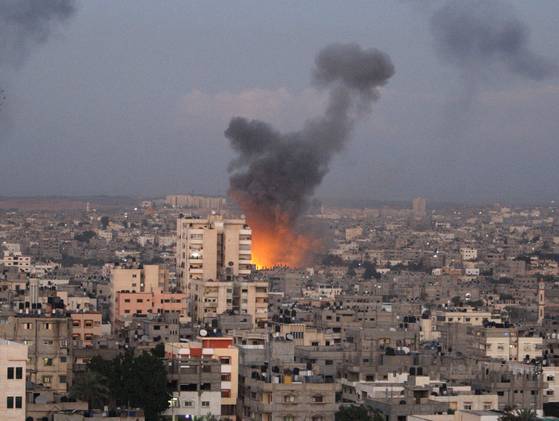
The joint IDF-Shin Bet air strike that killed Ahmed Jabari, Hamas's senior military commander in Gaza, appears to present one of two scenarios: the decapitation strike heralds a finale to Israeli Prime Minister Benjamin Netanyahu's campaign against Gaza's elusive rocket-launchers, or the beginning of a new war that could exceed the last.
Current developments suggest that the first option remains an outside possibility. Having bagged a trophy for his voting public, Netanyahu may attempt to stay out of a longer, more costly intervention of the Gaza Strip and protect the gains he has secured. Or someone could manage to talk some sense into him, and convince him that a large-scale operation in or above Gaza is not the means to win votes in the UN General Assembly.
However Hamas and Gaza's militant offshoots have no choice except to deliver on their promised retaliation, a cycle that Israel is equally willing to perpetuate. Multiple "truces" have immediately broken down and both sides attribute responsibility to the other. This fire is likely to heat up before cooling down. On Monday the Islamic Jihad's Khaled al-Batsh explained his group's status: "The ball is in Israel's court. The resistance factions will observe Israel's behavior on the ground and will act accordingly."
Israeli Home Defense Minister Avi Dichter announced on Tuesday, "There is no precedent in history of destroying terror by air power alone. It hasn't happened and it won't happen. Thus it is necessary to reformat Gaza altogether."
The air strike on Jabari soon followed.
In the event of a large-scale conflict in Gaza, its fourth-generation waves will reach across oceans and could seriously threaten the region's stability. More political theater than war at this point, Netanyahu is visibly positioning his right-wing coalition with Foreign Minister Avigdor Lieberman for January 22d's election. He's also sending a twisted message to the UN General Assembly, as if to prove that Israel will do whatever it wants if it feels threatened. This message has been repeatedly delivered to and discarded by a sizable portion of the international community, which views Israel's disproportionate response as counterproductive to solving Gaza's dilemma. Its latest air strikes are on their way to killing more civilians than Palestinian rockets killed in the last 3 years.
The Israeli government is already floating the idea of withdrawing completely from the Oslo Accords if Mahmoud Abbas plays his hand for "advanced status" on November 29th.
And is there any coincidence to the fact that Ahmed Jabari was assassinated on the same day that President Barack Obama issued his first post-election address, remarks that focused on diplomacy with Iran? The attack on Gaza appears to be aimed equally at Hamas, Iran and Obama, who allowed 2008's invasion to pass in silence and appears unable to stop another. Obama could opt split the difference by opposing war in Gaza and the Palestinians's UN bid; Tehran, Damascus and Cairo's responses are less predictable. None of these options promise much for the people on the ground.
Many combustible factors are reacting to each other in the region, turning Gaza into a microcosm of its surroundings. Information and disinformation has spiked, and further advances in social media will infect the conflict. Only time will shakedown the possibilities into reality.
[Update - The U.S. State Department has just released the following statement voicing unequivocal support for Israel's actions:
STATEMENT BY MARK TONER, DEPUTY SPOKESPERSON
U.S. STATE DEPARTMENT
Gaza Rocket Attacks
We strongly condemn the barrage of rocket fire from Gaza into southern Israel, and we regret the death and injury of innocent Israeli and Palestinian civilians caused by the ensuing violence. There is no justification for the violence that Hamas and other terrorist organizations are employing against the people of Israel. We call on those responsible to stop these cowardly acts immediately. We support Israel’s right to defend itself, and we encourage Israel to continue to take every effort to avoid civilian casualties.
Hamas claims to have the best interests of the Palestinian people at heart, yet it continues to engage in violence that is counterproductive to the Palestinian cause. Attacking Israel on a near daily basis does nothing to help Palestinians in Gaza or to move the Palestinian people any closer to achieving self determination.
[Update - The U.S. State Department has just released the following statement voicing unequivocal support for Israel's actions:
STATEMENT BY MARK TONER, DEPUTY SPOKESPERSON
U.S. STATE DEPARTMENT
Gaza Rocket Attacks
We strongly condemn the barrage of rocket fire from Gaza into southern Israel, and we regret the death and injury of innocent Israeli and Palestinian civilians caused by the ensuing violence. There is no justification for the violence that Hamas and other terrorist organizations are employing against the people of Israel. We call on those responsible to stop these cowardly acts immediately. We support Israel’s right to defend itself, and we encourage Israel to continue to take every effort to avoid civilian casualties.
Hamas claims to have the best interests of the Palestinian people at heart, yet it continues to engage in violence that is counterproductive to the Palestinian cause. Attacking Israel on a near daily basis does nothing to help Palestinians in Gaza or to move the Palestinian people any closer to achieving self determination.
November 11, 2012
Yemeni Government Subservient To US, Saudi Regime
Press TV reports work on a hit or miss basis. This one hits:
Yemenis have staged several anti-US protests over Washington’s interference in Yemeni affairs and its assassination drone attacks in the country over the past few months. The protesters have called on the government to cut all ties with Washington over the drone strikes.
Press TV has conducted an interview with Moufid Jaber, Middle East Center for Studies and Public Relations, from Beirut, to further discuss the issue. Jaber is joined by Hakim al-Mesmari, editor-in-chief of the Yemen Post, from Sana’a. The following is a rough transcription of the interview.
Press TV: Al-Mesmari is saying that the Yemeni government wants to see an increase in these drone attacks; however, we see almost on a daily basis or at least weekly, the Yemeni people taking to the streets and condemning these drone attacks. Where does it lie? Does the Yemeni government actually represent the Yemeni people or is it basically subservient to the US?
Jaber: As we know, the Yemeni government in its present form came largely as a result of a Saudi-brokered agreement. Without the approval of the US and of Saudi Arabia, there wouldn’t be a Yemeni government. [It] is largely decided in Saudi and the US. As you know, yes, the Yemeni government is to a great extent subservient to the US and to Saudi Arabia.
November 8, 2012
Clinton's Replacement Frontrunners: Kerry, Rice, Donilon
Three poor choices being floated for Hillary Clinton's replacement at the State Department.
WASHINGTON — Foreign policy wasn’t the issue that got President Barack Obama re-elected Tuesday, but with upheaval in the Middle East, a war to end in Afghanistan and strained relations with superpowers Russia and China, it’s sure to play an outsized role in shaping his legacy as he enters a hard-won second term.
One of Obama’s first and most crucial tasks will be naming a successor to Secretary of State Hillary Clinton, who’s vowed to step down after this year. Still reeling from his administration’s botched handling of the deadly terrorist attacks on U.S. diplomatic targets in Libya, Obama is no doubt seeking a deft and versatile replacement to guard and advance U.S. interests in a volatile world, especially in the Middle East, where creeping fundamentalism undermines longstanding U.S. influence.
“This so-called Arab Spring has not run its course and, in the short to medium term, and I certainly mean to the end of this decade, I think it’s going to be very tumultuous,” said Richard Armitage, who served as deputy secretary of state under President George W. Bush. “You are going to have volatile, weak leadership governments that are Islamic leaning. That is not necessarily going to end up that way. But it’s going to occupy an increasing amount of our time.”
Among those rumored to be under consideration for the top diplomatic slot are Sen. John Kerry, the Massachusetts Democrat and chairman of the Senate Foreign Relations Committee, National Security Adviser Thomas Donilon and U.N. Ambassador Susan Rice. Rice’s star has fallen somewhat since her role in spreading incorrect information – she says unwittingly – in the aftermath of the Libya attacks that killed Ambassador Christopher Stevens and three other American personnel on Sept. 11.
Clinton’s replacement will inherit headaches in virtually every corner of the world: the unresolved debt crisis in Europe, the rise of militant Islamist factions in transitional Arab states, a nuclear showdown with Iran, a moribund Palestinian-Israeli peace process, trade disputes with China, looming wars in Africa, disagreements with Russia over missile defense and Syria, and a backlash to the U.S. drug war in Latin America.
November 1, 2012
Obama, Romney Vie for Middle East Hegemony

Published by Muftah.org - Visit Muftah for independent analysis on events in North Africa, the Middle East and South Asia.
In the days following President Barack Obama’s speech at the
Democratic National Convention in September 2012, administration
officials and U.S. media seesawed over a post-convention “bump” that
elevated his standing above Republican challenger, Mitt Romney. Numerous
polls, including a recent Fox News survey, marked
a widening gap between the candidates on a variety of issues, with
Obama largely taking the lead: education (+14), Medicare (+11),
terrorism (+8 points) and foreign policy, where Obama rated 15 points
higher than Romney.
However, no matter who wins this November, people in the United
States and Middle East will likely be stuck with largely the same U.S.
policies toward the Middle East and North Africa that have held sway for
decades.
Romney Runs on Traditional GOP Diesel
Although Romney’s policies in the Arab world are masked by ambiguity,
scarecrows and red herrings designed to project a friendly aura toward
the region, his administration runs on traditional GOP (Grand Old Party)
diesel and exploits a widespread anti-Muslim trend in the mainstream Republican party.
While blaming Obama for “diminishing American leadership” is standard
fare, and a valid point when it comes to the Middle East, Romney’s
hawkish and insensitive tendencies toward local populations and
fledgling pro-democracy movements in the region are undeniable. In his
own words, Romney’s circle is staffed by pollsters who apparently are not “going to let our campaign be dictated by fact checkers.”
More importantly, however, in many areas outside Iran and Israel’s airspace, Romney’s proposals mirror Obama’s. In his October 2011 white paper,
titled “American Century Strategy: secure America’s enduring interests
and values,” Romney demonstrates the numerous points of mutual agreement
between himself and Obama while exposing the toxicity beneath his sweet
rhetoric.
According to this document, the “unfinished” project for an “American
Century” is something his administration would complete, and the Arab
revolutions something to be manipulated under the banner of democracy: "To protect our enduring national interests and to promote our
ideals, a Romney administration will pursue a strategy of supporting
groups and governments across the Middle East to advance the values of
representative government, economic opportunity, and human rights, and
opposing any extension of Iranian or jihadist influence. The Romney
administration will strive to ensure that the Arab Spring is not
followed by an Arab winter."
In a “dangerous, destructive, chaotic” world, Romney plans to “lead
the free world” as the “free world leads the entire world.” This policy
includes joining Israel’s crusade against Iran’s nuclear sites, a
potential war that an estimated 60-70% of Americans disapprove of, as a
means of projecting America’s strength.
Two Sides of the Same Imperialist Coin
Obama, on the other hand, has fashioned himself into an arbitrator of
war and peace, wielding a Nobel Peace Prize in one fist and Osama bin
Laden’s head in the other.
Four years removed from his promise of a new era of engagement
between the U.S. government and Muslim world, negative perceptions that
have accumulated between both sides as a result of decades of war,
intervention, exploitation and continual strife continue to hold sway.
Obama is not personally responsible for this entrenched status quo,
but he is to blame for overselling and under-delivering on his promise
to repair relations with the ambiguously-defined Muslim world. Under
Obama’s watch, U.S. policy in the Persian Gulf’s sphere of influence has
continued to lack “American leadership.”
The race for bin Laden represented a triumph for whoever reached him
first and Obama will likely reap the personal benefits of this success
for the rest of his life. The glorified kill, along with an increase in
drone warfare across the region and the strategic rise of U.S. Special
Forces missions, has allowed Obama to continue his foreign policy of
“less force” with minimal domestic resistance.
Obama’s case for non-military action against Iran, withdrawing from
Iraq and Afghanistan, and promise to “disrupt terror plots wherever they
form” became more convincing after bin Laden’s death on May 2nd, 2011.
Well-meaning critics of America’s new military strategy find it
difficult to attack a policy that costs less American lives and taxpayer
dollars.
Iraq & Afghanistan
Obama and Romney have wrangled over their respective policy positions
on Iraq and Afghanistan. Nevertheless, they share more common ground
than differences and have both failed to present a realistic approach to
U.S. engagement with these countries. The President has grown fond of bragging that he “ended the war in Iraq,” and has refused to unspin Romney’s own policy, as ongoing Iraqi casualties make for dangerous political ground.
With regard to Iraq, Romney claims that “a democratic Iraq allied to
the United States is within our reach,” but that Obama has “threaten[ed]
to snatch defeat from the jaws of victory.”
Promising to use a “broad array of foreign policy tools – diplomatic,
economic, military” to bring Iraq within the U.S. sphere of influence,
Romney focuses on Obama’s “failure” to install a residual military
force. He ignores the political void that the administration has
encouraged by supporting Prime Minister Nouri al-Maliki. To the extent
that the Obama administration has responded to Romney’s attacks, it has
described his approach to Iraq as “tragic.”
In reality, Obama and Romney have ended up in al-Maliki’s leaky boat,
a circumstance that neither candidate likes to discuss. Both fail to
acknowledge (at least publicly) that Washington’s deficiencies in Iraq
stem from political inequalities, not military shortages. Prolonging the
deployment of U.S. troops under the authority of the divisive al-Maliki
would have added to the Iraqi prime minister’s leverage over Sunni,
Shia, and Kurdish political opponents; an extension of American
involvement would have generated as many security problems as it would
have solved.
The incumbent and challenger find similar common ground in
Afghanistan, where Romney agrees with the bulk of Obama’s strategy
despite public feuding. In line with Obama administration policy,
Romney’s white paper approves of the 2014 transition to Afghan security
forces and demands greater accountability from Afghanistan and
Pakistan’s governments. Contrary to Obama’s DNC announcement that “in
2014, our longest war [Afghanistan] will be over,” his administration –
like Romney’s – hopes to maintain a long-term security presence in the
country after 2014.
Romney opposes negotiating with the Taliban and still intends to
eliminate the group from Afghanistan, an unrealistic move that would
ultimately extend the war. Much like Obama, Romney is liable to send air
or ground troops across Pakistan’s border in search of the elusive
Haqqani network, one of the Afghan Taliban’s most organized arms and a
major thorn in U.S. strategy. Such a move would likely perpetuate
Afghanistan’s war by causing new friction between Washington and
Islamabad.
The Illusion of Choice
The greatest regional divergence between the candidates centers
around U.S. policy toward Israel and Iran. On this front, Romney
believes he can score fast points by portraying himself as the
anti-Obama. For his part, Obama has remained focused on isolating Iran
globally and has tread cautiously around talk of war, in response both
to advice from America’s military leadership and public resistance to
another “big” war in the Gulf.
While conceding that economic and diplomatic isolation is necessary,
Romney insists that defusing Iran’s nuclear ambitions can only be
achieved through the real threat of war – a plan that includes
“repairing relations with Israel.” Unlike Obama, Romney would “never
refuse a meeting” with Prime Minster Benjamin Netanyahu (a story that the White House denied), reject Israel’s insistence on a “red-line” for stopping Iran’s enrichment program, or throw Israel “under the bus.
Romney casts Obama as “pro-Palestinian,” reinforcing the twisted
state of U.S. policy toward the Arab-Israeli conflict under either
candidate. In reality, Obama has abandoned the Palestinians and spent
far more energy confronting the Iranians, as the Israelis prefer.
Upon taking office, Obama announced that he would break from the Bush
administration’s 11th-hour drive for peace between Israelis and
Palestinians and pursue an equitable two-state solution “from day one.”
Sadly, Obama has fallen into the same trap of bias and inaction, even
excluding the Palestinians from his acceptance speech at the DNC. If
peace is harder to make than war, it stands to reason that greater
energy must be applied.
As for Romney, he is far from eager to help the Palestinians and
certainly more passionate about the Israeli cause. He claims that Iran,
not the Israeli-Palestinian conflict, serves as the region’s central
issue. Tehran’s regional policies admittedly run on a variety of
unrelated interests, from Syria and Afghanistan to its hegemonic dispute
with Saudi Arabia. Its nuclear ambitions may beyond compromise. Yet, at
the same time, one cannot help observing that the Islamic Republic of
Iran has never known a world with a sovereign Palestinian state. Should
such a state come to be, one wonders how Iran’s regional ambitions and
strategies might change.
Continuity on the Arabian Peninsula
In Yemen, the current administration has deployed Obama’s trusted counterterrorism adviser John Brennan
as its lord of war and occasional senior “diplomat” in the country.
Both he and U.S. Ambassador to Yemen, Gerald Feierstein, are extremely
unpopular figures due to U.S. handling of Yemen’s ongoing revolution,
its extensive drone program, and other covert U.S. activities in the
country.
Romney would likely follow similar policies in Yemen by utilizing
drones, Special Forces and CIA personnel to safeguard U.S. interests.
As Obama and Romney both operate their regional agendas on a steep
Iranian tilt, U.S. policy toward Bahrain would also stay consistent
between administrations – planted firmly on the side of Bahraini King
Hamad bin Isa Al Khalifa’s crackdown against pro-democracy forces.
America’s counterrevolutionary actions in select regional states have
reinforced the hypocrisy of U.S. foreign policy in the region,
especially toward the Libya and Syria interventions. Rather than
pointing to this inconsistency, Romney has instead accused Obama of
encouraging an “Islamic winter,” while portraying himself as tougher on
Iran and Islamists.
Conclusion: Marooned on Hope Island
Given his own positions, Romney is clearly incapable of fostering
lasting stability and peace in the Middle East. Improving the trajectory
of U.S. policy in the region requires the type of personality that
Obama promised and never delivered, making his failures historically
significant.
Poll after poll concludes
that Obama fell into an enormous trust gap left by previous
administrations. Too many Muslims still perceive America as a unilateral
actor in the region and an outright threat to
their national interests. Accordingly, in Egypt, Turkey, Jordan, Yemen,
Pakistan, the Palestinian territories and other regional countries
entangled within U.S. foreign policy, Obama’s popularity remains very
low.
Romney is minimally concerned with public relations in these
countries. He is, nevertheless, right one on account: Obama has failed
to deliver the leadership that he promised in the Middle East. Romney
would, however, offer no respite from Obama’s fox-like friendship with
the Palestinians and pro-democracy actors in the region.
The dilemma of lesser evils may be an inherent problem of democracy,
but the ranking of America’s presidential candidates cannot be pegged to
the failures of past leaders, such as George W. Bush. Finding a truly
excellent candidate is an ideal worth pursuing. As for the diverse
peoples of the Middle East, nothing has changed since Obama entered the
Oval Office and nothing will change if Romney evicts him: they must
still free themselves of foreign interference on the path toward
determining their own future.
Subscribe to:
Posts (Atom)