Showing posts with label Lebanon. Show all posts

February 17, 2013

Amid Peace Talks, Bahrain's Monarchy Cries Iran

The Bahraini monarchy's second attempt at a poorly-named "National Dialogue" has become inevitably obscured by the haze of asymmetric warfare. Given the common theory that King Hamad bin Isa Al-Khalifa's regime is provoking Bahrain's opposition to justify harsh retaliation - whether jailing its leadership or shooting its youth - one must speculate on the timing between political negotiations and the February 14th anniversary. The monarchy clearly anticipated demonstrations on this day and has worked diligently to exploit their fallout in its favor.

Restarting the National Dialogue after its first government-induced collapse accomplishes multiple objectives at once: the opposition's actions in the streets are subverted by diplomatic outreach and ultimately held responsible for any failures at the negotiating table.

Days of running battles between protesters and security forces have also presented an opportune time to announce Bahrain's latest "terrorist cell" and bomb plot, courtesy of Iran's shadow. After highlighting the government's own casualties and the vicious actions of "saboteurs," meaning rock and Molotov-throwing youth protesters, Minister of Interior Lt-General Shaikh Rashid bin Abdullah Al Khalifa informed a televised audience that a 2-kg bomb had been defused at the King Fahd Causeway. Five men linked to Iran's Revolutionary Guard already stand accused of receiving training in a camp along the Syrian-Lebanese, and allegedly admitted (during interrogation) that they planned to start a terrorist organization in Bahrain.

Accordingly, Al-Khalifa confirmed the arrest of eight individuals with "links to Iran, Iraq and Lebanon," where they received weapons and explosives training similar to the previous cells.

The possibility that Iran and its proxies are operating through Bahrain is high, but they are equally unlikely to cooperate with the island's opposition. These actors are pursuing their own ends rather than the democratic opposition's cause of political representation, and in doing have been conveniently shackled to the youth and Al Wefaq. The Iranian specter undermines Bahrain's opposition too efficiently for anyone other than the Bahraini monarchy's enjoyment - combined with Saudi backing and America's Fifth Fleet, Iranian-funded terror cells and bombs form the trump cards in its arsenal. Now, instead of covering the disproportionate force that triggers civil disobedience, Bahrain's narrative in the international media has mutated into terrorist plots.

The contrived elements of this situation are rendered evident by the precise media roll out of Bahraini officials, beginning with hardline Prime Minister Khalifa bin Salman Al Khalifa and his speech of "unity." Regardless of the messenger, the overall message of King Hamad's royal circle remains unchanged: cast protesters as the island's problem and King Hamad's rule as the solution.

"We will not be discouraged by the actions of those who are intent on undermining the stability and peaceful endeavors of Bahrain's government," the Interior Minister declared on Saturday night. "Ours is a nation committed to reforms, human rights and the rule of law."

All of these transparent moves are too insincere to improve the noxious climate of Bahrain's National Dialogue.

February 16, 2013

Iran warns Israel: We'll avenge Guards commander

A variety of allied and competing forces are attempting to pull Syria's revolution into a wider regional conflict. The possibility of deescalation currently rests at 0%.
Iran will soon exact revenge on Israel for the recent killing of an Iranian Revolutionary Guard Corps commander in Syria, an aide to Iranian Supreme Leader Ayatollah Ali Khamenei was quoted on Saturday as saying.

Iran said on Thursday that an Iranian military commander named Hassan Shateri, also known as Hessam Khoshnevis, had been killed in Syria by rebels fighting President Bashar Assad, an ally of Tehran.

But Iran’s envoy to Beirut, Ghazanfar Roknabadi, on Thursday drew a link between the killing and Israel.

Ali Shirazi, Khamenei’s representative to the IRGC’s elite Quds force, said on Friday evening that Iran’s “resolve against Israel” had only grown stronger with Shateri’s killing.

“Our enemies should also know that we will quickly get revenge for [the death of] Haj Hassan [Shateri] from the Israelis, and the enemies cannot shut off the Iranian people with such stupid acts,” Shirazi was quoted as saying by the Iranian Students’ News Agency on Saturday.

Israel has not commented on the killing.
Continue Reading

September 17, 2012

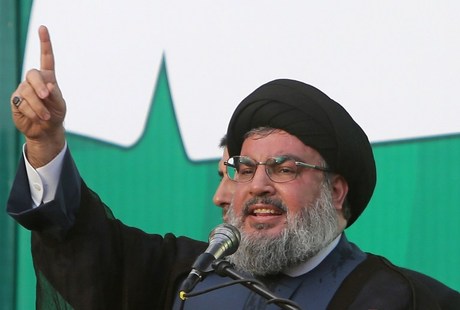
Hezbollah's Nasrallah Sharpens Muslim Outrage

As government officials and international news organizations race to examine the plots of extremist splinters, reactions of involved governments and their relation to the U.S. Embassy protests, Washington finds itself confronting a parallel threat to the safety of its diplomatic assets. America's opponents have grown adept at capitalizing on anti-Muslim propaganda made by rightwing personalities, using the opportunity to challenge Washington's foreign policy and advance their own local interests. The friction generated by this dog-pile effect represents the holistic threat posed by inflammatory anti-Muslim films.

In Yemen, a large body of protesters rallied not to protest Nakoula Basseley Nakoula but Ambassador Gerald Feierstein, whose cooperation with former president Ali Abdullah Saleh and the new government has earned him widespread disapproval. They have every right and ample motivation to "take advantage of the situation." The Taliban slapped Nakoula's film onto their raid of Camp Bastion even though the assault was planned weeks (or longer) ahead of time, and intend to milk its propaganda for as long as possible. Now another bad nightmare has manifested in reality and jumped on the pile. Speaking to an estimated 500,000 Shia Lebanese on Monday, Hebzollah chief Hassan Nasrallah urged protesters to organize peaceful and sustained demonstrations against the film, the U.S. and Israel.

"The world should know that our anger is not a passing thing... This is the start of a serious campaign that must continue all over the Muslim world in defense of the prophet of God. As long as there's blood in us, we will not remain silent over insults against our prophet."

A credible voice in at least parts of the Arab world, including many anti-Western havens, Nasrallah's words could force the Obama administration into some form of direct response. Hezbollah's face and brains has conclusively lost Muslim support over the last five years, particularly in Egypt and Jordan, and risks a significant amount of popularity by standing behind Syria's Bashar al-Assad. Nasrallah would boldly call for more urgent action from the Arab League, a demand that provokes more ridicule than agreement. At the same time, Hezbollah is still viewed favorably in comparison to other Islamic militant groups and considered a legitimate resistance movement by millions of Arabs. While the group is suffering from a general trend against extremism, active social work and military restraint has kept the group from drifting into al-Qaeda territory.

Anti-Israeli opinion also remains a useful supplier of popularity.

Nasrallah's strategic mindset and flare for the dramatic further demonstrate why his charisma draws supporters from outside Shia Lebanon. Appearing in public for the first time since December 2011, an animated Nasrallah spent the majority of his 15 minutes painting lavish religious overtones and history lessons. He believes that the film is “more serious than burning Al-Aqsa Mosque," which was set aflame by Denis Michael Rohan in 1969 with the intention of spawning the return of Jesus Christ. Yet Nasrallah wisely appeals to peace rather than war, stressing peaceful rallies and unity with other religions in an apparent attempt to modernize Hezbollah's image.

“We should bear the historical responsibility of the whole Islamic Ummah (Nation) and of every honorable Christian believing in coexistence to work to issue an international resolution criminalizing the defamation of heavenly religions, and the prophets at least, especially Abraham, Moses, Jesus and Mohammad.“

In conjunction with his religious call to action, Nasrallah also sees an opportunity to lead the political counterattack against the U.S., Israeli and Arab governments - an offensive that has no central command. Holding Washington responsible for the film's availability, Nastallah called on the Obama administration to intervene and censor the film's release online. This unrealistic but seemingly reasonable demand casts Washington and allied Arab governments as accomplices to the film, “which offers another witness to its hypocrisy, deception and double standards in dealing with issues.”

"The ones who should be held accountable and boycotted are those who support and protect the producers, namely the U.S. administration," Nasrallah said. "We should not only express our anger at an American embassy here or there. We should tell our rulers in the Arab and Muslim world that it is 'your responsibility in the first place' and since you officially represent the governments and states of the Muslim world you should impose on the United States, Europe and the whole world that our prophet, our Quran and our holy places and honor of our Prophet be respected."

In effect, Nasrallah has designed an interdependent politico-religious narrative that, at times, neutralizes the religious in favor of the political. He would get nowhere by portraying the battle as Muslims versus Christians - especially in his own country - and instead posits another conflict between America, Israel and the Arab world. Announcing that, "Muslims released their anger on the U.S. and Israel, and not on Christians," highlights this shift from his perspective. He also dares to transfer blame onto Israel as a means of diffusing tensions with Christians: "Those who made the movie knew that the Muslims would be enraged by it, and attributed it to Christians to cause strife between Muslims and Christians. Israel wants to watch Muslims killing Christians and burning their Churches.”

Protests could wane over time as they tend to do; if not, Nasrallah might only play a limited role in mobilizing sustained demonstrations. Yet the Obama administration cannot afford to ignore the principle of his warning or underestimate his regional influence. Although Hezbollah's strongman will be unable to escape the title of propagandist and extremist, his speech currently represents the highest level of articulation from America's asymmetric opponents in the Middle East.

January 31, 2011

Revolution Traps Washington in Strategic Dilemma

The video phones are ringing off the hook. Crumbling and nervous allies, observing foreign governments, journalists, activists, maybe an opposition figure or two. All wanting to know how the White House will respond to the revolutionary furor sweeping the Middle East - all wanting to know what President Barack Obama will do next.

But what can he do?

As Tunisia’s revolutionary fire spread from Cairo to Egypt’s periphery, the U.S. media began to reflect an uncharacteristically harsh light back upon the White House. With Obama and Secretary of State Hillary Clinton’s pleas falling on deaf ears and Egyptian security forces multiplying by the day, news organizations were left with nothing to print except the truth. Sinking into the same historical quicksand as Egyptian President Hosni Mubarak, reports starting labeling the Obama administration as “surprised,” “overwhelmed,” and “trying to catch up” to Tunisia’s chain reaction.

The descriptions fit. A novice in foreign affairs and seemingly afraid to get dirty, Obama has relied on Clinton to do most of his talking. Experience has finally assumed a dominate role, and Obama is reportedly leaning hard on his stable of advisers to handle the massive flow of information. Though he needs a couple dozen heads to track the region’s quakes, a lack of executive decision-making has slowed the White House’s response time during a pivotal moment in world history - and Obama’s presidency.

These factors, however, shape the mold of the real handcuffs limiting America's reaction. Even a mind perceiving the deepest nature of the Middle East’s upheaval would, when dumped with the collective failure of U.S. policy, find the challenge impossible to solve overnight. He or she must summon their full imagination and unconventionally extract America from its position “on the wrong side of history.” Unfortunately Washington’s dilemma is strategic in nature and rooted in decades of shaky policy, and thus faces the prospect of having no solution.

"There's no easy answer," Clinton admitted on CNN's "State of the Union.”

America’s paradox can be expressed in a simple syllogism. To contain Islamic elements hostile to the U.S. or Israel, it became necessary to prop up those regimes that could exert relative control of their territory. This arrangement of convenience often inflames tensions between the government and opposition groups; popular movements are quelled at the expense of long-term stability, as militant groups thrive on the unequal status quo.

al-Qaeda’s ideology bases itself on overthrowing morally-bankrupt Western puppets.

Counterinsurgency lives or dies by its message - in word, deed, and impression - and America has long contradicted its message of freedom and democracy through support for unpopular or unlawful regimes. Now, as legitimate revolutionary protests spread across the Middle East, Washington must weigh the risks of bankrupting its ideals against an Islamic uprising that intentionally or unintentionally empowers its enemies. This fatal contradiction poses the main strategic dilemma in America’s war against al-Qaeda, and the White House knows it.

One former Obama administration official who spoke on condition of anonymity said the Oval Office, "recognized that change was coming and they needed to be on the right side of history and not try to keep Mubarak in power against all odds. It's a very difficult balance to be struck... The administration understand this. But the most important thing they understand is that they have to get in front of this and not behind it.''

Yet this reasoning has left U.S. officials to overly spin the situation. Portraying Obama as active and attune with movements on the streets, the White House even released a statement saying that he received "multiple updates," and that he was currently on the phone with foreign leaders. Clinton bombarded Sunday news programs with a warm but stern message to both Mubarak and protesters, urging them to work together and move forward.

Beyond neutralizing the crisis, these efforts were designed to stem criticism that the White House has over-focused on the perception of its response, neglecting the response itself.

"The events in Egypt as well as in Tunisia, Yemen, Jordan, and Algeria should spark a broader rethink in America's approach to the entire region," says Brian Katulis, a fellow at the Center for American Progress in Washington. "Currently, the Obama administration is largely stuck in a reactive and tactical crisis management mode on many key fronts.”

Obama and Clinton are now floating a “peaceful transition” in Egypt to appease both sides, calling on the Mubarak regime to negotiate and for protesters to refrain from violence. For all the reasons above, the White House continues to toe the line hoping it can prevent outright revolution. Seeking a transition through the chaos, not a transition of the Mubarak government, some officials believe it wise to, "stay on the sidelines and keep American fingerprints off too much support of the regime on one hand and too much support for protesters on the other."

But negotiations and lineage are unlikely to yield permanent stability, and maintaining the region’s equilibrium contradicts the realization that the Middle East is metamorphosing. At some point, sooner than later, the White House may well be forced to pick a side: the government or popular movement attempting to replace it. The middle of the road ultimately reflects indecision, not pragmatism or wisdom, and is where people get run over.

Washington must take a decisive stand to break out of its strategic dilemma. Mohamed ElBaradi, Egypt’s highest-profile opposition figure, countered in his own series of interviews to CBS and ABC, "It is better for President Obama not to appear that he is the last one to say to President Mubarak, 'It's time for you to go.’”

And to CNN’s Fareed Zakaria, “People need to see that you not only talk the talk, but walk the walk... To say we have a tight rope - between the people and the dictator - to say that we are asking a dictator who's been in power for 30 years to implement democracy is an oxymoron, frankly.”

So what can Obama and Clinton do right now to improve the situations in Egypt and Yemen, Algeria and Jordan? Any strategy must operate on multiple levels. If the choice ultimately comes down to governments or populaces, then America must let the dust settle wherever the people cast it. If the Muslim Brotherhood comes into power, so be it. As in Hezbollah and Muqtada al-Sadr’s cases, the Brotherhood isn’t about to attack U.S. or Israeli targets after securing political power.

With the group in her sights, Clinton claimed that she wanted to see “real democracy... not a democracy for six months or a year and then evolving into essentially a military dictatorship or a so-called democracy that then leads to what we saw in Iran." In fact, the Brotherhood has taken a conscious back-seat in Egypt’s revolution, and their main “threat” appears to be increased support for the Palestinians. Mohammed Mahdi Akef, the group’s retired leader, explained, "This is on purpose. We want to be part of the fabric of society. If we had led, they would have massacred us. All we want is freedom for all the people. Freedom would give us space for movement."

"They are no way extremists,” ElBaradei told ABC's "This Week" program. “They are no way using violence. This is what the regime... sold to the West and to the US: 'It's either us, repression or al Qaeda-type Islamists.’”

Exactly America’s strategic dilemma - and the means to escape is by rejecting fear.

This strategy does become more difficult in Yemen. To blanket opposition movements as Islamists is politically and morally reckless, yet there’s no doubt that al-Qaeda in the Arabian Peninsula eagerly awaits a situation similar to Egypt’s. AQAP doesn’t even need a power vacuum to thrive; a temporary raid on a military base could stock the group, which has shown itself adept at living off the enemy. As a smaller cadre AQAP can’t afford many suicide bombings, and instead employs ambushes to overwhelm and loot Yemeni security forces. Last week a payroll convoy was stolen.

After watching Egyptian inmates break out into the chaos, AQAP could use the growing protests against President Ali Abdullah Saleh to strike an armory or financial institution.

In general, the war against AQAP will suffer so long as Saleh must focus his energy on political survival. Washington has few options since Saleh poses the same problem as Mubarak. Recently ordering his General People’s Congress (GPC) to set about eliminating his term limit, which expires in 2013, Clinton was forced to urge a dialogue after Yemen’s opposition threatened to boycott April’s parliamentary election. But repeated references to “unity” indicate that America doesn’t want to see a divided Yemen, despite some of the deepest resentment emanating from the secessionist Southern Movement.

Now, just as Washington is trying to ramp up operations in Yemen, Obama must choose between the unpopular Saleh - and the wrong side of the future - or Yemen’s opposition and the risk of AQAP’s expansion.

Any solution requires a persistent grind and continual emphasis on non-military operations. Although $300 million in aid is marked for 2011, supposedly split between military and non-military aid, reports have $250 million going to military support. Non-military aid should greatly exceed military assistance to prove the sincerity of America’s concern for the Yemeni people. AQAP tries to avoid killing civilians, non-Houthis anyway, and busies itself supplying food, medicine, and wells for local tribes.

America has to consistently beat this message over time.

At the macro-level, it seems too obvious that Obama must redouble (or triple) his efforts on the Israeli-Palestinian front. Clinton has spent a good deal of air-time spinning Arab revolt into an example of why America advocates a permanent peace. Yet negotiating in Israel’s favor, the present breakdown with the Palestinians, and now the infamous Palestine Papers magnifies America’s favoritism and ineptitude on an international level. A policy reversal won’t address the grievances of each regional crisis, but one must assume a general improvement in U.S. relations with the Muslim world.

Unfortunately Egypt, Yemen, and other hot-spots appear to have further distracted the White House from conflict-resolution. Though America’s support for Israel remains a main source of negativity, protecting it from the fallout has introduced another check on Washington’s decision-making. The White House and Congress must realize that the best way to protect Israel is an equitable two-state solution, complete with a divided Jerusalem that Obama should personally split.

Becoming distracted from the peace process during such a critical moment leads into a death spiral.

With Washington lagging far behind the revolutionary train that left Tunisia and panting to catch up, the Obama administration has no time for an Afghanistan-like review or Palestinian collapse. Events in the Middle East call for rapid, unconventional thinking and decisive action. Only drastic measures will jump America to the right side of history.

Being the tortoise doesn’t work after starting off as the hare.

January 24, 2011

Lebanon Needs Interaction, Not Isolation

Though its response has been comical up to this point, Washington has every reason to panic over Lebanon’s ongoing political crisis. al-Qaeda isn’t the ultimate night-mare scenario - unless, of course, it’s nuclear armed. In fact, al-Qaeda serves a useful purpose by offering America justification to occupy and militarize unstable Muslim states.

No, the real threat emanates from groups like Hamas, Muqtada al-Sadr's Mahdi Army, and Hezbollah, “terrorist” organizations that have evolved to the highest form of guerrilla warfare: legitimate political representation. So now that Hezbollah has positioned itself to take over Lebanon’s government, America is responding to the move like a declaration of war.

But if Washington actually expects to out-maneuver Hezbollah, it can’t treat Lebanon like the Gaza Strip.

Three days after Walid Jumblatt, leader of the Progressive Socialist Party (PSP), threw at least seven of his 11 parliamentary seats behind Hezbollah’s choice for prime minister, the March 8th Alliance dropped a bombshell on the Western world by announcing it held a majority of parliament - 65 out of 128 seats. Comprised of Hezbollah, the Shia Amal Movement, and Michel Aoun’s Christian Free Patriotic Movement (FPM), March 8 has also selected its candidate for prime minister, Sunni billionaire Najib Mikati.

“It’s Mikati, unless something happens at the last minute,” a senior March 8 source told The Daily Star.

We were initially unsure of whether Hezbollah made right choice to dissolve Lebanon’s government. At the time it appeared to be a rash move to dodge the UN's tribunal over former Prime Minister Rafik Hariri's assassination, a "guilty" move that could jeopardize Hezbollah's own political support. But Hezbollah apparently realized it had the numbers all along, otherwise it wouldn’t have resorted to its current strategy.

And it already had its candidate lined up in Mikati, a seemingly perfect fit to avoid the UN’s tribunal and disarmament campaign. Asked about the tribunal, Mikati responded that "any dispute can be solved only through dialogue."

Considered politically neutral and wary of rocking the boat, Mikati comes with the additional bonus of believable unity. Instead of choosing Omar Karami, whose pro-Syrian interests threw him into media speculation, Hezbollah has trotted out a smiling face to offer an olive branch to Sunni Lebanese. Hassan Nasrallah, the group’s leader, claimed he favored a unity government during a speech Sunday night, though his reasons are certainly questionable.

“We have agreed with Mikati there is no objection to the formation of a partnership government, but without granting veto power [to the March 14 coalition],” said the Hezbollah source. “If they [March 14] refuse to join such a government, we will not beat ourselves up.”

Likely envisioned as Hezbollah’s checkmate, Mikati also happens to be on friendly terms with Lebanese Prime Minister Saad Hariri. It’s widely believed that Hezbollah, rather than choosing an easy target to oppose, selected Mikati to force Hariri into rejecting an ally. Hariri said on Monday morning that he won't a Hezbollah-led government, but Mikati is expected to rub his charm on the current PM.

"I don't distinguish between anyone," said Mikati, a Harvard graduate whose wealth is estimated at $2.5 billion, after meeting President Michel Suleiman on Monday. "I extend my hand to everyone without exception... I say to Prime Minister Saad Hariri, let us all work together for the sake of Lebanon."

So how should America react to these developments?

A contrary position is likely to serve a greater interest than conventional thinking. Washington has achieved little progress in isolating groups like Hamas and individuals like al-Sadr, a policy that attracts criticism for “selective democracy” and often backfires by empowering U.S. opponents. Staying in the thick of Lebanon’s power vacuum and keeping an open mind to Hezbollah’s alliance could dampen accusations of U.S. meddling, as well as limit new Iranian overtures.

And as some point out, Hezbollah isn’t usurping power so much as skillfully manipulating Lebanon’s internal politics.

One reporter asked State Department spokesman Philip Crowley, “Hariri’s government had two ministers from Hezbollah in it. And it seems they’re probably not going to get more than two ministers. Are you more focused on the role of Hezbollah or the process itself? Because it seems the process is democratic and constitutional. So you’re not going to recognize a government that reflects the will of representatives of the Lebanese people?”

Crowley pegged a “representative” government on the UN’s tribunal, which Washington views as its best opportunity to weaken Hezbollah’s political power. Apparently America only wants to reflect the will of Sunni Lebanese. But with Hezbollah holding such a commanding political position whether it secures the premiership or not, icing out Hezbollah in hopes of marginalizing it doesn’t offer a realistic solution to Lebanon's crisis.

For now, though, this appears to be America’s course of action.

“We will reserve judgment until a government is formed,” Crowley replied, as if Washington’s judgment hadn’t already formed. “Our view of Hezbollah is very well known. We see it as a terrorist organization and will have great concerns about a government that – within which Hezbollah plays a leading role. It is hard for us to imagine any government as being truly representative of all of Lebanon if that government is prepared to take steps back, for example, from its ongoing support for the work of the tribunal.”

He added, “The larger the role played by Hezbollah in this government the more problematic our relationship will be.”

Now, with the Israeli Defense Force already on high alert, unconfirmed reports have two Western military fleets streaming towards the Mediterranean Sea, complete with two nuclear aircraft carriers, 200 warplanes, and upwards of 5,000 Marines. Hezbollah isn’t about to launch an attack while attempting to climb Lebanon’s power ladder, yet America and Israel are acting as though they’ll blockade the country. As if they can back down Hezbollah through their own show of force.

This scheme has historically encouraged Hezbollah’s pursuit of power.

Lebanon’s latest crisis calls for a new tactic of accepting the inevitable. While the state cannot be ceded entirely to Hezbollah, neither can Washington close its eyes and wish Hezbollah away. Real politik demands a practical response. America has fought against Hezbollah’s political representation from the beginning - and look at the result of this policy.

January 11, 2011

Hezbollah to Resign from Lebanon’s Cabinet

From The Daily Star:

BEIRUT: The March 8 coalition is set to topple Prime Minister Saad Hariri’s national unity Cabinet Wednesday, a day after it declared the Saudi-Syrian initiative aimed at resolving Lebanon’s months-long political crisis had reached a dead end.

“The opposition ministers have agreed to resign. Their resignation will be announced tomorrow [Wednesday],” a senior March 8 source told The Daily Star Tuesday night. He said 11 ministers are set to quit, which would automatically lead to the resignation of the Cabinet.

Despite the reported collapse of the Saudi-Syrian initiative, Hariri pledged to continue efforts aimed at resolving the political crisis. “We will seek all means to reach solutions that can guarantee stability, calm and maintain national unity, which is the only guarantee for all the Lebanese to confront the challenges,” Hariri said in a statement in Washington released by his office in Beirut.

Hariri, who is currently in the U.S., consulted by telephone with President Michel Sleiman on “developments relating to the Saudi-Syrian efforts to consolidate stability in Lebanon,” it said. He will continue consultations with Sleiman and other leaders upon his return to Beirut, the statement said.

Hariri thanked Saudi King Abdullah bin Abdul-Aziz and Syrian President Bashar Assad for their efforts to bolster stability in Lebanon. “Hope is pinned on all brothers and friends to help Lebanon pull through this difficult phase. Hope is also pinned in the first place on the wisdom of the Lebanese and their leaders. We all have sought to avoid being dragged to reactions,” Hariri said, in a clear reference to the March 8 coalition’s escalatory steps.

“This phase requires from all of us the highest level of wisdom and responsibility because the primary beneficiary from divisions among the Lebanese is the Israeli enemy,” he added.
Hariri flew from New York to Washington Tuesday for a scheduled meeting with U.S. President Barack Obama at 5 p.m. Wednesday (Beirut time).

Hariri’s statement came following an escalation by the March 8 coalition, which has given him and Sleiman a Wednesday morning deadline to call for a Cabinet session to end Lebanon’s cooperation with the U.N.-backed Special Tribunal for Lebanon (S.T.L.).

Following a policy coordination meeting at M.P. Michel Aoun’s residence in Rabieh, north of Beirut Tuesday night, the 10 March 8 ministers said they were waiting for a response from
Sleiman to their demands before deciding on their next steps after Saudi Arabia and Syria have failed to forge a deal aimed at defusing political tension over the S.T.L.’s impending indictment into the 2005 assassination of statesman Rafik Hariri.

Speaking to reporters after the meeting, Hizbullah’s Minister of State for Administrative Reform Mohammed Fneish refused to answer a question as to whether the March 8 ministers would resign if their demands were not met. “Let’s not rush things… We will tell you tomorrow [the March 8’s next move],” he said.

The failure of the Saudi-Syrian initiative was dramatically announced earlier by Aoun, who is also the head of the Free Patriotic Movement.

The March 8 alliance has 10 ministers in the Cabinet. A minister close to Sleiman, Adnan Sayyed Hussein, will also submit his resignation, political sources said.

The Saudi-Syrian initiative has ended without any result, Aoun told a news conference at his residence in Rabieh. “Prime Minister Hariri’s team did not respond to the [Saudi-Syrian] efforts, which led us to a dead end,” Aoun, a close ally of Hizbullah, said. 


Fneish stressed Sleiman’s role to convene the Cabinet. “The president, who is the one chiefly responsible for the country’s stability and unity, is required to revive the role of [state] institutions and ask the prime minister to convene the Cabinet,” he said. “Today or tomorrow morning, we will know the result.”

Fneish blamed “American intervention” for the failure of the Saudi-Syrian initiative. “These efforts were derailed by American intervention and the inability of the other [March 14] team to overcome this intervention,” he said.

A March 8 ministerial source said that a March 8 delegation that met Sleiman had asked him to convene the Cabinet Wednesday at the latest with the issue of the tribunal being the only item on the agenda.

Among other things, the March 8 ministers want the Cabinet to stop payment of Lebanon’s share toward the financing of the S.T.L., withdraw the Lebanese judges from the tribunal, end Lebanon’s cooperation with the S.T.L., and prosecute the “false witnesses” linked to the U.N. probe into Rafik Hariri’s killing, the source told The Daily Star.

Saudi Arabia and Syria, main power brokers in Lebanon backing rival political parties, have been coordinating their efforts since late July to find a solution acceptable to the March 8 and March 14 factions for Lebanon’s months-long political stalemate over the S.T.L.’s impending indictment into Hariri’s killing. The indictment is widely expected to implicate some Hizbullah members in Hariri’s assassination, heightening fears of sectarian strife.

The announcement of the collapse of the Saudi-Syrian initiative followed high-level talks in Washington and New York on the Lebanese crisis involving Obama, French President Nicholas Sarkozy, King Abdullah, Hariri and U.S. Secretary of State Hillary Clinton. The Lebanese crisis was one of the topics discussed by Obama and Sarkozy at the White House Monday. Sarkozy later traveled to New York where he met separately with the Saudi king and Hariri.

The Cabinet has been paralyzed for months over political tension over the S.T.L.’s indictment and the rival factions’ dispute over the issue of witnesses who allegedly misled the U.N. investigation with their false testimonies. The Cabinet has met only once since November 10 and it failed at its last meeting on December 15 to settle the issue of “false witnesses” when the March 8 ministers demanded a vote for referring the issue to the Judicial Council, the country’s highest court, prompting Sleiman to defer the discussions.

“We have supported the [Saudi-Syrian] initiative because we cannot be against efforts seeking good. But the mediators have cautioned us that we must assume our responsibilities as Lebanese in order to reach a solution,” Aoun said. “We demand a Cabinet meeting at which we will propose all the ideas we want.”

Aoun said that rival Lebanese factions should work together to reach a Lebanese solution for the crisis. He said the failure of the initiative was not a failure for Syria, Saudi Arabia or the United States. “Rather, it was a Lebanese failure. Therefore, a solution has now become the responsibility of the Lebanese,” he said.

Progressive Socialist party leader M.P. Walid Jumblatt traveled to Damascus Tuesday where he met with Syrian officials to discuss the fast moving developments in Lebanon. Jumblatt had planned to talk about the Saudi-Syrian efforts at a news conference at noon Tuesday but the conference was cancelled. No reason was given for the cancellation.

This appears to be a bad move on Hezbollah’s part. Withdrawing from the government could strengthen America’s position in the country. Though Hezbollah has already begun to counter U.S. influence by blaming it for intervening in Syrian-Saudi affairs, it must push its propaganda to a new level to counter what should be redoubling of Washington’s attention.

The UN must really have something on Hezbollah to forgo its hard earned political power.
If reports are true, and they seem extremely detailed not to be, we will have more analysis on this development as it unfolds.

November 16, 2010

Israel’s Insanity Eclipses Hezbollah’s


Even casual observers of the Middle East have been submerged in the flood of reports predicting war between Israel and Hezbollah. A matter of when, not if. The situation has reached a perverted stage of positive thinking - the odds are rising simply because each side believes conflict is inevitable.

Whether or not an appeal to probability has been committed remains to be seen, although Murphy’s Law often rules in the Middle East. But attributing war to powers beyond humans would ignore their many faults. Hezbollah’s response to the UN’s Special Tribunal for Lebanon (STL) is self-destructive not just to the state but to its own base. Meanwhile Israel, confident of America’s tacit support, is doing everything possible to destabilize Lebanon and scapegoat Hezbollah.

Naturally few Western officials would agree, but of the two instigators Hezbollah (and its Syrian/Iranian muscle) comes off as the most rational. As Thanassis Cambanis, a veteran Lebanese journalist and former Mideast bureau chief for The Boston Globe, explains in his new book, A Privilege to Die, Hezbollah chief Hassan Nasrallah keeps himself up to date on Israeli reading material such as biographies and war accounts. Cambanis found Israeli officials lacking in comparative interest of Hezbollah’s history.

As for US officials, “A trio of diplomats briefed me on aid, military cooperation, and politics. I hoped they were lying to me, because their assessments were so out of kilter with reality.”

In addition to the potential assassination of former Prime Minister Rafiq al-Hariri, Hezbollah’s current position towards the STL is egregious and conflicts with its image as a protective force. None of its recent behavior enjoys justification, whether Nasrallah’s threat to “cut the hand that reaches out for any one of them” or the gradual military saturation of Beirut. Cambanis recently told Charlie Rose that thousands of proxy fighters loyal to, but not full-time soldiers of, Hezbollah are arming themselves in preparation for the STL’s final judgment and high-level arrests.

Weakening Hezbollah’s position even more, beyond its fundamental risks, is the possibility that Hezbollah could do better. As the world’s leading guerrilla movement, successfully transforming its military strength and social base into legal political power, Hezbollah retains the option of diplomatically resolving the present crisis. Though Rafiq’s son Saad, Lebanon’s current Prime Minister, warned Nasrallah that, “I don’t give in to threats,” he nevertheless added, "I'm ready for calm and constructive dialogue.”

Hezbollah feels it must shield its own to protect its autonomy and integrity, regardless of the cost. Yet passing up the opportunity to avoid widespread confrontation, after losing popularity from the last Beirut flare-up, would commit a grave strategic mistake - and Nasrallah prides himself on learning from the past. Why risk the power he has acquired? Giving up the guilty few implicates Nasrallah, but might also allow Hezbollah to escape relatively unharmed.

In her own response to Nasrallah, US Secretary of State Hillary Clinton said, "The problem in Lebanon is not the Special Tribunal for Lebanon. The problem is that some are threatening violence in order to try to stop justice.”

She’s correct that Hezbollah’s "intimidation or threats" shouldn’t be tolerated - outside or inside the group. Of course, Hezbollah isn’t the only entity waist deep in intimidation and threats.

Believing he can sustain or repair any potential damage within Lebanon, Nasrallah has proven resilient to disapproval created by internal strife. So long as the majority of Shiites remain firmly on Hezbollah’s side, and they have, Nasrallah can likely weather the STL with the right post-crisis strategy. How violent Hezbollah resorts to defend itself is a key factor - it’s entirely possible that Hezbollah irreparably harms itself with neutral Lebanese.

But its objectives aren’t nearly as impossible or illogical as Israel and America’s, who seek Hezbollah’s total destruction.

To date Washington has issued no public warning to Israel, no demand to halt its intimidation tactics. On Lebanon’s ground and in its airspace, Israel has been accused of countless violations while expanding its intelligence network. War jets regularly buzz across the border while the Lebanese army and Hezbollah actively pursue a sophisticated Israeli spy-ring. Such tactics are common in war, except Israel’s military provocation has brought al-Hariri and Nasrallah closer together.

And for those quick to point out Hezbollah’s own provocation, holding Israel to guerrilla standards underestimates the advantage of the moral high-ground and leads to defeat.

Back in Israel’s private meetings a steady flow of threats reinforce its aggressive behavior. After failing to cripple Hezbollah’s military strength or political support in 2006, then watching it rearm from 13,000 to 40,000 rockets along with other unknown tricks, Israel’s stated goal is the obliteration of Hezbollah’s stockpile and infrastructure. In a recent farewell with the Knesset's Foreign Affairs and Defense Committee, outgoing Israeli Military Intelligence Chief Amos Yadlin ominously warned of a large-scale conflict that will drag in Syria and Iran (and thus America).

“The next conflict, even if it is limited in scale,” warned the former IAF general, “will be much bigger, much broader, and with many more casualties than we saw in Operation Cast Lead or the Second Lebanon War.”

Whether Syria and Iran get sucked in or not, Hezbollah and Israel promise a war to dwarf the last. But only Israel can actually deliver such massive destruction, and appears intent on exploiting this destruction to lure Syria or Iran directly into the fight so as to justify an attack on them too. Now, with new reports circulating of Hezbollah suspect Mustafa Badreddine, IDF chief Gabi Ashkenazi told Israeli radio that Nasrallah may order a coup to prevent the STL’s decision.

Not the worst propaganda, but obvious fear-mongering. Israel has always resented Beirut and would like nothing more than for Hezbollah to seize power - to justify total warfare. Nasrallah is well aware of this.

Meanwhile America’s position towards Hezbollah has utterly failed to contain it, having grown militarily and politically since 2006. Washington continues to follow a short-sighted and immoral policy of denying legitimate political power to democratically elected movements (Hamas, Muqtada al-Sadr), creating distortions in their states’ social fabric. While fully backing Israel’s aggression, Washington has ignored the Palestinians and wasted its political energy trying to isolate Hezbollah.

And apparently is foolish enough to believe it can be destroyed militarily.

There’s no disputing that Hezbollah poses a threat to Israel, and for this reason Israel logically desires war. However, the way it intends to go about war is illogical. Conflict is doomed from the start without overt provocation from Hezbollah. And even in self-defense, which Israel always claims, retaliation rapidly escalates into a disproportionate offensive, spawning an eventual stalemate and thus defeat in fourth-generation warfare.

Unless Hezbollah commits a totally unprovoked attack, Israel will always fail to blame Hezbollah for its own destructive actions. It cannot win the majority of Lebanese “hearts and minds” and turn them against Hezbollah through massive bombardment. Once the destruction, conveyed through the media, reaches an international limit, Israel is then pressured to cease fire by European and Muslim states who ultimately overrun America’s wall. Israel reluctantly withdraws more unpopular and isolated than before.

Conversely, any attack that Hezbollah can partially justify grants automatic victory, so long as it holds its own on the battlefield. The cache won in 2006 was largely due to Hezbollah lasting longer than any Arab army, which dishonored the IDF, and through highly-mobile warfare may be able to dodge Israel's next offensive as well. Dead civilians will be blamed not on Hezbollah but Israel. At the most basic level, any Israeli attack reaffirms Hezbollah’s ideology and existence.

Cambanis describes Nasrallah’s platform as “rapture, resistance, revolution.” Hezbollah needs resistance to live and Israel is all too eager to oblige.

Though Nasrallah maintains a public position of Israel’s destruction, the defensive nature of Hezbollah ensures that he never actually attempts the impossible. Only madness would believe Shia could be bombed out of their support for Hezbollah, and Israel has tried before. Cambanis interviewed many locals along Israel’s border and most are still willing to die for Nasrallah. Kill them and new recruits will pick up their weapons - a truly futile strategy.

Failure to learn this lesson will yield the appropriate consequences.

When will Israel and America finally understand that technology and resources can’t overcome deficiencies in ideology and strategy? Israel and Hezbollah’s struggle is defined by narrative and Cambanis argues that Hezbollah is winning, even if by default. Despite Hezbollah’s polarizing existence in the Arab and greater Muslim world, Israel lags far behind in providing an alternative to perpetual war. Drunk with US support, Israel instead continues to threaten the Lebanese and negotiate behind the Palestinians, playing right into Hezbollah’s message.

Israel can only delegitimize Hezbollah by respecting the Palestinian and Lebanese people; it cannot defeat Hezbollah with military force. Even if it did Hezbollah would probably grow back.

At the grand level Cambanis believes, as does this writer, that a two-state solution would dry up Hezbollah’s platform and deplete its momentum faster than any third-generation war. Yet Israeli Prime Minister Benjamin Netanyahu has adopted a hostile attitude towards the Palestinians, twisting US President Barack Obama into lopsided terms through his many allies in Washington. The Lebanese are watching Netanyahu run wild over Obama, witnessing the possibility of a fair two-state solution recede into darkness.

And with it any real possibility of delegitimizing Hezbollah.

September 1, 2010

Hamas Pulls an Israel

During the Gaza war’s aftermath, Israeli officials took to boasting that Hamas underestimated how hard the IDF would hit. Though several Hamas commanders were vaporized in air-strikes during the initial push into Gaza City, none were irreplaceable. The only surprise among Hamas leadership may have been Israel’s willingness to target civilian infrastructure used as camouflage.

All in all, the Gaza war epitomized Israel’s way of making war: tactical victory followed by strategic defeat. Like Lebanon’s 2006 war, the international media - namely Al Jazeera and its exclusive access - forced the hand of the international community into condemning Israel’s disproportionate and seemingly indiscriminate fire on starving Palestinians. Hamas’s bait succeeded, demonizing Israel and conjuring the Goldstone report while entrenching its own position.

Lingering tensions from 2009 resulted in further isolation after Israeli commandos raided the Freedom flotilla in May 2010.

Hamas may appear “crazy” or “evil,” but the movement usually operates with a rational mind. Though a significant portion of Palestinian society has turned away from naked violence, Israel’s persistent obstructionism has kept alive Hamas’s message that Israel doesn’t truly desire peace. This is why the deaths of Yitzhak Ames, and his wife Tali Ames, Kochava Ben- Haim, and Avishai Schindler are so surprising. Not because Hamas committed the vicious act, but that it failed to learn from Israel’s errors and Hezbollah’s wisdom.

Beyond their human tragedy, Hamas has pulled an Israel by murdering these four Israelis. Tactical objectives may be achieved, but the strategic results are in serious doubt.

By claiming “full responsibility for the heroic operation in Hebron,” Hamas isn’t simply attempting to overshadow or torpedo direct talks between Israel and the Palestinians, which resume tomorrow in Washington. Hamas is trying to bait Israeli Prime Minister Benjamin Netanyahu into canceling and taking blame himself. Thus Netanyahu can evade Hamas’s strategy by remaining in negotiations while also launching a ground sweep for Hamas commanders and pounding Hamas positions by air.

Perhaps Hamas is trying to provoke another war, and Israeli Defense Minister Ehud Barak has vowed retaliation, but Hamas’s bait flagrantly left a murder scene in shock, four bodies full of bullets. Israel launched its invasion of Gaza after weeks of rocket fire, without a concrete incident of provocation. Hamas orphaned the Ames’s six children, which will attract sympathy worldwide. Many analysts believe the attack wasn’t intense enough to warrant canceling direct talks, but its vividness leaves Hamas unable to cry foul during a new war.

Only slightly more rational is Hamas’s capitalization on Palestinian opposition to unconditional direct talks. It’s true that Palestinians favor peace by a wide margin, often cited by US-Israeli advocates as evidence for why direct talks will succeed. But Palestinian President Mahmoud Abbas’s credibility and popularity have crumbled after Washington dragged him to the negotiating table, and many West Bank factions are as eager to condemn him as Hamas. Yet the majority of Palestinians have turned their back on organized military resistance, realizing it does more harm than good to their cause.

Hamas had one option - civil disobedience like the First Intifada - and it failed to coordinate wide-scale rallies with Fatah factions standing in opposition to Abbas’s decision.

Hamas is also a loser inside direct negotiations. After condemning the attack, US Secretary of State Hillary Clinton justified an absolute position regarding Israel’s security. Netanyahu is likely to push harder than ever for an IDF force on Palestine’s border and the inflow of US arms will surely increase. Making Abbas’s job harder is part of the plan, but Hamas also reinforces US military support for Israel in these talks or, should they fail, in future attempts.

Even more foolish, Hamas just bumped America out of its position as villain. Up until now Washington had attracted the most condemnation among Palestinians and Arabs states for protecting Israel’s negotiating advantage. That’s over too. Hamas’s error knows no limit. Beyond the many causes of failure, attacking now violates an ancient military law in conventional and unconventional warfare alike.

When your enemy nears collapse, do nothing.

Most everyone outside of Israel and Washington, and many inside Israel as well, doubt Netanyahu’s ability to negotiate fairly. Hamas just had to wait until September 26th, when Netanyahu’s “freeze” on West Bank settlements expires. Though he has agreed to negotiate the issue within direct talks, few believe Netanyahu will actually issue a permanent freeze given his domestic opposition. US officials have been actively searching for loopholes around the condition, which would have kept Israel and America in a negative light.

Military attacks relieve the pressure from Netanyahu, validating his public distrust towards the Palestinians and saving him in direct negotiations.

Most alarming, Hamas spokesman Sami Abu-Zuhri warned, "This attack is a chain in a series of attacks, some have been executed, and others will follow.” Such behavior would verge on the suicidal. Hamas should have taken notes from Hezbollah’s lesson on the Blue Line after Israel provoked an encounter with Lebanon.

Netanyahu doesn’t need to be tripped to fall.

August 21, 2010

Israel Blurring Hezbollah with Lebanese Army

What exactly happened on the Blue Line near Adaisseh is still anyone’s guess, but the skirmish between Israeli and Lebanese troops has tilted heavily towards Beirut’s favor. Israel seized the initiative with a diplomatic and media blitz that painted Lebanon as the aggressor, thereby justifying its probing encroachment on Hezbollah and blocking US military aid in Congress.

And with direct negotiations between Israel and the Palestinians blanketing the front pages, Prime Minister Benjamin Netanyahu is surviving off the fumes of US sympathy.

But like direct negotiations, which may prematurely implode, Israel has lost the strategic advantage after its tactical flurry. Iran quickly offered to replace America’s military aid and Lebanon opened a special account to collect donations from abroad. Beirut convincingly portrayed Israel as an instigator for deliberately axing a disputed tree and failing to grant Lebanese forces an extension to prepare.

Most importantly, Israel’s strategic objective - Hezbollah - has emerged in a stronger position than before. By keeping out of the fighting completely, Hezbollah was free to rally the resistance without attracting scrutiny from outside its base. Israeli aggression further legitimized Hezbollah’s core platform and its necessity, pushing away the ultimate aim of demobilizing the movement.

Hezbollah’s final outcome is now set for integration.

Samir Geagea’s Lebanese Forces only hold 5% of Lebanese parliament, but as a member of the March 14th alliance, it’s likely that his position more or less represents the Lebanese army. Having already made the transition from militia to political party, Geagea suggested that Hezbollah come under command of the Lebanese army during a National Dialogue on future defense strategy. And rather than dissolve into the ranks, Geagea proposed that Hezbollah’s former members operate as a special unit along the border, in civilian clothing as the situation requires.

While Iran may lose its military grip as a nuclear showdown develops, Hezbollah's political wing can assume precedence and secure uninterrupted influence. Its troops are left on the border, ready as ever. Geagea refuted criticism of a "trap," saying, "Where is the trap? The plan calls for cooperation between Hezbollah and the army without the party revealing its capabilities or weapons."

This arrangement would satisfy Lebanon much more than trying to grab Hezbollah’s weapons out of its hands and evict it from its villages, though it does not fulfill Hezbollah’s independence. When several Hezbollah lawmakers objected that “the resistance” is necessary to national security, Geagea rationally argued that all military forces should come under state institutions representing the people. Yet Hezbollah is also backed by the people, and gaining their approval to subsume their movement may be more vital than Hassan Nasrallah’s consent.

Thus the outcome remains in the distance.

But Nasrallah now holds its trump card. If the UN tries to confiscate its weapons, or a UN tribunal rules against it in the case of assassinated Prime Minister Rafik Hariri, or if Israeli batters Hezbollah in a future war, Hezbollah can simply fade into the Lebanese army. Never will it truly be disarmed. At some point its soldiers may transform back into yellow clad guerrillas.

Israel’s position, a result of its specific history and relationship with Lebanon, doesn’t speak for broader counterinsurgency though. Assimilating militias is a common tactic used, among many places, in Iraq and Afghanistan. America would be wise to apply the tactic to Muqtada al-Sadr’s militia rather than declare war on it. With 40 parliamentary seats of his own (12% of all seats), the Sadr Movement commands 70 seats overall with the National Iraqi Alliance, making al-Sadr a pivotal actor in Iraq’s deadlock.

At this point little difference exists between Hezbollah and the Sadr Movement’s leadership, politico-religious platform, and military capability.

As for Israel, Adaisseh proved that it will cross the Blue Line and that Hezbollah plays a legitimate role in Lebanon. Israel has always had difficulty turning tactical supremacy into strategy victory.

August 9, 2010

Netanyahu Running With Nowhere To Hide

Last week the US government and media lauded Israel’s decision to cooperate with a UN investigation into the Freedom Flotilla raid. Although Israeli opinion was more critical of Prime Minister Benjamin Netanyahu’s decision, the general consensus realized he had no choice. Stonewall here and Israel would have absolutely nothing to stand on going into the pivotal month of September, when Israel’s settlement “freeze” in the West Bank expires and the UN will debate Palestinian statehood.

"We thank both governments (Israeli and Turkish) for the constructive and cooperative spirit they have shown and the Secretary General for his leadership and determination," said Susan Rice, US Ambassador to the UN.

Seven days later and no one is praising Ban Ki-moon anymore. Only hours after Netanyahu testified to the UN that Turkish decision-making was ultimately to blame, the
UN Secretary-General “quashed what he called a rumor” that Israeli soldiers were off limits to questioning. “There was no such agreement behind the scenes,” he claimed, prompting Netanyahu to threaten that Israel won’t cooperate with that level of investigation.

"Prime Minister Benjamin Netanyahu makes it absolutely clear that Israel will not cooperate with and will not take part in any panel that seeks to interrogate Israeli soldiers," read a statement from his office.

Netanyahu speaks as though he failed to accurately judge the tactical and strategic situation. Testifying that, “Turkey did not see potential friction between Turkish activists and Israel as something that goes against its interests,” reveals either real or feigned ignorance. Although Turkish-Israeli relations have soured, Turkey’s global interests have improved dramatically since the Gaza war. Israel knows and resents this.

And while Netanyahu blames Turkey for setting a trap, why did Israel, the self-proclaimed most advanced and moral army on Earth, allow itself to be so easily provoked? Turkey may have set a trap, but Israel blindly grabbed at the bait and wrecked its image against the rocks. That’s not Turkey’s fault.

The problem for Netanyahu is that he’s stuck in a no-win situation. Cooperation over the flotilla raid offered the chance to relieve international pressure and a long-shot towards avoiding an extended settlement freeze. Conversely, Netanyahu’s own political position demands that he stonewall invasions of Israeli sovereignty. But Israel is out of ways to boost its credibility with Arabs and the West - it cannot continue dictating terms. Run now and there’s no place to hide.

Except, of course, America.

Despite Israel’s obstinate and sometimes combative behavior towards Arab states and the West itself, America’s level of support remains unchanged. The idea that President Barack Obama has toughened on Israelis is a myth borne out of the need to appear pro-Palestinian. While his public rhetoric encourages Palestinian statehood, his actions leave the status quo tilted heavily in Israel’s favor. Washington's latest theory believes that increasing military aid to Israel will help it make "tough choices." Even now Obama's main focus is forcing Palestinians into Israel's terms rather than creating a stable environment for a two-state solution.

Although Israel’s actions have inspired progressively less confidence in Palestinians and Arabs, creating an infertile ground for final-status negotiations, Washington presses ahead with its demand for direct talks. Never-mind that the opportunity to set up direct talks was ignored during indirect talks and that three months have yielded no reason for optimism. Forget that Palestinian public opinion wants direct talks but not on Israel and America’s terms. Obama needs direct talks to save his own flailing image in the Muslim world, even if the conditions aren’t right, but this depresses his popularity even further.

"Now we are facing these pressures,” said Palestinian President Mahmoud Abbas. “Until now, we did not agree. We may face other pressures that we cannot endure. If that happens, I will study this thing with the leadership and take the appropriate decision... No one can endure the pressure that is being put on us.”

Abbas was likely speaking indirectly to representatives from dozens of Palestinian factions and organizations, which had warned earlier in the day “against succumbing to pressure to open direct talks unconditionally.” A statement claimed that Israel was planning to exploit the negotiations, “to cover up for its practices, including the Judaization of Jerusalem, continued settlement construction and the completion of the racist separation fence.”

They also warned that entering direct talks under the Washington's conditions would “save Israel from the international campaign of boycott and condemnation.” Abbas repeated his and the Arab League's call to the Quartet - US, EU, UN, and Russia - for a settlement freeze and 24 month deadline: “I will immediately go to direct talks because it includes everything I am asking for.”

But Washington is unlikely to bring this pressure to bear on Israel, unless it’s waiting for the very last moment. Philip Crowley, spokesman for the US State Department, went so far as to say of US envoy George Mitchel's latest visit, "We think that what he needs to accomplish can be done with rather quick meetings with both of the leaders." If he comes with a settlement freeze.

Otherwise
indirect talks are likely to dead end in September and set the stage for a contentious debate on the region’s future, spun through the turbulence of US Congressional elections in November.

Trapped in this web of events, Netanyahu’s actions in Lebanon begin to take on new life. Clearly Israel felt a great need to remedy its international standing and elicit sympathy from America, which has responded vigorously in its defense. Not only that, Israel needed to trigger the correct instrument of US policy - Congress, its dependable advantage. A lack of progress on the Palestinian front contrasts sharply to Israel’s victory in blocking Lebanon from $100 million in US military aid.

“Until we know more about this incident and the nature of Hezbollah influence on the LAF – and can assure that the LAF is a responsible actor – I cannot in good conscience allow the United States to continue sending weapons to Lebanon,” said House Foreign Affairs Chairman Howard Berman, a prominent Israeli advocate.

Representative Eric Cantor, another Israeli booster, added, “The LAF’s unprovoked attack on the Israeli defense forces in undisputed Israeli territory demands a sweeping reassessment of how we distribute our foreign aid... For the past few years, the US and the international community looked the other way as the lines between Hizbullah and the Lebanese military and government became blurred. But the days of ignoring the LAF’s provocations against Israel and protection of Hizbullah in southern Lebanon are over.”

Given a lack of progress with the Palestinians and simultaneous political action against Lebanon, the odds that Israel intentionally provoked a conflict to rile up Congress appear high. Although the UN ruled that the controversial tree lies within Israeli territory, it’s easy to imagine this particular piece of Blue Line coming under dispute as Lebanon claims. The UN requested a delay in Israel's operation, indicating the sensitivity of the area. All the while Israeli officials claim that Lebanon used the extra time to set an ambush, making it impossible to believe that Israel didn’t expect a reaction. The political assault began as soon as the border clash ended.

US fallout against Lebanon indicates that Netanyahu was running to his only refuge. How that saves him from the Palestinians is far less certain.

August 3, 2010

Drizzle in Lebanon, or Calm Before Storm?

Now a little theory on Lebanon. Today’s events could be a volcano letting off steam, but there’s no ruling out an eruption either. We’re waiting for new clashes to break out and a trend to develop before predicting a full-blown war. It does seem that Israel’s day in the sun won’t be followed by an encore though.

One day it yields to the UN, the next it attacks. One step forward, two steps back. Business as usual.

Israel and Lebanon exist in a state of 4th generation warfare, where the media may be more a decisive arena than the military. Both sides blame each other absolutely and contradictory, sparking a ferocious propaganda battle. Each supplied rapid information to favorable media sources as the incident unfolded in order to distort the actual events.

Israel says its forces approached “The Tree,” which both sides claim, in coordination with UNIFIL officials. Lebanese forces had mustered on their side of the border. An Associated Press photo showed an Israeli standing on a crane reaching over the fence that Israel erected to separate the two countries. The IDF argues, "It was over the fence but still within Israeli territory.”

At that point a verbal battle occurred, followed by one of two events. Either Lebanese snipers, acting under independent command of a higher officer, opened fire on an Israeli outpost, killing Lt. Col. Dov Harari and seriously wounding Captain Ezra Lakia. The IDF now claims the entire situation was an ambush planned by that same officer.

Or, as Lebanon claims, “Israelis crossed onto Lebanese soil despite calls from the U.N. and Lebanon to stop. When the Israelis persisted, Lebanese troops opened fire with small arms and rocket-propelled grenades.” Israel responded with tank and helicopter fire, killing two Lebanese soldiers and a journalist. How Harari and Lakia were hit wasn’t explained.

Israel would be suicidal to start a new war with Lebanon. It will gain no diversion from Palestine and Iran, only scorn. But Israel's objective doesn't appear to be a diversion; its propaganda barrage indicates an attempt to regain US and European sympathy and channel it those spheres. Pressuring UNIFIL to clamp down on Hezbollah is likely a secondary goal. Said Israeli Prime Minister Benjamin Netanyahu, "I hold the Lebanese government directly responsible for this provocation.”

But he’s been saying the same of Palestinians for the last month. Netanyahu has no benefit of the doubt - he’s cried wolf too many times. And even if Lebanon opened fire first, now was a provocative time to cut down a controversial tree. MSNBC's picture isn't flattering.

Conversely, foreign factors seeking a diversion cannot be ruled out on the Lebanese side. Iran, Syria, and Egypt, all of them constantly probing for Israel’s weak-points, offered immediate military support. Or a Lebanese officer simply hated Israel enough to risk a regional war. In any case the most responsible actor appears to be Hezbollah. By offering assistance while also refraining from entering the fray, Nasrallah attached himself to Lebanon’s defense while highlighting his force’s discipline.

He is the winner in today’s clash, a Sun Tzu-like victory without fighting.

This is especially why any Israeli aggression inside Lebanon would be self-defeating. Israel was able to lean on IDF casualties and hostages to justify the July war in 2006. An exploitable George Bush was also necessary. Hezbollah clearly wants to make sure Israel starts the next conflict so that it can fight a total war with the Lebanese army. Nasrallah believes, were Israel to instigate the war, that he would win on the ground, in the international community, and in the media.

As the Freedom flotilla comes under UN investigation and America echoes Israel's call for direct talks with the Palestinians, Netanyahu would not enjoy the one month Washington approved in during 2006. World support wouldn’t last a week, maybe not even a day.

[Update: A UNIFIL official has, “confirmed that we received notification from the IDF about the work and we passed the information on to the Lebanese Army.” However Lebanon doesn’t dispute UNIFIL’s awareness, as its soldiers deployed after UNIFIL communication. More importantly, the official believed the tree in question resided in Israeli territory. A technical team dispatched to analyze the scene found that the tree was indeed on Israel’s side of the blue line, but the area is still under inspection.

The Haaretz also reports, “Israel will launch a diplomatic campaign calling on the United States and France to stop their military assistance to Lebanon following Tuesday's exchange of fire on the northern border.”]

Minutes of Israeli-Lebanese Clash

Not much to add to Gregg Carlstrom’s round by round update on the skirmish between Israeli and Lebanese soldiers. From Al Jazeera:

12:45pm: There are many conflicting reports from southern Lebanon, but the latest confirmed details right now (from the Lebanese defense ministry) are that three Lebanese soldiers were killed, and four others wounded. There are also reports of an Israeli soldier killed in the fighting - the Al-Manar television station, which is run by Hezbollah, has carried that story for an hour or so - but no confirmation from the Israeli military.

A journalist was also killed in the fighting; Lebanese media are identifying him as Assaf Abou Rahhal, from the Al-Akhbar newspaper.

12:51pm: Saad Hariri, the Lebanese prime minister, and Michel Sleiman, the Lebanese president, were the first two senior Lebanese politicians to comment on the clash. Hariri's statement was predictable: It condemned Israel's "violation of Lebanese sovereignty" and demanded that the UN stop the fighting.

Sleiman said much the same thing, but he also included a message for the Lebanese army, asking it to "confront any Israeli aggression, whatever the sacrifices."

12:56pm: Israeli foreign minister Avigdor Lieberman, meanwhile, said Israel "holds the Lebanese government responsible" for the incident. This recent violation is one of many violations of Resolution 1701, the most severe of which is the massive rearmament of Hizbullah, including the rearmament of Hizbullah units in southern Lebanon.

He also directed the Israeli representative at the United Nations to file a formal complaint about Lebanon.

1:08pm: The Israeli military, which issued only a brief statement this morning on the clashes, just e-mailed a longer statement to reporters.

It claims an Israeli army unit was carrying out "routine maintenance" along the border, and that the work was "pre-coordinated" with UNIFIL, the United Nations peacekeeping force in the region. The IDF force immediately returned fire with light arms at a force of the LAF, and the IDF also made use of artillery fire.

[...] The IDF holds the LAF responsible for the incident that disrupted the calm in the region, and its consequences.

1:14pm: Many reports say this whole incident started because Israeli troops were trying to cut down a tree on the Lebanese side of the border. The US television network MSNBC has posted a photograph that appears to show an Israeli soldier, in a crane, cutting down a tree on the Lebanese side of the border fence.

1:24pm: A few regional reactions. Bashar al-Assad, the Syrian president, phoned Sleiman and told him Syria "stands with Lebanon." And Ahmed Aboul Gheit, the Egyptian foreign minister, spoke with Hariri and promised Egyptian support. He also called for "self-restraint," and asked the UN to intervene to "de-escalate" the situation.

1:33pm: Al Jazeera just spoke with Neeraj Singh, a spokesman for UNIFIL, who said that peacekeepers are being deployed in the area. We are focused on restoring calm in the area... UNIFIL peacekeepers are deployed in the area, and our immediate priority right now is to restore calm.

1:43pm: Syria's state-run SANA news agency released a summary (in Arabic) of Bashar al-Assad's phone call with Sleiman. President Bashar al-Assad telephoned Lebanese president Michel Sleiman on Tuesday and expressed Syria's support for Lebanon against the brazen aggression launched by Israel.

Assad believes that this aggression proves once more that Israel has always sought to destabilize security and stability in Lebanon and the region.

1:54pm: NOW Lebanon is reporting that Sleiman has called for an emergency session of Lebanon's higher defence council.

2:24pm: As we mentioned in a story yesterday: The International Crisis Group has a timely new report out called Drums of War, assessing the possibility of another conflict between Israel and Lebanon. Their summary of the situation:

Four years after the last war, the situation in the Levant is paradoxical. It is exceptionally quiet and uniquely dangerous, both for the same reason. The build-up in military forces and threats of an all-out war that would spare neither civilians nor civilian infrastructure, together with the worrisome prospect of its regionalisation, are effectively deterring all sides. Today, none of the parties can soberly contemplate the prospect of a conflict that would be uncontrolled, unprecedented and unscripted.

2:43pm: General Gadi Eisenkot, the head of Israel's northern command, just called the clashes a "one-time event," and said he didn't expect the violence to escalate. He also said two Israeli officers were wounded in the fighting.

3:08pm: The Israeli army has confirmed that a lieutenant colonel was killed during the skirmish today.

3:20pm: Selim el-Sayegh, Lebanon's minister of social affairs (and a member of the Phalange party), told Al Jazeera that he didn't believe the Lebanese army instigated the fighting (as the Israeli government has alleged). The history of the Lebanese army's actions have been defensive... it is in no position whatsoever to conduct any attack against Israel. It wants only to defend Lebanese territory... Israel has been doing these activities as a matter of provocation.

3:45pm: The Israeli army just confirmed that another officer - a captain - was wounded in the fighting today. To recap the casualty figures, then: Three Lebanese soldiers were killed, and four wounded; one Israeli soldier was killed, and one wounded; and a Lebanese journalist was killed.

4:44pm: The United Nations Security Council just wrapped up a brief closed-door meeting on Israel and Lebanon. Alain Le Roy, the head of UN peacekeeping operations, said the UN is still investigating the incident, and that he'll have more details tomorrow. The Security Council didn't issue any formal statement on today's skirmish.

4:51pm: Lebanon's higher defense council just wrapped up the emergency meeting called by president Michel Sleiman.

“After consultations, the council has ... given instructions to face all aggressions on our territory, army and people by all available means, no matter the sacrifices,” said General Said Eid, the head of the council.

5:45pm: PJ Crowley, the US state department spokesman, urged "maximum restraint" from both sides, and said the US was in touch with both the Israeli and Lebanese governments. We are trying to understand what happened... our greatest concern is that whatever did happen not be repeated. The region has enough tension as it is. The last thing that we want to see is that this incident expand into something more significant.

6:18pm: Hezbollah chief Hassan Nasrallah is speaking right now in front of a large crowd in Beirut (Nasrallah, as usual, is not actually at the rally; he's delivering his speech via video). Hezbollah was not involved in the skirmish today. They also haven't said anything about the incident until now - presumably because the group didn't want to preempt Nasrallah's speech, which was already scheduled for this evening.

Nasrallah said that Hezbollah would put itself "at the disposal" of the Lebanese army, which he praised for its bravery.

“We were immediately at a high state of alert... but the national interest demanded that the Lebanese resistance put itself at the disposal of the army. We called the president, the parliament speaker and the prime minister, and we said, we will not take any action [unilaterally], despite the great pain we felt.”

6:46pm: Two other items from Nasrallah's (still-ongoing) speech. First, he threatened to retaliate against Israel for any "future aggression."

“The Israeli hand that targets the Lebanese army will be cut off.”

He also attacked Israel on several other issues: He accused it once again of running a large spy ring in Lebanon, and said more than 100 spies have been arrested in the last two years; and he accused it of trying to use the UN Special Tribunal for Lebanon, which is investigating the assassination of Rafiq al-Hariri, to create divisions in Lebanon.

7:03pm: Avital Liebovich, a spokeswoman for the Israeli military, was on Al Jazeera a little while ago talking about the attack. She called it a "pre-planned" attack and accused the Lebanese army of positioning snipers in the area. We coordinated this operation with Unifil. It was not done in a secret manner. We have reason to believe this attack was pre-planned by the Lebanese army.
Liebovich did not provide any evidence to back up that claim, though, nor has the Israeli military.

8:15pm: A few other odds and ends we missed earlier today.

First, Binyamin Netanyahu, the Israeli prime minister, echoed what we've heard from other Israeli officials (including foreign minister Avigdor Lieberman). He called the skirmish a violation of UN resolution 1701, and said the Lebanese government was "directly responsible." Several other countries, including Iran and Jordan, offered their reactions throughout the day.

We've rounded them up here.

And the United Nations promised to announce the results of its investigation into the skirmish at a press conference on Wednesday. Major General Alberto Asarta Cuevas, the head of the UN peacekeeping force in Lebanon, has been in New York for the last few days meeting with senior UN officials; he is now on his way back to Lebanon.

9:00pm: That's all for the live-blogging this evening! But we'll obviously continue to follow this story on the main Al Jazeera Web site in the hours and days to come.

November 9, 2009

COIN 101

Another war between Israel and Hezbollah had become a question of when, not if, before the latest Guardian report from Lebanon. According to one Hezbollah commander, the group expects an Israeli attack within the next year and is preparing accordingly.

Though Hezbollah frequently, and falsely, warns of invasion and would fortify its territory regardless of the odds of war, the motion towards battle is shaking the region. Record US-Israel war games, record arms seizure, Deputy Prime Minister Moshe Ya'alon admitting to spying, Lebanese allegations of sabotage - peace is in the other direction.

Instead of ending conflict, the Litani River only altered its landscape. Hezbollah’s armory is no secret. Said the Hezbollah official, “Sure, we are rearming, we have even said that we have far more rockets and missiles than we did in 2006.”

According to Ronen Bergman
, author of Israel’s Secret War with Iran, Hezbollah's 40,000 rockets include Iranian-made Zelzal (range 130mi), Fajr-3, Fajr-5 (range 50mi), and 122 mm rockets (with cluster warheads) and Syrian-made 302 mm rockets. Being pushed back 20 miles from the Israeli border merely forced Hezbollah to increase the range of its missiles. Rockets also remain a deterrent more than a tactical weapon.

Rather than painting over the lines of combat, the Litani river buffer zone redrew them. While the days of reinforcing the Israeli border with arms caches, tunnels, and bunkers are over, Hezbollah maintains a presence throughout southern Lebanon. Individual villages are being “hardened” as the first line of defense and its fighters still inhabit the hills.

"We had to blow up or leave some of our bunkers and fighting positions, but we still have plenty of capabilities in the south,” said the Hezbollah commander.

But the real line of control is being established on the Litani’s northern banks, where Hezbollah is securing the entrances to Beirut and the strategic Beqaa Valley. Lebanon’s dominant agricultural region happens to house opium farms, Hezbollah training camps, and “fallout” shelters - locations considered outside of Israel’s range.

Believing that Israel realizes the southern Litani is mainly a distraction and will aim for the valley, Hezbollah's backbone, the group is busy fortifying the entire region. “We expect the Israelis to come soon," said the commander, if not this winter, then they will wait until spring, when the ground isn't too soft for their tanks."

Militaries must prepare at all times for battle so the latest information isn’t out of the ordinary. A lack of political progress makes the trend extraordinary though, counterinsurgency being equal parts politics and military. Israel and Lebanon haven’t improved relations after 1701, providing the potential spark to piling dynamite.

It's a bad sign when rumors of war are being fueled by Israel's need for a distraction. Israeli Prime Minister Benjamin Netanyahu seems unconcerned with repairing Israel’s aggressive persona, criticizing the UN for not enforcing 1701 and denouncing the Goldstone report while playing the war crimes card in Lebanon.

"It is a war crime that the U.N. Security Council should have a special meeting over," he told reporters in Tel Aviv. "A major component of this shipment were rockets whose only goal was to hit civilians and kill as many civilians as possible — women, children, old people.”

While Israel won't admit that disproportionate force in Gaza or Lebanon targeted the civilian populations, the results indicate a policy of punishing their democratic tendencies. But this strategy hasn’t produced the desired reaction.

Hezbollah didn’t improve its standing in the last election and it shouldn’t have. Hezbollah suffered from high expectations, the decision to hand the entire country to the March 8th bloc being too heavy for independents. Hezbollah did what it needed to do - retain the support it had. After all, it had seen a rough couple of years.

Hezbollah didn’t make the leap, but holding its ground proved that Israeli attacks are futile. Hezbollah stands a greater chance of being defeated on the political battlefield than on the conventional. Israel can't pin down Hezbollah precisely because it forgoes the political for the military. Barring a particularly disastrous error, Hezbollah will never lose its political support among its Shia base, and hence cannot be defeated militarily.

The relative impunity Hezbollah still operates under is explained partly by its popular power and partly by Lebanese president Michel Suleiman, who, in Israel’s mind, has gone soft on the group. Suleiman sided with Hezbollah multiple times in the sense that he condemns Israeli aggression - espionage, warplanes, drones, naval routes, land disputes.

Given that both Suleiman and Hezbollah are concerned of an Israeli assault, the possibility likely factored into speeding up formation of Lebanon’s parliament. Hezbollah has ten seats in Lebanon’s parliament no matter what Israel does on the battlefield, successfully transitioning into the political stage of guerrilla warfare.

The most logical means to disarm Hezbollah is locked inside Lebanese politics. Hezbollah’s arms are a major point of contention in Lebanese negotiations and though unrealistic, Nasrallah is more likely to give his soldiers and arms to the Lebanese army than the UN.

Israel can claim Hezbollah is to blame for everything and that if it simply disarms, there would be no war. But until Israel improves the political facet of its counterinsurgency, Hezbollah will remain entrenched, loaded, and waiting.

August 13, 2009

Signal Flares

Playing the strongman is a taxing role unless the actor is a natural. Israeli Prime Minister Benjamin Netanyahu never seems to tire of sparking controversy. While touring the Lakhish region on the northern Gaza border, he told reporters, “If Hezbollah joins the Lebanese government as an official entity, let it be clear that the Lebanese government, as far as we are concerned, is responsible for any attack - any attack - from its area on the state of Israel.”

Naturally Hezbollah took offense and unleashed its own public relations barrage. The next day Netanyahu tried to squelch the story by clarifying, “We do not see anything special up there. There are no winds of war blowing. This is a storm created by the media.”

Maybe his words were intended to be innocent, but the genie is free. If Netanyahu revealed any of his strategy to disarm Hezbollah, he should reconsider the signals he’s sending.

That Israel’s fear of Hezbollah is rising is expected. The resilient organization withstood the blow that Hamas struggled to counter and continued its weapons flow without interruption. Now Iran is closer than ever. Even worse for Israel, Hezbollah has successfully transitioned into a political party with legal representation. Leader Hassan Nasrallah has dug into Lebanon, solidifying Hezbollah as a permanent fixture in the Middle East.

Netanyahu feels disarmament is slipping away. Israeli officials have raised several official complaints, and many unofficial ones, to the UN since he became prime minister. The most recent cause for alarm, an alleged weapons cache discovered by the IDF in July, confirmed the worst to Israel. The UN concurred that Hezbollah had violated Council Resolution 1701 by storing weapons in civilian structures.

“This house was connected to an entire underground network that was built right under the noses of UNIFIL and the Lebanese army,” one IDF officer said. “This is a major violation of United Nations Security Council Resolution 1701.”

Hezbollah has unquestionably broken Resolution 1701, which explicitly calls for Hezbollah to be disarmed. Mixing guerrilla tactics with political strategy makes Hezbollah a more potent threat to Israel than Hamas, but the bells of irony toll when Israel protests to the UN after defying it during the Gaza War. Meanwhile the UN’s futility can be observed with each Israeli objection. Over three years have passed since the July War, enough time to assume 1701 is dead.

Instead of wasting energy with the UN, Israel should understand why 1701 failed. Hezbollah has a solid political and social foundation, an undeniable truism. Hezbollah is a manifestation of the Lebanese Shiite people, a shield to those who had none. Israel must accept Hezbollah as a perennial feature in Lebanese politics and society, but Netanyahu is trying vainly to scare people away from Nasrallah.

Israel has adopted the tactic of making people feel the consequences of their political decisions, penalizing those who vote for Hamas or Hezbollah with aerial bombardment and political isolation. This tactic runs contrary to the basic counterinsurgency principle of protecting the populace. Instead of fracturing the Lebanese, Netanyahu is bringing them together.

“The Israeli threats, repeated almost on a daily basis recently, expose the enemy government's tendentious intentions toward Lebanon,” President Michel Suleiman told reporters. “These threats call on us to work seriously to close ranks and speed up the formation of a national unity government.”

Riding the government’s legitimacy, Hezbollah Foreign Relations chief Ammar Mousawi told Al-Manar TV, “There is no doubt that he [Netanyahu] was meant to influence Lebanese politics ahead of the formation of the new government. But the Lebanese people will send out a message that they are stronger than these threats.”

Both Israeli and Hezbollah officials maintain, underneath their war of words, that no one is lining up for battle, but their relations are clearly deteriorating to an unstable level. Netanyahu would likely scoff at the suggestion, but he should try speaking to the Lebanese people in a nicer tone since it is they who legitimize Hezbollah. Supporting the only party that represents you isn't a crime.

Speaking more positively is deceptively realistic. When Netanyahu warns of collective punishment, he merely invigorates Hezbollah’s supporters and drives away independents. Even Hezbollah’s enemies are unlikely to appreciate Israel’s threats. Would it hurt for Netanyahu to try something like, “Israel doesn’t want war with Lebanon. Let us work peacefully to resolve outstanding disputes.”

Israel may not like it, but the road to disarming Hezbollah runs through the Lebanese people. Improve relations with them and maybe they’ll begin to weaken on Hezbollah. Undermine Hezbollah’s reason to exist by proving that Israel isn’t hostile. Apologize for mistakes in the July War, stop making incursions into Shebaa Farms. Be the bigger man. Ultimately Israel and Lebanon must sign a bilateral treaty to demilitarize the region, which will require substantial popular support.

The realist solution is to dissolve Hezbollah’s military wing in the Lebanese National Army. For that to occur, Lebanon needs to be sure that Israel isn’t a threat.