Showing posts with label COIN. Show all posts

March 8, 2013

With "Friends" Like Yemen's, No Enemies Needed

In early January 2011, former U.S. Secretary of State Hillary Clinton landed in Sana'a to manage the autocratic habits of a useful ally in the war against al-Qaeda.

Having warned other allies (Tunisia, Egypt, Jordan, Algeria) of a youth bulge prior to the Arab uprisings, the Secretary now found herself just above the surface of a volcano as she mingled with Yemeni president Ali Abdullah Saleh. U.S. policy needed his approval to facilitate an expansion of military and counter-terrorism platforms in the country, but that need required less antagonistic leadership atop the government. For Clinton, this meant walking Saleh away from a parliamentary proposal that would eliminate term limits and allow him to run indefinitely, which he eventually agreed to in return for Washington's political and military assistance.

“We support an inclusive government,” Clinton replied when asked how the Obama administration could support Saleh's government and human rights at the same time. “We see that Yemen is going through a transition. And you’re right: it could one way or the other. It could go the right way or the wrong way.”

Yemen's revolution would spark weeks after Clinton shook hands with Saleh and departed the capital, never to return. Despite her professed support for a representative government, the Obama administration first treated Yemen's uprising as an obstruction to be neutralized, fearing a loss of influence with the next government. During this time al-Qaeda in the Arabian Peninsula (AQAP) capitalized on Saleh's distraction in the cities to expand its ranks and territorial control in Yemen's southern governorates; Saleh's U.S.-trained counter-terrorism forces aided the process by fighting Yemen's revolutionaries and tribesmen rather than terrorists. However this chain of events ultimately created an opportunity for Washington and its allies, namely Saudi Arabia and European partners, to replace the duplicitous Saleh with his vice president and continue their policies unimpeded.

President Abd Rabbuh Mansur al-Hadi, "elected" through the UN's single-candidate referendum in February 2012, doubles as a leading proponent of U.S. drone strikes in Yemen.

This hegemonic policy was displayed again on Thursday when the Obama administration released a two-part press notice from the White House and State Department. Lying to the American people when talking Yemen, unfortunately, is simpler and easier than stealing candy from a baby. The American majority lives in ignorance of Yemen's troubles and their government's own interference in the country. Chronic fear of al-Qaeda and a high degree of hostility, reminiscent of American attitudes towards Pakistanis and Iraqis, contribute to this detachment, which in turn allows the Obama administration to interfere in Yemen's affairs without domestic cost.

Lack of political incentives to support the Yemeni people have endangered them in multiple ways: undermining their quest for representative government, damaging property and life without legal recourse, and ensuring that AQAP retains a presence in their country. Such a defeat in the war for "hearts and minds" is especially tragic when considering Yemenis' fondness for Americans themselves.

Current U.S. policy presents a view diametrically opposed to Yemen's streets, where the actions of Washington and its allies have obstructed a continuation of the revolution.

"Over the past 15 months,” U.S. Deputy Secretary of State William Burns told the latest "Friends of Yemen" Ministerial, "Yemen – with the support of all of its friends – has made important progress in implementing the Gulf Cooperation Council Initiative. Yemenis elected a new leader for the first time in three decades, launched a major reform of their armed forces, regained control of large areas of their national territory held by Al Qaeda in the Arabian Peninsula, and today stand on the cusp of an historic National Dialogue."

Burns' statements are constructed on the boundary of inaccuracy. Yemenis selected Hadi out of necessity and coercion rather than free will, while Hadi himself was tasked to clean up a mess made by Saleh and the foreign policies that supported him. The so-called GCC initiative also excluded the same youth that the White House claims to support. Instead, the power-sharing agreement granted immunity for Saleh's human rights abuses (some committed with U.S. equipment), as well as preserving military influence with the new government. That U.S. interests in Yemen have improved since Saleh's resignation is unquestionable, even as U.S. policy remains unpopular with everyone outside the GCC initiative: the independent revolutionaries, northern-based Houthi sect and secessionist-minded Southern Movement.

Yemen's youth received the least seats of all parties - nearly four times less than Saleh's General People's Congress (GPC) - in the heralded National Dialogue.

Further complicating the situation, the GCC's power-sharing agreement obstructs deeply-rooted political causes in the north and south, as their autonomous designs threaten the central government's authority and, by extension, involved foreign powers. In mid-February the United Nations Security Council (UNSC) released a statement warning against interference in Yemen's affairs, only this statement targeted Saleh to the extent that it isolated a former Vice President and current Southern activist, Ali Salim Al-Beidh. The statement had minimal effect on Saleh, who copied the UNSC's message (minus himself) during a speech to commemorate Hadi's promotion, but it did spark Southern protests that led to clashes with the government and oppositional Islah party.

Hadi eventually met with Southern leaders to ease tensions and coax them into the National Dialogue, but the movement's leaders and followers remain leery of participating under UN-GCC terms. While a national dialogue is needed to advance Yemen's revolution, the present environment could degenerate into political warfare between the ruling GPC, Islah and Hirak.

To some credit U.S. non-military assistance has increased since the revolution launched in January 2011. Problematically, the long-term reality in Yemen indicates that these measures serve as camouflage for widespread geopolitical interference. U.S. aid has risen above $100 million to keep pace with a similar figure in the military column, and this information is used to promote a comprehensive policy. Since military and counterterrorism spending is especially obscured in Yemen, one of Washington's biggest "small wars," State Department officials and CIA Director John Brennan can now claim with greater safety that non-military spending exceeds military spending.

However U.S. policy remains decisively oriented towards influencing Yemen's political and military spheres - economic development and humanitarian support furthers this goal.

Yemen's revolution is effectively over in the eyes of UN, EU and GCC powers, and they have stopped at nothing to control its "transition." In their world 2014's elections will continue the reforms started by Hadi and Yemen will be gradually integrated into the GCC with Western assistance. Far from genuinely helping its people, U.S. policy in Yemen currently amounts to a joint neocolonialist takeover with neighboring Saudi Arabia, whose government rivals Washington and Tehran in unpopularity. All have worked tirelessly to prevent a national revolution in Yemen, while at the same time claiming to advance it.

"The transition is about to enter a new, critical, phase," Burns told his audience in London. "While Yemenis courageously work to rebuild their country, extremists and their patrons are working hard to tear it down. The Co-Chairs called on all parties to commit to the principle of non-interference and the unity, sovereignty, independence, and territorial integrity of Yemen. This is an effort we endorse in the strongest terms."

Rampant foreign interference is no secret amongst Yemenis and concerned observers. Burns' own statements demonstrate the oxymoronic forces at work: supporting Yemen's unity and territorial integrity, for instance, directly contradicts the principles of sovereignty and independence. Washington, Riyadh and their allies are not looking to create a new future based on self-determination, but to recreate Yemen's old hegemonic model using new tactics and materials.

These "friends" will sell anything except the truth to Yemenis and Americans alike.

February 23, 2013

Ongoing Mystery of Afghanistan's Post-2014 Force

When Hamid Karzai visited the White House in early January to discuss all things Afghanistan, a peculiar piece of disinformation awaited him at the doors of America's capital. Karzai had arrived to sort out the details of many issues, from prisoner treatment to NATO training and air strikes, but most Americans only concern themselves with one topic in Afghanistan: when all U.S. soldiers are coming home for good. Thus the White House exploited this singular concern and deployed its communications director to leak the unrealistic possibility of a "zero option" during Karzai's visit.

Barring a veto from Afghanistan's parliament or Karzai himself (or his potential replacement after 2014's election), the only zero in this plan is the zero possibility of implementation.

That the Obama administration desires a post-2014 military presence (U.S. Defense Secretary Leon Panetta uses the phrase "enduring presence") in Afghanistan is no secret. Having watched Iraq regress into political deadlock and asymmetric warfare following the withdrawal of U.S. combat forces, the White House and Pentagon presumably realize that the scope of Afghanistan's challenges exceed its sister war and will not bow easily. They will push Karzai or his replacement to the limit of their political influence. Assuming they comply, the only certainty of a post-2014 force is a number higher than zero.

The mystery over President Barack Obama's final decision is fueling a repetitive cycle of media speculation, with no credible source venturing outside the 3,000-15,000 range. The latest estimate has emerged as NATO ministers meet in Brussels to discuss the war's options: between 8,000 and 12,000 NATO troops. This reasonable estimate was immediately struck down by the Pentagon as hearsay, suggesting that a force of similar proportions may be anticipated. Given the possibility of covert forces, though, the American and Afghan publics are unlikely to receive the full truth.

"First of all, that report is not correct..." Panetta told a press conference on Friday. "I don't want to go into particular numbers, because, frankly, we want - we want to be able to have the flexibility to look at a range of options that we ought to have for our enduring presence. But I want to make very clear that the range of options we were discussing was with regards to the NATO force."

Pentagon spokesman George Little added, "A range of 8,000 to 12,000 troops was discussed as the possible size of the overall NATO mission, not the U.S. contribution."

A "range of options," amongst other advantages on the battlefield, helps keep the Pentagon in control of policy rather than locked into a set exit. The DOD has privately and publicly resisted the White House's troop caps and deadlines, and the loss of a residual force would erode the Pentagon's grip on Afghanistan (as in Iraq). Whatever the relationship with NATO, whose participation is mostly due to appearances and politicking, Washington is certain to provide more troops than any other country.

The size of this force also nullifies any potential agreement between the U.S. and the Taliban, at least in theory. Rumors from within the insurgency's leadership have claimed that the Taliban's shura may be willing to accept a U.S. presence after 2014, but American troops will only stay to kill Taliban and train Afghan forces to kill Taliban. This policy will be sold as "counter-terrorism operations" against al-Qaeda "and its affiliates," largely meaning the Taliban itself and the elusive Haqqani network that serves as one branch of the movement. U.S. commanders were unable to conduct a planned operation in eastern Afghanistan and resorted to drone operations as a patch - they have yet to give up completely on a ground operation.

For this reason, a more plausible scenario will operate along Mullah Omar's lines and not accept the presence one U.S. soldier after 2014. Ongoing hostilities could then break down a political deal between Kabul and Islamabad, prolonging the war indefinitely.

U.S. forces plan to stay until 2020 and possibly beyond.

Lacking air power from NATO, how long will the fight continue between ANA troops, their U.S. trainers and the Taliban? Washington seems to expect a shorter time-line, and all U.S. officials shy away from the slightest negativity in Afghanistan (but not before cautioning against hard times ahead). Panetta told reporters that "expectations" set at last year's Chicago meetings were "truly exceeded": "The ANSF are now in the lead for nearly 90 percent of combat operations. And they are on track to step into the lead for all of these operations by this spring."

"Afghanization" offers the only hope for Washington's controlled withdrawal and has been highlighted over all other aspects of U.S. policy. To what degree desertion takes hold after 2014, and how often U.S. forces need to reinforce their Afghan counterparts, remains to be seen.

The Obama administration intends to leave 52,500 troops in the country until November, hoping to inflict more damage on the Taliban ahead of a political resolution. The insurgency has already survived the full brunt of Obama's surge and will not be significantly impacted by another summer of losses; while the group's foot soldiers may see a time of rest ahead, they are equally unlikely to surrender at this time. One final season (the last 34,000 troops will begin to withdraw after February 2014) may follow to keep the Taliban off-balance ahead of December 2014.


Yet two summers of fighting will simply reinforce Afghanistan's stalemate and leave a bad taste in both parties' mouths. Abruptly shutting off the conflict after more bloodshed is impossible. Considering the war's present conditions and future outlook, the U.S. and its NATO allies are preparing a recipe for ongoing low-intensity conflict that will stretch far past 2014 - when Obama will be tempted to replicate his policy in Iraq and declare an false end to the conflict. This lack of attention is feared by Afghans across the country, as evidenced by a question from Tolo TV Afghanistan.

"Sir, most of the Afghans believe that the U.S. will abandon Afghanistan again when the combat mission finishes in Afghanistan.  What type of guarantee you can give them, sir?  Because on one hand, Taliban still pose a serious threat to the Afghan government, and the peace process is also not going well."

"I want to make clear," Panetta answers, "that the United States and ISAF, the NATO -- the NATO countries that are involved in the ISAF effort, all of us are committed to supporting Afghanistan, not just now, but in the future. And that commitment is unwavering."

How these words translate into confidence amongst Afghans and Americans alike is much less certain.

February 13, 2013

After Mali Comes Niger

This report on Niger makes no mention of a potential U.S. drone base in Niger, except in a negative context at the end, but also favors increased support to an admittedly corrupt government:
Last month, the French army's rapid advance into northern Mali and the timely deployment of troops from the Economic Community of West African States (ECOWAS) seemed to result in a swift victory over Islamist and Tuareg militants there. Equally important, however, was the Islamist and Tuareg militants' hasty withdrawal into northeastern Mali. With France planning to pull its troops out of the country as soon as March, Mali will almost certainly be turned into an ECOWAS trusteeship. The most likely upshot is not a neat end to the conflict but, rather, a migration of the problem into neighboring Niger.

Parts of the Tuareg leadership, which signed a power-sharing agreement in March 2012 with three jihadist militias -- al Qaeda in the Islamic Maghreb, Ansar Dine, and the Movement for Oneness and Jihad in West Africa -- have already fled across the unguarded Nigerien border, where they will try to regroup. Given Niger's weak government structures, they also pose a serious security threat to the country as a whole.

Niger presents an appealingly easy target. For one, despite several attempts at reform by President Mahamadou Issoufou, who was elected in April 2011, Niger's secular political elite lacks legitimacy in the eyes of its largely illiterate, rural, and deeply religious population. Numerous failed attempts at democratization and rampant corruption by previous governments have plagued the country for over two decades. Among the population, this troubled legacy has fostered a general sense of alienation from the capital.

Large parts of the Nigerien army, meanwhile, are opposed to the notion of civilian rule. Ever since it was pushed out of power in 1991, the army leadership has cultivated a deep mistrust of the civilian elite among all military ranks. Consumed with hatred for the Tuareg following two major military campaigns against them (1990-1995 and 2007-2009, respectively), the Nigerien army has overthrown three civilian governments since 1993. Although recent coup attempts in 2011 and 2012 proved amateurish and lacked sufficient support among both the armed forces and the population, they indicate long-standing tensions between parts of the military and the civilian elites.
Continue Reading

February 12, 2013

Afghan peace plan in trouble as Pakistani clerics balk at proposed meeting in Kabul

Why anyone would propose a six-month deadline to an Afghan-Pakistan-US-Taliban peace agreement makes little sense, given that such a deadline is doomed to fail:
A portion of a peace plan intended to smooth the way for an exit from Afghanistan of U.S.-led military forces already is in trouble, before it has even gotten underway.

At issue is a conference between Pakistani and Afghan religious leaders scheduled for next month in Kabul, the Afghan capital, that was intended to provide religious support for efforts to resolve the war in Afghanistan. But the Pakistani clerics are refusing to participate unless the Taliban are included, something that would be impossible in Afghanistan. The Pakistanis also said they were unwilling to participate in any conference if it could be seen as an endorsement of Afghan President Hamid Karzai.

An emergency meeting Monday in Islamabad between Pakistani and Afghan delegations seemed to make no progress.

“How come people can talk to the Taliban all over the world but not in Kabul?” asked Tahir Ashrafi, chairman of the Pakistan Ulema Council, a leading organization of Pakistani clerics, who was seen as a possible leader of the Pakistani side of the conference. “We support peace talks. But if we are to discuss peace, then how can you leave out one of the parties to the war?”

The proposed conference was announced last month at a meeting in Great Britain between Karzai and Pakistani President Asif Zardari, hosted by British Prime Minister David Cameron.

With virtually no chance that the Taliban will be defeated on the battlefield, a peace deal with the insurgents is considered the most hopeful way of avoiding Afghanistan sinking into chaos as the American-led coalition force leaves next year. Washington is eagerly supporting the peace process. 
Continue Reading

Read more here: http://www.mcclatchydc.com/2013/02/11/182700/afghan-peace-plan-in-trouble-as.html#storylink=cpy

February 6, 2013

No "Winning" In Yemen With Brennan

On Thursday, February 7th, a relatively quiet affair will unfold at the Hart Senate Office Building in Washington DC.

His path to the top finally cleared by marital scandal, John Brennan is set to assume the CIA's Directorship after what should be a smooth confirmation before the Senate Select Committee On Intelligence. President Barack Obama's counterterrorism coordinator has been lauded as a tireless model of integrity, portrayed by the U.S. media as one of the President's closest advisers, and delivers the cost-efficient counterterrorism favored by the majority of Congress. Some Senators promise hard questioning - particularly in regards to torture policies, foiled terror plots and the constitutional legality of killing U.S. citizens in foreign countries - but Brennan and the Obama administration expect minimal objections to his promotion.

"There's no indication of any trouble," National Security Council spokesman Tommy Vietor said Monday.

Accordingly, few Senators are likely to challenge Brennan too deeply on the future of U.S. counter-terrorism operations against al-Qaeda's remaining networks (dubbed al-Qaeda 2.0), and this outcome is especially probable in a country where Brennan's unpopularity rivals al-Qaeda's. Never mind that his confirmation hearing is scheduled to revolve around the targeted assassination of U.S. citizen Anwar al-Awlaki, whose case just resurfaced in the form of a Justice Department "white paper" that backs the use of lethal force. This topic, although highly relevant in general, skims right over al-Awlaki's Yemeni homeland and conceals the many gaps that prevent U.S. policy from establishing sustainable relations with its people.

This attention deficit will similarly disregard Brennan's personal approval in Yemen, a reckless way of overseeing an expanding "small" war that was never formally declared by Congress. The systematic bombing of Yemeni territory and any resulting civilian casualties - Brennan estimates few - has been attributed to his hands, and Yemenis rightfully expect the worst from his future actions. Speaking to The New York Times in August 2011, Brennan defended the accelerated use of drones by claiming, "for more than a year, due to our discretion and precision, the U.S. government has not found credible evidence of collateral deaths resulting from U.S. counterterrorism operations outside of Afghanistan or Iraq."

If this statement was accurate, and independence evidence suggests otherwise, the argument still functions as a temporal loophole in Yemen. Dozens of civilians (including women and children) were killed by the administration's initial Tomahawk and drone strikes following the attempted Christmas bombing in December 2009, christening the front against al-Qaeda in the Arabian Peninsula (AQAP) in disastrous fashion. Amnesty International later published evidence of U.S. cluster bombs and their lethal bomblets, and the Yemeni journalist investigating this event was jailed indefinitely under pressure from the Obama administration.

Brennan has repeatedly argued that U.S. counter-terror operations succeed when the U.S. "supports good governance that addresses people’s basic needs, when we stand up for universal human rights."

Human rights didn't make the agenda on October 14th, 2011, when al-Awlaki's 16-year old son Abdulrahman (a U.S. citizen with no proven involvement in terrorism) was assassinated following his father's execution on September 30th. Abdulrahman's death has never been fully acknowledged, investigated or explained beyond an "outrageous mistake." More civilian casualties would follow up to the present, including one high-profile bombing of a bus in Rada'a, and many Yemenis question the veracity of official statements announcing the deaths of "suspected militants." The New York Times recently published an account of the August 2012 strike that killed Ahmed bin Ali Jaber, a cleric that denounced terrorism only to be bombed when AQAP came looking for him.

Suffering from a total lack of credibility, the latest uptick in Yemen's drone strikes has created the impression that Brennan is padding his stats before confirmation, a charge he that surely denies but cannot erase. In coordination with Brennan's hearing, Yemenis are organizing a Twitter protest - #NoDrones - to express their advice and ignored feelings to the Obama administration.

Furthermore, Brennan played an integral role in negotiating David Petraeus's secret arrangement with dictator Ali Abdullah Saleh, which opened Yemen's skies to drones under corrupt and obscure terms. The unstable interchange between Saleh and the Obama administration manufactured numerous coverups (Saleh infamously promised Petraeus that he would take credit for U.S. air strikes, but exploited the collateral when things went wrong) and a "secret" drone base along the Yemeni-Saudi border, and seeded the ground for political hegemony during Yemen's revolution. Brennan was later deployed to assist the equally unpopular Gerald Feierstein, Obama's ambassador in Sana'a, in orchestrating the Gulf Cooperation Council's (GCC) power-sharing agreement between Saleh's ruling party and the oppositional Joint Meeting Parties (JMP).

This agreement, among other injustices, offered immunity to Saleh for the very crimes committed jointly with the Obama administration.

Perhaps worst of all is Brennan's public and egotistical indifference to these issues, as this attitude suggests a continuation of the present course. At first the Obama administration's counter-terrorism team would ignore the rancor bubbling up from inaccurate drone strikes and local resentment, whether in Yemen or Pakistan. Following the triumphant killing of Osama bin Laden, the administration elected to take the offensive and began a media rollout of its legal argument for targeted assassinations, led by Brennan and Attorney General Eric Holder. During this phase Brennan rejected a cautionary letter authored by Yemenis and foreign observers, demonstrating his inflexibility by arguing that drone strikes don't cause as much hostility as believed.

"Contrary to conventional wisdom," he told the Council on Foreign Relations in August 2012, "we see little evidence that these actions are generating widespread anti-American sentiment or recruits for AQAP."

Accompanying this statement were outlandish claims of a relationship that few Yemenis would recognize. Of course Brennan would never speak of his own role in the undermining of Yemen's revolution, and won't touch Abdulrahman al-Awlaki's death. He appears to have convinced himself that U.S. policy fully addresses Yemen's non-military needs, and supports the Yemeni people in their quest for political representation and universal rights. Flatly denied is the "suggestion that our policy toward Yemen is dominated by our security and counterterrorism efforts." Nor does Brennan acknowledge the widespread negativity directed towards Riyadh, Washington's partner in crime in Yemen.

"Whenever I go out to Yemen, I invariably will go to Saudi Arabia, sometimes before and as well as after my visits there, because what the Saudis and the Yemenis want to do is to make sure that we're working this together."

As a result, the Obama administration's public stance towards Yemen's people gives the impression that the White House is viewing an alternate reality, or else weighs political and military access with Yemen's transitional government above local sentiments. Left over is the pervasive feeling that U.S. economic support increased as a counterbalance to political interference and military operations; up to this point Brennan and the Obama administration remain unresponsive to Yemen's revolutionaries, activists, tribal authorities, common citizens and whole political blocs. Brennan and U.S. commanders of Special Forces go so far as to claim that "great progress" has been made in Yemen, and that "the corner" is finally being turned against AQAP.

Several questions immediately leap to mind, questions that won't be asked at the Senate's confirmation hearing. First, what happens if transitional President Abd Rabbo Mansur Hadi follows through on his public intention not to run for president in 2014? Will the U.S. lose operational access due to a less cooperative government, strong-arm this new government into submission or fly over its head? Will Hadi remain in power at the urging of Washington, and would another cooperative government pose the same threat to democracy as relations with Saleh's regime? More to the point, how can the solution to a problem be as problematic as the problem itself?

Brennan represents the antithesis of democracy in Yemen and offers an ideal villain for AQAP's propaganda - so how can his image or strategies defeat al-Qaeda's ideology?

February 4, 2013

Al-Qaeda Rises, Falls According To U.S. Politics

Last Sunday, The Washington Post published a not-so-fascinating map of al-Qaeda's diversification and decentralization from its previous headquarters in Pakistan and Afghanistan (although Osama bin Laden began jihad in response to U.S. troops on Saudi territory and Israel's occupation of Palestinian lands). The simplistic map is mis-weighted by an inaccurate assessment of al-Qaeda in the Arabian Peninsula (AQAP), whose prospects in Yemen remain on an upward "trend" despite losing territory. The insurgency is, at the least, treading sideways rather than permanently falling, and swapping AQAP would give three "green arrows" to al-Qaeda's core.

In any event, measuring the protracted nature of insurgency and terrorism in dualistic terms of "up" and "down" is the realm of mainstream media.

The Washington Post offers few pieces of information that would catch the attention of international observers, but one startling figure is the high estimate of al-Qaeda in Iraq: 2,500. The largest operational count on the map (if roughly accurate) not only occurs within a country that al-Qaeda entered after American soldiers - al-Qaeda has maintained a presence in a war that was supposed to be over. Today the network allegedly struck again when a suicide bomber infiltrated the Sahwa - "Sons of Iraq" - headquarters in Taji, presumably as retaliation for the so-called Sunni Awakening. An estimated 340 civilians were killed and many hundreds wounded in January alone and, with Baghdad paralyzed by a power struggle between Prime Minister Nouri al-Maliki and the Sunni opposition, Iraq's violence stands to persist and possibly intensify.

While al-Qaeda's ideology may be on set on a long-term "path to defeat," as the Obama administration and U.S. mainstream media continue to assert, an entire war has been declared over when it is far from it. This broken "promise" became the third leg of President Barack Obama's re-election campaign, illustrating how al-Qaeda's estimated strength varies in relation to the administration's political needs at a given time. Taking Syria into account adds a new dimension to this dilemma. Now the same war that is supposedly "over" is fueling a new war across the border and new fears in Washington, where concerns of al-Noura's influence have overshadowed other aspects of Syria's revolution.

The administration clearly wants these situations to cut both ways - Syria is new news, Iraq is old news. Highlighting accomplishments and concealing failures is standard practice.

Add al-Qaeda's operations Iraq and Syria to AQAP and, to a lesser extent AQIM's activities in North Africa, and al-Qaeda's momentum doesn't feel as weak as the Obama administration claims. This isn't to lobby in favor of escalation, but to advise against an endless campaign of militarizing Muslim states and the undermining of their peoples. In order to truly counter al-Qaeda's ideology over the long-term, U.S. foreign policy must invest in the political energy needed to compliment military operations and establish genuine relations with local populations.

Such a multidimensional policy remains sorely missing in Yemen, Iraq, Mali and Pakistan.

February 2, 2013

U.S. Accelerates Cycle of War In Yemen

Hopefully U.S. officials will demonstrate a greater understanding of low-intensity conflict 100 years from now.

With the tide of war seemingly turning for the better in Somalia and Yemen, two long-standing sources of concern for Washington, the National Defense Industrial Association’s 24th Annual Special Operations and Low-intensity Conflict Symposium provided a fitting venue to tout the effectiveness of U.S. counter-terrorism. Anchoring the event were two heavyweights of America's Special Forces - Navy Adm. William H. McRaven of the United States Special Operations Command (SOCOM) and Michael A. Sheehan, Assistant Secretary of Defense for special operations and low-intensity conflict - who reviewed the “innovative, low-cost approaches” being rolled out by the Obama administration.

This hybrid strategy of "small American footprints” and "building partner capacity" is widely praised by U.S. General Carter Ham, commander of AFRICOM, as the future of America's global counter-terrorism operations, and is currently being unveiled around Mali.

One assumes that the Pentagon expects eventual success against the militant alliance dug into northern Mali, given that Sheehan sees "good results" in Somalia and Yemen. Recent developments in Mogadishu are admittedly significant and, if nurtured, could present a genuine opportunity to decelerate the country's vicious mixture of clan warfare, insurgency, terrorism and foreign intervention. As for the evolution of U.S. policy, the aftermath of Black Hawk Down would necessitate adaption and serve as the mother of invention. Proxies needed to be applied instead of U.S. ground troops, inside and outside Somalia, and within the multilateral framework demanded by multinational insurgencies.

Once Ethiopia's U.S.-supported invasion failed to pacify the country on their terms, the African Union finally took over and scaled up its mission with Western financing.

Three years of hard fighting, punctuated by U.S. drone strikes and Special Forces raids, have now driven al-Shabaab out of its urban bases and into a weakened state. Despite numerous outstanding political issues, such as clan representation and the territorial status of southernly Jubaland, a new government is in the process of jumping from transitional to legitimate. Of course America's (and the European Union's) "small footprint" has been stamped on Somalia for years: Special Forces on the ground, CIA manning Mogadishu's "secret" interrogation center, PMCs training Somali soldiers, flotillas along the coast and drone bases at its corners.

This network also comes with the "small" price of Ethiopia and Uganda's heavy assistance, reinforcing the non-democratic elements of partner building. However these issues have escaped the American majority and pose no real threat to Somalia's portfolio, hence the general success.

Equally unconcerning to the majority of Americans (but no less frightening) is an opposing scenario across the Gulf of Aden. Here Shehaan appears to be even more bullish about the prospects of U.S. special operations, using phrases that few Yemenis outside the government would apply to their country's situation. For years they have watched U.S. policy in Yemen revolve single-mindedly around the presence of al-Qaeda in the Arabian Peninsula (AQAP), and seen the group's influence expand over the same period of time. Yet the Assistant Secretary of Defense claims that, after several years of interrupted operations, U.S. Special Forces and intelligence personnel have finally helped Yemen's government “turned the corner" against AQAP.

“A year ago in Yemen," Sheehan told his receptive audience, "al-Qaida had taken over vast swaths of territory... and was really threatening the state in Yemen, and also threatening to re-establish some capabilities that were very problematic. Over the past year, we’ve made great progress in Yemen.”

Denying the progress of intergovernmental relations between Washington and Sana'a is impossible. Until this past year, U.S. policy remained hitched to the corrupt and duplicitous behavior of strongman Ali Abdullah Saleh, who traded drone strikes for U.S. favoritism and shared intelligence only when his interests needed protecting (or his enemies needed bombing). He was even known to utilize local jihadists for his own ends, paying them or arresting (and later releasing) them in order to create artificial instability and secure U.S. funds/weapons. The Obama administration managed to replace Saleh with his vice president, Abd Mansur Rabbo Hadi, in response to a nation-wide revolution, and U.S. operations have smoothed since he assumed command in February 2012. 

The time between December 2009 and 2012 verged on calamity though, and Washington's “partner building” would have failed spectacularly if continued under Saleh's regime. The Obama administration, in the end, lucked out during Yemen's revolution, but a sustainable partnership with its people remains absent.

What McRaven and Sheehan didn't explain to their audiences is how U.S. policy contributed to AQAP's influence in the jihadist world and its local support with Yemen's tribes, brought on by unaccountable military operations in their lands. The Obama administration would ramp up vertically in response to Umar Farouk Abdulmutallab's failed bombing on Christmas 2009 and never look back. From the civilians killed by initial cruise missiles and drone strikes to Ma'rib's deputy governor Jabar al shabwani, to Anwar al-Awlaki's 16-year old son and younger civilians, the administration has struck with impunity during its hunt for AQAP leadership. All of these strikes were enabled by a secret agreement between Saleh and former CIA Director David Petraeus, then commander of CENTCOM, who passed along the arrangement to his nominated replacement, John Brennan. 

Amid Yemen's revolution, construction of a drone base along the Saudi border was also reportedly accelerated from two years to eight months.

McRaven says that all U.S. Special Forces are invited by foreign governments and don't operate without their permission - except this process can error militarily and trample over democracy along the way. The outbreak of Yemen's revolution would compel Saleh to distort the situation with AQAP, creating a false analogy that now serves as the driving rationale of U.S. policy. Beyond leveraging access to Yemen's air-space in return for political protection, Saleh relocated some of his U.S.-trained "counter-terrorism" forces to kill protesters and ordered others to stand down, which enabled AQAP's takeover of "vast swaths of territory" in Yemen's south.

Now the two governments must take back the same territory that they just lost due to incompetence, short-sightedness and greed.

While greater cooperation with Yemen's government has been attained in the aftermath of Saleh's resignation, U.S. policy has also reached the depths of unpopularity with Yemeni civilians, activists and tribes. How much these factors offset military achievements is difficult to gauge, but the chain reaction is visibly evident. Yemenis universally cringed as President Barack Obama promoted a public enemy to bomb their country. They reject foreign interference from Washington and nearby Riyadh, as does, coincidentally, AQAP. It's true that America is leaving smaller footprints in Muslim countries, only these boots are still relatively large and obtrusive, and they cannot defeat al-Qaeda's ideology without the help of Yemen's people. The Pentagon's argument is thus circular: U.S. counterterrorism is both poison and cure, but ultimately perpetual rather than remedial.

A recipe for low-intensity conflict in Yemen.

February 1, 2013

Taliban "Rift" Conceals Similar U.S. Divisions

As some parts of the Obama administration explore safe passage out of Afghanistan and Pakistan's harsh battlefields, other parts must remain on the offensive in their campaign against the Taliban network. This asymmetric task naturally extends beyond the military battlefield to global media, where the battle for Afghanistan is waged just as fiercely by the Taliban and NATO forces.

Both sides follow the rule of Propaganda 101: lead with truth and end in falsity.

Speaking to Jim Michaels, USA TODAY's military editor, on the topic of Mullah Omar's "code of conduct," Pentagon official David Sedney says that Omar's order to avoid civilian casualties has agitated the foot soldiers that rely on IEDs and suicide vests to attack U.S. and Afghan convoys. This order was first given in response to the Obama administration incoming surge, as part of its own PSYOPS for Afghan "hearts and minds," but the operational side of Omar's tactic didn't fit with the Taliban's style of fighting. Unarmored guerrillas need explosives to counter NATO armor and penetrate security countdowns, and the constant nature of IEDs inevitably outpaces the civilian casualties from U.S. air-strikes and raids. 

Sedney, a deputy assistant Secretary of Defense, paraphrased the thought process of an average Taliban gunman: "'You're telling us to keep fighting and we have no choice but to use those methods.'"

"That's creating a lot of tension."

The Pentagon is obviously motivated to announce its interpretation through the U.S. mainstream (and in a brief report with no alternative viewpoint). Faced with a disbelieving, war-weary public and the sobering reality that the Taliban isn't near capitulation, the Obama administration must pry inside the insurgency in order to generate negotiating leverage in 2013 and 2014. Effectively spreading division amongst the Taliban's long-term strategists could be a quick means of bringing pragmatic individuals into Kabul's political fold, or at least driving some foot soldiers into reconciliation programs.

"It's already clear that some parts of the Taliban are interested in a political solution," Sedney explains.

However the Taliban are likely to unite against any Pentagon official, and Sedney's rhetoric appears to be aimed at Americans before Afghans. His points of friction are common knowledge to the Taliban and foreign observers alike; The Daily Beast and other U.S. media have covered the issue in relative detail by tracking down players in the Taliban's mid-level and senior leadership. The "very large losses" endured by foot soldiers is frequently cited as a main source of contention, and one can imagine the feelings of disgruntled or tired guerrillas as they question Mullah Omar's alleged home inside Pakistani territory. 

Sedney and the Pentagon may be correct to assume, "The contrast between that and the life of the leaders who are staying in Pakistan has become even greater." Yet the Taliban remains operational and potent to this day - U.S. officials are engaging in PSYOPS precisely because the insurgency has maintained a resilience beyond Washington's public expectations. Unless the Taliban's leadership makes an exceptionally rash decision, few guerrillas out of some 25,000 will ultimately choose Kabul's authority and the presence of American soldiers over "The Commander of the Faithful." Most soldiers fight far from their supreme commanders anyway, and managing to assassinate Omar wouldn't guarantee their surrender. 

Additionally, Omar's shura should be interested in a political solution because the Taliban lack the strength needed to openly defeat a conventional army. Stalemate is victory and political power the prize.

Omar's dilemma lies in the terms that Washington, at this point, refuses to give him: the withdrawal of every last American soldier, spy and war plane. Thus the Taliban is compelled to wage war until 2014 at the earliest, when its actions may force the U.S. into a smaller post-2014 role, and possibly beyond to secure control over its traditional territory. This policy could create the same political threat to U.S. influence that Muqtada al-Sadr and Hassan Nasrallah pose in their respective countries.

Nor is the U.S. position towards Afghanistan's hazardous negotiations any surer than the Taliban's. Three years after President Barack Obama's first surge troops landed in Kandahar and Helmand provinces - with the intention of "breaking the Taliban's momentum" and strong-arming Omar to the negotiating table - Ambassador James Cunningham recently told reporters that the “process that hasn’t even really begun.” Washington as a whole remains split over its options: negotiate soon or continue fighting until the Taliban's leadership softens its terms over a long-term U.S. presence.

The White House and Pentagon are also locked in disagreements over how many troops to leave, who to leave, how long to leave them, and the types of missions they will be assigned. This decision was initially expected in December 2012 and later discussed during President Hamid Karzai's stateside visit in mid-January, when an implausible "zero option" was floated for political purposes. A final decision on the extension of U.S. forces hinges on a wide variety of competing factors in Washington, Kabul and Islamabad. The result is two opposing scenarios of equal instability: the U.S. will lose its military presence in the end, as in Iraq's case, or keep a military-intelligence force and continue fighting indefinitely until one side concedes politically.

Iraq's ongoing insurgency suggests that Afghanistan's war won't be ending when Obama says it will.

January 29, 2013

U.S. Drone Base Headed For North Africa

After months of speculation that concrete plans would begin to take shape, the theoretical is finally nearing reality in an undecided North African location.

For more than a decade U.S. military and intelligence officials have laid the groundwork of a "light" but vast network across the Sahel region, chasing al-Qaeda affiliates that have spun off their own franchises. In order to counter impressions of colonialism, utilize local forces and intelligence, and keep large numbers of U.S. troops off the continent, this process hinges on bi-lateral and multi-lateral relations with cooperative African states. Included are a series of joint forward operating bases constructed through the Sahel, and training programs between national and U.S. forces.

The same program that failed amid Mali's coup and left Washington to patch together a emergency response, as reported by The New York Times earlier this month: "American spy planes and surveillance drones have tried to make sense of the mess, but American officials and their allies are still scrambling even to get a detailed picture of who they are up against."

The next logical step of a bigger presence in North Africa is drone bases in friendly (and needy) countries, and that is where the Obama administration and its partners are headed. Neighboring Niger has been designated as the leading candidate - few African leaders have urged a quicker NATO intervention than President Mahamadou Issoufou - followed by Burkina Faso. The latter currently serves as the base for clandestine PC-12 surveillance aircraft.

The military necessities of a drone base or, more likely, a series of bases around Mali is clear enough. American military commanders and intelligence analysts have good reason to complain about “sorely lacking" information in northern Mali, a territory roughly the size of France and many times more extreme. This environment has already created hurdles for logistics and overflights, and plays into the hands of militants in control of mountainous desert until international air-power scales up (at which point guerrillas lose their advantage).

The task will increase in difficulty when Ansar Dine, al-Qaeda in the Islamic Maghreb (AQIM) and Movement for Oneness and Jihad in North Africa (MUJAO) fall back to their mountain bases along the Algerian border.

America is the only state capable of delivering the level of surveillance required to effectively coordinate African ground forces with Western air power; eliminate U.S. support and NATO's mission in Mali will collapse. However U.S. officials won't be as candid about the litany of questions and concerns that drones entail. Suffice to say, drone bases function as instruments of control and are never built without strings attached. This manipulation goes both ways too, especially when an unpopular government makes use of U.S. support to buttress its international standing (Yemen and Ethiopia being primary examples). Some observers suspect that Issoufou is operating along these lines.

Mali's conflict has now afforded the perfect opportunity to begin building the first of several "lily pads" in the desert, a plan that is designed to synchronize with greater numbers of U.S. Special Forces and intelligence operatives. U.S. officials say that the drones will fly unarmed over Mali, but Mali is bigger than Mali to both the international community and al-Qaeda's ideology. Each side is thinking in decades, not months or years, and U.S. drones will eventually be armed. Consider the force brought to bear in Yemen, a smaller and more accessible country that houses a similar number of al-Qaeda militants.

Everything is a matter of time in North Africa. A NATO intervention in Libya that, according to the opinion of U.S. intelligence, overwhelmed U.S. military planners in Mali is now being trailed by a spine of bases into the Sahara. Within the alleged chaos lies a chain reaction so precise and efficient that it belies the region's unpredictability.

January 28, 2013

Counting Down to 2014 in Afghanistan

By Ann Jones, published at Tom's Dispatch:
Kabul, Afghanistan -- Compromise, conflict, or collapse: ask an Afghan what to expect in 2014 and you’re likely to get a scenario that falls under one of those three headings. 2014, of course, is the year of the double whammy in Afghanistan: the next presidential election coupled with the departure of most American and other foreign forces. Many Afghans fear a turn for the worse, while others are no less afraid that everything will stay the same.  Some even think things will get better when the occupying forces leave.  Most predict a more conservative climate, but everyone is quick to say that it’s anybody’s guess.

Only one thing is certain in 2014: it will be a year of American military defeat.  For more than a decade, U.S. forces have fought many types of wars in Afghanistan, from a low-footprint invasion, to multiple surges, to a flirtation with Vietnam-style counterinsurgency, to a ramped-up, gloves-off air war.  And yet, despite all the experiments in styles of war-making, the American military and its coalition partners have ended up in the same place: stalemate, which in a battle with guerrillas means defeat.  For years, a modest-sized, generally unpopular, ragtag set of insurgents has fought the planet’s most heavily armed, technologically advanced military to a standstill, leaving the country shaken and its citizens anxiously imagining the outcome of unpalatable scenarios.


The first, compromise, suggests the possibility of reaching some sort of almost inconceivable power-sharing agreement with multiple insurgent militias.  While Washington presses for negotiations with its designated enemy, “the Taliban,” representatives of President Hamid Karzai’s High Peace Council, which includes 12 members of the former Taliban government and many sympathizers, are making the rounds to talk disarmament and reconciliation with all the armed insurgent groups that the Afghan intelligence service has identified across the country. There are 1,500 of them.


One member of the Council told me, “It will take a long time before we get to Mullah Omar [the Taliban’s titular leader].  Some of these militias can’t even remember what they’ve been fighting about.”


The second scenario, open conflict, would mean another dreaded round of civil war like the one in the 1990s, after the Soviet Union withdrew in defeat -- the one that destroyed the Afghan capital, Kabul, devastated parts of the country, and gave rise to the Taliban.


The third scenario, collapse, sounds so apocalyptic that it’s seldom brought up by Afghans, but it’s implied in the exodus already underway of those citizens who can afford to leave the country.  The departures aren’t dramatic.  There are no helicopters lifting off the roof of the U.S. Embassy with desperate Afghans clamoring to get on board; just a record number of asylum applications in 2011, a year in which, according to official figures, almost 36,000 Afghans were openly looking for a safe place to land, preferably in Europe.  That figure is likely to be at least matched, if not exceeded, when the U.N. releases the complete data for 2012.
Continue Reading

January 24, 2013

Ansar Dine Split Clouds Mali's Netwar

In their quest to create larger and more organized structures than their individual parts, non-state actors (both military and civilian) are driven by necessity to connect with like-minded groups and their own hierarchies. Unless commanded by strong central leadership at the network's hub, they generally assume flatter shapes that make them harder to kill but easier to divide - especially in insurgency environments where everyone has interests to pursue. The benefits of netwar can evaporate as quickly as one network breaks away from another, and time will soon tell how much Mali's Islamist alliance suffers from division.

Speaking to the Associated Press on Thursday, former Ansar Dine official Alghabass Ag Intalla has announced the creation of a new all-Malian Tuareg front: the Islamic Movement for Azawad (IMA). Ag Intalla had initially chosen Iyad Ag Ghaly's newly-established Ansar Dine over the National Movement for the Liberation of Azawad (MNLA) during their joint takeover of the north, locking down the Kidal region that both call home. The urgent question is whether Ag Intalla's intentions are sincere. Chafing under Ag Ghaly's authority would be natural for multiple reasons; Ag Intalla is considered a moderate Muslim and the heir to Kidal's tribal leadership. Just as the ambitious Ag Ghaly has involved himself in the Tuareg movement to the point of several failed takeovers, Ag Intalla doesn't want to take orders from someone else.

“We are neither AQIM or MUJAO,” he said, referring to al-Qaida in the Islamic Maghreb and the Movement for the Unity and Jihad in West Africa. “We are a group of people from the north of Mali who have a set of grievances that date back at least 50 years.”

Ag Intalla's actions are believed to be driven by French air-strikes in the Kidal region, the first phase of bombardment on AQIM's catacomb bases located along the Mali-Algerian border. This must be partially true if his loyalist forces reject fighting and dying for "al-Qaeda's war," but Ag Intalla is also working a deal with international mediators and seems to expect his terms to be considered. For months African and European diplomats had used him in their attempts to pry Ansar Dine away from AQIM and MUJAO, with the intention of jelling it back together with the MNLA. Except Ag Ghaly was never serious about negotiating - later deemed a "miscalculation" by foreign sources - and instead offered MNLA fighters an ultimatum to join or die before storming their last towns with AQIM and MUJAO's assistance.

Ag Intalla and his foreign handlers presumably reached out to each other when the French landed last week in Sevare, and the first details are now going public.

Accordingly, French officials say they are taking Ag Intalla at his word until his actions prove otherwise. They likely trust his immediate motivation to distance himself from al-Qaeda's flag, but they expect the type of rapid assistance that could shorten Mali's operation and win praise at home. Demanding that they "prove it on the ground," one anonymous diplomat said that Paris is looking for the IMA to "free up territory" and work with the Malian army in Kidal. Plugging into Ag Intalla's local network should ease the burden of fighting the Islamists' embedded positions in Mali's rugged north, so one can understand how eager the international community is to flip him.

For his part Ag Intalla claims his men are prepared to fight Ansar Dine and its allies. Less clear is his willingness to cooperate with the MNLA; forming a new group suggests a loose relationship, but they may be forced together by the circumstances. Also uncertain is the long-term effects on the Islamist alliance. Can Ag Ghaly afford to target Ag Intalla and risk provoking his own Tuareg base? Does Ag Intalla possess enough strength to confront Ag Ghaly and his allies head on? Will other groups splinter off and create a web of networks operating on competing agendas, and will this patchwork facilitate or obstruct a political resolution to the north's conflict?

And what if Ag Intalla wants what the international community isn't prepared to give any Tuareg: autonomy or independence? This current situation, like everything else in Mali, is shrouded in a fog of asymmetric warfare.

January 22, 2013

Info-Battle Over the Playstation Generation of War

That war is first taught as a game is no secret. For thousands of years young males have been introduced to war through figurines, wooden swords, wrestling, races and similar means developed by their fathers, whose own war games train themselves for the real thing. More recently, 20th century flight simulations and technological advances have blended with consumer electronics to transmit war onto a screen, both outside and inside the battlefield.

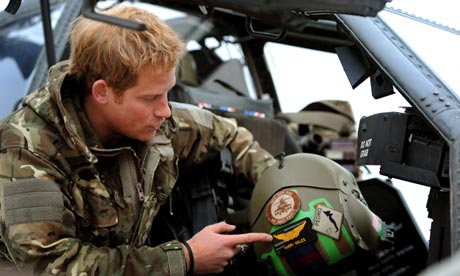
"It's a joy for me because I'm one of those people who loves playing PlayStation and Xbox, so with my thumbs I like to think I'm probably quite useful," Britain's Prince Harry said during interviews released upon his return from Afghanistan.

Explaining his four-month role as co-pilot of an Apache attack helicopter, Harry described the thrill of emergency response and the weapons systems he controlled in the gunship's two-man cockpit: Hellfire air-to-surface missiles, rockets and a 30-millimetre gun. Such statements are hardly surprising or shocking, but asymmetric warfare is fought along information lines and consumes anything in its path. Despite being cleared by the Ministry of Defense, Harry's comments quickly attracted negative press (targeting his princely qualities) and spurred a few grimaces on the MOD's own face.

"I'm not going to second guess whether he should or shouldn't have said it," spokesman Jim Murphy told the Guardian. "He's obviously a young and brave man. He was candid. Perhaps he may have been more candid than the Palace may have wished."

The Taliban naturally pounced on Harry's statements after failing to kill or capture him as promised. Spokesman Zabiullah Mujahid announced that, "49 countries with their powerful military failing in the fight against the mujahideen, and now this prince comes and compares this war with his games, PlayStation or whatever he calls it." Easily assailing the Prince for the flippant perception of his comments, Mujahid's counterattack appealed to any Afghan who loathes the notion of Afghanistan being treated as a game board for Westerners - from Britain and Russia's "Great Game" in the 1830s to the Soviet and NATO invasions nearly 200 years later. In this sense the disrespect of a "game" is very real in Afghanistan.

"This is a serious war, a historic war, resistance for us, for our people," Mujahid says.

However Harry's interviews are unlikely to make any immediate impact in Afghanistan. His testimony only confirms a new technological phase of an established pattern in war, and most Afghan civilians won't react as though he just murdered an innocent family or burned a Quran. Efforts to connect Harry's "mental problems" with the prolonged nature and brutality of Afghanistan's war may have more effect in Western countries than Afghan villages. Even Mujahid admits, "we don't take his comments very seriously, as we have all seen and heard that many foreign soldiers, occupiers who come to Afghanistan, develop some kind of mental problems on their way out."

More dangerous is the impetus to stage new Taliban attacks on Western targets in Kabul or elsewhere, which will be attributed to Harry's statements. Another factor to monitor outside Afghanistan is the public opposition of American video games set in foreign countries. These war games strike a cord with a variety of individuals, both the politically liberal and religiously conservative, who don't relate to the glamorous gamer side of war. The Trench has spoken with Yemenis who view Black Ops II's use of their country as gratuitous (try searching Yemen on YouTube), and some Pakistanis are beginning to organize a boycott against Call of Duty. Although the influence of these games on actual battlefields is minimal, public perceptions are crucial in counterinsurgency's wider scope and cannot be ignored at any size.

Any American force that generates anti-Americanism in a counterinsurgency environment is cause for concern.

Most disturbing are the long-term potentialities of advanced technological warfare: namely the gradual removal of humans from the killing process. Advocates of automated warfare argue that humans maintain control of the machine, a defense that is largely true for the moment but could break down over time. Drones may be more or less corruptible to enemy actors than humans; the process of this military experiment should be chaotic. Ultimately, whole fleets of drones could be concentrated in the hands of a small group or even one individual, further removing the human element from war. Drones could also be armed with weapons of mass destruction in the future.

Dehumanization is a constant theme of war - humanity might not be able to kill as it does without it. Problematically, all of these concerns and many others won't be eagerly addressed by Western governments or mainstream media.

January 20, 2013

Slow Treading In Mali's Asymmetric Fog

The gears of humanitarian intervention are rolling along smoothly if one takes the words of government and military officials at face value. Backed by over 2,000 French soldiers, their Malian counterparts have managed to establish the beginning of a defensive barrier and halt the Islamist coalition's movements in the country's inner delta. For several months Ansar Dine, the north's Tuareg-Islamist outfit, had leveraged its al-Qaeda contacts to encroach upon the country's mid-section, seizing positions on both sides of the Niger River before advancing on Konna. This move proved one step too close to Sevare's airport, the Islamists' likely target, and the town has now been fortified by French troops in less than a week.

VOA French to Africa correspondent Idrissa Fall described Sevare as being in a "state of war," overrun by French and Malian military forces, and empty of civilians. Its airbase will serve as a main international jump-point into the north.

The influx of French troops has allowed for the creation of a defensive line between Sevare and Diablay, a modest town that was overrun by militants shortly after France's initial air-strikes in Konna. Several hundred miles to the southwest and 50 miles below Diablay lies the town of Niono. Here French forces have entrenched themselves with Malian soldiers as they construct a forward operating base on the conflict's northwestern flank. French commanders are currently awaiting reinforcements and scouting reports from the north, and plan to take control of Diablay after the town is checked for disguised militants (who reportedly vacated on Saturday).

“The deployment towards the north... which began 24 hours ago, is on course with troops inside the towns of Niono and Sevare,” Lieutenant Colonel Emmanuel Dosseur told reporters on Sunday.

Accordingly, defensive lines should be stretched in the opposite direction of Sevare as more French troops and the first African contingents arrive. 50 Senegalese troops landed in the capital on Sunday and 200 have been cleared to deploy from Niger. National media is interpreting their activation as a possible second front on Mali's eastern border, where Ansar Dine and the Movement for Unity and Oneness in West Africa (MUJAO) are particularly entrenched. Neighboring Burkina Faso has also pledged to contribute a force inside Mali and to deploy a separate force along its border, theoretically connecting French and African troops along Mali's north-south divide.

In a potential boost, Chad recently offered to raise the total African force from 3,800 to 5,800.

So how long will the international community's wheels keep rolling in what they view as an uninterrupted state? Questioning over the conflict's anticipated schedule has yet to disperse, instead becoming less clear by the day. Every action and decision tends to run longer than expected in guerrilla warfare, as the style of warfare is designed to slow a larger army, and Mali's conflict is already headed in this direction. Less than 150 African soldiers have landed in Mali since French officials announced the beginning if their ground intervention; deploying the entire force will take weeks at best, months at worst.

“Step by step, I think it’s a question from what I heard this morning of some days, some weeks,” France's Foreign Minister, Laurent Fabius, said during a press conference in the Ivory Coast.

These troops are then scheduled to receive further combat training from NATO advisers, giving the Islamists more time to prepare and sliding the immediate brunt of combat onto Western forces.

To compensate for delays and soften northern Mali's ground targets, the French have begun bombing the Kidal region to the far north of Konna and Diablay. The ongoing assault is presumably intended to weaken the Islamists' material resources, not destroy their capabilities entirely, but "shock and awe" applies equally for the Western public. Such measures cannot be understand at the surface level. An extensive aerial campaign is insufficient by itself and requires a hard ground campaign against militants that have prepared underground since Mali's crisis began in early 2012. France's Defense Minister, Jean-Yves Le Drian, explains NATO's urgent dilemma: "The goal is to ensure that AFISMA, the African force, can take the baton from our own intervention."

Paris has continually measured its mission in weeks but, given the nature of asymmetric warfare and relative isolation of Mali, this number will hit double digits before the last African troops deploy and continue long afterward. For his part French President François Hollande has announced that France's mission will "last as long as necessary to win over terrorism in this part of Africa"; other officials, such as Prime Minister Jean-Marc Ayrault and Le Drian have issued more optimistic assessments. However Le Drian's latest statements, whether true or false, help understand Mali's vast proportions. Telling France 5, "The goal is the total reconquest of Mali. We will not leave any pockets of resistance," he was subsequently asked how far north Paris is willing to go.

"If necessary, the African forces can appeal for support from French forces when they arrive in Timbuktu," Le Drian answered.

Timbuktu rests at the edge of the war though. How long will African troops need to cross 500 miles of desert and recapture Kidal - six months to year? Holding the area until Mali's government can reassert authority could take even longer (elections are tentatively planned for April), and the Islamists are embedded in the city's mountainous surroundings. As with most of their urban holdings, the Islamists can afford to withdraw from Kidal and continue their guerrilla war along society's margins. French and possibly other Western forces thus stand a good chance of accompanying African troops throughout the initial phase of their campaign.

Timbuktu would just be the starting point.

With these issues come a variety of related problems that must be addressed in the near-term and long-term: the unstable status of Diablay and Konna, French calls for greater U.S. support, the uncertain depth of Washington's military commitment, African expectations of Western financial support. Descriptions of the Islamists in Diablay pile complications onto seizing any town, big or small; locals recount that they "generally kept their promise" to leave the people be, although their presence forced the town to shut down. Eyewitnesses said that every fighter masked his face, but they also reported a significant number of Algerians and Libyans in Ansar Dine's ranks, which are mostly composed of Tuaregs. Separating their legitimate grievances from the Islamist alliance's wider agenda presents a chronic challenge for the international community.

Only one factor appears concrete in Mali: the conflict will always move slower than described by government officials. Asked at Niomo whether a "long war" had finally begun, the commanding officer Colonel Frederic replied, "Maybe, yes."