Iran will soon exact revenge on Israel for the recent killing of an Iranian Revolutionary Guard Corps commander in Syria, an aide to Iranian Supreme Leader Ayatollah Ali Khamenei was quoted on Saturday as saying.Continue Reading
Iran said on Thursday that an Iranian military commander named Hassan Shateri, also known as Hessam Khoshnevis, had been killed in Syria by rebels fighting President Bashar Assad, an ally of Tehran.
But Iran’s envoy to Beirut, Ghazanfar Roknabadi, on Thursday drew a link between the killing and Israel.
Ali Shirazi, Khamenei’s representative to the IRGC’s elite Quds force, said on Friday evening that Iran’s “resolve against Israel” had only grown stronger with Shateri’s killing.
“Our enemies should also know that we will quickly get revenge for [the death of] Haj Hassan [Shateri] from the Israelis, and the enemies cannot shut off the Iranian people with such stupid acts,” Shirazi was quoted as saying by the Iranian Students’ News Agency on Saturday.
Israel has not commented on the killing.

Showing posts with label Israel. Show all posts
Showing posts with label Israel. Show all posts
February 16, 2013
Iran warns Israel: We'll avenge Guards commander
A variety of allied and competing forces are attempting to pull Syria's revolution into a wider regional conflict. The possibility of deescalation currently rests at 0%.

December 13, 2012
The Void Between Israeli Settlements and Obama's "Bravery"
In the days following Israel's latest settlement announcement at East Jerusalem's controversial E-1 plan, more than a few media sources on the liberal side of America's Jewish base unleashed a cautiously firm critique of Prime Minister Benjamin Netanyahu's decision-making process. Among them: The Atlantic, New York Times and Economist. Besides the shared frustration with Israel's hawkish premier, their editorials were bound by another common thread of advice on the U.S. front. All would express the need for President Barack Obama to speak louder against Netanyahu and do more to resurrect a peace process that too many have declared dead.
"A braver Mr Obama would this time tell Israel some home truths," The Economist concluded.
Given that Obama's administration has reacted with deceptively tepid concern from lower officials - not a personal and public response - is the President himself acting on strategy or cowardliness? An administration that pulled in an estimated 75% of Jewish-American voters in two elections naturally defends its policy as active and balanced, punching back against all contrary observations, and surface ripples are liable to create this impression. Several administration officials expressed the White House's concern in public, augmenting the scripted answers fed to a hungry press corp.
"I can just tell you," spokesman Jay Carney told inquiring reporters, "that I don't have any specific information about those communications between the Israeli government and this administration. I don't think we could be clearer about our position that we oppose unilateral actions that make the return to bilateral negotiations harder. We oppose Israeli settlement activity and the construction in East Jerusalem. And we're obviously communicating that."
Except the obviousness of what Washington is communicating, and who is doing the communicating, remains blurred. According to Palestinian sources, Jordanian King Abdullah II "conveyed U.S. assurances" to de facto President Mahmoud Abbas that the Obama administration would block the E1 settlement plans from moving forward. This pressure, if real, still comes with a cost - "not starting the Palestinian efforts to join UN agencies" - that has been inserted under Washington's opposition to unilateral actions. The eventual pressure may skimp on the Israeli side as the Obama administration attempts to block Palestinian advances in the United Nations.
The administration has also constructed a second defense that avoids an appeal to morality, and instead focuses on strategy to highlight Obama's policy in the region. According to The Daily Beast's Peter Beinart, a noted White House insider, the administration is testing out a new plan to isolate Netanyahu and thus alter his behavior towards the Palestinians. This plan isn't as "clear" as Carney's description, since the bulk of it has been leaked by anonymous officials nearly two weeks after Israel's announcement.
"And even though the Israelis alerted the White House mere hours before they announced the decision," Beinart reports, "the Obama administration’s response was pro forma and bland. Publicly, Obama himself said nothing. It was the first sign of what senior administration officials predict may be a new approach to the Israeli-Palestinian conflict in Obama’s second term: benign neglect."
In this scenario, the administration hopes that international isolation will force Netanyahu to "shift course and embrace the kind of Palestinian state supported by his predecessor." This policy would theoretically contract European allies to do Washington's dirty work and cut down the individual friction with Netanyahu. Furthermore, Beinart claims that the administration will not appoint a "big name" envoy or initiate another formal round of peace negotiations, believing that Netanyahu would attempt to stall the talks and prevent isolation. Beinart, for good reason, expresses skepticism towards this plan. Fundamentally, the entire process hinges on the assumption that Netanyahu will respond to international pressure, when his past behavior forecasts a stubborn defiance.
He may, as Beinart predicts, simply politicize the issue ahead of an election that his right-wing alliance is currently favored to win.
Obama's passivity stands a higher chance of backfiring than altering the conflict's status quo. Expecting any significant change in Netanyahu's negotiating position or regional perspective, whether pressured by the world or not, is unrealistic. The administration's decision to sit back from a peace initiative also runs contrary to its repeated calls for "direct negotiations," which the White House intends to mediate. This policy will reinforce the status quo by allowing Netanyahu to continue acting as he sees fit, and by allowing the conflict to drift further into a vicious cycle of hostilities without any corresponding movement in negotiations.
Although Netanyahu may relish the opportunity to challenge Obama personally, earnestly standing up to him could disrupt a status quo that shows no current sign of breaking. Failure to confront has reinforced a personal weakness and lack of urgency on Obama's part, giving Netanyahu the continual impression that he can act without real consequence from Washington. The notion of "isolation" is similarly flawed; in the heat of battle, when everything counts most, Obama stood beside Netanyahu as he bombarded Gaza and took a "principled stand" against the Palestinians' observer status in the UN.
The administration is now covering its tracks with media mirages, but cowardliness attributed to politicking and self-interests won't revive the peace process of an entrenched long war.
December 4, 2012
Israeli Settlements Become Prop In U.S. Propaganda
"No one will build until it is clear what will be done there," Israeli Housing Minister Ariel Attias attempted to clarify on Sunday.
However his government's message is crystal clear. In addition to the E1 announcement, 1,600 units were also penciled into the Ramat Shlomo settlement, which gained prominence in March 2010 at the expense of visiting U.S. Vice President Joe Biden. The following year, 1,000 units were announced prior to an April 2011 meeting between U.S. President Barack Obama and Israeli President Shimon Peres. Apparently Israel's Interior Ministry doesn't put a premium on creativity, since it announced 1,600 units in Ramat Shlomo during the run-up to last year's UN confrontation with the Palestinians. This settlement, in addition to E1, is being utilized as provocative soft-power against the Palestinians and Washington alike - a threat capable of morphing into tangible damage to a two-state solution.
"The answer to the attack on the Zionist character of the state of Israel obliges us to increase the tempo of settlement building plans in all the areas that the government has decided to settle in," Netanyahu said before the start of his weekly Cabinet meeting in Jerusalem.
How Israel benefits from these decisions remains speculative, given that Israeli officials and citizens expressed regret over the announcement's nature. Current and former officials, along with Israel's various allies, have unveiled a calculated response that weighs Israel's right to build against the provocative selection of territory. They generally believe that Netanyahu erred in defying Washington so soon after the Obama administration stood on the losing side of an overwhelming victory in the UN, as well as the losing side of Gaza's 8-day battle. And they fear that a two-state solution is drifting further into history with each passing day.
Even pro-settlement actors have been forced to disapprove of Netanyahu's timing and its implications.
"We don’t like the idea of developing our communities as a sort of retaliatory or punitive step,” said Dani Dayan, the leader of Israel’s settler movement and a supporter of E1.
Except Israel's government will get what it wants in the end - sticking its finger in the UN's chest - and suffer negligible punishment from Western capitals. The EU ministers that rushed to condemn settlement announcements in East Jerusalem still hope to "persuade" Israel back to the negotiating table with the Palestinians. Nor is President Barack Obama and his administration willing to openly break ranks with Netanyahu's hardline government, whatever the cost to America's image. The White House and State Department defended America's "no" vote as a "principled stand" when reporters inquired into the motivation behind resisting the international community at large.
AP journalist Matt Lee was forced to respond, "Doesn’t this ever give anybody any pause that you might be – that your principled stance doesn’t – isn’t seen as a principled stance by the rest of the world, but seen as – it’s seen as an obstacle? Doesn’t anyone ever – why does the United States think that it has the moral high ground and the rest of the world doesn’t on this when the rest of the world disagrees with you?"
As for Washington, settlement announcements prove too useful to a government in need of appearing objective. The output of criticism from the White House and State department has certainly piled up since the weekend announcement, having nowhere else to go after the UN debacle; ironically, spokeswoman Victoria Nuland told reporters on Friday that the administration opposes "any action that undercuts the way Israel is seen by the world." Unfortunately a hollow tone continues to pervade U.S. rhetoric. Each statement is so formulaic that a sense of "going through the motions" becomes evident. Now the U.S. gets to oppose Israel's unilateral actions and market itself as "fair and balanced," a narrative that runs perpendicular to reality. The U.S. will still be standing behind Israel during "direct negotiations" with the Palestinians - whether on the table or battlefield.
"We reiterate our longstanding opposition to settlements and east Jerusalem construction and announcements," said Tommy Vietor, spokesman for Obama's National Security Council. "We believe these actions are counterproductive and make it harder to resume direct negotiations or achieve a two-state solution. Direct negotiations remain our goal and we encourage all parties to take steps to make that easier to achieve."
"We have made clear to the Israeli Government that such action is contrary to U.S. policy," added a special statement from the State Department, which quickly flooded the international media with false headlines of "shock" and "condemnation." "The United States and the international community expect all parties to play a constructive role in efforts to achieve peace. We urge the parties to cease unilateral actions and take concrete steps to return to direct negotiations so all the issues can be discussed and the goal of two states living side by side in peace and security can be realized."
This situation is too coincidental to be coincidental.
At least Israeli Finance Minister Yuval Steinitz will allude to this much: "I want to tell you that those same Europeans and Americans who are now telling us 'naughty, naughty' over our response, understand full-well that we have to respond, and they themselves warned the Palestinian Authority."
November 29, 2012
Palestinians Secure UN Observer Status, New Battles Await

The vote culminates a multi-year plan by de facto Palestinian President Mahmoud Abbas, whose term officially ended in January 2009, and his dangerous dance with Israel and Western powers. These forces had hoped to use Abbas as their own pawn during final-status negotiations, a plan that contributed to Abbas's image as an U.S.-Israeli puppet, but they appear to have underestimated his pliability and survivalism. Abbas will now face a higher level of Western pressure to reengage the Israelis on their terms, before his UN mission and future elections potentially decreases the control over Palestinian leadership.
"Regardless of what happens in New York today," the State Department's Victoria Nuland told a group of incredulous reporters shortly before the vote, "the United States is going to continue to try to bring these parties back to the table. Obviously we’re going to. The President is committed to that, and I think the only question is what kind of environment we’re working in."
Obviously - because President Barack Obama has been so supportive of the Palestinians and generally engaging towards a frozen peace process.
There is no questioning the type of environment that Washington envisions. The Obama administration's new diplomatic push will almost certainly be directed behind Israeli and Western interests, rather than an equitable two-state solution. Accordingly, the administration attempted (futilely) to counteract these immovable perceptions by deploying UN Ambassador Susan Rice with a serious piece of doublespeak:
For decades, the United States has worked to help achieve a comprehensive end to the long and tragic Arab-Israeli conflict. We have always been clear that only through direct negotiations between the parties can the Palestinians and Israelis achieve the peace that both deserve: two states for two peoples, with a sovereign, viable and independent Palestine living side by side in peace and security with a Jewish and democratic Israel.
That remains our goal, and we therefore measure any proposed action against that clear yardstick: will it bring the parties closer to peace or push them further apart? Will it help Israelis and Palestinians return to negotiations or hinder their efforts to reach a mutually acceptable agreement? Today’s unfortunate and counterproductive resolution places further obstacles in the path to peace. That is why the United States voted against it.
The rest of her speech continues to advance this argument: only the Israelis and Palestinians can solve their problems, therefore no one should get in the middle. Except if Rice meant what she said, Washington wouldn't dictate terms to the Palestinians at the behest of Israel - deciding Jerusalem's fate or a demilitarized Palestine, for example. Rice's twisted logic is designed to whitewash America's own dirty hands in the process, and to spin the source of obstruction from the Israelis back into the Palestinians. Israel's blockade of Gaza and disproportionate warfare is counterproductive to peace. So too is the U.S. bias in Israel's favor, whether inside or outside the Palestinian conflict. The Obama administration isn't protecting regional or world peace, only the private interests of Wasington and allies, and the Palestinians must guard against Western diplomatic retaliation.
Today's vote is widely viewed as a vote for or against oppression and occupation. The Obama administration possesses no rhetoric capable of burying this reality, but it will try in the coming months.
November 24, 2012
John Mearsheimer: "A Pillar Built on Sand"
This analysis by John Mearsheimer, co-author of The Israeli Lobby, immediately captured the futility of Israel's 4GW beyond anything The Trench witnessed during Gaza's latest battle:
In response to a recent upsurge in tit for tat strikes between Israel and the Palestinians in Gaza, Israel decided to ratchet up the violence even further by assassinating Hamas’s military chief, Ahmad Jabari. Hamas, which had been playing a minor role in these exchanges and even appears to have been interested in working out a long-term ceasefire, predictably responded by launching hundreds of rockets into Israel, a few even landing near Tel Aviv. Not surprisingly, the Israelis have threatened a wider conflict, to include a possible invasion of Gaza to topple Hamas and eliminate the rocket threat.
There is some chance that Operation ‘Pillar of Defence’, as the Israelis are calling their current campaign, might become a full-scale war. But even if it does, it will not put an end to Israel’s troubles in Gaza. After all, Israel launched a devastating war against Hamas in the winter of 2008-9 – Operation Cast Lead – and Hamas is still in power and still firing rockets at Israel. In the summer of 2006 Israel went to war against Hizbullah in order to eliminate its missiles and weaken its political position in Lebanon. That offensive failed as well: Hizbullah has far more missiles today than it had in 2006 and its influence in Lebanon is arguably greater than it was in 2006. Pillar of Defence is likely to share a similar fate.
Israel can use force against Hamas in three distinct ways. First, it can try to cripple the organisation by assassinating its leaders, as it did when it killed Jabari two days ago. Decapitation will not work, however, because there is no shortage of subordinates to replace the dead leaders, and sometimes the new ones are more capable and dangerous than their predecessors. The Israelis found this out in Lebanon in 1992 when they assassinated Hizbullah’s leader, Abbas Musawi, only to find that his replacement, Hassan Nasrallah, was an even more formidable adversary.
Second, the Israelis can invade Gaza and take it over. The IDF could do this fairly easily, topple Hamas and put an end to the rocket fire from Gaza. But they would then have to occupy Gaza for years to come, since if they left Hamas would come back to power, the rocket attacks would resume, and Israel would be back where it started.
An occupation of Gaza would trigger bitter and bloody resistance, as the Israelis learned in southern Lebanon between 1982 and 2000. After 18 years of occupation they conceded defeat and withdrew all their forces. This experience is the reason the IDF did not try to invade and conquer southern Lebanon in 2006 or Gaza in 2008-9. Nothing has changed since then to make a full-scale invasion of Gaza a viable alternative today.
Occupying Gaza would also place another 1.5 million Palestinians under formal Israel control, thereby worsening the so-called ‘demographic threat’. Ariel Sharon withdrew Israeli settlers from Gaza in 2005 to reduce the number of Palestinians living under the Israeli flag; going back now would be a huge strategic reversal.
Continue readingThe final, preferred option is aerial bombardment with aircraft, artillery, missiles, mortars and rockets. The problem, however, is that the strategy does not work as advertised. Israel used it against Hizbullah in 2006 and Hamas in 2008-9, but both groups are still in power and armed to the teeth with rockets and missiles. It is hard to believe that any serious defence analyst in Israel thinks another campaign of sustained bombardment against Gaza will topple Hamas and end the rocket fire permanently.
November 21, 2012
Israel Remains Careless In Gaza's Fourth-Generation Warfare

Hamas and those Palestinian leaders that fail to offer an alternative deserve their share of responsibility for bringing Gaza to boil. Fatah's inability to move a peaceful solution forward, albeit within a biased system of international mediation, has given Hamas ample room to grow and kept Israel's leadership focused on military action. However the blunt reality of asymmetric warfare does not place the burden of responsibility on non-state actors, but on the state actors theoretically beholden to international standards. Non-state actors attract popular support by offering modest improvements over a tyrannical, corrupt government. For this reason (and others, of course), Hamas's behavior is partially or fully accepted by Palestinians and Muslims who view Israel's behavior as incomparably monstrous.
Advanced states can make fourth-generation warfare (4GW) look flawless and futile at the same time.
4GW is named for its placement after 3GW, a phase that technologically evolved the tactical and strategic concepts developed in the 20th century. A major difference between 3GW and 4GW stems from the balance of power; while 3GW conflicts generally occur between states, 4GW develops between state and non-state actors. Firepower becomes less important in this type of warfare as the conflict blurs deeper into the local civilian population, placing a premium on the non-military factors - political, economic and social - that govern a territory. This strategy addresses the need to protect an area's natural and human resources instead of destroying them, along with the tasks of cooperating with international organizations and keeping battlefield blunders out of the international news cycle.
Although amplified by technology, 4GW is designed to confound superior militaries and their technological advantages. Accordingly, retired Marine Colonel Thomas X. Hammes advises America's leadership against believing that technology can overcome non-military sources of conflict and their political manifestations. Having monitored Washington's delusional expeditions in Afghanistan, Iraq and the "War on Terror," Hammes holds this error above all others in asymmetric warfare.
"We continue to focus on technological solutions at the tactical and operational levels without a serious discussion of the strategic imperatives of the nature of the war we are fighting," he writes in The Sling and The Stone, an authoritative study of 4GW.
Israeli leadership and the soldiers under their command are similarly geared towards urban warfare rather than the totality of 4GW. Israel's objectives remain military-oriented: eliminate a key Hamas strategist, destroy his long-range weapons, stop Gazan rockets from falling on southern Israel, and ultimately impose a ceasefire that demands the elimination of Egypt's smuggling tunnels into Gaza. Prime Minister Benjamin Netanyahu's political objective is domestic in nature, or else aimed at the Palestinians' upcoming recognition bid at the United Nations. Settling the conflict's non-military grievances has been noticeably absent from Netanyahu's agenda throughout his four-year term.
Israel certainly enjoys an abundance of political power and media influence, strong-arming Western governments with ease by dangling a ground invasion beneath a massive air raid. Netanyahu has reportedly told President Barack Obama that he will only launch a ground operation if Hamas continues firing rockets into Israel. Naturally Gaza's bombardment becomes more palatable in the face of a bloodier alternative, a comparison that helps maintain the West's green light for as long as possible. Furthermore, Netanyahu is attempting to portray himself as a tough but wise statesman (think Iran) ahead of January 22nd's election.
"Before deciding on a ground invasion, the prime minister intends to exhaust the diplomatic move in order to see if a long-term ceasefire can be achieved," a senior Israeli official said after Monday night's cabinet meeting.
U.S. Secretary of State Hillary Clinton has now arrived in the region to broker a truce "in the days ahead," allowing Israel to continue bombing every last target and giving Hamas little incentive to comply. Except this Western reservoir of diplomatic power cannot fully overcome the power attributed to world opinion, and steamrolling over all objections to the disproportionate force being applied in Gaza generates more enemies - civilian and militant alike - than Israel can eliminate.
Israel's government has grown dangerously accustomed to winning Gaza's tactical battles and losing the conflict's wider political narrative. Its military and intelligence agencies, among the world's elite, skillfully locate arms caches, intercept rockets and track Hamas officials with a Skynet-like grid of technology. Over 1,350 air strikes were counted by Monday, a growing number of them launched from unmanned aerial vehicles (UAVs). Many of Hamas's Fajr-5 rockets, considered a "tie-breaker," were wiped out in the moments after Ahmed Jabari's assassination. The Israeli military just Tweeted that it "surgically targeted a Hamas intelligence operations centre" on the seventh floor of a media building.
Meanwhile Carmela Avner, Israel's chief information officer, boasts that Israel can fight a war on three technological fronts: "The first is physical, the second is on the world of social networks and the third is cyber."
All of these capabilities, as Hammes warns, gives Israel's leadership a false sense of control over Gaza's military and non-military battlefields. There will always be more rockets to intercept from the political status quo. New Hamas leaders will inevitably replace the fallen and Israel's own websites are being hacked by supporters of the Palestinians. Worse still, the false sense of security inspired by the Iron Dome emboldens Israel to strike with minimal consequence, producing more hostilities instead of reducing them. "Precision" air strikes, far from precise, contribute to the eventual stalemate imposed by the international community's frantic jockeying to savage credibility with their own populations.
Israel is a master of war - disproportionate warfare. Over 150 Palestinians have been killed (at least 50 of them civilians) and over 840 wounded, including 225 children, since Operation Pillar of Defense began on November 14th. Israelis have suffered five fatalities and an estimated 250 injuries from Gaza's rockets, underscoring the conflict's fundamentally disproportionate nature. The faces of dead Palestinian children will outweigh anything Israel has to say to the world at large, and the government is losing minds and hearts at an unsustainable pace. Contrary to resolving any sources of conflict, disproportionate force and the resulting spectacle functions as a main driver of 4GW.
Israel's government argues that Hamas's stockpile has essentially been reset, but the same breathing room failed to yield any progress towards a two-state solution following Gaza's last war. Netanyahu will emerge wrapped in victorious rhetoric, ignoring 4GW and dooming the cycle to repeat again.
And if his government doesn't care what the world thinks, why should the world treat Israel with special care?
November 20, 2012

November 19, 2012
Where Does Sudan Fit Into Gaza's Endgame?

On Saturday The New York Times reported one of the primary objectives of Israeli military operations in the Gaza Strip: Fajr-5 rockets capable of hitting Jerusalem and Tel Aviv. These rockets are allegedly shipped into Gaza via a complex smuggling chain, imported to Sudan in pieces and transported through Egypt before being assembled in Gaza by Hamas and Iranian arms experts. Each is then assigned a "special operator" to man his rocket on the "day of judgment" at the orders of Hamas's political leadership.
Problematically for Hamas, its "tie-breaker" broke minutes after an Israeli air strike terminated its senior military strategist, Ahmed Jabari.
The pinpoint destruction of Hamas's Iranian-manufactured Fajr-5 rockets, which range to 50 miles, appears to be the greatest tactical blow suffered thus far by the group (Hamas also lost its internal UAV plant). According to the Times, "most" of an estimated 100 rockets were destroyed in the first bombing waves; anonymous Israeli officials place their figure at a modest 20, leaving the probable number somewhere in between. The means of destruction, though, count more than its end. Largely a creation of Jabari, each piece of Hamas's stockpile had been monitored and tagged over several years by IDF intelligence chief Maj. Gen. Aviv Kochavi.
"The innocent-looking launching sites, covered by soil, were supposed to go into action when the time came,” Al-Monitor reports. "However, the IDF was ahead of them: Just a few minutes following the targeting and killing of Jabari, the second wave of air strikes was already underway and within a quarter of an hour, virtually the entire lineup of Fajr-5 rockets was eliminated."
The upshot is that Hamas need more rockets and will almost certainly find a way to smuggle them in, taking into account Israel's sophisticated intelligence network. This development advances the question of what role, if any, Sudan's government plans to play in Gaza's renewed fighting.
Khartoum's likeliest immediate answer won't extend beyond political rancor. Shortly after Jabari's assassination, Sudanese President Omar Bashir called Israel the “Zionist enemy” that “will remain the enemy" of Sudan and Muslims. Sudan's Foreign Minister, Ali Karti, followed up his boss's rhetoric by calling for the Arab League's heads of state to hold an emergency summit. Raising more eyebrows, Hamas's Khalid Meshal popped up at Khartoum's Armed Forces Mosque after Friday Prayers, vowing retaliation for the Israeli strike on Yarmouk Ammunition Factory.
"You killed Jabari and you can go on and kill Mashaal and others," the defiant chairman told his audience, "but in the end it'll pave our way to Jerusalem… Assassinating our leaders will only make us more powerful."
Meshal boasted that the Sudanese people will "hear good news soon," and the emptiness of his promise is easily taken for granted. Yet the situation's terms do appear to be evolving and Israeli security observers believe that last month's attack on Yarmouk brought Sudan directly into the conflict. This preemptive raid and its warning shot now marks Israel's latest operation in Gaza, and is fortunately enjoying a large share of retrospective observation as a result. While Israel has targeted Sudanese interests throughout the last decade with minimal consequences, the accumulation of grievances and interconnectivity of Israel's relations with the Arab world cannot be underestimated either.
This is not to say that, in the event of an Israeli ground invasion, Sudan will assume any direct combat or support role for Hamas. What should be expected is renewed effort to outsmart the Israelis, improve the defenses of Hamas's armories and stock them with more advanced weaponry. Neither Iran nor Sudan's government will be deterred by Israeli military action, which also serves domestic interests, and Hamas isn't built to quit armed resistance. Rocket fire has yet to abate in the face of over 1,000 airstrikes. Both sides, in the end, are playing into each other's hands and maintaining a regional stalemate.
Gaza's current battle may burn out soon or rage for weeks, but one conclusion is already apparent: Hamas will re-up its weapons and replace Jalabi, leaving the region more hostile for all peoples. How the group refills its army is something to monitor until Gaza's next battle.
November 14, 2012
Reading The Omen Of Israel's Air Strike On Ahmed Jabari
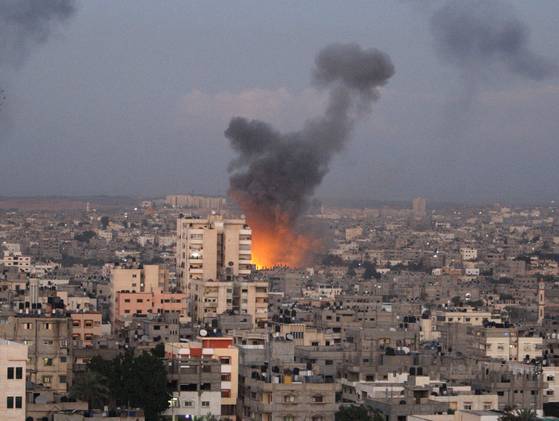
The joint IDF-Shin Bet air strike that killed Ahmed Jabari, Hamas's senior military commander in Gaza, appears to present one of two scenarios: the decapitation strike heralds a finale to Israeli Prime Minister Benjamin Netanyahu's campaign against Gaza's elusive rocket-launchers, or the beginning of a new war that could exceed the last.
Current developments suggest that the first option remains an outside possibility. Having bagged a trophy for his voting public, Netanyahu may attempt to stay out of a longer, more costly intervention of the Gaza Strip and protect the gains he has secured. Or someone could manage to talk some sense into him, and convince him that a large-scale operation in or above Gaza is not the means to win votes in the UN General Assembly.
However Hamas and Gaza's militant offshoots have no choice except to deliver on their promised retaliation, a cycle that Israel is equally willing to perpetuate. Multiple "truces" have immediately broken down and both sides attribute responsibility to the other. This fire is likely to heat up before cooling down. On Monday the Islamic Jihad's Khaled al-Batsh explained his group's status: "The ball is in Israel's court. The resistance factions will observe Israel's behavior on the ground and will act accordingly."
Israeli Home Defense Minister Avi Dichter announced on Tuesday, "There is no precedent in history of destroying terror by air power alone. It hasn't happened and it won't happen. Thus it is necessary to reformat Gaza altogether."
The air strike on Jabari soon followed.
In the event of a large-scale conflict in Gaza, its fourth-generation waves will reach across oceans and could seriously threaten the region's stability. More political theater than war at this point, Netanyahu is visibly positioning his right-wing coalition with Foreign Minister Avigdor Lieberman for January 22d's election. He's also sending a twisted message to the UN General Assembly, as if to prove that Israel will do whatever it wants if it feels threatened. This message has been repeatedly delivered to and discarded by a sizable portion of the international community, which views Israel's disproportionate response as counterproductive to solving Gaza's dilemma. Its latest air strikes are on their way to killing more civilians than Palestinian rockets killed in the last 3 years.
The Israeli government is already floating the idea of withdrawing completely from the Oslo Accords if Mahmoud Abbas plays his hand for "advanced status" on November 29th.
And is there any coincidence to the fact that Ahmed Jabari was assassinated on the same day that President Barack Obama issued his first post-election address, remarks that focused on diplomacy with Iran? The attack on Gaza appears to be aimed equally at Hamas, Iran and Obama, who allowed 2008's invasion to pass in silence and appears unable to stop another. Obama could opt split the difference by opposing war in Gaza and the Palestinians's UN bid; Tehran, Damascus and Cairo's responses are less predictable. None of these options promise much for the people on the ground.
Many combustible factors are reacting to each other in the region, turning Gaza into a microcosm of its surroundings. Information and disinformation has spiked, and further advances in social media will infect the conflict. Only time will shakedown the possibilities into reality.
[Update - The U.S. State Department has just released the following statement voicing unequivocal support for Israel's actions:
STATEMENT BY MARK TONER, DEPUTY SPOKESPERSON
U.S. STATE DEPARTMENT
Gaza Rocket Attacks
We strongly condemn the barrage of rocket fire from Gaza into southern Israel, and we regret the death and injury of innocent Israeli and Palestinian civilians caused by the ensuing violence. There is no justification for the violence that Hamas and other terrorist organizations are employing against the people of Israel. We call on those responsible to stop these cowardly acts immediately. We support Israel’s right to defend itself, and we encourage Israel to continue to take every effort to avoid civilian casualties.
Hamas claims to have the best interests of the Palestinian people at heart, yet it continues to engage in violence that is counterproductive to the Palestinian cause. Attacking Israel on a near daily basis does nothing to help Palestinians in Gaza or to move the Palestinian people any closer to achieving self determination.
[Update - The U.S. State Department has just released the following statement voicing unequivocal support for Israel's actions:
STATEMENT BY MARK TONER, DEPUTY SPOKESPERSON
U.S. STATE DEPARTMENT
Gaza Rocket Attacks
We strongly condemn the barrage of rocket fire from Gaza into southern Israel, and we regret the death and injury of innocent Israeli and Palestinian civilians caused by the ensuing violence. There is no justification for the violence that Hamas and other terrorist organizations are employing against the people of Israel. We call on those responsible to stop these cowardly acts immediately. We support Israel’s right to defend itself, and we encourage Israel to continue to take every effort to avoid civilian casualties.
Hamas claims to have the best interests of the Palestinian people at heart, yet it continues to engage in violence that is counterproductive to the Palestinian cause. Attacking Israel on a near daily basis does nothing to help Palestinians in Gaza or to move the Palestinian people any closer to achieving self determination.
October 31, 2012
Team Romney/Netanyahu A Worst-Case Scenario

As Hurricane Sandy inflicts its damage along the American Northeast, another sobering set of "perfect storm" conditions is approaching the Middle East and threatening its inhabitants.
This storm is less certain to develop than relatively predictable weather patterns, but Mitt Romney has managed to stay within striking distance of an upset over President Barack Obama and is currently forcing a tie on pollsters. Romney's victory seems implausible despite his rise in the polls; putting aside Obama's own loss of Democratic support, the American public must undertake a leap of faith in order to approve Romney's entry to the Oval Office. However the Republican challenger is now running neck and neck with Obama, setting the stage for a tight finish and chaotic outcomes.
The effects of Romney's potential victory on U.S. foreign policy are difficult to fully ascertain. His emphasis on an "American Century" and defense spending suggests that Romney will pursue a more overt projection of American power than Obama. Or, given his similarities with Obama, U.S. foreign policy may change styles more than substance in crucial areas: Russia, India, China and the Pacific, North Africa and the Middle East. Their responses to Afghanistan's war, the Arab revolutions and Israeli-Palestinian conflict are left virtually identical after stripping away their personal rhetoric. Romney couldn't agree with Obama's assassination "matrix" fast enough during last Monday's foreign policy debate.
Of their many "differences," though, Obama and Romney's contingencies towards Iran ring truest and hold the potential to affect both hemispheres. Here Romney has struck hardest to distance himself from Obama's “dual track" of containment and diplomacy, which the GOP challenger concedes as necessary but also criticizes as a dead end. A win for Romney pushes the odds of war with Iran to their peak. He doesn't tolerate a sliver of daylight between Jerusalem and has consistently defended Israel's "red-line" on uranium enrichment - slandering Obama for throwing Israel "under the bus" in the process. Loaded with players of George Bush's administration, Romney's circle appears even more gung-ho to bomb Iran's nuclear facilities and has awaited this exact window (2012-2016) to open.
Obama's second term would delay, although not necessarily prevent, an open conflict with Iran. Romney is already playing chicken before his first.
War between America, Israel, Iran and all of their proxies represents a worst-case scenario for the Middle East. One party's unilateral actions can trigger this disastrous outcome, whereby Obama's administration is leveraged into Israel's defense, except two keys are more likely to turn the engine. Washington and Jerusalem are certain to close ranks before a preemptive strike; regardless of their private disagreements, a unilateral decision to bomb Iranian targets is theoretically impossible. That said, a war on this scale may be carried out less effectively by divided leadership, and Obama has experienced his share of trouble with Israeli Premier Benjamin Netanyahu throughout their terms.
The only trouble expected by a Romney-Netanyahu ticket is how to sell a massive war to their publics. These "old friends" can "almost speak in shorthand" when discussing Iran and other regional issues.
Unpopular with his own people, Western capitals, human rights groups and individuals of all nationalities, Benjamin Netanyahu continues to defy the political odds in his quest for permanent authority. 2011 saw the brief rise and fall of a protest movement for affordable housing. Earlier this year Israel's Kadima party quit his coalition, citing a range of disagreements from military conscription to West Bank settlements and negotiations with the Palestinians. Some commentators believe that Netanyahu's abuse of Obama has made no difference to Israelis, but Americans have generally tired of Netanyahu and so too have the Israelis sitting outside his orthodox voting base.
Now, after announcing an early election in January, Netanyahu has been pegged as the clear frontrunner against a weak field of contenders. The deal between his Likud Party and Avigdor Lieberman's Yisrael Beitenu seals a nightmare ticket for the Palestinians, whom Netanyahu and Lieberman hold responsible for the current breakdown in negotiations. Neither politician will expend any genuine effort to resolve the longstanding crisis - building up Israeli settlements in Jerusalem is a higher priority - for they will be too busy plotting war against Iran and politicking against their own people.
"We are facing great challenges and this is the time to unite forces for the sake of Israel," Netanyahu explained at a news conference. "Therefore Likud and Yisrael Beitenu will run together on the same ticket in the next elections. We are asking for a mandate from the public to lead Israel against security threats, above all preventing Iran from arming itself with nuclear weapons and the struggle against terror."
The elusive dream of world peace would face a great challenge if Romney and Netanyahu manage to unite their forces.
October 25, 2012
Sudanese Militants Watch Israeli Bombing From Mali
The Sudanese government has issued a defiant response to the combustable events of Wednesday morning.
Citing eyewitnesses and gathered evidence, Culture and Information Minister Ahmed Bilal Osman informed reporters that his government holds Israel responsible for a midnight explosion at the Yarmouk industrial complex. The resulting fire in the munitions factory, located south of Khartoum, sent exploding rounds into nearby neighborhoods and triggered panic amongst the locals. This collateral damage has attracted criticism over the factory's proximity to residential housing, adding to the government's urgent need for a scapegoat.
"They think that this factory supplies our army, and by attacking it, they are going to make it easier for the rebels to take over," Bilal told Al Jazeera. "Plus, they have accused us, [saying] that these arms would find their way to Hamas. These are allegations which are not correct."
He later clarified, "We are now certain that this flagrant attack was authorized by the same state of Israel. The main purpose is to frustrate our military capabilities and stop any development there and ultimately weaken our national sovereignty."
For now Khartoum has settled on a political offensive to mute its domestic concerns. Sudanese officials immediately turned to the Arab League for support and is keeping the bloc notified of their state's investigation. The accumulating evidence will then be submitted to the United Nations, where Ambassador Daffa-Alla Elhag Ali Osman is pushing the Security Council to "condemn this attack because it is a blatant violation of the concepts of peace and security." Western capitals won't entertain the thought, of course, and many observers will point to the purchasers of Sudanese arms as the true roots of conflict. However Khartoum won't be daunted by its unpopular motions, as Israel has done no favor to its own popularity and must now confront a Sudanese response in the UN.
At the same time, this political action could form the basis of Khartoum's national argument for legitimate military action. Stopping any illegal arms shipments is unrealistic; targeting Israel seems unlikely as well, but jingoism is a standard tool for governments looking to cast their populations' eyes elsewhere. Multiple precedents don't hurt Khartoum's national and regional case either.
"We have to reply," Bilal told Al Jazeera. "This is too much. This is the fourth time they have done this. We have our right to attack the interests of Israel wherever - this is a legal target for us from now on... They killed our people. these lives are not cheap - and we know how to retaliate."
"Israel is a country of injustice that needs to be deterred," Vice President Ali Osman Tah later declared at the side of President Omar Hassan al-Bashir. "This attack only strengthens our firmness."
Bilal claims that Khartoum isn't planning "direct attacks" on Israeli interests, as Iran is accused of carrying out, but added, "We reserve the right to react at a place and time we choose." The government could order a proxy attack through one of Gaza's extremist factions, except this process is below the level of an official response. The only possible deterrent is an air-strike or covert operation of similar proportion, conducted on a target that can be relatively justified to the international community. How exactly Khartoum decides to send its message remains to be seen.
What The Trench can't help noticing is the timing of Wednesday's bombing and last weekend's reports of a Sudanese infusion for northern Mali's Islamist network. Anywhere between dozens and 355 Sudanese recruits supposedly entered the country over the last five days, depending on the source of information, but all of them share a hatred for Israel and its Western allies. Khartoum doesn't need to arm Hamas or export its own jihadists for training - those seeking a holy war against the West and "infidel" African governments will find their own way to Mali. A distinct cause-and-effect influences the interaction between Sudanese-Israeli hostilities and Sudanese jihadism. Those Sudanese now training in Mali are monitoring Wednesday's incident with equal parts anger and determination, and more are likely to follow as Western and African capitals prepare their intervention.
The Obama administration isn't in the business censuring Israel's government, but a private message of "concern" would not be surprising in light of northern Mali's crisis.
Subscribe to:
Posts (Atom)