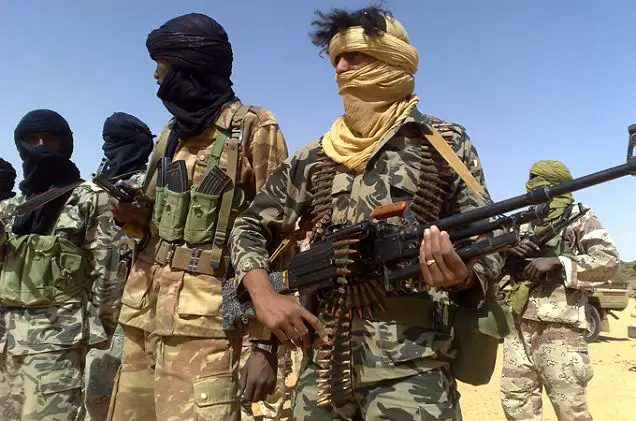
After months of speculation that concrete plans would begin to take shape, the theoretical is finally nearing reality in an undecided North African location.
For more than a decade U.S. military and intelligence officials have laid the groundwork of a "light" but vast network across the Sahel region, chasing al-Qaeda affiliates that have spun off their own franchises. In order to counter impressions of colonialism, utilize local forces and intelligence, and keep large numbers of U.S. troops off the continent, this process hinges on bi-lateral and multi-lateral relations with cooperative African states. Included are a series of joint forward operating bases constructed through the Sahel, and training programs between national and U.S. forces.
The same program that failed amid Mali's coup and left Washington to patch together a emergency response, as reported by The New York Times earlier this month: "American spy planes and surveillance drones have tried to make sense of the mess, but American officials and their allies are still scrambling even to get a detailed picture of who they are up against."
The next logical step of a bigger presence in North Africa is drone bases in friendly (and needy) countries, and that is where the Obama administration and its partners are headed. Neighboring Niger has been designated as the leading candidate - few African leaders have urged a quicker NATO intervention than President Mahamadou Issoufou - followed by Burkina Faso. The latter currently serves as the base for clandestine PC-12 surveillance aircraft.
The military necessities of a drone base or, more likely, a series of bases around Mali is clear enough. American military commanders and intelligence analysts have good reason to complain about “sorely lacking" information in northern Mali, a territory roughly the size of France and many times more extreme. This environment has already created hurdles for logistics and overflights, and plays into the hands of militants in control of mountainous desert until international air-power scales up (at which point guerrillas lose their advantage).
The task will increase in difficulty when Ansar Dine, al-Qaeda in the Islamic Maghreb (AQIM) and Movement for Oneness and Jihad in North Africa (MUJAO) fall back to their mountain bases along the Algerian border.
America is the only state capable of delivering the level of surveillance required to effectively coordinate African ground forces with Western air power; eliminate U.S. support and NATO's mission in Mali will collapse. However U.S. officials won't be as candid about the litany of questions and concerns that drones entail. Suffice to say, drone bases function as instruments of control and are never built without strings attached. This manipulation goes both ways too, especially when an unpopular government makes use of U.S. support to buttress its international standing (Yemen and Ethiopia being primary examples). Some observers suspect that Issoufou is operating along these lines.
Mali's conflict has now afforded the perfect opportunity to begin building the first of several "lily pads" in the desert, a plan that is designed to synchronize with greater numbers of U.S. Special Forces and intelligence operatives. U.S. officials say that the drones will fly unarmed over Mali, but Mali is bigger than Mali to both the international community and al-Qaeda's ideology. Each side is thinking in decades, not months or years, and U.S. drones will eventually be armed. Consider the force brought to bear in Yemen, a smaller and more accessible country that houses a similar number of al-Qaeda militants.
Everything is a matter of time in North Africa. A NATO intervention in Libya that, according to the opinion of U.S. intelligence, overwhelmed U.S. military planners in Mali is now being trailed by a spine of bases into the Sahara. Within the alleged chaos lies a chain reaction so precise and efficient that it belies the region's unpredictability.
Showing posts with label Guerrilla Warfare. Show all posts
January 29, 2013
U.S. Drone Base Headed For North Africa
Labels:
4GW,
Ansar Dine,
AQIM,
Asymmetric Warfare,
COIN,
Drone warfare,
ECOWAS,
ethiopia,
France,
Guerrilla Warfare,
Mali,
MUJAO,
NATO,
Niger,
Nigeria,
Yemen
January 19, 2013
AQAP, U.S. Drones Compete For Unpopularity In Yemen
As if to prove to any lingering doubters (few exist) that the Obama administration is going big into Yemen in pursuit of al-Qaeda in the Arabia (AQAP), between two and four drone strikes were conducted on Saturday night in Mareb governorate - the latter would be a 24-hour record. The bombings occurred in the Abedah valley near Wadi Abida, suggesting that a meeting was about to take place or had just taken place. A modest total of nine casualties have been reported, with varying accounts of their identification. Yemen's Defense Ministry recorded the destruction of two vehicles carrying AQAP suspects; local media has reported various AQAP-related deaths, at least one of them a Saudi national.
Estimating the total damage caused by drones is inherently challenging due to diverging local accounts, misreporting and media bias. Governments also cooperate or disagree with the U.S. (Pakistan, Yemen, Somalia) when denying civilian casualties or inflating militant kills. In short, every factor is preconditioned to obscure the truth.
Today's public outrage was immediate regardless of the collateral damage, hitting Yemen's local media and social networks hours before Marib's strikes reached the international press. Angry at their own government's inability to confront AQAP without foreign assistance, at the White House and House of Suad for interfering with their land, and at the lies told to cover up civilian casualties, Yemenis are stuck in a vicious catch 22: their current government and military lack the independent strength needed to reverse AQAP's influence, but the U.S. drones that temporarily fill this need are undermining the Yemeni government's own credibility with its people.
Wadi Abida is the same town that witnessed the droning of Jaber al-Shabwani, deputy governor of Marib. This episode opened a brief rift between Ali Abdullah Saleh, Yemen's former dictator, and the U.S. officials (David Petraeus and John Brennan) that received his approval to begin systematically bombing Yemen. Saleh's former vice president, Abd Rabbo Mansur Hadi, is now overseeing an escalation of this policy after the Obama administration and Saudi Arabia successfully installed Hadi as Yemen's transitional president.
The ongoing debate of whether drones bring more long-term risk than short-term reward has yet to impede the Obama administration's escalation in Yemen, where the dual priorities of political and military hegemony overrule the immediate need for popular support. A large amount of today's condemnation was directed against John Brennan, President Barack Obama's nominee to replace Petraeus as CIA Director. This continuity is especially pronounced in Yemen, as Petraeus and Brennan handled Saleh's profile prior to the country's revolution and lobbied to fund the same "counter-terrorism" forces that have attacked Yemeni protesters, Southerners and Houthi members.
The Obama administration continues to maintain ignorance of Brennan and U.S. Ambassador Gerald Feierstein's unpopularity - concrete evidence that U.S. policy has no intention of building sincere relations with Yemen's people.
How the U.S. and Yemeni governments are supposed to defeat AQAP's influence with this strategy has never been fully explained. Few U.S. officials are willing to address the specific effects of drones and U.S. policy in Yemen, and Washington's "commitment to supporting Yemen during its historic transition" hinges solely on self-interests, a policy that perpetuates guerrilla warfare. Luckily renewed focus is being driven onto this counter-productively as Brennan nears his confirmation hearing on February 7th, but popular appeals and collateral damage won't sway U.S. policymakers.
The final outcome will present a vivid contrast of reality - the Senate welcoming Brennan's rise and Yemenis wishing for his fall.
Estimating the total damage caused by drones is inherently challenging due to diverging local accounts, misreporting and media bias. Governments also cooperate or disagree with the U.S. (Pakistan, Yemen, Somalia) when denying civilian casualties or inflating militant kills. In short, every factor is preconditioned to obscure the truth.
Today's public outrage was immediate regardless of the collateral damage, hitting Yemen's local media and social networks hours before Marib's strikes reached the international press. Angry at their own government's inability to confront AQAP without foreign assistance, at the White House and House of Suad for interfering with their land, and at the lies told to cover up civilian casualties, Yemenis are stuck in a vicious catch 22: their current government and military lack the independent strength needed to reverse AQAP's influence, but the U.S. drones that temporarily fill this need are undermining the Yemeni government's own credibility with its people.
Wadi Abida is the same town that witnessed the droning of Jaber al-Shabwani, deputy governor of Marib. This episode opened a brief rift between Ali Abdullah Saleh, Yemen's former dictator, and the U.S. officials (David Petraeus and John Brennan) that received his approval to begin systematically bombing Yemen. Saleh's former vice president, Abd Rabbo Mansur Hadi, is now overseeing an escalation of this policy after the Obama administration and Saudi Arabia successfully installed Hadi as Yemen's transitional president.
The ongoing debate of whether drones bring more long-term risk than short-term reward has yet to impede the Obama administration's escalation in Yemen, where the dual priorities of political and military hegemony overrule the immediate need for popular support. A large amount of today's condemnation was directed against John Brennan, President Barack Obama's nominee to replace Petraeus as CIA Director. This continuity is especially pronounced in Yemen, as Petraeus and Brennan handled Saleh's profile prior to the country's revolution and lobbied to fund the same "counter-terrorism" forces that have attacked Yemeni protesters, Southerners and Houthi members.
The Obama administration continues to maintain ignorance of Brennan and U.S. Ambassador Gerald Feierstein's unpopularity - concrete evidence that U.S. policy has no intention of building sincere relations with Yemen's people.
How the U.S. and Yemeni governments are supposed to defeat AQAP's influence with this strategy has never been fully explained. Few U.S. officials are willing to address the specific effects of drones and U.S. policy in Yemen, and Washington's "commitment to supporting Yemen during its historic transition" hinges solely on self-interests, a policy that perpetuates guerrilla warfare. Luckily renewed focus is being driven onto this counter-productively as Brennan nears his confirmation hearing on February 7th, but popular appeals and collateral damage won't sway U.S. policymakers.
The final outcome will present a vivid contrast of reality - the Senate welcoming Brennan's rise and Yemenis wishing for his fall.
January 15, 2013
Estimating Force Levels In Mali's Asymmetric War
The Trench has called attention to the reality that French officials have dramatically oversold the threat in Mali by claiming that its capital, Bamako, would have fallen by now without Paris's direct intervention. This observation isn't made in resistance to a well-planned and executed counterinsurgency, but to the raise awareness of a potential destabilizing factor in a mission with little margin for error.
As reported on Monday, the notion of an Islamist tsunami sweeping through the south and into the capital is militarily infeasible. Even gung-ho jihadists with minimal strategic skills would recognize the impossibility of Paris's narrative. Thousands of guerrillas would be needed to secure population centers on the way to the capital, located some 450 miles from their northern bases, and still possess enough forces to assert their authority in Bamako. A defensive force must also guard their northern and rear fronts, along with the cities under their control, further depleting the manpower available in the south. The best-case scenario of a fully-resource offensive would leave the Islamists with sporadic control inside and outside of the capital, and maintaining this authority on a permanent basis would require substantial reinforcements and supply lines.
The Islamists would be idiotic to believe they could take Bamako as easily as Paris predicted, and the French would be equally foolish to believe so. More likely, Paris has exaggerated the threat in order to justify a larger ground operation than any NATO member publicly announced in the run-up to Mali's intervention.
Based on Western estimates, the reported flow of jihadist recruits, the ability to conduct multiple operations in separate areas and the reserved tasked to defensive works, the Islamists' ranks appear to possess between 1,500 and 2,000 trained guerrillas. Washington, for its part, estimates a force of 800-1,200. Some African capitals have posited higher figures, but these are likely attributed to the hyperbole of their own frantic (albeit legitimate) calls for Western assistance. Reuters notes that independent estimates "on their numbers and their origin vary wildly."
"The numbers I have heard range from 100s to 1,000s, so it is clear that no one has much of a clue," a senior Western security official told Reuters.
A disturbing statement in itself, extreme estimates of 4,000-5,000 would still push the Islamists to their breaking point in the event that they storm Bamako. While measuring insurgent forces is never simple or completely accurate, one must obtain a reasonable estimate to predict their objectives. Interestingly, France's Foreign Minister Laurent Fabius believes that "the presence of French troops on the ground in Mali, an Islamic country, would not galvanize Al Qaeda recruitment in the region."
The latest reports have France pouring in 2,500 troops to secure the border until an equivalent number of forces arrive from the Economic Community of West African States (ECOWAS). Nearly 800 French troops have already landed in Mali to repel the militants' immediate counterattack and prep the ground for ECOWAS's campaign in the north. They expect to greet their African comrades in the next two weeks, the current breakdown being as follows: 144 troops from Guinea, 300 from Benin, 500 from Burkina Faso, 500 each from Niger, Senegal and Togo, 900 from mission leader Nigeria, and an unspecified number from Chad.
Supporting these forces is a robust logistics and intelligence network of American, British, French, German and Canadian personnel. Paris has also inquired into the availability of the Saudi-dominated Gulf Cooperation Council (GCC), whose reach in the Eastern Hemisphere continues to grow with every Western initiative (Yemen, Bahrain, Syria, Egypt).
This joint force, if left intact, is capable of retaking northern Mali's population belt and inflicting heavy losses on the Islamists. The overriding question, from a strategic and tactical level, is what ECOWAS can do after the Islamists go underground to emerge at a later time - or when they resist beyond foreign expectations. Clearing is always easier than holding and building, and uncertainty will immediately set in if NATO pulls back early into ECOWAS's campaign. As Al Jazeera notes, the incoming African task-force will undergo further combat training with French and other NATO personnel before launching a sustained offensive. The result: a holding pattern between the north-south divide near Konna until ECOWAS can head north. This period will be dominated by NATO air strikes and ground raids on the Islamists leadership.
What French forces plan to do after ECOWAS crosses north remains unstated, but they will likely participate in both offensive and defensive operations with African units. On Tuesday U.S. General Carter Ham, the head of AMISOM, told The Wall Street Journal that the French campaign "may prove to be decisive," but added that aerial operations will be necessary until then. His "sense" tells him that "the French are committed and understand this will not be a short-term campaign." On the other hand, Paris has committed a large measure of force with the apparent hope that it can quickly smash the Islamists and leave ECOWAS to mop up.
"France is today in the vanguard, but within a week African forces will start to deploy on the ground," Prime Ministr Jean-Marc Ayrault said on Tuesday, telling reporters that "French forces won't have to bear the. Burden of fighting in Mali for very long."
No, just part of the burden for an undetermined length of time.
As reported on Monday, the notion of an Islamist tsunami sweeping through the south and into the capital is militarily infeasible. Even gung-ho jihadists with minimal strategic skills would recognize the impossibility of Paris's narrative. Thousands of guerrillas would be needed to secure population centers on the way to the capital, located some 450 miles from their northern bases, and still possess enough forces to assert their authority in Bamako. A defensive force must also guard their northern and rear fronts, along with the cities under their control, further depleting the manpower available in the south. The best-case scenario of a fully-resource offensive would leave the Islamists with sporadic control inside and outside of the capital, and maintaining this authority on a permanent basis would require substantial reinforcements and supply lines.
The Islamists would be idiotic to believe they could take Bamako as easily as Paris predicted, and the French would be equally foolish to believe so. More likely, Paris has exaggerated the threat in order to justify a larger ground operation than any NATO member publicly announced in the run-up to Mali's intervention.
Based on Western estimates, the reported flow of jihadist recruits, the ability to conduct multiple operations in separate areas and the reserved tasked to defensive works, the Islamists' ranks appear to possess between 1,500 and 2,000 trained guerrillas. Washington, for its part, estimates a force of 800-1,200. Some African capitals have posited higher figures, but these are likely attributed to the hyperbole of their own frantic (albeit legitimate) calls for Western assistance. Reuters notes that independent estimates "on their numbers and their origin vary wildly."
"The numbers I have heard range from 100s to 1,000s, so it is clear that no one has much of a clue," a senior Western security official told Reuters.
A disturbing statement in itself, extreme estimates of 4,000-5,000 would still push the Islamists to their breaking point in the event that they storm Bamako. While measuring insurgent forces is never simple or completely accurate, one must obtain a reasonable estimate to predict their objectives. Interestingly, France's Foreign Minister Laurent Fabius believes that "the presence of French troops on the ground in Mali, an Islamic country, would not galvanize Al Qaeda recruitment in the region."
The latest reports have France pouring in 2,500 troops to secure the border until an equivalent number of forces arrive from the Economic Community of West African States (ECOWAS). Nearly 800 French troops have already landed in Mali to repel the militants' immediate counterattack and prep the ground for ECOWAS's campaign in the north. They expect to greet their African comrades in the next two weeks, the current breakdown being as follows: 144 troops from Guinea, 300 from Benin, 500 from Burkina Faso, 500 each from Niger, Senegal and Togo, 900 from mission leader Nigeria, and an unspecified number from Chad.
Supporting these forces is a robust logistics and intelligence network of American, British, French, German and Canadian personnel. Paris has also inquired into the availability of the Saudi-dominated Gulf Cooperation Council (GCC), whose reach in the Eastern Hemisphere continues to grow with every Western initiative (Yemen, Bahrain, Syria, Egypt).
This joint force, if left intact, is capable of retaking northern Mali's population belt and inflicting heavy losses on the Islamists. The overriding question, from a strategic and tactical level, is what ECOWAS can do after the Islamists go underground to emerge at a later time - or when they resist beyond foreign expectations. Clearing is always easier than holding and building, and uncertainty will immediately set in if NATO pulls back early into ECOWAS's campaign. As Al Jazeera notes, the incoming African task-force will undergo further combat training with French and other NATO personnel before launching a sustained offensive. The result: a holding pattern between the north-south divide near Konna until ECOWAS can head north. This period will be dominated by NATO air strikes and ground raids on the Islamists leadership.
What French forces plan to do after ECOWAS crosses north remains unstated, but they will likely participate in both offensive and defensive operations with African units. On Tuesday U.S. General Carter Ham, the head of AMISOM, told The Wall Street Journal that the French campaign "may prove to be decisive," but added that aerial operations will be necessary until then. His "sense" tells him that "the French are committed and understand this will not be a short-term campaign." On the other hand, Paris has committed a large measure of force with the apparent hope that it can quickly smash the Islamists and leave ECOWAS to mop up.
"France is today in the vanguard, but within a week African forces will start to deploy on the ground," Prime Ministr Jean-Marc Ayrault said on Tuesday, telling reporters that "French forces won't have to bear the. Burden of fighting in Mali for very long."
No, just part of the burden for an undetermined length of time.
Labels:
4GW,
African Union,
Ansar Dine,
AQIM,
Asymmetric Warfare,
COIN,
Drone warfare,
ECOWAS,
France,
Guerrilla Warfare,
Information Warfare,
Mali,
MUJAO,
NATO,
Netwar,
Niger,
Nigeria,
UN
French, NATO Oscillations Intensyfing In Mali
Tough talking and bombing aside, Paris's response in central and northern Mali has assumed a dangerously comical quality.
Over the weekend French officials repeatedly boasted that they had stopped the Islamists' advance southward at Konna and inflicted heavy casualties, along with substantial material losses, at their northern bases near Gao. Not long afterward, they also admitted that the militants' antiaircraft capabilities had "surprised" the war cabinet of President François Hollande, and the town of Diablay has now been seized after a "surprise" raid on its Malian garrison. French Defense Minister Jean-Yves Le Drian admitted (with obligatory embellishment) that the well-armed militants, "took Diabaly after fierce fighting and resistance from the Malian army, that couldn't hold them back."
The Associated Press was able to reach a local commander at nearby Niono before Diabaly fell. Once contacted after the battle, the AP reported that he sounded "almost desperate" in comparison to his previous confidence: "We feel truly threatened."
War is inherently complex, unpredictable and rapid; capabilities and intentions are often misestimated due to the fact that every side is trying to mask them. However French officials are publicly expressing the swings of a disturbing pattern. The beginning of NATO's long intervention in Mali has already launched as an emergency deployment rather than a coordinated assault with the Economic Community of West African States (ECOWAS) and an elected Malian government, which remains stricken by the effects of March 2012's coup. Two wide-ranging objectives - defense of the south and intervention in the north - have been floated by Paris, a divergence noted by many regional observers.
Marina Ottaway, of the Woodrow Wilson International Center for Scholars, warns, "The shortcoming of the French approach is that it's not clear what the next step is. They're just going in and stopping the advance of the rebel groups."
This assessment isn't entirely accurate since the bulk of French ground forces only need to remain operational until ECOWAS's task-force arrives (between 1-2 months) to secure Mali's middle region and push northward. The root problem is the insufficient size of ECOWAS's planned force, as 3,200 ground troops will need continual U.S. and French air support to cover Mali's northern territory - roughly the size of France. NATO's special forces will be needed to enable offensive and defensive operations, and are likely to increase their numbers unless other African states phase in reinforcements after the initial waves.
The fight will eventually be taken north by ECOWAS ground forces, and outside forces Mauritania and Algeria may decide to act from the west and north. NATO and the EU may be left off the official record as the U.S., U.K. France, Canada and other states respond with bilateral action. What remains unclear are NATO's force ratio and how long its contributors believe they have to stay in Mali, especially when they don't plan on informing the public for the time being.
“There has been no request, no discussion (within NATO) on the situation in Mali, the alliance as such is not involved in this crisis,” spokeswoman Oana Lungescu told reporters.
All available information suggests that NATO's muscle and expertise will be needed in greater quantities, and for a longer period of time, than its members are willing to publicly concede. The Islamist umbrella of Ansar Dine, al-Qaeda in the Arabian Peninsula (AQIM) and the Movement for Oneness and Jihad in West Africa (MUJAO) suffers from military and non-military weaknesses that can be exploited, but the groups are also well-funded by drug and kidnapping profits. On Saturday the Prime Ministers of Algeria, Libya and Tunisia pledged to begin sharing intelligence and jointly patrolling their borders in response to the networks being established by al-Qaeda's loose fronts; Tunisia’s President Moncef Marzouki described his country as "a corridor for Libyan weapons."
Trained with dependable arms by veteran jihadists looking for the next Afghanistan, these forces cannot be caught totally off guard because they expected a NATO invasion since taking control of northern Mali. Their response is likely to be twofold. On one hand, hard fighting will be delivered in the form of mountain warfare along the Algerian border. Here AQIM has recreated a Tora Tora scenario around Kidal, in the Adrar des Ifoghas, by drilling into the rocky desert and constructing bases inside. Whether saved for first or last, this mission alone requires extensive aerial bombardment and ground combat.
Conversely, these bases have likely been built in order to be abandoned in time. While Ansar Dine's spokesman, Oumar Ould Hamaha, has taunted the French by egging them to "attack on the ground if they are men," the Islamists would be foolish to "welcome them with open arms." Such a plan is presumably intended for jihadist consumption, as it goes against the grain of unconventional warfare. They have already begun to disperse, vacating MUJAO's base in Douentza before French planes struck and moving west on Diablay to draw attention away from Mopti's central position. Frontal maneuvers on French troops should be an infrequent development. Although the Islamists are eager to fight undisciplined Malian troops and can score quick propaganda victories with French casualties, they will likely drag the fight on as long as possible to disrupt NATO's operation schedule and raise the cost of intervention.
And as J. Peter Pham notes, "by planting their flag there, it's now become the latest place to go if you want to fight a Western army."
All of these factors add up to a longer and more intense intervention than France is currently telling its public, yet Paris is equally guilty of exaggerating the Islamists' advance. Following the events in Diablay, Le Drian speculated that if Paris hadn't intervened five days ago to stop the Islamists at Konna, "Bamako would be today in the hands of the terrorists." Unless the Islamists' ranks have been vastly underestimated by the thousands, the situation described by French defense officials isn't militarily feasible or strategically probable. Diabaly is a modest town of 36,000, and assaulting the city makes sense from a guerrilla's standpoint - they will attack wherever NATO isn't, then move to where NATO moves from. This pattern necessitates the force saturation that NATO is wary of committing.
Diabaly is located on the road to Bamako, as French officials remind us, and all possibilities must be considered in war. However several major cities stand in the way of the capital, some 300 miles south, and the Islamists need to garrison each population center in order for their offensive to be more than an exercise. That leaves few guerrillas - troops that usually wage urban warfare on the defensive - to storm a capital of 1.5 million. They could hold no territory along the way and still lack the necessary forces to assert control in Bamako, as the demand for weapons will be exceeded and supply lines will be severed deeper inside the south. Either option also reduces the men assigned to defend the north, which remains their prize due to the territory's inaccessibility.
Nothing adds up on this side of Mali's equation except for France and NATO's desire to justify all of their decisions and actions, whether sound or not.
"Our assessment was that they (the rebels) were actually able to take Bamako," Gerard Araud, French ambassador to the United Nations, said on Monday. "So we decided that what was at stake was the existence of the state of Mali, and beyond Mali was the stability of all west Africa.nWe had no other choice to launch this military intervention."
The main dilemma in Mali was never if, but how.
Over the weekend French officials repeatedly boasted that they had stopped the Islamists' advance southward at Konna and inflicted heavy casualties, along with substantial material losses, at their northern bases near Gao. Not long afterward, they also admitted that the militants' antiaircraft capabilities had "surprised" the war cabinet of President François Hollande, and the town of Diablay has now been seized after a "surprise" raid on its Malian garrison. French Defense Minister Jean-Yves Le Drian admitted (with obligatory embellishment) that the well-armed militants, "took Diabaly after fierce fighting and resistance from the Malian army, that couldn't hold them back."
The Associated Press was able to reach a local commander at nearby Niono before Diabaly fell. Once contacted after the battle, the AP reported that he sounded "almost desperate" in comparison to his previous confidence: "We feel truly threatened."
War is inherently complex, unpredictable and rapid; capabilities and intentions are often misestimated due to the fact that every side is trying to mask them. However French officials are publicly expressing the swings of a disturbing pattern. The beginning of NATO's long intervention in Mali has already launched as an emergency deployment rather than a coordinated assault with the Economic Community of West African States (ECOWAS) and an elected Malian government, which remains stricken by the effects of March 2012's coup. Two wide-ranging objectives - defense of the south and intervention in the north - have been floated by Paris, a divergence noted by many regional observers.
Marina Ottaway, of the Woodrow Wilson International Center for Scholars, warns, "The shortcoming of the French approach is that it's not clear what the next step is. They're just going in and stopping the advance of the rebel groups."
This assessment isn't entirely accurate since the bulk of French ground forces only need to remain operational until ECOWAS's task-force arrives (between 1-2 months) to secure Mali's middle region and push northward. The root problem is the insufficient size of ECOWAS's planned force, as 3,200 ground troops will need continual U.S. and French air support to cover Mali's northern territory - roughly the size of France. NATO's special forces will be needed to enable offensive and defensive operations, and are likely to increase their numbers unless other African states phase in reinforcements after the initial waves.
The fight will eventually be taken north by ECOWAS ground forces, and outside forces Mauritania and Algeria may decide to act from the west and north. NATO and the EU may be left off the official record as the U.S., U.K. France, Canada and other states respond with bilateral action. What remains unclear are NATO's force ratio and how long its contributors believe they have to stay in Mali, especially when they don't plan on informing the public for the time being.
“There has been no request, no discussion (within NATO) on the situation in Mali, the alliance as such is not involved in this crisis,” spokeswoman Oana Lungescu told reporters.
All available information suggests that NATO's muscle and expertise will be needed in greater quantities, and for a longer period of time, than its members are willing to publicly concede. The Islamist umbrella of Ansar Dine, al-Qaeda in the Arabian Peninsula (AQIM) and the Movement for Oneness and Jihad in West Africa (MUJAO) suffers from military and non-military weaknesses that can be exploited, but the groups are also well-funded by drug and kidnapping profits. On Saturday the Prime Ministers of Algeria, Libya and Tunisia pledged to begin sharing intelligence and jointly patrolling their borders in response to the networks being established by al-Qaeda's loose fronts; Tunisia’s President Moncef Marzouki described his country as "a corridor for Libyan weapons."
Trained with dependable arms by veteran jihadists looking for the next Afghanistan, these forces cannot be caught totally off guard because they expected a NATO invasion since taking control of northern Mali. Their response is likely to be twofold. On one hand, hard fighting will be delivered in the form of mountain warfare along the Algerian border. Here AQIM has recreated a Tora Tora scenario around Kidal, in the Adrar des Ifoghas, by drilling into the rocky desert and constructing bases inside. Whether saved for first or last, this mission alone requires extensive aerial bombardment and ground combat.
Conversely, these bases have likely been built in order to be abandoned in time. While Ansar Dine's spokesman, Oumar Ould Hamaha, has taunted the French by egging them to "attack on the ground if they are men," the Islamists would be foolish to "welcome them with open arms." Such a plan is presumably intended for jihadist consumption, as it goes against the grain of unconventional warfare. They have already begun to disperse, vacating MUJAO's base in Douentza before French planes struck and moving west on Diablay to draw attention away from Mopti's central position. Frontal maneuvers on French troops should be an infrequent development. Although the Islamists are eager to fight undisciplined Malian troops and can score quick propaganda victories with French casualties, they will likely drag the fight on as long as possible to disrupt NATO's operation schedule and raise the cost of intervention.
And as J. Peter Pham notes, "by planting their flag there, it's now become the latest place to go if you want to fight a Western army."
All of these factors add up to a longer and more intense intervention than France is currently telling its public, yet Paris is equally guilty of exaggerating the Islamists' advance. Following the events in Diablay, Le Drian speculated that if Paris hadn't intervened five days ago to stop the Islamists at Konna, "Bamako would be today in the hands of the terrorists." Unless the Islamists' ranks have been vastly underestimated by the thousands, the situation described by French defense officials isn't militarily feasible or strategically probable. Diabaly is a modest town of 36,000, and assaulting the city makes sense from a guerrilla's standpoint - they will attack wherever NATO isn't, then move to where NATO moves from. This pattern necessitates the force saturation that NATO is wary of committing.
Diabaly is located on the road to Bamako, as French officials remind us, and all possibilities must be considered in war. However several major cities stand in the way of the capital, some 300 miles south, and the Islamists need to garrison each population center in order for their offensive to be more than an exercise. That leaves few guerrillas - troops that usually wage urban warfare on the defensive - to storm a capital of 1.5 million. They could hold no territory along the way and still lack the necessary forces to assert control in Bamako, as the demand for weapons will be exceeded and supply lines will be severed deeper inside the south. Either option also reduces the men assigned to defend the north, which remains their prize due to the territory's inaccessibility.
Nothing adds up on this side of Mali's equation except for France and NATO's desire to justify all of their decisions and actions, whether sound or not.
"Our assessment was that they (the rebels) were actually able to take Bamako," Gerard Araud, French ambassador to the United Nations, said on Monday. "So we decided that what was at stake was the existence of the state of Mali, and beyond Mali was the stability of all west Africa.nWe had no other choice to launch this military intervention."
The main dilemma in Mali was never if, but how.
Labels:
4GW,
Afghanistan,
African Union,
Ansar Dine,
AQIM,
COIN,
Drone warfare,
ECOWAS,
France,
Guerrilla Warfare,
Mali,
Mauritania,
MNLA,
MUJAO,
NATO,
North Africa,
UN
January 11, 2013
Islamist Alliance Fortifying Mali's Natural Defenses
Fresh alarms have sounded inside and outside Mali as the Islamist militias currently ruling the northern territory continue to advance south. Their latest move on Konna follows a general culmination of activities into the Inner Niger Delta, the natural barrier between Mali's southern and northern regions, and positions them on both sides of the river. As has been the case with most urban takeovers in Mali's fledgling conflict, each side has disseminated opposing narratives to maintain the upper hand in a fast-paced information war.
"We have chased the army out of the city of Konna, which we have occupied since 11 a.m.," declared Sanda Abou Mohamed, a spokesman for the Ansar Dine militant group, speaking by telephone from Timbuktu.
Several Mali spokesmen have refused to comment on Konna's status. Other officials denied losing control of the town, which sits at the edge of government-controlled territory along the Islamists' front-lines. A third account from Malian soldiers suggests that they staged a tactical retreat with minimal losses, and they probably won't return until Mali's army and foreign allies launch an organized offensive into the Timbuktu region.
"We have deployed technical means and reinforcements to secure the front,"one military official told Reuters by telephone, asking not to be named. "We think (the Islamists) want to attack Sevare.”
Fears of a southerly invasion have injected renewed urgency into African leadership and the international apparatus that is attempting to reach a consensus of action: the African Union (AU), Economic Community of West African States (ECOWAS), United Nations (UN) and NATO. Responding to Tuesday's statements by Benin President and AU chairman Thomas Yayi Boni, who told reporters that "NATO should play a part and the African force would lead the way as was done by NATO in Afghanistan," an anonymous NATO official struck the idea down in public even though an intervention is likely to follow Boni's description.
Given that all involved African capitals expect some level of NATO assistance - from training and logistics to intelligence and air-power - this denial is explicitly false: “There has been no request or discussion on a possible role for NATO in Mali. NATO is not involved in this crisis but the situation in northern Mali is of course of grave concern to us all."
Nevertheless, NATO's total involvement is unlikely to accelerate until the UN approves the permanent guidelines of Resolutions 2071 and 2085, drafted in October and December to advance the international community's overall response to northern Mali. French support troops were allegedly scheduled to deploy in late January and may land shortly, but Paris and Washington are equally leery of diving in head first. The UN is currently in the process of holding a closed-doors meeting in response to the Islamists' ongoing movements and their impact on regional mediation. New efforts have been delayed to January 21st in order to give the Tuareg-Islamist faction, Ansar Dine, more time to comply with international demands.
Until then, the UN can merely repeat its futile request.
“We ask the Malian rebel groups to abide by Security Council resolutions 2071 and 2085 calling for them to cut off all ties with terrorist organizations,” Martin Nesirky said from UN headquarters in New York. "We urge adherence to the cessation of hostilities declared on 4 December 2012 in Ouagadougou and continue to call on the parties to engage in dialogue to address the situation."
The possibility of a southerly offensive towards Bamako, located 430 miles southwest of Konna, cannot be ruled out entirely; anticipating and planning for the worst scenarios is central to warfare and political science. In the event that the Islamists do push southward, NATO and the AU must be prepared to rapidly deploy a small number of solders as a front and last line of defense. These troops should assist in defending high-level human and structural targets, coordinating logistics, establishing communications, scouting and targeted raids. At the same time, Mali's own forces and civilian population must be tasked to the actual combat of Islamist militants in their local areas.
Direct foreign intervention is more necessary in the north than south, where the population should be and must be capable of mounting a formidable counterinsurgency.
These factors being duly considered, the Islamists appear to be working towards the alternative objective of reinforcing their perimeter. Rather than an organizing a sincere campaign into Mali's south, which would overtax their resources and commit a potentially fatal blunder, Ansar Dine and its allies are engaged in the strategic defense of their northern territory. Using the muscle imported by al-Qaeda in the Islamic Maghreb and its regional offshoot, the Movement for Oneness and Jihad in West Africa (MUJAO), Ansar Dine has gradually surrounded the Inner Niger for months in preparation for an international assault. Konna and the local center, Mopti, fit into a larger campaign to secure the entire delta, and thus obstruct the initial advance of Malian and foreign military units.
This plan includes the capture or destruction of Mopti's nearby airport at Sevare.
Having used the cover of dialogue with Ansar Dine to expand their area of operations, AQIM and MUJAO have also set about fortifying Mali's surrounding defenses. To the delta's north lies a desert of greater size than southern Afghanistan or Yemen, which doubles as the established territory between AQIM's network in Mauritania and Algeria. No surprise advance will occur through this terrain. Meanwhile, to the east, several groups operating under the command of AQIM and Ansar Dine have been tasked to fortify the mountains surrounding the Kidal region. These forces expect an Algerian assault at some point during an intervention, although Algiers has strongly backed negotiations with Ansar Dine, and evicting them from the Adrar des Ifoghas will be a challenge in itself.
Viewed as intentional strategic depth, the ongoing assault on Mopti's surrounding areas represents the creation of a buffer zone around northern Mali's population belt. The Islamists expect to be hit hard by foreign armor and air power, and thus expect to lose control of its front lines in the aftermath of "shock and awe" tactics. This inevitability forces them to push out as far as possible, in order to facilitate an organized withdrawal into the north and engage its opponent from multiple directions. Using a combination of ambushes, organized resistance and retreat, the Islamists will occupy a more solid position than if they were to let Malian and foreign forces smash into them at Timbuktu.
Mali's conflict must somehow reach a political agreement with the Tuaregs and other ethnic groups in order to create permanent stability, but the region won't see the light of resolution before a military confrontation.
[Note: This analysis was completed on Thursday night. Updates on France's emerging military involvement will be posted shortly.]
"We have chased the army out of the city of Konna, which we have occupied since 11 a.m.," declared Sanda Abou Mohamed, a spokesman for the Ansar Dine militant group, speaking by telephone from Timbuktu.
Several Mali spokesmen have refused to comment on Konna's status. Other officials denied losing control of the town, which sits at the edge of government-controlled territory along the Islamists' front-lines. A third account from Malian soldiers suggests that they staged a tactical retreat with minimal losses, and they probably won't return until Mali's army and foreign allies launch an organized offensive into the Timbuktu region.
"We have deployed technical means and reinforcements to secure the front,"one military official told Reuters by telephone, asking not to be named. "We think (the Islamists) want to attack Sevare.”
Fears of a southerly invasion have injected renewed urgency into African leadership and the international apparatus that is attempting to reach a consensus of action: the African Union (AU), Economic Community of West African States (ECOWAS), United Nations (UN) and NATO. Responding to Tuesday's statements by Benin President and AU chairman Thomas Yayi Boni, who told reporters that "NATO should play a part and the African force would lead the way as was done by NATO in Afghanistan," an anonymous NATO official struck the idea down in public even though an intervention is likely to follow Boni's description.
Given that all involved African capitals expect some level of NATO assistance - from training and logistics to intelligence and air-power - this denial is explicitly false: “There has been no request or discussion on a possible role for NATO in Mali. NATO is not involved in this crisis but the situation in northern Mali is of course of grave concern to us all."
Nevertheless, NATO's total involvement is unlikely to accelerate until the UN approves the permanent guidelines of Resolutions 2071 and 2085, drafted in October and December to advance the international community's overall response to northern Mali. French support troops were allegedly scheduled to deploy in late January and may land shortly, but Paris and Washington are equally leery of diving in head first. The UN is currently in the process of holding a closed-doors meeting in response to the Islamists' ongoing movements and their impact on regional mediation. New efforts have been delayed to January 21st in order to give the Tuareg-Islamist faction, Ansar Dine, more time to comply with international demands.
Until then, the UN can merely repeat its futile request.
“We ask the Malian rebel groups to abide by Security Council resolutions 2071 and 2085 calling for them to cut off all ties with terrorist organizations,” Martin Nesirky said from UN headquarters in New York. "We urge adherence to the cessation of hostilities declared on 4 December 2012 in Ouagadougou and continue to call on the parties to engage in dialogue to address the situation."
The possibility of a southerly offensive towards Bamako, located 430 miles southwest of Konna, cannot be ruled out entirely; anticipating and planning for the worst scenarios is central to warfare and political science. In the event that the Islamists do push southward, NATO and the AU must be prepared to rapidly deploy a small number of solders as a front and last line of defense. These troops should assist in defending high-level human and structural targets, coordinating logistics, establishing communications, scouting and targeted raids. At the same time, Mali's own forces and civilian population must be tasked to the actual combat of Islamist militants in their local areas.
Direct foreign intervention is more necessary in the north than south, where the population should be and must be capable of mounting a formidable counterinsurgency.
These factors being duly considered, the Islamists appear to be working towards the alternative objective of reinforcing their perimeter. Rather than an organizing a sincere campaign into Mali's south, which would overtax their resources and commit a potentially fatal blunder, Ansar Dine and its allies are engaged in the strategic defense of their northern territory. Using the muscle imported by al-Qaeda in the Islamic Maghreb and its regional offshoot, the Movement for Oneness and Jihad in West Africa (MUJAO), Ansar Dine has gradually surrounded the Inner Niger for months in preparation for an international assault. Konna and the local center, Mopti, fit into a larger campaign to secure the entire delta, and thus obstruct the initial advance of Malian and foreign military units.
This plan includes the capture or destruction of Mopti's nearby airport at Sevare.
Having used the cover of dialogue with Ansar Dine to expand their area of operations, AQIM and MUJAO have also set about fortifying Mali's surrounding defenses. To the delta's north lies a desert of greater size than southern Afghanistan or Yemen, which doubles as the established territory between AQIM's network in Mauritania and Algeria. No surprise advance will occur through this terrain. Meanwhile, to the east, several groups operating under the command of AQIM and Ansar Dine have been tasked to fortify the mountains surrounding the Kidal region. These forces expect an Algerian assault at some point during an intervention, although Algiers has strongly backed negotiations with Ansar Dine, and evicting them from the Adrar des Ifoghas will be a challenge in itself.
Viewed as intentional strategic depth, the ongoing assault on Mopti's surrounding areas represents the creation of a buffer zone around northern Mali's population belt. The Islamists expect to be hit hard by foreign armor and air power, and thus expect to lose control of its front lines in the aftermath of "shock and awe" tactics. This inevitability forces them to push out as far as possible, in order to facilitate an organized withdrawal into the north and engage its opponent from multiple directions. Using a combination of ambushes, organized resistance and retreat, the Islamists will occupy a more solid position than if they were to let Malian and foreign forces smash into them at Timbuktu.
Mali's conflict must somehow reach a political agreement with the Tuaregs and other ethnic groups in order to create permanent stability, but the region won't see the light of resolution before a military confrontation.
[Note: This analysis was completed on Thursday night. Updates on France's emerging military involvement will be posted shortly.]
Labels:
4GW,
African Union,
Algeria,
Ansar Dine,
AQIM,
COIN,
ECOWAS,
EU,
France,
Guerrilla Warfare,
Information Warfare,
Mali,
Mauritania,
UN
October 17, 2012
Al Jazeera Speaks With PKK Rebel Leader
Interesting interview with Murat Karayilan, acting chief of the Kurdistan Workers' Party (PKK). The asymmetric conflict between Turkey and the PKK bears no evidence of a resolution in the foreseeable future.
October 12, 2012
Disinformation Fogs U.S.-Jordanian Troop Movements
On the sidelines of Wednesday's meeting of NATO defense ministers in Brussels, U.S. Defense Secretary Leon Panetta generated minor headlines by publicizing the deployment of U.S. Special Forces to Jordan. Primarily tasked to assist in the response of any chemical emergency in Syria, Panetta told reporters that Washington and Amman are similarly coordinating a response to the area's humanitarian crisis. Special Forces have been moving across the border for months, or presumably longer, to gain situational intelligence.
“We’ve also been working with [Jordan] to try to develop their own military and operational capabilities in the event of any contingency there,” Panetta said.
His relative frankness can be appreciated for a brief moment. In response to NATO's events, the Jordanian government quickly issued a denial through Jordan News Agency (Petra) and claimed that the Jordanian Armed Forces "is capable of confronting any future threats that may arise without outside assistance." A separate statement from the JAF added that all international military personnel on Jordanian soil are participating in unrelated joint-training exercises. Why the Jordanian government decided on this course isn't fully explainable. The two governments have held joint exercises since May, nicknamed the "Eager Lion," to develop reactive strategies in the event of a chemical weapons attack inside or outside of Syria.
Naturally the King and his forces are leery of appearing more pro-American than they are already perceived, and would like to keep their public space at a manageable level. Their current denial, though, is only reinforcing the negative image that they want to dispel. The JAF's statements are attributed to a New York Times report of Panetta's press conference, not the high-profile media session itself. There's nowhere to run except into shadow.
“We’ve also been working with [Jordan] to try to develop their own military and operational capabilities in the event of any contingency there,” Panetta explained. "We have a group of our forces there, working to help them build a headquarters and to ensure that we make the relationship between the United States and Jordan a strong one so we can deal with all of the possible consequences."
This headquarters goes by the name of King Abdullah II Special Operations Training Center, where roughly 150 U.S. Special Forces are working overtime to train Jordanian commandoes. The 16 square-mile bunker complex is hard to miss if you can get close enough - it also has its own website - and judging its activities isn't exceedingly difficult. The base functions as one of Jordan's largest Special Forces schools, making it an ideal launch pad for American and British Special Forces (and intelligence agents). Again, Jordanian officials concede that a variety of operations are being developed with Western "specialists," while denying the presence of US “boots on the ground." The latter information is simply false, as the majority of American personnel are reportedly drawn from the U.S. Army's network: Delta Force and Rangers.
Both of these forces wear boots when walking on the ground. They are equally proficient in combat and training, and are only limited by their controllers in Washington. Although currently providing "technical and logistical support” to secure the Jordanian-Syrian border, they can and will spearhead any military contingency that is being rehearsed with Jordanian forces. Amman and Washington are "currently exploring the possibility of establishing a 'buffer-zone' along the border region," a move that would require significant U.S. assistance.
Information Minister Sameeh Maaytah, the only official who spoke on the record, said the U.S. presence was part of "routine training exercises." He denied any involvement in Syria's planning; Panetta and other Jordanian officials say that blueprints are being developed at this moment.
As jarring as this disinformation may be, one can understand Amman's plight and the caution exercised over the presence of Western military advisers. Jordan remains involved in the diplomatic attempt to remove al-Assad from Syria's presidential office, and must attempt to remain in a defensive position for as long as possible. The Jordanian government also suspects al-Assad's regime of maintaining sleeper cells in the country and hopes to avoid the blowback of any Western-Gulf actions. Except al-Assad's regime isn't so incompetent that it will be deceived by U.S. cooperation, leaving the American and Jordanian publics as the main targets of disinformation. The fact that Jordan is experiencing its own unrest cannot be ignored either (not that the Kingdom's security forces need help crushing a revolution), and the state is integral to the Gulf Cooperation Council's (GCC) expansion plans (whose strings are pulled by Riyadh).
These wider factors demonstrate that the true nature of U.S. policy in Jordan is hegemonic, not humanitarian.
October 5, 2012
U.S. State Department: Taliban Has The Ball
The New York Times recently reported that the Obama administration has lost faith in a direct political resolution between the U.S. government and Mullah Omar's Taliban. The first official response to this information (or possibly disinformation) is no less encouraging than the administration's current plan to hammer out a sustainable agreement. Forced to address the topic of "reconciliation" on Wednesday, the State Department's Victoria Nuland demonstrated why Afghanistan's war is more likely to rush past 2014 than end "on time," a ridiculous notion in asymmetric warfare.
”On the reconciliation side, as we’ve said for a long time now, we support an Afghan-led process, and there has been a lot of work done to prepare the ground for that. It’s really – the ball is in the Taliban court, whether they want to play or not.”
Putting aside the fact that Washington is exploring diplomatic channels behind Hamid Karzai's back, Nuland's analogy leads to the following questions: is the Taliban holding the ball in Washington's court, or is Washington still playing in the Taliban's court? And what is more valuable, the ball or the court? What happens when Kabul takes control of the court? The Trench understands the need to negotiate directly between Afghanistan's government and Taliban, but giving them "the ball" seems dangerously passive. Washington argues the opposite - an enormous quantity of kinetic action has forced the Taliban onto the defensive - except this theory is incomplete. The Taliban cannot be killed into submission, and such thinking relies on Western minds to interpret an insurgency's thought process. Far from engaging Kabul on Washington's terms, the insurgency is likely to keep fighting and stalling until they receive a favorable offer.
In the event that no reconciliation agreement is reached before 2015, a new Status of Forces Agreement (SOFA) between Kabul and Washington could legitimize the Taliban's ongoing fight against occupation.
Not everyone was convinced by Nuland's attempt. Asked, "as far as reconciliation is concerned, do you think it’s working now?" the spokeswoman refuses to budge from her predetermined answer: "They’ve got an open door to it. It’s now for the Taliban to decide if they want to take advantage of it." This passivity is again concealed by military action, which has supposedly forced the Taliban to the negotiating table, and shifts blame away from the failures of U.S. strategy. By arguing that Mullah Omar refuses to walk through this door, the administration can claim that it did everything possible to end Afghanistan's war "responsibly." The only culprit is the Taliban, for rejecting peace, and not the unrealistic "red lines" drawn by Washington: renounce al-Qaeda, accept Afghanistan's constitution and lay down arms. That and accept a U.S. military presence after 2014.
If the Taliban do reconcile with the Afghan government on the condition that no U.S. military forces remain inside the county, these terms may cause significant annoyance in the U.S. government.
Demanding surrender over resolution ultimately puts Afghanistan's war on a longer track; in general, whoever possesses "the ball" in any sport occupies an advantageous position. While the NYT report claims that the Obama administration has accepted the fact that the Taliban will keep fighting, the State Department continues to advocate the established policy of "negotiation by destruction." The inability to capitulate the Taliban has been conceded by Pentagon officials, however these admissions don't match the Pentagon's impulse to continue killing or its public bravado. Interestingly, the Department of Defense trotted out two non-Americans to deliver this message to Americans.
"They are, we think, at the point of realizing that they simply cannot achieve their political aims by military means alone," Lieutenant General Adrian Bradshaw of the British army told reporters on Tuesday. "In fact, we see some real signs of that in our intelligence reporting. This is a very important point in any insurgency, because this is the signal to the insurgents that they must join the political process. When they do that, of course, the reintegration program provides their fighters a mechanism by which to reintegrate into society. So in that respect it could become a game-changer."
Only a foolish insurgency would believe that "military means alone" are response for political victory. The Taliban has never believed in this simplistic equation and always fought on non-military fronts to compensate for its inferior strength. "Blue on Green" is politically oriented. Nor is the Taliban searching for a military conquest of Kabul and the rest of the country at this point; various reports indicate that the insurgency will content itself with governing its historic territory and maintaining political representation in the national government (similar to Hezbollah, Hamas or Muqtada al-Sadr's strategy). Of the two forces, America is more likely to chase military results than the Taliban. The U.S. cannot achieve their political aims by military means alone either, so these statements are mostly composed of air.
"The likelihood of a Taliban military victory is less likely than ever before, and they understand that,” said Brigadier Roger Noble of the Australian army, deputy deputy chief of staff for NATO's International Security Assistance Force (ISAF).
Does the Pentagon and NATO understand that similar odds apply to them?
July 29, 2012
U.S. Building African Proxy Armies
New rays of light are being increasingly cast on America's operations in Africa, specifically across the continent's upper half, as U.S. foreign policy chases al-Qaeda into the shadows. "Secret" bases, overflights, security contractors and renditions have gone as mainstream as possible. Less developed is the wider strategic picture that connects Washington and an assortment of receptive African capitals, as shadows can only do so much fighting. The Trench's previous analysis observed that the U.S. is hoping to use northern Mali's crisis to build combat experience in the Economic Community of West African States (ECOWAS).
This arrangement is based on mutual needs: African capitals need Western air and logistics support, intelligence and financing for all of it, generating a natural control over the continent's largest proxy armies.
Today The Los Angeles Times recapped most of this blueprint's designs in Somalia. Although the Times reports that the Obama administration "has not disclosed much in public about its role... because African Union officials do not want their force seen as a Washington puppet," almost none of the presented information is fresh. In addition to financially injecting Somalia's government, the U.S. and European powers (such as France and Italy) have been training AMISOM forces to defeat al-Shabaab since the Transitional Federal Government (TFG) formed in 2009 under UN guidance. Wafula Wamunyinyi, deputy head of the African Union mission, described the assistance of "quite enormous," and Washington is deeply involved in every level of operations.
In terms of payment, U.S. funds are covering the costs of lethal aid as EU pays out checks to AU soldiers in the field, a historically debilitating problem. Western trainers and/or contractors also assist/lead a 13-week basic training course and oversee specialized programs for engineers, intelligence personnel and medics. Recruits receive combat gear (uniforms, weapons, night vision devices, communications, medical aid and other supplies) and sometimes deploy to the field in Western-purchased armored personnel carriers. A large package that include RQ-11 Raven drones was delivered to Uganda in 2011, but this supply chain likely extends to multiple partners.
While U.S. officials claim that no military personnel are deployed to Somalia with African troops, independent evidence indicates the opposite. Shadow wars also demand skepticism rather than the inclination to believe government accounts. Michael Bittrick, a State Department official who oversees U.S. policy in the area, says that private firms hire "retired foreign military personnel" to advise in the field, except U.S. Special Forces and CIA operatives are unilaterally embedded around Somalia's frontlines (French agents allegedly operate as liaisons by directly coordinating with AU units). According to the investigative reporting of The Nation's Jeremy Scahill, the CIA maintains a detention facility in the remnants of Siad Barre's torturous prison in Mogadishu, dubbed Godka or "The Hole." Here the CIA keeps Somali intelligence personnel on a private payroll due to government corruption, and arranges interrogations of national and foreign suspects.
"They support us in a big way financially,” a senior Somali intelligence official told Scahill in 2011. “They are the largest [funder] by far.”
Special Forces and CIA personnel also operate aerial missions (including drones) out of Mogadishu's Aden Adde International airport.
The only new information offered by The Los Angeles Times is an itinerary of the Sierre Leone battalion in transport to Kenya, where it will be picked up by vehicles paid for by Washington and imported from ally South Africa. The soldiers will then be driven into southern Somalia and link with three Kenyan battalions "who have been bogged down" for months. Launched in late October 2011, Operation Linda Nchi ran straight into Somalia's second rainy season and has yet to reach its stated objective: clear al-Shabaab's port stronghold, Kismayo, before the TFG dissolves in August. The AU must eventually take the port or risk jeopardizing its ongoing national offensive.
The Los Angeles Times simply paints a picture of near-absolute control over AMISOM and Somalia's fledgling defense forces.
"Officially, the troops are under the auspices of the African Union. But in truth, according to interviews by U.S. and African officials and senior military officers and budget documents, the 15,000-strong force pulled from five African countries is largely a creation of the State Department and Pentagon, trained and supplied by the U.S. government and guided by dozens of retired foreign military personnel hired through private contractors.”
The positives of this strategy are evident. Combining all of the lessons learned from past errors, AMISOM's present force is cheaper and more relatable than an American or Ethiopian intervention. Now U.S. forces can operate freely out of Mogadishu with 10,000 AU soldiers patrolling the city and its surroundings, a vivid contrast from 1993's isolated mission. General Carter Ham, the chief of AFRICOM, implies that Somalia's model can be replicated in response to other African crises: "We think that's an ideal role for the United States — not a large U.S. military presence… but rather applying the resources that we do have to help those countries who are willing to contribute to this effort.”
Costs, on the other and, are already being felt outside of Somalia's battle zone. In return for their "generous" services, dictatorships in Uganda and Ethiopia maintain healthy relationships with Washington just as U.S. counterterrorism operations work in the Algerian government's favor. Those governments that pair with the U.S. and EU are encouraged to "reform" and "promote democracy," but manipulation of this arrangement is inevitable. Uganda's minor protests, for example, were crushed with minimal objection from the Obama administration. Higher still, the manipulation of political blocs could affect entire regions of people.
How solid U.S. military influence grows in Africa, along with any potential backlashes and human rights controversies, remains to be seen.
July 15, 2012
UN Says Syrian Troops Targeted Opposition Fighters In Tremseh
Updates from the field:
The Syrian military attack on Tremseh mainly targeted guerrilla forces and their supporters, the United Nations has said, hours after its observers entered the battered town.New Evidence Points to Syrian Firefight:
Residents of Tremseh, a small farming community in central Syria, say they were all targets of a bombardment on Thursday that involved mortars, artillery and helicopters. They claim that close to 150 people from the town are dead or missing.
The Syrian foreign ministry said on Sunday that 37 opposition fighters and two civilians had been killed in an operation against rebels who were using the town as a base to launch attacks on other areas.
The conflicting claims came as the International Committee of the Red Cross (ICRC) said it now regarded the violence in Syria as a civil war – a significant distinction that means international humanitarian law now applies in the country and any attacks on civilians and the abuse or killing of detainees could now constitute war crimes.
The Geneva-based agency had previously classed the violence in Syria as localised civil wars in three areas: Homs, Hama and Idlib. But hostilities have spread, with parts of southern Damascus on Sunday experiencing some of its heaviest daytime fighting to date, according to Reuters.
"There is a non-international armed conflict in Syria. Not every place is affected, but it is not only limited to those three areas; it has spread to several other areas," said an ICRC spokesman, Hicham Hassan.
There remains uncertainty over the deaths last week in Tremseh. The UN monitoring mission in Syria, which sent an 11-vehicle team of observers to the town, said in a statement late on Saturday: "The attack on Tremseh appeared targeted at specific groups and houses, mainly of army defectors and activists."
Opposition sources in Hama, around 20 miles south-east of Tremseh, say they have compiled a list of 103 fatalities, all of whom are male, which adds weight to the view that fighting-aged males were at least partly targeted.
Syria's government says it was fighting a terror gang in Tremseh, some of whose members had been responsible for a massacre in June in al-Kubeir village, a farming community in nearby Homs province.
A foreign ministry spokesman, Jihad Makdissi, said on Sunday: "What happened in Tremseh was a military operation, not a massacre." He denied accusations by the UN that state forces used heavy weapons and helicopters in the attack. "Government forces did not use planes or helicopters or tanks or artillery. The heaviest weapon used was an RPG ," Makdissi said.
"Yesterday we received a letter from Mr Kofi Annan [the UN envoy] addressed to the foreign minister, Walid al-Moualem. The least that can be said about this letter about what happened in Tremseh is that it did not rely on facts. As diplomatically as possible, we say that this letter was very rushed."
To support its claims, the government has offered testimonies of men it said had been ringleaders of a gang in Tremseh who had allegedly made confessions after their capture.
Observers who made it to Tremseh on Saturday reported scenes of destruction in the wake of the fighting, which the UN earlier said had involved between 50-100 explosions caused by artillery shells or rockets fired from helicopters.
"There were pools of blood and blood spatters in rooms of several homes together with bullet cases," said the UN spokeswoman Sausan Ghosheh. "A wide range of weapons were used, including artillery, mortars and small arms."
Earlier Annan said he had been shocked and appalled by the violence in Tremseh. Monitors reported that many homes and a school had been badly damaged or destroyed.
Two Tremseh residents who spoke to the Observer on Saturday denied that guerrilla forces such as the Free Syria Army had been in Tremseh in large numbers before the fighting started. However, one witness said FSA elements had joined the battle by mid-afternoon on Thursday, when regime forces, backed by a militia, are thought to have entered the town.
Residents said they fled their homes and as regime forces entered and said some of them were hunted down in nearby crop fields. "We don't understand why they attacked us," said a local woman, Umm Khaled. "We haven't brought harm to the region. All we've done here is hold demonstrations.
"I swear that we don't have any terrorists, Salafists, or anyone from the outside here. People have been terrified ever since [regime forces] came to the village in January and killed 40 of us. This time they stole from our homes, they robbed jewellery from women. All of this because we support the revolution?"
New evidence on last week's killings in a village in central Syria indicate that the bloodshed may have involved a raid by heavily armed government forces to arrest male rebels that quickly evolved into a lopsided gunbattle in which opposition fighters were obliterated, rather than a deliberate massacre of around 200 civilians as initially reported by Syrian opposition leaders and their Western allies.
Preliminary findings by a team of Syria-based United Nations observers may ease the pressure on Russia and China to back tougher measures against Bashar al-Assad's government, underscoring how competing narratives and interpretations of events in Syria continue to divide world powers over how to end a conflict now recognized by most as a civil war.
Two casualty lists with the names, genders and ages of victims compiled by separate activist networks and seen by The Wall Street Journal on Sunday also appeared to corroborate this version of events in Treimseh, northwest of the city of Hama. The majority of the 65 to 68 people identified so far were men in their 20s, most likely rebels from Treimseh and surrounding villages affiliated to the so-called Free Syrian Army of local fighters and defecting military personnel.
"On the basis of some of the destruction observed in the town and the witness accounts, the attack appears targeted at army defectors and activists," said Sausan Ghosheh, spokeswoman for the U.N. observer team in Syria, on Sunday, hours after the monitors visited the village.
In a news conference in Damascus earlier Sunday, Syria's foreign-ministry spokesman, Jihad Makdissi, insisted that the regime had every right to dispatch troops to Treimseh on Thursday to confront the fighters, whom he said had stockpiled an arsenal of weapons and ammunition inside the village to use as a launch pad for attacks on army checkpoints in the Hama countryside.
Mr. Makdissi said initial reports of a civilian massacre and the strong reactions that followed from the likes of U.N. chief Ban Ki-moon and U.S. Secretary of State Hillary Clinton were primarily intended to pressure Mr. Assad's ally Russia into backing a proposed U.N. Security Council resolution this week that would impose tough trade and financial sanctions on Damascus if it continues to use heavy weapons against populated areas.
"They wanted a vitamin boost to defeat the wise Russian endeavors in the Security Council," he said.
April 13, 2012
Mali's Future Increasingly Uncertain
Already wary of injecting themselves into another regional quagmire, the foreign backers of Syria's National Council (SNC) are now watching their fears spring to life in the western end of Africa.A complex web of historical struggles and ethnic causes, northern Mali is viewed as a worst-case scenario through Western and African eyes alike. On top of a Tuareg independence movement that has ensnared over half a dozen ethnicities, the parallel conflict involving Ansar Dine is generating a vast amount of information and disinformation to process. Concrete predictions are scarce, but a handful of scenarios can guide strategic expectations of Mali's future. All of the appear to contain an unavoidable element of violence.
Three weeks ago - and less than two months before late April's presidential election - a group of Mali soldiers took control of the capital in a coup de tat. The officers offered many grievances to explain their actions, including the corrupt rule of President Amadou Toumani Toure and a mismanagement of affairs in northern Mali. A fraction of the military's anger is rooted in Aguelhok, where a vicious battle ended after the army ran out of ammunition (Ansar Dine later took credit for the ambush). Perceiving the enhanced threat of heavily armed Tuareg insurgents, recruited by Tuareg leaders and former Gaddafi officials following "the Colonel's" downfall, the military announced that it needed to restore a functioning chain of command. Only the insurgency has since claimed all of the territory its leadership sought for decades in a span of weeks. Following the seizure of Kibal and Gao, insurgents emerged victorious in another battle for Timbuktu and seized government buildings, military posts and the airport.
Mayor Ousmane Halle soon announced, "The city is totally under their control."
Days later the Tuareg-led Azawad National Liberation Movement (known by its French acronym MNLA) delivered on pledges made after the capture of Timbuktu. Hama Ag Mahmoud, one of several spokesmen for the group, spoke in peaceful but forceful terms, unequivocally dividing northern Mali (Azawad) from the western half of the country. He said the MNLA doesn't want to "give anyone the impression that we're gung-ho for war, so from the moment we have liberated our territories, our objective is achieved, we stop there. Our objective is not to go further than the Azawad borders."
"We don't want to create problems for the government of Mali, and even less create problems in the sub-region."
The MNLA is speaking truthfully in regards to its territorial and military ambitions. Rearmed with the fallout of Libya's revolutionary war, the Tuareg insurgency has enough manpower and weapons to organize a fierce defense of the land now under its loose authority. With no reason to advance into western Mali, the group is attempting to preempt a counteroffensive and keep its acquisitions without fighting new battles. Mahmoud claims that the MNLA is "open to all... means of negotiations through [the Economic Community of West African States (ECOWAS) bloc]" or other regional powers."
Problematically, the MNLA cannot deliver on its declaration of independence since Mali's next government and international blocs aren't prepared for Mali to follow Sudan's uncertain future. The compromise of autonomy may be inedible to both sides. Many actors, including ECOWAS President Kadre Desire Ouedraogo, express interest in a peaceful solution, but the hammer is always quick to follow. Ouedraogo told Al Jazeera that "in case they don't accept the offer of negotiations, then ECOWAS will use any other means to protect the territorial integrity of Mali." ECOWAS hopes to avoid deploying an emergency force, as it did during Ivory Coast's recent conflict, except northern Mali's two visions of "peace" sound like a collision in the making. While ECOWAS would enjoy logistical and intelligence support from Western nations, experienced Tuareg fighters hold the strategic advantage and must be dislodged from a range of environments. Limited roads make helicopters more vulnerable to SAMs, which the insurgency allegedly looted from Libya.
Both ECOWAS and Western capitals prefer to keep their ground forces out of northern Mali's complexities, and acknowledge the possibility of local resentment. Yet Mali's military may be helpless to retake "Azawad," a territory equivalent to a large American state, without the support of foreign armor and air power.
Most of these problems are strategic or tactical in nature, and thus subservient to the political dominance in COIN. In order to retake control of the country, the future government and foreign powers must politically "defeat" the MNLA and its grievances. That task is hindered by an obscured understanding of the situation. Although ECOWAS has reportedly brokered a transition with Toure and the coup's leader, Captain Amadou Sanogo, the interim government will be challenged to hold elections in the territory that it still controls. Establishing unification between Burkina Faso, ECOWAS, the African Union (AU) and Western nations is essential to before turning north, because the insurgency is likely to prove difficult to negotiate with. The MNLA claims that all ethnic groups in Azawad will be represented, but no one is sure of their final objectives or how many groups they speak for. Tuaregs aren't the most numerous group in northern Mali, only the most organized and weaponized. This power equation gives their leadership a disproportionate amount of political influence and comes with the potential cost of ethnic strife.
In a conflict full of wild cards, al-Qaeda remains the likeliest source to amplify a transnational conflict: a force multiplier that feeds on the stronger insurgency in a given area. Ansar Dine, a group affiliated with al-Qaeda in the Islamic Magreb (AQIM), has already sown discord in the mediating process by raising its black flag over Timbuktu and hassling residents. Females, Christians and foreigners fled a newly-instated Islamic law and Mayor Halle later told the Associated Press, "I do not know who our master is."
On Saturday France's Foreign Minister, Alain Juppe, said that Paris considered the MNLA to be a credible political movement. Various officials within ECOWAS have speculated on negotiating with both groups, but Juppe drew the line at Ansar Dine's objective "to establish an Islamist regime in Mali and the Sahel as a whole."
"The advance of the National Liberation Movement of Azawad, associated with terrorist groups like AQIM and Ansar Dine and others, gives sufficient reason to the entire region to be put on notice," added Gen. Soumaila Bakayoko, chief of Ivory Coast's army.
The split between Ansar Dine and the MNLA is unlikely to be solved in the near future. Ansar's Tuareg leader, Iyad Ag Ghaly, resents being denied a leadership position within the MNLA but uses the group for his own military purposes. Soon after the MNLA declared independence, the "Defenders of Faith" announced that its global jihad doesn't stop at Azawad. Ag Ghaly is acquiring power by making noise in the name of jihad, but his combination of words and actions have put a scare into Western and African capitals, adding to the Sahel's existing urgency against AQIM. Ansar Dine threatens the MNLA's territorial claims, suggesting that the two groups may be irreconcilable, and the international community must guard against an overreaction that would multiply the conflict as al-Qaeda's ideology envisions. Cooperating with the MNLA is useful in this particular case, but the cost of autonomy or independence may be too high to stomach.
Mali's chaos breaks down into a simple two-step process: restore order to the government, then address the MNLA in as non-lethal methods as possible. "Total war," in the words of interim president Dioncounda Traore, is doomed to stalemate. However weak the Tuaregs are perceived, the foreknowledge of a bloody and protracted conflict offers a realistic deferent to secure their political ambitions.
Labels:
Algeria,
AQIM,
Guerrilla Warfare,
Libya,
Mali
April 9, 2012
Forecasting After Annan's Syrian Plan Implodes
According to one version of events, revolutionary insurgents ambushed Syrian forces near Salama village before fleeing across the Turkish border. Syrian troops returned fire as the surviving insurgents dashed towards the Oncupinar refugee camp, taking the lives of several rebels and refugees in the process. Another version contends that Syrian insurgents were attempting to open a humanitarian corridor when they were ambushed; one anonymous official from Turkey's Foreign Ministry said a group of refugees came under attack after linking up with Turkish personnel.
Separately, plain-clothed gunmen launched an hours-long assault on a Lebanese media team in Wadi Khaled. Ali Shaaban, a cameraman for al-Jadeed TV, was killed in a hail of gunfire that Syrian state media attributed to repeated "terrorist" infiltrations. The government claims that a border post came under just as the journalists were moving through the area.
The parallel between Oncupinar and Wadi Khaled tragically illustrates Syria's situation in blood. With both sides unable to entangle themselves from the country's numerous front lines, al-Assad's regime and the many parts that form Syria's armed opposition continue to hold each other responsible for escalating the conflict. Street militias and the nominal commander of the Free Syrian Army (FSA), Raid al Assad, say they are willing to ceasefire but refuse to lay down their arms as the regime demands. al-Assad has manipulated this power equation throughout his negotiations with the Arab League and United Nations, trapping and baiting the opposition with brutal assault waves. The Britain-based Syrian Observatory for Human Rights reported at least 84 deaths on Monday alone, while al Assad counted over 1,000 casualties in the last two weeks.
The areas around Homs, Hama and Idlib remain open war zones.
"I am shocked by reports of a surge of violence and atrocities in several towns and villages in Syria, resulting in alarming levels of casualties, refugees and displaced persons, in violation of assurances given to me," Kofi Annan, the UN's newly-installed point man, said on Sunday. "As we get closer to the Tuesday 10 April deadline, I remind the Syrian government of the need for full implementation of its commitments and stress that the present escalation of violence is unacceptable."
Many Syrians and observers are not shocked by al-Assad's actions, only tormented by the vast damage and loss of life inflicted on Syrians of all ethnicities. Few actors within Syria's National Council (SNC) expected Annan's six-point initiative to end differently than the Arab League's monitoring mission, which collapsed under its own weight in January. They anticipated the ferocity that accompanies al-Assad's "compliance" with international demands. The SNC has kept a political branch extended to the international community in order to maintain Syria's moral high ground, but the more vocal FSA is known to speak its collective mind.
"When the regime asks Kofi Annan for written guarantees that we will drop our weapons it is actually mocking the United Nations," remarked Colonel Qassem Saad al-Deen, spokesman for the FSA's joint-command. "This is a joke."
Despite a low probability of success, Western and Gulf capitals continue to pursue a negotiated settlement to an intense asymmetric conflict. This strategy has been adopted due to the absence of a "Plan B," and no one is sure how long al-Assad's opponents are willing to haggle with his allies. Washington, European states, Ankara and Riyadh have yet to concede the impossibility of a compromise with Moscow and Beijing. Perhaps al-Assad's own "friends" will eventually switch sides to preserve their influence in the country, but this theory has only escalated Syria's conflict to the present day. Moscow and Beijing still refuse to budge from their "solution": "a political settlement process."
"Attempts to force a solution on Syria from outside will lead only to an escalation of tension," Gennady Gatilov, Russia's Deputy Foreign Minister, warned foreign powers. "Everything must follow from respect for Syria's sovereignty, and violence must be stopped."
Up until now Moscow's calculated warnings to al-Assad, along with the potential scale of military intervention, has contained U.S. policy to the diplomatic level. Calls to fully arm the FSA have only translated into logistics equipment. The Obama administration also refuses to confront the reality of al-Assad's defiance until Tuesday's deadline passes, suggesting that another round of political warfare will preempt an organized military campaign. Repeatedly pressed on Washington's future course of action, the State Department's Victoria Nuland told a skeptical press corps that Annan would propose his next steps on Tuesday "and take it from there." The White House's Jay Carney didn't "want to get ahead of that deadline or Mr. Annan’s assessment" either, saying "there will be discussions to decide what should happen next." Nuland was specifically asked whether the administration takes "any kind of responsibility for your choice of policy on the Annan plan?"
"The fact that it hasn’t worked yet," she responded, "doesn’t change the fact that having the international community increasingly united and increasingly willing to pressure Assad will not eventually bring him down. He will go down."
Nuland has made similar comments before, except al-Assad won't be going down any time soon without delivering material support to the opposition. Even a well-trained and equipped insurgency could need years to destroy his regime's structure. Whether the Obama administration wants to hide behind Annan's neutrality or refuses to militarily intervene in Syri (both factors are active), UN ambassador Susan Rice told reporters that she still hopes a diplomatic approach is "possible." Yet she also claimed that Annan's proposal is the last of its kind. This scenario is impossible to verify, but the Turkish and Lebanese attacks have injected additional urgency behind the push for humanitarian corridors.
Such a move would be perceived as a direct act of war and end the initial debate over military intervention in Syria. The international community should prepare for this outcome regardless of the coming days, because any fresh debate around a political solution will trend towards the same outcome: protracted insurgency.
March 31, 2012
Annan's Syrian Plan Circles Drain
Kofi Annan is presumably acting with good intentions. When he flatters Bashar al-Assad with the slightest expectations, Annan is speaking from a lack of options to end Syria's bloodshed. He must stay neutral or al-Assad could run off like a frightened deer - except al-Assad is no deer and Syria isn't experiencing a crisis to be resolved ASAP. Annan's conflict resolution has little immediate place in a revolutionary conflict. While Syria's revolutionaries continue to fight for their lives and future, the United Nations and Arab League are fighting to sell their failed proposal.
"The government must stop first and then discuss a cessation of hostilities with the other side," Annan spokesman Ahmad Fawzi told reporters on Friday morning, three days after al-Assad ”accepted" the former secretary-general's six-point initiative. "We are appealing to the stronger party to make a gesture of good faith... The deadline is now."
This reasoning is fatally distorted by the intense nature of Syria's burning revolution. Attempting to counter widespread doubts over the AL/UN proposal, Fawzi insists, "We expect him to implement this plan immediately." Where their expectation comes from (beyond propaganda and desperation) is a mystery. al-Assad's regime has intentionally scuttled the Arab League's diplomacy and "negotiations" with Annan were paired with assaults on oppositional territory. The Local Coordination Committees estimated that upwards of 50 people were killed on Thursday, Friday and Saturday. al-Assad is speaking through violence and has no intention of "making a gesture of good faith."
The Annan plan "specifically asks the government to withdraw its troops, to cease using heavy weapons in populated centers," Fawzi said. "The very clear implication here is that the government must stop first and then discuss a cessation of hostilities with the other side and with the mediator."
According to various media sources, al-Assad will deliver a speech next week that offers a ceasefire on the condition that Syria's rebels halt their operations first. He is almost certain to blame the opposition for all of the state's woes and vindicate the regime's "leadership." Foreign Ministry spokesman Jihad Makdessi gave a preview on Friday night, saying that military units won't withdraw from "any zone" until it "returns to normal life." Normal, to Makdessi, means the killing and taking of hostages by opposition forces, but his slander transcends the physical. Normal is simple code for prerevolutionary - the thought that Syria's revolution doesn't exist. In comments that are sure to be echoed by al-Assad, Makdessi declared on state TV, "The battle to bring down the state in Syria has already ended and the battle of reinforcing stability has started."
"The regime wants to send a message to the Friends of Syria that all is well and they have control of the situation, to break the morale of the revolution," said Wadi Jamal, a coordinator between the Syrian National Council (SNC) and Free Syrian Army (FSA).
Foreign powers are clearly stalling for time just as al-Assad is. Although many Western and Gulf officials doubted the sincerity of his latest response, the UN's rhetoric is gashed by a major disconnect with al-Assad's personality. The international community is currently adding to the opposition's division by pushing a divisive political initiative upon them, one that stipulates a dialogue with al-Assad despite his brutal insistence to remain in power. SNC chairman Burhan Ghalioun has yet to solidify his standing with local Syrians, but the exile may speak for many revolutionaries when he announced, "We have no illusions over the possibility of the mission's success because Bashar Assad and the Syrian regime have no credibility to engage in a political process. It will soon become obvious the regime won't even implement the first clause of the agreement."
The opposition's problems also distract from the reality that Western and Gulf states are divided on a course of action - they might not be able to decide on their scale of intervention even when given a transparent opposition. Meanwhile al-Assad remains flanked by a unified Moscow and Beijing, who supported Annan's shuttle diplomacy as a means of relieving pressure on al-Assad and themselves. They also expect to subvert Annan's proposal by shifting the burden of responsibility to Syria's opposition and involved foreign powers - a classic counterrevolutionary tactic. Before al-Assad had done anything at all, Russian Deputy Foreign Minister Gennady Gatilov told reporters on Tuesday, "this is a step forward... Now it's the opposition's turn."
"We'd like to call on Syria's opposition to make responses as soon as possible to create conditions for opening dialogue and stopping violence," Chinese Foreign Ministry spokesman Hong Lei added on Friday.
U.S. Secretary of State Hillary Clinton is presently highlighting the divisions between Western and Gulf capitals as she attempts to close the gaps before Sunday's "Friends of Syria" conference. Stopping over in Riyadh en route to Istanbul, Clinton fulfilled one of al-Assad's stipulations by applying her brakes to King Abdullah's suspected arming of the opposition. Whether Washington genuinely or only publicly opposes a weaponization process remains unknown; a double game with Riyadh and its hegemonic arm, the Gulf Cooperation Council (GCC), is easily playable. According to media reports, Clinton responded "very well said" after Saudi Foreign Minister Saud al-Faisal told her, "The arming of the opposition is a duty, I believe, because it cannot defend itself without weapons."
Washington and Riyadh have succeeded if their objective is to manufacture a legitimate cause to intervene. Otherwise a massive amount of pressure to arm Syria's revolutionaries is due to erupt on Sunday. Unimpressed with Annan's diplomacy and the international proposal that he represents, Ghalioun considers al-Assad's "acceptance" to be "another lie and a maneuver" to disguise his crackdown. Similarly, the Syrian Revolution's activists on Facebook reported to the Arab League's "national dialogue" by posting, "The Muslims and the Arabs have abandoned us ... but God is with us ... and our determination will carry us to victory."
Ghalioun says the council and its allies have "repeatedly called for the arming of the Free Syrian Army. We want the 'Friends of Syria' conference to live up to this demand."
Implementation of a "safe no-fly zone" into Turkey forms the other half of an asymmetric struggle to oust al-Assad's regime. His flirtation with Annan indicates an organized drive to pit his foes against each other, and the strongman will feed on discord if the SNC and its alleged friends cannot reach an agreement on Sunday. Syria's current narrative in the media is focusing on the lack of a "Plan B" and accompanying low expectations hovering over Istanbul, but the summit is packed with significance: the potential to force a strategic review in Washington.
Labels:
4GW,
counter-revolution,
GCC,
Guerrilla Warfare,
Iran,
Iraq,
qatar,
revolution,
Saudi Arabia,
Syria,
UN
Subscribe to:
Posts (Atom)


