January 14, 2013

Information Vortex Trailing French Actions In Mali

The acceleration of NATO intervention in Mali has left observers in a thick mass of war fog. Much like the water or air column that follows a body in motion, a wave of information has formed behind NATO's military activities as the Economic Community of West African States (ECOWAS) readies an emergency task-force. This wave is crushing everything outside its direct path, as is typical in warfare, and obscuring the ground situation in north-central Mali.

Further analysis will be posted as the information cycle allows.

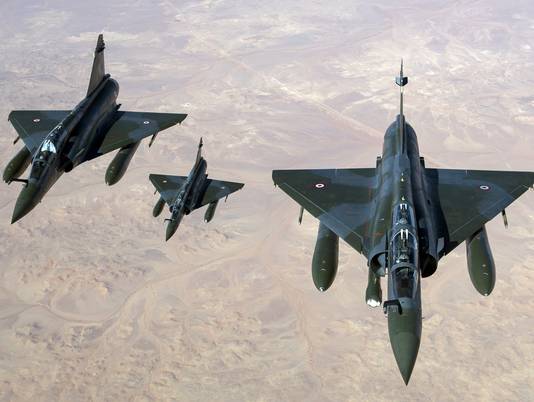
For now a basic sketch of NATO's unfolding offensive must suffice, beginning in central Mali and expanding outward. At least 550 French air and ground troops have reportedly deployed inside the country as air strikes continue for the third day. A significant portion of these troops landed at the airport in Sevare, the predicted target of Islamist militants that had recently staged attacks on the nearby towns of Konna and Mopti. Malian forces regained Konna with the help of French Mirage and Rafale jets, working in conjunction with assault helicopters, but they would have needed French air-combat controllers in the ground. The war-zone around Sevare was quickly ringed by checkpoints and French ground forces have been deployed from Sevare's airport to Konna and Mopti.

Western sources are already "reporting" the unconfirmed death of Ansar Dine commander Iyad Ag Ghaly, a veteran Tuareg jihadist, but his loss is unlikely to imperil the group.

Using the Inner Niger as NATO and ECOWAS's forward operating position into northern Mali, French warplanes and helicopters have launched an air campaign to shock the Islamists across their territory. Mirages reportedly destroyed a government base that had been taken over in Lere, located on the delta's west side, while a series of strikes targeted bases in Timbuktu and Gao. The latter now serves as the headquarters of the Movement For Oneness and Jihad in West Africa (MUJAO). Air strikes are set to increase in the immediate future before tapering down in reaction to the Islamists' movements.

"Hundreds" of French troops have also been deployed to Bamako to "assess the capital," secure diplomatic personnel and aide French nationals.

Given the fast-moving uncertainty, these factors are worth monitoring in the run-up to Africa's next asymmetric land war. 

Shifting Objectives

One set of determining factors is the multiple objectives offered by French officials as they attempt to convince their own voters of Mali's just cause. On Saturday President François Hollande announced that current operations in Mali are "limited to preparing for the deployment of an African intervention force." The Defense Ministry subsequently declared that Paris's goal "is to lead a relentless struggle against terrorist groups," including the prevention of "any new offensive of these groups to the south of Mali." These objectives ultimately intercept: France must provide the force to block the militants' offensive actions and defend the border between north and south until African reinforcements arrive. 2,000 of the planned 3,200 ECOWAS troops are expected to land by Monday - 500 each from Burkina Faso, Niger, Nigeria and Senegal - and NATO air operations will continue throughout their deployment.

How these strikes are interpreted by the local population - as the Islamists full responsibility or hostility towards the south and international community - has been decided for the immediate future. Residents have reportedly welcomed French flags in the sky and expect African ground forces to follow, sentiments that must be nurtured in order for NATO and ECOWAS's mission to succeed. NATO is currently operating without the support of a legitimate government or military.

A U.S. official also confirmed that Washington will deploy drones for surveillance purposes (easily armed at a moment's notice), and Britain has dispatched two C17 aircrafts to transport allied troops. Both powers prefer that France "take the lead" in what could be a long, messy war in Mali.

Underestimating Guerrillas' Capabilities

The joint NATO-ECOWAS force is rightfully viewed as vastly superior to the Islamist umbrella currently entrenching itself in northern Mali. However Western and African capitals should be wary of falling into a quintessential guerrilla trap: underestimating the opponent. Many negative things have been said of the Islamists' relative strength, how they only defeated a rag-tag Malian army, and how professionally trained armies will overpower them. This pattern represents the nature of insurgency; asymmetric forces are inherently weaker than conventional forces, and usually stronger in comparison to weak governments. Some insurgencies, such as Hezbollah and the Taliban, are more disciplined than others, which must evolve their capabilities or risk elimination from the actions of stronger governments.

A weaker insurgency is known to become stronger through the only school of war that is often available: direct combat. This phenomena was noted in U.S. observations of Iraq's insurgency and appears to be occurring in Mali.

After a great deal of talk concerning their weakness, French officials are either flattering Mali's militants or genuinely surprised by their abilities - which would be an inexcusable error and ominous sign of future events. How the Islamists fight NATO and ECOWAS soldiers on land remains to be seen, but the militants are putting their air defense weapons to immediate use. Western intelligence suspects that al-Qaeda in the Islamic Maghreb (AQIM) smuggled out a cache of Libya's surface-to-air missiles, potential fear-mongering that doubles as a real possibility. Heavy machine guns have also been mounted onto the Islamists' pickups.

"What has struck us markedly is how modern their equipment is and their ability to use it," said one of Hollande's aide, but another French official said that Paris expects a short campaign before ECOWAS takes over.

This reaction may come true - or suggests that NATO still has much to learn about the Islamists' overall forces and the non-military environment in Mali. Three different networks, operating with semi-independent agendas, have spent the last six months recruiting across Africa, the Middle East and South Asia in preparation for NATO's intervention.

Overselling Guerrillas' Capabilities

Taken together with this potential underestimate, politically overestimating the situation in Mali could generate more unexpected consequences in a country divided by its own government. French officials speak as though the capital was facing imminent danger, an assessment that The Trench disagrees with considering that thousands of well-trained militants would be needed to effectively sweep across the south. Building on Hollande's mixture of humanitarian and nationalist rhetoric, Foreign Minister Laurent Fabius boasted that, "The Islamist offensive has been stopped. Blocking the terrorists... we've done it." 

The Islamists had launched an offensive into the central delta but no one knows how far - they could stopped at Mopti. Yet French intelligence services claim they "detected preparations for what they described as a 'major offensive' organized and coordinated by al-Qaida in the Islamic Maghreb."

Jean-Yves Le Drian, France's Defense Minister, unequivocally announced on Sunday, “There was a spectacular acceleration of these [jihadi] groups since Thursday. If no one intervened, Bamako would have fallen two or three days later. France is at war against terrorism.”

Instability and other uncertainties normally accompany the hype of war against terrorism.

Political Resolution Is Mali's Only Exit

Lastly, the concrete deployment of NATO forces will push a negotiated settlement even further away from reality. African capitals have invested months into pulling Ansar Dine away from AQIM and MUJAO, hoping at the least to sow division between networks. Now this possibility goes from implausible to impossible. Accordingly, NATO and ECOWAS must commit an even greater amount of time and energy to organizing a political-economic resolution with the north's diverse ethnic groups.

None of these challenges begin to address the present lack of government in Bamako.

January 12, 2013

France's Rapid Burst Jumpstarts Mali's Long War

[Note: The current situation in Mali continues to accelerate within the fog of war:  "Hundreds of French troops drive back Mali rebels."]

Clearly deeming the situation as immanently unacceptable, the start of what should be a long foreign intervention has finally commenced in Mali's central river delta. Responding to estimates of 500-900 Islamic gunmen and their convoys, French military assistance has reportedly driven Ansar Dine and its allied muscle out of Konna for the time being. The bones of this information were jointly confirmed by Malian officials and French President Francois Hollande, who issued a national address on Friday to announce that France's operations will "last as long as necessary."

"French armed forces supported Malian units this afternoon to fight against terrorist elements," Hollande said from Paris.

The muscles and flesh of this information, though, remain obscured by the fog of war and must be pieced together as best as possible. Accepted as true is the presence of French military forces on Malian soil; Col. Abdrahmane Baby, an operations adviser for the foreign affairs ministry, confirmed that French forces had arrived in the country. Who landed, where they arrived, how long they plan to stay and what they specifically intend to do is left unanswered. It's possible that French forces had already arrived in the country on standby, and one must assume that standard soldiers were not called upon for the task at hand. France's Army Special Forces Brigade (known by the French acronym BFST), which experienced combat in Afghanistan, is the most likely unit to land first.

Beyond providing air combat controllers to multiply Mali's existing forces, the BFST would fulfill the initial training and scouting duties until NATO's first official batch of trainers arrives.

Also obscured is the status of Konna and how Malian forces dislodged the Islamist umbrella that moved on the city days earlier. French air-strikes were reportedly used to roll back militants and establish momentum for Malian forces, but no further information was provided to explain the actions of French soldiers. Paraphrasing the other officials willing to go on record, Lieutenant Colonel Diaran Kone simply told Reuters, "The Malian army has retaken Konna with the help of our military partners. We are there now."

For his part, Ansar Dine spokesman Sanda Ould Boumana denied that the group vacated Konna and its surrounding area. He claimed that “some planes came and bombed some civilians,” along with a mosque - overt propaganda to discredit the French. He would state matter-of-factly, "That’s France, and that’s the West. We are not surprised.”

The developing counteroffensive to Ansar Dine and al-Qaeda in the Islamic Maghreb's (AQIM) activities in central Mali holds the potential to accelerate a foreign intervention, or else spin it out of control at its launch. Delayed by all sorts of obstacles - U.S. laws barring direct support to Mali's coup-stricken government, the vast terrain of northern Mali and expected forecasts of its rainy seasons - the international blocs planned to unroll an intervention over the next eight months. Now the first NATO member is sliding down Mali's slope and threatening to pull other members in, even though Mali's government and military remains inoperable at the national level.

Washington and France had previously demanded that Mali hold elections, scheduled for April, before an intervention could begin.

Hollande also seems to be overselling the urgent threat of Mali's Islamists in order to justify a preemptive strike. Arguing that the "very existence of the Malian state" is at stake, France's president repeats his emphasis by adding the Islamists "are seeking to deal a fatal blow to the very existence of Mali." In reality the Islamist alliance has already dealt a fatal blow to Mali's sovereignty by sheering off half of the state, and the cost of re-securing the north outweighs the ease that it will lost. However The Trench believes that the Islamists are unlikely to pursue a genuine offensive into the south, so the threat of losing Konna and nearby Mopti is defensive-oriented. Capturing these areas and the air-base at Sevare would hinder an intervention into the north, and thus hinder its reunification with the south.

A full-blown march on the capital, Bamako, has no basis in reality.

Problematically in the near-term, the Islamists don't need to hold Konna at the moment and can leave the town alone while they target other areas in the Inner Niger. Once they withstand the initial air-strikes, they will likely take greater pains to disperse their forces in civilian areas. France will then be forced to add more troops, or else receive assistance from other NATO or AU forces (presumably the U.S. and U.K.), in order to provide defensive support and pursue several networks of militants; over-relying on air support is liable to backfire. Meanwhile Catherine Ashton, the European Union's (EU) foreign policy chief, has called for "accelerated international engagement" and said the bloc would speed up the deployment of 200 trainers, but organizing this process requires more time than coordinating offensive actions.

Furthermore, the Islamist coalition is likely to enjoy its own boost from France's involvement, and should receive an influx of recruits in the coming weeks. That pressure would add to the lobbying for more troops, but risks their deployment without a  defined time limit or the resources necessary to compete their mission. The air-strikes that will be used to supplement an initial force carry the potential of civilian casualties, and U.S. drones are likely to make an eventual switch from surveillance to targeted strikes. Mali's war will subsequently expand into a front along the boundary between north and south, and then degenerate into a multi-year conflict inside the north.

Ultimately, more rush will add to the international community's friction and could work in the Islamists' favor. Counterbalancing this force is vital to their success in central and northern Mali.

January 11, 2013

Islamist Alliance Fortifying Mali's Natural Defenses

Fresh alarms have sounded inside and outside Mali as the Islamist militias currently ruling the northern territory continue to advance south. Their latest move on Konna follows a general culmination of activities into the Inner Niger Delta, the natural barrier between Mali's southern and northern regions, and positions them on both sides of the river. As has been the case with most urban takeovers in Mali's fledgling conflict, each side has disseminated opposing narratives to maintain the upper hand in a fast-paced information war.

"We have chased the army out of the city of Konna, which we have occupied since 11 a.m.," declared Sanda Abou Mohamed, a spokesman for the Ansar Dine militant group, speaking by telephone from Timbuktu.

Several Mali spokesmen have refused to comment on Konna's status. Other officials denied losing control of the town, which sits at the edge of government-controlled territory along the Islamists' front-lines. A third account from Malian soldiers suggests that they staged a tactical retreat with minimal losses, and they probably won't return until Mali's army and foreign allies launch an organized offensive into the Timbuktu region.

"We have deployed technical means and reinforcements to secure the front,"one military official told Reuters by telephone, asking not to be named. "We think (the Islamists) want to attack Sevare.”

Fears of a southerly invasion have injected renewed urgency into African leadership and the international apparatus that is attempting to reach a consensus of action: the African Union (AU), Economic Community of West African States (ECOWAS), United Nations (UN) and NATO. Responding to Tuesday's statements by Benin President and AU chairman Thomas Yayi Boni, who told reporters that "NATO should play a part and the African force would lead the way as was done by NATO in Afghanistan," an anonymous NATO official struck the idea down in public even though an intervention is likely to follow Boni's description.

Given that all involved African capitals expect some level of NATO assistance - from training and logistics to intelligence and air-power - this denial is explicitly false: “There has been no request or discussion on a possible role for NATO in Mali. NATO is not involved in this crisis but the situation in northern Mali is of course of grave concern to us all."

Nevertheless, NATO's total involvement is unlikely to accelerate until the UN approves the permanent guidelines of Resolutions 2071 and 2085, drafted in October and December to advance the international community's overall response to northern Mali. French support troops were allegedly scheduled to deploy in late January and may land shortly, but Paris and Washington are equally leery of diving in head first. The UN is currently in the process of holding a closed-doors meeting in response to the Islamists' ongoing movements and their impact on regional mediation. New efforts have been delayed to January 21st in order to give the Tuareg-Islamist faction, Ansar Dine, more time to comply with international demands. 

Until then, the UN can merely repeat its futile request.

“We ask the Malian rebel groups to abide by Security Council resolutions 2071 and 2085 calling for them to cut off all ties with terrorist organizations,” Martin Nesirky said from UN headquarters in New York. "We urge adherence to the cessation of hostilities declared on 4 December 2012 in Ouagadougou and continue to call on the parties to engage in dialogue to address the situation."

The possibility of a southerly offensive towards Bamako, located 430 miles southwest of Konna, cannot be ruled out entirely; anticipating and planning for the worst scenarios is central to warfare and political science. In the event that the Islamists do push southward, NATO and the AU must be prepared to rapidly deploy a small number of solders as a front and last line of defense. These troops should assist in defending high-level human and structural targets, coordinating logistics, establishing communications, scouting and targeted raids. At the same time, Mali's own forces and civilian population must be tasked to the actual combat of Islamist militants in their local areas. 

Direct foreign intervention is more necessary in the north than south, where the population should be and must be capable of mounting a formidable counterinsurgency.

These factors being duly considered, the Islamists appear to be working towards the alternative objective of reinforcing their perimeter. Rather than an organizing a sincere campaign into Mali's south, which would overtax their resources and commit a potentially fatal blunder, Ansar Dine and its allies are engaged in the strategic defense of their northern territory. Using the muscle imported by al-Qaeda in the Islamic Maghreb and its regional offshoot, the Movement for Oneness and Jihad in West Africa (MUJAO), Ansar Dine has gradually surrounded the Inner Niger for months in preparation for an international assault. Konna and the local center, Mopti, fit into a larger campaign to secure the entire delta, and thus obstruct the initial advance of Malian and foreign military units.

This plan includes the capture or destruction of Mopti's nearby airport at Sevare.

Having used the cover of dialogue with Ansar Dine to expand their area of operations, AQIM and MUJAO have also set about fortifying Mali's surrounding defenses. To the delta's north lies a desert of greater size than southern Afghanistan or Yemen, which doubles as the established territory between AQIM's network in Mauritania and Algeria. No surprise advance will occur through this terrain. Meanwhile, to the east, several groups operating under the command of AQIM and Ansar Dine have been tasked to fortify the mountains surrounding the Kidal region. These forces expect an Algerian assault at some point during an intervention, although Algiers has strongly backed negotiations with Ansar Dine, and evicting them from the Adrar des Ifoghas will be a challenge in itself.

Viewed as intentional strategic depth, the ongoing assault on Mopti's surrounding areas represents the creation of a buffer zone around northern Mali's population belt. The Islamists expect to be hit hard by foreign armor and air power, and thus expect to lose control of its front lines in the aftermath of "shock and awe" tactics. This inevitability forces them to push out as far as possible, in order to facilitate an organized withdrawal into the north and engage its opponent from multiple directions. Using a combination of ambushes, organized resistance and retreat, the Islamists will occupy a more solid position than if they were to let Malian and foreign forces smash into them at Timbuktu.

Mali's conflict must somehow reach a political agreement with the Tuaregs and other ethnic groups in order to create permanent stability, but the region won't see the light of resolution before a military confrontation.

[Note: This analysis was completed on Thursday night. Updates on France's emerging military involvement will be posted shortly.]

January 10, 2013

U.S. Interference Spoiling Yemen's Revolution

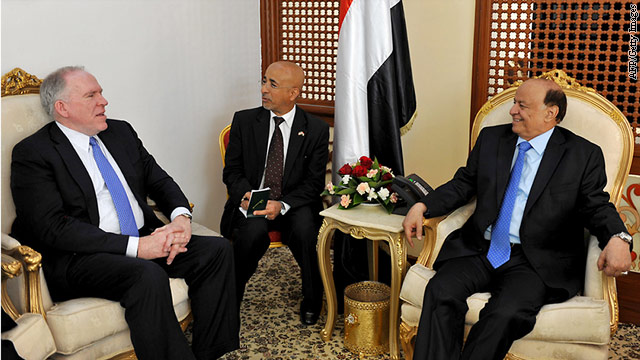
Yemen's new President, Abd Rabbuh Mansur Hadi, established working relations with John Brennan while serving as vice president to Ali Abdullah Saleh

The latest military restructuring announced by Yemeni President Abd Rabbuh Mansur Hadi brought much-needed relief to an anxious nation. Beyond establishing new regional commands to increase the Defense Ministry's centralization, Hadi's decrees finally terminated several high-ranking relatives of former president Ali Abdullah Saleh, namely his son Ahmed and nephew Yahya. Yemenis had demanded their dismissal from Saleh's personal "counter-terrorism" units since launching a revolution in January 2011, and both would assume instrumental roles in spearheading Saleh's vicious crackdown on peaceful demonstrators.

Gone, too, is the First Armored Division commanded by rogue general Ali Mohsen al-Ahmar, who defected from Saleh's government in March 2011 to escape punishment and pursue his own interests. His division and Ahmed Saleh's Republican Guard now count themselves as part of Yemen's Special Operations Command and Strategic Reserve Forces, and theoretically fall under Hadi's personal authority.

This news was lauded by John Brennan, the Obama administration's counter-terrorism coordinator (and current nominee for CIA Director): "Mr. Brennan extended President Obama’s congratulations to President Hadi for the decrees issued yesterday to further restructure the Yemeni armed forces, advancing the goal of a unified, professional military that serves the Yemeni people."

Unfortunately the jubilant air soon cleared and Yemen's situation has tumbled back downhill in the days since. Following their "removal," the normally resistant Salehs welcomed Hadi's announcement and pledged to cooperate fully, triggering immediate suspicion of their payoffs. Ali Mohsen greeted Hadi's orders as though they had nothing to do with him. Reports then surfaced to explain their reactions - new military appointments - and were half-confirmed by the spokesman of Yemen's embassy in Washington; Mohammed Albasha announced on December 23rd that “there are no restrictions to their reappointments in the Ministry of Defense."

Subsequent reports predict that Hadi's decrees could take six months to implement, and that Ahmed Saleh and Ali Mohsen will continue to oversee their positions until then. If they do receive new regional commands or advisory positions, they can thank their ongoing survival for the immunity granted by the Gulf Cooperation Council (GCC) and United Nations Security Council (UNSC).

These collective actions serve more private interests than Yemen's people, beginning with Hadi's interim government and the foreign powers that secured his promotion. Although he has admirably stepped up to fill Saleh's void after serving nearly two decades as his vice president, Hadi remains a controllable instrument of the GCC deal's true brokers, Riyadh and Washington. That leaves Yemen's revolutionaries - the country's future - at the bottom of national and international priorities, at a time when they have enough interference to deal with at home. Out-resourced by the oppositional Islah party, which dips its hands into most of Yemen's political movements, the country's civil parties have already been isolated in the UN-sponsored National Dialogue with few seats relative to the whole (the youth and women received 60 combined seats out of 565).

They could easily be squashed by Saleh's own General People's Congress (GPC) and the 112 delegates they plan to sit - the most of any bloc.

As of now the Islah-dominated Joint Meeting Parties (JMP), in addition to the youth, refuses to participate in the event that Saleh does represent his party (another "medical leave" is being planned by Riyadh and Washington, but both rumor and reality are fraught with uncertainties). Conversely, Islah has interfered with efforts to organize an independent youth conference, a phenomenal idea to advance a democratic Yemen, while Ali Mohsen's loyalists have "protected" the youth by militarizing their square at Sana'a University. The general recently agreed to withdraw his forces following persistent demonstrations against their presence, but only after months of physical altercations with the youth camps.

Yemen's youth and women are tragically viewed as groups to appease with scraps, not sources of national power to nurture and cooperate with. They have found few allies inside or outside the country due to their independent agenda, and cannot turn to the United States in their hour of need. The second incarnation of Yemen's Life March, a mobile demonstration traveling from the revolutionary hub of Ta'izz in December 2011 en route to Sana'a, recently arrived in the capital to remind Hadi and his foreign backers that they won't back down either. With no action taken by their transitional government or the UNSC, Yemenis once again marched to advocate their standing demands: "Dismissal of all military leaders who worked with Saleh, headed by Ahmad Ali Saleh, Ali Mohsen Saleh, Ghalib Algamesh and fully dismissing them and not reshuffling their positions in the new appointments, whatever the circumstances."

The march ended when government forces blocked its path and violently dispersed protesters with tear gas, eroding another piece of the goodwill initially earned by Hadi's military shakeup.

U.S. influence is hardly responsible for all of Yemen's politico-economic dilemmas and the tribal knots created by Saleh's nepotism. However the sheer gravity of America's counter-terrorism is warping Yemen's political and military reforms. The Obama administration no longer has practical use for Saleh and company, but they possess too much incriminating evidence on Saudi and U.S. actions in Yemen to be cast away completely. Instead Saleh has been kept close, traveling to America twice since the revolution began, and silent under the GCC's immunity package. Potential sanctions against "spoilers" - the always unnamed Saleh - remain a manipulative tool to avoid accountability.

In the meantime U.S. drones continue to strike at suspected targets of al-Qaeda in the Arabian Peninsula (AQAP), accumulating enough collateral damage to produce a bombshell report by The Washington Post. Hadi has opened a wider door than his predecessor in exchange for U.S. and Saudi support, approving the Obama administration's covert activities and moving to kill inquiries into civilian casualties. This relationship-building and the preservation of mutual interests is more responsible for Hadi's decrees than any genuine effort to uproot Saleh's regime from Yemen's political equation.

Ultimately, Ali Abdullah Saleh cannot be held accountable for decades of misrule because the U.S. and Yemen's power-sharing government are working outside the bounds of accountability. The fact that Washington and Riyadh have exhausted their operational need for his regime is far from stabilizing, and poses an enhanced threat to Yemen's democratic growth. One can reasonably assume that Washington will possess greater influence over Hadi's Special Operations Command than Saleh's U.S.-trained units. Counter-terrorism activities are being established in systematic fashion - land, sea and air forces surround the peninsula nation - but U.S. policy as a whole represents counterinsurgency at its worse: deep hostility and mistrust with the local population.

The Obama administration cannot realistically expect to defeat AQAP with its current strategy, and the same power that lifted Hadi to his current position is weighing him down with his own people.


"The main problem is not only with the US administration - extrajudicial killings in Yemen of 'suspected' targets, killing and terrorizing civilians and creating animosity towards the US - but rather with our government’s position, approving those drone strikes," says Noon Arabia, a Yemeni-Egyptian blogger who maintains her anonymity for personal and security reasons. "Former president Saleh with all his shortcomings tried to hide his role in allowing the US drones to strike in Yemen, before being exposed by Wikileaks. However his predecessor President Hadi not only publicly endorsed them, he even argued regarding their accuracy. Drone strikes in Pakistan decreased by 41% in 2011 and another 40% in 2012 because the Pakistani government publicly condemned and disapproved of them. Yet in Yemen they have increased by 240% in 2011, and another 250% in 2012 and most likely will increase further in 2013 thanks to our puppet government."

Yemen's revolutionaries are marching, bleeding and dying for a better future than what is currently being forced onto them. The U.S. would be wise to begin a new era of engagement and vanquish the same fear that is normally reserved for al-Qaeda.

January 9, 2013

Near-Zero Odds For Afghanistan's "Zero Option"

Keeping the enemy in the dark is a relatively straightforward task. Hiding information from a populace that has funded 12 years of seemingly endless warfare becomes murkier business, although governments have conducted their activities in such fashion for thousands of years.

Afghan President Hamid Karzai has arrived in Washington for three days of consultations with the Obama administration, and a hazy beginning portends a hazy end. Since the main reason for his arrival cannot be obscured - Karzai and President Barack Obama are both under pressure to make a decision on America's post-2014 operations - the inner workings of their summit have been fogged to create political breathing room. There's certainly something positive to be said about negotiating bilaterally, and privacy may be the only means of reaching a compromise between governments.

However the U.S. and Afghan governments have told so many lies, and manipulated so much information for so long, that neither enjoys credibility with either populace.

Rather than face Americans and Afghans honestly, both of their governments continue to dance behind private doors as they seek the best outcome for themselves. Karzai, for his part, wants and needs a continual U.S. military presence to stay on his terms. The White House likewise hopes to supplement America's political presence with military capabilities, while simultaneously tamping down its military profile as low as possible. At least 30,000 U.S. and NATO troops are expected to remain in the country after 2013's withdrawals, meaning at least two more years of hard combat. The longer Afghanistan's bloodshed continues with minimal results from the central government, the more Americans will oppose a long-term military presence in the country.

Problematically, a post-2014 Afghanistan needs U.S./NATO forces to continue training, overseeing, patrolling, raiding and generally providing a "visual presence" in the country. They, in turn, need the funds and attention that come with U.S. military operations; Iraq has already fallen down the list of priorities after U.S. combat troops withdrew in December 2011, a loss of focus that contributes to the present stalemate between Nouri al-Maliki and an oppositional alliance of Sunni, Shia and Kurd. The Obama administration also believes it needs a military presence to leverage during negotiations with the Taliban, whose leadership expects a share of Afghanistan's power regardless of Washington's plans. Hostilities will be difficult enough to stop with an agreement, let alone without one.

Despite the optimistic rhetoric employed by the Obama administration and Pentagon in particular, many Afghans expect their country to enter a new period of instability and uncertainty following the exit of U.S. troops.

“Let’s be honest,” Mohammed Omar Barakzai, a senior shura member in Helmand province, told The New York Times. “The Afghan government is like a generator. The foreigners have provided enough fuel so that it will run until 2014. If they don’t refill the fuel tank, it will stop working.”

Now, instead of simply owning up to this inevitability, the Obama administration has dropped a "zero option" into the media to temporarily relieve pressure around Karzai's visit and mislead the American public. Knocked down from the 20,000 troops that the Pentagon hoped to leave behind, the White House was reportedly considering force-level options of 3,000, 6,000 or 9,000 before Tuesday's leak polluted the waters. All of these figures represent more realistic assessments of Afghanistan's ground conditions than the Obama administration's present rumor.

"That would be an option that we would consider," deputy national-security adviser Ben Rhodes answered when questioned during a conference call on Tuesday. "The president does not view these negotiations as having a goal of keeping U.S. troops in Afghanistan."

Stripping away the "zero option's" political skin leaves a naked scam, one intended to placate U.S. opposition to an open-ended commitment and deflect the Taliban's recent claim that it will hold the U.S. responsible for the war's continuation. This conundrum runs to the heart of Afghanistan's war: the U.S. wants to maintain a politico-military presence past 2020, but cannot realistically expect to mediate a political agreement between the Taliban, Kabul and Islamabad if U.S. forces remain in the country indefinitely. The Taliban mean what they say when opposing a post-2014 presence - one U.S. soldier or a thousand will justify their position. Nevertheless, the Obama administration is certain to leave troops behind if a deal can be struck before Karzai's term expires. Thus the U.S. headlines accurately capture this scenario: White House "floats zero option."

Float, as in bait for guppies.

Afghanistan's "zero option" rests at the opposite end of the truth spectrum and shouldn't be swallowed whole as the White House intends. The administration seeks to avoid the overwhelming situation that it currently faces in Iraq, and surely anticipates the political fallout of a chaotic Afghanistan. The only reason that U.S. troops and air vehicles won't remain in the country after 2014 has already played out in Iraq: Karzai, as Nouri al-Maliki did before him, opposes the renewed immunity for U.S. soldiers. This factor is especially critical since the Washington expects to continue Special Forces raids on Afghan villages.

The Obama administration's "zero option" exists by default, not choice or design, and will be forced upon rather than decided by Washington.

January 8, 2013

Brennan Dons CIA's Death Mask In Yemen

Brennan maintained cordial relations with dictator Ali Saleh until he became less useful than his vice president 

As the majority of Washington's political and media establishment concentrate their firepower on Senator Chuck Hagel's nomination for Defense Secretary, John Brennan is doing what he does best and slipping through the shadows. Rumored since President Barack Obama secured his second term in office, Brennan has finally received a formal nomination to replace the scandalized David Petraeus and improve upon his work at the CIA. Disturbingly but not surprisingly, many American pundits have welcomed Brennan's promotion as a solid choice for the CIA's Directorship and expect a majority confirmation. 

They generally avoid real discussions over the areas of operations affected (and afflicted) by U.S. counter-terrorism, instead preferring the glamorous statistics of high-profile kills and Brennan's alleged construction of a "legal framework" for drones - as recently claimed by the United States District Court for the Southern District of New York (SDNY).

Brennan's positives are easy to list: "More al Qaeda leaders and commanders have been removed from the battlefield than at any time since 9/11." He has applied his extensive influence to “literally building" and leading the National Counterterrorism Center, which entailed the coordination of various military, intelligence and civilian departments across the globe. In the process Brennan has become one of Obama's most trusted advisors, so close that, “I don’t think we’ve had a disagreement.”

"For the last four years," Obama announced from the East Room, "as my Advisor for Counterterrorism and Homeland Security, John developed and has overseen our comprehensive counterterrorism strategy - a collaborative effort across the government, including intelligence and defense and homeland security, and law enforcement agencies."

However this fantasy hits a steel wall in Yemen, where Brennan and U.S. Ambassador Gerald Feierstein may be the most despised Americans to touch its soil. The immediate reaction to Brennan's promotion has been universally negative for good reason, as he reinforces the single-mindedness and unaccountability that drives an assortment of U.S. counterterrorism platforms being constructed around the nation. Brennan now picks up  Petraeus's "secret" agreement with Yemen's former dictator, Ali Abdullah Saleh, and was even deployed to Sana'a on multiple occasions during the country's ongoing revolution; he would assist Feierstein in facilitating the Gulf Cooperation Council's (GCC) unpopular power-sharing agreement when a drone strike didn't require overseeing.

Brennan told the Wilson Center in April 2012, "Yemen was fortunate that they do - did have a degree of political pluralism there, Ali Abdullah Saleh in fact allowed certain political institutions to develop, and we were very fortunate to have a peaceful transition from the previous regime to the government of President Hadi now."

A known intimate of Saudi Arabia's royal circle, Brennan's promotion also corresponds to recent investigative reporting on Saudi bombings in Yemen. Now he's promoted a week later, highlighting the obvious favoritism and imperialism that assisted his rise atop the CIA.

Given that Brennan has been nominated, in part, to embed the CIA deeper into Yemen, his presence is ultimately counterproductive to defeating al-Qaeda in the Arabian Peninsula (AQAP) and improving relations with Yemen's people. "Traveling through the Arabian Peninsula where he camped with tribesmen in the desert" has done little to promote their human rights and dignity, which are trampled on daily by the national government and its foreign partners. Victims of drone strikes have no recourse, and Yemen's revolution has been blocked by opportunistic relations with the ruling General People's Congress (GP) and oppositional Joint Meeting Parties (JMP).

Washington's Pakistani "model" has been improved by establishing better relations with the transitional government, led by Saleh's former VP Abd Rabbuh Mansur Hadi, but the exact same hostility is repeating within those who serve as the real front lines against AQAP.

A "keen understanding of a dynamic world" has also been absent from Yemen's counterterrorism operations. During a prolonged defense of the CIA's targeted killings, orchestrated throughout 2012 and Yemen's emerging bombardment, Brennan claimed that drones don't cause as much resentment as commonly believed. He never acknowledged a revolution amid the Obama administration's micromanaging of a "political crisis," and has no relationship with the people that are needed to stop AQAP at its roots. He's even been known to claim that drones don't kill any civilians, or else very few.

What Brennan will ensure is that AQAP's status remains healthy, and that Yemen remains under the firm grip of Washington and Riyadh.

To overrule these "results," as Obama calls them, flattery and hyperbole is piled onto Brennan's shoulders in an effort to democratize him, so to speak. Instead of a calculated killer that has taken his share of civilian life, Brennan is heralded as a "legendary, tireless patriot" and a model of American "integrity." Ethics and values are stressed as a counterweight to the perceived constitutional violations that drone warfare entails.

"There’s another reason I value John so much, and that is his integrity and his commitment to the values that define us as Americans. He has worked to embed our efforts in a strong legal framework. He understands we are a nation of laws. In moments of debate and decision, he asks the tough question and he insists on high and rigorous standards. Time and again, he’s spoken to the American people about our counterterrorism policies because he recognizes we have a responsibility to be [as] open and transparent as possible."

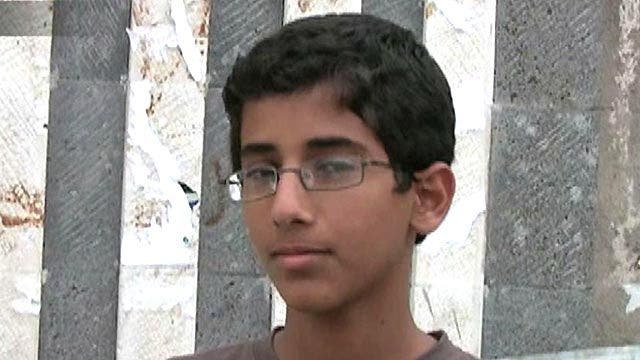
The SDNY recently refused to address the killing of 16-year old U.S. citizen Abdulahman al-Awlaki, son of Anwar al-Awlaki, on the grounds that the Obama administration never released any information on his killing. Unlike his father, whose droned body was held up as a trophy by Brennan and company, Abdulrahman's murder was first denied, then silenced and finally labeled an "outrageous mistake" by an anonymous official over a year later.

His or her statements occurred within a glowing profile of the CIA veteran.

Brennan was incapable of bringing a shred of peace to Yemen as Obama's counterterrorism advisor and remains helpless at the CIA - he can only deliver death and destruction. His tireless drone fleet will always kill civilians in between terrorists and the process will stay classified to Americans and Yemenis alike. The Predator and its sole purpose of killing serves as a permanent symbol of U.S. imperialism, and lacks the ability to build relationships at the local level. Mere flyovers cause terror. This policy violates America's morals, the spirit of the Nobel and the strategic essence of counterinsurgency all at once. A plan that fails to kill more militants than it creates doesn't qualify for counter-terrorism or counterinsurgency - expedient recklessness is a more accurate definition.

"What scares me about drone strikes is how they are perceived around the world," retired general Stanley McCrystal told Reuters in a new interview, coincidentally implicating Brennan himself. "The resentment created by American use of unmanned strikes ... is much greater than the average American appreciates. They are hated on a visceral level, even by people who've never seen one or seen the effects of one."

Until U.S. policy undergoes a radical shift in fundamentals, a change unlikely to occur under Brennan, America has already lost its small war in Yemen.

January 7, 2013

U.S. and Bahrain: Oppressive Allies Think Alike

In a predictably totalitarian move that threatens the regime itself in the long-term, Bahrain's court system has finally buried the appeals process for 13 oppositional activist accused of plotting to overthrow the government. The decision culminates months of legal warfare with King Hamad bin Isa al-Khalifa's army of legal soldiers, but this illusionary battle never offered a chance to the political prisoners trapped in the monarchy's web. Last month an appeals court knocked one year off Nabeel Rajab's three-year sentence in the vain appearance of fairness. 

Now his partner at the Bahrain Center for Human Rights (BCHR), Abdulhadi al-Khawaja, has been sentenced once and for all to life, while his daughter faces nearly a dozen charges herself for protesting peacefully (and often in solitude). Several of al-Khawaja's fellow defendants were accused of plotting an Iranian coup.

Thus it is clear inconsistencies numerous and large among its ruling the Court of Appeal supported the provisions of the courts of national safety, and what came in the report of BICI of the observations and conclusions which lead that all that the defendants in this case have not only exercised their fundamental freedoms in the regulation and expression, peaceful assembly but they were subjected to serious abuses during their arrest, detention and trial.

As is evident the Court did not respond to the recommendations of the Commission of Inquiry to investigate violations and to prosecute those involved. As is evident synergies of the Constitutional Court and the criminal courts and public prosecution and continuation in the previous approach, making this issue a stark example of the lack of independence of the judiciary in Bahrain, and lack of seriousness in implementing the recommendations of the fact-finding committee.
The rapid nature of news and social media has produced numerous observations to the effect that Bahrain's monarchy "has shown its true colors" - or "pushed the country closer to the brink" - and that its Western allies will be unable to defends its actions. The first two general reactions are inaccurate but partially true. King Hamad's royal circle has demonstrated their inability to redress Bahrain's crisis since the uprising began, making the wrong choice with Saudi Arabia's Peninsula Shield and never looking back from the destruction of Pearl Monument. Aside from a successful propaganda campaign with Western governments and skillful use of low-intensity violence, Bahrain's monarchy has made strategic errors at every turn - if its goal is the resolution of a fundamental political dispute.

Otherwise the monarchy is succeeding wildly in its attempt to provoke and crack down on the island's Shia majority.

Sentencing the opposition's leadership to life in prison sentences the regime itself to permanent unrest. Accordingly, Bahrain has already reached the brink and descended into a canyon of tyrannical abuse and sectarian tensions. Monday's sentencing is simply a new feature in this dangerous environment, and will produce new waves of oppositional action in the streets and at the party level. Protests will occur, counterassaults will follow, and the island will continue spinning out of control until Bahrain's king decides to be a good one - or is removed, internally or externally.

As for Hamad's Western support, particularly Washington and London, they spent last night trying to cover their pig in lipstick rather than formulate a genuine policy to support Bahrain's opposition. Repeated calls for dialogue have bounced off a hardening situation in the streets and prisons, and the modest criticism levied at calculated times has made no lasting effect when outweighed by statements of this type (also here and here). That U.S. policy is blowing in a chaotic wind is increasingly acknowledged by left and right, accepted even by The Washington Post, Wall Street Journal and Max Boot. Yet the same pattern of "concern" and "regret” that has failed to yield any positive change was on display Monday in the State Department.

"We regret today’s decision by the Bahraini Court of Cassation to uphold the convictions and the sentences of these 13 activists. We’re concerned that this decision further restricts freedom of expression and compromises the atmosphere within Bahrain for reconciliation. We have repeatedly voiced our concern about these cases both publicly and privately and at the highest levels, and urged the Government of Bahrain to abide by its international obligations, and we have also had Embassy observers at the trial. So we call on the Government of Bahrain to investigate all reports of torture, including those made by the defendants in this case, as it has pledged to do, and to hold accountable any who are found responsible."

The "atmosphere within Bahrain for reconciliation" is already compromised. Conversely, Western "concern" and naked abuse is regularly heaped on the opposition's use of violence in a systematic effort to disguise the all-consuming reality: involved governments are too busy pursuing their own interests to responsibly address Bahrain's full-spectrum crisis.

They refuse to believe that anyone can stop them and dare the people to prove them wrong.

January 5, 2013

U.S. Response Flailing Amid Iraq's Protests

In the absence of any sincere goodwill from Nouri al-Maliki's government to resolve Iraq's political gridlock, demonstrations in Sunni territory are predictably escalating to alarming levels. Al-Maliki has strut a fine line since the new protests gained momentum two weeks ago, softening his language at points while demeaning Sunnis as Baathists, Saddamist and other derogatory labels. Insulted by the flying of Iraq's old flag and Syria's colors, which inevitably led to al-Qaeda and "foreign elements," al-Maliki has become trapped in circular rhetoric and another standoff with a diverse opposition.

He's smart enough to realize that a massive crackdown on demonstrators - Shia, Sunni and Kurds have all joined the protests in Anbar - would only bring him down quicker, but not smart enough to share power equitably.

For their part two Iraqi officials, including State of Law MP Khalid al-Asadi, denied an Al-Arabya report that parliament will be dissolved within 48 hours, "leaving Prime Minister Nouri al-Maliki to govern as a caretaker." However he added that al-Maliki's party "will not stand against" any party's request to dissolve the government and call for early elections, a prospect that al-Maliki's opponents weighed throughout 2012. Al-Maliki has reflected the specter of another election, and along with the uncertainty that comes with it, onto his opponents in his effort to back them down from their no-confidence vote. Without a solid majority to guarantee future power, they have been left with few alternatives except to apply pressure in the streets.

Alaa Makki, Iraqiya's senior representative in parliament, warned al-Maliki through Al Jazeera, "This is the last chance for correction of all the [political] environment in Iraq, the political system and the judiciary system. They [the protesters] are waiting for the government to send somebody there, representing the governmental concerns."

Having falsely declared an end to Iraq's ongoing long-war throughout his reelection campaign, the Obama administration naturally seeks to keep its public distance from Iraq's unrest as it attempts to manage the situation from the background. On Wednesday the State Department was quizzed for the first of three straight days, with its response progressively degenerating over the heat of skeptical reporters. Questioned on the protesters' actions and their grievances with al-Maliki ("sectarian practices, arresting women and torturing them"), spokeswoman Victoria Nuland used most of her time to clarify Washington's support for peaceful expression and caution "any party" against subverting the rule of law or provoking ethnic tensions.

Nuland concludes, "So we want to see these difficult issues settled through consultation among Iraqi leaders, and we want to see them reach an agreement on the path forward for Iraq."

Her answer studiously avoids responding to the protesters' actual grievances against a fair-weather U.S. ally.

Visibly unsatisfied with Nuland's evasion, several journalists fired again on Thursday only to meet a heightened state of resistance. Told that "your reaction is like that of Switzerland," Nuland rejected the characterization that Washington has acted too passively towards Iraq's crisis. She instead claims that the Obama administration has been "extraordinarily active for many, many months now with Iraqis of all stripes and all groups," going so far as to describe the White House's policy as "enormously vigilant." These types of hyperbolic phrases are employed by those in the business of overselling.

As new waves of protesters descended on Sunni cities following Friday prayers, Nuland came particularly armed to impress the depth of U.S. mediation upon her audience. Focus is increasingly kept on the peacefulness of demonstrations, a legitimate factor of concern that happens to divert attention from the political issues at stake. While Washington publicly opposes disobedience in foreign countries as a general rule to maintain impartiality, urging peaceful protests is more subjective than it may appear. Civil disobedience is often warranted by the suppressive environment created by an unrepresentative government, and applied when peaceful options have failed to effect a positive change.

Civil disobedience and outright violence also compels a government to react disproportionately, further eroding its national and international credibility, and the Obama administration doesn't want Iraqis to provoke a hardline response from al-Maliki. This scenario would push him deeper into Baghdad's sand and force a more vocal response from Washington - a possibility that the White House hopes to avoid. Pressed on the estimated 50,000 Sunnis suspected of being imprisoned for political reasons, Nuland refuses to answer beyond the need "for the justice system to be transparent, for there to be fairness and a level playing field."

And when finally asked about Iraqiya chairman Ayad Allawi's latest call for al-Maliki to resign, Nuland does everything possible to steer the conversation in the opposite direction.

"You know that on a weekly basis, sometimes on a daily basis, our Ambassador in Iraq has meetings with all of the key leaders, encouraging them to work with each other to settle issues that they have through dialogue, to protect and preserve the basic tenets of the Iraqi constitution. He regularly sees the Prime Minister, the deputy prime ministers, the Vice President, cabinet ministers, deputy ministers, parliamentarians. So we try to use our good offices with all of the groups to encourage them to participate actively in dialogue with each other."

The dilemma of U.S. policy isn't simply what hasn't been accomplished since U.S. combat forces redeployed in December 2011, but how the Obama administration is laboring under the belief that its policy is "extraordinarily active": regular meetings with Iraqi officials, anonymous statements, and Turkish diplomacy. These measures combined have proven insufficient for correcting al-Maliki's authoritarian tendencies, while U.S. pressure for dialogue was applied all year with no results - Baghdad remains stalemated as it did in January 2012. Furthermore, the terms “negotiate” and "dialogue” imply a give and take of power, when al-Maliki is constitutionally obligated to give up the power that he's illegally holding in the Defense and Interior Ministries.

Some issues such as regional autonomy must be debated in a national forum, but government actions targeting al-Maliki's various opponents leave nothing to be negotiated. Iraq's situation wouldn't be what it is if the country's was continuing "on a stable, peaceful, democratic trajectory."

President Barack Obama's administration clearly has no intention of admitting its part in the confrontation: negotiating al-Maliki back into power through 2010's Irbil Agreement, failing to hold him accountable for violating the agreement, and personally enflaming the situation with political theater. Many of the power brokers that U.S. officials meet with "on a daily and weekly basis," from Allawi and Vice Prime Minister Saleh al-Mutlaq to Shia cleric Muqtada al-Sadr and Kurdish President Massoud Barzani, have called the White House out directly for its weak response. This is no coincidence or perception, but the reality of U.S. policy in Iraq.

“When I last met Obama, I said I hoped withdrawals of American forces, which was natural, would not mean the withdrawal of American interest and American commitment to Iraq,” Barzani said in April 2012. “That question is still on the table. In fact, the American position has to be very public and very clear, so that the Iraqi people can see that the United States will not allow and will not support another dictatorship in Iraq.”

Ill-advised political moves aren't solved by denying them, and U.S. policy will continue to drown until the Obama administration stops denying its bias for al-Maliki's rule.

January 3, 2013

Yemenis Walled In By National, U.S. Courts

On Wednesday the United States District Court for the Southern District of New York (SDNY) dismissed a Freedom of Information Act lawsuit (FIOA) initiated by the American Civil Liberties Union (ACLU). The ACLU had requested government records of Anwar Al-Awlaki, Abdulrahman al-Alwaki and Samir Khan's "targeted killings," but the SDNY predictably struck down an inquiry into the explanation of their deaths - citing the Obama administration's own defense of drones as sufficient reason not to disclose their operations.

The Trench is less interested in becoming mired in al-Awlaki's case, and the questions of whether he constituted an imminent threat and qualified for treason. The U.S.-born preacher had urged jihadists to attack the U.S. homeland and will never win a legal battle regarding his citizenship. Khan's involvement with Inspire magazine, al-Qaeda in the Arabian Peninsula's (AQAP) main propaganda outlet, also leaves no alternatives for a U.S. court. Two overarching debates were heard by the FIOA's end: the constitutional legality of targeted assassinations against U.S. citizens, and whether the U.S. public has a right to transparency.

These issues, though obviously vital to America's health and privacy, ignore another fundamental and interconnected dilemma: U.S. counter-terrorism is making more opponents in Yemen.

In the aftermath of al-Awkali's death, which triggered a miniature replica of Osama bin Laden's killing, the Obama administration readily manipulated a "brand name" to justify an ongoing militarization of the country - a plan that the American majority remains indifferent to. By branding him as the leader or else a high-ranking strategist of AQAP (a ploy that just repeated today), the White House failed to correct exaggerations of his importance in the U.S. mainstream media. Al-Awlaki did run with the group's core and considered himself a planner, preacher and propagandist, but he was far from AQAP's most valuable figure. He's probably more valuable dead, and AQAP has continued to grow its organization in his absence.

A U.S. court of law naturally takes minimal interests in these transgressions.

Of greater concern to The Trench is the blatantly unlawful assassination of al-Awlaki's 16-year old son, Abdulrahman, to be treated in depth shortly. Droned three weeks later at a barbecue without the fanfare of his father, the Denver-born Abdulrahman was unassociated with his father's radical teachings and killed without committing a crime. This heinous act was recognized as such by the Obama administration's own coverup; Abdulrahman's killing has yet to be formally addressed directly, and only recently admitted indirectly by anonymous U.S. officials.

His death was excused as "an outrageous mistake" in a Washington Post report that "coincidentally" glorify John Brennan's "true model" of counter-terrorism in Yemen.

Due to ambiguity and denial, the court ruled out the release of his records because no admission was made by the Obama administration. Gross perversity of circular logic is difficult to explain: because the White House didn't talk about a murder it committed, America's courts can't either. The ultimate tragedy of Abdulrahman being erased from the SDNY's ruling, beyond his personal suffering and his family's irreplaceable loss, is how Abdulrahman represents the average Yemeni plight. Few to no Yemeni-Americans are plotting within AQAP to bring down America, while millions of Yemenis live and sleep under drone patrols, and they can't count on either government for protection or accountability.

Yemen's transitional government remains under a heavy American arm and has blocked numerous investigations into civilian casualties, overburdening the remnants of Ali Abdullah Saleh's legal system. Meanwhile the U.S. court system is unlikely to provide any recourse to Yemenis or Yemeni-Americans who become victims of America's escalating war with AQAP.

This policy generates no possibility of improving American relations with Yemen's people - the key to defeating AQAP - and smothers all light of justice.


U.S. Drones Target TTP's Maulvi Nazir, Pakistani Negotiations

A vivid contrast between the light shone on civilian casualties and militant commanders reflects off a MQ-9 Reaper's wing. In Pakistan's case, this light often comes from the numerous intelligence sources deployed to see and hear everything in the Federally Administered Tribal Areas (FATA).

Around 12:30 AM in Islamabad, a pair of U.S. drones fired four missiles at a compound located in South Waziristan's Angor Adda. The first international reports surfaced 4-5 hours afterward; less than 12 hours later, the target had been identified as Tehrik-i-Taliban Pakistan (TTP) commander Maulvi Nazir and his deputies, Atta Ullah and Rafey Kkan. The Hellfire missiles struck Nazir's convoy in the Sra Kanda area as it was traveling from Angor Adda to the local capital of Wana. One Pakistani official said Nazir and his fighters were caught swapping vehicles after their "double cabin pick-up encountered a mechanical fault."

Nazir's death has reportedly been announced over Wana and Angor Adda's mosque speakers, while the TPP has yet to issue a statement as of this moment. One will presumably be released shortly.

Nazir's death, if confirmed, will yield positives and negatives for Washington, along with a bundle of negatives for Islamabad. He's certainly a veteran player in the TPP and a name to throw at Americans, if that counts for anything 11 years into Afghanistan's war. He also keeps in line with al-Qaeda's general ideology despite chafing under Uzbek influence; the Long War Journal notes that "Ilyas Kashmiri, Abu Khabab al Masri, Osama al Kini, Sheikh Ahmed Salim Swedan, and Abu Zaid al Iraqi were killed while being sheltered by Nazir." Now these types of personalities will need somewhere else to live and train. Moreover, Nazir enjoys relations with the Haqqanis and facilitates their movement through his territory.

Eliminating Nazir rather than his rival, TTP chieftain Hakimullah Mehsud, is the correct strategy for instigating the group's self destruction. Mehsud's divisive leadership has kept its regional commanders split into factions since assuming power in August 2009, and targeting him first would be counterintuitive. Instead, Nazir and those TTP commanders focused on Afghanistan - namely South Waziristan's Waliur ul-Rehman and North Waziristan's Hafiz Gul Bahadur - should be targeted in place of Mehsud until the group collapses on itself. Problematically, this strategy runs contrary to Pakistan's containment policy towards both branches of the Taliban.

Nazir also remains a second or even third tier target and his absence won't alter the battlefield in Afghanistan or Pakistan. Although a leading advocate of concentrating TTP resources on NATO forces in Afghanistan, his death alone is insufficient for drying up TTP activity along the border and largely turns another COIN into whack-a-mole. As a result, the Obama administration's handling of Afghanistan will see a negligible bump in U.S. polls, and the war's trend will continue as is.

A second strike in North Waziristan reportedly targeted an Uzbek commander, however civilian casualties have been reported after villagers closed around the scene.

Unless more high-level targets soon experience Nazir's fate, his assassination brings more risk than reward to Washington and Islamabad's tables as they attempt to negotiate a more solid grip on the region. Nearly all of Nazir's details remain to be shaked out over the coming days (perhaps Islamabad ran out of use for him) but the timing appears extremely volatile. Nazir had allegedly made enemies with Hakimullah's camp for keeping open relations Islamabad, which theoretically needed his presence within the TTP's council.  Now the government must explain through backchannels why Nazir was targeted during a potentially new phase of interaction with Hakimullah and Rehman.

The Obama administration and its supporters in Afghanistan have invested a noticeable amount of energy reviving their prospects on the back of Islamabad's recent diplomacy - Thursday's drone strike runs against this grain.