
July 9, 2011
al-Shabab Regroups Under UN Umbrella
Earlier this week a slight drizzle descended on the Somali people from an unlikely source.
"We have now decided to welcome all Muslim and non-Muslim aid agencies to assist the drought-stricken Somalis in our areas," said Sheikh Ali Mohamud Rage, spokesman for al-Shabab. "All aid agencies whose objective is only humanitarian relief are free to operate in our area. We are standing by to provide any assistance they need if their exact desire is helping the droughts affected people.”
Until recently the group had blocked humanitarian aid from reaching people inside its southern territory. Either Somalia’s Transitional Federal Government (TFG) was using aid groups to spy on their movements, or the aid groups themselves were spying for Western capitals. Neither accusation is more than an exaggerated threat to maintain influence, but with al-Shabab’s fortunes trending downward after a relatively successful 2010, it appears to have decided that blocking aid constitutes a more immediate threat. Now Somalis, the UN and Washington must dissect al-Shabab’s sincerity and ascertain the realistic impact of an aid influx.
The answer is likely to mirror the results of al-Shabab’s strategic balancing act. Consider its motivation for opening up its territory: to take advantage of this aid for themselves, to halt a migration to government territory, to counter the TFG and African Union (AU) burgeoning success in Mogadishu, and preemptively block a campaign into the south. Its first objective may automatically jeopardize the others if pursued to the extreme, as Mark Bowden warned against interfering in the UN’s operations.
“I welcome the suspension of restrictions on aid agencies and I am happy to cooperate with anybody who can help to alleviate the current crisis and save hundreds of Somali lives,” said the UN Humanitarian Coordinator for Somalia. “We stand ready to scale up assistance in southern Somalia but need guarantees that humanitarian workers can operate safely in the area and will not be targeted or agencies taxed.”
Thus al-Shabab may procure only a nominal amount of aid for its own ranks.
While keeping Somalis within its own territory could see more tangible results, this task is extraordinarily daunting. A historic drought has yielded a deathly level of food production - boosting the overall cost of food by 50% - and the UN estimates that number of malnourished children increased from 376,000 to 476,000 in the first half of 2011. Southern areas under Al-Shabaab control are pegged near 80%. The number of people in urgent need of humanitarian assistance also increased to 2.85 million people in the first half of 2011, a yearly increase of nearly 850,000.
“The current situation in southern Somalia is the worst it has been in the last decade and if humanitarian interventions do not occur immediately, thousands of people will die,” warned the United Nations Office for the Coordination of Humanitarian Affairs (OCHA). “The suspension of some humanitarian activities in southern areas has affected millions of people in southern Somalia for the last two years. Now, the situation has become unbearable because of the drought and a catastrophic rise in food prices meaning that many families can no longer afford a daily meal.”
The scale of Somalia’s humanitarian disaster means that al-Shabab’s respite came too late. Some Somalis will remain in its territory because they have no way of moving. Others will be stopped from relocating. A sizable portion, though, may find their way north to Mogadishu. al-Shabab fears this possibility most.
Releasing humanitarian aid is ultimately intended to counter the TFG and AU’s recent military success, starting with the halt of displaced Somalis. By finally bowing to local needs, al-Shabab must expect a modest boost in popularity. In the last six months the TFG has made a notable effort to reconnect with Somalis, and al-Shabab must realize that the government is no longer as unpopular or as weak as before. The decision appears to have caused a new rift inside the group’s leadership, but allowing foreign aid was one of the few options to countering the government’s growing appeal.
Ahmed Abdi Godane, al-Shabab’s former chief, recently admitted that the group is suffering from high level casualties and a government spy ring. As Godane was cast out of leadership in December 2010, his statements must be viewed with a degree of skepticism. However a kernel truth does lie within his candid propaganda, whether or not al-Shabab's second-in-command was killed by a U.S. air-strike. (Godane was evicted by Mukhtar (Abu Mansur) Robow, al-Shabab's deputy in command, who subsequenty replaced Godane with Ibrahim al Afghani.)
The need to work with aid agencies might also be exploited against incoming government operations. While Mogadishu is far from secure, the AU and TFG have seized a number of neighborhoods and districts from al-Shabab. Along the group’s western front, TFG forces backed by Ethiopian armor and Ahlu Sunna Waljama'a, a Somali paramilitary group tentatively allied with the TFG and funded by Ethiopia, have obstructed al-Shabab from sending reinforcements north. With the AU now consolidating its gains and the TFG preparing new units in Kenya and Uganda, the TFG’s defense ministry has openly declared a looming operation into al-Shabab’s Gedo and Lower Jubba regions.
The group might be thinking that humanitarian aid could blunt this operation.
To return to the overriding question, then, al-Shabab is likely to experience partial military success at best. The UN has voiced its intent to proceed cautiously and won’t rush into battle only to become human shields. The scale of Somalia's humanitarian disaster already exceeds the UN's basic capabilities, and a sluggish response will increase the starving and displaced. Nor will all Somalis trust al-Shabab’s word, and the group cannot afford to lose more of its population to government territory. Conversely, its ploy may slow the TFG and AU’s military gears while al-Shabab’s offering is verified and tested. At least one of its objectives has been temporarily achieved: confuse the enemy.
Yet the group’s leadership needs months, not weeks, to regroup, and even then the balance of power may have shifted beyond al-Shabab’s control. It won’t be surprising if al-Shabab toys with the UN for as long as possible, until it comes up with a new strategy to regain lost ground.

Bahrain’s “National Dialogue” Already Collapsing
Last weekend the White House “commended” King Hamad bin Isa al-Khalifa “for his leadership in initiating” Bahrain’s “National Dialogue,” and trumpeted the last minute inclusion of Al Wefaq, the country’s largest political party and main opposition group. Now the largely ceremonial proceedings are crumbling in Washington’s usual silence. After Al Wefaq gradually reduced its presence throughout the week, the White House and State Department have yet to respond to their latest foiled attempt to douse Bahrain’s uprising.
The Obama administration must be too busy plotting its next transparent scheme to oppress Arab revolutionaries.
Contrary to positive statements from Isa Abdulrahman, the “National Dialogue’s” spokesman, last Saturday’s opening pageant started downhill and never recovered. One of Al Wefaq’s five delegates, Jawad Fairoz, remains in a detention center along with an unspecified number of political activists and medical officials, and two nights of controlled meetings further revealed a lack of sincerity on the government’s part. Hadi al-Mosawi, an Al-Wefaq representative, told CNN that only 35 of 300 delegates represented the opposition, and warned the dialogue “has been set so that it is directed towards a pre-determined outcome.”
Jameel Kadhim of Al Wefaq added, "The discussions are overwhelmed by pro-government supporters who obstruct any criticism of the status-quo.”
Substantial topics such as the constitution and security environment are blocked. The government has also pushed back against demands for additional speaking time; delegates are only given three to five minutes to make their points. The government claims that written responses are meant to facilitate discussion, however the opposition believes this system dodges the core driver of Bahrain’s uprising. "All are much below expectations," Kadhim said of the issues currently under debate.
Meanwhile Bahraini security forces continue to suppress anti-government protesters boycotting the “National Dialogue,” escalating pressure on Al Wefaq to pull out altogether. Officials have admitted that the possibility is under consideration. For now the group has decided to reject half of the “workshops” (economic and social) until progress is made in the others (political and security). Khalil Al Marzooq, Al Wefaq’s leading delegate, skipped the “social sessions” due to neglect of the political and rights committees. He’s still awaiting a response to 33 questions he submitted on the “National Dialogue’s” mechanisms.
“The dialogue is intentionally structured in a way that will only lead to more contention," Al Marzooq said. "So our fear is that this type of dialogue and environment and process is not going to help us and it will ignite even more sectarianism in the country. They are not serious. If they were serious, they would not do it this way.”
The lack of progress over the last week has reinforced two truths: Bahrain’s government isn’t serious about political reform and Al Wefaq only joined to corner the regime. One cannot assume the group would have rejected a fairer process, but it entered negotiations under the firm belief that such a process wouldn’t materialize. Marzooq, a former First Deputy Speaker of Bahrain's Parliament, explained, “The International community accuses us of not responding to the Crown Prince's call for a Dialogue although we had met with him. We don't want to have a scenario again where people say that the opposition is resisting in trying to find a political solution.”
Al Wefaq obviously wants to reverse the tables on the government.
Although Washington and Riyadh remain in a position of control in Bahrain, their counter-revolution is far from the raging success that it sometimes appears to be. Both have erred too many times to properly recover on the right side of history, and backing Saudi Arabia’s intervention is proving an irreversible mistake for the Obama administration. No amount of rhetoric can whitewash this illegitimate occupation. During his “Moment of Opportunity,“ President Barack Obama went so far as to justify Saudi troops for supporting Bahrain’s “security,” while accusing Iran of fomenting “disorder.”
He then claimed, “We have insisted both publicly and privately that mass arrests and brute force are at odds with the universal rights of Bahrain’s citizens, and such steps will not make legitimate calls for reform go away. The only way forward is for the government and opposition to engage in a dialogue, and you can’t have a real dialogue, when parts of the peaceful opposition are in jail. The government must create the conditions for dialogue, and the opposition must participate to forge a just future for all Bahrainis."
Bahrain’s government hasn’t met any of these conditions. Last Friday Sheik Isa Qassim, a leading Shia cleric, cautiously welcomed the “National Dialogue” and a special committee to investigate human rights abuses. Yesterday Qassim, who has advocated the release of political prisoners, denounced the negotiations as superficial: "The people sacrifice so much for reform, and they (the rulers) talk about the need for gradual change. They want to give reform in small doses while inflicting massive injustice."
King al-Khalifa should consider himself fortunate that the opposition has yet to seek total regime change. Not even reform is being delivered though. More protesters are beginning to chant “Down with Hamad.” They see right through the “Dialogue of Death,” the same futile plot pushed on Egyptians, Syrians and Yemenis. While the Obama administration's response to the latter countries may appear day and night, the White House has stuck to “reform” as its answer to both revolutions. Obama promised to support those regimes that do reform during his “Moment of Opportunity,” but America’s real level of support is on display.
Useful regimes are also rewarded for bad behavior, while brave revolutionaries are treated with deathly silence.
The Obama administration must be too busy plotting its next transparent scheme to oppress Arab revolutionaries.
Contrary to positive statements from Isa Abdulrahman, the “National Dialogue’s” spokesman, last Saturday’s opening pageant started downhill and never recovered. One of Al Wefaq’s five delegates, Jawad Fairoz, remains in a detention center along with an unspecified number of political activists and medical officials, and two nights of controlled meetings further revealed a lack of sincerity on the government’s part. Hadi al-Mosawi, an Al-Wefaq representative, told CNN that only 35 of 300 delegates represented the opposition, and warned the dialogue “has been set so that it is directed towards a pre-determined outcome.”
Jameel Kadhim of Al Wefaq added, "The discussions are overwhelmed by pro-government supporters who obstruct any criticism of the status-quo.”
Substantial topics such as the constitution and security environment are blocked. The government has also pushed back against demands for additional speaking time; delegates are only given three to five minutes to make their points. The government claims that written responses are meant to facilitate discussion, however the opposition believes this system dodges the core driver of Bahrain’s uprising. "All are much below expectations," Kadhim said of the issues currently under debate.
Meanwhile Bahraini security forces continue to suppress anti-government protesters boycotting the “National Dialogue,” escalating pressure on Al Wefaq to pull out altogether. Officials have admitted that the possibility is under consideration. For now the group has decided to reject half of the “workshops” (economic and social) until progress is made in the others (political and security). Khalil Al Marzooq, Al Wefaq’s leading delegate, skipped the “social sessions” due to neglect of the political and rights committees. He’s still awaiting a response to 33 questions he submitted on the “National Dialogue’s” mechanisms.
“The dialogue is intentionally structured in a way that will only lead to more contention," Al Marzooq said. "So our fear is that this type of dialogue and environment and process is not going to help us and it will ignite even more sectarianism in the country. They are not serious. If they were serious, they would not do it this way.”
The lack of progress over the last week has reinforced two truths: Bahrain’s government isn’t serious about political reform and Al Wefaq only joined to corner the regime. One cannot assume the group would have rejected a fairer process, but it entered negotiations under the firm belief that such a process wouldn’t materialize. Marzooq, a former First Deputy Speaker of Bahrain's Parliament, explained, “The International community accuses us of not responding to the Crown Prince's call for a Dialogue although we had met with him. We don't want to have a scenario again where people say that the opposition is resisting in trying to find a political solution.”
Al Wefaq obviously wants to reverse the tables on the government.
Although Washington and Riyadh remain in a position of control in Bahrain, their counter-revolution is far from the raging success that it sometimes appears to be. Both have erred too many times to properly recover on the right side of history, and backing Saudi Arabia’s intervention is proving an irreversible mistake for the Obama administration. No amount of rhetoric can whitewash this illegitimate occupation. During his “Moment of Opportunity,“ President Barack Obama went so far as to justify Saudi troops for supporting Bahrain’s “security,” while accusing Iran of fomenting “disorder.”
He then claimed, “We have insisted both publicly and privately that mass arrests and brute force are at odds with the universal rights of Bahrain’s citizens, and such steps will not make legitimate calls for reform go away. The only way forward is for the government and opposition to engage in a dialogue, and you can’t have a real dialogue, when parts of the peaceful opposition are in jail. The government must create the conditions for dialogue, and the opposition must participate to forge a just future for all Bahrainis."
Bahrain’s government hasn’t met any of these conditions. Last Friday Sheik Isa Qassim, a leading Shia cleric, cautiously welcomed the “National Dialogue” and a special committee to investigate human rights abuses. Yesterday Qassim, who has advocated the release of political prisoners, denounced the negotiations as superficial: "The people sacrifice so much for reform, and they (the rulers) talk about the need for gradual change. They want to give reform in small doses while inflicting massive injustice."
King al-Khalifa should consider himself fortunate that the opposition has yet to seek total regime change. Not even reform is being delivered though. More protesters are beginning to chant “Down with Hamad.” They see right through the “Dialogue of Death,” the same futile plot pushed on Egyptians, Syrians and Yemenis. While the Obama administration's response to the latter countries may appear day and night, the White House has stuck to “reform” as its answer to both revolutions. Obama promised to support those regimes that do reform during his “Moment of Opportunity,” but America’s real level of support is on display.
Useful regimes are also rewarded for bad behavior, while brave revolutionaries are treated with deathly silence.
Will Malaysian Crackdown Seed an Uprising?
 "The public is reminded not to be involved in any demonstration," the federal police force said in a statement, warning of "stern action ... against those who disobey."
July 8, 2011
U.S. Playing Chicken With Shahzad’s Assassination
What Washington stands to gain by publicly challenging Islamabad on Syed Saleem Shahzad is anyone’s guess. Points are scored on the U.S. and Indian political front and within the journalistic community, particularly Pakistan’s, but the government’s assassination of Shahzad’s is the latest mine to detonate its relationship with America. Private diplomacy often blows up in Washington’s face, as Pakistanis have acquired a deep-rooted distrust over a half century of interference.
Now appeared to be the time for private action though. Public intervention won’t repair the existing damage, only aggravate a delicate rejuvenation process that remains in its infancy.
That the Pentagon finally called out Pakistan’s Inter-Services Intelligence (ISI) isn’t surprising, given the accumulating body of evidence against the spy outfit. Political pressure from Washington’s anti-Pakistani bloc, namely the U.S. Congress, helped push the White House’s criticism outward. With the Pentagon priding itself on Washington’s most functional relationship with Islamabad, delivering the message through its mouthpiece seemingly attempted to soften the blow.
"His (death) isn't the first,” said Michael Mullen, the outgoing Chairman of the Joint Chiefs of Staff (CJCS). "For whatever reason, it has been used as a method historically. It's not a way to move ahead. It's a way to continue to, quite frankly, spiral in the wrong direction.”
Cluelessness is an inherent element of U.S. policy in Pakistan.
While Mullen has tacitly admitted in previous interviews that relations with Pakistanis remain soured, the Admiral believes he enjoys a healthy bond with Pakistan’s military. Yet repeated push-back against Mullen’s statement over North Waziristan, nuclear weapons and Mullah Omar beg to differ; Islamabad’s public posturing doesn’t fully compensate for its resistance against U.S. interference. Maybe Mullen decided that, since he was moving out in September, he could sacrifice himself over an extremely flammable topic. Pakistani Information Minister Dr. Firdous Ashiq Awan labeled Mullen’s comments an "extremely irresponsible and unfortunate statement.”
"This statement will create problems and difficulties for the bilateral relations between Pakistan and America,” she told reporters on Friday. “It will definitely deal a blow to our common efforts with regard to the war on terror.”
Washington’s warning appears designed to pit Islamabad against its own people, not the wisest strategy in a land that America has yet to comprehend. However one can see why an opportunity is believed to exist. In the same way that Islamabad is trying to capitalize on rising opposition to the Pakistani Taliban and regional militancy in general - Dr. Awan just discussed a “code of conduct” with the media - Washington hopes to siphon the ISI’s own unpopularity for its own purposes. The Saleem Shahzad Commission of Inquiry, headed by Supreme Court judge, Justice Saqib Nisar, said it would welcome any evidence from the U.S. government regarding Islamabad’s involvement.
Shahzad’s killing triggered an enormous backlash that the White House seeks to ride.
At the end of the day, though, Pakistanis are likely to perceive America’s “concern” as a self-interested scheme to clean out the ISI. The agency is believed to have looked away from Osama bin Laden’s Abbottabod compound, or else protected him outright. A rogue faction is suspected of working with Hakimullah’s branch of the TTP. The Pentagon clashes regularly on the ISI’s support for Kashmir insurgent groups, primarily Lashkar-e-Taiba (LeT), Jaish-e-Mohammed (JeM) and Harkat-ul-Mujahideen (HuM). The CIA also met resistance over its expanding spy network, forcing it to circumvent Pakistan's entire government.
Many Pakistanis agree that the ISI must be reigned in - but not by Washington’s not-so-hidden hands. This is why Prime Minister Yousuf Raza Gilani warned on Wednesday that pursuing “narrow interests” hurt Pakistan’s sovereignty.
However calling the ISI out on Shahzad’s murder is eclipsed by deploying The New York Times for a propaganda attack. With both the NYT and Wall Street Journal stumping for U.S. policy in Pakistan, such a direct editorial must be viewed as a pure extension of the White House. The NYT starts by singling out President Asif Zardari, “who needs to speak out firmly against abuses, insist on adherence to the rule of law and join his political rival, Nawaz Sharif, in pressing the security services to change. That can start by insisting on the retirement of Lt. Gen. Ahmed Shuja Pasha, the ISI chief, and the appointment of a more credible successor.”
As one of Pakistan’s weakest politicians, Zardari is likely to get nowhere with the ISI by himself or with Sharif.
Ironically Pakistan’s military, in theory, would function as a more practical source of pressure. Why the NYT would balk at calling out the military is difficult to understand when it is so willing to inflame: “The United States needs to use its influence to hasten Mr. Pasha’s departure. It should tell Pakistan’s security leadership that if Washington identifies anyone in ISI or the army as abetting terrorists, those individuals will face sanctions like travel bans or other measures. The ISI has become inimical to Pakistani and American interests.”
What, then, is the solution? Scrap the ISI altogether? Of course not - simply bring it back under full Pakistani (translation: American) control.
Perhaps Washington’s objective is accomplished by a friendlier ISI director, if such a person exists, but this needle is buried within the haystack. The ISI’s leadership and ranks are considered equally hostile to the U.S. and India, their traditional rival. Finding a neutral direct will be challenging enough; a friendly ISI commander is mythical. This task is rendered all the more improbable by attempting to meddle in ISI’s internal affairs. Calling for a new director is the opposite approach for securing its allegiance, and will only radicalize the ISI. Replacing its head would be tantamount to the ISI replacing the CIA - to the ISI replacing Panetta or Petraeus because of drone strikes - and how many fans would that policy win in Langley?
The gamesmanship over Shahzad could be headed to the brink.
July 7, 2011
U.S.-Saudi Arms Deal Targets U.S. Public
The Arab Spring may have brought them even closer together. At the least, Washington and Riyadh’s relationship has withstood the massive flux of over 100 million protesters demanding self-determination from their alliance. Yet the power pair is also struggling to stay afloat during a revolutionary wave, battered by encroaching threats to their regional influence. Their latest show of force - a new $30 billion arms deal - displays weakness more than strength.
200 of Germany’s most advanced tank, the Leopard 2A7+, and an expanding naval fleet have their practical military applications. Saudi Arabia presumably wishes to shore up its internal defenses and its border with Iraq, in addition to securing the Persian Gulf. Some analysts attribute the deal to false economies created to fuel the U.S. defense industry, a truth that bundles with other motives. Militarization justified by Iranian hegemony provides a second overpowering drive. Factor in the entirety of the Middle East’s situation, though, and the deal appears to be one big promotion: 30$ billion in propaganda.
The rich don’t hesitate to spend lavishly on their image.
Publicity may sound counterintuitive in the cone of silence enveloping the arms deal, and all the wrong areas are being highlighted, but unsubtle messages can be found throughout Riyadh’s “commerce.” The notion of a “threat to Israel” is flagrant propaganda, immediately revealing ulterior motives. Saudi Arabia and Israel enjoy favorable relations, relatively speaking, and are working towards the same purpose in Iran and Lebanon. Although Israel has viewed foreign aerial systems with more suspicion, media elements have played up a non-existent threat.
Deputy Foreign Minister Danny Ayalon told reporters in response to Riyadh’s transaction with Berlin, “it is in the nature of such matters that one does not speak about them publicly. But I can assure you that we fully and completely trust Germany’s government.”
Many observers are asking why, exactly, does Saudi Arabia need to continue arming itself when these weapons are rarely, if ever, deployed for active service. Iran inevitably crops up as an all-purpose answer, and for good reason. Threats of Iranian aggression serve as its own terrorism, a psychological umbrella meant to unnerve those that would challenge Saudi Arabia’s regional hegemony. Arms deals are justified and militarization of the Middle East’s air and sea proceeds accordingly. All of these actions form patches of the global umbrella the U.S.-Israeli-Saudi triumvirate are constructing around Iran.
Perhaps it would be wise to leave Saudi Arabia’s latest business at that. However the following theory, while seemingly illogical, appears to be unfolding as well. With propaganda directed at Iran, its satellites and those states under Saudi influence, the psychological impact of its latest purchases cannot go unmentioned. That this propaganda is of low quality appears to be of little concern to Riyadh, as the revolutions don’t serve as its main targets. Despite its use of “dialogue” to quell uprisings in Yemen and Bahrain, the Kingdom doesn’t seem concerned with winning hearts and minds in the region.
Perceiving the Leopard 2A7+, a highly mobile tank designed for low-intensity conflict, as a direct threat, Bahraini opposition figures wasted no time criticizing the agreement and Saudi Arabia’s wider influence in their government. Germany’s government is largely under fire because of Riyadh’s suppressive influence in the Arab Spring.
In the end Germany’s tanks may symbolize nothing more than Saudi Arabia’s desire for advanced weaponry. Nevertheless, Washington and Riyadh are communicating to each other’s capital through their militaries, judging by their mutual position and dependency. Just because the exceptional strength of their alliance is holding doesn’t mean that isn’t slowly eroding. After a divergence over Egypt’s revolution, Washington and Riyadh seemingly buried their differences by trading an invasion of Bahrain for a NATO mission in Libya. Except Syria’s revolution split the governments on how to proceed; policy in Yemen and Bahrain, while still functioning, is much less stable.
The totality of the Arab Spring and its effects on U.S.-Israeli-Saudi relations has generated a significant level of apprehension in Washington. Only last year the Kingdom had positioned the region on its terms, but the Arab Spring has cast its shadow war against Iran into new doubts. Now U.S. lawmakers aren’t as positive of Riyadh’s actions and must look over their shoulder when supporting revolution. $30 billion in arms contracts may seem like an odd way to reassure the U.S. public, but those unconcerned with Saudi Arabia’s counter-revolution won’t notice.
As a result Riyadh hopes to counter the Arab Spring by exploiting unrest and further legitimizing its alliance with Washington, similar to those arms deals that underpin U.S.-Israeli relations. The King is speaking to those Americans and lawmakers who supported Mubarak, who accept the Fifth Fleet as sufficient reason to crush Bahrain’s revolution. They believe President Barack Obama forced Ali Abdullah Saleh out of Yemen. They advocate aggressive deterrents against Iran and want to know that Saudi Arabia has America’s back, as if its support was ever in doubt. Many Americans support Muslims in their quest for liberation, but many others, unfortunately, view the Arab Spring as a negative development.
These people will be soothed, if only temporarily, by the continual flow of U.S. arms to America’s “best friend” in the Middle East.
U.S.-Chinese Hegemony Chokes Yemen’s Revolution
 Much like a failed experiment that yields an unintentional discovery, failed states suffer from a warped exploitation within the lab of American empire. The twisted nature of a seemingly endless war against al-Qaeda and like-minded groups is on vivid display around the Horn of Africa, where the threat of attack against the U.S. homeland serves as a de facto license for unilateral military operations. Contrary to the logical objective of stabilization, chaos serves a higher purpose in the grand scheme of U.S. geopolitics.
Yemen and Somalia form a broken spear-tip against Chinese hegemony in the Eastern Hemisphere.
The International Maritime Bureau (IMB), a sub-component of International Chamber of Commerce (ICC), is no stranger to perpetuating the Western status quo into the Indian Ocean. Militarization of the Gulf of Aden didn’t begin yesterday, nor is piracy a new phenomena around the Yemeni archipelago of Socotra. However the IMB’s latest warning that Somali pirates are refueling and arming on Socotra overtly reveals the U.S. plot at work.
"Socotra is strategically located because it is right up there against the Gulf of Aden and also along the eastern seaboard of Yemen," IMB director Pottengal Mukundan explained. "If it is true that the pirates are using Socotra, then it is an extremely disturbing development and it requires immediate investigation."
Mukundan’s claim employs a legitimate front to conceal the real motions behind Somali piracy. It’s true that Yemeni pirates have based themselves out of Socotra and other islands in the past, as several analysts told Reuters Africa. Corrupt officials within Yemen’s government have also been accused of assisting Somali crews. Unidentified pirates just attacked a ship only 20 miles from Aden, Yemen's southern port, necessitating a U.S. Navy rescue mission. The threat of piracy is real enough to provide a shiny veneer of justification for increased military activity within the Maritime Security Patrol Area (MSPA), as the U.S. Navy designated the Gulf of Aden in 2008, and around Socotra.
"Socotra has been used for months if not longer," said Michael Frodl, with C-LEVEL maritime risk consultancy and an adviser to Lloyd's of London underwriters, citing intelligence reports. "It is perhaps the most important refueling hub for hijacked merchant vessels used as motherships, especially those operating between the Gulf of Aden and India's western waters, mainly off Oman and increasingly closer to the Strait of Hormuz."
Yet these hijacked vessels now symbolize Washington’s hijacking of Yemen’s revolution. For a variety of reasons (all rooted in the acquisition of power), the U.S.-Saudi alliance has imposed a political siege on Yemen’s street coalitions. The IMB’s warning is no coincidence but a ping on the Pentagon’s radar, where Socotra has long tempted Washington into constructing a new base. With U.S. officials legitimizing the remnants of Ali Abdullah Saleh’s regime and the Pentagon flying drones into southern Yemen’s localized political conflict, increased naval activity along its coast would effectively blockade the fragile nation during a time of historic upheaval.
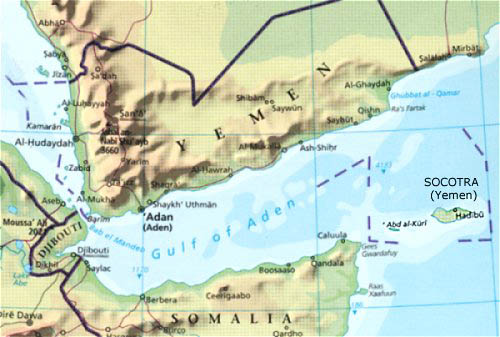 Fully aware of Socotra’s strategic advantages both regionally and internationally, the Pentagon has pursed inroads to link up with its bomber base in Diego Garcia, roughly 1,900 miles east. One need only glance at a map to observe Socotra’s strategic advantage, the way it caps Africa’s Horn and juts 200 miles into the Indian Ocean. Some analysts suspect that covert operations are already underway. The arrangement, whatever its current stage, would assert new control over the Bab-el-Mandeb choke-point; when combined with the Straight of Hormuz, these points outweigh China’s influence over the Strait of Malacca.
Beyond a regional drone and Special Forces base, militarization of Socotra and the wider Gulf of Aden aims America’s power projection eastward. al-Qaeda’s presence in Yemen and Somalia is protecting America’s spheres of influence in Africa and the Middle East, nudging China into Asia’s eastern half. Already buried under AQAP’s 300-500 fighters, 23 million Yemenis are being crushed by 1.3 billion (non-threatening) Chinese.
Socotra’s propaganda operation, if not a concrete base, is already in effect: heap anything on Yemen’s fire so that it burns blindingly bright. So bright that the nuclear pile is rendered practically invulnerable to external criticism. Terror threats are more common than political details and Washington’s plan, for the most part, is succeeding. The Obama administration has steamrolled Yemen’s revolutionaries without any real damage in U.S. public opinion, which remains low after nearly six months of protests and the Arab Spring's only assassination attempt. "Chaos," in turn, is rising thanks to an economic crisis and U.S.-Yemeni military operations against local militias in the south.
Meanwhile the U.S.-funded African Union mission in Somalia only recently lifted off the ground and requires decades to make a permanent recovery. Last month’s air-strike against an al-Shabab convoy also timed itself to John Brennan’s counter-terror declaration, during which he openly promised to bring U.S. Special Forces, CIA and war machines to Yemen and Somalia. The targets themselves remain nameless, but U.S. officials assured the public that they had “direct ties” to Anwar al-Alwaki, a leading cleric in Yemen’s al-Qaeda in the Arabian Peninsula (AQAP). Ahmed Abdulkadir Warsame, the Somali pirate who turned up in a New York Court, is now undergoing a similar branding.
Washington’s general scheme to link Yemen and Somalia operates on three levels: both are plotting attacks on the U.S. mainland, AQAP has link to al-Shabab through al-Awlaki, and a future Yemen could undergo “Somaliization.”
The first two claims are true to varying degrees. While al-Qaeda and al-Shabab officials have issued threats against the U.S. homeland, neither has produced a serious attempt to strike. al-Shabab remains a nationalist movement, relatively speaking, and faces internal resistance against turning transnational. al-Qaeda’s local leadership has been left to multiply al-Shabab’s force and concentrate on regional plots. AQAP and Somalia’s AQ cell have also voiced ideological and material support for one another, but these groups mostly operate independently of each other. The third claim undermines the first two through sheer falsity; the threat of al-Qaeda and civil war has been exploited to obstruct Yemen’s revolution.
Given the clandestine mechanisms at work, China itself is being overlooked through no coincidence. The U.S.-Chinese hegemony war isn’t strictly long-term in distance or time; Beijing is laying trade inroads with the Gulf Cooperation Council (GCC). Having bid its time in Yemen, China has protected Saleh from the threat of revolution by obstructing UN motions and backing the GCC’s biased power transfer, moves that fit into Libya and Syria’s wider pattern. The battle for Yemen's geopolitical value is very real and immediate.
Although America hasn’t learned many lessons from Yemen and Somalia’s local conflicts, al-Qaeda’s presence is being exploited to further U.S. counter-maneuvers against China. In both Yemen and Somalia’s case, U.S. Special Forces and drones will fail to accomplish the local goals of defeating al-Qaeda and stabilizing the host nation. These tactics will only produce lasting results within a full-spectrum political strategy that, so far, has failed to materialize. Instability on land will generate spillover in the form of piracy, necessitating naval operations that fail to stabilize the conflicts. They will, on the other hand, militarize Africa’s Horn over the next decade and possibly over the next century.
Joseph Stalin once remarked that nuclear weapons “are meant to frighten those with weak nerves,” and the same can be said of al-Qaeda. As the Obama administration's response to Yemen’s revolution conclusively demonstrates, Washington’s public fear of domestic terrorism doesn’t match its private willingness to exploit it internationally.
July 6, 2011
Bahrain's National Dialogue Accumulating Doubts
Update from Reuters:
Bahrain's opposition said on Wednesday the first session of a national dialogue for reforms in the Gulf island kingdom raised questions over whether talks aimed at easing tensions after unrest this year can succeed.
The country's Sunni rulers crushed mostly Shi'ite-led pro-democracy protests in March. After a four-month crackdown, Bahrain hopes to lay the groundwork to heal deep rifts.
But opposition groups said the first working session of the dialogue on Tuesday night left them concerned that their main demand -- a representative, directly elected government -- would never reach a consensus in break-out groups where some 60 people were allowed only five minutes to present their views.
"To reach a complete solution to the big problems, you have five minutes to speak? What is that?" asked Sayed al-Mousawi of the main Shi'ite opposition group Wefaq. "Is this dialogue?"
The organizers of the national dialogue have said sessions will continue over a two-week period and then convene again if consensus is not reached on specific issues.
Bahrain faced international pressure to begin reconciliation after the fierce crackdown in which hundreds of mostly Shi'ites were arrested in the tiny Gulf island state, a financial hub and host to the Fifth Fleet, the U.S. Navy's main regional outpost.
The dialogue has been widely praised by foreign governments as an opportunity for reform and reconciliation. But opposition groups mocked a system where participants were handed numbered placards and called upon to give their five-minute speech.
Four separate sub-groups are involved in the talks, discussing economic, political, social and legal reform issues.
In all, there are 300 participants in the dialogue and just 35 of them are from the opposition. Other representatives are from more pro-government political parties, as well as rights groups, companies and even educational organisations like the Bahrain Astronomical Society.
The government says the make-up guarantees well-rounded talks that represent the whole country. The opposition argues most other participants at the talks are government loyalists.
National Dialogue spokesman Isa Abdul Rahman said the talks were off to a positive start, and that opposition complaints of timing restrictions could be addressed.
"We have to maintain fairness, we can't give one party more time to speak than others. But this is something that could be changed if agreed upon between participants and facilitators," he said.
SECTARIANISM HIGH
Some participants at the Tuesday session said tensions were still high among a population recently embroiled in unrest that had taken on sectarian dimensions.
The government previously accused the Shi'ite-led protesters of a sectarian agenda backed by Shi'ite power Iran, just across Gulf waters. The opposition insists its aims are only democratic reform but most Sunni groups loyal to the state say they remain deeply suspicious that the opposition has loyalties to Iran.
Munira Fakhro of the leftist group Waad, Bahrain's second largest opposition party, said sectarianism had taken over the two most critical sessions, on legal and political reforms.
"In the legal session, there was a big dispute between them over Shi'ite and Sunni views on the laws," she said. "The political session had rising tensions, and they still have not raised the very difficult issues. They should."
The next session may be even more contentious. It will discuss reforming the upper house of parliament, a body directly appointed by the king which limits the elected chamber's powers.
Meanwhile, many in Shi'ite villages around the capital Manama are angry that the opposition has agreed to dialogue while hundreds of people are still in jail and dozens face military trial. Many have taken to daily protests demanding the opposition reject the national dialogue.
Around 500 people took part in a protest on Saturday, the day the dialogue was launched. Police fired teargas and rubber bullets and rights groups said several protesters were hurt.
"The street is already angry, really angry," said Sayed al-Mousawy of Wefaq, whose leadership fears losing street support over backing the talks. "For us it's not a comfortable situation."
July 5, 2011
Obama Playing Political Games With Iraq’s Withdrawal
As usual, transparency in U.S. foreign policy continues to be sacrificed for “national security interests.” These interests include, among other activities, drone operations in Yemen, where “secrecy” means isolating a revolution to keep the ruling regime in power. In Afghanistan, President Barack Obama left the timing of his withdrawal open to interpretation with the Pentagon, a position designed to put him on both sides of the aisle (where Obama feels most comfortable). By leaving the withdrawal’s specifics for a future review, the administration is hoping to mask its movements from the Taliban (an idealistic goal) while upping the Pentagon’s input for credibility purposes.
Limited details, though, aim for one overriding purpose: maintain America’s war in Afghanistan. Thus with reports surfacing of a White House offer to keep 10,000 troops in Iraq, Press Secretary Jay Carney naturally chose to respond through non-denial denial.
“Our plan is to fulfill our obligations with the agreement,” he told reporters on Tuesday, “the Status of Forces Agreement, with the Iraqi government, which requires us to withdraw all U.S. forces by the end of this year, this calendar year. We intend to keep that agreement; we are on track to do that. We have also said that we would consider a request by the Iraqi government for some sort of sustained presence by U.S. troops. That request has not been made. We are on track to withdraw all our forces down to zero by December 31st of this year.”
This dense, “one foot in, one foot out” position isn’t nearly as clever as it may appear. National security functions as a plausible argument on the surface, whether in Kabul or Baghdad, and U.S. officials are justifiably worried of provoking violence against the remaining 48,000 troops in Iraq. Mere speculation over their future has driven Iran and Shia cleric Muqtada al-Sadr to harden their posturing, and a certain extension of Iraq’s Status of Forces Agreement (SOFA) will produce certain violence against those U.S. troops left behind.
In general Washington seeks to keep its movements secret from Tehran for as long as possible, even when this isn’t possible.
However the political component of Obama’s policy in Iraq remains a key factor in his ultimate decision. Carney emphasizes that the President is on track to fulfill his promise and remove all troops in line with the SOFA. Although Obama hasn’t personally blinked in declaring all troops will withdrawal by December, allowing former Secretary of Defense Robert Gates to stump from a residual force gave many the impression that Obama spoke through Gates. And now, by hitching himself to Iraq’s SOFA instead of his own campaign promise, Obama has opened the loophole for upwards of 10,000 troops to remain as trainers, intelligence gatherers and emergency responders.
“I think that we are waiting -- awaiting to see whether or not the Iraqi government makes a request of us,” Carney tried to explain. “That has not happened. We are obviously now in July. We are drawing down to zero. We are on schedule to draw down to zero by December 31st, in keeping with our agreement with the Iraqi government. And we will continue doing that as planned. So there’s a certain amount of -- I mean, not sensitivity, but there’s only so much time here available for the Iraqi government to make such a request. If they do, we will consider it. Otherwise we are keeping on schedule.”
Time is running out, of course, because no single Iraqi party wants to take responsibility for editing the SOFA. Beyond breaking his promise to exit by 2011, Obama won’t risk his neck for a decision that Iraq’s politicians also fear making. While Prime Minister Nouri al-Maliki approves of a limited extension to the SOFA, he worries that al-Sadr’s coalition could threaten his position and open the door for rival Ayad Allawi, whose neutral Iraqiya List represents many Sunni constituents. al-Maliki has said that a decision must be reached by 70% consensus, a direct shot at the 20% held by al-Sadr within the National Iraqi Alliance.
That the fate of U.S. troops should be reached by political consensus and not al-Maliki’s personal interests is sound policy. However it also reveals the skepticism that many Iraqis associate with U.S. forces. Ali al-Shilah, a member of al-Maliki’s State of Law coalition, said, “All political groups should be making this decision, because we do not want to shoulder the responsibility alone for such a grave and sovereign issue. The situation is still complicated because all the political blocs are avoiding giving a final and clear decision on this.”
Creating more friction on the process, al-Maliki has reportedly demanded that the remaining U.S. troops stay on Iraqi bases, and that bulky combat trucks and armored personnel carriers would be off limits. Obama likely accords with the Prime Minister’s desire to conceal the residual force, however the Pentagon has reportedly balked at al-Maliki’s request. Iraq’s parliament is also unwilling to grant the immunity that Washington requests for U.S. troops.
In short, Iraq’s ongoing insecurity provides a basic but faulty excuse to justify a continued U.S. presence. This strategy makes a degree of sense within a training mission. Problematically, “combat missions” in Iraq have only ended in theory, and a continued U.S. presence will attract renewed attention from Shia and Sunni militias alike. Casting al-Sadr out of the political sphere is similarly reckless. Iraq’s decision to extend the SOFA will create political and military instability unless handled with perfect care, an unlikely outcome given war’s inherent unpredictability.
And if Senator Harry Reid’s warning means anything along the Democratic lines in Washington, Obama will be forced to confront Congress before Iraq’s parliament.
At this point a battle seems inevitable. While extending Iraq’s time-line would create disturbances in Afghanistan's, parts of the country do remain too unstable for its own security forces to adequately control. Even if Shia militias lose their impetus without a U.S. presence, al-Qaeda’s network will remain online and likely escalate its activity. The Pentagon is also bent on retaining a buffer around Iran. In a July 1 letter, Army Chief of Staff Gen. Martin E. Dempsey told U.S. forces in Baghdad’s governorate to expect to stay in Iraq “longer than they expected,” right up to December 31st. Obama has adhered to his time-line - and is fully prepared to “revise” it.
Carney eventually attempts to backtrack to no avail: “So we have said for a long time now if the Iraqi government asks us to maintain some level of troops beyond that end-of-the-year deadline, we would consider it. That doesn’t necessarily mean we would do it. We would just consider it.”
Yet who believes the Pentagon would pressure for an extension only to reject the offer? This contradiction demonstrates why non-denial denials, more often than silencing political controversy, highlight and amplify it. Fortunately the White House’s lack of transparency could increase the glare on Iraq, which has sunk to the bottom of America’s foreign policy debate.
Saudi Arabia Dominates Bahrain’s “National Dialogue”
From The Associated Press:
DUBAI, United Arab Emirates (AP) — Saudi Arabia doesn't have a seat at Bahrain's crisis talks, but it carries a critical voice in everything from the tone of debate to the eventual offers on the table.Additional reading from Bloomberg:
After four months of Shiite-led protests and harsh crackdowns, Saudi Arabia has become the protector, patron and political gatekeeper for Bahrain's Sunni monarchy in the Gulf leadership's front-line fight against the Arab Spring.
How Bahrain's rulers approach the talks — whose first official session is scheduled for Tuesday — largely depends on how far Saudi Arabia is willing to allow concessions on its tiny Gulf neighbor. For the powerful Saudi royal family and its Gulf partners, Bahrain represents a line that cannot be crossed.
Any setbacks by Bahrain's 200-year-old ruling Al Khalifa dynasty is considered a threat to all monarchs and sheiks in the Gulf — and a possible opening for Shiite power Iran to make headway among the pro-Western Gulf states anchored by Saudi Arabia.
"Bahrain is crucial to Saudi national interest and Riyadh will provide it with all they have to show they are committed to preserving the rule of the Khalifas," said Ayham Kamel, a Middle East analyst at the Eurasia Group in Washington.
Bahrain's Shiites account for about 70 percent of the kingdom's population, but claim they are the target of systematic discrimination including being effectively blocked from top military and political posts. Their protests in February — inspired by wider Arab uprisings — have been by far the biggest challenge to any Gulf ruler in decades.
Saudi King Abdullah deployed about 1,000 troops to lead a Gulf military force to reinforce Bahrain's monarchy, which launched widespread arrests and martial law-style rule to smother the protests for greater rights. At least 32 people have been killed in the unrest in the strategic nation, which is home of the U.S. Navy's 5th Fleet.
The Saudi king also sent millions of dollars to pull the tiny neighbor's royals from the brink of bankruptcy and even married off one of his sons to a daughter of the Bahraini monarch.
"It's a powerful act, the royal wedding," said Rima Sabban, a Dubai-based sociologist. "It has nothing to do with love or passion. A marriage like that is strictly political."
Iran has relentlessly assailed Bahrain's rulers for crackdowns against the country's Shiite majority and called the Saudi-led Gulf force an "occupation" army.
There is no strong evidence of any Iranian links to Shiite political groups in Bahrain, however. Opposition leaders repeatedly denied Iran had any role in the uprising and demanded that the Saudi-led force leaves the kingdom before any talks begin.
"The presence of foreign troops is part of Bahrain's problem, not the solution," said Ali Salman, the leader of Bahrain's largest Shiite opposition party, Al Wefaq.
Al Wefaq reluctantly joined the government-designed reconciliation talks while hundreds of protesters are on trial for anti-state crimes and in jail, including eight prominent activists, serving life sentences for their role in protests.
Ahead of U.S.-supported dialogue, that opened with a ceremonial session on Saturday, the government has made some token concessions, including sanctioning an international investigation that will include probes into the conduct of security forces during the revolt and halting trials of opposition supporters in a military-linked tribunal that has sentenced two protesters to death.
But the government has not relented on opposition demands to free all detainees and clear others convicted of protest-linked charges, all harshly criticized by international rights groups and Bahrain's Western allies, including the United States.
"It's more to defuse criticism of the West than to make concessions to the opposition parties, like Al Wefaq, they already feel they have defeated," said Marina Ottoway, director of the Middle East Program at the Carnegie Endowment for International Peace.
There are Saudi fingerprints all over Bahrain's so-called National Dialogue, Ottoway said.
"Saudi Arabia wants dialogue since confrontation is not the Saudi way of dealing with things," she said, adding that Riyadh is fully behind the reconciliation talks as long as they don't turn into "negotiations between the monarchy and the people."
For now, Shiite leaders appear willing to give the rulers one last chance, if only to deprive them of blaming the talks' failure on the opposition's decision to boycott dialogue.
"Our demands are clear," Salman said. "For any talks to be successful, people who ask for democracy, should be released from prison and people who ask to be free should get a chance to elect their government."
Bahraini state television, promoting a “national dialogue” after unrest, shows two girls playing and then squabbling, smiles replaced by scowls. Then the smiles return, accompanied by a caption: “Like any family, we have our differences, but we love each other.”
Many of the 300 attending are pro-government loyalists, while the biggest Shiite party, al-Wefaq, has five seats.
July 4, 2011
Duty of a Citizen: Question Authority
Haunted by the word “withdrawal,” John McCain decided to take action by organizing his own mini-surge in Afghanistan. The Senator landed in Kabul to commemorate July 4th with his hawkish comrades, Senators Lindsey Graham and Joe Lieberman, and quickly fanned out to assail President Obama’s withdrawal plan. Although the exact details and timing remain unknown to the public, Obama has expressed his intent to withdraw 10,000 U.S. troops by December and the rest “by next summer.”
Engaging in open propaganda, Graham countered, “What I’m mostly concerned about is that the accelerated withdrawal of surge forces has created a perception that we’re leaving. Withdrawal is what the enemy hopes to hear. And our goal is to make sure the enemy doesn’t hear withdrawal and the Afghan people do not hear withdrawal.”
"I believe that the planned drawdown is an unnecessary risk,” McCain added, “and that is why there is no military leader that recommended it.”
Politically savvy as he is, General David Petraeus didn’t enjoy being thrown into Washington’s ring against his will. Some responsibility is attributed to himself and Michael Mullen, outgoing Chairman of the Joint Chiefs of Staff (CJCS), who testified to Congress that Obama’s withdrawal exceeded their personal level of risk. Speculation that Obama’s withdrawal didn’t fit within Petraeus’s recommendations hasn’t been put to rest (and may never be).
Speaking to a press gaggle on his eve of his departure to the CIA, Petraeus pushed through Afghanistan’s haze by telling reporters, "I think it's probably time to stop second-guessing the decision that only the president can make. Only he has the full range of issues, considerations that he has to deal with. That decision has been made... It is our job to get on with it and do the absolute best we can."
Petraeus’s supporters will undoubtedly hail the “go getter” attitude that fueled his rise to the Pentagon’s summit. One of the general’s favorite cards, Petraeus played “the mission” when Obama squeezed the force level of his surge and their accompanying withdrawal time-line. Washington pundits hailed his leadership. Petraeus then testified to Congress after Obama’s “Way Forward in Afghanistan,” that his job is to complete the mission at all costs, winning him new praise. Indeed, the resolve to overcome impossible tasks forms the core of all successful generals.
However generals and soldiers shouldn’t follow orders blindly either.
Petraeus is correct in his personal belief to direct the war to his fullest abilities, whether he favors or opposes Obama’s withdrawal plan. For him to second-guess Obama, rather than move on and devise a strategy to enable his decision, is a relative waste of time. War is especially harsh to the undecided and a political fight cannot be realistically expected in favor of withdrawal. Petraeus should resign from the CIA if he disagrees with Obama’s decision to go lighter, as his job will now focus extensively on moving Afghanistan’s strategy “offshore.”
Congress, the media and Americans, on the other hand, are under no obligation to stop debating the war’s strategy and objectives, or Obama's military acumen. To his supporters Petraeus is fighting to spread democracy. To his opponents he’s eroding a national duty to hold the government accountable. "Patriotism" mixed with totalitarianism.
McCain, Graham and Lieberman aren’t Obama’s leading second-guessers either; Lieberman remarked that their differences were “consequential” but “not great.” The Senators would have liked Obama to half his immediate withdrawal of 10,000 by December and extend the next round of redeployments from pre-summer to post-summer. Their major disagreement occurs in the east, where Petraeus requested a robust force to break up the Haqqani network. Now he must chance a small number of ground troops and inject the main surge with U.S. Special Forces and intelligence - meaning more night-raids and air-strikes without a corresponding level of local contact.
The Senators believe the Taliban will eventually crack and concede their leverage in negotiations with Kabul and Washington. This outcome is unlikely though, as eastern Afghanistan is particularly isolated and inhospitable to coalition forces. A year-long air raid over the border isn’t likely to push the war to an endgame, and all 68,000 U.S. troops will be needed to maintain pressure on the Taliban through 2013. An increase in Afghan forces could be negated by the withdrawal of NATO units. More U.S. troops could begin to redeploy in 2014, but a residual force will likely remain in the country past 2016, possibly to 2020. Thus Afghanistan’s death toll will continue to ring throughout the decade.
The Senators’ differences aren’t so great as, say, bringing the war to a full stop. Key Democratic lawmakers wanted Obama’s entire surge out by 2012, paving the way for an escalated “offshore” campaign backed by 20,000-30,000 troops. Yet even this plan will grind away on daily life in Afghanistan. Many Americans, Europeans, Afghans and Pakistanis don’t believe in the war’s objectives at all, and they won’t stop “second-guessing” a conflict that began on questionable grounds and continues down an immoral path.
Just as Petraeus has his duties, so too do the American people.
AU Calls Out America’s Double-Standard
 It’s too early to make any definitive judgements on the latest developments in Libya. Nevertheless, the revolutionaries appear to have conceded the African Union’s (AU) position on Muammar Gaddafi after reversing their public stance. While Libya’s National Transitional Council (NTC) has stood by its demand to remove Gaddafi from Libya, the organization is under Western and AU pressure to extract Gaddafi through “face-saving measures.” The AU’s weekend summit produced a favorable consensus on Gaddafi, denouncing the International Criminal Court’s (ICC) warrant and including him in Libya’s ceasefire negotiations.
Left with little choice except to soften his line, NTC chief Mustafa Abdel Jalil told reporters on Sunday that Gaddafi could remain in Libya under "international supervision” while negotiations began. For their part the revolutionaries seem to have listened to international advice. Now the West - America in particular - should listen up.
"We support the fight against impunity, we do not support impunity, we are not even against the Criminal Court," explained Jean Ping, AU Commission chairperson. "We are against the way justice is being rendered because... it looks as if this ICC is only interested in trying the Africans.”
Obviously this isn’t first complaint against Western imperialism and double-standards. Although we support the Libyan revolutionaries in their struggle against Gaddafi, the AU’s overall response is a legitimate warning against imbalanced and hypocritical international law. The law of the strong, meanwhile, continues to stand the test of time. Ping added, "It is not only in Africa that there are problems. So why no one else except the Africans are being tried and judged by this court?"
“Does this mean that in Pakistan, Afghanistan, Gaza, in Chechnya, there is nothing happening there?”
Having accused Western governments of holding a double-standard to their own war machines, U.S. policymakers and the public will likely ignore the AU’s complaints. Gaddafi’s 40-year rule and the slaughter of his finale don’t compare to the abuses committed by U.S. troops in Afghanistan or Iraq. Israel’s siege of Gaza will be justified. Drones are within the rule of international law - and maybe they are. Except they also demonstrate the political and moral recklessness of escalating military operations in fragile nations such as Yemen.
Similarly, Ali Abdullah Saleh faces no real threat from the international community. While Gaddafi runs from NATO warplanes, America and the EU have illegitimately granted Yemen’s battered president immunity for his entire family. The key motive: Washington is protecting Saleh from human rights abuses potentially committed with U.S. arms. Meanwhile his regime is being preserved at the cost of Yemen’s revolution.
AU countries see the difference between American’s response to Libya and Yemen, to Syria and Bahrain. They easily perceive the favoritism at Washington’s unilateral level and the Western community at large. They watch drones fly over Yemen’s revolutionaries as they protest U.S. interference, and monitor Saudi troops backing Bahraini security forces in their crackdown. The AU isn’t the only political actor believing a Western double-standard exists between its own behavior and developing states, whether political, military, economic or environmental.
Many developing countries and their peoples believe this to be true. So do a substantial number of Americans and Europeans.
Drones are now starting to resemble butterflies. Clearly their effects are being felt internationally, and this pattern is bound to intensify under Washington’s “new” counter-terrorism strategy. In reality this plan is nothing extraordinary and built on years of preparation; “new” means drones and enhanced intelligence gathering/sharing. Automated warfare is arriving on an expanding scale, at a time when the Obama administration needed a deceptively easy equation. Due to economic shortfalls and popular pressure to reign in foreign spending, the administration scaled back conventional ground forces while increasing unconventional forces: U.S. Special Forces and the CIA.
These forces are exponentially cheaper and pack an immediate delivery to hype at the public level. They satisfy the Democratic thirst to reign in military spending and the Republican desire for military escalation. The U.S. media suppresses public debate to a minimal level, and Americans are sacrificed in full knowledge that the average understanding of Yemen or Somalia runs low. The ultimate drawback of this seemingly invincible strategy is a high chance of failure within the conflicts themselves (particularly Yemen, which will be updated tomorrow). However the Obama administration’s response to the Arab Spring and its “post-Arab Spring” CT strategy will also collide within various interpretations of international law.
So far the Nobel Prize winner hasn’t run out of rhetoric to whitewash his hypocrisy, but his international audience continues to head for the exits.
July 3, 2011
Al-Sadr Dares Obama To Stay In Iraq
Denial is the first sign of a problem, at least according to one psychological theory, and President Barack Obama has demonstrated an unabashed eagerness to prove it. During a briefing for his “Way Forward in Afghanistan,” one senior administration official was asked if negative public opinion played a role in determining the level of America's withdrawal. The official acknowledged financial troubles at home before denying that polls had influenced Obama’s decision.
The President would go on to argue that America is withdrawing from a position of strength, then spent the second half of his speech touting “nation-building at home.” A variety exit polls believed his decision, right or wrong, was politically calculated for the 2012 presidential election.
Now that Iraq is forcing itself back into the U.S. media cycle by speaking its language - American bloodshed - another tactic isn’t compatible with the rest of Afghanistan and Iraq’s comparison. Baghdad is supposedly due to rule on an extension its Status of Forces Agreement (SOFA) before August, leaving July primed by all sides for a showdown over U.S. troop levels. For two years former Secretary of Defense Robert Gates threw his weight behind an extension, including one final push before his exit. While Obama ignored these calls right up to Gates’s ceremonial dismissal, promising to withdraw all forces by December, Ambassador James F. Jeffrey formally told reporters the Obama administration “would consider a request to keep some of the roughly 46,000 U.S. troops.”
For these reasons and more, attacks have increased against the present force to their highest level in two years. The U.S. media has since profiled the cause after three more casualties raised June’s toll to 14: Hezbollah Brigades and two branches of Muqtada al-Sadr’s Mahdi Army. All three are funded by Iran’s Republican Guard. However the Mahdi Army has interwoven its movements through the Promised Day Brigade and Asaib Ahl al-Haq (League of Righteousness). The former serves as al-Sadr’s personal arm and accepts only nominal funding from Iran to maintain a nationalist orientation. Some Sadirst officials also claim the majority of the Mahdi army isn’t looking to fight, and that the Promised Day Brigade represents its hardened core.
Asaib Ahl al-Haq, the weakest of the three, has splintered off and funds itself solely through Iran’s Quds Force. Commanded by Qais al-Khazili, a former Sadr spokesman who was expelled in 2004, the League serves under the U.S.-designated “Special Groups,” a coalition of Shia militias brought online by Iran after the U.S. invasion. One Sadrist MP said of the group’s dynamic, "We have some leaders inside Sadr's offices and among Mehdi Army troops who follow Sadr publicly but they receive orders from Asaib.”
As he has done so frequently in the past, Gates singled out Iran one last time for funding its proxies in Iraq. True as his warning is in a vacuum, Iran’s response to America’s long-term presence in the region serves as an overt excuse to stay put. Beyond their propaganda campaign to “drive America out,” constant U.S. pressure on Prime Minister Nouri al-Maliki is fueling Iran and al-Sadr’s operations. Jeffrey claimed that rising violence is "not going to have an impact on us leaving or staying,” when this too can be inferred in the opposite; Shia militias are being openly exploited to justify the SOFA's extension.
Countering this impression as well, Jeffrey argued, “If we weren’t around, they’d go after somebody else. We’re target number one right now, but they’ll find other targets. This is a problem that Iraq has to deal with.”
While Hezbollah Brigades represents its own challenge, who would the Madhi army target without besides U.S. troops? Sunni militias, corrupt police and military units remain a possibility, except these are largely preexisting problems. The Mahdi army needs a reason to disintegrate or a mechanism to demilitarize into Iraq’s army. Frontal assaults are a relatively pointless display of strength, and U.S. officials claim that all Iranian-backed militias operate under cell-based secrecy. A major operation in Maysan, a border province led by al-Sadr’s choice of governor, is only intended to run interference and clean up the Iranian border.
2008’s battle in Basra merely brought Iraq's situation to its current point.
However Washington isn’t ultimately concerned with destroying the Mahdi Army, only managing it to justify a long-term military presence in Iraq. Jeffrey told reporters on Saturday, “Of particular concern, at least to me, is the Sadrist movement. The AAH (Asaib al-Haq) and the Kata’ib Hizballah are basically nothing more than thuggish clones of their IRGC Qods force masters.” This policy requires a reduction in al-Sadr’s amassing political power, and here the Pentagon’s goals converge with al-Maliki’s. Of equal consequence to his military activity, al-Sadr’s organization recently motioned 10 of 18 provincial councils to excluded U.S. forces from cities and government buildings. Basra's council was one of several to approve this resolution.
The reality is that limiting al-Sadr’s political and military capacity borders on an impossible task, one that trends towards confrontation over stability. al-Sadr didn’t seize power - millions of supporters voted for his bloc. Targeting his militia may provoke a response that Washington can capitalize on politically, but this strategy is useless in drying up popular support. Any isolation from outside the Shia ranks will be negated by al-Sadr’s rallying base, and other Iraqis are liable to reject the continued presence of U.S. troops.
Though an effective tactic inside Washington, efforts to scapegoat America's own problems and Iraq’s chronic struggles, including al-Maliki’s deficiencies, will fail to bear plentiful fruit in Iraq. The Prime Minister began his new term on shaky ground and has backed out of a foreign policy council due to be chaired by Ayad Allawi, his main challenger in 2010’s parliamentary election. Himself a Shia, Allawi was locked out of al-Maliki and al-Sadr’s own Shia bloc after eight months of political maneuvering, even though his Iraqiyya list had secured the highest number of individual seats. With Allawi and his Sunni constituents remaining marginalized and the Kurds consumed by their own interests, Maliki isn’t well positioned to challenge al-Sadr on the future of U.S. troops
Extending the SOFA remains a possibility, of course, but the collapse of al-Maliki's coalition would throw Iraq into new disorder.
Iraq is both a first and last line of defense against U.S. opinion in Afghanistan. Extend Iraq’s deadline and many Americans will question the authenticity of Afghanistan’s time-table, already an ambiguous concept. Though Obama pairs his “responsible ends” in the same sentence, Afghanistan lags far behind Iraq’s security forces, economic development and civil structure. The Taliban pose a greater opponent than Iraq’s patchwork insurgency and reconciliation will prove more complicated than Iraq’s political dynamics. So to slide on Iraq is to directly push Afghanistan’s time-line beyond 2015.
al-Sadr is politically savvy enough to understand this situation on top of Iraq’s internal dilemma. He knows that, contrary to U.S. claims, Obama cares a great deal about public opinion and cannot afford to stay in Iraq. If the White House intends to challenge al-Sadr directly, it must carefully weigh his combined political and military strength. America can obviously marshal international forces beyond al-Sadr’s scope, but his local weight is great enough to asymmetrically counter Washington’s.
And ties usually goes to the guerrilla.
The President would go on to argue that America is withdrawing from a position of strength, then spent the second half of his speech touting “nation-building at home.” A variety exit polls believed his decision, right or wrong, was politically calculated for the 2012 presidential election.
Now that Iraq is forcing itself back into the U.S. media cycle by speaking its language - American bloodshed - another tactic isn’t compatible with the rest of Afghanistan and Iraq’s comparison. Baghdad is supposedly due to rule on an extension its Status of Forces Agreement (SOFA) before August, leaving July primed by all sides for a showdown over U.S. troop levels. For two years former Secretary of Defense Robert Gates threw his weight behind an extension, including one final push before his exit. While Obama ignored these calls right up to Gates’s ceremonial dismissal, promising to withdraw all forces by December, Ambassador James F. Jeffrey formally told reporters the Obama administration “would consider a request to keep some of the roughly 46,000 U.S. troops.”
For these reasons and more, attacks have increased against the present force to their highest level in two years. The U.S. media has since profiled the cause after three more casualties raised June’s toll to 14: Hezbollah Brigades and two branches of Muqtada al-Sadr’s Mahdi Army. All three are funded by Iran’s Republican Guard. However the Mahdi Army has interwoven its movements through the Promised Day Brigade and Asaib Ahl al-Haq (League of Righteousness). The former serves as al-Sadr’s personal arm and accepts only nominal funding from Iran to maintain a nationalist orientation. Some Sadirst officials also claim the majority of the Mahdi army isn’t looking to fight, and that the Promised Day Brigade represents its hardened core.
Asaib Ahl al-Haq, the weakest of the three, has splintered off and funds itself solely through Iran’s Quds Force. Commanded by Qais al-Khazili, a former Sadr spokesman who was expelled in 2004, the League serves under the U.S.-designated “Special Groups,” a coalition of Shia militias brought online by Iran after the U.S. invasion. One Sadrist MP said of the group’s dynamic, "We have some leaders inside Sadr's offices and among Mehdi Army troops who follow Sadr publicly but they receive orders from Asaib.”
As he has done so frequently in the past, Gates singled out Iran one last time for funding its proxies in Iraq. True as his warning is in a vacuum, Iran’s response to America’s long-term presence in the region serves as an overt excuse to stay put. Beyond their propaganda campaign to “drive America out,” constant U.S. pressure on Prime Minister Nouri al-Maliki is fueling Iran and al-Sadr’s operations. Jeffrey claimed that rising violence is "not going to have an impact on us leaving or staying,” when this too can be inferred in the opposite; Shia militias are being openly exploited to justify the SOFA's extension.
Countering this impression as well, Jeffrey argued, “If we weren’t around, they’d go after somebody else. We’re target number one right now, but they’ll find other targets. This is a problem that Iraq has to deal with.”
While Hezbollah Brigades represents its own challenge, who would the Madhi army target without besides U.S. troops? Sunni militias, corrupt police and military units remain a possibility, except these are largely preexisting problems. The Mahdi army needs a reason to disintegrate or a mechanism to demilitarize into Iraq’s army. Frontal assaults are a relatively pointless display of strength, and U.S. officials claim that all Iranian-backed militias operate under cell-based secrecy. A major operation in Maysan, a border province led by al-Sadr’s choice of governor, is only intended to run interference and clean up the Iranian border.
2008’s battle in Basra merely brought Iraq's situation to its current point.
However Washington isn’t ultimately concerned with destroying the Mahdi Army, only managing it to justify a long-term military presence in Iraq. Jeffrey told reporters on Saturday, “Of particular concern, at least to me, is the Sadrist movement. The AAH (Asaib al-Haq) and the Kata’ib Hizballah are basically nothing more than thuggish clones of their IRGC Qods force masters.” This policy requires a reduction in al-Sadr’s amassing political power, and here the Pentagon’s goals converge with al-Maliki’s. Of equal consequence to his military activity, al-Sadr’s organization recently motioned 10 of 18 provincial councils to excluded U.S. forces from cities and government buildings. Basra's council was one of several to approve this resolution.
The reality is that limiting al-Sadr’s political and military capacity borders on an impossible task, one that trends towards confrontation over stability. al-Sadr didn’t seize power - millions of supporters voted for his bloc. Targeting his militia may provoke a response that Washington can capitalize on politically, but this strategy is useless in drying up popular support. Any isolation from outside the Shia ranks will be negated by al-Sadr’s rallying base, and other Iraqis are liable to reject the continued presence of U.S. troops.
Though an effective tactic inside Washington, efforts to scapegoat America's own problems and Iraq’s chronic struggles, including al-Maliki’s deficiencies, will fail to bear plentiful fruit in Iraq. The Prime Minister began his new term on shaky ground and has backed out of a foreign policy council due to be chaired by Ayad Allawi, his main challenger in 2010’s parliamentary election. Himself a Shia, Allawi was locked out of al-Maliki and al-Sadr’s own Shia bloc after eight months of political maneuvering, even though his Iraqiyya list had secured the highest number of individual seats. With Allawi and his Sunni constituents remaining marginalized and the Kurds consumed by their own interests, Maliki isn’t well positioned to challenge al-Sadr on the future of U.S. troops
Extending the SOFA remains a possibility, of course, but the collapse of al-Maliki's coalition would throw Iraq into new disorder.
Iraq is both a first and last line of defense against U.S. opinion in Afghanistan. Extend Iraq’s deadline and many Americans will question the authenticity of Afghanistan’s time-table, already an ambiguous concept. Though Obama pairs his “responsible ends” in the same sentence, Afghanistan lags far behind Iraq’s security forces, economic development and civil structure. The Taliban pose a greater opponent than Iraq’s patchwork insurgency and reconciliation will prove more complicated than Iraq’s political dynamics. So to slide on Iraq is to directly push Afghanistan’s time-line beyond 2015.
al-Sadr is politically savvy enough to understand this situation on top of Iraq’s internal dilemma. He knows that, contrary to U.S. claims, Obama cares a great deal about public opinion and cannot afford to stay in Iraq. If the White House intends to challenge al-Sadr directly, it must carefully weigh his combined political and military strength. America can obviously marshal international forces beyond al-Sadr’s scope, but his local weight is great enough to asymmetrically counter Washington’s.
And ties usually goes to the guerrilla.
July 2, 2011
Arab Spring Exposes Hypocrisy of July 4th
The White House is in full campaign mode.
Not for 2012’s presidential election. The “peaceful and orderly transition” campaign against the Arab Spring and for expanding U.S. counter-terror (CT) operations has a new buzzword: “values.” President Barack Obama confidently told the Muslim world that America’s “singular role” is based on “the principles upon which our union was founded.” Freedom and prosperity at home, he says, is protected by “extending it to others.” A week later his counter-terror chief, John Brennan, justified expanding U.S. drones to Yemen and Somalia by “upholding the core values that define us as Americans.”
“This year, we have been reminded again that these are not just American values, they are truly universal values,” Secretary of State Hillary Clinton remarked on Saturday to commemorate America's Independence. “And as people across North Africa, the Middle East and around the world risk their lives to claim these universal human rights and freedoms, Americans are proud to stand with them. We are united by our common hopes and aspirations for a better world.”
The Obama administration will celebrate July 4th abroad by suppressing Muslim revolutions - the spirit of democracy - and replacing fireworks with teargas canisters, bullets and Hellfires.
Today the White House hailed America’s values as Bahraini security forces continued their five-month crackdown on pro-democracy protesters. In a speech televised late on Friday, King Hamad Ibn Isa al-Khalifa assured protesters that the looming National Dialogue would include all parties of the opposition. When Al Wifaq, Bahrain’s largest party, decided at the final moment to participate in order to reaffirm its own demands, the White House and State Department pounced on the meeting as a definite sign of progress. That the government’s impending attack on resistant protesters would have altered their script is doubtful.
“President Obama welcomes the launch of the National Dialogue in Bahrain, which represents an important moment of promise for the people of Bahrain,” read Saturday's statement. “The United States commends King Hamad bin Isa al-Khalifa for his leadership in initiating the dialogue. We also commend the decision by Al Wifaq, Bahrain's largest opposition group, to join the dialogue. We urge all Bahrainis to seize this opportunity to forge a more just future together. It is important that government and political leaders create a positive atmosphere to help promote a successful dialogue process.”
His administration (and many governments, for that matter) is fond of making absolute claims without a basis in reality. “The National Dialogue is an important moment of promise,” and “the Government of Bahrain is taking concrete steps which could contribute to national unity and stability.” As if these were established facts.
The National Dialogue proceeded to unfold in the farce that many protesters expected. None of the ruling al-Khalifa family materialized to meet with “300 oppositional members,” which ultimately turned out to be 35, and a regal ceremony attempted to delegitimize their movement. These figures also appear to have met only as a show of propaganda - to prove the government isn’t serious and only bowed to U.S. and Saudi pressure. Sheikh Ali Salman, al-Wifaq's leader, told a Friday rally in Diraz, “No one cares for us, no one is listening to us. We will go to the dialogue, but if the dialogue does not deliver what the people need, we will withdraw.”
The next day Al Wefaq’s delegates blasted the “dialogue.”
"It started as a monologue," said Bushra al-Hindi, one of the delegates. "The agenda has been previously set by the government in order to exclude talks about critical issues, such as moving along with a process that will reshape the country into a constitutional monarchy."
On the outside looking in, protesters took to the streets to denounce the government’s dialogue as insincere. Western press has labeled them hard-liners, however they are no different than the millions of revolutionaries now immune to “negotiations.” Many protesters said that al-Wafiq didn’t represent their cause, a sentiment shared between Yemen’s revolutionaries and the opposition Joint Meeting Parties (JMP). The dialogue of death is fully alive in Bahrain as its youth chant “dialogue is suicide.”
Meanwhile riot police continue to disperse protesters calling for self-determination. Political prisoners have yet to be released and fear permeates the air. Hailed as a turning point in Bahrain’s “crisis,” Saturday’s National Dialogue is more likely to escalate the uprising and reinforce its demands. U.S. statements have been rendered completely delusional. Even the administration's wires are mixed up; Bahrain’s statements cannot be found on its own Embassy site but instead on Yemen’s, where another revolution is struggling to overcome U.S.-Saudi hegemony.
The White House claims that, “as a long-standing partner of Bahrain, the United States continues to believe that Bahrain's stability will be enhanced by respecting the universal rights of the people of Bahrain.” Unfortunately U.S. policy in Bahrain makes little sense beyond Riyadh, Tehran and the 5th Fleet. The same goes for Yemen, Syria and Egypt, where “dialogue” and “values” are codewords for Israel, Saudi Arabia and al-Qaeda.
America isn’t living by its civil values during the Arab Spring, but dying from single-minded militarism.
Freedom Flotilla II: New Beginning, Same End
After a series of military blunders isolated Israel to its weakest point in decades, its second attempt to stop a Gaza-bound flotilla appears to be proceeding better than the last. Wielding a fortified combination of political, legal and unconventional warfare, Prime Minister Benjamin Netanyahu has indefinitely stalled the 10-ship armada in Athens and reduced its vessels by two without firing a shot. Israeli policymakers must be cautiously pleased with their results, an improvement upon the bloody Freedom Flotilla raid that left nine activists dead and dozens injured.
"I wish to thank the many world leaders who expressed themselves and acted against this provocation flotilla, including the US, Europe, the UN secretary general and the prime minister of Greece,” Netanyahu said at a graduating ceremony for Israel Air Force pilots. “Hamas is a cruel enemy who maliciously harms our people and children and holds Gilad Shalit captive against all humane standards.”
Privately embarrassed by a disastrous boarding of the Turkish MV Mavi Marmara, IDF officials wasted no time drawing up plans for the next flotilla. Initial measures have succeeded in pushing the battle away from Israel's coast while still keeping out of international waters. Yet the apparent success of political pressure, commandos and the straw man of Hamas’s arms smuggling is headed towards a familiar outcome. While Israel is clearly trying to rip the pariah label off of its back, crippling the second Freedom Flotilla will amount to another Pyrrhic victory. Coupled with a lack of effort during negotiations with the Palestinians, tyrannizing international activists has merely reaffirmed Israel’s obstruction on the world stage.
Israeli officials have generally avoided responsibility through non-denial denial. Netanyahu himself, when he isn’t busy praising Western governments for their cooperation, vowed to stop the flotilla at all costs. However his spokesman, Mark Regev, argued, “There are those who routinely blame Israel for every calamity, and of course they’re not always right.” Because so many other governments have the agenda and politico-military capabilities to maintain Gaza’s blockade. Foreign Ministry spokesman Yigal Palmor chose a similar but unique response to belittle Israel’s foes.
“They think they live in a James Bond movie,” he told reporters. “They should come out of the film world and start getting real... This is not Hollywood, and Israel is not the bad guy. We are not surprised that the rule they live by is that if anything goes wrong, accuse Israel. This was an Israeli-bash fest since day one, and that it continues that way does not surprise anyone.”
No, Israeli agents have never killed a Hamas leader by helicopter, poisoned another in the ear or stolen foreign identities to raid a Dubai hotel. Palmor is right - movies were modeled after real clandestine operations, not the other way around.
Israel’s systematic hounding of the international flotilla has demilitarized a page out of Operation Wrath of God. To international activists the episode must be feeling like a miniature Odyssey, an obstacle course of political, legal, naval and information hazards. After a “seaworthy” complaint was lodged by an Israeli front group against the U.S.-organized Audacity of Hope, the Swedish-Greek-Norwegian Giuliano discovered that its propeller and engine had been sabotaged from underwater. The Irish MV Saoirse was sabotaged in identical fashion in Göcek, Turkey, forcing activists to drop all pretense of Israel’s innocence. Suspicious fisherman have shown up in the wrong places and some activists were reportedly robbed.
In the meantime Israel’s government has launched a blistering (but largely unsuccessful) propaganda campaign to degrade the flotilla’s credibility: trained by Hamas fundraiser Amin Abu Rashid, its ships are carrying arms for Hamas and chemical weapons for IDF soldiers - and won’t let homosexuals on board. At the highest level, Israel and its Western arms have squeezed a cash-strapped Greek government to keep the flotilla in port.
Israel’s infiltration of Piraeus led many activists to believe that, until the flotilla can be formed and launched immediately, a safer position lies at sea. The Audacity of Hope tested this logic on Friday and was met with the full extension of Israel’s reach. Jane Hirschmann, one of the American group's organizers, told of how a Greek vessel first appeared and ordered them to return to Athens. Their reason: “it would be safer there.” When the captain refused on the grounds that the port was more dangerous, “a second coast guard ship came by with six armed commandos who wore masks and pointed guns at our passengers and said they had to turn around so the captain thought for the safety of the passengers they must return."
Some Israeli and U.S. commentators have already declared this feat a victory.
While their tactics will win admiration inside their camp, supporters have dwindled over the last five years to 2011’s low-point. To those on the right side of the Arab Spring, Israel and America’s thuggish tactics and political coercion represent the state oppression under revolt in the Middle East and Africa. Rigging boats to destroy themselves and the evidence along with it, mysterious plain-clothed “civilians,” financial extortion, smear campaigns - these methods won’t regain broad international support in time for UN meetings in September. Nor will a growing portion of the U.S. public enjoy being dragged into another of Israel’s schemes, which is exactly why U.S. organizers are targeting their homeland.
White House and State Department officials have joined in on Israel's denial, saying only that “these flotillas are a bad idea, and there’s other ways to get this kind of assistance to the people of Gaza.” Hirschmann countered by telling reporters, "The people in Gaza are not free so what we’re hoping is that the public around the world will see what’s happening, that the US and Israeli government have outsourced the occupation and dragged Greece into enforcing it."
The Freedom Flotilla II has nothing to do with immediate aid or weapons smuggling. Some of the boats, such as The Audacity of Hope, claim that letters are their only cargo. The Freedom Flotilla explicitly stated in a June 18th press release, “Our goal is to lift the illegal siege, completely and permanently and freedom for the Palestinian people.” Its objective is to shine a ray of light into Gaza, to breach the fear barrier as well as the physical barrier, and to do so under maximum international exposure. Israel is so obsessed with Hamas that it hasn’t fully utilized its only sustainable weapon against the group: a sincere effort to reach an equitable two-state solution with the Palestinians.
Instead Netanyahu wiped out all traces of goodwill after President Barack Obama attempted to reconnect with the Muslim world (the timing and rhetoric of Obama's "Moment of Opportunity" were admittedly naive). Since the two assumed office at the hip, Netanyahu has demanded much while ceding and explaining little to the Palestinians. He would be lucky if 20% trusted him to negotiate in good faith. Now he claims that future vessels are Israel’s primary concern, a legitimate argument rendered hollow by the sheer inhumanity of Gaza’s blockade.
"If there were no humanitarian crisis, if there weren't a crisis in almost every aspect of live in Gaza there would be no need for the flotilla,” said Chris Gunness, spokesman for United Nations Relief and Works Agency for Palestine Refugees (UNRWA). "If there were no blockade, there'd be no need for the flotilla. 95 percent of all water in Gaza is undrinkable, 40 percent of all disease is water-borne... 45.2 percent of the labor force is unemployed, 80 percent aid dependency, a tripling of the abject poor since the start of the blockade. Let's get rid of this blockade and there would be no need for a flotilla."
How far would negotiations progress with the Palestinians if Netanyahu expended the same energy as when plotting designs to thwart international activists? What could be achieved in Gaza if he wasn’t preoccupied with a future siege against the UN? Of course Palestinian leadership deserves its share of blame for the political deadlock, but accusing Hamas for every misdeed in Palestine is too easy. As easy as “blaming Israel.”
In the end Netanyahu’s response to the Freedom Flotilla II is nothing more than a bad sequel.
July 1, 2011
Egypt's IMF-backed Revolution? No Thanks
By Wael Khalil, published in The Guardian:
News that the Egyptian interim government has struck a deal with the IMF through which the fund will hand Egypt a $3bn loan has met with differing reactions. It was greeted with relief by some, as proof of the country's positive economic prospects in the medium and long term, and a rebuttal to those scaremongers who have been loudly warning that Egypt is on the verge of bankruptcy because of the revolution and of the continuing protests and street activities.But many people, myself included, were unhappy with this news and the impact such a loan will have on deepening the country's debt and mounting debt servicing burden.
And there's a more disturbing detail – this is the IMF for God's sake. I recall repeatedly demonstrating over the past 10 years against the Hosni Mubarak regime and chanting against the "Fund" and the "Bank", meaning the IMF and the World Bank. "We will not be governed by the Bank, we will not be governed by imperialism", we chanted, "and here are the terms of the Bank: poverty, hunger and rising prices."
The IMF and the World Bank have for years been pushing the neoliberal measures implemented by Mubarak and his governments, piling praise on him for his courage and achievements.
Year after year, the international experts would commend the Egyptian economic "progress" and "performance" while the majority of Egyptians watched as their lives deteriorated and their living conditions worsened. A survey by the International Republican Institute found that 60% of the population felt their living standards had fallen over the previous year, and that this was one of the key reasons for participation in the 25 January revolution.
Year after year, we watched how the rich and powerful got richer and even more powerful. Year after year, we waited in vain for the successive economic growth to trickle down to the poor and working masses. None was forthcoming.
And while the IMF and similar international institutions called on Egypt to eliminate "waste and efficiencies" such as social measures or food subsidies, they maintained a polite silence on the outrageous corruption perpetrated by the country's ruler, his family and their friends and cronies. Mubarak's last finance minister, Youssef Boutros-Ghali, a graduate of the IMF who served as chair of its policy advisory committee, was sentenced to 30 years in prison for corruption related to improper use of cars impounded by Egypt's customs service. Boutros-Ghali was sentenced in absentia as he was one of the few clever officials that left the country as soon as the protest that led to the bringing down of Mubarak's regime started in January.
I believe that this country's future lies not with the same highly paid, unelected, unaccountable bureaucrats of the IMF, nor with their sacred indicators of budget deficits and market economics. Our future lies with a new home-grown economics that caters for the majority of Egyptians, the schools where their children are educated, the hospitals where they receive healthcare, and the jobs that guarantee them decent and honourable living.
Our revolution, before it called for bringing down Mubarak, has called for "social justice and human dignity" and we will not stop until that is achieved.
Wael Khalil is a socialist activist and a blogger at Waelk.net. He is active in the Palestinian solidarity, anti-war and democracy movements that filled the Egyptian scene in the decade that preceded the revolution and is a software engineer by education and profession.
U.S. Plan To Keep Syria's Al Assad
More information on the Obama administration's duplicitous policy in Syria. From Gulf News:
Washington: The US is promoting a roadmap for political reforms in Syria which would transform the regime of Bashar Al Assad but leave him in place for now despite demands for his overthrow during the country's bloody three-month uprising.
Syrian opposition sources have revealed that the US state department has been discreetly encouraging discussion of the unpublished draft document which was circulated at an unprecedented opposition conference held on June 27 in Damascus. The US ambassador is urging dialogue with the regime, the sources say.
Al Assad would oversee what the roadmap calls "a secure and peaceful transition to civil democracy". It calls for tighter control over the security forces, the disbanding of ‘Shabiha' gangs accused of atrocities, the legal right to peaceful demonstrations, extensive media freedoms and the appointment of a transitional assembly.
Law on political parties
The carefully phrased 3,000-word document demands a "clear and frank apology" and accountability for organisations and individuals who "failed to accommodate legitimate protests" and compensation for the families of victims of repression. The opposition says 1,400 people have been killed since mid-March. The government says 500 members of the security forces have died.
It calls for the ruling Baath party to be subject to a new law on political parties though the party would still provide 30 of 100 members for a proposed transitional national assembly. Seventy others would be appointed by the president in consultation with opposition nominees which will still leave Al Assad in a powerful position.
Several of the proposed measures have already been mentioned in public by Al Assad, fueling speculation he is at least partially following through on some recommendations.
The roadmap is signed by Louay Hussain and Maan Abdul Salam, leading secular intellectuals in a group called the National Action Committee.
Both men met the vice-president, Farouk Al Shar'a, before Al Assad's most recent speech, diplomats said. On June 27 they chaired the Damascus conference, which was attended by 150 people and was publicly welcomed by the US.
Strategy will not work
Wael Sawah, another member of the group, is an adviser to the US embassy in Damascus but did not sign the text, apparently so as not to discredit it in the eyes of Syrians suspicious of foreign meddling.
Quiet US backing for the roadmap dovetails with public demands from Washington that Al Assad reform or step down. Robert Ford, the US ambassador, has been urging opposition figures to talk to the regime, said Radwan Ziadeh, a leading exile who insisted the strategy would not work.
"They are asking Bashar to lead the transition and this is not acceptable to the protesters," he said. "It is too late."
Washington's Dialogue of Death
Judging by her dress, speech and general demeanor, Hillary Clinton seems to believe she’s an angel of democracy. Floating down to Syria’s melee from her European lectern, the U.S. Secretary of State told the “Community of Democracies” forum in Lithuania, "I'm just hurt by recent reports of continuing violence on the border and in Aleppo, where demonstrators have been beaten, attacked with knives by government-organized groups and security forces.”
"It doesn't appear that there's a coherent and consistent message coming from Syria," Clinton warned. "We know what they have to do. They must begin a genuine transition to democracy and allowing one meeting of the opposition in Damascus is not sufficient action toward achieving that goal."
Under growing criticism to move faster in halting the brutal crackdown of Bashar al-Assad, the White House reinforced this point during Thursday’s press briefing. Much of the Arab media had already broadcast side-by-side images of violent security forces and political meetings in Damascus. After parts of the U.S. media attempted to characterize Syria’s pro-democracy movement as fractured because dissidents met with the regime, Clinton was forced to confront the incompatible duality between negotiations in the capital and brutality in the streets. Then she attempted to divide the opposition again, pushing for reform when the possibility expired hundreds of deaths ago.
Clinton called for, "a serious political process that will include peaceful protests to take place throughout Syria and engage in a productive dialogue with members of the opposition and civil society, or they are going to see increasingly organized resistance."
"It is absolutely clear that the Syrian government is running out of time. There isn't any question about that," she added... "We regret the loss of life and we regret the violence but this choice is up to the Syrian government. And right now we're looking for actions not words, and we haven't seen enough of that.”
Exactly how many protesters across the Middle East feel about America.
In order to slow the pace of Muslim uprisings down to a manipulative level, Western governments and a select core of states in the Eastern Hemisphere have notoriously substituted political crises for revolution. Yet because of the arms race between regimes and revolutions, the offering of a dialogue - designed to exploit international allies and sap local energy - has become a kiss of death left untouched by protesters. Every revolution has passed the point of no return. The majority of Syrian protesters, like their comrades in Yemen and Bahrain, have rejected all dialogue until their unconditional demands are met.
According to the newly-formed Local Coordination Committees, Syria’s popular opposition refuses to negotiate before al-Assad withdraw his army from all towns and cities. This appears to be a technicality though. Said one LCC member, "We Syrians took an oath at the beginning of the uprising that we will peacefully protest till we topple the regime."
al-Assad is already out of time, just like all those teetering and fallen dictators uprooted by the Arab Spring.
Subscribe to:
Posts (Atom)