In their quest to create larger and more organized structures than their individual parts, non-state actors (both military and civilian) are driven by necessity to connect with like-minded groups and their own hierarchies. Unless commanded by strong central leadership at the network's hub, they generally assume flatter shapes that make them harder to kill but easier to divide - especially in insurgency environments where everyone has interests to pursue. The benefits of netwar can evaporate as quickly as one network breaks away from another, and time will soon tell how much Mali's Islamist alliance suffers from division.
Speaking to the Associated Press on Thursday, former Ansar Dine official Alghabass Ag Intalla has announced the creation of a new all-Malian Tuareg front: the Islamic Movement for Azawad (IMA). Ag Intalla had initially chosen Iyad Ag Ghaly's newly-established Ansar Dine over the National Movement for the Liberation of Azawad (MNLA) during their joint takeover of the north, locking down the Kidal region that both call home. The urgent question is whether Ag Intalla's intentions are sincere. Chafing under Ag Ghaly's authority would be natural for multiple reasons; Ag Intalla is considered a moderate Muslim and the heir to Kidal's tribal leadership. Just as the ambitious Ag Ghaly has involved himself in the Tuareg movement to the point of several failed takeovers, Ag Intalla doesn't want to take orders from someone else.
“We are neither AQIM or MUJAO,” he said, referring to al-Qaida in the Islamic Maghreb and the Movement for the Unity and Jihad in West Africa. “We are a group of people from the north of Mali who have a set of grievances that date back at least 50 years.”
Ag Intalla's actions are believed to be driven by French air-strikes in the Kidal region, the first phase of bombardment on AQIM's catacomb bases located along the Mali-Algerian border. This must be partially true if his loyalist forces reject fighting and dying for "al-Qaeda's war," but Ag Intalla is also working a deal with international mediators and seems to expect his terms to be considered. For months African and European diplomats had used him in their attempts to pry Ansar Dine away from AQIM and MUJAO, with the intention of jelling it back together with the MNLA. Except Ag Ghaly was never serious about negotiating - later deemed a "miscalculation" by foreign sources - and instead offered MNLA fighters an ultimatum to join or die before storming their last towns with AQIM and MUJAO's assistance.
Ag Intalla and his foreign handlers presumably reached out to each other when the French landed last week in Sevare, and the first details are now going public.
Accordingly, French officials say they are taking Ag Intalla at his word until his actions prove otherwise. They likely trust his immediate motivation to distance himself from al-Qaeda's flag, but they expect the type of rapid assistance that could shorten Mali's operation and win praise at home. Demanding that they "prove it on the ground," one anonymous diplomat said that Paris is looking for the IMA to "free up territory" and work with the Malian army in Kidal. Plugging into Ag Intalla's local network should ease the burden of fighting the Islamists' embedded positions in Mali's rugged north, so one can understand how eager the international community is to flip him.
For his part Ag Intalla claims his men are prepared to fight Ansar Dine and its allies. Less clear is his willingness to cooperate with the MNLA; forming a new group suggests a loose relationship, but they may be forced together by the circumstances. Also uncertain is the long-term effects on the Islamist alliance. Can Ag Ghaly afford to target Ag Intalla and risk provoking his own Tuareg base? Does Ag Intalla possess enough strength to confront Ag Ghaly and his allies head on? Will other groups splinter off and create a web of networks operating on competing agendas, and will this patchwork facilitate or obstruct a political resolution to the north's conflict?
And what if Ag Intalla wants what the international community isn't prepared to give any Tuareg: autonomy or independence? This current situation, like everything else in Mali, is shrouded in a fog of asymmetric warfare.

Showing posts sorted by relevance for query ansar dine split. Sort by date Show all posts
Showing posts sorted by relevance for query ansar dine split. Sort by date Show all posts
January 24, 2013

April 13, 2012
Mali's Future Increasingly Uncertain
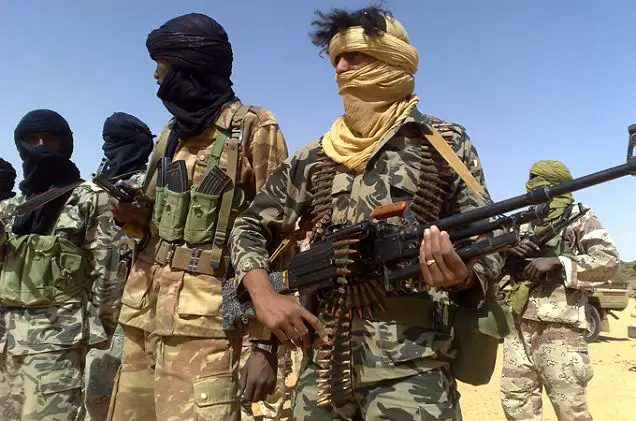 Already wary of injecting themselves into another regional quagmire, the foreign backers of Syria's National Council (SNC) are now watching their fears spring to life in the western end of Africa.
A complex web of historical struggles and ethnic causes, northern Mali is viewed as a worst-case scenario through Western and African eyes alike. On top of a Tuareg independence movement that has ensnared over half a dozen ethnicities, the parallel conflict involving Ansar Dine is generating a vast amount of information and disinformation to process. Concrete predictions are scarce, but a handful of scenarios can guide strategic expectations of Mali's future. All of the appear to contain an unavoidable element of violence.
Three weeks ago - and less than two months before late April's presidential election - a group of Mali soldiers took control of the capital in a coup de tat. The officers offered many grievances to explain their actions, including the corrupt rule of President Amadou Toumani Toure and a mismanagement of affairs in northern Mali. A fraction of the military's anger is rooted in Aguelhok, where a vicious battle ended after the army ran out of ammunition (Ansar Dine later took credit for the ambush). Perceiving the enhanced threat of heavily armed Tuareg insurgents, recruited by Tuareg leaders and former Gaddafi officials following "the Colonel's" downfall, the military announced that it needed to restore a functioning chain of command. Only the insurgency has since claimed all of the territory its leadership sought for decades in a span of weeks. Following the seizure of Kibal and Gao, insurgents emerged victorious in another battle for Timbuktu and seized government buildings, military posts and the airport.
Mayor Ousmane Halle soon announced, "The city is totally under their control."
Days later the Tuareg-led Azawad National Liberation Movement (known by its French acronym MNLA) delivered on pledges made after the capture of Timbuktu. Hama Ag Mahmoud, one of several spokesmen for the group, spoke in peaceful but forceful terms, unequivocally dividing northern Mali (Azawad) from the western half of the country. He said the MNLA doesn't want to "give anyone the impression that we're gung-ho for war, so from the moment we have liberated our territories, our objective is achieved, we stop there. Our objective is not to go further than the Azawad borders."
"We don't want to create problems for the government of Mali, and even less create problems in the sub-region."
The MNLA is speaking truthfully in regards to its territorial and military ambitions. Rearmed with the fallout of Libya's revolutionary war, the Tuareg insurgency has enough manpower and weapons to organize a fierce defense of the land now under its loose authority. With no reason to advance into western Mali, the group is attempting to preempt a counteroffensive and keep its acquisitions without fighting new battles. Mahmoud claims that the MNLA is "open to all... means of negotiations through [the Economic Community of West African States (ECOWAS) bloc]" or other regional powers."
Problematically, the MNLA cannot deliver on its declaration of independence since Mali's next government and international blocs aren't prepared for Mali to follow Sudan's uncertain future. The compromise of autonomy may be inedible to both sides. Many actors, including ECOWAS President Kadre Desire Ouedraogo, express interest in a peaceful solution, but the hammer is always quick to follow. Ouedraogo told Al Jazeera that "in case they don't accept the offer of negotiations, then ECOWAS will use any other means to protect the territorial integrity of Mali." ECOWAS hopes to avoid deploying an emergency force, as it did during Ivory Coast's recent conflict, except northern Mali's two visions of "peace" sound like a collision in the making. While ECOWAS would enjoy logistical and intelligence support from Western nations, experienced Tuareg fighters hold the strategic advantage and must be dislodged from a range of environments. Limited roads make helicopters more vulnerable to SAMs, which the insurgency allegedly looted from Libya.
Both ECOWAS and Western capitals prefer to keep their ground forces out of northern Mali's complexities, and acknowledge the possibility of local resentment. Yet Mali's military may be helpless to retake "Azawad," a territory equivalent to a large American state, without the support of foreign armor and air power.
Most of these problems are strategic or tactical in nature, and thus subservient to the political dominance in COIN. In order to retake control of the country, the future government and foreign powers must politically "defeat" the MNLA and its grievances. That task is hindered by an obscured understanding of the situation. Although ECOWAS has reportedly brokered a transition with Toure and the coup's leader, Captain Amadou Sanogo, the interim government will be challenged to hold elections in the territory that it still controls. Establishing unification between Burkina Faso, ECOWAS, the African Union (AU) and Western nations is essential to before turning north, because the insurgency is likely to prove difficult to negotiate with. The MNLA claims that all ethnic groups in Azawad will be represented, but no one is sure of their final objectives or how many groups they speak for. Tuaregs aren't the most numerous group in northern Mali, only the most organized and weaponized. This power equation gives their leadership a disproportionate amount of political influence and comes with the potential cost of ethnic strife.
In a conflict full of wild cards, al-Qaeda remains the likeliest source to amplify a transnational conflict: a force multiplier that feeds on the stronger insurgency in a given area. Ansar Dine, a group affiliated with al-Qaeda in the Islamic Magreb (AQIM), has already sown discord in the mediating process by raising its black flag over Timbuktu and hassling residents. Females, Christians and foreigners fled a newly-instated Islamic law and Mayor Halle later told the Associated Press, "I do not know who our master is."
On Saturday France's Foreign Minister, Alain Juppe, said that Paris considered the MNLA to be a credible political movement. Various officials within ECOWAS have speculated on negotiating with both groups, but Juppe drew the line at Ansar Dine's objective "to establish an Islamist regime in Mali and the Sahel as a whole."
"The advance of the National Liberation Movement of Azawad, associated with terrorist groups like AQIM and Ansar Dine and others, gives sufficient reason to the entire region to be put on notice," added Gen. Soumaila Bakayoko, chief of Ivory Coast's army.
The split between Ansar Dine and the MNLA is unlikely to be solved in the near future. Ansar's Tuareg leader, Iyad Ag Ghaly, resents being denied a leadership position within the MNLA but uses the group for his own military purposes. Soon after the MNLA declared independence, the "Defenders of Faith" announced that its global jihad doesn't stop at Azawad. Ag Ghaly is acquiring power by making noise in the name of jihad, but his combination of words and actions have put a scare into Western and African capitals, adding to the Sahel's existing urgency against AQIM. Ansar Dine threatens the MNLA's territorial claims, suggesting that the two groups may be irreconcilable, and the international community must guard against an overreaction that would multiply the conflict as al-Qaeda's ideology envisions. Cooperating with the MNLA is useful in this particular case, but the cost of autonomy or independence may be too high to stomach.
Mali's chaos breaks down into a simple two-step process: restore order to the government, then address the MNLA in as non-lethal methods as possible. "Total war," in the words of interim president Dioncounda Traore, is doomed to stalemate. However weak the Tuaregs are perceived, the foreknowledge of a bloody and protracted conflict offers a realistic deferent to secure their political ambitions.
December 3, 2012
Belmokhtar Splinters From AQIM, Eyes Sahara
One of the latest development's in the fast-paced Sahel holds the potential to alter both sides of Mali's crisis.
Several days ago Mokhtar Belmokhtar, a former commander for al-Qaeda in the Islamic Maghreb (AQIM), emerged to warn the international community of "the impossibility of controlling the limits and results of a war in the region." His statements were clipped from a recent interview in Gao, where the Movement for Oneness and Jihad in West Africa (MUJAO) now commands its operations in northern Mali, and dovetail with AQIM and Ansar Dine's overarching narrative in the country (to be addressed in a future post). Essentially, the Islamic alliance that swept across northern Mali is feigning ignorance by entertaining the possibility of a negotiated settlement, and thus positioning itself as the defender rather than the aggressor. They know that an Islamic state leaves no room for compromise with Western capitals and their African allies, and they're playing with house money in Mali.
“We will help and support them - be it at war or during times of peace," Belmokhtar concluded.
Of course the veteran jihadist, a former leader in AQIM, has his own causes to support. Dubbed "Al-A'war" ("the one-eyed") and "the Uncatchable," Belmokhtar is obviously angling himself back into the picture by offering his "unconditional" help - surely with strings attached. He was reported dead during the fog of Gao's battle between MUJAO, Ansar Dine and the oppositional National Movement for the Liberation of Azawad (MNLA), only to emerge in another dispute with AQIM's leadership. After allegedly refusing to step down as commander of the offshoot Al-Mulathameen ("Masked Men Brigade"), Belmokhtar is now pledging to "respect any decision" made by MUJAO, Ansar Dine and the local Tuareg tribes they hope to woo in Mali. He said that his group, “will reveal more details and show his group’s clear position on the war and the methods that they will adopt to repel aggression.”
To this end, Belmokhtar's deputy has confirmed the regional agenda of his network.
“It’s true,” Oumar Ould Hamaha told reporters from northern Mali. “It’s so that we can better operate in the field that we have left this group which is tied to the ‘Maghreb’ appellation. We want to enlarge our zone of operation throughout the entire Sahara, going from Niger through to Chad and Burkina Faso.”
Hamaha is the ideal mediator between AQIM and northern Mali's environment. A native of the Timbuktu region, Hamaha has been involved with Belmokhtar since AQIM's formation in the early 2000s, and now serves as a spokesman for Ansar Dine and MUJAO. He claims that Belmokhtar and himself have technically left AQIM while remaining under the group's regional strategy. Their semi-independence mimics the activity of other AQIM offshoots, such as Mohammed Ghadir's ("Abdelhamid Abou Zeid") Tareq ibn Ziyad batallion, and further diversifies a nebulous collection of militant groups assembling in and around Mali. MUJAO has purportedly split from AQIM for the same reason offered by Hamaha: more independence in expanding regional operations.
Many groups are mobilizing under AQIM's loose control, using the umbrella's affiliation to boost their own profile as they pursue various objectives across West Africa. How these splinters cooperate in Mali will determine the effectiveness of their political cohesion and military defense against an international task force.
Subscribe to:
Posts (Atom)