Branding Yemen as “the next Afghanistan” was fashionable before US air-strikes in December 2009, and they officially marked the outbreak of war. Some US officials and pundits go so far as to warn that Yemen’s external threat has overtaken Afghanistan and Pakistan, prompting the immediate question: why is a mass of US troops deployed in the wrong theater of operations?
But while Washington breathlessly hypes the semi-failed state to justify an ever-expanding war against al-Qaeda, a real threat emanates from the group as it evolves into the next square on al-Qaeda’s chessboard. War has commenced.
Now the battlefield is taking shape.
“We are preparing to implement the first steps of the Aden-Abyan Army to defend the nation and its religion.... and free this land of crusaders and their apostate agents," said Qassim al-Rimi, military chief of Al-Qaeda in the Arabian Peninsula (AQAP), in a message posted online. "This army is in its early stages.”
And in Sana’a, America’s newly appointed ambassador greeted the headquarters of the Yemeni Journalist Syndicate, where Gerald Feierstein reaffirmed the Obama administration's burgeoning proxy war. Formerly the deputy chief of the US mission in Pakistan, Feierstein told his audience, “We will undertake the activities that are necessary to provide that support. We will continue to train and equip Yemen’s counter-terrorism forces to eliminate the immediate threat that AQAP poses to our collective security.”
To be clear (clarity is sorely lacking in US counterinsurgency), Yemen isn’t “the next Afghanistan” anymore than the other battlefields in al-Qaeda’s global theater. “The next Afghanistan” represents the ideal conditions that attract al-Qaeda to a state, failed or in the process of failing, always capitalizing on the same weaknesses - political, economic, social. So no matter where al-Qaeda fights its war the battlefield will stay relatively unchanged from Afghanistan.
al-Qaeda’s virus-like cycle has three standard stages. After taking refuge and reproducing it provokes Western intervention, in Yemen’s case failed Christmas bomber Umar Farouk Abdulmutallab, to inflame the local populace, spawning a third stage of protracted warfare to exhaust America’s resources and international credibility. Comparing his group to the Taliban and al-Shabab, al-Rimi bluntly stated that AQAP is conducting a "war of attrition to widen the front with the enemy in order to weaken it.”
“The next Afghanistan” is truly reflected by the sequence in which Yemen events are unfolding. While the initial phase of the Afghan war delivered an overwhelming tactical victory, ill-advised planning and short-sighted goals led America to eight years of strategic stalemate. The beginning of Yemen’s insurgency, a crucial period in counterinsurgency, has gone so terrible that the infant strategy is already under revision.
But no signs of improvements exist on the horizon.
The initial phase of the US campaign has gotten off to a counterproductive start. Though the US military already had its hands in Yemen, America officially declared war in December 2009 with a series of internationally publicized air-strikes. Billed as a raving success that eliminated multiple al-Qaeda operatives, their deaths were later retracted and replaced with scores of civilians. Air-strikes also failed to stop Abdulmutallab, AQAP's first volley. It should be noted that al-Rimi was supposedly killed in one of these strikes only to emerge and come under fire again. Yemeni officials finally confirmed his death in January 2010, meaning more false information or someone with a detailed al-Qaeda script is commanding through his name.
Furthermore, Yemeni Foreign Minister Abu Bakr al-Kurbi recently told Al-Hayat that US air-strikes "resulted in nothing," claiming that President Ali Abdullah Saleh canceled additional strikes after December. An errant strike in May disproves this account, but the resulting fallout out between Washington and Sana’a stuck a lid on a boiling pot, leaving even less margin for error in the future.
Unsuccessful air-strikes haven’t permanently canceled future operations, but they have forced Washington’s resources into training Yemen’s security forces and supplying them with high-tech hardware. US officials argue that training local forces is preferable in counterinsurgency, a partial truth that often backfires when supplying troops of an unpopular and corrupt government. Nor can they substitute for air-strikes in the desolate, often hostile terrain that al-Qaeda operates from.
Rooting al-Qaeda out of its rural positions simply isn’t a military matter, yet America is repeating the frequent mistake of disproportionate military force.
That hasn’t stopped Washington from trying to hide this fact. The New York Times recently reported that the Pentagon drew up a muscled initiative eventually toned down by the State Department. Feierstein claimed that Washington “recognizes that security cooperation alone will not achieve the goal of defeating violent extremism,” telling journalists, “We also need to take on the longer-term effort of building a more hopeful future for all Yemeni people, one without the despair and political discord in which extremism takes root.”
Feierstein clearly came prepared with the list of grievances submitted by opponents of US policy in Yemen. A national dialogue between the government, northern Houthi tribe, and the Southern Secessionists, corruption and economic reforms - these are “all essential steps to ensuring a more secure future for Yemen.”
Unfortunately, as often the case, Washington doesn’t put its money where its mouth is. So far America has committed a total of $150 million in humanitarian and economic aid, compared to $150 million in military assistance in 2010 alone. Another $1.2 billion in military funds is under development in the State Department’s policy. Christopher Boucek, an associate with the Carnegie Middle East Program, labeled current US policy as “backwards - it will actually increase the threat of terrorism out of Yemen.” Washington must apply an equal balance, perhaps even 50-50 - an unthinkable ratio.
For now, like Afghanistan, America has rolled out a counterinsurgency in name only. Counter-terrorism reigns supreme, a process that, when applied to insurgency, creates more “terrorists.”
Said al-Qirb, "Yemen is not getting its fair share of international aid. We hope this will change. If it does not change, the problem will persist because terrorism always takes advantage of people's living and economic conditions and drives people to complain against governments and against the international order in general.”
The effects are already manifesting. AQAP attacks are growing in sophistication and brazenness, releasing a kill list of Yemeni officials and targeting small troop units on desolate ground, avoiding direct confrontation in urban environments. al-Rimi ominously warned that AQAP has, "so far kept its main cards up its sleeve, and would only use them according to the changing circumstances." Possessing an estimated 200-400 fighters, AQAP’s lack of manpower is supplemented by spirit (AQAP swears loyalty to its own leaders, not Osama bin Laden, and operates in autonomy) and a relatively friendly population.
Years of political and economic marginalziation have ground down Yemeni society - nearly 50% of respondents in a recent poll don’t care about politics, with the primary reason being government opposition. al-Qaeda’s name has also been used to suppress secessionists in the south, possibly the most grievous offense in US policy.
Now America’s botched operations, coupled with the looming war in general, is fulfilling the rest of AQAP’s needs. US military activity has justified Yemen as “the new Afghanistan” to regional fighters, giving foreign and local recruits ample time to flock to AQAP before the insurgency builds up steam. Helpless in the face of “al-Qaeda is on the run,” the Obama administration has no choice but to give AQAP exactly what it wants - importing a war - playing directly into al-Qaeda’s short and long-term goals.
All signs point to a long insurgency. Yemen’s struggles are decades in the making and will likely take decades to resolve, and Washington’s initial counterproductivity is adding years to the insurgency’s time-line. al-Qaeda has positioned itself right where it wants to be, actively growing in multiple failed states that all include US Special Forces or combat troops, mutually supporting each other and undermining Washington’s claims of success. As America slips deeper into entrapment, al-Qaeda’s global strategy is unfolding as planned.
In light of Afghanistan’s current dilemma, US officials offer a strange sight as they avow their new war in Yemen. They should be perfectly aware of the outcome.

October 12, 2010

October 11, 2010
Palestinians Must Fight Fire With Fire

For a moment the Palestinians appeared to be playing with fire by continuing Israel’s momentum. September 26th felt like a distant memory when the Arab League finally convened a special summit to debate the future of direct talks with Israeli Prime Minister Benjamin Netanyahu, who resists any thought of a free extension on settlement restrictions. The intervening weeks have further eroded the Palestinians’ weak negotiating position as Washington rolls over to prevent another collapse of US-sponsored talks and shield its own floundering image in the Middle East.
Then Mahmoud Abbas, acting president of the Palestinian National Authority (PNA), and the Arab League gave President Barack Obama and his team another month to skew a final status agreement.
This “crisis” has the makings of an organized heist and a scam, so it seemed particularly suicidal to offer America more time to coax a settlement extension out of Israel. No political maneuver should be ruled out of the shrewd Netanyahu’s arsenal, and a partial 10-month freeze looks chopped down from a year. Confident that Washington would pay extra for the final two months, Netanyahu’s predictable stalling has him dictating terms to the White House. America’s mediation has become more lopsided by the day under Dennis Ross’s watch, ensuring the rich get richer.
US Congress and the multitude of pro-Israeli officials walking the White House halls settle for nothing less. Speaking before the Arab League meeting, Deputy State Department Spokesman Mark Toner said that what Washington considered "the best outcome is continued support in the region for direct negotiations."
Israel and America optimistically maintain this position because they command the high ground on the Palestinians.
What reason, then, do the Palestinians have to enter that fight? Farther ahead on September 26th than they are now, they’ve caught themselves in a dilemma beyond settlements. As Washington tries to seal a new deal with Israel, at what point does it break its agreement with the Palestinians - the concept of blind justice? Bilateral agreements that indirectly affect the Palestinians, such as military and financial packages, have morphed into direct infringements on their negotiating terms.
An obvious sleeper cell installed within the White House, Ross’s overt emergence marked the beginning of new deterioration to the Palestinian position. Manifested in a draft letter promising security guarantees to Israel in exchange for a 60-day extension to Netanyhu’s partial freeze, Ross’s influence and connections have come to dominate US-Israeli relations and thus negotiations with the Palestinians. Described as “a crucial, behind-the-scenes conduit between the White House and the Israeli government,” an October 6th report from The Washington Post noted that “Israeli officials have long preferred to bypass the State Department and peace envoys, and deal directly with a senior official in the White House.”
The report goes on to detail how both Ross and Netanyahu, realizing the stalemate between their governments, came looking for each other. One Israeli official said of the latest communications, "Very few players are involved. The prime minister has said it is crucial that we do this in a discreet and quiet fashion."
This leaves a few choice Israeli advocates within the White House largely in control of negotiations with the Palestinians, subverting Obama’s own authority.
The contents of Washington’s package to Israel are well known by now, but it’s worth recounting just how much the sum weighs down the Palestinians. One of the first rumors allowed an Israeli military force in the Jordan Valley, which the Palestinians oppose as enabling the West Bank’s occupation. Although US officials later told the Palestinians that the Jordan Valley offer was not included, they would have to be recklessly naive to believe everything Washington tells them.
In regards to settlements, Israel has demanded that one 60-day extension be its last and that if future borders aren’t defined by then - tough luck for the Palestinians.
One Israeli official said the wish list also includes “U.S. guarantees to veto anti-Israeli resolutions at the United Nations,” even though Washington has consistently threatened to veto a unilateral declaration of Palestinian statehood. Accentuating this obstructionism is Israel’s new “loyalty oath,” passed by Netanyahu’s cabinet and on its way to the Knesset for a final vote. Rejected by the Palestinians and moderate Israelis alike, who expect a settlement freeze as payoff, the oath requires non-Jewish immigrants to swear loyalty to the "Jewish, democratic state” of Israel.
Though Netanyahu claims the oath recognizes Israel’s legitimacy as a Jewish state, it stands as a warning salvo to Israel’s demand that the Palestinians recognize Israel as a Jewish state. Palestinians also view the oath as a new wall for potential refugees attempting to return; with Washington’s position on Palestinian refugees mirroring Israel’s, Netanyahu has reportedly requested a US guarantee to block their return. Thus as Israel defines its own laws that will affect Palestinians, it’s also blocking the Palestinians’ unilateral moves at the UN.
Meanwhile Knesset Speaker Reuven Rivlin told recently told The Jerusalem Post that Netanyahu will never divide Jerusalem, despite what they expect to be “significant pressure” from Washington. This fear appears unfounded. While no agreement has been finalized, Israel’s wish list ends with, “guarantees that Washington would not impose an accord on Israel or force a full withdrawal from the West Bank and east Jerusalem.” And Netanyahu’s position is consistent with most of Washington: religious sites in East Jerusalem would open to all faiths while the streets around them remain under Israeli control.
Negotiations look to become even more lopsided in the coming months, especially in the event of a GOP victory in mid-term Congressional elections. Ross’s actions have attracted a degree of scrutiny for undermining the State Department and US envoy George Mitchell, mimicking his own escape from State to Obama’s personal adviser on the Persian Gulf and Southwest Asia. One of Ross’s associates claims that he understood the “risk,” but risk is hardly the word for a calculated move nearly certain to succeed in feeding Israel its desires.
This was the plan all along.
And Ross’s maneuver may be the future trend. Elliott Abrams, a prominent Israeli advocate and lead negotiator under George W. Bush, recently called for Mitchell to be replaced. A bellwether of the Israeli lobby, Abrams told the Washington office of the Council on Foreign Relations, “It’s October 2010. We’re in a mess. Who’s really been the lead player here? And the answer is that we have a special envoy.”
Given the last two weeks, it’s not unrealistic to expect a more malleable envoy in the future - as if Washington wasn’t pro-Israeli enough.
For the Palestinians, the danger of engaging direct talks under these conditions is proportional to Israel’s bravado. Abbas himself told Arab leaders on Saturday that he doesn’t expect any significant compromise from Netanyahu. But as the minutes leaked out of the Arab League’s summit, the outline of what should be the Palestinians’ future strategy began to take shape. Through innovative strategy and coordination, they must attempt to fight fire with fire.
"We are not willing anymore to consider 60 days," Nabil Shaath, one of several senior Palestinian negotiators, told The Associated Press. "When you see nothing but hardened positions, you really have to meet it with the same tactic.”
Though the first part of Shaath’s threat is likely a bluff, his attitude is shared by the bulk of the PLO. Objectives have shifted from halting Israeli settlements to retrieving illegally-occupied Palestinian land. However, the Palestinians and Arab League chose wisely in their first stage of operations: avoiding Netanyahu’s trap to scapegoat failed talks. Once settled the counterattack can begin, which it already has. The Palestinians have reversed the pressure back on America and Israel for the time being and set them up for their own potential fall.
Even if the two parties build up implausible conditions, the Palestinians can veto an unfavorable agreement under better pretenses.
Saeb Erekat, the chief Palestinian negotiator, also informed reporters that Abbas prepared the Arab League to represent Palestine’s statehood claims in the UN. While Ahmed bin Helli, the Arab League undersecretary-general, said that Arab leaders did not immediately respond to Abbas' request, only a month ago this threat was off the table. Aware that Washington will block any resolution against Israel, Palestinian statehood or otherwise, Erekat now said that measures would nonetheless be presented to the Security Council.
But here the Palestinians must launch a new campaign to turn a symbolic gesture into strategic advantage. Rather than simply focus the world’s attention, the Palestinians can combine a media offensive with political flanking maneuvers for a potentially devastating result.
For over 25 years the Palestinians have worked to isolate Israel at the international and propaganda levels, a natural reaction to Israel’s military superiority. Their efforts bore fruit as Israel’s credibility plummets and now, rather than use America to blockade Israel, they must isolate Washington too if it refuses to apply impartial judgment. Rumors spread of appealing to the Quartet in full - America, the EU, Russia, and the UN - a strategy that has yet to be applied but demands serious consideration.
America’s guidance has proven itself distorted and so the logical reaction is to appeal to more favorable actors. Ban Ki-moon, the UN secretary-general, has frequently called upon Israel to “restore settlement restraint under its road map obligations” and the recent terror threat in Europe provides new incentive for the EU to assume a more proactive role. With its support added to Muslim states and as many neutral countries that can be gathered, the Palestinians must then hold both Israel and America accountable on the world stage.
The Palestinians must beat into world’s collective mind that an unequal final-status agreement will collapse and return the situation to a stalemate. Erekat would later tell Al Jazeera, "The whole world holds Netanyahu responsible for what is happening in the region, after he chose to push ahead with the settlement project at the expense of an advance in the peace process. Settlement freeze is a commitment Netanyahu should respect."
And if worst comes to worst, Abbas may choose to blow up the PNA if an agreement fails to be reached. The threat of resignation is nothing new, but its proliferation has spiked in recent weeks and now may be the time to actually play it, leaving Washington to deal with a less moderate Palestinian leader. Abbas, who made suggestive comments to Mitchell during his last visit, would be a lame duck if left empty-handed anyway.
Might as well go out with a bang.
There’s a difference between playing hardball and descending into legitimate warfare. Right now Israel and the Palestinians are engaged in the latter, a fourth-generation conflict waged through political means to break each other’s political will. The Palestinians will never be able to match Israel’s military strength. Their only hope is to overwhelm its political and media firepower, then encircle Washington before it can come to the rescue again.
October 9, 2010
al-Shabab’s Crisis Likely Overblown
 As disunity once again descends upon Somalia, the attention now zeros on the militant group al-Shabab, who’s transitioning through strategic turbulence. Believing themselves past the rift between President Sharif Ahmed and former Prime Minister Omar Abdirashid Ali Sharmarke, Transitional Federal Government (TFG) and African Union (AU) officials claim that infighting has allowed AU troops to seize ground in Mogadishu, including several al-Shabab bases.
Beggars can’t be choosers and the TFG, completely supported by international funds, will take any advantage it can get. But for as many signs that al-Shabab could split, an equal number indicate the less optimistic forecast.
That nationalistic al-Shabab leaders have clashed with those harboring the influx of foreign al-Qaeda fighters is nothing new; the group’s fracturing has been predicted by various analysts since 2008. However, the latest feud burst into light after a still-unidentified helicopter strike on the port town of Marka, roughly 40 miles south of Mogadishu. Presumably sponsored by Washington, the operation would pose some significance if any operatives were actually killed.
al-Shabab denied any casualties and US officials have yet to comment.
Rather than simply eliminate one or more commanders as they plotted their next campaign, the raid disrupted what was ultimately revealed to be a reconciliation between the group’s conflicting members. From here TFG officials and Somali analysts predicted that al-Shabab is headed for a split over al-Qaeda. Rashid Abdi, a Somalia expert with the International Crisis Group, is the key instrument driving the latest reports on al-Shabab’s crisis, calling the group "deeply troubled.”
The danger in this prediction is that it looks truer than it may actually be, and Abdi made sure to qualify himself.
"It is a deeply fragmented movement,” he explains. “But the remarkable thing is that despite that fragmentation al-Shabab has continued to be militarily dominant and it currently - as evidenced by the control of the bulk of Mogadishu - shows that the movement still has the military initiative. The government should renew its commitment towards that strategy of beginning to reach out to figures of al-Shabab who may be disenchanted with the hard-line position being taken by Godane and his foreign jihadist allies.”
Much of the details concerning al-Shabab’s internal division come from Abdi, who says the feud between leader Sheikh Moktar Ali Zubeyr and deputy Sheik Muktar Robow has accumulated over three years. Robow, code-name Abu Mansor, assumed command of the group in 2008 after a US air-strike eliminated Aden Hashi Farah "Ayrow,” only to be replaced by Zubeyr.
Zubeyr, more commonly known as Ahmed Abdi Godane, later relieved Robow’s duty as al-Shabab’s spokesman.
The feud is both political and social in nature. As an Isaaq from Somaliland, Zubeyr envisions a sweeping strategy to establish al-Shabab’s version of Sharia in all of Somalia, including Somaliland and Puntland. Robow, born in the south, appears more concerned with Somalia proper, although he too likely holds regional ambitions. More recently Zubeyr appointed a fellow tribesman to al-Shabab’s treasury secretary, upsetting Robow.
An ideological gulf amplifies these tensions. Robow, the alleged moderate of the group, is open to humanitarian groups and supposedly opposed to the increase in foreign fighters.
For a moment al-Shabab must have actually appeared in disarray. Robow’s fighters reportedly withdrew from areas of Mogadishu, allowing the AU and TFG to capitalize where they could. Somalia’s information minister, Abdirahman Omar Osman, later told reporters that most of al-Shabab’s casualties were from Robow’s clan.
“The Shabab lost hundreds of fighters in the Ramadan offensive mainly from Abu Mansor’s clansmen,” said Osman, leading Robow to challenge Zubeyr.
On top of this, the Ethiopian military and supporting TFG soldiers made another advance into Beledweyne, a border city controlled by al-Shabab. Facing overwhelming odds the group withdrew its fighters to the city’s outskirts and were reported heading west, but reports later claimed that Robow also withdrew his forces from Beledweyne as a show of power.
Now would be an opportune time for the AU and TFG to launch a counteroffensive, which is why Uganda submitted a proposal to deploy another 13,000 troops - if the US, EU, and UN foot the bill. Uganda has also called for a naval blockade. This would be one big proxy war, and the level of funding and coordination may toll the US Special Forces’ bell. Unfortunately any cross-country offensive needs to be mounted immediately, which the AU and TFG aren’t prepared to do. Whatever gash exists in al-Shabab may be sown up soon enough.
First, al-Shabab officials told The New York Times that the real feud is between Robow and a member of his own clan, Muktar Abu Muslim. Considered an ally of Zubeyr, Muslim is believed to have pushed out aid organizations and favors al-Qaeda’s transnational ideology. If true, Zubeyr and Robow may be able to resolve their dispute without either one leaving. Or dying.
That al-Shabab was trying to settle its differences also indicates that a compromise remains probable. Insurgencies naturally compose themselves from multiple parts, leading to inevitable conflict among its leadership. Most insurgencies struggle with maintaining a unified front yet continue to operate with relative efficiency. The nature of insurgency, of network warfare (netwar), allows it to cope with this inevitable clash of ideologies and interests.
It’s why netwar evolved to begin with.
Tehrik-i-Taliban Pakistan (TTP) offers the most recent example. A half dozen commanders of Pakistan’s tribal agencies vied for power after a US drone killed Baitullah Mehsud, leading to furious reporting of its collapse as Pakistani’s military prepared to invade South Waziristan. Hakimullah Mehsud eventually assumed leadership. While Wali-ur Rehman, the TTP’s leader in South Waziristan, remains cool to Mehsud and his uncle, TTP suicide chief Qari Hussain, all regional commanders continue to operate in near unity.
Incoming military offensives have a habit of reuniting rather than dividing militants. Speaking on Friday after mosque prayers in Mogadishu, Robow dismissed a rift between al-Shabab leadership as government accusations.
“What, I can tell you, is that we are still united, we are not divided, so I do not like to reply for the TFG and AMISOM. It is not good for me to answer their baseless reports. We still continue our war that we declared in the Ramadan. I am confirming to you and all the Mujahideen that there are no differences between us. We shall continue our latest clashes against AMISOM and the TFG.”
Robow then informed the public that he sent a message to Osama Bin Laden, reaffirming his allegiance and promising that no dispute exists in al-Shabab.
Of course Robow’s latest comments must filter through the appropriate skepticism, but no reason exists to discard the general idea of his rhetoric. Insurgents fall out and reunite during the ebb and flow of long duration of fourth-generation warfare. At least half of Hizbul Islam, a former ally-turned-rival, has switched back to al-Shabab’s side, and the Long War Journal reported one rumor that Robow would merge with Hizbul Islam and assume command. But Robow shot down this rumor too.
al-Shabab and al-Qaeda's leadership realizes that all they have is each other and, pragmatic as insurgents are, understand the power of unity. Despite their failure to seize Mogadishu, al-Shabab likely never expected to do so, instead diverting itself from a northern push to disrupt a new deployment of AU troops. And even if it loses all of the capital, a damaging blow to be sure, the main battles would still occur in al-Shabab territory. Clearing it from Mogadishu is the easy part compared to Somalia’s southern desert.
The quickest way to al-Shabab’s defeat is self-division, not an AU and TFG offensive. While various insurgent factions would still prolong the conflict, they wouldn’t present a threat on a national scale. The TTP knew it, the TFG knows it, and deep down every al-Shabab and al-Qaeda commander knows it too.
October 8, 2010
Reality Displays Afghan Perceptions
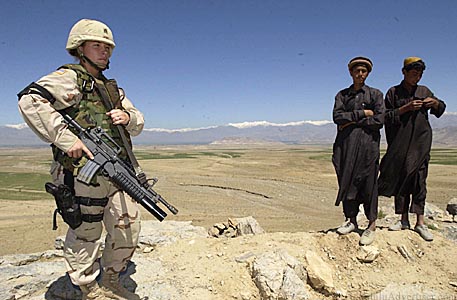 Another day in Afghanistan. After tribal militiamen in Khost province allegedly opened fire on NATO helicopters, returning fire left at least six dead. A funeral procession-turned-protest then carried the dead tribesmen, a key initiative of US General David Petraeus, to the provincial governor’s house.
Chanting “death to America" and "long live the Taliban.”
In typical Afghanistan fashion, the incident is a smoking mass of disorientation. Youqib Khan, the deputy provincial police chief, told reporters, "What I confirm now is six local security forces were killed by NATO's helicopters. NATO told us the militiamen fired first. We don't know who to blame.”
But judging by the reaction of both the militiamen and villagers, America appears the cause simply for existing in the country. George Soros’s Open Society Foundation is only the latest organization to report that the very presence of US troops legitimizes the Taliban’s actions to an extent. This presents a potentially unavoidable dilemma as Petraeus seeks to minimize civilian casualties.
The Foundation’s survey also reached several other conclusions likely unpopular with the US military. One is to stop the increased use of night raids as the “primary kill/capture mechanism,” a mechanism that has become the primary propaganda of US officials arguing that America is regaining “the momentum.” But Afghans including President Hamid Karzai claim night raids are incredibility antagonizing for villagers caught in the crossfire.
The Foundation advocates the establishment of an Afghan tribunal to authorize and investigate Special Forces raids, an unrealistic prospect. The program would include a national registry of civilian victims, cause of death and who is responsible to provide “greater political accountability.” The idea of a body investigating Afghan deaths has been floated by none other than the Taliban, although this may simply be for propaganda purposes, but some type of remedy is clearly necessary.
Wikileaks irreversibly exposed NATO’s policy of smudging the facts behind civilian casualties, a deadly perception that erodes the reduction in US-caused civilian casualties. The Open Society Foundation reports:
"Western public perceptions about the causes of instability in Afghanistan and the role of international forces and insurgents could be characterized as follows: 1) Insurgents treat the civilian population far worse than disciplined and professional international forces; insurgents are brutal in their intimidation and harassment of the population. 2) Insurgents are, quantitatively and qualitatively, more responsible than international forces for civilian harm and escalating the conflict.Another “suggestion” is to, “reconsider the new counterinsurgency strategy of pushing international troops closer to villagers until the population can be meaningfully protected from the increased insurgent violence, collateral damage from international forces, and broader humanitarian consequences that often accompany such troop movements.”
These baseline assumptions are not, however, shared by most Afghans. Most Afghans we spoke with believed the opposite to be true. They blamed insurgents for many attacks against civilians and other misconduct, but they did not think the international military had a much better record than insurgents, citing continued insecurity, detention abuses, air-strikes that killed civilians, and night raids that offended entire communities.”
This finding has Marjah and Kandahar written all over it. Most any report on these cities will include Afghans wondering why NATO stirs up a hornets nest that it can’t clear, let alone hold and build in. Thus when the Taliban increases its activity, the resulting civilian casualties are still partially attributed to the cause - foreign troops.
And more precautionary than coincidental or ironic, the Foundation’s study warns: “Exercise caution regarding initiatives that arm, train, or otherwise empower local militias. Past attempts have often resulted in the unintended side effects of empowering local warlords, leading to abuses of power, inflaming tribal rivalries, indirectly supporting insurgent groups, and otherwise feeding the conflict.”
Like shooting at a NATO helicopter, apparently a justifiable act to the people below.
October 7, 2010
Marines in Marjah face full-blown insurgency
Associated Press account of Marjah, where US military officials claim the Taliban is suffering from money and morale shortages:
MARJAH, Afghanistan — The young Marine had a simple question for the farmer with the white beard: Have you seen any Taliban today?
The answer came within seconds — from insurgents hiding nearby who ended the conversation with bursts of automatic rifle fire that sent deadly rounds cracking overhead.
It was a telling coincidence — and the start of yet another gunbattle in Marjah, the southern poppy-producing hub which U.S. forces wrested from Taliban control in February to restore government rule.
Eight months on, the Taliban are still here in force, waging a full-blown guerrilla insurgency that rages daily across a bomb-riddled landscape of agricultural fields and irrigation trenches.
As U.S. involvement in the war enters its 10th year, the failure to pacify this town raises questions about the effectiveness of America's overall strategy. Similarly crucial operations are now under way in neighboring Kandahar province, the Taliban's birthplace.
There are signs the situation in Marjah is beginning to improve, but "it's still a very tough fight," said Capt. Chuck Anklam, whose Marine company has lost three men since arriving in July. "We're in firefights all over, every day."
"There's no area that's void of enemy. But there's no area void of Marines and (Afghan forces) either," said Anklam, 34, of Fort Lauderdale, Florida. "It's a constant presence both sides are trying to exert."
That day, militants in his zone of operations alone had attacked Marines in four separate locations by mid-afternoon.
The February assault on Marjah was the first major offensive since President Barack Obama ordered the 30,000-man troop surge to Afghanistan and the biggest joint NATO-Afghan operation since the war began in 2001.
Since then, Marjah has become a microcosm of the war itself — and a metaphor for an insurgency that has spread nationwide.
On Oct. 7, 2001, the Bush administration launched a withering bombing campaign that forced the Taliban from power weeks later. But what looked like quick victory turned out to be the start of one of the longest wars in U.S. history.
Similarly, the end of Taliban control in Marjah has sown the seeds of an entrenched guerrilla war that has tied down at least two U.S. Marine battalions and hordes of Afghan police and army troops.
The result, so far at least: Residents say the town is more insecure than ever.
"There was peace here before you came," farmer Khari Badar told one Marine patrol that recently visited his home. "Today, there is only fighting."
Marines say the Taliban can no longer move freely through the town with fighters and weapons. But the militants are still doing so clandestinely — so much so, that "we have areas where every time we go in, we know we're going to become engaged" in fighting, Anklam said.
On their way to Badar's home, Marines snatched cell phones from suspicious men believed to have been spotting for insurgents
"The presence is that consistent and that heavy of enemy," Anklam said. "But there's no area that we allow the Taliban to say they can claim ownership over."
Marjah always had a long way to go, even before the Taliban took it over. More than 50,000 people are still thought to live here, but it's more a vast patchwork of fields and dried mud homes than a town. There's no electricity, running water or paved roads.
The coalition has succeeded in setting up a nascent government in the town's district center. But the local officials' connection to the people they govern is thin. The most visible signs of authority today are sandbagged police checkpoints that frequently come under attack.
Taliban militants have sown fear into the heart of the population in a bid to undermine the U.S.-led effort, warning people to stay clear of American and Afghan government projects.
Markets have come back to life in some parts of town, including the biggest one in northern Marjah. But the only one in Anklam's 18-square-mile zone closed a few weeks ago after shopkeepers succumbed to Taliban threats.
Anklam has helped oversee the opening of three government schools. Attendance at one of them rose recently to a high of 18, then plummeted a few days later to zero because parents were either too terrified of the Taliban or the security situation to let their children attend. Other schools have fared better — one in central Marjah has so many kids that officials have had to find tents to accommodate them all.
Coalition forces are also trying to win over the population by organizing the delivery of solar panels to businessmen, and refurbishing shops, wells and mosques, Anklam said. But residents are weary: One Marine simply trying to give away a lollipop to children at a checkpoint tried three times before finding one who would take it.
"It's hearts and minds versus fear and intimidation," said Marine Lance Cpl. Chuck Martin, 24, of Middletown, Rhode Island, referring to the Marines' attempt to gain the backing people terrified of Taliban threats. "And right now, fear and intimidation are winning."
Anklam said the Taliban enjoy "the tacit support of probably the vast majority of the population," but said they had known little other rule for years and were still too scared to stand up to them. He said several dismembered bodies, apparently of suspected coalition sympathizers, had been found over the last few months in the town's canals.
With Marine and Afghan forces present across the town, "people are starting to realize their government has a vested interest that's not going to disappear," Anklam said. The Taliban, by contrast, "have nothing to offer the people. When people are sick or injured, they come to us."
When the 2nd Battalion, 9th Marines arrived two months ago, most people were too terrified of Taliban reprisals even to speak to U.S. troops during the day, Anklam said. Now, Marines routinely talk to shop owners and farmers in their homes.
"Most of them still won't tell us anything yet about the enemy's activity," he said. "But slowly, it's starting to happen."
Indeed, the white-bearded farmer whom Marines asked about the Taliban presence said he'd seen several fighters moving through the fields around his home during another gunfight — an honest and rare response troops often don't get even when they visit a home from which insurgents were just shooting, Martin said.
The old man also did something else that that was novel for Martin's platoon: He waved the Americans and their Afghan counterparts inside his home when the shooting started.
While the family hid inside, Marines climbed onto his roof and took cover behind a crumbling wall, firing a barrage of bullets toward insurgents a few hundred yards (meters) away. One Marine corpsman pushed an Afghan soldier — who was spraying bursts of fire aimlessly straight up into the sky — out of the way and began taking studied single shots.
Anklam has spread the Marines of Echo company as much as possible. The squads are now based at 13 small outposts — twice as many as in July. As a result, Marines say that although firefights occur daily, violence has decreased overall.
Maj. Dallas Shah, the 2/9 Marines' 42-year-old operations commander from Fairfax, Virginia, confirmed that assessment, but said firefights were on the rise in another company's part of Marjah to the north.
"As you lock down one area," Shaw said, "you have to accept that they're going to move into another area."
October 6, 2010
Getting to the Bottom of Nigeria’s Oil Well
Getting to the Bottom of Nigeria’s Oil Well
What at first appeared to be a routine terrorist bombing in Nigeria has descended into a bottomless pit. Soon after an explosion rocked Golden Jubilee celebrations in the central city of Abuja, killing at least 12 people, MEND spokesman Jomo Gbomo criticized the government not just for ignoring the Niger Delta’s plight, but five days of MEND warnings to stay away from parked cars.
“In evacuating the area, keep a safe distance from vehicles and trash bins,” read a message from Gbomo sent to media outlets one hour before the explosion. “There is nothing worth celebrating after 50 years of failure. For 50 years, the people of the Niger Delta have had their land and resources stolen from them. The constitution before independence which offered resource control was mutilated by illegal military governments and this injustice is yet to be addressed.”
Less than two days later Nigerian President Goodluck Jonathon declared that MEND had no knowledge of the attack.
"It is a small terrorist group that resides outside Nigeria that was paid by some people within to perpetrate the dastardly act," he said in a statement released by his press office. "We are on their trail and I promise Nigerians that the matter will be investigated to the last, and until everybody that is connected is brought to book, we will not rest.”
Jonathon, as if sympathizing with the group, accused unspecified terrorist elements of hiding beneath MEND’s umbrella, whose various factions are known to work as individuals instead of a collective. The group has further splintered under a government amnesty program in summer 2009.
“Government will no longer condone this culture of impunity,” Jonathon said. “There was a statement purported to have been written by MEND, but investigations show that members of MEND have said they don’t know about it. Anybody who thinks that he can come under the cover of Niger Delta struggle to perpetrate violence and criminality, your time is over. We will no longer tolerate it, we will not accept it, the security agents are on their trail, and Nigerians will soon know the actors behind this evil."
Without any means of verifying Jonathon’s claims, part of his story checks out. MEND’s operating methods aim for oil pipelines and platforms along with Nigerian military and police; Nigerian civilians are usually off-limits. Gbomo's own statements expressed regret for the loss of life. The idea of a ceasefire, signed in October 2009 only to be broken by MEND in January 2010, is harder to digest. MEND has carried out several attacks since then.
But the plot thickened once Henry Okah, an ex-MEND leader recently arrested in South Africa, told Al Jazeera that Jonathon ordered him to retract MEND’s statement and blame “northerners.” The implication is that Jonathan, a southerner, would campaign on the incident during Nigeria’s upcoming presidential and parliamentary elections in January 2011. As a native of the Niger Delta, Jonathon has political interests in the amnesty program and suppressing MEND’s demands and threats.
"On Saturday morning,” Okah recalled, “just a day after the attack, a very close associate of President Jonathan called me and explained to me that there had been a bombing in Nigeria and that President Jonathan wanted me to reach out to the group, Mend, and get them to retract the earlier statement they had issued claiming the attacks. They wanted to blame the attacks on northerners who are trying to fight against him [Jonathan] to come back as president and if this was done, I was not going to have any problems with the South African government.”
"I declined to do this and a few hours later I was arrested,” says Okah, who was released several days later. “It was based on their belief that I was going to do that that Jonathan issued a statement saying that Mend did not carry out the attack."
So without Okah, Jonathon pulled together other MEND’s ex-leaders, including Government Tompolo, to accomplish his objective.
"I am the leader of MEND,” Tompolo, who received amnesty in 2009, declared during a summit with Jonathon several days ago. “We are not part of the incident of October 1. MEND is not involved. I am the owner of MEND. We are going to work with you to save this country Nigeria for everyone."
Tompolo added, “MEND is not responsible. We have disarmed. We say to the world, these people claiming they are MEND are impersonating. It is a terrorist act.”
As for Jonathon, his office only today released a press briefing clarifying his statements on MEND, which have been criticized for “rushing to judgment.” Apparently the president was eliminating prejudices and not immediately blaming MEND for the attack, even though MEND had claimed responsibility. Jonathon’s prior statements make very clear that he believes a “terrorist group” committed the act, which could be an act but is also a rush to judgment.
The president’s campaign organization then criticized Okah over his allegation that Jonathon asked him to implicate the north, and state security services continue to describe Okah as a primary suspect. These events have grown progressively suspicious.
Unfortunately the truth is covered in layers of deception. Much of the controversy revolves around MEND’s initial claims, which Tompolo addressed: "Jomo Gbomo does not exist. If the person handling the media sector has a problem and another person takes over so far he has the password of the email he can use the name of Jomo Gbomo and cover up as Jomo Gbomo. So there is nothing as Jomo Gbomo, he does not exist."
Tompolo’s argument could be valid - maybe “Jomo Gbomo” doesn’t exist. But someone is speaking regardless of the name and Gbomo isn’t new. Besides claiming responsibility for various acts before 2009, Gbomo declared the ceasefire broken in January 2010, confirmed a March bombing, and badmouthed Diezani Alison-Madueke, Nigeria’s new oil minister, in early September. Perhaps a “terrorist” group hacked the account or created a false one, maybe a faction of MEND has gone rogue, or maybe the group actually lives on as it claims.
In a new interview with Nigeria’s Daily Champion, MEND insisted that former military president, General Ibrahim Babangida, his campaign director, Chief Raymond Dokpesi and Henry Okah played no part in the bombing.
"The amnesty is a scam,” read MEND’s statement, consistent with statements made throughout the amnesty period. “Those you said embraced it are not genuine fighters but hired miscreants... We can not offer such a promise but such attacks will be directed at the military when we resume hostilities in the Niger Delta.”
Nigeria by itself offers a complex insurgency to study, but this is no fringe conflict. Already a Goldman Sachs “Next Eleven” economy, Nigeria just moved into third place on US oil imports at 1.143 million barrels per day, only behind Canada and Mexico and topping Saudi Arabia, Venezuela, and Iraq. It's also logical that Nigeria will move up from 48th on the EU's imports. As Africa’s largest oil exporter, Nigeria’s fate will inevitably impact the West on an economic scale as oil reserves deplete, affecting US and international interests as the 21st century progresses.
Nigeria’s corruption, disproportionate wealth, poverty, and environmental hazards also make it potentially attractive to al-Qaeda. Nigerians would likely scoff at the notion, and indeed the country is nowhere near al-Qaeda’s temperature. The country's makeup works against the group in many ways, including one of the world's highest US-approval ratings and a large Christian population, similar to the Philippines. Nor is MEND’s conflict ideological, especially Islamic radicalism, but an egalitarian, eco-insurgency.
Yet give al-Qaeda another ten years and there’s no telling where it will infiltrate. Its future strategy appears heavily geared towards Africa to create distance between the Middle East, and more than oil flows beneath the Delta’s mangroves. Where there’s money, weapons, and drugs, al-Qaeda agents in West Africa are usually lurking somewhere in the background. A pipeline all the way to the Sahara desert could be a potential long-term goal.
Nigeria’s surface prosperity cannot disguise its continual vulnerability - and neither can a conspiracy. But judging by how much happened in five days, Nigeria’s latest plot still has a ways to go before reaching the bottom.
October 4, 2010
Obama Sealing His Bunker in Afghanistan
 After a month of rumors that no major changes would be made to US strategy in Afghanistan and Pakistan, US President Barack Obama has finally confirmed anti-war opponents' worst fears - and a few pro-war opponents too.
"We are continuing to implement the policy as described in December and do not believe further adjustments are required at this time," Obama wrote in his latest update to Congress. "As the Congress continues its deliberations on the way ahead in Afghanistan and Pakistan, I want to continue to underscore our nation's interests in the successful implementation of this policy."
In doing so Obama also confirmed the delusions afflicting the White House and Pentagon.
This new political slogan of “no major changes” is bewildering on a number of levels, as Afghanistan is trending downward to both war opponents and supporters. Each view the same events somewhat similarly: protracted Marjah and Kandahar campaigns, an active Taliban throughout the country and communications with senior Taliban officials, Hamid Karzai’s falling approval, another potentially fraudulent election, drones that kill but don’t resolve conflict, and tense relations with Pakistan.
How the country will noticeably improve in nine months is the great unknown. Obama’s base, reading the writing on the walls, has crashed back to reality and believes he’s lost in another Vietnam, while GOP Senators hope to delay a July 2011 deadline that they believe is approaching too fast. The December review, theoretically, was supposed to factor in changes and non-changes within the environment. Forming a resistance so early is disturbingly narrow-minded.
Why announce a review at all?
In reality, the December review was likely nothing more than July 2011, a political gimmick designed to create breathing room for a suspect strategy. The only real decision is to confirm or postpone the beginning of a withdrawal or low-ball its numbers, with the final result being an ongoing war. Obama seems to believe he’s fulfilling his pledge to withdraw forces, but US military officials including General David Petraeus and Defense Secretary Robert Gates have repeatedly played down the deadline. If this were the “real” strategy then Obama wouldn’t need any changes, except to cook up an excuse to push back July 2011.
The driver behind the Obama administration’s bunker mentality is also found in Obama’s Wars, Bob Woodward’s expose on the 2009 fall review, which itself is playing an active role in Washington’s decision-making. Up until now many suspected a divided house on Afghanistan, but Woodward’s account provides the highest confirmation of the schism between the White House and Pentagon. Completely underestimating the insurgency, Obama rejected the Pentagon’s large-scale surge of 80,000 US troops that allegedly topped several hundred thousand. Only willing to give two political years to a potentially decades-long counterinsurgency, Obama opted for the lowest possible force that still appeared to bite.
At the time US generals visibly chafed at the low number of troops and 18 months, and Woodward informs us that the Pentagon rejected a light surge of 20,000 US troops. It wanted 40,000 at the minimum. Now everyone knows Obama is caught between his generals.
And so, not surprisingly, the White House and Pentagon spun Woodward’s account into another false front. 2010 hasn’t lived up to Obama’s expectations and with Woodward’s book shaping perceptions before December, the White House and Pentagon have retreated deeper into their bunker. Instead of admitting to mistakes both political and military in nature, Obama is glued to the image of his academic, deliberate, and “accurate” 2009 review. To admit Afghanistan’s many shortcomings and errors is to admit a flawed strategy from the beginning.
And so he continues to play politics with Afghanistan from one campaign to the next, even if it makes for bad politics in the end.
“The White House has played down any internal rifts and says the book as a whole portrays Obama as analytical and decisive,” reports Reuters. Going several leaps further, Gates denied any infighting over the Afghan war strategy between Obama, other White House officials such as Vice President Joe Biden, and the Pentagon. Describing relations within the government as "harmonious," Gates ignored his own powerless anger to stop the Pentagon’s leak war against the White House.
The question remains why Obama, if he initially felt the need to escape Afghanistan, now feels the war requires no changes. US policy is ripe for protracted counterinsurgency: still under-resourced and overextended, lacking in crucial political spheres, continually misunderstood, and thus fundamentally flawed. Worst of all, the government waging the counterinsurgency still appears in confusion and disarray. “No changes” essentially means more war, which may indicate that Obama expects a GOP Congress to rescue him in December.
But if Obama truly intends to stand firm on July 2011 as a significant withdrawal date, one option seems to jump out - he doesn’t care if Afghanistan destabilizes. Because that’s the direction US strategy is headed under his command without “major changes.”
And he won’t kill enough al-Qaeda to prove that he “dismantled” it either.
Pakistan’s Cancer of US Origin
 Amid the controversy over America’s use of armed drones in Afghanistan and Pakistan, all parties agree on at least one point: psychological warfare.
The US military, on top of killing militants, hopes to frighten new recruits from joining. Locals on the ground, even if opposed to Taliban rule, shutter at the buzz of a Predator patrolling their village at night. And while anti-American elements within Pakistan wield drones to bash Washington’s extensive influence in the country, Tehrik-i-Taliban Pakistan (TTP) has written them into their recruiting propaganda.
But September’s barrage - at least 21 strikes - has magnified another psychological objective recently disclosed by Bob Woodward in his new book Obama’s Wars. Recounting an Oval Office meeting on November 25th, 2009, Woodward describes how President Barack Obama, annoyed by Pakistan’s persistent fence-sitting, told his strategic team that safe havens would no longer be tolerated.
“We need to make clear to people that the cancer is in Pakistan," Obama ordered, arguing that escalation in Afghanistan was necessary "so the cancer doesn't spread there."
Although this trend developed before Obama’s fall review, September has crystallized the fact that Washington is employing drones as psychological warfare against the American and NATO publics. Foreign sanctuary is undeniably decisive in counterinsurgency, and appetizing logic for someone looking to shift the responsibility from one conflict zone to another. But Washington is also using drones to excuse Afghanistan’s homegrown conflict by diverting attention to Pakistan.
Yet history demonstrates that America, if not the real cancer, injected Pakistan with its current malady, now misdiagnosed by Obama and applied as psychological warfare. And the truth disproves another of Obama’s political slogans in Afghanistan - the concept of a “good war.”
Like so many of Afghanistan and Pakistan’s current woes, the TTP's origins begin with the ill-fated, US-induced invasion of the Soviet Union. The war turned West Asia into a militant hotbed, not just for al-Qaeda leadership but Pakistani tribesmen and Uzbeks who fought along side their Afghan mujahideen “brothers.” After the war they returned to Pakistan and laid relatively dormant through six years of Taliban rule - until 9/11.
Afghanistan’s war hasn’t simply been under-resourced; its flawed planning stacks up with Iraq’s strategic errors. Although Afghanistan’s justification may appear more legitimate than Iraq’s, the prior US policy of militarization and neglect render this concept a fallacy. America's invasion in 2001 never intended to correct historic and moral wrongs, only to retaliate against al-Qaeda. Washington quickly shifted its attention to Iraq once the Taliban government collapsed, revealing how little America cared of Afghanistan’s “liberation.”
And the Obama administration has similarly abandoned “democracy” in Afghanistan, claiming that securing Pakistani nuclear weapons is the main objective.
Failing to realize or plan for the regional militarization that would follow “regime change” in Afghanistan, the Bush administration’s reaction to 9/11 spawned what would eventually become the Pakistani Taliban. Tribal and militant leaders connected with the Afghan Taliban, primarily the charismatic Nek Mohammad, quickly mobilized logistics support and shelter for Afghans fighting and fleeing the US invasion. During the war’s initial years these groups gradually began offensive operations against US troops in Afghanistan. Pakistani tribesmen believed that America had come to conquer and no one disproved them.
Washington did immediately perceived the TTP’s military threat in 9/11’s aftermath, leading to a controversial exchange between Richard Armitage, former US deputy Secretary of State, and ex-Pakistani President Pervez Musharraf. But whether Armitage actually threatened to “bomb Pakistan back to the stone-age” if Musharraf didn’t attack militants on his side of the border is irrelevant. Washington applied its political and economic pressure, yielding the same failed counterinsurgency in the 1990’s.
Unsurprisingly, the nuclear weapons so feared in Pakistan trace their origins back to America; Islamabad had developed its first nuclear weapons with Chinese uranium in 1983, promised by Mao Zedong before his death in 1976. Though opposed for a variety of geopolitical reasons unrelated to nuclear proliferation (India had tested its first bomb in 1974), Washington begrudgingly ignored Islamabad’s program as it funneled America's proxy war against the Soviets.
No sooner had the Soviets withdrawn did US President George Bush, invoking Pakistan's nuclear weapons program, cut off funding to Islamabad and effectively quarantine the country throughout the 1990’s.
Among the many counterproductive effects against US-Pakistani relations, this short-sighted policy ensured that Pakistani tribes remained disenfranchised and primed for an anti-American jihad when 9/11 struck. Yet Washington doubled down on a militaristic policy instead of recognizing Islamabad’s (and thus America’s) need to win over Pakistani tribes. So while Iraq was just beginning to reveal its own insurgency to a shocked Washington, the Bush administration had already committed a strategic sin in Afghanistan by making the same error twice.
This backwards counterinsurgency should have been evident from the beginning. As Mohammad, an Ahmadzai Wazir, gathered strength from the reputable Wazir tribe, Washington decided that military operations would suffice to destroy a popular insurgency. Meanwhile Pakistan didn’t launch its first invasion of South Waziristan until 2004, demonstrating a late reaction to the insurgency. Mohammad mounted a stiff enough resistance to force a ceasefire that he broke shortly thereafter, but this fact doesn’t absolve America for eliminating him in a drone strike weeks afterward.
Mohammad’s victory and martyrdom rallied thousands of Wazir and Mehsud tribesmen to the TTP banner then taken up by Baitullah Mehsud, who would drop it only after five years of active support for the Afghan Taliban.
From before 1990 to the first major battle in 2004 to another unproductive encounter in 2008, Pakistan’s tribal areas received relatively no attention and resources from Islamabad or Washington. Corrupt remains a leech on the system. It wasn’t until 2009 that caring for tribes became a priority for Pakistan, although its actions have yet to meet its promises, a running theme. The TTP has dealt itself the most damage, reducing its once high approval by eliminating of hundreds of tribal elders, bombing Pakistan’s cities, and ultimately displacing their own tribes.
Guerrillas often wound themselves due to the extreme pressures involved, but relying on their disorganization is more luck than counterinsurgency.
Unfortunately this futile cycle continues to signal repetition. While Washington has made a point of increasing humanitarian aid to keep up with massive military expenditures, Pakistan’s tribes continue to suffer political and economic marginalization. Rah-e-Nijat, South Waziristan’s latest operation, was supposed to follow with a social initiative, but the combination of economic turbulence and environmental disaster wiped out whatever plans existed.
Meanwhile Islamabad’s ceasefire with Hafiz Gul Bahadur, the TTP’s commander of North Waziristan, has survived, meaning that the government’s authority remains absent. Militants from South Waziristan have based themselves out of the north, cycling in fresh teams to wage an insurgency against Pakistani troops in the south, while the Haqqani network uses North Waziristan as its own sanctuary to raid Afghanistan. And Washington remains unsatisfied with its drone fleet. CIA director Leon Panetta recently complained after three cross-border helicopter raids, "We can't do this without some boots on the ground. They could be Pakistani boots or they can be our boots, but we got to have some boots on the ground."
But none of these options offer the best way to gain authority over the political, economic, and social realms of Pakistan’s tribal region, which are the keys to establishing military control.
After 30 years of systematic neglect, the reality is that America played a significant role in creating both the Afghan and Pakistani Taliban. Establishing Pakistani sovereignty over its tribal agencies requires tens, perhaps hundreds of billions in economic and social programs, along with a vast number of qualified civil servants. These funds must coincide with the re-establishment of tribal authority, a daunting challenge with Pakistan’s government in disarray. As for long-term political representation, only when a new generation of skilled representatives can advance tribal needs at the national level can full order be restored.
Permanently denying the TTP its population and territory could easily take a decade, likely longer.
The Obama administration has relied on fallacies in Afghanistan from the beginning. A “good war” wouldn’t have spawned a cancer in Pakistan, and while Obama is partially true when he argues that Afghanistan was neglected, the time-line goes back further than 2002. Though quick to state the war “is just beginning,” US officials don’t welcome the same discussion on Afghanistan between 1980 and 2001.
Where all of the conflict’s roots lie.
October 3, 2010
Quote of the Day
"Pakistan is saying we will take care of all terrorists on the Pakistani side of the border, but we will do it on our timeline. We cannot always follow a timeline that our allies set for us, because we are allies, not a satellite."
- Husain Haqqani, Pakistani ambassador to the US
- Husain Haqqani, Pakistani ambassador to the US
October 2, 2010
Netanyahu Humiliates Obama Again
"The Obama administration's attempts at seducing Benjamin Netanyahu, the Israeli prime minister, are getting embarrassing. Netanyahu has made it very clear he is not interested.
According to Ha'aretz, the latest (and most cringe-worthy) moment in the saga came this week when Dennis Ross, the president's top adviser on Israel-Palestinian issues, convinced Obama that Israel would only agree to an extension of the settlements freeze if Obama would "come off as friendlier" to Bibi.
So Ross and his aides (working with the Israelis) drafted a letter to Netanyahu in which the US would give Israel everything it could possibly want in exchange for a two-month freeze.
The details of the letter were revealed by researcher David Makovsky on the website of the Washington Institute for Near East Policy.
According to the report, the letter included incentives crucial to Israel's security that Netanyahu has been demanding for years. For example, the US pledged to support Israel's position on stationing Israeli troops in the Jordan Valley after the establishment of a Palestinian state, in order to prevent weapons smuggling.
The US also would not ask Israel to further extend the building moratorium and would pledge that the issue of settlements would be dealt with only as part of final-status talks with the Palestinians, the letter reportedly said.
The US also reportedly would veto any UN Security Council resolutions on the Israeli-Palestinian conflict this year, would upgrade Israel's defence capabilities after the peace agreement, and would increase security assistance.
This reportedly would include providing Israel with advanced fighter jets and early warning systems, including satellites. The US also would start talks with Arab countries toward a regional agreement vis-a-vis Iran.
Netanyahu's one-way street
It is hard to imagine anything Ross left out. For Bibi, the Ross offer was a dream come true. All that for a 60-day freeze.
But Bibi said "no".
And why? "Netanyahu said he appreciated the letter but could not accept the American proposal because it included a two-month extension of the construction moratorium, which he said would damage his public credibility."
But the "moratorium" was the whole point of the offer. Bibi seems not to believe that his dealings with the US have to be two-way streets. He will only consider deals where the US gives and he gets. (But then, that is the way it always is.)
Ross and the other administration figures are now "incensed," having been played yet again.
They even went up to Capitol Hill to discuss the situation with Bibi's pals up there. No dice.
So it is back to the drawing board. Maybe Ross can give Bibi one of the 50 states (Alaska!).
But that will not work. The word from Israel is that Netanyahu is counting on a huge GOP landslide to save him from Obama. And then in 2012, there will be a Republican president who is more likely than Obama to let him bomb Iran.
Netanyahu has done this before. During the Lewinsky affair, he came to Washington, ignored President Clinton, and went up to the Hill to smoke cigars with Speaker Newt Gingrich and exchange Monica jokes. To understand Bibi, you need to realise that as much as he is Likud, he is a right-wing Republican.
Here is what we should do. Tell Netanyahu that either he agrees to the freeze or the US slows down the delivery of aid. After all, Israel is the #1 recipient of US aid in the world. Surely, there are ways the Pentagon can indicate displeasure.
Or maybe we can refuse to veto one of those Security Council resolutions that rightly condemn Israel's actions in occupied areas. We do not always have to be the one country in the world that stands alone at Israel's side when the UN attempts to pass a resolution we know is right.
I mean, we are the United States. We are also Israel's only real ally on the planet. We do not have to take this kind of dissing lying down.
And Dennis Ross, who came to the White House from the AIPAC-created Washington Institute for Near East Peace, should devote his attention to some other region of the world, one in which his penchant for wishful thinking would be relevant."
MJ Rosenberg is a senior foreign policy fellow at Media Matters Action Network. The above article first appeared in Foreign Policy Matters, a part of the Media Matters Action Network, and republished in Al Jazeera.
Direct Negotiations Doomed Through Palestinian Eyes
From Ramallah, a Palestinian student tries to explain to readers ‘outside’ how he thinks the negotiations appear 'internally' to Palestinian eyes. Courtesy of Open Democracy:
"In January 2010, I began researching for a PhD at the LSE. I wanted to pursue these studies partly in order to better understand the society that I was born into, Palestinian society, and why we still don't have our own state and freedom despite being involved in direct peace talks and negotiations for twenty years. Since I was born in 1984, I have never experienced freedom. I am from a family that comes from Al-Lud, a city in historical Palestine where what is now the Israeli Ben Gurion International Airport began to be built after they kicked out our families in the 1948 Nakhba. My family was forced to move to Ramallah, and I was born there. Therefore, I am a refugee, and I am still waiting to become a normal citizen. Meanwhile, I have figured out that for the Palestinians, at least, our country must live in us and not vice versa.
I witnessed the first intifada, the peace accords, although I was young, and I saw how a calm development period gave way to the second Intifada/Uprising and the duress of the re-occupation of the West Bank in 2002/3. I lost friends to the conflict and many others were arrested. In retrospect it seems almost dreamlike that I was able to come and go safely from the university there, when I think of the Israeli occupation checkpoints and their policies. However, I have been living there for a quarter of a century, trying to plant hope and waiting to see if we can harvest good outcomes.
Since the first of July, I have returned to Ramallah for my preliminary field research, and as I write this, am heading back to London tomorrow. These three months that I have spent in Ramallah and the West Bank, I mainly spent talking. I have interviewed many Palestinian Authority representatives, the Prime Minister, ministers, leaders. More importantly, I met there and talked about the situation and the restart of negotiations, to friends and ordinary citizens. I can claim that I met hundreds of people, most of them people I had never talked to before. The vast majority of them, including leaders of the Palestinian Authorities, believe what I am about to try and explain in this article. I have tried simply to translate the voices of the people in the streets of the West Bank, especially in Ramallah, so that they might reach the ears and eyes of listeners and readers elsewhere in the world.
While I was there, I went to many public gatherings that came out against the direct negotiations in their current uneven format. I felt the real anger inside people who wish for nothing other than peace and justice. During my three months’ stay, I felt more than at any other time that people were desperate to be heard by their own leadership in particular. And this is what I believe they would like to say…
The last few months have witnessed an unprecedented level of diplomatic effort, led by the U.S. administration, aimed at reviving the direct ‘peace’ talks between the Palestinian Authority and its negotiators and their Israeli counterpart. The US administration was able to ‘force’ both Palestinians and Israelis, along with the Jordanian and Egyptian leaderships, to sit at one table again, talk for hours on end, have nice dinners, and announce the re-commencement of direct talks despite a high level of ambiguity and uncertainty. So, what is ‘new’ about this? It may be argued that such meetings have occurred over the last 20 years and following each round of negotiation, ‘history’ teaches us that Palestinian life only becomes more difficult and complex. Indeed, the ‘Hilliarian’ year ahead will be full of old-new talks by the same people who have been negotiating for many years, without achieving any tangible success. In fact they have so far only procured an outstanding failure.
Unanswered questions scatter the surface: What kind of innovative diplomatic tools will Hillary Clinton use? Can these ‘magical solutions’ end the prolonged Israeli occupation and do away with the apartheid status of Palestinians? Can this preliminary and ‘framework’ peace talks be sufficient for creating an everlasting peace? Can people thirsty for peace and freedom accept again another ‘framework’ agreement instead of real positive changes on the ground? How long will ordinary citizens have to scour the news on TV before they can arrive at any glimpse of an understanding of what their ‘leaders’ are doing in Washington, Oslo, Geneva, Sharm El-Shakeh and elsewhere? Can illegitimate negotiators bring legitimate peace accords? And finally, is it possible to negotiate when you are not free? These are questions very difficult for the Palestinian negotiators to answer. However if their response is not clear, that of the Palestinian majority of ordinary citizens is obvious enough: these negotiations will fail sooner or later: they are doomed to failure.
Why is the Palestinian ‘ordinary’ man or woman in the street so certain about the ultimate failure of the negotiation when their leadership think differently? Put simply and bluntly, this is because the ‘ordinary’ citizens are the people who cross the checkpoints. They don’t have the VIP cards; they suffer daily harassments by Israeli settlers; they suffer while crossing the ‘Bridge’ which their negotiators traverse with ease; their lands are confiscated and their houses are demolished; they strive to have sufficient clean water while their negotiators enjoy time out in the swimming pools or on the beach; they are the people who care about their rights in their land, while their negotiators care about their positions, cars and bodyguards; they are the people who can’t compromise at the expense of their dignity, because they want to live freely. The difference between the Palestinian citizens and their negotiators can be listed forever. However, such inequalities can only partially explain this distance. What is key is that the negotiators, although they also live under occupation, are still far removed from listening to their citizens’ demands, beliefs and perceptions. The Palestinian negotiators forget that those who afford them any legitimacy and credibility are their own people and not the people of Israel or the international community. The Palestinian negotiators forget that having all of the superficial trappings of a nation-state is not like having a real state.
Until this gap can be bridged between the Authority and its negotiators and the ordinary citizens, negotiations as a tool to end the Occupation remain fundamentally unpersuasive. When Palestinian ordinary citizens inform their negotiators about various issues that must be raised if renewed failure is to be avoided in the peace negotiation, their negotiators fly to Washington to ‘apologise’ to the Israelis for the disappointments that the Palestinians cause them. The Palestinian negotiators (the colonized) consider themselves partners with the colonizers - a typical slave mentality. The Palestinian negotiators have forgotten to read Frantz Fanon, Edward Said, Azmi Bishara and others before going into negotiation. The Palestinian citizens told their negotiators, who are supposed to represent them, that you can’t negotiate without having our support, you can’t negotiate with the continuation of the Wall and settlements expansion and the creation of more isolated lands cut off in the West Bank. You can’t negotiate while thousands of Palestinian are in Israeli prisons. You can’t negotiate without having a clear national consensus, while isolating the role of Hamas and their supporters as key players in Palestinian life, while 1.5 million Palestinians are struggling to survive under the Israeli siege in Gaza. You can’t negotiate while ignoring the other opposition leftist parties and civil society, while your jails are full of political prisoners; you can’t negotiate while you oppress people who try to express their opposition to the direct talks, and you can’t negotiate with the Israelis and at the same time apologise to them as if you were the problem. You can’t negotiate with the same people who have failed so many times previously, that they forget that the problem is with the negotiators and not with the Cause.
The Palestinian negotiators have never understood the way Zionist ideology envisages the fate of Palestinian territory, spelled out very clearly by successive World Zionist Movement conferences from the sixth conference held in Basel in 1903 until the eleventh conference held in Vienna, in 1913. It can perhaps be best summarized as a myth that Palestine was uninhabited - a myth that duly had to be put into practice. The chauvinist principle is made quite clear in the demand to be given, ‘a land without a people for a people without a land.’ The Israeli occupying authorities' ideology is based on imposing a technique of colonization and hegemony that is different in type from experiences witnessed over the past century. Israeli colonization derives from a colonial ideology as well as a denial of the Palestinians’ right to land. From an Israeli perspective, occupation of the Palestinian territory is not temporary and Israeli colonization is not only in place for economic gain, cultural hegemony, or annexation of strategic territories. Settlement activity throughout the occupied Palestinian Territories is the spine of Israeli policy and Prime Minister Benjamin Netanyahu was elected in order to maintain this policy and avoid the establishment of a Palestinian state. How can a ‘negotiator’ ignore such facts!
For all of these reasons ordinary Palestinian citizens believe that the new direct talks and rounds of negotiations will fail sooner or later. The regular meetings may progress well in relation to security arrangements and economic conditions. However, when the negotiators reach the ‘serious and important’ talks about the refugees, Jerusalem and the borders, all will vanish. So, the ordinary citizens ask why they need to waste more time? Why do the negotiators ignore all attempts to re-build Palestinian unity, preferring to satisfy the international powers rather than their own people? Why are the Palestinian negotiators so keen not to isolate the Israeli apartheid state? And why do they want to give the legitimacy to the occupier in such uneven positions which can only favour the colonizers?
There is after all, an alternative way forward. Firstly, the Palestinian leadership should consider the Israelis as the colonizer and not the partner in these negotiations. The Palestinian leadership shall remind the international community and all the people they are meant to represent that the Palestinian people are living under an apartheid Israeli regime and occupation. This will help the international community not to waste their time and money on trivial issues, but to address the problem at its roots. The international community and powers will finally recognise that the Israeli occupation is illegal, contradicting all human values and justice, and that the priority is to end the occupation rather than helping it to sustain itself. All the media chat and pragmatism in the world will not achieve success until stakeholders recognize that the Israeli occupation is the main obstacle to peace. Meanwhile, negotiations in their current settings can never bring any good news to Palestinians either inside or outside the occupied territories, simply because those who are negotiating are not free men. If negotiation will lead one day to the end of the occupation, it shall be because it is based on justice, equality and freedom."Alaa Tartir is a Palestinian PhD candidate in Development Studies and Global Governance at the London School of Economics, researching the role of good governance in state formation in Palestine.
October 1, 2010
One Obstacle Leads To Another
 He said it a month ago when direct talks between Israel and the Palestinians finally got off the ground. He said it at Sharm el-Sheikh, where the two sides failed to breach the settlement blockade. And despite the negative clouds lingering over meetings with Israeli Prime Minister Benjamin Netanyahu and Mahmoud Abbas, president of the Palestinian National Authority (PNA), US envoy George Mitchell repeated his optimistic script on the way to Qatar.
"Both the president and the prime minister have agreed that we will continue our discussions,” Mitchell said from Ramallah, “in an effort to move forward in this process toward what we all share as a common goal: the establishment of comprehensive peace in the Middle East. There remain obstacles. Our determination continues.”
Mitchell is leaving the West Bank without an agreement on Israeli settlements, warned by the Palestinians that direct negotiations cannot continue without one. Washington is desperate to strike a deal that both sides can live with, but the White House should be careful in its rush not to trip straight into a new obstacle.
Determined to get his way at all costs regardless of the expense to Palestinians, Netanyahu is squeezing the US as if he planned a heist from the beginning. To a point America and Israel’s relationship is irrelevant to the peace process. If Washington wants to offer new loan guarantees and military hardware, this may be one way of enticing Israel into extending its settlement “freeze.” But these bilateral agreements become counterproductive as soon as they impinge on the Palestinians, which they often do.
"In light of the American guarantee package and in light of what Israel can get from the United States for two additional months of freeze, chances are that when the time comes we won't oppose an extension of the freeze, if such a demand is presented by the prime minister," said one Likud official within Netanyahu’s cabinet.
Security guarantees reportedly include an Israeli military force on the western border of a Palestinian state, which Abbas has repeatedly rejected. He has in the past offered the compromise of NATO forces, but Israeli troops would simply trade one obstacle for another. Interestingly Netanyahu allegedly rejected this offer, perhaps already confident of such a force. His recent actions are wrecking their own havoc by confirming the perception that he dictates terms to America, who in turn dictates to the Palestinians.
Why would the PLO agree to that?
“We are making a joint effort with Senator Mitchell to continue talks with Abbas,” Netanyahu told a press conference with Mitchell. “We want to continue talks, and I want it... We froze construction in order to give Abu Mazen [Palestinian Authority President Mahmoud Abbas] an opening to enter into direct negotiations without preconditions."
Netanyahu failed to mention that Israel collapsed indirect talks in May by announcing a settlement bloc during meetings with US Vice President Joe Biden, wasting the four months that Abbas is now asking for.
"Everyone knows that restrained and moderate construction in Judea and Samaria in the next year will not even affect the peace process,” Netanyahu continued. “Therefore the international community needs to call on the Palestinians to continue engaging in peace talks. It is in the interest of the Palestinians just as it is in ours.”
“Everyone knows” that Netanyahu didn’t freeze “all” construction, just “new” construction, and even then continued to build in spurts and off the grid. The basic fact is that restrained construction affects the peace process - right now.
"Unfortunately, as opposed to us,” Netanyahu concluded, “the Palestinians are just hardening their stance."
Palestinians have to laugh at the cruel comedy of this line. While the words “moderate” and “restrained” may indicate a future compromise, Netanyahu is the epitome of a hard stance. Of course he’s open to negotiations with the Palestinians - the US-mediated process operates on his terms.
"I have met all of my commitments to the Palestinians, the American administration and the international community," Netanyahu told his advisers in a closed conversation. "Now I expect the Palestinians to relax their conditions and stay in the talks."
What comes next can go one of several ways. A bilateral agreement between America and Israel offers the most promise and risk. Conversely, signs of weakness have emerged from the Palestinians. Egyptian Foreign Minister Ahmad Aboul Gheit, who until today has demanded a settlement extension, criticized the “insistence” of a freeze in al-Hayat. The Arab League’s meeting has been postponed another two days until Saturday, four in total days, suggesting both indecision and resistance to stepping in Netanyahu’s trap.
The Prime Minister, so committed to peace, pointed his finger at Palestinians the entire day, a trend he’s likely to continue throughout next week. Netanyahu told his advisers, "The international community needs to call on the Palestinians to remain in the peace talks. It's in the Palestinians best interest just as it is in our own best interest."
But Abbas and his chief negotiator, Saeb Erekat, reaffirmed the necessity of a settlement extension after meeting with Mitchell, claiming Netanyahu has demonstrated a lack of good faith. The Palestinians must receive a trophy to show their people regardless of their decision, otherwise they'll lose the majority of their support to continue direct negotiations. One Palestinian source said that PLO leadership is looking not only to halt settlement construction, but to embed a US monitoring team to guarantee a “supervision system.”
Though they may weaken in the end, Abbas and Erekat are also likely to chant their slogan until next Saturday: “Either Israel chooses settlements or peace.” The same goes for Washington - an Israeli military force leads down the path of war.
NATO Helicopters Spawn Chain of Controversy
 In a land where secret handshakes and conspiracies run wild - false-flag Blackwater operations for instance - the latest events in Pakistan demonstrate exactly why rumors and propaganda thrive along the Afghan-Pakistan border. Too often conspiracies land close to reality.
Pakistanis have witnessed NATO helicopters raiding Pakistani territory before, so Monday wasn’t exactly a surprise. Each time Washington and Islamabad stage their act, one claiming a private agreement and the other denying to save face. The agreement has more or less served its purpose during America’s drone campaign, upwards of 150 strikes since 2008.
But NATO helicopters aren’t something Pakistanis can get used to on a regular basis.
And so Islamabad vehemently denied Pakistani territory or airspace to US troops, threatening return fire for public consumption. Because of past events many Pakistanis continued to assume that Washington received permission - then two more NATO helicopters “mistook” a Frontier Corps outpost for militants, killing three Pakistani paramilitiries and wounding several more.
Did Pakistan accept NATO raids and, if so, has it voided this agreement? Or does no agreement exist, and was Washington sending the message that it will act freely? The information vacuum is swelling, almost all of it beyond Washington’s control. That’s how rumors are born.
Pakistan indisputably retaliated by closing Torkham, a main supply route into Afghanistan, despite some reports indicating no reason for the decision. Islamabad has threatened numerous times to close supply routes in the event that Pakistan’s border - “the red line” - were crossed, as it provides a strategic, non-lethal alternative to firing at helicopters.
But now the question is whether Islamabad had any influence on the 27 NATO supply trucks flaming on their detour to a second crossing.
It’s entirely possible that the TTP’s intelligence was simply accurate, having raided multiple military installations across Pakistan, rammed into a convoy carrying US Special Forces, and bombed a CIA base in Afghanistan. Tracking convoys is easy work by comparison. Yet the chain of events leaves too many uncertainties in a place like Pakistan.
Naturally such an accusation wouldn’t go over well with Islamabad, despite its own threats to return fire and obstruct America’s war in Afghanistan. However the Pakistani government wouldn’t need to involve itself, just a friendly ISI agent. Tracing any evidence is impossible. And no Pakistani drivers were killed. Sealing the supply routes and guiding the TTP to NATO lorries sends an overpowering message that, even though America could strike dozens of miles into Pakistan, Pakistan could also blockade US troops in Afghanistan at any time.
Isn’t that what Pakistan is going for?
Nor does Islamabad need to repeat its message (although Pakistan closed the Khyber Pass for a second day) if Washington listens, and the White House must be feeling the need to lay low by now. These two states can’t possibly wage open war on each other, not at this moment anyway.
No further raids would suggest that an agreement on cross-border raids was halted once the fallout became unsustainable, or else never existed in the first place. But like any plot, we may only know for sure if the threads continue to unravel.
We do know one other certainty: Washington is officially desperate in Afghanistan and might increasingly defy predictions as a result.
Subscribe to:
Posts (Atom)