April 10, 2010

US Democracy Backtracking Around The World

US foreign policy is heading towards a critical mass. With the Obama administration losing control of Israel and watching error after error crop up in Afghanistan, a secondary group of suspects is threatening to overload the White House’s final years.

Their common denominator: backtracking democracies under America’s watch.

Sri Lanka

To President Mahinda Rajapaksa and his millions of supporters Sri Lanka is a shining beacon of democracy and economics, ready to forge a prosperous nation for all of its citizens. Seeing that Tamils were never treated like first class citizens, it’s difficult enough to believe a better future awaits them.

The latest poll results could be nails in the coffin.

Sri Lanka is winding up its parliamentary elections which saw 117 of 180 seats go to Rajapaksa’s United People's Freedom Alliance (UPFA) party, or 65%. 225 total seats are set to be filled, reducing UPFA’s total to 52%, but the majority of the rest, “will be picked from a national list on the basis of votes the parties receive countrywide.”

UPFA has more votes coming then. One official said the party expects it to pick up the seats necessary to cross the 66% threshold, opening the door for constitutional reform.

“I appealed to you to elect a strong parliament capable of crushing any challenge against the motherland,” Rajapaksa told his supporters. “You have presented the UPFA with its greatest ever victory in the three-decade history of the proportional representative system. I consider this as an endorsement of the ‘Mahinda Chintana’ policy.”

Tamils are presumably terrified of his policy.

Reports indicate that Thursday’ turnout was the lowest in Sri Lanka's post-independence history; just over half of Sri Lanka's 14 million registered voters cast ballots. Tamils were a significant reason why, with the vote in Jaffna, the north’s nerve center, estimated at 20%. A senior government politician attributed the low voter turn-out to the UNPers accepting defeat.

Rather than correct itself at this “defining moment,” that moment is long past. Tamil disenfranchisement already struck once in the presidential election and the parliamentary election just widened Sri Lanka’s political schism.

Unfortunately US inaction has forced Europe to apply economic pressure on Sri Lanka to hold an independent investigation into humans rights violations. The imprisoned, hungry-striking former general Sarath Fonseka raised no alarm in Washington.

Beijing is too deep in Colombo.

“The 2.5 million strong Tamil population cannot be wished away,” writes Sandeep Gopalan in The Huffington Post. “Unless the Sinhalese find a way to bring them back into the mainstream quickly, chances are that another cycle of separatist violence is only a few years away.”

We feel the same way as him except for his conclusion: “Sri Lanka must not miss this historic opportunity to establish a lasting peace after winning a just war against the LTTE.”

That is exactly what we fear has happened - the opportunity is gone. Our intention isn’t to denigrate Sri Lanka’s democracy and those who participate in it, but warn that their country is drifting back towards conflict, an insurgency different than the last but just as real.

Kyrgyzstan

A problematic aspect of US foreign policy is that Washington’s reaction to democracy isn’t universal. Two subgroups create a primary filter, whether elections and revolutions work for and against US interests. Silence, denial, or support is then chosen to implement those interests.

Silence wins out in Sri Lanka silence just as denial sounds from Kyrgyzstan. While the “conservative media” scolds Moscow’s hand, the “liberal media” is repackaging the same message with a democratic bow. Except questions abound whether this “democracy” the US media speaks of ever existed.

The latest propaganda from The New York Times on the Red revolution: “Kyrgyzstan needs to break the cycle. And the United States needs to help encourage the change.”

Because it did such a good job the first time. The NYT admits the White House, “was far too willing to overlook President Bakiyev’s brutal and corrupt ways - a fact the new leadership has bitterly criticized.”

So naturally, “The United States should be prepared to counter new efforts by Russia and China to persuade the new Kyrgyz leaders to evict the Americans. The Obama administration can prove its value as an ally by committing from the start to support democratic values and clean government. Kyrgyzstan’s new leaders say they are committed to both.”

The NYT concludes, “It’s certainly a pitch neither Moscow nor Beijing will make. It may help the Americans keep the base. It may even help Kyrgyzstan get a cleaner and more democratic government.”

The significance of this editorial isn’t its contradictions so much as the same contradiction are found in US State Department spokesman Philip Crowley’s press briefing.
“Let’s start with this point. The situation is ongoing. We will be governed by the facts. We will operate in accordance with U.S. law. I think one of the important factors by law is the question of a military coup. There’s no indication that the military or security services played any role or any meaningful role in what has happened in Kyrgyzstan. Our interest is in seeing a peaceful resolution and we will work with the government ministries and Kyrgyz officials to see the restoration of democratic rule as quickly as possible.

QUESTION: Was that democratic rule really there before?

MR. CROWLEY: We want to help Kyrgyzstan continue on a path towards effective democracy."
Unsatisfied with his responses, Crowley is asked again:
"QUESTION: But wait, just on that – but, I mean, do you believe that Kyrgyzstan was on a path to democracy before this whole incident? I mean, if you had a restoration of the status quo, would that be a return to democracy?

MR. CROWLEY: We have expressed our concerns about Kyrgyzstan and corruption within its government. We want to see Kyrgyzstan continue to develop on a path to democracy.

QUESTION: But was it on that path, I guess, is my – was it on the path before, like, last week?

MR. CROWLEY: Well, there – I mean, there was an election in Kyrgyzstan not so long ago. We stated our concerns at the time about the manner in which that election was conducted. At the same time, we recognize that there was a government in Kyrgyzstan and we have been dealing with that government. We are closely monitoring the situation. We are talking to all of the figures involved in this situation and we will continue to encourage them to resolve this in a peaceful way.”
This is really simple: the US government and media, embodied by The New York Times, are encouraging a democracy that America didn’t encourage. Yet they still believe Obama can out maneuver Russia and China.

Both Crowley and the NYT sweated to deny that democracy hasn’t gone well, ultimately cracking in the end, but they would probably deny that too. What they can’t deny is that Kyrgyzstan’s opposition just threw out America’s “democracy.” Why would they believe America could offer democracy now?


Their primary concern is Manas, then Kyrgyzstan’s people.

Kyrgyzstan has shades of Pakistan. We vividly remember the Bush administration pleading for “democracy” as Pervez Musharraf was finally toppled, just to keep its military operations up and running.

Sudan

Part of the explanation for Sri Lanka’s silence and Kyrgyzstan’s denial is that their geopolitical weight is relatively light compared to other hotspots. Kyrgyzstan would matter without Manas given Russia’s hand, but the air-base puts Bishkek on America's front pages.

Sudan inhabits the opposite end of the spectrum. A heavyweight capable of affecting swaths of Africa and linked to Hezbollah, Hamas, and Iran, Sudan demands action. Full speed ahead with what should be a disastrous national election.

“The National Elections Commission has confirmed that polling will begin, beginning on Sunday, April 11,” Crowley said at his Friday press briefing. “The Sudanese People’s Liberation Movement, or SPLM, and the Umma National Party have announced that they have withdrawn some candidates from competition, but that others may continue. We view these elections as an important step in the implementation of the Comprehensive Peace Agreement which ended a 22-year war between North and South.”

We’re beginning to wonder if Crowley is in control of US foreign policy.

Other than America only President Omar al-Bashir and his supporters view Sunday’s election as an important step. With Sudan’s entire political opposition set to boycott the vote in the north, the only surer bet than chaos is Save Darfur’s venom headed the White House’s way.

Back in October Obama had warned, “Sudan is now poised to fall further into chaos if swift action is not taken. if swift action is not taken.” Six months later America is Bashir’s only international support, pushing an election the rest of the world is sounding the alarm on.

What a change.

“There are no choices in this election; the two parties are all going in one direction, toward power,” says Ahmed Sabiel, a political and risk analyst in Khartoum. “There is no clear strategy of how to keep the country together, or how to rule the country. There is no clear policy, and there is no clear objective. All the parties are just focusing on power.”

We’re expecting a mockery in Sudan. Former president Jimmy Carter arrived on Thursday, his first act being to “express regret” at the opposition’s decision to boycott. He failed to mention their conclusion that the election is rigged.

"We are glad that everything at this point is peaceful and many parties are participating, so we look forward to successful elections," Carter said. “We are hoping that it will be a fair and honest election, at least for the ones who are participating... There are about 16,000 candidates still involved in the election."

The Carter Center said last month that a short delay to the elections may be necessary because of logistical problems, “Bashir threatened last month to expel election observers after the Carter Centre called for the delay.”

And he still gets a thumbs up from Carter.

At the end of his briefing Crowley drops what is becoming an infamously hollow promise: “The United States will continue to raise concerns where we see them and... we will not hesitate to state when we think that these efforts fall short of international standards.”

This promise has failed in Afghanistan and Israel, and it’s already collapsed in Sudan.

"We expected a more constructive role from the international community, and Washington's backing of Al-Bashir came as something of an unpleasant surprise as far as we are concerned," conceded Farouk Abu Eissa, who oversees Sudan’s umbrella opposition. “The government is trying in vain to ‘save face.’”

But Eissa, SPLM presidential candidate Yasser Arman, and Umma Party leader Sadig Al-Mahdi, should have expected that America often puts expediency before democracy. And the result is usually instability.

April 9, 2010

Israeli Lobby Targets Octopus Mountain

We joked of being unhelpful bloggers, those parasites of the Internet that General David Petraeus blamed for his Israeli “miscommunication” to Congress. Never did we believe we might actually be included in said bloggers, at least according to Andrew C. McCarthy.

A former Assistant United States Attorney and current conservative analyst, McCarthy attempts to counteract Petraeus’ effects in the National Review with the message we so recently predicted, and uses my “nettlesome” self in the process.

Though grouped in with other “Islamic sympathizers,” how can we interpret McCarthy’s attention other than flattery to place us in the company of Stephen Walt? Random that may be.
“As night follows day, Islamist sympathizers leapt on a statement from CENTCOM’s commander that Israel causes America’s problems. Stephen Walt, the Kennedy School’s reliable Israel-basher (and, many years ago, Petraeus’s faculty adviser at Princeton), quoted the general’s testimony to bolster Walt’s argument that Israel’s policies threaten American security and interests. Rami Khouri, a renowned Palestinian-American progressive who blames Ariel Sharon for the existence of Hamas and Hezbollah, could barely contain his delight that Petraeus had “openly criticized Israel.” “The top military leadership speaking out in public with such clarity,” he proclaimed in Middle East Online, “is about as serious as it gets in terms of credible criticisms in Washington.” His views were amplified elsewhere: “By now General David Petraeus’s warning that U.S. policy with Israel is negatively affecting the Middle East has spread far and wide,” wrote James Gundun in the Palestinian Chronicle. “Petraeus believed that Israel hadn’t gotten the message yet and so lit a fire under the White House, hoping it too would learn a lesson.”
We couldn’t be happier with the chosen quote. Petraeus’ initial impression is still spreading otherwise McCarthy wouldn’t focus on him, and he is far from Israel’s last shaper.

But as we also argued after Petraeus first made headlines on Foreign Policy, the overriding issue isn’t his interpretation of Israel. His opinion, as reported at the time, were weighty but commonplace. The bigger picture was a jumbled US counterinsurgency strategy being pulled in different directions by the White House, Congress, the Pentagon, and special interest groups like the Israeli and Indian lobbies.

The resulting policy has sought, during globalization, to disconnect Palestine from the Middle Eastern stability and Kashmir from South Asia.

The backlash from Petraeus himself and his defenders feeds into this problem. By making the slightest attempt to divert blame onto Foreign Policy and the blogosphere, the US public is being told to stay silent on military matters, not just Israel. Petraeus was policed in a way he’s still unaccustomed to and that, along with pressure from Israel, is why he objected.

For a general to feel this way in a democracy, where US military officials have no direct accountability to the US public, is illuminating. Far from the days of Greece and Rome are we.

Bloggers are not the problem even if they did overly spin Petraeus’ words. We deal in reality, not political correctness or mainstream propaganda, and the reality is that bloggers have become a part of America’s civil sphere. We may be a generally uninformed mass, but how does that differ from democracy?

Or from the US media for that matter? To condemn bloggers rather than adapt to them suggests the US military isn’t fully keeping up to speed with the new media era.

But we know Petraeus understands the effects of perception in war, of Israel and the Internet, and that he isn’t as naive as he’s spinning himself. Thus Petraeus is further muddling US counterinsurgency by letting Pandora out and then trying to stuff her back in. This is, frankly, unhelpful.

I wonder if that will make us “terrorist groupies” too.

Quotes of the Day

"I'm not concerned that anyone would think that Israel is a terrorist regime. Everybody knows a terrorist and rogue regime when they see one, and believe me, they see quite a few around Israel."

- Israeli Prime Minister Benjamin Netanyahu, upon canceling his trip to the world nuclear conference in Washington

"We obviously would like to have the prime minister but the deputy prime minister will be leading the delegation and it will be a robust Israeli delegation.”

- U.S. National Security Adviser General Jim Jones, describing US-Israeli relations as "ongoing, fine and continuous"

“We have gotten through this period.”

"I think this is really behind us now."

- Jones, also glossing over rumors that the White House is looking for ways around Afghan President Hamid Karzai

April 8, 2010

Israel Shapes Its New Message

The US-Israeli spat has reached a temporary conclusion. Israel has no intention of halting construction of settlements in East Jerusalem, as both Israeli Prime Minister Benjamin Netanyahu and Palestinian negotiator Saeb Erekat recently revealed.

The White House correspondingly went silent for Passover and the peace process remains frozen until further notice.

Whether US officials have truly pressured Israel to the limit or we’re watching an elaborate show remains uncertain, though many indications lean towards stagecraft over statecraft. A new “crisis” looms in the near future, whenever Jerusalem comes to a head again, or Gaza, or something completely new. But whatever the case, America and Israel have transitioned from defending themselves to damage control.

Having won its battle, Israel is already deep into a re-branding campaign.

One example was a recent Haaretz report by Zvi Bar'el explaining how a third intifada plays into Israel’s hands - by returning it to the role of victim. Such thinking is likely found in Israel's cabinet, as military operations in Gaza are another way of triggering the sympathy response. Anything to mold Israel from bully back into a discriminated target.

Israel has bigger plans in motion too.

Throughout the “crisis” its lobby mingled in Congress like it owned the place, but it was also busy securing the support of retired US generals and admirals. Conducted by the Jewish Institute for National Security Affairs (JINSA) and released April 2nd, over 50 high ranking US military officials are demanding public support of Israel and silence of dissent.

The initiative forms a major part of the Israeli lobby’s response to General David Petraeus, who inflicted more damage to Israel’s image than the Biden flap by suggesting Israel presents a danger to US policy in the Middle East.

JINSA opens the letter, “While we recognize, as Gen. Petraeus did, that American support for Israel is used by our adversaries to foment anti-Americanism, we also recognize that the important countries of the region won't like us any better if we shed Israel as an ally. They will wonder how quickly we will shed THEM when they are inconvenient. The correct response to those who denigrate the U.S.-Israel relationship, is to note that Israel is a friend by virtue of shared civic and political values and a security asset upon which the United States can rely.”

But as previously stated Israel is well underway in damage control, mobilizing its lobby to assail Congress and the Pentagon as soon the White House gave the slightest hint of mounting a resistance, however exaggerated it may be. A shift in Petraeus’ stance apparently rattled Israel more than Obama, but even still, JINSA’s muscle seems kind of silly since Petraeus made a 180 weeks ago.

The lobby had gotten to him already. 50 retired US generals and admirals are meant to leave no doubt.

Petraeus was pleased to set the record “straight” during a press briefing at St. Anselm College, in New Hampshire, after being asked to clarify himself by The American Spectator’s Philip Klein. According to Petraeus he did none of the following: suggest Israel is the main obstacle to peace in the Middle East or that it endangers the lives of US soldiers, or request from the White House that the Palestinian territories be transferred from EUCOM to CENTCOM.

It is neither conspiratorial nor paranoid to say the Israeli lobby’s power is on full display.

Let’s reverse engineer by starting with Petraeus’ denial of eying the Palestinian territories, as it is indicative of his other responses. Though he told reporters,“I don’t send things to the White House,” Petraeus left out that Foreign Policy, which broke the story, corrected the error through its military sources. His request had been sent to Joint Chief of Staff Michael Mullen.

For Petraeus to emphasize the White House is classic non-denial denial. The same pattern developed for the other two issues, and in these cases a third party emerged to shape Israel’s message: neoconservative commentator Max Boot.

The Huffington Post
reported soon after Petraeus’s walk-back, “Petraeus himself said that Max Boot of Commentary magazine understood his position and clearly sorted through the issues. In fact, Petraeus believes Boot's grasp of what he actually said was so accurate, he told Klein he sent a copy of Boot's original blog post to General Gabi Ashkenazi, chief of staff of the Israel Defense Forces, saying the ‘blog by Max Boot... picked apart this whole thing, as he typically does, pretty astutely.’"

This statement is remarkably revealing. Boot is a proud neocon and staunch Israeli advocate who did a stint at the Project for a New American Century. He supported the Iraq war from the beginning, supports imperialism and “spreading democracy” in the Middle East through “temporary” occupation, and believes in American exceptionalism. For Petraeus to consider Boot’s thinking “astute” says a lot in itself.

What, then, did Boot’s “so accurate” analysis conclude?

“General Petraeus obviously doesn’t see the Israeli-Arab ‘peace process’ as a top issue for his command, because he didn’t even raise it in his opening statement,” he wrote in one of three defenses. “When he was pressed on it, he made a fairly anodyne statement about the need to encourage negotiations to help moderate Arab regimes.”

Boot makes sure to declare Mark Perry, the Foreign Policy correspondent that touched off the controversy, a “terrorist groupie” before explaining his analysis. After denying that Petraeus defined Israel as the main obstacle in the Middle East, Boot reports, “Petraeus barely mentioned Israel (until prompted to do so) and never talked about settlements at all throughout his testimony to Congress.”

The possibility that Israel endangers US troops in the region is completely fictitious. Boot quotes Petraeus himself as saying, “There is no mention of lives anywhere in there. I actually reread the statement. It doesn’t say that at all.”

What Petraeus really meant, according to Boot, is that, “many other important factors stand in the way of peace, including a whole bunch of extremist organizations, some of which by the way deny Israel’s right to exist. There’s a country that has a nuclear program who denies that the Holocaust took place. So again we have all these factors in there. This [Israel] is just one.”

So Israel isn’t “the main” obstacle to peace in the region, just one. Much clearer.

As for the safety of US troops, Boot claims that Petraeus is only worried about the perception of US-Israeli relations. Perceived immunity towards Israel is, again, none of many causes of anti-US sentiment in the Middle East, not the only cause. Petraeus denied any tangible risk to US troops.

Apparently this is the truth.

Throughout his explanation Boot positions himself as a defender of the US military, saying, “I hope Petraeus’s comments will put an end to this whole weird episode. Those who are either happy or unhappy about the administration’s approach to Israel should lodge their compliments or complaints where they belong - at the White House, not at Central Command.”

Except Boot’s personal translation of Petraeus and unconvincing disguise of ardent Israeli boosting shouldn’t fool anyone; the Petraeus controversy had already died down when JINSA released its letter. Fast forward two days later and, on cue, Israeli ambassador Michael Oren brought Petraeus’s new message to the US public.

Speaking in an interview with CNN, Oren said that if Israel did not exist more extremists in the region would join Al-Qaeda. "The US is much safer thanks to Israeli-American cooperation," he said.

Oren, like Petreaus and Boot, wants us fixated on the physical level: US troops are safer in Afghanistan because of Israeli intelligence and supplies, and because it scares terrorists. The larger point is obscured by design. US-Israeli relations do have a political and psychological effect across the Middle East, resulting in lower US popularity. Most any insurgent, “terrorist,” average Muslim, or Arab capital will tell you so.

Since US military officials adore him, Israel is Clausewitz’s friction on American political and military operations in Africa, the Middle East, and South Asia.

To be clear the question isn’t whether America should support Israel, but whether its support should be absolute and without consequence. Israel has abused its special relationship with America and grown complacent in the process. It believes the region - often the world - revolves around its existence, and that it might not need peace with the Palestinians.

Israeli arrogance is a liability to US policy in the Middle East that drags down overall Western popularity at a time when perception is crucial to modern counterinsurgency. Petraeus must know as much, having oversaw the US Army’s COIN manual that makes perception a priority, thus his backtracking speaks louder than his prior statements. What he didn’t say outweighs what he did.

Petraeus, along with Oren, Boot, and all of Israeli’s supporters, are trying to put Pandora back in the box. Watching them try is enlightening of the real US policy towards Israel and Palestine.

And these moves should have company soon. Many people have ignored Petraeus’ backtracking as his original quotes continue to spread across the Middle East media cycle. Jordan’s King Abdullah II recently raised the issue, followed by Turkish Prime Minister Recep Tayyip Erdogan.

Fresh off a collapse on the Israeli-Syrian front, Erdogan told reporters in Paris before meeting French President Nicolas Sarkozy, "Israel represents now the main threat to regional peace. "If a country makes use of disproportionate force in Palestine and use phosphorous bombs in Gaza ... We demand that how can it do that.”

This message will be preached more and more unless Israel alters its position on East Jerusalem and its behavior in general. But the odds favor increased marketing from Washington and Jerusalem over a real change in policy.

Russia Stabs US in Kyrgyzstan

President Barack Obama’s attempt to reengage Russia on nuclear weapons is laudable, but he might not get far on the claim that US-Russian ties are on the mend.

"Today is an important milestone for nuclear security and non-proliferation, and for US-Russia relations," Obama told the crowd.

Russia often wields an iron hammer, yet it likes to augment this persona by hiding its dagger behind a smile. While Obama and Russian President Dmitry Medvedev exchanged pleasantries in the Spanish Hall of the Prague Castle, Kyrgyzstan’s newly installed opposition claimed Russia is providing muscle.

Attempting to head these reports off at the pass, Michael McFaul, Obama's senior director for Russian affairs, emphasized that the White House did not view the conflict as a proxy struggle between the U.S and Russia. He said the two countries are hoping to jointly police any potential crisis.

"This is not some anti-American coup, that we know for sure," he said. "And this is not some sponsored-by-the-Russians coup, there's just no evidence of that."

Maybe not, but Russian troops have landed in Kyrgyzstan to protect its bases, so it says. And the giant elephant that is Manas International Airport is about to become a political and possibly military battleground.

The Washington Post reported earlier in the day that Kyrgyzstan’s opposition has already put Manas under review. Their plan, like the old government, is to extort an even higher price from America or close the base, which would have crippling effects on the US supply route into Afghanistan.

The Post reports that Manas traffic has tripled since Obama ordered his surge, so shutting down the pipeline creates a potentially insurmountable challenge inside Afghanistan. Yes, another one.

The White House will also be at a disadvantage if it must scramble to find another route; whatever country agrees would be able to name its price. And whatever became of Russia's promise to allow combat flights over its territory? Most likely another dagger.

Then there’s the possibility of Russia taking over the base, which makes more sense than letting it go to waste.

Skeptics of Moscow, and they have valid reasons, have quickly poked holes through Obama’s engagement, but the real dagger is in Kyrgyzstan.

Obama Still Trapped in Karzai's Illusion

He must possess no shame to utter these words.

“Nobody in the Administration had any illusions about Karzai,” Bruce Riedel, a former adviser to President Barack Obama, recently told The London Times. “They’ve always recognized that he is not an ideal partner but they really don’t have a viable alternative. They are stuck with Karzai whether they like it or not.”

That’s where he’s especially wrong - the penalty once again falls on the American people.

Riedel’s comments are unacceptable coming from one of the prime architects of Obama’s strategy in Afghanistan and Pakistan. And though Riedel is apparently a “former adviser” now, he dovetails perfectly into the hottest foreign policy rumor: the White House is considering ways to isolate Hamid Karzai.

This after six months of the repeated answer, “Karzai is the elected leader of Afghanistan...” when questioned on his legitimacy.

Though we have nothing personal against Karzai, in our opinion US strategy is doomed with him as the political centerpiece. But the solution isn’t to “lock out” Karzai, as his power circle extends too far out for a blockade to be effective. His supporters, and he does have a significant minority, will be alienated. If Abdullah Abdullah already resents America, add the Taliban and who is left to support a US military campaign?

Local authority is critical to the war, but isolating Karzai so late in the game will most likely tear the country's political schism even wider apart. This is a desperate move in the 11th hour, not sound strategy.

Even Peter Galbraith, whom we trust, is doing no good by hinting at Karzai’s drug use.

But what is totally unacceptable is Riedel’s statement that the White House doubted Karzai and pulled the trigger on a surge anyway. It is unacceptable to protect Karzai through a fraudulent election then dump him and refuse responsibility. Withdrawal from a potentially unwinnable war never crossed the White House’s collective mind.

Apparently it’s “defeatist” and weak” to retreat from an indefensible position. Much stronger to hold out in a lost situation as long as possible. Maybe die honorably, which depending on the situation is another word for stupidly.

US foreign policy is visibly destabilizing, from supporting boycotted elections in Sudan to a fractured Iraqi political system to a defiant Israel. These events don't bode well with a rogue Karzai, shortage of NATO forces, and now a bleak German account of Afghan security forces.

Judging by its actions the White House is bent on passing these consequences to the American and Afghan people, and everyone else who will continue suffering endlessly.

If what Riedel says is accurate then more energy must be devoted into withdrawal contingencies, not pitting Afghanistan’s local and national politics against each other and plowing on with a hopeless military campaign on its way past a trillion dollars. US opposition to Taliban reconciliation also needs revision or else the insurgency will never end.

It looks like the Obama administration indeed had illusions of Karzai. Better to wake up now than never.

April 7, 2010

The Drones' New World

We have good news for drone advocates, but also for those suspicious of where drones are taking the human species. Their natural habitat is the next frontier, the largest humans have conceived.

Space is drone heaven.

Aerospace engineers, astronomers, and government officials have been aware for half a century, meaning space is also a primary genesis of the drones now deployed on Earth. Thus it’s natural for their kind will cycle back into space after undergoing extensive terrestrial testing, while also entering a new phase of utility.

The time is coming for robotics to do more than collect information from the cosmos, and the place is the Moon.

The heart of a drone is efficiency, a factor that weighs more on the Moon than Earth. Though drones are about to go through a decades long terrestrial killing spree, 50+ years from now they will be as necessary to lunar life as water and renewable energy. No area is out of orbit: defense, science, economics, communications, transportation, recreation, tourism.

And drones’ omnipotent potential makes them the perfect virtual tour for lunar expansion.

Drones - moonbots - will likely outnumber the first lunar team, boosting the productivity of its human members as they set up the initial outpost. Parts of this outpost will already be automated to conserve human energy and time. Autonomous rovers will be programmed with ideal travel routes to designated ice sources and scientific locations, while aerial drones scout for new sources of sunlight, water, and points of interest.

Once additional outposts are constructed drones will serve as their link, transporting people, supplies, messages, and experiments between them.

As the burgeoning lunar colony expands human-drone dependence will reach a level so far unseen on Earth. Though a lunar colony has no defined purpose, science will likely take the initial lead and to this end drones will assist in every conceivable task. They will roam and drill, collect samples, explore dangerous terrain, basically anything a human doesn’t have to or shouldn’t do.

Shadows have always been the problem in terms in solar energy, but it seems feasible to program solar rovers that follow sunlight 24 hours a day. Factory-like greenhouses will also be configured to optimal growing conditions. Drones have become a harbinger of death, but their true essence cannot be obscured - automation.

And the essence of automation is efficiency, exponentially more valuable to life on the Moon.

Once scientific research feels the gains and begins providing mineral data to governments and corporations, efficiency will really begin to shine as a lunar economy starts to develop. This economy might be divided into three sections: discovery, extraction, and production. In all areas drones should be the principle actors, guided by a select team of humans.

It quickly becomes evident on the Moon that drones stand a high chance of becoming the 21st century’s engine.

Parallels to the 20th century are particularly found in the assembly line, a mass driver of efficiency. A lunar factory staffed with humans would be ridiculous unless absolutely necessary. Drone factories are the more logical choice, rows of machines extracting minerals, transporting them to other machines for processing, with no pay or needs except solar power.

Humans would then be free to focus on oversight and maintenance, where their hands will be more than full given the potential negative effects of Moon dust.

Crossing back over into science, drones will also be instrumental in operating spaceports, the colony’s vital lines for transporting supplies to and from Earth.

Once the scientific and economic aspects of a lunar colony are staked out it won’t be long before tourists find their way to lunar hotels, where drones will do anything not required by humans. Pure social skills are precious resources, to be directed towards the guests themselves.

Unfortunately lunar driving could be farther away than tourists hope. More plausible is an automated transportation grid in what should be a planned tourist hub.

Overriding these areas of human activity will be the use of drones for social contact, as the Moon will still be a desolate place even with a permanent population of thousands. Whether scientific, economic, or touristic, drones will lend a helping hand and possibly an ear.

Certainly drones will assist in the laboratory, but they could also be programmed with an ideal or romanticized voice, perhaps the voice of someone on Earth. Stylized after ourselves, drones in 50 years might be able to provide a supplemental level of convincing social contact.

Finally, what lunar colony would be possible without a robust defense? There’s no telling what space debris bombards the Moon over an extended period time, but a large and diverse quantity should be the working assumption. Luckily the US military and other major powers are deep into laser technology, driven by Star Wars (both Reagan and Lucas) and Palestinian guerrillas.

Meteors are the same principle as missiles.

Lasers have been testing in Iraq since 2008, somehow keeping a relatively low profile until the Air Force made waves last February by testing an airborne laser. This was ironic because only weeks prior the Navy had beat the Air Force to its own target. In late January Northrop Grumman announced that its Maritime Laser Demonstration (MLD) system is nearing the final design review and was proceeding to testing.

"These reviews indicate that our MLD design should meet the Navy's objectives in future demonstrations," said Steve Hixson, vice president of Advanced Concepts - Space and Directed Energy Systems for Northrop Grumman's Aerospace Systems sector. "Next we will finalize detailed test plans and move into land-based, live fire tests."

In mid-March more than 30 US government and National Laboratory representatives attended a design review in Arlington, Virginia.

UPI observed, “Laser weaponry now encompasses all branches of the military with a range of laser-based defense equipment already destined for the inventories of the U.S. Army and U.S. Air Force.”

But what’s critical to understand of laser weapons systems isn’t how far they’ve come from science fiction into reality, but how far they are away from perfection - how much room for improvement exists.

Northrop Grumman, who jointly designed the ALTB with Boeing and Lockheed Martin, explained of the Air Force test, "While ballistic missiles like the one ALTB destroyed move at speeds of about 4,000 miles per hour, they are no match for a super-heated, high-energy laser beam racing toward it at 670 million mph."

Less reported is the fact that ALTB was sent back to the drawing board because it wasn’t good enough. Last May, Defense Secretary Robert Gates told Congress that the ABL's range was limited to 135 kilometers, short of the minimum requirement of 200 km. This range was unable to be improved upon to a “useful” degree.

“ABL will be used for more tests this year,” reports New Scientist, “but the MDA's (Missile Defense Agency) latest budget documents reveal it will devote the rest of its ‘directed energy research’ budget towards a new kind of laser yet to even escape the research lab.”

Translation: lasers will be thousands, possibly millions of times more powerful in 50 to 100 years, similar to the evolution of nuclear weapons.

The US military has also learned how to transmit data through lasers, which could provide for faster and more accurate tracking. Mounted to a layered system of drones in space and on the lunar surface, theoretically any target, along with its potential debris, can be destroyed simultaneously.

IAF chief Maj. General Ido Nechushtan might as well be talking about lunar lasers when he told his Conference on Energy: The Challenge of the Future, “To win, we’ll have to invent things before we even know them.”

How the Moon might be militarized by drones warrants separate analysis.

Naturally this whole scenario opens new avenues into space weaponry which could in turn be applied back on Earth, completing the cycle and potentially starting a new one. So whether creation or destruction, the 21st century is likely to be the Drone Century, its conquests unlimited.

April 6, 2010

Quotes of the Day

“We will continue developing in the north and the south, and certainly in Jerusalem."

- Israeli Prime Minister Benjamin Netanyahu, celebrating the end of Passover

"It appears that all the consultations that have happened with the Israeli government and the American administration and other states have reached a dead end with Israeli positions insisting on a continuation of settlement."

- Senior Palestinian negotiator Saeb Erekat

Moaist Tidal Wave

Days after refusing to enter the conflict, India’s military may not have a choice now. Early this morning, in the heart of the Red Corridor, an estimated 1,000 Naxalite guerrillas crashed into a 100 member unit of the paramilitary Central Reserve Police Force (CRPF) patrolling the Mukrana forests, wiping out at least 73.

India has been shocked and awed. We tried to warn it.

Worst still, the CRPF forces were apparently baited into a trap. Indian officials call them “savages.” Perhaps, but expert guerrillas nonetheless.

"Government of Chattisgarh and CRPF together had planned this operation,” said Home minister P Chidambara shortly after the dawn attack. “They had mobilized both the state forces and the CRPF but something has gone drastically wrong. They seem to have walked into a trap set by Naxalites.”

Today will certainly alter the direction of the war, a war with growing regional implications. How exactly is more difficult to say, but a crackdown is logical and the military’s participation seems inevitable. These moves could further inflame the insurgency though if unilateral.

A wiser move would be coming to terms with Pakistan and Kashmir. The Naxalite insurgency isn’t going out any time soon.

April 5, 2010

Obama Tries Fooling Us Again on Karzai

He may want to consider where he travels before the next April Fools Day. Several days after President Barack Obama’s surprise visit to Afghanistan, where he graciously met with Afghan President Hamid Karzai to show support (while lamenting “slow progress"), Karzai reciprocated with a vicious prank.

Possibly referencing corruption in general, Karzai blamed foreigners for “fraud” in the August election, runoff, and even in the Afghan parliament. The next day State Secretary Hillary Clinton called him to “clarify” his remarks, after which they supposedly had a “constructive talk.”

But how real can two actors be?

Rather than give any indication that Karzai is breaking away from Washington and that Afghanistan is drifting, the White House doubled down on its risky gamble with others’ money. Karzai’s latest controversy corresponded to silent troops requests to Canada, France, and Germany.

White House officials also sought to allay the fears of the US public, whose trust of Karzai hovers in the 20’s, by assuring us they are “concerned.” Spokesman Robert Gibbs described Karzai’s comments as “troubling,” a candidate for understatement of the year, then proceeded to assure us Karzai is cleaning up his act.

It doesn’t seem that the White House abides by the shame of being fooled twice. Instead it’s passing the buck to Americans again.

The first storm had barely passed when Karzai brewed up another. After doing damage control all week, Karzai recently told a group of parliament members, “that if foreign interference in his government continues, the Taliban would become a legitimate resistance — one that he might even join, according to several lawmakers present.”

Gibbs’ reply: "On behalf of the American people, we're frustrated with the remarks."

On the contrary, we understand what Karzai is up to - it’s the White House’s strategy that we're "frustrated" with. Obama’s strategy is what a large part of America is concerned with, not Karzai specifically. Gates response along with other Obama officials is a feeble attempt to both mitigate and capitalize on US opposition to the war and distrust of Karzai.

Last week was like plugging your ears and now covering your eyes to the reality of Afghanistan. Karzai, regardless of his true merit, is not a partner Obama can succeed with in the time he has given himself.

So, after taking so much time to review the war, will the White House review its strategy as serious holes are already rip into it? Or will it plow head and warn Karzai to stay quiet?

"These comments can undercut the kind of support that we think we need on all sides of this equation if we're going to move forward," State Department spokesman P.J. Crowley concluded in a comical briefing. "Clearly, you know, what he says does have an impact back here in the United States and he should choose his words carefully."

But in a way we should be thankful to Karzai for revealing his true feelings and intentions. If he was a good little puppet we would have less awareness of Afghanistan’s fractious position, both within itself and with the West.

At this point Americans aren’t outraged at Karzai so much as Obama for resting America’s fate on him. Does the White House not understand this dilemma - is it truly delusional? Or is it merely displaying a false countenance while inwardly panicking?

Either presents a bad road down Afghanistan, and we know who always ends up paying the price.

COIN 101: Gardēz Doomed to Repeat

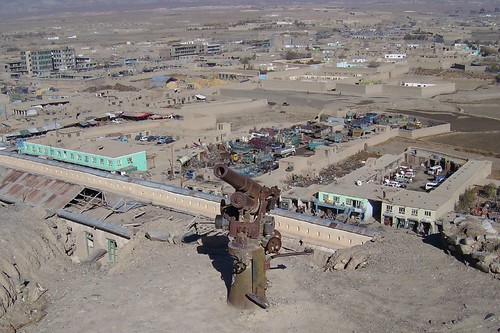
Russian cannon overlooking Gardēz
Maybe it’s not fair to transfer judgments from one incident to another, but the deaths of innocent Afghan civilians aren’t fair either. And ISAF is asking for trouble by posting the two stories right next to each other, an unflattering pairing.

Still working out the propaganda kinks we see.

Four days ago NATO launched its Defence Cultural Specialist Unit, comprised of 42 UK specialists in Afghan culture and language, to advise commanders in Helmand province. Part of President Obama’s frequently cited “civilian surge,” “the specialists will help identify and understand issues relating to the local cultural, political, economic, social and historical environment to help commanders make better and more informed decisions.”

The report states, “British troops, as part of ISAF, follow General McChrystal’s classic counter insurgency tactics - putting the people of Afghanistan at the centre of their work.”

Here’s hoping they do a better job than in Gardēz.

Yesterday a NATO investigation concluded, “that international forces were responsible for the deaths of three women who were in the same compound where two men were killed by the joint Afghan-international patrol searching for a Taliban.”

"We deeply regret the outcome of this operation, accept responsibility for our actions that night, and know that this loss will be felt forever by the families," said Brig Gen. Eric Tremblay, ISAF Spokesperson. "The force went to the compound based on reliable information in search of a Taliban insurgent and believed that the two men posed a threat to their personal safety. We now understand that the men killed were only trying to protect their families."

Initially it’s hard to gauge the sincerity of this backtracking. Until now NATO had maintained a position of denial, and notice that they didn’t conclusively determine what happened. Add the publicized harassment of British journalist Jerome Starkey, who exposed the truth of Gardez, and a forced confession could be the result.

This event has no bottom.

On the initial level lies a military cover-up; underneath are tactical errors on the battlefield. A rocket misses its target, US Special-Ops soldiers guns down innocent women in darkness. Accidents of war, we’re told.

"We are continuing our dialogue with our Afghan security partners to improve coordination for future operations and help prevent such mistakes from happening again," said Tremblay.

Yet it’s not like this happened a year ago. The event in question took place February 12th, 2010, when the war was supposed to turning around according to General McCrystal and the White House. Every time it’s the same “we take every precaution speech," along with assurances that knowledge of Afghan culture is a priority.

How much longer will these problems be “fixed” and yet continue to occur?

Deeper lurks the roots of chaos. A cover-up might be preferable in the long run because the reality could be worse. Cultural ignorance will be hard to stamp out in Afghanistan.

“The investigation found the releases issued shortly after the operation were based on a lack of cultural understanding by the joint force and the chain of command. The statement noted the women had been bound and gagged, but this information was taken from an initial report by the international members of the joint force who were not familiar with Islamic burial customs.”

"We regret any confusion caused by the initial statements and are committed to improving our coordination and understanding of Afghan culture and customs," said Tremblay.

Which means, until further notice, that US and NATO troops in towns and villages like Gardēz will continuing confusing men protecting their families for “insurgents” and Islamic burial customs as “bound and gagged.”

Back in Helmand province, Assistant Chief of the Defence Staff (Operations) Air Vice-Marshal Andy Pulford said of his unit, “Cultural awareness is at the heart of General McChrystal’s Counter Insurgency Strategy. This unit will help improve the military understanding and appreciation of the region, its people and how to do business there.”

America will have a hard time winning this war without one of these units in Gardez and every other town like it.

April 4, 2010

CNN's Remedy is Reality

The story has grown so big that CNN might be able to boost its ratings by reporting its decline.

But while you could spend hours on the blogosphere pondering CNN’s ailment, Dan Kennedy of Media Nation can save a lot of time. His theory, like the thousands analyzing CNN’s ratings, just needs a few tweaks. CNN hasn’t lost its essence, strayed outside its borders, or forgotten its purpose as a non-partisan news provider.

CNN is losing the expectations war.

Fox News and MSNBC viewers know what to expect, while significant doubts exists as to what CNN’s purpose is. Some believe it too neutral, others not neutral enough. Some believe it news, others don’t know what to believe.

From a distance CNN can simply appear too old. Larry King’s audience dropped 43% for the first quarter and 52% in March, down to 771,000 viewers from 1.34 million in 2009. As Kennedy says his time is over, and we will bash Larry. Rambling interviews with pop icons have no use in civil society.

King may also be what news junkies expect most from CNN, and are fleeing accordingly.

Elsewhere Anderson Cooper dropped 42% in viewers and 46% among the 25-to-54-year-old audience, his lowest ratings to date, while Campbell Brown also suffered her lowest rating. Real analysis is not expected of them. For non-informative commentary, the rambling duo of MSNBC’s Keith Oberman and Rachel Maddow is the void to turn.


At least viewers know what they’re getting - opinion, banter, and insults directed at the GOP.

Fox News also continues its rise, fresh off its biggest year in 2009 after Obama’s political opposition turned to an outlet outside the GOP. Greta Van Susteren is up 25% from the previous year, Bill O’Reilly up 28% to 3.65 million views, and Glenn Beck up 50%, fueled by his intentionally controversial actions.

And the ratings will only increase while Fox News is indulged as the villain by MSNBC.

These snap shots indicate that controversy beats real news and that CNN is sinking, but that isn’t necessarily the case. As CNN officials point out, the network is still profitable and well established, though the brand has lost its luster in the digital media age.

It also maintains more total viewers than MSNBC and Fox; the drop comes in the time viewers stay tuned to the channel.

CNN’s web traffic is up as well, although the same can be said for many news organizations. Regardless, its internet viewers dwarf Fox News and MSBC. The New York Times, America’s most visited newspaper online, closed the gap over the last year but remains behind for now.

No, the immediate problem isn’t monetary, viewers, or the choice to stick with the news, but coyness. Being a tool of the US government since the Gulf War, CNN’s analysts are hardly non-partisan or independent, and thus its “hard news” has always been relatively soft.

Take a look at this roster, aside from the bland band of Wolf Blitzer, John King, Anderson Cooper, Larry King, Campbell Brown, who offer no value whatsoever:
Fareed Zakaria
Joe Klien
Paul Begala
James Carville
Roland Martin
David Gergen
Jamal Simmons
Gloria Borger
William Bennett
Many of these figures are Washington insiders. Some are already inside the White House, others past players itching to return. The result is that few challenge the current order, yielding bland political analysis. For instance alleged heavyweight Fareed Zakara blames Arabs for tensions in the Israeli-Palestinian conflict, letting Israel and Obama completely off the hook.

The market is opening for more balanced reporting on Israel, but CNN hasn’t chosen to seize it. Compare CNN’s stable to Fox News’ “Great American Panel” and MSNBC’s own string of insiders and CNN looks no different. And isn’t that the point, to be different? CNN is losing that expectations battle.

But it can’t go back to its basics - it must build the basics it never had.

“CNN’s biggest problem may actually be its founding principles,” writes Michael Hirschorn of New York Magazine. “In an era when news flows like water—available everywhere, all the time, instantly—a network devoted to providing headlines topped with a touch of analysis no longer seems quite so useful. If anything, sitting down for 22 minutes to watch a middlebrow mix of politics and weather that’s too proud to dabble more than passingly in the latest Hollywood crack-whoredom seems... inefficient.”

Hirschorn’s statements only become truth when fused with Kennedy’s, but they contain several critical components. He describes CNN’s “founding principle” as “22 minutes of middlebrow politics.” What more could describe its problem? A market still exists for real politics, domestic and international.

CNN just hasn’t filled it.

“What I’d like to see,” says Kennedy, “is a smart, analytical approach that makes sense out of all the news tidbits we accumulate throughout the day, unafraid to call out lies and misrepresentations but nonpartisan in its overall approach.”

Though a large part of America lacks the interest to embrace this kind of news channel, another large part is waiting to devour it. A monopoly on the international news front is particularly up for grabs. Then again, CNN would lose its access if it called out lies and misrepresentations on both political sides.

So it will continue middling down the road, refusing to go all opinion while keeping its opinions out of the news, serving pure vanilla.

“CNN executives have steadfastly said that they will not change their approach to prime-time programs, which are led by hosts not aligned with any partisan point of view,” The New York Times reported after the ratings were released.

CNN’s saving grace is its war trio, and they would go along way were it to reemphasize world events. Currently Michael Ware wastes most of his time schooling other CNN analysts on America’s wars, and receives little overall face time as a consequence. You can notice him usually seated at the end of CNN’s infamously long analyst panels.

He should have his own show.

Nick Robertson is another excellent reporter who, if we were in charge, would be on TV all the time. Peter Bergen has his moments as well, but an NPR interview after President Barack Obama’s Afghanistan speech with Terry Gross paints an unflattering picture of him.

For those with Direct TV or who receive Link TV anyway, a fascinating report on the US media addresses, among many topics, how news organizations continually poll viewers to shape their content. The problem is that “hard news” sites are supposed to lead and shape opinion, not be shaped.

Fox and MSNBC gives its viewers what they want. CNN must give its viewers what they don’t want to see and hear: the real world.

As Kennedy concludes, “Maybe everyone would get off the network’s back about its poor ratings if it were offering not just an alternative to Fox and MSNBC, but one that is compelling and smart.”

We’re waiting.

Quote of the Day

"Great."

- Michael Oren, Israeli ambassador to the US, when asked by CNN's Cindy Crowly, "
I literally need a one-word answer. The state of U.S.- Israeli relations is..."

India Playing with Maoist Fire

India is giving off some heavily mixed signals. Maybe this is by design, in which case deception must be significantly taken into account, but the Naxalite rebellion’s explosion over recent years suggests disorder outweighs order.

The Maoists greatest advantage may not be poor, rural India, but New Dehli’s ego. Hopefully, for its own sake and the region’s, India is portraying a false front to disguise its upcoming operations. Otherwise the Red Corridor will continue to grow until one day, very much like Moscow, the Maoists strike at Indian cities and erupt the war.

This fate could still be avoided with the proper strategy, but waiting isn’t an option.

On the political front India appears genuinely willing to negotiate with Maoist officials, so long as they lay down their arms. This demand has ensured no actual movement in the diplomatic tract, and Maoist leadership isn’t exactly in a position to respond.

India’s real intentions might also be the opposite, but it is comforting nonetheless that Home Minister P Chidambaram keeps his private line open.

“We have invited them for talks after they abjure violence,” he told reporters after landing in West Bengal to survey the battlefield. “If they really want development, if they really want to solve problems of the people, they are welcome to talk. I have said we can talk about anything in the world. (They should) just give up violence.”

A wise strategy to offer an open invitation, whether the Maoists accept or not, since military force would have a more destructive effect anyway. At least when utilized alone. But it is also clear that some force is required when paired with political engagement and economic/social reforms - and that force must be effective.

Perhaps the lack of non-military operations has caused a military delay. It can’t be because India still underestimates the Naxalite insurgency, which is surging because of previous underestimating.

“No,” announced Chamberlain after meeting with local security officials, “we are not contemplating military action against Naxals and state police, state armed police and paramilitary forces alone will be deployed to fight the Naxals. Naxals are cowards. Why are they hiding in forests?”

Because they are guerrillas, and guerrillas thrive on the trivialization and pride of their enemy, capitalizing with a guerrilla’s most basic weapon - surprise. And if they were weak, how come Chamberlain himself admits recent security operations have yielded mixed results? It seems India hasn’t learned the full lesson yet, whose military officials are out in force to keep themselves above the fray.

As if the insurgency is beneath them.

Possibly the reason why Chamberlain rejected army assistance, new Army chief General Vijay Kumar Singh recently said the armed forces are already `assisting' central paramilitary and state police forces with training and logistics. But they don’t want to be directly involved in the counterinsurgency against Naxalism.

"The Naxalite problem is a law and order problem, which is a state subject,” he said after being sworn in on Wednesday. “It stems from certain issues on the ground, be it of governance, be it of administration, be it of socio-economic factors. Since it is not a secessionist movement, I think our polity is astute and wise enough to know the implications of using the Army against their own people.”

To a point Chamberlain and Singh’s assertions are logical. The conflict does stem from politico-economic factors and they don’t want to use a hammer to swat a fly. Nor do they want to dignify the Maoists with their highest force, which could encourage them as much as terrify them.

But that point ends with the claim that the Naxalites haven’t formed a secessionist movement. Not only is their declared goal a separatist state, Indian intelligence even links the Maoists to their counterparts in Nepal and elements of the LeT. This insurgency is both international and secessionist in nature, and to deny so is either posturing or naivety.

India is too intelligent to be naive, but intelligence also gives birth to pride. Indian Air Force Air Chief Marshal P V Naik, who took over as chairman of the chiefs of staff on Tuesday, said afterward that the armed forces don’t want to become involved in the conflict.

"If the scale (of the Maoist rebellion) becomes so big that the police and paramilitary are unable to handle it, then only will the government decide if the armed forces are to be involved,'' he said.

Well, the rebellion is so big that the police and paramilitary forces are unable to handle it. And after all, isn’t it an army’s duty to protect the state? Why can’t local, regional, and national forces work together? That would be real counterinsurgency, not this limited division of forces.

The reality is that India’s heads of its armed forces would be keeping quiet if the Naxalites weren’t getting out of control; they’re responding to pre-existing pressure. A state by state ad-hoc approach to the insurgency has resulted in failure, and New Delhi must soon adopt a national strategy whether it wants to or not. Decide and plan what to do now, not later, because there is no time to waste.

Eliminate the small before it becomes big.

If the Maoists believe they can triumph over local security forces and anti-Naxalite militias, they’re only compulsion will be to expand their territory, not negotiate the future of it.

April 3, 2010

Quote of the Day

"They [the NEC] have given me a lot of information that gives me confidence that the elections will start on time and that they will be as free and fair as possible. This has been a difficult challenge but I believe they have stepped up and met the challenge."

- US special envoy to Sudan Scott Gration, toeing the Khartoum line

White House Must Face Reality of Sudan

What planet has the White House been living on lately? Israel, Afghanistan, Iraq - add Sudan to the list of delusional behavior. Put it at the top even, in light of retired Air Force Major General Scott Gration’s current activity in the country.

The US envoy to Sudan told reporters three weeks ago in Nairobi, "There are going to be a lot of things that are keeping us from focusing on Darfur. That's why we have this little window where we really need to get the framework solidified. In the next two weeks I think we are going to see a real big focus on the election.”

Two weeks later Khartoum was hit by a cataclysm of oppositional boycotts, triggered by the withdrawal of Yasser Arman, the opposition candidate of the Sudan People's Liberation Movement (SPLM).

Arman fought with and was a personal friend of the late SPLM leader John Garang, and was the primary challenger to President Omar al-Bashir. Today Gration found himself in Sudan vainly pushing a last-ditch effort on the SPLM to salvage the sinking presidential election.

"We certainly hope the parties can reach agreement so there will be maximum participation,” said State Department spokesman Philip Crowley. “What's important here is to put together credible, legitimate institutions of government that can govern all of Sudan.”

That is certainly important, but of immediate concern is that Sudan lacks credible, legitimate institutions to run the election.

Grassroots activists and supporters of both the North and South are said to be agitating under the prospect of a delayed or canceled election. It’s hard to blame them having built up the entire apparatus only to see it come crashing down. According to the government around 15 million people of an electorate of 19 million have registered to vote, nearly 80% of all eligible voters.

Sudan's political-military opposition, fearful of sparking an internal backlash, has correspondingly kept the door ajar for partial participation in select districts. But the truth has been exposed for good.

Khalil Ibrahim, leader of the Justice and Equality Movement (Jem), Sudan’s largest opposition bloc, told Al Jazeera, "These elections are based mainly on false senses, especially in Darfur. Masses of populations... will be excluded from the elections. I don't think the other parties will accept this, there will be chaos and war if he [al-Bashir] wins."

“Security conditions in Darfur does not allow the elections to be held in its scheduled time, especially in West Darfur, and a large area in North Darfur,” added Mariam Al Mahdi, a spokeswoman for the Umma party.

Regardless of how many Sudanese people want free and fair elections, as that includes all of them, no one seems to believe the elections will be free and fair. Not al-Bashir, who rattled international observers all month, not the political opposition, and definitely not outside observers.

Prosecutor Luis Moreno-Ocampo, who called for the ICC arrest warrant issued last year against al-Bashir, sounded the alarm a day after Bashir threatened to expel international election monitors for saying the vote might delayed due to logistical problems.

Moreno-Campo told a Brussels seminar, “It's like monitoring a Hitler election. It's a huge challenge."

Indeed hundreds of monitors are supposed to police over ten thousand polling stations, and with limited international security; the US-based Carter Center, the largest US monitoring team, is sending only 60 observers. An estimated 16,083 stations, 10,335 of them in the north and 5,748 in the south, were set to open on election day.

And the Carter Center admitted even before the current meltdown that the election was, "at risk on multiple fronts."

"The elections for president is made for one person, it is not made for a democratic process or for the Sudanese people, it was only made to save General Bashir from the ICC," Arman said on Thursday as he stepped down.

And yet, when asked the next day to clarify the US position on a delayed election, Crowley responded, "At the present time, we're working hard to try to resolve these issues. I think we are still aiming for the election to occur on April 11."

Why is that?

Because the Obama administration possesses no strategy except to force feed this election upon the Sudanese people. John Norris of Enough! observes a root of the problem that has plagued the White House from the beginning - it’s divided on what to do.

“As yesterday's dueling statements made obvious,” Norris writes of Gration and UN ambassador Susan Rice, “the administration needs to start singing from a common song-sheet and hold President Bashir accountable for facts on the ground as it said it would when the Sudan policy review was first rolled out.”

Then there’s the problem of timing. If Sudan fails to hold its presidential election on schedule the referendum on secession in 2011 becomes a guaranteed time bomb, set to explode right in the middle of Afghanistan, a potential war with Iran, and in Sudan’s backyard, a new crisis in Zimbabwe.

2011 is hinting at pandemonium, partially because of Sudan, meaning Washington is trying to limit how many fires it must fight. In a way it’s hard to lay blame since Sudan doesn’t really have a solution, but eyes cannot be shut to reality.

Were Sudan to hold a corrupt election on schedule America would have just as big a mess on its hands in 2011, like Afghanistan.

And how do you offer a solution to vote-rigging? Please don’t rig the vote? The only thing Bashir really cares about is not being invaded. To this degree he will do the minimum to keep Washington off out of his territory, dangling the hope of reform in front of Gration and the West in general.

Right now America is propping up a regime accused of international war crimes, a staggering policy. Instead the White House should be preparing with the Pentagon for the worst case scenario, as it’s more likely than the best.

First, after the White House gets on the same page, an international political framework must be constructed for the event a postponed presidential election and referendum on secession. The latter is especially critical as al-Bashir stands almost no chance of letting the South break away. America needs agreements in place with the EU, UN, and AU before 2011.

When the time comes, and it appears destined to, the international community will be compelled to act on the violence that results from Sudan’s political turbulence, or face the consequences of inaction. Special-Ops teams should be covertly pre-positioned in surrounding African nations as first line responders. The primary military options should already be chosen, tested, and ready, whether that entails a peacekeeping role, military strikes, or funding the insurgency against al-Bashir.

The White House won’t get an extended period of time to review, and can’t wait until hell breaks loose to decide.

Sudan is shaping up to become one of Obama’s biggest foreign policy challenges, right before his re-election bid begins. Strategy for 2011 must already be deep in planning for a failed election and renewed civil war if he wants to avoid that fate.

Ignoring what the entire country is screaming is not a realistic option.

April 2, 2010

Quote of the Day

“Obviously some of the comments by President Karzai are troubling, they are cause for real and genuine concern. The amount of resources that have been dedicated to both deal with extremists in Afghanistan as well as to set up the type of government necessary at all levels.”

- White House spokesman Robert Gibbs

Karzai Fooling Obama

There’s no other way to put it and nothing funny about it. Afghan President Hamid Karzai’s latest statements, in which he blamed presumably his own fraudulent election on “foreign interference,” have made a fool of President Barack Obama and his recent jaunt to Afghanistan.

But the joke heard round the world is on more than him.

Repeatedly fooled by Karzai, the White House is hoping to cover its own mistakes by fooling US allies and the American people. Apathy to the war will run high until unemployment decreases and the White House will run as far as it can on Afghanistan until then. Maybe it’s time then to erect a roadblock, seeing that instability isn’t showing signs of decelerating.

US military officials would contend that progress is discernible to the well-trained eye. Opium seizures are up as DEA agents flood the country, multiple operations are driving insurgents out of population centers, Taliban popularity is in the teens. Across the border Pakistan has declared total war on its own Taliban, Tehrik-i-Taliban Pakistan, while improving ties with Washington.

Yet these military officials are the same ones who in 2009 began to preach that military progress is dependent on political progress, and who taught their civilian counterparts to speak the same. And how much “progress” is real when the political front in Afghanistan has been deteriorating since its disastrous national election in last August?

US strategy has suffered a string of explosions since then.

From the very beginning Afghan opposition candidate Abdullah Abdullah set a foreboding tone by boycotting the run-off in November. Having providing Karzai’s only protection during the corruption-laced election, US officials such as senior Obama official David Axelrod shrugged off Abdullah by saying he couldn’t win anyway.

Parliamentary elections, whose local nature many consider more significant, were subsequently delayed from May to September. Karzai also failed to form a full cabinet twice and has yet to complete the process, eight months after election day.

Lately he engaged in several suspicious acts, most notably issuing a decree below the radar that gave himself the right to appoint all five commissioners to the Electoral Complaints Commission (ECC), previously staffed by the UN. So when Afghanistan’s lower house of parliament rejected the decree recently, it became clear that Karzai was venting at both the then and now.

"There was fraud in the presidential and provincial election, with no doubt there was massive fraud," he told employees of the state election commission. "This wasn't fraud by Afghans but the fraud of foreigners, the fraud of Galbraith, of [head of the EU's observers Philippe] Morillon and the votes of the Afghan nation were in the control of an embassy."

But he also revealed, “Foreigners will make excuses, they do not want us to have a parliamentary election. They want parliament to be weakened and battered, and for me to be an ineffective president and for parliament to be ineffective.”

Obama had personally told Karzai during his secret rendezvous, “the American people are encouraged by the progress,” but no progress is visible in this chain of events. It is presumed that Obama knows this and was merely saving face, and that Karzai must don his anti-US mask for the public, but these assumptions aren’t entirely true.

Yes, Obama and Karzai must play their parts, but both are destructive acts. Afghanistan is a lie that keeps getting bigger and bigger before it ultimately collapsing. While fallout could occur if one side or the other spoke in truths, the final explosion will be all the worse if this spectacle continues uninterrupted.

And two parties outside of Afghanistan and Pakistan are particularly inside the blast zone - NATO and the US public.

The White House, having committed the original sins of sheltering Karzai and low-balling General Stanley McChrystal’s troop request, is now stuck in the sorry position of begging NATO allies for additional troops. The London Conference generated only 500 additional UK soldiers, leaving the White House scrambling to push its surge to 40,000.

Perhaps Washington’s lowly position explained its frustration.

“The demilitarization of Europe - where large swaths of the general public and political class are averse to military force and the risks that go with it - has gone from a blessing in the 20th century to an impediment to achieving real security and lasting peace in the 21st,’’ Defense Secretary Robert Gates told a NATO audience in February.

This was his way of asking for help.

Realizing the inefficiency of Gates’ methods, the White House quickly adopted the opposite approach. General David Petraeus wooed Turkey during an early March visit, implying the need for more trainers while never directly asking for more military assistance.

The end of March saw two more NATO members hit up. First Secretary of State Hillary Clinton culminated a week of rumors that America would ask Canada to extend its combat mission beyond 2011, its withdrawal date. Clinton, tongue in cheek, praised the excellence of Canadian forces - then denied making a formal request.

So did Canada, but that’s the point of a silent request, and apparently US denial wasn’t enough because Prime Minister Stephen Harper put his foot down twice. Too many Canadians oppose the war to leave any doubt.

Colin Robertson, a former senior diplomat at Canada's embassy in Washington, now a senior fellow with the Canadian Defence & Foreign Affairs Institute, put it succinctly: “This is all by design."

The same strategy was just applied to France as President Obama dined with President Nicolas Sarkozy. Their meeting generated a humorous New York Times editorial claiming Sarkozy must pay up for the Obama boost. Apparently Sarkozy got everything he wanted from Obama and now has the popularity to send combat reinforcements, trainers at the least.

But was the point to temporarily raise Sarkozy’s approval just to manipulate him for more troops? Is America so desperate in Afghanistan as to meddle in France’s internal politics, and doesn’t this process cancels itself out anyway? What’s the point of having France, or any country in the same situation, send more troops without the public support to sustain them?

The present reality suggests that NATO members secretly doubt Karzai and hence the military mission, otherwise they wouldn't be freezing troop levels when more are clearly needed, or dropping out all together. In every major country - the UK, France, Germany, Canada, Australia - a majority of the public opposes the war.

America is being forced down a unilateral path. Sarkozy made a rather clairvoyant statement when he beamed, “When Obama says something, he keeps his word. When he can, he delivers. When he can’t, he says so. So there are no surprises.”

Obama has told the American people that he thinks he made the best decision available, and that he thinks he can deliver victory, but surely he must know better that Afghanistan isn’t how he and his officials are portraying it.

The coalition clearly remains short of troops as well as trainers, which are supposed to be the linchpin of US withdrawal. Disagreement between Kabul and Washington over Taliban reconciliation may never be bridged. Pakistan remains strategically balanced between America and the Afghan Taliban, while India has no intentions of resolving the Kashmir conflict.

And it’s been proven that what’s good for Karzai isn’t necessarily good for America. Kandahar is a disaster waiting to happen with his half-brother Wali still running the provincial council and, allegedly, the opium trade.

US officials have resorted to warning him, according to one military official, “I'm going to be watching every step you take. I'm going to put you on the JPEL (Joint Prioritized Engagement Lis). "That means that I can capture or kill you."

Marvelous political strategy.

All of these factors point to one overriding conclusion: America cannot wait until December 2010, as planned, to review Afghanistan. This is simply an excuse to silence dissent. An immediate reversal in policy - withdrawal - is unrealistic so a first step must be formed in its place.

There is certainly some merit to sticking with a strategy and allowing time to yield results before evaluating, but conditions for the military surge don’t exist.

Afghanistan isn’t like Iraq 2007, where a tribal uprising was already developing. Rather than correcting mistakes before they become uncontrollable, Afghanistan feels like gambling more to pay back a gambling debt. The war requires constant modification and reconsideration, not hiding it in the closet until 2011.

Back in Canada for a G8 meeting, Clinton told reporters, "The last 15 months have demonstrated clearly the unwillingness of Iran to fulfill its international obligations.” Yet the same can be said for Karzai, whom she made no mention of. Former UN official Peter Galbraith could have easily been speaking of the White House as he defended himself from Karzai’s attack.

“What this really suggests is that Karzai has a slim connection with reality,” he said. “Frankly, I think Karzai is a bit unhinged."

Which means Obama is losing his grip on Afghanistan too, and if he falls the only ones laughing will be the Taliban.

April 1, 2010

The Caucasus: 9/11 Hall of Mirrors

The explosions and death tolls are incomparable, but there’s no doubt that the coordinated attacks on Russian infrastructure have a 9/11 feel. Maybe because every major terror attack - the UK, Spain, Pakistan, India, and now Russia - is styled in the 9/11 mold by the government and media for maximum effect.

9/11 analogies can be found in any US or international newspaper, but a multitude of similarities trump the “terrorist” link.

For starters Moscow’s response couldn’t be more American. First Prime Minister Vladimir Putin superfluously threatened, “We know that they are lying low. But it is a matter of honor for the security services to drag them out of the bottom of the sewers into the light of God.”

President Dmitry Medvedev was right behind him: "This job is even harder than looking for and destroying terrorists. But we will do it anyway, as well as establish order by using forcible methods."

Certainly there’s a high degree of political posturing going on here, especially since Putin’s image is sliding in the wake of a surging Chechen insurgency, but what could be more 9/11? How about missed warnings, Osama bin Laden, and Afghanistan?

Andrei Soldatov, an investigative reporter who covers Russian security agencies, claims the Federal Security Service of the Russian Federation (FSB) ignored early signs the rebels were shifting tactics and preparing to resume attacks in Moscow. How that’s possible seems impossible, very 9/11-ish. Last month Chechen rebel leader Doku Umarov, aka Dokka Abu Usman, threatened to target Russian population centers.

Following Osama bin Laden’s blueprint, the “Emir of the Caucasus Emirate” warned in February, “If Russians think that the war is happening only on television, somewhere far off in the Caucasus, and it will not touch them, then we are going to show them that this war will return to their homes.”

Like bin Laden, Umarov’s threats went unheeded.

"You Russians only see the war on television and hear about it on the radio, and this is why you are quiet and do not react to the atrocities that your bandit groups under Putin's command carry out in the Caucasus," Umarov says in a 4.5-minute video released yesterday. "I promise you that the war will come to your streets, and you will feel it in your lives and under your skin."

Shamsuddin Botokayov, a representative of the "Caucasus Emirate,” told Al Jazeera, "Our emir says he wants the Russian people to wake up and to tell Putin and his government to leave the Caucasus and go back home. The emir says that this attack will not be the last, the coming will even be bigger.”

Yes, bigger. Sergei Lavrov, the Russian foreign minister, said foreign involvement in the attacks had not been ruled out.

"We all know very well that clandestine terrorists are very active on the border between Afghanistan and Pakistan," the Interfax news agency quoted him as saying. "We know that several attacks have been prepared there, to be carried out not only in Afghanistan, but also in other countries. Sometimes, these journeys go as far as the Caucasus.”

But the ultimate question is how far Russia will go in mirroring 9/11. Will it follow the usual script and further inflame the situation in the Caucasus through force and oppression? Or will it learn from America’s mistakes and apply counterinsurgency to an insurgency instead of predictable counter-terrorism?

Russian leaders are sending mixed signals.

"We destroy terrorists and will continue to destroy them," Medvedev said, who also boasted of “annihilating” previous insurgents. "But it is much more difficult to create correct, modern conditions for education, for conducting business, for overcoming the clan system."

The latter rhetoric would be flowing if a radical shift in Russian strategy had materialized, not thrown in at the end. Medvedev had been doing well to succumb to the reality of poverty in the Caucasus region, but not slipping back into iron fist mode has proven challenging. He must hold strong if he sincerely understands the roots of conflict.

The wiser approach to the Caucasus, no matter how deadly the insurgent network grows, is what Medvedev described back in June 2009 - a politico-economic solution.

“It is no secret to anyone here that these problems in the North Caucasus, and in the south of our country in general, are systemic,” he said in Daghestan. “By saying that, I am referring to the low living standards, high unemployment and massive, horrifyingly widespread corruption.”

Gennady Gudkov, the deputy chair of the security committee of the State Duma, recently acknowledged, "It's not tough actions against terrorism that fuel tensions, but the violations of human rights that happen because of the incorrect actions of law enforcement organs and power structures. The population today often suffers from lawlessness coming from the law enforcement organs."

Originally we were going to advise, in the chaotic aftermath of the bombings, not to rush back into old habits. Now is the best time to demonstrate new learning, keep anger in check, and patiently hold the course towards social development. But those US newspapers that aren’t calling for Umarov’s head already have this basic truth covered.

Many Russians know it well.

So instead we’re looking towards will happen, not what should happen, and judging by Russia’s behavior the forecast is more gun showers and bomb blasts. Accordingly this is exactly what Umarov and most Chechen insurgents desire, for Russia to swallow the bait of their attacks - an 9/11 type response.

"The FSB is still inclined toward a shoot-to-kill policy in the North Caucasus," Soldatov said. "This approach works against large groups of militants in the forests but not against would-be suicide bombers. They simply love their brutal tactics.

Speaking to Al Jazeera, human rights worker Magomed Mutsolgov, a human rights worker in said in Ingushetia, "There will be some tighter security here, more police checks, even rough violent checks, not just because of what happened in Dagestan but also in Moscow. And across all the north Caucusus there will be more raids, and lots of checks of suspicious people.

"There will be various lists – relatives of people who died, relatives of militia, relatives of victims,” says Mutsologv. “I'm sure there will be more violations, persecutions and discomfort for people. To put it mildly. I don't doubt this will happen.”

Which in turn will coincide with and spawn more insurgent attacks; reports indicate the female suicide bombers were part of a team of 30 Black Widows. It will be a shame if Russia misses the opportunity to blaze its own counterinsurgency and instead justifies another gamble on roulette-style counter-terrorism.

But, like 9/11, we expect the war to detonate again afterward.