February 2, 2013

U.S. Accelerates Cycle of War In Yemen

Hopefully U.S. officials will demonstrate a greater understanding of low-intensity conflict 100 years from now.

With the tide of war seemingly turning for the better in Somalia and Yemen, two long-standing sources of concern for Washington, the National Defense Industrial Association’s 24th Annual Special Operations and Low-intensity Conflict Symposium provided a fitting venue to tout the effectiveness of U.S. counter-terrorism. Anchoring the event were two heavyweights of America's Special Forces - Navy Adm. William H. McRaven of the United States Special Operations Command (SOCOM) and Michael A. Sheehan, Assistant Secretary of Defense for special operations and low-intensity conflict - who reviewed the “innovative, low-cost approaches” being rolled out by the Obama administration.

This hybrid strategy of "small American footprints” and "building partner capacity" is widely praised by U.S. General Carter Ham, commander of AFRICOM, as the future of America's global counter-terrorism operations, and is currently being unveiled around Mali.

One assumes that the Pentagon expects eventual success against the militant alliance dug into northern Mali, given that Sheehan sees "good results" in Somalia and Yemen. Recent developments in Mogadishu are admittedly significant and, if nurtured, could present a genuine opportunity to decelerate the country's vicious mixture of clan warfare, insurgency, terrorism and foreign intervention. As for the evolution of U.S. policy, the aftermath of Black Hawk Down would necessitate adaption and serve as the mother of invention. Proxies needed to be applied instead of U.S. ground troops, inside and outside Somalia, and within the multilateral framework demanded by multinational insurgencies.

Once Ethiopia's U.S.-supported invasion failed to pacify the country on their terms, the African Union finally took over and scaled up its mission with Western financing.

Three years of hard fighting, punctuated by U.S. drone strikes and Special Forces raids, have now driven al-Shabaab out of its urban bases and into a weakened state. Despite numerous outstanding political issues, such as clan representation and the territorial status of southernly Jubaland, a new government is in the process of jumping from transitional to legitimate. Of course America's (and the European Union's) "small footprint" has been stamped on Somalia for years: Special Forces on the ground, CIA manning Mogadishu's "secret" interrogation center, PMCs training Somali soldiers, flotillas along the coast and drone bases at its corners.

This network also comes with the "small" price of Ethiopia and Uganda's heavy assistance, reinforcing the non-democratic elements of partner building. However these issues have escaped the American majority and pose no real threat to Somalia's portfolio, hence the general success.

Equally unconcerning to the majority of Americans (but no less frightening) is an opposing scenario across the Gulf of Aden. Here Shehaan appears to be even more bullish about the prospects of U.S. special operations, using phrases that few Yemenis outside the government would apply to their country's situation. For years they have watched U.S. policy in Yemen revolve single-mindedly around the presence of al-Qaeda in the Arabian Peninsula (AQAP), and seen the group's influence expand over the same period of time. Yet the Assistant Secretary of Defense claims that, after several years of interrupted operations, U.S. Special Forces and intelligence personnel have finally helped Yemen's government “turned the corner" against AQAP.

“A year ago in Yemen," Sheehan told his receptive audience, "al-Qaida had taken over vast swaths of territory... and was really threatening the state in Yemen, and also threatening to re-establish some capabilities that were very problematic. Over the past year, we’ve made great progress in Yemen.”

Denying the progress of intergovernmental relations between Washington and Sana'a is impossible. Until this past year, U.S. policy remained hitched to the corrupt and duplicitous behavior of strongman Ali Abdullah Saleh, who traded drone strikes for U.S. favoritism and shared intelligence only when his interests needed protecting (or his enemies needed bombing). He was even known to utilize local jihadists for his own ends, paying them or arresting (and later releasing) them in order to create artificial instability and secure U.S. funds/weapons. The Obama administration managed to replace Saleh with his vice president, Abd Mansur Rabbo Hadi, in response to a nation-wide revolution, and U.S. operations have smoothed since he assumed command in February 2012. 

The time between December 2009 and 2012 verged on calamity though, and Washington's “partner building” would have failed spectacularly if continued under Saleh's regime. The Obama administration, in the end, lucked out during Yemen's revolution, but a sustainable partnership with its people remains absent.

What McRaven and Sheehan didn't explain to their audiences is how U.S. policy contributed to AQAP's influence in the jihadist world and its local support with Yemen's tribes, brought on by unaccountable military operations in their lands. The Obama administration would ramp up vertically in response to Umar Farouk Abdulmutallab's failed bombing on Christmas 2009 and never look back. From the civilians killed by initial cruise missiles and drone strikes to Ma'rib's deputy governor Jabar al shabwani, to Anwar al-Awlaki's 16-year old son and younger civilians, the administration has struck with impunity during its hunt for AQAP leadership. All of these strikes were enabled by a secret agreement between Saleh and former CIA Director David Petraeus, then commander of CENTCOM, who passed along the arrangement to his nominated replacement, John Brennan. 

Amid Yemen's revolution, construction of a drone base along the Saudi border was also reportedly accelerated from two years to eight months.

McRaven says that all U.S. Special Forces are invited by foreign governments and don't operate without their permission - except this process can error militarily and trample over democracy along the way. The outbreak of Yemen's revolution would compel Saleh to distort the situation with AQAP, creating a false analogy that now serves as the driving rationale of U.S. policy. Beyond leveraging access to Yemen's air-space in return for political protection, Saleh relocated some of his U.S.-trained "counter-terrorism" forces to kill protesters and ordered others to stand down, which enabled AQAP's takeover of "vast swaths of territory" in Yemen's south.

Now the two governments must take back the same territory that they just lost due to incompetence, short-sightedness and greed.

While greater cooperation with Yemen's government has been attained in the aftermath of Saleh's resignation, U.S. policy has also reached the depths of unpopularity with Yemeni civilians, activists and tribes. How much these factors offset military achievements is difficult to gauge, but the chain reaction is visibly evident. Yemenis universally cringed as President Barack Obama promoted a public enemy to bomb their country. They reject foreign interference from Washington and nearby Riyadh, as does, coincidentally, AQAP. It's true that America is leaving smaller footprints in Muslim countries, only these boots are still relatively large and obtrusive, and they cannot defeat al-Qaeda's ideology without the help of Yemen's people. The Pentagon's argument is thus circular: U.S. counterterrorism is both poison and cure, but ultimately perpetual rather than remedial.

A recipe for low-intensity conflict in Yemen.

February 1, 2013

Taliban "Rift" Conceals Similar U.S. Divisions

As some parts of the Obama administration explore safe passage out of Afghanistan and Pakistan's harsh battlefields, other parts must remain on the offensive in their campaign against the Taliban network. This asymmetric task naturally extends beyond the military battlefield to global media, where the battle for Afghanistan is waged just as fiercely by the Taliban and NATO forces.

Both sides follow the rule of Propaganda 101: lead with truth and end in falsity.

Speaking to Jim Michaels, USA TODAY's military editor, on the topic of Mullah Omar's "code of conduct," Pentagon official David Sedney says that Omar's order to avoid civilian casualties has agitated the foot soldiers that rely on IEDs and suicide vests to attack U.S. and Afghan convoys. This order was first given in response to the Obama administration incoming surge, as part of its own PSYOPS for Afghan "hearts and minds," but the operational side of Omar's tactic didn't fit with the Taliban's style of fighting. Unarmored guerrillas need explosives to counter NATO armor and penetrate security countdowns, and the constant nature of IEDs inevitably outpaces the civilian casualties from U.S. air-strikes and raids. 

Sedney, a deputy assistant Secretary of Defense, paraphrased the thought process of an average Taliban gunman: "'You're telling us to keep fighting and we have no choice but to use those methods.'"

"That's creating a lot of tension."

The Pentagon is obviously motivated to announce its interpretation through the U.S. mainstream (and in a brief report with no alternative viewpoint). Faced with a disbelieving, war-weary public and the sobering reality that the Taliban isn't near capitulation, the Obama administration must pry inside the insurgency in order to generate negotiating leverage in 2013 and 2014. Effectively spreading division amongst the Taliban's long-term strategists could be a quick means of bringing pragmatic individuals into Kabul's political fold, or at least driving some foot soldiers into reconciliation programs.

"It's already clear that some parts of the Taliban are interested in a political solution," Sedney explains.

However the Taliban are likely to unite against any Pentagon official, and Sedney's rhetoric appears to be aimed at Americans before Afghans. His points of friction are common knowledge to the Taliban and foreign observers alike; The Daily Beast and other U.S. media have covered the issue in relative detail by tracking down players in the Taliban's mid-level and senior leadership. The "very large losses" endured by foot soldiers is frequently cited as a main source of contention, and one can imagine the feelings of disgruntled or tired guerrillas as they question Mullah Omar's alleged home inside Pakistani territory. 

Sedney and the Pentagon may be correct to assume, "The contrast between that and the life of the leaders who are staying in Pakistan has become even greater." Yet the Taliban remains operational and potent to this day - U.S. officials are engaging in PSYOPS precisely because the insurgency has maintained a resilience beyond Washington's public expectations. Unless the Taliban's leadership makes an exceptionally rash decision, few guerrillas out of some 25,000 will ultimately choose Kabul's authority and the presence of American soldiers over "The Commander of the Faithful." Most soldiers fight far from their supreme commanders anyway, and managing to assassinate Omar wouldn't guarantee their surrender. 

Additionally, Omar's shura should be interested in a political solution because the Taliban lack the strength needed to openly defeat a conventional army. Stalemate is victory and political power the prize.

Omar's dilemma lies in the terms that Washington, at this point, refuses to give him: the withdrawal of every last American soldier, spy and war plane. Thus the Taliban is compelled to wage war until 2014 at the earliest, when its actions may force the U.S. into a smaller post-2014 role, and possibly beyond to secure control over its traditional territory. This policy could create the same political threat to U.S. influence that Muqtada al-Sadr and Hassan Nasrallah pose in their respective countries.

Nor is the U.S. position towards Afghanistan's hazardous negotiations any surer than the Taliban's. Three years after President Barack Obama's first surge troops landed in Kandahar and Helmand provinces - with the intention of "breaking the Taliban's momentum" and strong-arming Omar to the negotiating table - Ambassador James Cunningham recently told reporters that the “process that hasn’t even really begun.” Washington as a whole remains split over its options: negotiate soon or continue fighting until the Taliban's leadership softens its terms over a long-term U.S. presence.

The White House and Pentagon are also locked in disagreements over how many troops to leave, who to leave, how long to leave them, and the types of missions they will be assigned. This decision was initially expected in December 2012 and later discussed during President Hamid Karzai's stateside visit in mid-January, when an implausible "zero option" was floated for political purposes. A final decision on the extension of U.S. forces hinges on a wide variety of competing factors in Washington, Kabul and Islamabad. The result is two opposing scenarios of equal instability: the U.S. will lose its military presence in the end, as in Iraq's case, or keep a military-intelligence force and continue fighting indefinitely until one side concedes politically.

Iraq's ongoing insurgency suggests that Afghanistan's war won't be ending when Obama says it will.

January 30, 2013

UN Face Masks US-Saudi Counterrevolution In Yemen

Yemenis march against Saleh's immunity agreement with the GCC and UNSC

The United Nations Security Council (UNSC) recently landed a team in Yemen to assess the country's political situation and lend support to a planned National Dialogue, which has been delayed several times since its scheduled opening in November 2012. The busy delegation would hold its own council with many of Yemen's political actors, including President Abd Mansur Rabbo Hadi's transitional government, the country's Military Committee and National Dialogue Technical Committee, and representatives of the ruling General People's Congress (GPC) and oppositional Joint Meeting Parties (JMP).

"We believe that President Hadi's leadership has been instrumental in driving forward the reforms necessary to make Yemen a more stable and prosperous country," British representative Mark Lyall Grant said as foreign sponsors met to discuss the progress of the Gulf Cooperation Council's (GCC) power-sharing agreement.

The UN's representatives surely arrived in Sana'a with good intentions to aide Yemenis during a time of crisis and hardship. Assisting their new president has become the pillar of international efforts to prevent civil strife between Yemen's array of political actors, re-energize the country's crippled economy, and roll back the influence of al-Qaeda in the Arabian Peninsula (AQAP). To his credit Hadi has performed beyond expectations in his quest to achieve independence from his former boss, Ali Abdullah Saleh, and is gradually nudging the dictator's relatives out of their political and military positions. Without Hadi's perceived neutrality, Yemen's diverse set of actors would struggle to find an individual capable of guiding the country through a National Dialogue.

However this same earnestness doesn't apply to the powers that these individuals represent, and rarely has a UN mission been dominated by so few powers. In reality the UNSC is minimally involved with Yemen's crisis. The political transition that its officials speak of originated in the back-channels of U.S.-Saudi relations, conceived with the intention of salvaging the useful remains of Saleh's regime and the influence they amassed within Yemen's government. The GCC's power-sharing deal was initially crafted by U.S. and Saudi diplomats in conjunction with Saleh's GPC and the equally unpopular JMP, as a means of splitting power amongst themselves.

Left out of the equation were the civil revolutionaries that forced Washington and Riyadh to intervene against their cause of a sovereign Yemen.

This private agreement was eventually passed along to the GCC itself and signed by Saleh in Riyadh, far from Yemen's street demonstrations, before undergoing final ratification in the UNSC. Unlike in Syria or Libya's geopolitical war zones, the UNSC's five permanent members had already unified around the U.S.-Saudi position in Yemen and approved the measure unanimously, adding the final veneer of international law to the GCC's "initiative." Among those conditions endorsed by the UNSC: immunity for Saleh and his family, the powers responsible for mismanaging Yemen and attempting to violently suppress the country's revolution.

UN officials have argued otherwise at infrequent points, claiming that those responsible for human rights abuses should face justice, but that argument invalidates itself. UNSC Resolution 2014 accepts the GCC initiative and all of its conditions as the basis of the UN-sponsored "political transition," a term used by foreign officials in lieu of revolution. While Resolution 2014 "stresses that all those responsible for violence, human rights violations and abuses should be held accountable," its legal wording is theoretical rather than practical - Saleh and his crew "should" or "must" be held accountable, but they won't be. Instead UN and U.S. officials surface on occasion to remind certain "spoilers" that sanctions could be levied on them, but only if they don't obey the powers in control of Yemen's transition. The strongman and his relatives possess too much information on U.S. and Saudi to see an international court or endure Western-Gulf sanctions.

Coordinating their actions with the UN's, Yemenis rallied over the weekend to hammer their objective into diplomatic minds and repeat their demands to prosecute Saleh for crimes against humanity.

A letter written by Yemen's Nobel Laureate, Tawakkol Karman, delivered the following message to the UNSC's delegation: "Though the GCC-brokered deal, its implementation mechanism and UN Security Council resolutions envisaged the departure of Saleh and his family from power and politics in general, and despite the fact the deal has granted him immunity from prosecution, Saleh is still leading the General People's Congress (GPC) to take revenge at the political and public life in Yemen. Our people and great youth are waiting for your resolutions to openly bind Saleh not only to step aside as the chairman of the GPC, but also to quit politics once and for all, or else the transition will either fail or stall at best."

To this end Karman has urged Hadi to quit Saleh's GPC and form an independent party.

The Saleh family's immunity isn't the GCC and UNSC's only transgression. These blocs conveniently arranged for Hadi to replace his boss after serving for nearly 18 years as his vice president, a suspect trade-off in itself. After being selected by foreign powers to maintain their relationships, Hadi was then "elected" by a single-candidate referendum and tasked to lead the country through a two-year political transition, culminating in true elections in 2014. This policy continues to carry its positives and negatives into the future, as Hadi has utilized every ounce of strength and intelligence to hold the country together. Problematically, he also serves as an obvious tool of Washington and Riyadh, and has opened the skies to U.S. drones in an effort to secure influence with the Obama administration.

The controlled transition that is supposed to prevent civil war serves a double purpose of maintaining Yemen's status quo.

Yemen's National Dialogue has also been delayed for multiple reasons and, in the best case scenario, won't be held until months after its original date. On one hand a conference of this magnitude cannot begin until positive conditions are established, but a handful of delays could impact future electoral time-lines and reform policies. The main cited problem is the exclusion (or inclusion, depending on the viewpoint) of Yemen's Southern Movement, whose split leadership cautiously approached the process and has yet to make a final decision. UN and GCC officials have spent most of their energy trying to secure the South's participation, and for good reason since a National Dialogue goes nowhere with half of a country. Except the UNSC's position is determined by powers that oppose South Yemen's secession and refuse to allow self-determination; among the motivating factors is a loss of control over al-Qaeda's sanctuaries in the south.

UNSC Resolution 2014 begins by, "Reaffirming its strong commitment to the unity, sovereignty, independence and territorial integrity of Yemen." Responding to the UNSC's delegation, protesters gathered in the southern port of Aden to reject its coercion and chant, "The decision is ours."

Additionally, the JMP has publicly refused to participate in the National Dialogue if Saleh represents his GPC party, and the JMP in turn has interfered with the youth's efforts to be represented. The most seats went to Saleh's party, Southerners and JMP - in that order - leaving the youth and women's movements with leftover crumbs (60 combined seats out of 565). As a result, Yemen's civil movement has encountered disagreements over how deeply to participate and receives little attention from the international community. The country's northern-based Houthi sect has remained similarly ambivalent about a National Dialogue; its thirst for autonomy mirrors the outright hunger in Yemen's south.

A national summit is badly needed and clearly preferable to violence, but its current state is likely to inflame tensions and divisions rather than alleviate them. Yemenis must also be left to their own choices rather than be forced by foreign hands.

Yemen's present situation combines the local dilemmas of sharing power with the international dilemma of hoarding influence, and cannot move forward until numerous preconditions are established. Otherwise a dialogue stands a high chance of collapsing or becoming irreparably corrupted by self-interests (think Bahrain), at which point Yemen will continue along a dangerous course until 2014's wildcard elections. According to UNSC Resolution 2014, the implementation of the GCC's power-sharing agreement "is essential for an inclusive, orderly, and Yemeni-led process of political transition." Unfortunately this statement fails to conform with reality or else the whole initiative would be altered - or it may not exist to begin with.

Until Washington, Riyadh and their proxies elevate sovereignty to the top of Yemen's agenda, long-term hegemony will cast a destabilizing shadow over the country's future.

January 29, 2013

U.S. Drone Base Headed For North Africa

After months of speculation that concrete plans would begin to take shape, the theoretical is finally nearing reality in an undecided North African location.

For more than a decade U.S. military and intelligence officials have laid the groundwork of a "light" but vast network across the Sahel region, chasing al-Qaeda affiliates that have spun off their own franchises. In order to counter impressions of colonialism, utilize local forces and intelligence, and keep large numbers of U.S. troops off the continent, this process hinges on bi-lateral and multi-lateral relations with cooperative African states. Included are a series of joint forward operating bases constructed through the Sahel, and training programs between national and U.S. forces.

The same program that failed amid Mali's coup and left Washington to patch together a emergency response, as reported by The New York Times earlier this month: "American spy planes and surveillance drones have tried to make sense of the mess, but American officials and their allies are still scrambling even to get a detailed picture of who they are up against."

The next logical step of a bigger presence in North Africa is drone bases in friendly (and needy) countries, and that is where the Obama administration and its partners are headed. Neighboring Niger has been designated as the leading candidate - few African leaders have urged a quicker NATO intervention than President Mahamadou Issoufou - followed by Burkina Faso. The latter currently serves as the base for clandestine PC-12 surveillance aircraft.

The military necessities of a drone base or, more likely, a series of bases around Mali is clear enough. American military commanders and intelligence analysts have good reason to complain about “sorely lacking" information in northern Mali, a territory roughly the size of France and many times more extreme. This environment has already created hurdles for logistics and overflights, and plays into the hands of militants in control of mountainous desert until international air-power scales up (at which point guerrillas lose their advantage).

The task will increase in difficulty when Ansar Dine, al-Qaeda in the Islamic Maghreb (AQIM) and Movement for Oneness and Jihad in North Africa (MUJAO) fall back to their mountain bases along the Algerian border.

America is the only state capable of delivering the level of surveillance required to effectively coordinate African ground forces with Western air power; eliminate U.S. support and NATO's mission in Mali will collapse. However U.S. officials won't be as candid about the litany of questions and concerns that drones entail. Suffice to say, drone bases function as instruments of control and are never built without strings attached. This manipulation goes both ways too, especially when an unpopular government makes use of U.S. support to buttress its international standing (Yemen and Ethiopia being primary examples). Some observers suspect that Issoufou is operating along these lines.

Mali's conflict has now afforded the perfect opportunity to begin building the first of several "lily pads" in the desert, a plan that is designed to synchronize with greater numbers of U.S. Special Forces and intelligence operatives. U.S. officials say that the drones will fly unarmed over Mali, but Mali is bigger than Mali to both the international community and al-Qaeda's ideology. Each side is thinking in decades, not months or years, and U.S. drones will eventually be armed. Consider the force brought to bear in Yemen, a smaller and more accessible country that houses a similar number of al-Qaeda militants.

Everything is a matter of time in North Africa. A NATO intervention in Libya that, according to the opinion of U.S. intelligence, overwhelmed U.S. military planners in Mali is now being trailed by a spine of bases into the Sahara. Within the alleged chaos lies a chain reaction so precise and efficient that it belies the region's unpredictability.

January 28, 2013

Counting Down to 2014 in Afghanistan

By Ann Jones, published at Tom's Dispatch:
Kabul, Afghanistan -- Compromise, conflict, or collapse: ask an Afghan what to expect in 2014 and you’re likely to get a scenario that falls under one of those three headings. 2014, of course, is the year of the double whammy in Afghanistan: the next presidential election coupled with the departure of most American and other foreign forces. Many Afghans fear a turn for the worse, while others are no less afraid that everything will stay the same.  Some even think things will get better when the occupying forces leave.  Most predict a more conservative climate, but everyone is quick to say that it’s anybody’s guess.

Only one thing is certain in 2014: it will be a year of American military defeat.  For more than a decade, U.S. forces have fought many types of wars in Afghanistan, from a low-footprint invasion, to multiple surges, to a flirtation with Vietnam-style counterinsurgency, to a ramped-up, gloves-off air war.  And yet, despite all the experiments in styles of war-making, the American military and its coalition partners have ended up in the same place: stalemate, which in a battle with guerrillas means defeat.  For years, a modest-sized, generally unpopular, ragtag set of insurgents has fought the planet’s most heavily armed, technologically advanced military to a standstill, leaving the country shaken and its citizens anxiously imagining the outcome of unpalatable scenarios.


The first, compromise, suggests the possibility of reaching some sort of almost inconceivable power-sharing agreement with multiple insurgent militias.  While Washington presses for negotiations with its designated enemy, “the Taliban,” representatives of President Hamid Karzai’s High Peace Council, which includes 12 members of the former Taliban government and many sympathizers, are making the rounds to talk disarmament and reconciliation with all the armed insurgent groups that the Afghan intelligence service has identified across the country. There are 1,500 of them.


One member of the Council told me, “It will take a long time before we get to Mullah Omar [the Taliban’s titular leader].  Some of these militias can’t even remember what they’ve been fighting about.”


The second scenario, open conflict, would mean another dreaded round of civil war like the one in the 1990s, after the Soviet Union withdrew in defeat -- the one that destroyed the Afghan capital, Kabul, devastated parts of the country, and gave rise to the Taliban.


The third scenario, collapse, sounds so apocalyptic that it’s seldom brought up by Afghans, but it’s implied in the exodus already underway of those citizens who can afford to leave the country.  The departures aren’t dramatic.  There are no helicopters lifting off the roof of the U.S. Embassy with desperate Afghans clamoring to get on board; just a record number of asylum applications in 2011, a year in which, according to official figures, almost 36,000 Afghans were openly looking for a safe place to land, preferably in Europe.  That figure is likely to be at least matched, if not exceeded, when the U.N. releases the complete data for 2012.
Continue Reading

January 26, 2013

Iraqi Protests Highlight U.S. Insensitivity To Asymmetry

If a government genuinely seeks to deescalate a political confrontation with its citizens, opening fire on a rally entitled "Friday of No Retreat" would not be part of its agenda. Iraq's Prime Minister, Nouri al-Maliki, believes otherwise: that he has limited need for support outside his Shia base, and that he can maintain power through his second term regardless of the opposition massing against him. 

On Friday al-Maliki's security forces (he unconstitutionally holds the Interior and Defense Ministries) fired into an enormous anti-Maliki rally in Fallujah, killing five protesters and wounding at least 40. This dangerous omen of future events also extracted a small amount of "concern" from one of al-Maliki's foreign allies.

"We are concerned about the use of deadly force during today’s protests in Iraq," the State Department's Victoria Nuland told reporters after Friday's shooting. "We understand that the Iraqi Government has now issued a statement indicating that they are initiating a very prompt investigation into the incidents, and that they have called for restraint by security forces. We obviously stand ready to assist in that investigation if asked, but we would also say that as the government and government forces show restraint, the demonstrators also have a responsibility to exercise their right to protest in a nonviolent manner, as well as to continue to press their demands through the political process."

More obvious is the fact that the White House wasn't prepared to respond unless prompted to, whereas the same outburst in neighboring Iran or Syria is liable to trigger a harsher critique. An established pattern of U.S. bias can be traced back to the start of Iraq's latest outbreak of demonstrations, one determined by the Obama administration's personal relationship with al-Maliki - which connects a direct line of responsibility to Washington. As the White House has been unresponsive to Iraq's two-year crisis between al-Maliki and a diverse opposition of Sunni, Shia and Kurdish actors, so too has the Obama administration taken another pass on the protests that have sprung from this gridlock. 

At no point have protesting Iraqis been seriously addressed by the Obama administration or international community.

Instead they have been ignored, or else told to refrain from violence and engage in "dialogue" with the uncompromising Premier. Two weeks ago Martin Nesirky, spokesperson for UN Secretary-General Ban Ki-moon, told reporters that Martin Kobler, the Secretary-General’s Special Representative for Iraq, had "called on the protesters to refrain from violence and to maintain the peaceful character of their demonstrations." Nesirky added that Kobler expects Iraqi security forces to exercise "the utmost restraint in maintaining law and order," and hopes that all sides “engage without delay in a peaceful and constructive dialogue... in accordance with the Iraqi Constitution and Iraqi law."

Nuland stated on January 3rd, "Again, I think I said that we have been concerned about incidents of violence that – by various parties. And so we are again making it clear that if protests are peaceful, that’s one thing, but if there are incidents that incite violence or that are violent on any side, that would take Iraq backwards.”

This thinking is demonstrably backwards. While citizens generally have a responsibly to express their political beliefs and demands peacefully, Iraqis don't occupy an ordinary position. A majority didn't vote for al-Maliki's coalition and have no interest in his leadership, but are stuck with a tyrant until the opposition can remove him through political means. Al-Maliki's second term is a product of his savvy, the Iraqi opposition's inability to unify the necessary numbers to sideline him, and the foreign powers - mainly Washington and Tehran - that assisted in returning him to office. Iraqis have been shut out of Baghdad's political process and suppressed by their own government, therefore civil disobedience and low-intensity violence become legitimate political expressions. 

In terms of dialogue, al-Maliki's unconditional grip on various Iraqi ministries, agencies and courts invalidates a dialogue "in accordance with the Iraqi Constitution and Iraqi law." As The Trench has repeatedly pointed out, these demands are non-negotiable and should not be treated as such by foreign diplomats. 

Ceding his unconstitutional powers should be a precondition for a dialogue on national issues.

Attempts to compare protesters' actions with the governments' are similarly inaccurate; the responsibility to abstain from violence rests on the government before individual citizens. Diverging accounts explain why security forces began shooting, but both outcomes are inexcusable. Witness and government accounts claim that protesters began throwing rocks and other objects at Iraqi soldiers deployed to maintain order (and intimidate protesters), forcing them to defend themselves. Other Iraqis said that the soldiers opened fire after ordering protesters to stop filming their rooftop positions around al-Etisam Square.

In either case, oppressed citizens are within their natural rights to throw stones and don't deserve to be shot with live ammunition. Disproportionate force is a common tool - and a common weakness - of authoritarian regimes.

Efforts to equate two unequal levels of violence are more concerned with slandering anti-government protesters than maintaining peace and security. Al-Maliki would reinforce his counter-narrative by announcing that Fallujah's events didn't surprise him, and cited the "conspiracies" of regional intelligence services, Baathists and al-Qaeda's Syrian cohorts as the sources of instability. Anything and anyone except his own poor leadership. 

An anonymous official at the U.S. Embassy in Baghdad also says that the Obama administration "expressed concern that the protesters' peaceful expression of their viewpoints must not be usurped by extremists trying to provoke violence."

These political tactics are doomed to escalate Iraq's crisis, endanger lives and further weaken U.S. influence in the country, wasting any benefits gained by U.S. and allied forces. The Obama administration has no visible intention of providing responsive and unbiased mediation. U.S. policymakers simply wish that Iraqis would stop protesting, return home and allow al-Maliki to complete his second term uninterrupted.

January 24, 2013

Ansar Dine Split Clouds Mali's Netwar

In their quest to create larger and more organized structures than their individual parts, non-state actors (both military and civilian) are driven by necessity to connect with like-minded groups and their own hierarchies. Unless commanded by strong central leadership at the network's hub, they generally assume flatter shapes that make them harder to kill but easier to divide - especially in insurgency environments where everyone has interests to pursue. The benefits of netwar can evaporate as quickly as one network breaks away from another, and time will soon tell how much Mali's Islamist alliance suffers from division.

Speaking to the Associated Press on Thursday, former Ansar Dine official Alghabass Ag Intalla has announced the creation of a new all-Malian Tuareg front: the Islamic Movement for Azawad (IMA). Ag Intalla had initially chosen Iyad Ag Ghaly's newly-established Ansar Dine over the National Movement for the Liberation of Azawad (MNLA) during their joint takeover of the north, locking down the Kidal region that both call home. The urgent question is whether Ag Intalla's intentions are sincere. Chafing under Ag Ghaly's authority would be natural for multiple reasons; Ag Intalla is considered a moderate Muslim and the heir to Kidal's tribal leadership. Just as the ambitious Ag Ghaly has involved himself in the Tuareg movement to the point of several failed takeovers, Ag Intalla doesn't want to take orders from someone else.

“We are neither AQIM or MUJAO,” he said, referring to al-Qaida in the Islamic Maghreb and the Movement for the Unity and Jihad in West Africa. “We are a group of people from the north of Mali who have a set of grievances that date back at least 50 years.”

Ag Intalla's actions are believed to be driven by French air-strikes in the Kidal region, the first phase of bombardment on AQIM's catacomb bases located along the Mali-Algerian border. This must be partially true if his loyalist forces reject fighting and dying for "al-Qaeda's war," but Ag Intalla is also working a deal with international mediators and seems to expect his terms to be considered. For months African and European diplomats had used him in their attempts to pry Ansar Dine away from AQIM and MUJAO, with the intention of jelling it back together with the MNLA. Except Ag Ghaly was never serious about negotiating - later deemed a "miscalculation" by foreign sources - and instead offered MNLA fighters an ultimatum to join or die before storming their last towns with AQIM and MUJAO's assistance.

Ag Intalla and his foreign handlers presumably reached out to each other when the French landed last week in Sevare, and the first details are now going public.

Accordingly, French officials say they are taking Ag Intalla at his word until his actions prove otherwise. They likely trust his immediate motivation to distance himself from al-Qaeda's flag, but they expect the type of rapid assistance that could shorten Mali's operation and win praise at home. Demanding that they "prove it on the ground," one anonymous diplomat said that Paris is looking for the IMA to "free up territory" and work with the Malian army in Kidal. Plugging into Ag Intalla's local network should ease the burden of fighting the Islamists' embedded positions in Mali's rugged north, so one can understand how eager the international community is to flip him.

For his part Ag Intalla claims his men are prepared to fight Ansar Dine and its allies. Less clear is his willingness to cooperate with the MNLA; forming a new group suggests a loose relationship, but they may be forced together by the circumstances. Also uncertain is the long-term effects on the Islamist alliance. Can Ag Ghaly afford to target Ag Intalla and risk provoking his own Tuareg base? Does Ag Intalla possess enough strength to confront Ag Ghaly and his allies head on? Will other groups splinter off and create a web of networks operating on competing agendas, and will this patchwork facilitate or obstruct a political resolution to the north's conflict?

And what if Ag Intalla wants what the international community isn't prepared to give any Tuareg: autonomy or independence? This current situation, like everything else in Mali, is shrouded in a fog of asymmetric warfare.

January 23, 2013

U.S. Closes Eyes To Iraq's Crisis

The run-up to President Barack Obama's second inauguration triggered the usual landslide of puff pieces from mainstream media, some grading and others rounding up Obama's first-term achievements. Nearly all invariably listed the ending of Iraq's war as one of his foremost accomplishments; the tough-grading Washington Post counted as Iraq as one of few kept promises.
However the President himself glided over the country and its sister in the "War on Terror" on Sunday, simply announcing, "A decade of war is now ending."

More truth than meets the eye is captured in this short sentence. The outer core is utterly false, designed by the Obama administration to score political points with his Democratic base and conceal the fact that Iraq's war has yet to end. This tactic of simultaneous attention and distraction worked perfectly during his campaign, but the price has been extracted directly from U.S. policy in Iraq. As The Washington Post notes, "Since the drawdown, violence and political instability persist in Iraq." Only the withdrawal of U.S. combat forces is accurate, and Obama is technically correct when announcing the end of U.S. military involvement.

A long war is over for Americans - just not Iraqis.

How many lives have been lost since U.S. troops withdrew in December 2011 is subject to the competing estimates of government and media sources. They agree that multiple thousands of Iraqis have been killed, and many thousands more wounded, by an ongoing campaign of suicide bombings, IEDs and shootings. The last six months were particularly deadly; in October 2012, Washington's special inspector general to Iraq found that violence "during the last quarter rose to levels not seen for more than two years." 1,048 casualties were recorded in September, the highest total since 2010, and the proceeding months brought no respite. Iraq Body Count counted at least 230 fatalities in November and 250 in December, raising 2012's total to 4,557.

As bombings and shootings continue to plague the new year - striking from Mosul to Fallujah to Baghdad - a recent wave of attacks have underscored the multi-dimensional conflict facing Prime Minister Nouri al-Maliki's government. Following Monday's shooting of a well-connected Turkmen, a suicide bomber infiltrated the man's funeral at the Sayid al-Khurmatu mosque in Tuz Khurmatu and detonated in the middle of a crowd. The death toll stands at 45 and could rise higher, pushing January's total above 250. Ali Hashem Oghlu, the deputy chief of the Iraqi Turkman Front and a provincial councillor in Salaheddin, was injured in the blast.

“We demand to have international forces to secure us, for the Turkmen and our areas,”  Faid Alla, the head of a Turkmen tribe, announced from the carnage. “We are being targeted and our existence in Iraq is very dangerous and we are under genocide. The central government is doing nothing for us.”

In terms of U.S. policy, assigning responsibility for Iraq's ongoing breakdown of diplomacy and security extends back to the war's beginning. While the current period of instability was easy to predict - al-Qaeda's front announced its intention to go underground, reorganize and emerge after U.S. withdrawals - America as a whole lacked the credibility to stay when the Obama administration needed to rework a Status of Forces Agreement (SOFA) with Iraq's government. Such a task was impossible from the start, given that al-Maliki lacked the votes to pass an extension through parliament, and any attempt to force an extension would perpetuate attacks on Americans and Iraqis.

Yet the Obama administration is to blame for mishandling al-Maliki, misleading the American people, instigating and then disengaging from Iraq's crisis.

Beyond Iraq's regular violence lies a greater source of instability, a dilemma encapsulated by the gathering protests against al-Maliki and the Obama administration's lackadaisical response. The heated protests of Sunni, Shia and Kurd represent a enormous amount of energy accumulated by their collective marginalization, and are fueled by long-standing grievances of political and economic marginalization. Iraq's opposition has also made costly errors during its attempts to outmaneuver al-Maliki. At the same time, U.S. involvement in the recent handling of these grievances has further contributed to Baghdad's political gridlock. Having lobbied for al-Maliki's second term during the 2010 Irbil Agreement, which stipulated leadership positions for several Sunni officials (including Iraqiya chairman Iyad Allawi), the Obama administration failed to hold al-Maliki accountable for reneging on the agreement's terms.

For starters al-Maliki has retained personal control the Interior and Defense Ministries, a luxury that foments the impression of his private militias and their sectarian targets. Allawi never received a position of national security. By the time that al-Maliki visited the White House in December 2011 to mark the withdraw of U.S. forces, Iraqiya was already knee-deep in a boycott of his cabinet when Obama welcomed him as "the elected leader of a sovereign, self-reliant and democratic Iraq." Obama's remarks were promptly dismissed by Sunni and Kurdish officials, including Vice Premier Saleh al-Mutlaq and Kurdish President Massoud Barzani, and the ensuing fallout would produce more tremors between al-Maliki and his opponents.

The Obama administration largely ignored Iraq's crisis throughout 2012, breaking silence only when forced by the circumstances and rejecting personal responsibly. Except this policy, if it can be called such, cannot hide from the country's destabilization at the security and political levels. The two areas are interconnected: effective leadership by al-Maliki, not an extended deployment of U.S. troops, was the best medicine to reduce the country's violence. In the absence of representative and impartial leadership, al-Maliki's concentration of power and preoccupation with his opponents has encouraged al-Qaeda's attempts to divide Sunnis, Shiites and Kurds.

His sweeping arrest of the bodyguards serving Rafi al-Essawi, Iraq's Finance Minister, served as the catalyst for Iraq's ongoing wave of demonstrations.

The facts surrounding al-Essawi's case leave nothing to mystery. One of the most vocal opponents of al-Maliki's rule, the Finance Minister would join Allawi and Parliamentary Speaker Osama al-Nujaifi in authoring a New York Times hit-piece on the Premier. Wasting no time after his chief bodyguard was arrested for conspiring to murder Shiites, al-Essawi immediately called for mass protests and found a ready body in Iraq's diverse population. Although Sunnis would form the backbone of protests in Anbar province, Kurdish and Shia leaders quickly rallied to al-Essawi's defense as they picked up the banners of their own causes. Of course Sunni tribes have provided the sheer numbers needed to compliment the protesters' diversity.

This trend became evident at the end of December 2012 when the Dulaim tribe, Iraq's main Sunni body, joined the action and rallied its network to Samara. Haitham al-Haddad, head of the Ashraf tribe, now claims, "All the tribes of Samarra are participating. There are 25 tribes from Samarra, and 10 to 15 of their allied tribes."

Any easy way out of Iraq's crisis is a mirage - too many Iraqis hold al-Maliki personally responsible for their marginalization and low standard of living. Protesters have denounced the exploitation of anti-terror laws by al-Maliki’s Shia officials and demanded the release of thousands of political prisoners. Al-Maliki has started here to relieve pressure on his government, deploying Deputy Prime Minister Hussein al-Shahristani to apologize and release nearly 2,000 prisoners (half on bail). Problematically for him, protesters refuse to be appeased and have instead pressed forward, calling for the release of all Sunni political prisoners and the non-negotiable resignation of al-Maliki.

The positive sign is that Shia, Sunni and Kurd appear ready to cooperate under more responsive leadership, but al-Maliki can only be removed by a no-confidence vote and new elections. The chaos of this option is feared by both sides of the conflict, negating the possibility in the near future. What is needed from the Obama administration is more truthful and public diplomacy. Calls for dialogue and private U.S.-Turkish diplomacy has led nowhere since the proper environment hasn't been cultivated, and the administration's refusal to take ownership of its mistakes applies more friction to U.S. policy.

"Obviously, we’re concerned about increased political tensions inside Iraq," the State Department's Victoria Nuland told reporters on January 11th. "We have continually met with people on all sides, calling on them to exercise restraint, to respect the right of peaceful expression, to talk to each other, to engage in a broad national dialogue on the issues that divide them, and particularly that all parties ought to avoid any actions that subvert the rule of law or that provoke ethnic and sectarian tensions or risk undermining the significant progress that Iraq has made or the Iraqi constitution, which is obviously very carefully and delicately balanced. So we will continue the advocacy efforts in that direction that Ambassador Steve Beecroft makes every single day with Iraqis of all stripes."

These types of statements are half-aimed at Iraq's protesters, when in this case Washington must intervene directly; instead of "negotiating" with al-Maliki, his hands must be pulled off the Interior and Defense Ministries. The current arrangement violates the U.S.-mediated Irbil Agreement and poses an unconstitutional threat to Iraq's democracy, thereby leaving nothing to discuss with the opposition or foreign diplomats. From here al-Maliki's opponents may be able to be defang him, or else his resistance will provide further justification to oppose his rule.

Unfortunately the Obama administration remains unwilling to let go of its dictatorial partner or the myth that Iraq's has ended.

January 22, 2013

Info-Battle Over the Playstation Generation of War

That war is first taught as a game is no secret. For thousands of years young males have been introduced to war through figurines, wooden swords, wrestling, races and similar means developed by their fathers, whose own war games train themselves for the real thing. More recently, 20th century flight simulations and technological advances have blended with consumer electronics to transmit war onto a screen, both outside and inside the battlefield.

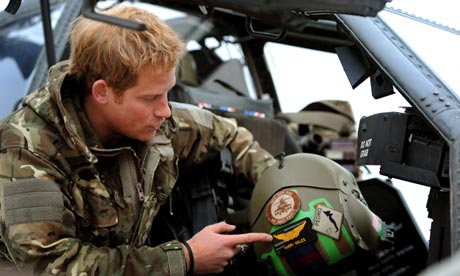
"It's a joy for me because I'm one of those people who loves playing PlayStation and Xbox, so with my thumbs I like to think I'm probably quite useful," Britain's Prince Harry said during interviews released upon his return from Afghanistan.

Explaining his four-month role as co-pilot of an Apache attack helicopter, Harry described the thrill of emergency response and the weapons systems he controlled in the gunship's two-man cockpit: Hellfire air-to-surface missiles, rockets and a 30-millimetre gun. Such statements are hardly surprising or shocking, but asymmetric warfare is fought along information lines and consumes anything in its path. Despite being cleared by the Ministry of Defense, Harry's comments quickly attracted negative press (targeting his princely qualities) and spurred a few grimaces on the MOD's own face.

"I'm not going to second guess whether he should or shouldn't have said it," spokesman Jim Murphy told the Guardian. "He's obviously a young and brave man. He was candid. Perhaps he may have been more candid than the Palace may have wished."

The Taliban naturally pounced on Harry's statements after failing to kill or capture him as promised. Spokesman Zabiullah Mujahid announced that, "49 countries with their powerful military failing in the fight against the mujahideen, and now this prince comes and compares this war with his games, PlayStation or whatever he calls it." Easily assailing the Prince for the flippant perception of his comments, Mujahid's counterattack appealed to any Afghan who loathes the notion of Afghanistan being treated as a game board for Westerners - from Britain and Russia's "Great Game" in the 1830s to the Soviet and NATO invasions nearly 200 years later. In this sense the disrespect of a "game" is very real in Afghanistan.

"This is a serious war, a historic war, resistance for us, for our people," Mujahid says.

However Harry's interviews are unlikely to make any immediate impact in Afghanistan. His testimony only confirms a new technological phase of an established pattern in war, and most Afghan civilians won't react as though he just murdered an innocent family or burned a Quran. Efforts to connect Harry's "mental problems" with the prolonged nature and brutality of Afghanistan's war may have more effect in Western countries than Afghan villages. Even Mujahid admits, "we don't take his comments very seriously, as we have all seen and heard that many foreign soldiers, occupiers who come to Afghanistan, develop some kind of mental problems on their way out."

More dangerous is the impetus to stage new Taliban attacks on Western targets in Kabul or elsewhere, which will be attributed to Harry's statements. Another factor to monitor outside Afghanistan is the public opposition of American video games set in foreign countries. These war games strike a cord with a variety of individuals, both the politically liberal and religiously conservative, who don't relate to the glamorous gamer side of war. The Trench has spoken with Yemenis who view Black Ops II's use of their country as gratuitous (try searching Yemen on YouTube), and some Pakistanis are beginning to organize a boycott against Call of Duty. Although the influence of these games on actual battlefields is minimal, public perceptions are crucial in counterinsurgency's wider scope and cannot be ignored at any size.

Any American force that generates anti-Americanism in a counterinsurgency environment is cause for concern.

Most disturbing are the long-term potentialities of advanced technological warfare: namely the gradual removal of humans from the killing process. Advocates of automated warfare argue that humans maintain control of the machine, a defense that is largely true for the moment but could break down over time. Drones may be more or less corruptible to enemy actors than humans; the process of this military experiment should be chaotic. Ultimately, whole fleets of drones could be concentrated in the hands of a small group or even one individual, further removing the human element from war. Drones could also be armed with weapons of mass destruction in the future.

Dehumanization is a constant theme of war - humanity might not be able to kill as it does without it. Problematically, all of these concerns and many others won't be eagerly addressed by Western governments or mainstream media.

January 20, 2013

Slow Treading In Mali's Asymmetric Fog

The gears of humanitarian intervention are rolling along smoothly if one takes the words of government and military officials at face value. Backed by over 2,000 French soldiers, their Malian counterparts have managed to establish the beginning of a defensive barrier and halt the Islamist coalition's movements in the country's inner delta. For several months Ansar Dine, the north's Tuareg-Islamist outfit, had leveraged its al-Qaeda contacts to encroach upon the country's mid-section, seizing positions on both sides of the Niger River before advancing on Konna. This move proved one step too close to Sevare's airport, the Islamists' likely target, and the town has now been fortified by French troops in less than a week.

VOA French to Africa correspondent Idrissa Fall described Sevare as being in a "state of war," overrun by French and Malian military forces, and empty of civilians. Its airbase will serve as a main international jump-point into the north.

The influx of French troops has allowed for the creation of a defensive line between Sevare and Diablay, a modest town that was overrun by militants shortly after France's initial air-strikes in Konna. Several hundred miles to the southwest and 50 miles below Diablay lies the town of Niono. Here French forces have entrenched themselves with Malian soldiers as they construct a forward operating base on the conflict's northwestern flank. French commanders are currently awaiting reinforcements and scouting reports from the north, and plan to take control of Diablay after the town is checked for disguised militants (who reportedly vacated on Saturday).

“The deployment towards the north... which began 24 hours ago, is on course with troops inside the towns of Niono and Sevare,” Lieutenant Colonel Emmanuel Dosseur told reporters on Sunday.

Accordingly, defensive lines should be stretched in the opposite direction of Sevare as more French troops and the first African contingents arrive. 50 Senegalese troops landed in the capital on Sunday and 200 have been cleared to deploy from Niger. National media is interpreting their activation as a possible second front on Mali's eastern border, where Ansar Dine and the Movement for Unity and Oneness in West Africa (MUJAO) are particularly entrenched. Neighboring Burkina Faso has also pledged to contribute a force inside Mali and to deploy a separate force along its border, theoretically connecting French and African troops along Mali's north-south divide.

In a potential boost, Chad recently offered to raise the total African force from 3,800 to 5,800.

So how long will the international community's wheels keep rolling in what they view as an uninterrupted state? Questioning over the conflict's anticipated schedule has yet to disperse, instead becoming less clear by the day. Every action and decision tends to run longer than expected in guerrilla warfare, as the style of warfare is designed to slow a larger army, and Mali's conflict is already headed in this direction. Less than 150 African soldiers have landed in Mali since French officials announced the beginning if their ground intervention; deploying the entire force will take weeks at best, months at worst.

“Step by step, I think it’s a question from what I heard this morning of some days, some weeks,” France's Foreign Minister, Laurent Fabius, said during a press conference in the Ivory Coast.

These troops are then scheduled to receive further combat training from NATO advisers, giving the Islamists more time to prepare and sliding the immediate brunt of combat onto Western forces.

To compensate for delays and soften northern Mali's ground targets, the French have begun bombing the Kidal region to the far north of Konna and Diablay. The ongoing assault is presumably intended to weaken the Islamists' material resources, not destroy their capabilities entirely, but "shock and awe" applies equally for the Western public. Such measures cannot be understand at the surface level. An extensive aerial campaign is insufficient by itself and requires a hard ground campaign against militants that have prepared underground since Mali's crisis began in early 2012. France's Defense Minister, Jean-Yves Le Drian, explains NATO's urgent dilemma: "The goal is to ensure that AFISMA, the African force, can take the baton from our own intervention."

Paris has continually measured its mission in weeks but, given the nature of asymmetric warfare and relative isolation of Mali, this number will hit double digits before the last African troops deploy and continue long afterward. For his part French President François Hollande has announced that France's mission will "last as long as necessary to win over terrorism in this part of Africa"; other officials, such as Prime Minister Jean-Marc Ayrault and Le Drian have issued more optimistic assessments. However Le Drian's latest statements, whether true or false, help understand Mali's vast proportions. Telling France 5, "The goal is the total reconquest of Mali. We will not leave any pockets of resistance," he was subsequently asked how far north Paris is willing to go.

"If necessary, the African forces can appeal for support from French forces when they arrive in Timbuktu," Le Drian answered.

Timbuktu rests at the edge of the war though. How long will African troops need to cross 500 miles of desert and recapture Kidal - six months to year? Holding the area until Mali's government can reassert authority could take even longer (elections are tentatively planned for April), and the Islamists are embedded in the city's mountainous surroundings. As with most of their urban holdings, the Islamists can afford to withdraw from Kidal and continue their guerrilla war along society's margins. French and possibly other Western forces thus stand a good chance of accompanying African troops throughout the initial phase of their campaign.

Timbuktu would just be the starting point.

With these issues come a variety of related problems that must be addressed in the near-term and long-term: the unstable status of Diablay and Konna, French calls for greater U.S. support, the uncertain depth of Washington's military commitment, African expectations of Western financial support. Descriptions of the Islamists in Diablay pile complications onto seizing any town, big or small; locals recount that they "generally kept their promise" to leave the people be, although their presence forced the town to shut down. Eyewitnesses said that every fighter masked his face, but they also reported a significant number of Algerians and Libyans in Ansar Dine's ranks, which are mostly composed of Tuaregs. Separating their legitimate grievances from the Islamist alliance's wider agenda presents a chronic challenge for the international community.

Only one factor appears concrete in Mali: the conflict will always move slower than described by government officials. Asked at Niomo whether a "long war" had finally begun, the commanding officer Colonel Frederic replied, "Maybe, yes."

January 19, 2013

AQAP, U.S. Drones Compete For Unpopularity In Yemen

As if to prove to any lingering doubters (few exist) that the Obama administration is going big into Yemen in pursuit of al-Qaeda in the Arabia (AQAP), between two and four drone strikes were conducted on Saturday night in Mareb governorate - the latter would be a 24-hour record. The bombings occurred in the Abedah valley near Wadi Abida, suggesting that a meeting was about to take place or had just taken place. A modest total of nine casualties have been reported, with varying accounts of their identification. Yemen's Defense Ministry recorded the destruction of two vehicles carrying AQAP suspects; local media has reported various AQAP-related deaths, at least one of them a Saudi national.

Estimating the total damage caused by drones is inherently challenging due to diverging local accounts, misreporting and media bias. Governments also cooperate or disagree with the U.S. (Pakistan, Yemen, Somalia) when denying civilian casualties or inflating militant kills. In short, every factor is preconditioned to obscure the truth.

Today's public outrage was immediate regardless of the collateral damage, hitting Yemen's local media and social networks hours before Marib's strikes reached the international press. Angry at their own government's inability to confront AQAP without foreign assistance, at the White House and House of Suad for interfering with their land, and at the lies told to cover up civilian casualties, Yemenis are stuck in a vicious catch 22: their current government and military lack the independent strength needed to reverse AQAP's influence, but the U.S. drones that temporarily fill this need are undermining the Yemeni government's own credibility with its people.

Wadi Abida is the same town that witnessed the droning of Jaber al-Shabwani, deputy governor of Marib. This episode opened a brief rift between Ali Abdullah Saleh, Yemen's former dictator, and the U.S. officials (David Petraeus and John Brennan) that received his approval to begin systematically bombing Yemen. Saleh's former vice president, Abd Rabbo Mansur Hadi, is now overseeing an escalation of this policy after the Obama administration and Saudi Arabia successfully installed Hadi as Yemen's transitional president.

The ongoing debate of whether drones bring more long-term risk than short-term reward  has yet to impede the Obama administration's escalation in Yemen, where the dual priorities of political and military hegemony overrule the immediate need for popular support. A large amount of today's condemnation was directed against John Brennan, President Barack Obama's nominee to replace Petraeus as CIA Director. This continuity is especially pronounced in Yemen, as Petraeus and Brennan handled Saleh's profile prior to the country's revolution and lobbied to fund the same "counter-terrorism" forces that have attacked Yemeni protesters, Southerners and Houthi members. 

The Obama administration continues to maintain ignorance of Brennan and U.S. Ambassador Gerald Feierstein's unpopularity - concrete evidence that U.S. policy has no intention of building sincere relations with Yemen's people.

How the U.S. and Yemeni governments are supposed to defeat AQAP's influence with this strategy has never been fully explained. Few U.S. officials are willing to address the specific effects of drones and U.S. policy in Yemen, and Washington's "commitment to supporting Yemen during its historic transition" hinges solely on self-interests, a policy that perpetuates guerrilla warfare. Luckily renewed focus is being driven onto this counter-productively as Brennan nears his confirmation hearing on February 7th, but popular appeals and collateral damage won't sway U.S. policymakers.

The final outcome will present a vivid contrast of reality - the Senate welcoming Brennan's rise and Yemenis wishing for his fall.

January 17, 2013

Hostages Become Easy Prey In Mali's Intervention

Tuesday's raid on an Algerian oil facility highlights the simplistic chaos of unconventional warfare. Known by many names - terrorism, guerrilla warfare, insurgency, rebellion, revolution - unconventional warfare encompasses all terms on the asymmetric side of warcraft, and has bedeviled countless sources of authority throughout human civilization. Even the predictable cannot be fully predicted and the unexpected happens enough to become expected.

Beyond the numerous strategic implications of the attack on Tigantourine, the raid is remarkable for two factors: the straightforward nature of the attack and its location. Despite the high alert of those European and African capitals contributing to Mali's intervention, none could anticipate where the Islamists eventually struck or how quickly they reacted to France's overflights through Algeria. Their "surprise" attack was also delivered exactly as promised. In early December Mokhtar Belmokhtar, a former commander of al-Qaeda in the Islamic Maghreb (AQIM), announced the creation of his El Moulethemine katibat ("Brigade of the Veiled Ones"), a unit dedicated to kidnapping foreigners in the Sahel region. Afterward followed an introductory video for the "Signers in Blood," a purported suicide squad.

The Algerian government, international media, and Belmokhtar's own men have attributed the attack to his second creation rather than the first, but both are loosely aligned with AQIM's strategic view. While Belmokhtar has splintered away from the core to be his own boss, he is particularly eager to assist his former deputy in Mali and has been regularly spotted in Gao since the Movement for Oneness and Jihad in West Africa (MUJAO) encamped in July 2012. Oumar Hamaha, a local Tuareg, doubles as a spokesman for Ansar Dine and a senior military official in MUJAO, and he would confirm Belmokhtar's cooperation with the two groups.

Accordingly, Hamaha was selected to inform The Associated Press of Belmokhtar's actions and the motivation behind them, namely Algeria's overflights and France's killing of Muslims. 

"We have a struck a blow to the heart (of the international community),"he declared ominously. "It's the United Nations that gave the green light to this intervention and all Western countries are now going to pay a price. We are now globalizing our conflict."

What is startling is the depth of Belmokhtar's raid, allegedly conducted by 20 men in three "heavily-armed" vehicles deep inside Algerian territory - a distance that exceeds the space between Mali's capital and the Islamists' northern bases. One immediately wonders how they traveled so far in open terrain, over multiple days, without being discovered by any government. It's certainly possible that the attackers traveled discreetly and acquired their vehicles near the strike point, or entered directly from Libya, but their range is equally impressive.

Hundreds of Algerians were initially taken hostage before being released or escaping. At least 41 people (including Americans, French, British, Irish, Norwegian and Japanese) are believed to have been captured, several more killed, and recent accounts of AQIM's kidnappers have described how quickly and quietly the Islamists move their bargaining chips. They will likely be taken into the cave network constructed along the southeast end of the Algerian-Malian border, where underground bases have been built dozens of miles apart. If the attackers can escape into Libyan territory, that is. 

Algerian forces have approached the complex where the hostages are being held (Westerns are reportedly being held in a separate wing) and reportedly fired shots in the area. Reached by telephone, one of the assailants was quoted as saying, "We will kill all the hostages if the Algerian army try to storm the area."

Even if the Algerian military cuts off their exits, NATO as a whole must factor the risk-reward of a major hostage situation into its plans as French troops mobilize for battle in Diablay, taken by the Islamists shortly after the French began landing en masse. They may need a week or two just to carefully dislodge the Islamists occupying the town - which, contrary to French claims of an offensive on the capital, appears to represent no more than a diversion tactic. Paris has repeatedly measured its ground campaign in weeks rather than months, but unless Special Forces and intelligence agencies can recover the new hostages, they will apply an immediate source of friction against NATO's campaign and further extend Mali's long war.

Another raid in Somalia recently failed to go as planned.

As for strategic planning in the international front, the pressing question is whether Algeria responds militarily on Mali's northern border or continues to take a passive-aggressive role in the conflict. Interior Minister Daho Ould Kabila told the official news agency APS, "The Algerian authorities will not respond to the demands of the terrorists and will not negotiate," suggesting that Belmokhtar has crossed a line that cannot be forgiven. The need for Algerian forces appeared inevitable from the start of Mali's insurgency, given that a hardened force must smash into the Islamists' mountain fortress and from multiple directions. Except Algeria's intelligence is also suspected of collaborating with elements of al-Qaeda in the Islamic Maghreb (AQIM) in order to enhance the government's regional influence, whether that means interfering with Tuareg separatists or securing Western favors without strings.

A vocal Algiers backed Ansar Dine's superficial dialogue with international mediators over the last five months, now termed a "miscalculation" but a suspicious one at that.

For its part the Algerian government hasn't looked forward to any uncontrollable disturbance, either from France and NATO or the Islamists and Tuaregs. Algiers prefers manageable instability and seeks to avoid entanglement on Mali's ground. Abdallah Baali, the country's ambassador to Washington, warned NATO less than two months ago, "You cannot really fight a conventional war there. Your enemy will vanish in the desert before your eyes."

Obviously Algeria would not fight conventionally inside or outside its territory; assault helicopters and Special Forces would coordinate with local intelligence to beat the Islamists at their own games - mobility and disguise. However the 1,000 mile Algerian-Malian border gives perspective to the enormity of the task at hand inside Mali, and the introduction of Algeria's hegemonic agenda creates yet another dimension to a rapidly evolving conflict.