August 14, 2012

Bahraini King Imprisoning Himself Within Discord

The Bahraini regime's latest act of gross injustice has surprised few and enraged many.

Building on repeated delays and hurdles to the legal cases's of many oppositional activists, a Bahraini court has postponed the verdict of Abdulhadi al-Khawaja and 19 other men until September 4th. Al-Khawaja famously staged a 110-day hunger strike earlier this year and functions as one of the opposition's most relatable personalities, rendering the government's decision strategically irrelevant. Bahrainis are ready to protest whether their leaders can join them in the streets or not, and the monarchy is simply extending higher lightning rods to provoke them.

Al-Khawaja's daughter, Zainab, also remains jailed as she awaits a ruling on her own case. Arrested for staging her latest one-woman protest in Manama, the activist has been imprisoned at least six times since February 2011 and has been abused by security forces during her "due process."

Postponing the ruling on Al-Khawaja's retrial sends fresh alarms throughout Bahrain's oppositional network. In the immediate term, activist Nabeel Rajab is due to receive his own verdict on Thursday after being held at Jaww prison since July 9th. He stands guilty of assaulting hard-line Prime Minister Khalifa bin Salman Al Khalifa with a Tweet and, given the repeated delays to his case, may end up in the same boat as Al-Khawaja. Bahrain's King has trapped himself in an unwinnable dilemma: holding and releasing high-profile figures of the opposition will inflict an equivalent damage on his regime's credibility.

Of the few who are likely to count themselves neither surprised nor outraged, the Obama administration greeted today's developments with typical silence. Nor has any U.S. official dared to release one stand-alone statement in defense of Rajab, today being no different. However Washington is trapped in the same dilemma as King Hamad Isa bin Al-Khalifa. Neither has any real hope of establishing a working dialogue with the opposition so long as its leaders remain unjustly imprisoned. In the meantime, intense and noxious clashes between security forces and street protesters, along with home invasions, are certain to continue.

Further demonstrating the King and his allies' systematic counterrevolution, the court's decision (unlikely independent) coincides with another of Hamad's hollow "unity" speeches - a text riddled with internal delusion and verbal assaults against a nameless Iran. Taking no sincere responsibility for any part of Bahrain's conflict, Hamad speaks in a consistently past tense as he infuses stark religious overtones into a tyrannical tirade against the opposition. A few examples: "our people knew how to persistently tackle the enemy and to unite their ranks, consolidate their discourse and allegiance to the ruler and crush the ambitions of foes. (And Allah repulsed the disbelievers in their wrath; they gained no good. Allah averted their attack from the believers. Allah is verily the Omnipotent and the Almighty.)"

"In the past year, the National Dialogue succeeded in accomplishing many of our socio-political aspirations building on what we had already achieved. So, what prevents us from continuing to build on what we have already achieved?"

And especially: “We have had to endure this year through challenging conditions due to hostile ambitions and foreign intervention which are yet to cease. We stood as united front in the face of strife mongers. We faced them with determination and persistent willpower as our duty and responsibility makes it imperative to defend this homeland, we will maintain our national unity and protect Bahraini people. During the zenith of such difficulties, we upheld wisdom, patience and forbearance and opened the doors for dialogue and called for forgiveness and tolerance as we rely on Allah alone and trust in His guaranteed victory."

The King would also refer to pro-democracy forces as "scammers, strife mongers or adventurous riskers of our national unity, cohesiveness and gains," before jetting off to a real enemy of Bahrain's stability. Hamad has now taken his seat amongst King Abdullah's counterrevolutionary summit - "The Extraordinary Islamic Solidarity Conference" - held in Mecca to exploit its "extraordinary" propaganda value.

All in a day's counterrevolution for two Kings.

August 13, 2012

Egypt's Revolution Still Defying Detractors

Some wondered if the revolution was over. Others questioned whether it had failed to achieve its objectives. Still others talked about launching a new revolution. The truth is that Egypt's revolution remains as active as yesterday and tomorrow.

After 21 years at the Defense Ministry and 17 months at the helm of an authoritarian transitional bloc, democratic convulsions have finally ousted General Hussein Tantawi from atop Egypt's defunct Supreme Council of Armed Forces (SCAF). Unanimity indicates that President Mohamed Morsi exploited a militant ambush on Egypt's security forces to strip Tantawi of his titles. No time in the foreseeable future would provide such an uncontested opportunity to cut down the SCAF's accumulated political power - even U.S. Secretaries Hillary Clinton and Leon Panetta reportedly pressured Tantawi to bring Sinai under control before something unfortunate occurred.

Morsi would reverse the SCAF's attempt to micromanage Egypt's national budget, legislation and the selection of a constituent assembly responsible for drafting a new constitution.

Both the ex-general and his allies are likely to play their hands calmly as they attempt to rewrite a favorable history. In Tantawi's case, he will likely grasp onto Egypt's first free elections in recent memory and not let go. His leave, he can easily argue, is the product of a fledgling democracy that he helped nourish through dangerous times. Most revolutionaries won't fall for his deception, instead viewing him as a primary counterrevolutionary force, but he has few alternative narratives to rally around. Bashing the Muslim Brotherhood only reaches so many ears when the mouth speaks from Mubarak's time.

Tantawi's defense, whether he uses it or not, is certain to be amended and proliferated by the Obama administration. On cue, the various departments responsible for crafting U.S. foreign policy are publicly eager to watch the democratic process unfold in Egypt - as if the Brotherhood's rise and Tantawi's fall are truly welcome events in Washington. Seeking to assure Americans that Washington maintains influence in Cairo, U.S. officials have deployed to articulate a standard script of counterrevolutionary platitudes. White House spokesman Jay Carney and Pentagon spokesman George Little both said that the administration expected "at some point there to be changes in the military leadership. Naturally, they expect "we’ll be able to maintain strong defense relations with Egypt."

"It’s important for the military and political leadership in Egypt to continue to work together to address both the economic and security challenges facing that country," they recited to reporters.

Significant portions of their statements were also directed towards the Sinai Peninsula and Israel, with Carney hoping that Morsi’s announcements "will serve the interests of the Egyptian people and maintain good relations with Egypt’s neighbors." He even dares to "commend General Tantawi for his service, especially during the extremely difficult transition from President Mubarak’s leadership through the elections." These types of statements strip Washington's skin bare and fully expose the skeleton of U.S. policy: foreign interests still place themselves ahead of the Egyptian people.

”I would also say,” added the State Department's Victoria Nuland, "as I think our colleagues at the Pentagon have already said, that these new appointees, the new leaders of the military, are all people that we have worked with before and who – many of whom have trained here in the United States as well.”

Nuland is clearly speaking to Americans and Israelis, not Egyptians.

Yet the administration's true reaction doesn't seem match the choreographed rhetoric sent out across its departments. Regardless of their support for Morsi (a diplomatic necessity) and feigned indifference for Tantawi's loss, the general was the last hope for Washington after Mubarak and Omar Suleiman collapsed into history. He served as the Obama administration's life-line and instrument of control during the revolution, receiving favorable coverage from Washington throughout repeated acts of violence and slander against the revolutionaries. Israel's government and media is also buzzing with "great concern" and "surprise," suggesting that Washington isn't as informed or collected as advertised.

Given the continual interference from Washington and the Brotherhood's own political interests, the rest of Morsi's decision is equally murky. His power move could yield substantial progress towards alleviating concerns within the revolutionary ranks, or lead to another cycle of revolutionary action at the conclusion of Ramadan. Pandering is inevitable but beneficial in this particular case, the opposite scenario being intolerable; in contrast to Yemen's replacement military officials, a decision made with substantial U.S. input, Tantawi's firing also appears more independent. Conversely, Egyptians on both sides of the revolution could view Egypt's new Defense Minister, General Abdel-Fattah El-Sisi, as a Brotherhood pawn within the military. Yasser Ali, Morsi's spokesman, also clarified that Tantawi had been given "the nation’s highest honors and appointed military adviser to the president."

As for the Brotherhood's own ambitions, Morsi is laying the foundation of a new Egypt - an Egypt where the group maintains a dominant political position. One cannot underestimate this sense of power after being deprived and suffering through decades of persecution, and curbing excessive ambitions won't be easy. Morsi's measures have now concentrated legislative and executive powers into his hands, and many Egyptian activists have reinforced the urgency of resolving this dilemma as soon as possible. After Tweeting, "Ending military rule is a step in the right direction," former IAEA chief Mohamed ElBaradei warned that Egypt's "transitional mess continues" so long as Morsi holds "imperial powers."

Similarly, the National Front demands that Morsi waste no time fulfilling the rest his promises: completing the "National Unity Project" (respect for all layers of society), establish a representative presidential cabinet, restructure the Constituent Assembly and draft a new constitution acceptable to all Egyptians, and hold new parliamentary elections. Composed of high-profile activists, writers and political figures, the National Front had previously agreed to support Morsi over Ahmed Shafiq on the condition that he follow through with their six-point plan. One point stipulates a "crisis-management group," including several National Front members, "to assist the president during the transition process until a complete handover of power is accomplished."

Their last demand: "abide by complete transparency with the people regarding any changes and developments."

For the most part Morsi's actions appears genuinely "sovereign" as described. He must realize that his group cannot ignore the revolutionaries any more than Mubarak or Tantawi, and that mass demonstrations await any misstep or abuse of power. External influence from Washington, Jerusalem, Riyadh and other capitals will continue seeping into Egypt's government - and the Brotherhood will cooperate out of national interests - but the group is also positioned to resist their motives. Whether the Muslim Brotherhood can continue delivering the fruits of revolution to civil and religious minds alike remains uncertain, but ending Tantawi's brief authoritarian reign is a big step in the right direction.

August 12, 2012

Info-Battle Over Somalia’s “Roadmap”

On the third day of Hillary Clinton’s nine-day Africathon, the Secretary of State dedicated a part of her stopover in Nairobi to Somali President Sheikh Ahmed Sharif and other members of the expiring Transitional Federal Government (TFG). Clinton would praise the government’s progress towards meeting “all the requirements of the roadmap by the August 20 deadline,” including the formation of a new parliament and constitution. Many Somalis and analysts, however, don’t share the view of foreign powers who they accuse of interfering in Somalia’s national affairs.

These counterarguments encapsulate many of their observations.

Somalia: The consequence of a cooked constitution

By Dr. Sadia Ali Aden, published in NewsTimeAfrica
Indeed nations need constitutions; a social contract to establish rule of law and become the foundations for needed legislations to protect the individual rights as well as the nations from greedy and corrupt politicians that may abuse the power vested in them. Furthermore, constitutions are needed to outline the domestic boundaries of authority and safeguard the sovereignty of the state. Constitutions are not always perfect; however, under such circumstances they are not entirely replaced. They are simply amended, but not in Somalia.
Somalia had one of Africa’s first democratically ratified constitutions. In 1961 the constitution of the newly independent nation was ratified by an overwhelming popular support of the citizens of a newly formed Somali nation state. So, one might ask, what prompted the new “provisional” constitution that was passed on August 1, 2012?

Anyone who has been following the Somali political saga even from a distance knows that there has been a huge controversy that surrounded the new constitution. He or she would also know the force and urgency that instigated, drove, and made it mandatory item in the Road Map was the international community (IC), or more specifically, the Ghost-lords or the elements within the IC who benefit from business as usual. While the fanfare in certain circles is somewhat fathomable, the absence of local and international media scrutiny is appalling.

This latest constitution does not only raise red flag in the outrageously pricey $60 million that the UNDP claims to have spent on it, but it affords the platform to further polarize the Somali society and aggravate the existing wounds that could give rise to renewed conflict. This is simply a reinvention of the status quo.

To give the new constitution certain domestic authenticity, Ghost-lords outsourced its plan to a few corrupt Somali politicians who were motivated by money, prestige, or political survival. Their task was to repeat what they were dictated to, without questioning its legitimacy, and convince the unsuspecting populace of that the new constitution was for their protection as people and a nation, and that it was essential for lasting peace. Since, as they say, the devil is in the details, the new constitution was shrouded in mysteries of secrecy for a long while. When the constitution was finally endorsed there were several versions or drafts that kept the average person in a state of confusion and frustration.
Moreover, according to BBC Somalia analyst Mary Harper, the constitution appears to exist in a parallel universe, a fantasy land, when compared with the reality on the ground in Somalia, with universal access to education and the end of female genital mutilation unlikely to happen anytime soon...
Somalia: Will corrupted MPs elect a genuine leader? 

By Osman Jabane, published in Horseed Media
Somalis currently discuss leadership qualities in every social setting. The question of leadership has emerged as the Transitional Federal Institutions (TFI) mandate is coming to an end in this month. The TFG agreed to hold an election while there is no efficient electoral commission in place that can conduct free and fair election. Most of the Somalis are highly skeptical and believe that this election will be the toughest in the history due to the presence of many candidates including corrupted ones.
It is obvious that the parliament cannot produce a genuine leader that can make a difference to the country unlike the current ones who have their own selfish interest. Most of the MPs whose list have been submitted to represent their constituent or clan, what so ever, cannot represent the Somali people. They are tribal affiliated rather than common citizenship. Some of them are not academically competent and to make it worse, they did not complete secondary school education which is the least education qualification one can have. There is wide spread rumors that some individuals are making fabricated secondary school certificates or equivalent experience so as to apply and qualify the position. Therefore, the question that we all supposed to ask is that, will corrupted Member of Parliament who came through tribalism, nepotism elect a genuine Somali president? I leave the answer to the Somali people but we need to learn a lesson from the past. Back 2004, we have witnessed a historic moment where most of the warlords became legislators, and we thought this was the end of lawlessness in the country but due to many factors there are still no functioning institutions in the country, and it can be said that the situation got worse and worse by the day and all that trial ended in vain.

On the other hand, front-runners of the current presidential elections are doing their best to convince members of the parliament in a different ways, some are concentrating on getting alliances that can campaign or do the hard work for them, some are approaching directly to parliamentarians, while others are contesting for the race in order to capture the media attention with a view to becoming a member of the new cabinet. It is evident that no candidate can win the election without the support of parliamentarians; therefore, candidates are aware of the importance of MPs as they are making the ultimate decision. But the problem is that neither 275 parliamentarians nor others who are currently involving the process are demanding to scrutinize candidates’ reasons of wanting to lead the nation. Without accountability or scrutiny, candidates will have the opportunity that they wished from the first place, hence the increase of candidates...

August 10, 2012

Infiltration No "Isolated Incident" In Sangin

The whole world knew that NATO was about to drop into Marjah. Public awareness was part of their plan, U.S. commanders counter-argued to their detractors, and they wanted the Taliban to know they were coming. Americans too.

Brigadier General Larry Nicholson, commander of all U.S. Marines in southern Afghanistan, would tell reporters, “We're going to go in big... I’m not looking for a fair fight. The message for the Taliban is: It will be easy, or it will be hard, but we are coming. At the end of the day, the Afghan flag will be over Marjah."

NATO''s plan partially succeeded; due to the disproportion of force - some 10,000 U.S., British and Afghan combat troops versus 500 Taliban - Marjah was never defended as the "stronghold" that U.S. officials dressed it up as. Some reports indicated that Pakistani Taliban had fled back across the border, creating resentment between, but an entrenched resistance would only waste men trained to fight a guerrilla war. The town simply wasn't worth dying for in the immediate future.

Still, a combination of factors would stunt the applause that the Obama administration had envisioned for Marjah. Hoping to model its newly-christened surge in the middle of Helmand Province, the village's significance was hyped beyond reality and ultimately questioned by independent sources. Errant missiles struck an Afghan house days into the campaign, killing 12 civilians. What was expected to take weeks dragged on for months as the Taliban resisted with hit-and-run tactics, jading Americans (especially Obama voters) who have already grown tired of seemingly endless asymmetric warfare. The village triggered Vietnam flashbacks and a miniature Tet in the media: although NATO troops eventually reduced the Taliban's influence in Marjah, the cost and time of securing a single village did not bode well for the rest of Afghanistan.

Kandahar's large-scale operation was later scrapped due to a variety of considerations, including local doubts that America would make a bigger mess.

When U.S. troops moved up river to Helmand's next "stronghold," scant media coverage and few official statements would accompany them into a truly dangerous area. The notorious graveyard of over 100 British soldiers, Sangin rested out of American sight and mind throughout the first nine years of war in Afghanistan. U.S. Marines finally relieved a hated British battalion in July 2010 as their commanders pumped up Helmand's new "Taliban stronghold," but this time the White House opted against amplifying their war cries. A good decision, to be sure, since numerous reports (and denials) of civilian casualties emerged during the initial weeks, and U.S. forces remain locked in an intense battle with a semi-invisible enemy.

U.S. officials do, of course, report on occasion that everything is going as planned.

The Trench invested a significant amount of time highlighting the similarities and differences between Marjah and Sangin: multiple "stronghold/opium hub" theory, ballooning time-lines and anticipated levels of resistance. Unlike Marjah, the Taliban never planned to forfeit Sangin as easily and will employ all available tactics to disrupt U.S. forces in the area. These collective factors leave nothing to surprise after the Taliban's latest attack in Sangin went public. Having invited "at least three Special Forces troops" from a nearby base to dine with him, Afghan policeman “Asadullah" gunned them down and evacuated "while in contact with the Taliban," according to spokesman Qari Yusuf Ahmadi.

"During dinner, the police commander and his colleagues shot them and then fled," a senior Afghan official told Reuters. "The commander was Afghan National Police in charge of local police in Sangin."

Other sources place Asadullah as the commander of a checkpoint near the Special Forces base.

U.S. denial is no more surprising than the Taliban's attempt to infiltrate Sangin's police force. White House spokesman Jay Carney told reporters that "it is too early to say that this latest is part of a stepped up effort," even though the Taliban have publicly announced their designs to infiltrate Afghanistan's military and police. ISAF spokesman Brig. Gen. Gunter Katz similarly told CBS News the "isolated incident... doesn't reflect the security situation," but Sangin's environment is every bit as dangerous as it appears.   Carney and Katz later addressed the need to "mitigate" the Taliban's "maximum exposure" and infiltration techniques, tacitly admitting to the problem at hand.

"Green on Blue" incidents have already accelerated France's time-line to withdraw, sucking U.S. Defense Secretary Leon Panetta into the fray. In the last seven months alone, at least thirty NATO soldiers have been killed by Afghans dressed in army or police uniforms. U.S. commanders automatically downplay the effects on security operations and inter-military relations, but the Taliban is aiming for American and European minds first. Every high profile "incident" pushes another needle into the American public, which often blames the Afghan government for something it cannot prevent, and a few spectacular ambushes could knock a NATO country (Germany, Italy, Australia) into submission.

These are no isolated attacks, either in Sangin or anywhere in the country, because Afghan-dressed Taliban will continue ambushing NATO forces through 2014 and beyond.

August 9, 2012

Imminent AU Assault On Kismayo?

The first hint came months ago, when Kenyan policymakers finally green-lit Operation Linda Nchi in October 2011. Despite the absence of a public time-line or an initial explanation of Kenya's role within the African Union Mission to Somalia (AMISOM), Nairobi's intentions in southern Somalia were telegraphed by both countries' urgent political environments. The logical assumption of Kenya's best-case scenario: clear al-Shabaab from its territory and the port of Kismayo before August 20th, when the UN-mandated Transitional Federal Government (TFG) is set to expire, and transfer the city's authority to Somalia's new government. Kenyan troops would hold the area until AU reinforcements arrive, or else embed  themselves with the populace until the government can send enough national troops and police.

A variety of factors emerged to lower the speed of Kenya's advance and throw its time-line into doubt. While al-Shabaab has yet to mount an organized resistance of any urban territory, a combination of guerrilla warfare and cross-border terrorism placed a premium on Kenya's rear lines. The speed of three battalions has suffered from al-Shabaab's tactics, the mud of Somalia's second rainy season and the need to help tens of thousands of Somalis as they advance through a relatively large area. Statements of securing all of Jubaland, an area nearly three times the size of the targeted Lower Juba, were realistically curtailed by months of hard fighting. On top of these problems, al-Shabaab has forcefully encouraged Kismayo's residents to fight with them and amplified the danger of storming a city.

February gave way to the first tangible anxiety of Kenya's neighbors when, according to Ethiopian commanders, Nairobi aborted a synchronized offensive on the port. Ethiopian convoys had rolled into Somalia's western flank to throw al-Shabaab into deeper disarray, and eagerly remain on standby if their armor is needed.

Yet Nairobi, realizing the significance of August 20th in regards to Somalia and its own power projection, still refuses to give up on its objective. Two months ago Prime Minister Raila Odinga repeated his promise to reach Kismayo before the 20th. Over 4,000 Kenyan soldiers were later absorbed into AMISOM, sealing the multi-year campaign that Nairobi has now signed on for, as Defense Minister Yussuf Haji declared "we cannot stop fighting in Somalia." Several weeks ago, The Los Angeles Times reported that a battalion from Sierre Leone was headed into southern Somalia (on America's dollar) to accelerate Kenya's march on the port. Now comes the latest assistance: Ugandan helicopter gunships.

Lt. Moses Omayo, spokesman for the Uganda Airforce, tells Reuters, "We have sent helicopters which will provide air cover for combat troops, escort convoys, conduct rescue missions and airdrop forces."

Omayo claims that the helicopters will "conduct operations only in areas in which troops that include those from Burundi and Djibouti are deployed," but neither country has deployed troops into the southern Somalia. Djibouti has yet to publicly move into Baidoa to relieve Ethiopian troops, as reportedly planned, so the country is unlikely to enter Kismayo in the near future. The Ugandan combat and support helicopters are more likely to cover an AU force of Kenyans, Ugandans and Ethiopians, with TFG soldiers and the proxy group Ras Kamboni serving in auxiliary or police roles. Reuters reports that a "combined force in Somalia is planning an onslaught on Kismayu... before August 20."

In addition to Ugandan and Kenyan air support, Odinga says that he has repeatedly requested naval assistance from Western powers operating in the region.

The least-worst scenario has dogged Nairobi across southern Somalia; instead of clearing Kismayo, it must be content to reach the port by the 20th and hope that al-Shabaab forfeits. However the militancy remains a constant threat in the cities that it has openly ceded, and the lucrative Kismayo occupies ground worth fighting for. The city has also exchanged hands numerous times due to the central government's inability to govern, a possibility that cannot be eliminated despite the progress made in Mogadishu. To their credit (and the help of Western governments), AU capitals have devised a pronged strategy to knock al-Shabaab out of its urban environment and create space for a new government to fill. That Kismayo's future, like Somalia's other war-torn cities, depends on a stable government (central or local) is no secret to any Somali or Somali observer.

When AU and Somali forces finally reach Kismayo, and how long the area takes to clear and hold, remains fogged by war clouds.

August 8, 2012

Primer On the US-KSA Counterrevolution In Yemen


John Brennan's latest propaganda assault on Yemen, and by extension all peoples of the region, complete with a meandering Q & A on non-Yemen topics. This plastic will take some time to break down since Brennan is one of many U.S. officials who talk AQAP first, democracy later:
When the subject of Yemen comes up, it's often through the prism of the terrorist threat that is emanating from within its borders. And for good reason: Al-Qaida in the Arabian Peninsula, or AQAP, is al-Qaida's most active affiliate. It has assassinated Yemeni leaders, murdered Yemeni citizens, kidnapped and killed aid workers, targeted American interests, encouraged attacks in the United States and attempted repeated attacks against U.S. aviation. Likewise, discussion of Yemeni and American counterterrorism efforts tend to focus almost exclusively on the use of one counterterrorism tool in particular: targeted strikes.

At the White House, we have always taken a broader view, both of Yemen's challenges and U.S. policy. Two months ago, however, a number of experts on Yemen wrote an open letter to President Obama arguing that there is a perception that the United States is singularly focused on AQAP to the exclusion of Yemen's broader political, economic and social ills. Among their recommendations, that U.S. officials publicly convey that the United States is making a sustained commitment to Yemen's political transition, economic development and stability. And it is in that spirit that I join you here today, both in my official capacity and as someone who has come to come know and admire Yemen and its people over the last three decades.

I want to begin with a snapshot of where Yemen is today. Since assuming office, President Hadi and his administration have made progress toward implementing two key elements of the Gulf Cooperation Council agreement that ended the rule of Ali Abdullah Saleh and provided a road map for political transition and reform.

As part of a military reorganization, powerful commanders, including some of the former president's family and supporters, have been dismissed or reassigned, and discussions are under way to bring the military under unified civilian command. And just two days ago President Hadi took the important step of issuing a decree that reassigns several brigades from under the command of Saleh's son as well as leading Saleh rival Ali Mohsen al-Ahmar.

In addition, to organize the national dialogue, President Hadi has appointed a committee with representatives from political parties, youth groups, women's organizations, the southern movement and Houthi oppositionists in the north. And that committee met for the first time this week.

On the security front, government forces have achieved important gains against AQAP. Today AQAP's black flag no longer flies over the city centers of Ja'ar, Loudur (ph) or Zinjibar. As one resident said, after AQAP's departure from these areas in June, it is like seeing darkness lifted from our lives after a year..."

August 7, 2012

Preventing An Imperial Exchange Within Yemen's Security Forces

Yemeni President Abd Rabbuh Mansur al-Hadi sits with U.S. Ambassador Gerald Feierstein, considered by some Yemenis to be a modern day viceroy.

Yesterday, after 19 months of peaceful revolution in Yemen, President Abd Rabbuh Mansur al-Hadi gave a partial bow to the will of his people. Facing protests to dump the remnants of Ali Abdullah Saleh's murderous regime, namely his son and nephew, one of Hadi's latest presidential decrees has finally relieved Ahmed from the command of his father's Republican Guard. The most loyal units will reform under Hadi's authority, acting as the Presidential Protective Forces, while the rest will be reassigned to other regional commands.

Ahmed's temporary liquidation doesn't come without benefits. One of the darkest symbols of Saleh's counterrevolution and his decades of misrule, his delusional son would spout hostile rhetoric towards the revolutionaries as he gunned them down in the streets. Ahmed's violent streak, along with his pharaoh-like presidential ambitions, meant that he had to be removed at all costs. However Hadi's decision remains ambiguously encouraging. After marshaling his influence in anticipation of a showdown with Saleh's son and primary instrument of power (Ahmed had already sparred with Hadi during Saleh's medical leave to Saudi Arabia), the President had little choice except to respond to revolutionary protests in Taiz and other cities. 

A series of meetings with the preparatory representatives of Yemen's newly-formed National Dialogue Committee, including a handful of youth and civil groups, further enticed Hadi to capitalize while the popular iron is hot.

This opportunistic politicking is understandable, but also represents an interconnected dilemma when mixed the other forces acting on Hadi. At one level, extinction means survival for the Salehs; their continual presence in the country hangs a shadow over the degree that his network can actually be pruned. Ahmed could easily resist through subversion tactics and rival General Ali Mohsen's presence won't be accepted lightly. While he may be unable to regain his former position, Ahmed is also speculated as a presidential candidate in 2014's election - a doomsday scenario for Yemen's revolutionaries. In the meantime, he's likely to operate a proxy force until his bank accounts dry up or he's expelled from the country.

Whether Saleh's blood remains in Sana'a when the National Dialogue opens in November will speak louder of Hadi's new government.

At a higher strategic level, Ahmed's destabilizing presence could be filled by another source of chronic instability in Yemen: the U.S. government. For months the Obama administration has tried to uproot Ahmed from his position, viewing his past assistance as a current liability to counterterrorism operations against al-Qaeda in the Arabian Peninsula (AQAP). Ahmed's unit benefitted greatly from the U.S. military aid that was misappropriated away from AQAP prior to the revolution, and his Republican Guard would cede southern Yemen in early 2011 to inflate AQAP's threat and theoretically prove Saleh's worth. His Republican Guard then turned its guns and air power on Yemen's revolutionaries and anti-government tribesmen, spearheading his father's bloody crackdown as U.S. officials maintained their praise of U.S.-Yemeni relations.

Unfortunately for Ahmed and Yemenis alike, Washington's tireless search for replacement liaisons has countered the Salehs' use of instability. The Obama administration's strategy has largely succeeded in Yemen after failing in Egypt: bury the Salehs' crimes and any U.S. complicity with UN-approved immunity, then swap them for more obedient and docile replacements. The end result is imperialistic manipulation, not a "democratic transition."

As for Ahmed's particular case, his replacement will surely be approved by and work with Washington as Yemeni forces maintain their offensive against AQAP. Countless rumors from multiple sources claim that Hadi and the Obama administration are organizing a new joint-counterterrorism force to relieve the corrupted Republican Guards. This force, were it to materialize, could be stocked with officers who could receive advanced training in the U.S., seeding future manipulation in the process. Existing units are already headed by friendly officers and knee deep in U.S. combat assistance.

Ahmed's termination is but one piece of the systematic hegemony crafted by Washington, Riyadh and their allies. The appearance of independence conceals the development of real independence, with representatives of the UN Security Council regularly monitoring Yemen's Committee on Military Affairs and Achieving Security and Stability. The sooner Yemen's military is "restructured," the quicker U.S. military aid can increase its flow into the country. More ground activity also supports a permanent use of drone strikes, which now form part of a wider strategy to combat AQAP. U.S. and Saudi influence in a key strategic area is thus maintained whether or not AQAP is defeated in the future.

Although the short-term factors of this strategy improve upon Washington's past relationship with Saleh's tyrannical regime, they fail to end the dangerously authoritarian policy of violating Yemen's sovereignty. Its revolutionaries must calculate the heights of mountains behind mountains and plan accordingly.

August 5, 2012

Smoke From Petraeus & ul-Islam Meetings Reveal Joint-Campaign

Rehman Malik needs to sign up for some advanced classes on information warfare before launching his next attack. Or perhaps he completed his current mission exactly as planned.

Speaking to Reuters after Pakistan's new intelligence chief, Lieutenant-General Zaheerul ul-Islam, met with an array of U.S. policymakers in Washington, the country's Interior Minister deployed a number of crude diversionary tactics to shape the ensuing media reaction. Malik, of course, knew what ul-Islam was walking into: intense American pressure to crack down on the Haqqani network and other militant commanders that maintain contact with Pakistan's Inter-Services Intelligence (ISI). Turning towards Pakistani militant "Radio" Mullah Fazlullah, he then made a predetermined redirection across the border.

"If somebody is living in somebody's house and you ask him 'who is giving you food, who is giving you all this shelter?' You know he is in Afghanistan. I think some of the elements (of the Afghan government) there are supporters. Maybe state actors, maybe non-state actors."

Malik's comments are suicidally unbelievable outside of Pakistan, but his risk hovers over an understandable series of decisions. At the surface, Malik's attempt to shift the border's focus and blame away from Islamabad will gain no ground by provoking Kabul and Washington. The Obama administration presumably shares the reaction of Afghan Interior Ministry spokesman Sediq Sediqqi, who responded, "These comments made by the Pakistani Interior Minister are irresponsible and a baseless allegation." However the layers beneath Malik's interview reveal a more nuanced strategy to manipulate the hydra-like dilemma of Pakistani militants. Putting Fazullah up for public trade is a concrete piece of the shadow games in progress between Washington and Islamabad.

"He is as dangerous (for Pakistan) as the Haqqanis are dangerous for Afghanistan," said Malik. "He is energizing terrorism now. He is recruiting people, he is planning."

While U.S. officials view this weighing as disproportionately absurd, Fazullah's threat to Pakistan is great enough to keep Washington involved in Islamabad's strategy. The "Radio Mullah" has organized attacks on Pakistani troops before and after they entered his Swat stronghold in 2009, and subsequently vowed to escalate his campaign after escaping to Afghanistan during Operation Black Thunderstorm. Pakistani officials have repeatedly called on U.S. and Afghan forces to target Fazullah, establishing their own precedent to not act decisively against the Haqqanis and other "friendly" TTP commanders. The inability of Afghans and Americans to respond, they argue, is no different than their own problem.

Denying Fazullah's threat, which was previously used by U.S. officials to amplify fears of loose Pakistani nuclear material, is a quick way to squash any willingness to confront the Haqqanis. As for their relationship with the ISI, Malik claims, "They are not our babies, they are no longer anyone's babies. They have become independent."

Washington will absorb all of these rhetorical bruises if the Obama administration can persuade Islamabad to launch a multi-year sweep before 2015. That scenario, at least, has floated up to the surface and dictates the bulk of Malik's statements. Instead of bluntly demanding that Islamabad "do more," U.S. and Pakistani officials have reportedly agreed to launch "Operation Tight Screw" in North Waziristan, a series of joint-campaigns ”intended to help stamp out major security threats facing each country.” Specifically, Pakistani officials asked their American counterparts to target "about a half-dozen Pakistani Taliban operatives based in Afghanistan's Nuristan and Kunar provinces," territory where America's presence is at its weakest. Islamabad frequently complains that Kabul and Washington fail to police the other side of the Durand Line, and the Obama administration is being forced to close off every avenue of excuse.

General ul-Islam would tell CIA Director David Patraeus that a halt on drone strikes would help drum up support for a ground operation.

Problematically, the idea of a joint-campaign appears to remain a smokescreen for both sides; Islamabad hopes to limit drone strikes and Washington wants to solidify expectations that may not materialize. The Obama administration desperately needs Islamabad to distract the Haqqani network from Afghanistan before 2014, theoretically reducing the country's overall violence and the high profile attacks that U.S. officials attribute to them. The country's non-military issues, along with Washington's own strategic errors, would be minimized in the process. On the Pakistani side, Islamabad is bending against U.S. pressure as far as possible without breaking, and staying involved is preferable to unilateral actions.

Many outstanding issues will add friction to any operation, starting with the controversial matter of intelligence sharing and ending with the popular backlash that may greet any U.S. activity on Pakistani soil. Taliban on both sides of the border have also been put on alert and could already be planning their deterrents.

The probable outcome of Operation Tight Screw, like previous U.S. and Pakistani operations, is indecision. Whether the Haqqanis are connected to Islamabad or not (they claim not to be), the network cannot be reduced to Washington's desired level within the allocated time and budget. U.S. officials know that the Haqqanis have spent the last four years diversifying outside of North Waziristan, so they cannot realistically expect the same results that they demand in public. The TTP is also likely to survive relatively intact, leaving the fractured network operational far past 2014, and the non-military conditions that enable militarism in Pakistan's tribal region will experience few positive changes.

Thus Washington and Islamabad are most likely to continue their own battle in 2013.

August 4, 2012

Bahraini-U.S. Relations Dripping With Delusion

Several days ago Bahrain's Crown Prince, Salman bin Hamad Al-Khalifa, praised the virtues of compassion and tolerance during an Iftar dinner with his fellow citizens at the Interior Ministry. Religion has always made for good politics and the communal symbolism of Iftar would conceal the Prince's true objective: speaking to the United States Congress.

Evidence of a coordinated politico-info assault is strewn across this week's information battlefield. Syncing ahead of the Tom Lantos Human Rights Commission, which "assessed Bahrain’s progress in implementing the recommendations of the Bahrain Independent Commission of Inquiry (BICI)," a lobbyist op-ed from Bahraini Ambassador Houda Ezra Nonoo would copy and paste the essence Salam's speech to the U.S. media. Multiple U.S. officials answered the monarchy's call on Wednesday, rushing to King Hamad Isa bin Al-Khalifa's defense and going through comical lengths to polish his statue. Indiana Congressmen Dan Burton announced that "acts of violence perpetrated by extremists and protestors prompt reaction from the Government," arguing, “The subjective concept of unjustified attacks, often used by the media, plays into the hands of one side solely."

Congressman Burton, through no coincidence, lobbied for his Royal Highness the Crown Prince "to engage a fruitful multiparty national dialogue, a step which was rejected by the opposition."

Yet no U.S. official could top the prepared statement of Michael Posner, Assistant US Secretary of State and de facto ambassador to Bahrain. Treating the island's uprising with the same subjectivity that Washington accuses the opposition and international media of (as if Bahrain receives excessive coverage), Posner would regurgitate the monarchy's own PR campaign instead of forming an independent assessment. Bahrain, he claims, is more stable than it was a year ago and King Hamad "deserves great credit" for implementing the BICI. Of grotesque interest is the open-face duplicity of Washington and Manama - overt authoritarian statements that "the U.S.-Bahrain relationship is particularly important in the face of rising threats from Iran."

According to reports displayed prominently by state media, "Posner also asserted that his country’s longstanding alliance with Bahrain is based on shared political, economic, and security interests, noting that 'because of this important strategic relationship that we have devoted so much attention to Bahrain in the last 18 months.'"

Self-determination and universal rights need not apply.

Posner claimed that normality is gradually returning to Bahrain as the monarchy implements its "reforms," another statement that triggered a large amount of ridicule from activists. The Secretary has dug himself into a deep hole by regularly defending the monarchy and his timing only throws more dirt on his face. "Normal" happened on Friday: security forces smothering "The People Demand Self-Determination" demonstration held across Manama, resulting in dozens of arrests and injuries. Multiple opposition sources and journalists report that the majority of protests were met with force, contrary to the Prince's appeal to "last resort." In a particularly inflammatory act, security forces arrested leading activist Zainab al-Khawaja after she began a solitary sit-in and allegedly burned a picture of King Hamad.

Oppositional sources claim that she was harassed after being detained.

The monarchy's violent response to Salman's speech demonstrates the marginal influence that he continues to wield beneath Bahrain's hawkish personalities, along with the futility of Washington's own position behind him. Conversely, the brave and ceaseless actions of al-Khawaja, who has been arrested multiple times for "illegally protesting," point to a distressing reality. Having been the first bloc to demand total regime change, the February 14th Coalition's network now counts independent activists such as the al-Khawajas and Nabeel Rajab amongst their ideological supporters, in turn forcing the oppositional Al Wefaq to support a deeper level of change than its current platform adopted. Given this escalating trend, the monarchy is dangerously close to pushing Bahrain's opposition past the point of no return.

The conflict will then expand beyond Washington or Manama's contingencies, turn increasingly lethal and potentially generate a real threat to the King's throne.

Gauging how out of touch the two governments are is a difficult process. U.S. officials clearly recognize a problem and are clearly being paid (politically or financially) to cover over Bahrain's uprising, employing standard counterrevolutionary rhetoric in the process. Posner, for example, is awaiting a study "to identify suitable locations for protests away from the centre of capital," and argues (as King Hamad has) that Bahrain isn't part of the region's democratic movement. Ignoring Rajab's detention and the abuse heaped on Al Wefaq's leadership, he would reiterate the administration's unrealistic call for "dialogue" and place the burden of responsibility squarely on Bahrain's opposition.

None of these counterrevolutionary tricks are surprising, but the combination of public denial and private inaction muddy a final analysis of U.S. policy. Seemingly expecting a repeat of the 1990's - an assessment that would ignore the present - Washington collectively believes that it can out-wait Bahrain's uprising until it goes away. This strategy, viewed from one angle, appears completely sensible, and wholly delusional when viewed from another direction.

August 3, 2012

Fitting Info-Battle Greets New ISI Chief In Washington

Dueling headlines have become obsolete in the face of single contradictory reports.

According to Reuters, one of two things happened yesterday when Pakistan's Lieutenant-General Zaheer ul-Islam sat down in David Petraeus's office. Selected in March to lead Pakistan's Inter-Services Intelligence (ISI), ul-Islam flew to Washington with general orders to maintain a degree of control, however loose, over U.S. military and intelligence operations inside the country. This "public preview" supposedly "displeased" U.S. officials even though Petraeus and the CIA have no intention of permanently halting drones inside Pakistani territory. What exactly happened remains open to interpretation, but not much is left to the imagination. "Sources familiar with the discussions" claim that Petraeus and ul-Islam aired their governments' "mutual grievances" without making "big strides on the main issues."

Equally telling, one U.S. official released a trite statement in an unconvincing effort to highlight U.S.-Pakistani relations: "The discussions today between General Zahir and Director Petraeus were substantive, professional, and productive. Both leaders reaffirmed their commitment to work together to counter the terrorist presence in the region that threatens both U.S. and Pakistani national security."

The Obama administration plans to ignore Pakistan's parliamentary veto on drone strikes.

Chatter between two spy agencies is usually informative so long as one ignores their lines and reads between them. U.S.-Pakistani relations remain as frigid and transactional as 30 years ago, and the Obama administration has managed to keep America at Bush-like unpopularity levels. Regardless of how close the two countries must cooperate in the name of national security, their fractious relationship will never create permanent stability for the region or trust between capitals. In the near term, Washington desperately needs Islamabad to ramp up pressure on the Haqqanis, either militarily or politically, as more U.S. and NATO forces redeploy ahead of 2015. Afghanistan's prospects are uncertain even with their network dismantled, but a strong core would further destabilize a post-2014 landscape in both countries.

Multiple reports conducted by the U.S. government have found that the Haqqanis' arm of the Taliban network remains intact, presenting one of many threats to the success of President Barack Obama's strategy.

Petraeus has tried to eliminate these sanctuaries since taking command of CENTCOM in 2008, and presumably argued that Islamabad must crack down if it doesn't want the Reapers to continue firing into tribal areas. Recent Congressional efforts have introduced legislation asking Secretary of State Hillary Clinton to label the Haqqani Network as a Foreign Terrorist Organization. One source claims that Islamabad will not object to this move, and the government is still inclined to accept the occasional drone strike in North Waziristan, but American pressure is unlikely to completely sway the Pakistanis against the Haqqanis or other proxies. Cheap rhetorical tricks - "the U.S. supports the Pakistanis taking more responsibility for ridding the tribal areas of al Qaeda and its militant allies" - certainly won't work.

Due to the pervasive doubts over Washington's own strategy for the region, Islamabad is waiting out America's withdrawal (along with the Taliban) and remains content to engage the Haqqanis and other quasi-allies on its terms.

The Obama administration is simply asking Islamabad to do too much, too quickly in Waziristan, and the inability to restore America's public image in Pakistan is only making the situation worse. Speaking to the London-based Bureau of Investigative Journalism, Pakistan's High Commissioner to the United Kingdom spelled out the obvious root of evil that plagues U.S.-Pakistani relations. Wajid Shamsul would plausibly assert that "there are those in the US government who would still prefer to be dealing with a dictator," a belief reinforced by the CIA's interaction with the ISI.

"The United States if you look at Pakistan's 65 year history has always preferred to deal with one man rather than with institutions, he said. "They would never like a matter to go to the parliament, to be debated there, for issues to be accountable to the parliament and the people, they don't want that, they want one man."

A final question lurks at the bottom of North Waziristan's uncertainty: will Washington eventually deploy ground forces if Islamabad refuses to launch its own mission, as so many reports have alleged over the years? Such an intervention appears to possess the  power to further destabilize Pakistan and Afghanistan, rather than generate a victorious Western endgame or peace for the local populations.

August 2, 2012

Stubborn Death of Syria's "Yemenskii Model"

At last, Kofi Annan has accepted the brutal reality of the United Nation's "political transition" in Syria, ending months of futile diplomacy.

Dead for months - possibly on arrival - the UN's plan is ironically forcing its previous secretary-general into submission while its intended target grinds onward. Annan himself deserves a limited amount of blame for this calamity, mainly for meeting so cordially with a murderously delusional Bashar al-Assad. Syria's "Mission Impossible," as he referred to it during Thursday's statements, was thrust upon him and required the engagement of all parties, regardless of their hostility. Maybe Annan will produce a hail mary agreement before his clock officially expires on August 30th. If not, he speculates that, in a world "full of crazy people like me," his replacement could step up and "do a better job."

U.S. officials also claim that "we’re going to continue full ahead with our strategy," however the UN's plan needs more than a facial lift to succeed. As long as foreign powers remain bent on controlling Syria's revolution and its aftermath, the entire situation is doomed to continue spiraling downward.

Before the UN Security Council had passed Resolution 2014 in October 2011, the White House and other allied governments were already busy copying the blueprints onto Syria's 4th generation battleground. Resolution 2014 would approve a single-candidate referendum in Yemen, replacing 33-year dictator Ali Abdullah Saleh with his 18-year vice president Abd Rabbuh Mansur al-Hadi, and grant Saleh immunity in return. A two-year transitional period, including a military restructure and "national dialogue," is scheduled to culminate with an open presidential election. This plan has yielded countless positives and negatives for Yemenis; although the threat of civil war has temporarily lifted and Hadi replaced many Saleh loyalists, fundamental divisions between the government, diverse political opposition, revolutionaries, tribal authorities and foreign powers remain outstanding.

Unfortunately, due to the ambitions of certain internal and external powers, the odds of these issues being bridged through November's dialogue are low. Once the Obama administration and King Abdullah's inner circle realized that they could drop Saleh for Hadi, thereby increasing their hegemony in the country, the Gulf Cooperation Council (GCC) was employed to maintain a controlled status quo in Yemen. The bulk of Washington and Riyadh's counterrevolution has rolled out under the specter of al-Qaeda in the Arabian Peninsula (AQAP), despite the fact that their own operations are contributing to its growth, and U.S. counterterrorism operations have further escalated since Hadi's ascendancy in February.

Many of Yemen's revolutionaries do not agree with Resolution 2014's terms.

One can easily understand (on top of the Iranian angle) why the two powers attempted to hoist "Yemen's model" onto Syria, and why al-Assad's allies saw the same opportunity to control Syria's transition. Russian Foreign Minister Sergey Lavrov wasted no time lobbying the exchange, telling a GCC ministerial in early November, "The Russian position has been embodied in the Security Council resolution on Yemen adopted a few days ago unanimously." Undeterred by this suspiciously mutual agreement, the White House held out an empty hope through multiple Russian statements of support and a UN proposal that didn't explicitly call for al-Assad's resignation.

As recently as May’s G-8 meetings, President Barack Obama himself lobbied the "Yemenskii Varient" to Prime Minister Dmitri Medvedev.

Leaving aside the vast situational differences between Yemen and Syria, along with the sputtering state of Yemen's transition, external conditions automatically torpedoed a cross-pollination of political designs. Unlike Yemen's agreement, which enjoyed unanimous approval in the UN Security Council, Syria's foreign matrix has been divided from the revolution's beginning. Each side is simply trying to outmaneuver the other through international blocs and their various proposals, whereas the other permanent members of the UN Security Council stood to profit in Yemen by obediently falling behind America's lead.

“Things fell apart in New York,” Annan concluded on Thursday. “The increasing militarization on the ground (in Syria) and the clear lack of unity in the Security Council have fundamentally changed the circumstances for the effective exercise of my role.”

This intensifying netwar between al-Bashar's international allies and enemies is once again manifesting in a tragically ridiculous war of rhetoric. Having defended Annan's mission in order to stall, a process that has enabled the deaths of thousands, Russian President Vladimir Putin called Annan "a very respectable person, a brilliant diplomat and a very decent man, so it's really a shame." White House officials chose similar language for Annan personally, but openly implied that Moscow and Beijing are responsible for Syria's political stalemate.

"Those vetoes," White House spokesman Jay Carney told reporters, "as we've said repeatedly, were highly regrettable, and place both Russia and China on the wrong side of history and on the wrong side of the Syrian people. Very unfortunate."

Thus Washington publicly expects Moscow to accept Yemen's "model" in Syria when both perceive a "transition" as manipulative. This strategy is far from the "realistic" plan that the Obama administration defends so righteously - a counterrevolution that no diplomat is able to conceal.

August 1, 2012

"Bahrain Understands Need For Futher Reforms"

This unvarnished piece of lobbyist propaganda, organized by Bahraini Ambassador Houda Ezra Nonoo and published by The Hill, demonstrates the bland, repetitive and disconnected nature of Prince Salam's script:
On Wednesday, the Tom Lantos Human Rights Commission will hold a hearing to assess Bahrain’s progress in implementing the recommendations of the Bahrain Independent Commission of Inquiry (BICI) Report. Despite what some critics continue to allege, the Government of Bahrain has made tangible, measurable, and verifiable progress in enacting reform in response to the events of February and March 2011. These reforms were not simply made to quiet Bahrain’s critics. Rather, they are a natural extension of a pluralistic, religiously tolerant society that has undergone constant reform over the past 11 years.

The decision by His Majesty King Hamad bin Isa Al Khalifa to establish an Independent Commission offered Bahrain an unprecedented opportunity to learn the truth about a painful time in our nation’s history. This forward-thinking move also provided a roadmap to ensure such events would not take place again.

Over the past eight months, Bahrain’s government has worked diligently to enact reforms in line with the Commission’s suggestions. To date, Bahrain has fully implemented 18 of the Report’s 26 recommendations. Work on seven of them has begun and they are in various stages of implementation. One is not yet applicable. The government’s actions resulted in meaningful steps toward reform that has positively impacted the situation on the ground.

Bahrain has begun the process of rebuilding religious sites demolished during the unrest. So far, five sites are nearing completion, eight sites have been prepared for work, and an additional nine sites have been designated for future construction.

With the help of former Miami-Dade Police Chief John Timoney, Bahrain has instituted a new police code of conduct, installed security cameras in all detention centers, begun a comprehensive retraining effort for Bahraini police officers and is working to expand the diversity of the police force.

Substantial progress has been made to reinstate those Bahrainis who lost their jobs during the unrest. To date, most government employees and 92 percent of private sector workers – excepting those charged with serious crimes – have returned to work at a level commensurate with the position they held before the unrest.

The Special Investigations Unit has investigated over 122 cases of misconduct. These investigations led to charges against 21 different police officers, including a lieutenant-colonel. These officers were charged with a variety of crimes up to and including murder.

Although a full accounting of the Bahrain’s response to the BICI report would take much more time and space, the above mentioned actions demonstrate the seriousness with which the government has taken its commitments. For a full accounting, I encourage you to visit my blog.

The progress made over the past eight months provides a genuine opportunity to re-engage with the opposition in a comprehensive, inclusive, multi-lateral dialogue without preconditions aimed at resolving our political differences. Bahrain’s government has repeatedly demonstrated its commitment – through His Royal Highness the Crown Prince’s dialogue initiative during the unrest, the comprehensive National Dialogue held in July 2011, and the National Commission appointed following the release of the BICI report – to resolve matters peacefully and at the negotiating table. The opposition failed to take advantage of each opportunity.

Despite this intransigence, the government has not lost sight of the need for political reform.  A variety of constitutional amendments expanded the powers of elected parliament to reject the government and its program, and updates to our freedom of expression law provide greater protection for those who engage in peaceful demonstrations. We have more to do, but progress is being made.

Bahrain has always been a politically progressive and religiously tolerant society. American missionaries established the first church in the Arabian Gulf in 1893. Today, standing next to thousands of mosques, Bahrain is home to 19 churches, a synagogue and countless Sikh and Hindu temples. Indeed, my story – that of a Jewish woman who rose on her merits to the top of Bahrain’s civil society – has been made possible by a country committed to religious pluralism and the freedom of opportunity. Continuing down a path toward greater inclusion of all genders and faiths must continue, because not doing so would be un-Bahraini.

Through its actions over the past eight months, the government of Bahrain has demonstrated its commitment to implementing the recommendations contained in the BICI report. The progress is measurable, verifiable, and significant. Bahrain welcomes the interest of our friends in Washington who are eager to share our successes and let us know when we can do more. Together, we can continue to shape the next chapter in the historic relationship between our two countries. 

July 31, 2012

Bahrain's Prince Toes Path of Less Resistance

Maybe he's learned some sort of lesson after all. 

Considered the savviest and most "modern" member of Bahrain's royal family, Prince Salam Bin Hamad Al Khalifa has watched King Hamad counterproductively agitate protesters throughout the island's 18-month uprising. He's also supposedly keeping watch on his father's hardline uncle, Khalifa bin Salman Al Khalifa, in an attempt to gradually force the Prime Minister from power after 41 years in office. It's not implausible that Salam views Khalifa as the primary source of instability in Bahrain, given his staunch support for counterrevolutionary tactics, and at some point the Prince must have realized that his family's survival strategy has become its own threat.

“The directives of His Majesty the King," he announced on Tuesday, "the Supreme Commander, are very clear and stress the full respect of the constitution and the law and that they should not be abused in any way."

Speaking to senior officers from the Interior Ministry at an Iftar banquet, Salam came armed with meticulous rhetoric that could have been written by the U.S. State Department or a Western PR firm. Freedom of expression and assembly, private property and equal rights were all enshrined as fundamental values of Bahrain's royalty. He also tried to reduce the boiling tension in Bahrain's streets by ordering security officials to use force "only when all security alternatives have been exhausted." The Prince would pour an extra sweet layer over his statements, declaring that "we must extend bridges and bolster optimism in order to fulfill our ambitions of protecting and moving forward with the nation."

“Bahrain has always been for all people. The diversity of its society makes mutual respect a duty for everyone. We consider maintaining social peace and cohesion a principal objective. This is a responsibility that we assume fully in order to ensure that the future generations inherit the values of co-existence and tolerance between all the segments of the society."

If only he were sincere enough to manifest real change.

While Prince Salam could ultimately facilitate a political resolution between the monarchy and Bahrain's diverse oppositional network, he currently remains a counterrevolutionary tool in the region's grander scheme. Viewed as "the best possible partner" for Al Wefaq, a realistic position is negated by the fact that "there is no alternative to him." Such a non-competitive arrangement is far from productive and has yet to yield tangible benefits for the opposition. When Salam first attempted to engage Al Wefaq's coalition in negotiations, the Prime Minister led the Saudi-bankrolled Peninsula Shield across King Fahd Causeway and smashed protesters in Pearl Roundabout. His second "National Dialogue" quickly collapsed in summer 2011 before descending into another of the Prince's creations: Bahrain's Independent Commission of Inquiry (BICI). The BICI would simultaneously concede human rights abuses and whitewash the King's responsibility by passing down blame to low level officers.

“We are for legitimacy and stability and we do not hesitate to engage in introspection," Salam claims. "Whoever says otherwise is wrong as was clear following the publication of the report by the Bahrain Independent Commission of Inquiry and the implementation of its recommendations."

How openminded.

The Prince also plays an integral role in Washington's counterrevolutionary strategy; by providing a democratic figurehead to promote in U.S. policy, Salam has further contributed to the long-term suppression of Bahrain's opposition. Vice President Joe Biden, Secretary of State Hillary Clinton and Secretary of Defense Leon Panetta would welcome him to Washington in May with the intention of releasing a new arms package, one that had been delayed by Congressional concerns. "We wanted to show that he could deliver," argued a senior U.S. official briefed on the Bahrain policy, but this logic is riddled with fallacies. Leading Bahraini activists such as Nabeel Rajab and Zainab Alkhawaja derided Salam's tour on Democracy Now!, explaining how they mocked U.S. and Bahraini statements from their jail cells.

Salam only returned with arms and conflict. His "moderate" voice continues to be shouted over as the regime and Washington exploit him to create a false sense of responding to Bahrain's conflict.

In the three months since Salam went stateside, Bahrain's situation has only grown more hostile to organized political movements and independent activists. Al Wefaq now endures a partial ban on protesting in the capital and Nabeel Rajab was thrown back in jail without any public response from Washington. A massive security presence continues to tamp down large-scale demonstrations, sparking dozens of conflict zones inside and outside of Manama. Security units have yet to tone down their non-lethal but violent (and noxious) response in the streets, while Al Wefaq is documenting a rise in home arrests. When the group's leadership approached a security blockade with flowers, they were gunned down in the head with bird shot, beaten and gassed into dispersal. Yet the Obama administration is only willing to break its silence to lobby a "dialogue" that cannot lift off the ground in its present condition.

According to one U.S. official, "The crown prince is one of the remaining, one of the only leaders and members of the royal family, who can reach across sectarian lines." Unfortunately for all Bahrainis, overly relying on the Prince to strike an end-all agreement with the opposition could be a fatal assumption. Bolstered by the confidence that Bahrain has "succeeded in addressing" past social conflicts - the new uprising proves that King Hamad failed to resolve the last one - Salam claims to understand the “need to use wisdom and objectivity in dealing with alien ideologies." He believes "we will succeed again by joining our efforts."

These words sound pragmatic until they start to sound delusional.

July 30, 2012

Long "Weeks" Ahead In Northern Mali

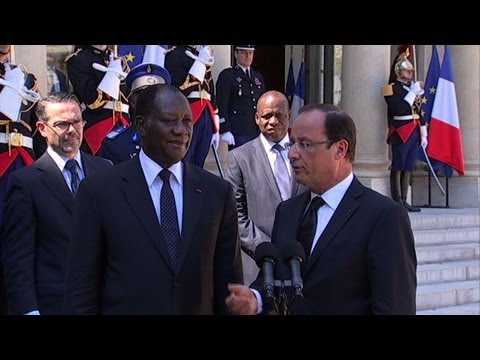
After staving off an intervention in his own country, with special thanks to previously deployed UN peacekeepers, Alassane Ouattara appears to have accelerated the Economic Community of West African States's campaign into northern Mali. Visiting Paris to discuss bilateral policies with President Francois Hollande, Côte d'Ivoire's newest President and current chairman of ECOWAS would lay political and military cables over the weekend before taking his plans public.

“If the situation doesn’t evolve favorably and rapidly, yes, there will be a military intervention in Mali,” he said in response to Le Journal du Dimanche's first question. “It seems inevitable.”

Besides the mounting anxiety in African and Western capitals, few conditions have changed since the United Nations ordered ECOWAS to clarify its initial request of force earlier this month. Ouattara begins by announcing the commonly-stated 3,300 troop level set by the bloc's Joint Chiefs of Staff, then partially elaborates that the force will be half Malian. Niger and Nigeria are expected to provide the majority of combat troops, and they in turn expect logistical and air support from Washington, Paris, London and possibly Madrid. Special Forces from the first three countries already operate inside and around Mali, but their numbers are expected to increase as demand for "counselors" rises.

Sticking to the U.S. script that seeks to eliminate "ground troops" from public perception, Ouattara said that he is "not considering the presence of ground troops who are not African."

With Hollande taking command of the UN Security Council on Wednesday, the diplomatic stars have aligned to green-light a pivotal intervention in northern Mali. Ouattara thinks that "we can talk in weeks, not in months," however his interview may produce a leap of inches rather than miles. First and foremost, 3,300 troops (including police and gendarmes) and a sizable contingent of Western military power cannot restore stability by themselves, and will require reinforcements in the near future. Many political considerations also remain unresolved, starting with the interim state of Mali's government; President Dioncounda Traore has finally returned from medical leave to announce a political overhaul, but a "government of national unity" is unlikely to be formed by the two week deadline that "regional mediators have requested." ECOWAS and the UN cannot launch an operation without a national government that is capable of restoring authority.

Even then, northern Malians may reject the legitimacy of any government formed without their input.

Traore also plans to establish a formal committee in a renewed effort to negotiate with "the armed groups in the north of Mali," a wise but complicated course of action. While some observers doubt that National Movement for the Liberation of Azawad (MNLA) will cooperate with African and Western capitals, failing to exhaust all means of negotiations would be equally rash. The group needs no coercion to move against the Islamic matrix that is al-Qaeda in the Islamic Maghreb (AQIM), Ansar Dine and the Movement For Oneness and Jihad in West Africa (MUJAO), and also provides the only oppositional channel to the Tuaregs. Problematically, the MNLA's secessionist agenda is treated on par with international jihad, and foreign powers are unlikely to reach a mutual agreement with the group. That void will force the international community to confront each power individually and collectively, as Ansar Dine and MUJAO have no intention of negotiating their vision of an Islamic state.

African and Western capitals have yet to reach a public consensus on the negotiating front, and the private situation may not be any different.

These factors necessarily undermine the completeness of ECOWAS's military proposal. While some political and military dominoes are being arranged with relative ease, other lie in a disheveled pile and expose large gaps in the overall strategy. Months are still needed to attempt a final sorting of northern Mali's puzzle, otherwise ECOWAS and the UN will increase the risk of entering a political quagmire in a territory that is nearly the size of France.