September 15, 2012

Obama's Hope Is the Middle East's Lesser Evil

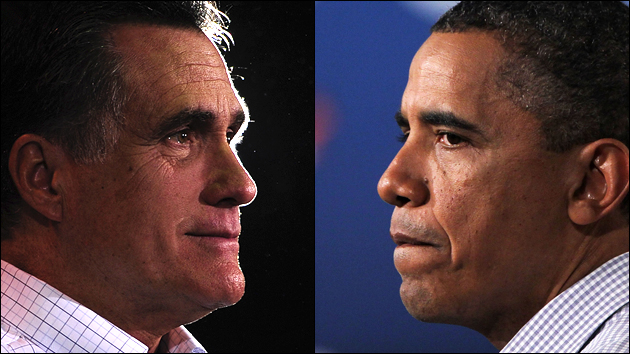
In the days following President Barack Obama's speech at the Democratic National Convention, administration officials and U.S. media seesawed over a post-convention "bump" that reportedly elevated his values above Republican challenger Mitt Romney. Numerous polls, including a recent Fox News survey, have marked down a widening gap across the board: education (+14), Medicare (+11), terrorism (+8 points) and foreign policy, where Obama rated 15 points higher than Romney. Many Americans and the Middle East's populaces do share something in common after all.

They are stuck with the Obama administration's foreign policy by default.

Judging from the overall actions of his first term, Obama himself received no bump in the Middle East after delivering a one-sided and misleading acceptance speech in Charlotte, North Carolina. Four years removed from promising a new era of engagement between the U.S. government and Muslim world, both sides refuse to stray far from the negative perceptions that have accumulated over decades of war, intervention, exploitation and continual strife. Obama isn't personally responsible for this status quo, only for over-promising and under-delivering in order to cast a favorable political glow upon himself. Stagecraft would trump statecraft as the U.S. economy came first and now U.S. policy in the Persian Gulf's sphere of influence is, as Romney warns, lacking "American leadership." Unfortunately his proposals are both vaguer than Obama's and more hostile to the region's stability, and his circle is staffed by pollsters that apparently aren't "going to let our campaign be dictated by fact checkers."

"The worst part of this election is there are so many valid grounds to criticize Obama," The Guardian's Glenn Greenwald Tweeted the day after Obama's speech, "and the Right voices almost none of them."

Washington's
Shades of War

Although Romney's policies in the Arab world are masked by ambiguity, scarecrows, red herrings and other distractions, his potential administration runs on traditional GOP diesel and factors into account a widespread anti-Muslim trend in the mainstream Republican party. Blaming Obama for "diminishing American leadership" is standard fare, and a valid point in the Middle East if not for his own hawkish and insensitive tendencies. Inside his October 2011 white paper, titled "American Century Strategy: secure America's enduring interests and values," Romney meets Obama at numerous points of mutual interest while exposing the toxicity brewing beneath his sweet rhetoric. His circle of GOP veterans believes that the "unfinished" project for an "American Century" is something to be completed, and the Arab revolutions something to be manipulated under the banner of democracy.

"To protect our enduring national interests and to promote our ideals, a Romney administration will pursue a strategy of supporting groups and governments across the Middle East to advance the values of representative government, economic opportunity, and human rights, and opposing any extension of Iranian or jihadist influence. The Romney administration will strive to ensure that the Arab Spring is not followed by an Arab winter."

In a "dangerous, destructive, chaotic" world, Romney plans to "lead the free world" as the "free world leads the entire world." This policy includes joining Israel's crusade against Iran's nuclear sites, a potential war that an estimated 60-70% of Americans disapprove of, as a means of projecting America's strength. Obama, on the other hand, has fashioned himself into an arbitrator of war and peace, wielding a Nobel in one fist and Osama bin Laden's head in the other. The race for bin Laden offered a trophy to the winning administration and Obama will personally reap the benefits as long as he lives. The glorified kill, along with the advance in drone warfare and strategic rise in U.S. Special Forces, also allows him to continue his foreign policy of "less force" with minimal domestic resistance.

Obama's case for non-military action against Iran, withdrawing from Iraq and Afghanistan, and promising to "disrupt terror plots wherever they form" became more convincing after May 2nd, 2011. Well-meaning critics of America's newest version of war find difficulty in attacking a policy that costs less American lives and taxpayer dollars.

War Obama still brings, though, and leaves unfinished. The President has grown fond of bragging that he "ended the war in Iraq," and refuses to unspin Romney's own policy because ongoing Iraqi casualties make for dangerous political ground. Romney claims that "a democratic Iraq allied to the United States is within our reach," but Obama is "threatening to snatch defeat from the jaws of victory." After promising to use a "broad array of foreign policy tools - diplomatic, economic, military," Romney then zeroes on Obama's "failure" to install a residual military force and ignores the political void that the administration has encouraged by supporting Prime Minister Nouri al-Maliki. He fails to understand (at least in public) that Washington's problems in Iraq stem from political inequalities, not military shortages. Prolonging the deployment of U.S. troops would give the divisive al-Maliki more leverage over his opponents, not less, while an extension could generate as many security problems as it solves.

Obama, Romney and Tehran have all ended up in al-Maliki's leaky boat, a circumstance that neither candidate likes to talk about.

The incumbent and challenger find similar common ground in Afghanistan, where Romney seems to agree with the bulk of Obama's strategy despite their public feuding. He may keep a lower profile for this reason: Romney's white paper approves of the 2014 transition to Afghan security forces, demands greater accountability from Afghanistan and Pakistan's governments, and expects a residual force to be discussed in the future. The Obama administration also hopes to maintain a long-term security presence after 2014, contrary to his DNC announcement that "in 2014, our longest war will be over."

Nor does the absence of U.S. troops end an asymmetric war. Here the candidates share something else in common, because Romney opposes negotiating with the Taliban and plans to "rid" the group from Afghanistan - and extend the war in this unrealistic quest. He's also more likely to send ground troops across Pakistan's border in search of the elusive Haqqani network, another move that is liable to prolong the conflict.

At a wider strategic level, Romney would surely get the hang of drone warfare as fast as Obama.

A Pattern of Division and Unity

The greatest regional divergence between candidates centers around U.S. policy towards Israel and Iran, where Romney believes he can score fast points by portraying himself as the anti-Obama. For his part Obama has tread cautiously around Tehran at the direction of America's military leadership and public resistance to a "big" war in the Gulf, awaiting the final results of global isolation. Romney concedes the need for economic and diplomatic isolation before clarifying that a real threat of war offers the only possibility of defusing Iran's nuclear ambitions, a plan that includes "repairing relations with Israel." Unlike Obama, he would "never refuse a meeting" with Prime Minster Benjamin Netanyahu (a story that the White House denies), reject Israel's insistence on a "red-line" for stopping Iran's enrichment program, or throw Israel "under the bus."

Casting Obama as "pro-Palestinian" reinforces the twisted state of U.S. policy under either candidate. In reality he has abandoned the Palestinians to Israel's terms for a two-state solution - requesting a settlement pause distorted this policy in America and Israel alike - and spent far more energy confronting the Iranians. Upon taking office, Obama announced that he would break ranks from the Bush administration's 11th-hour drive for peace and pursue an equitable two-state solution "from day one." Sadly he has fallen into the same trap of bias and inaction, even excluding the Palestinians from his second acceptance speech, which harms Israelis in the process. If peace is harder to make than war, it stands to reason that greater energy must be applied.

Romney claims that Iran, not the Israeli-Palestinian conflict, serves as the region's central issue, and Tehran's external policies do run on a variety of unrelated interests. Yet one cannot help observing that the Islamic Republic of Iran has never known a world with a sovereign Palestinian state.

Aside from this divide Romney finds a good amount of common ground in the region, and Washington's transition-oriented counterrevolution to the Arab revolutions is no exception. Obama's absence on the Palestinian sideline has done its own local damage, but this conflict falls into an established struggle between the modern world's haves and have-nots. Romney is right one on account: Obama has failed to deliver the leadership that he promised in the Middle East. However the GOP's new face would offer no respite from Obama's pseudo friendship with the Palestinians and other democratic actors. In Egypt, Romney has consistently and falsely accused the administration of supporting the Muslim Brotherhood, finding no fault in supporting the authoritarian Supreme Council of Arms Forces (SCAF) or thwarting Egypt's popular revolutionary forces.

Obama recently countered this charge by urging the Brotherhood to maintain Egypt's peace treaty with Israel.

Elsewhere in Yemen, Obama has deployed his trusted counterterrorism adviser John Brennan as his lord of war and, on important occasions, as Washington's senior "diplomat" in the country. Both he and Ambassador Gerald Feierstein are extremely unpopular figures due to the administration's handling of an ongoing revolution, and Feierstein is currently being denounced at the U.S. Embassy in Sana'a. Romney would surely appreciate the same luxuries afforded by drones, Special Forces, CIA agents and a dominate geopolitical relationship with Saudi Arabia, and thus operate no differently in Yemen. Bahrain's policy would also experience a smooth transition between Obama and Romney's administrations, just not the Bahraini protesters who labor under state-sponsored oppression. Counterrevolutionary actions in select states have reinforced a hypocritical pall over U.S. foreign policy in the region, especially Libya's mission and Syria's intervention, but neither acknowledges this burden.

Instead, Romney accuses Obama of encouraging an "Islamic winter" while portraying himself as tougher on Iran and Islamists. He presumably sees nothing wrong with supporting authoritarian governments, opposing Islamic political groups or aiding an Israeli military operation in the name of America's "enduring interests," even if this policy damages them. Before becoming trapped in another battle over apologies, Obama enjoyed his time in Charlotte by ripping Romney for "taking us back to an era of blustering and blundering that cost America so dearly."

Marooned On Hope Island

Given his own statements and positions, Romney is clearly incapable of fostering lasting stability and peace in the Gulf region. Improving the trajectory of U.S. policy in the Middle East requires the type of personality that Obama promised and never delivered, making his disappointment historically significant. Poll after poll concludes that he fell into an enormous trust gap left by previous administrations. Too many Muslims still perceive America as a unilateralist actor in the region - whether cooperating with its allies or not  - and an outright threat to their national interests. 

Accordingly, Obama's popularity remains anchored near Bush's in Egypt, Turkey, Jordan, Yemen, Pakistan, the Palestinian territories and other areas entangled in U.S. foreign policy.

The dilemma of lesser evil may be an inherent problem of democracy, but rating America's presidential candidates cannot be jaded by the previous failures of George W. Bush's administration and past presidents. Finding a truly excellent candidate, rather than once again settling for the lesser of two negatives, is an ideal worth pursuing throughout history. As for the diverse peoples of the Middle East, nothing has changed since Obama entered the Oval Office: they must free themselves of foreign interference on the way to determining their future.

September 13, 2012

The Lethal Bureaucrat: Who is John Brennan?

Micah Zenko, writing for Foreign Policy, raises an equally important question: who courted who?
No politically appointed official in U.S. history has played such a prominent role in killing so many people outside of a war zone as John Brennan. He has been a "close advisor" to President Barack Obama since November 2008, was a Team Lead for the president-elect's review of the U.S. Intelligence Community (IC), and has served as homeland security advisor and deputy national security advisor for counterterrorism, with the rank of assistant to the president, since the first day Obama entered office. Brennan does not merely fill a White House position, but also meets with the president several times a day and -- according to administration officials -- serves as "a priest whose blessing has become indispensable to Obama."
Brennan plays the essential role in shaping and implementing  Obama's vision for protecting the United States, its allies, and its interests from politically motivated violence. The predominant counterterrorism tool under Obama has been targeted killings in non-battlefield settings, and Brennan reportedly oversees and manages the 100-person inter-agency process that nominates and vets suspected militants and terrorists for the United States' various kill lists -- implemented by the CIA and Joint Special Operations Command. Obama's has been a "lethal presidency," and  Brennan is the Lethal Bureaucrat. Despite his close relationship to Obama and preeminent duty in coordinating the kill lists, he flies largely under the mainstream media's radar.

First, it is important to understand the scope of what Obama has authorized in comparison with his predecessor. Since Sept. 11, 2001, there have been an estimated 393 targeted killings -- in Yemen, Pakistan, Somalia, and the Philippines. (President George W. Bush also authorized an October 2008 raid six miles inside Syria to kill Abu Ghadiyah, an Iraqi-born senior operative of Al Qaeda in Iraq, as well as several of his bodyguards and several civilians.) Under Bush, there were roughly 50 targeted killings; under Obama there have been 343 in less than half the time -- 95 percent of them by Predator or Reaper drones. At least 2,000 people have been killed by U.S. targeted killings since Obama entered office.

Brennan is especially well-suited for his position at the intersection of lethal covert operations and bureaucratic management. He spent a quarter-century in the IC, serving in wide-range of distinguished roles, including as Middle East chief of station, daily intelligence briefer for President Bill Clinton, and -- from 1999 through 2005 -- chief of staff to CIA Director George Tenet, deputy executive director of the CIA, and head of the Terrorist Threat Integration Center, later named the National Counterterrorism Center. It was during these years that Bush authorized the CIA to use enhanced interrogation techniques (i.e., torture) by its agents, and transferred hundreds of people into the extraordinary rendition program where many were tortured by foreign intelligence agencies.

In 2005, Brennan retired -- as he claimed -- "to lead and shape the future direction of The Analysis Corp (TAC)," an intelligence consulting firm where he was president and CEO. While running TAC, according to a corporate press release: "Brennan leveraged his knowledge of intelligence matters and his expertise on terrorism and security issues to guide the company's rapid corporate growth and innovative business strategy." During this time Brennan also appeared on TV to discuss the Bush administration's controversial counterterrorism policies. In 2005, on PBS' Newshour he described extraordinary rendition as "an absolutely vital tool," which "without a doubt has been very successful as far as producing intelligence that has saved lives." In 2007, he told CBS News that waterboarding was "the classic definition of torture," which is "inconsistent with American values and it's something that should be prohibited."

In 2007, Brennan also became a foreign-policy adviser to the Obama presidential campaign, though he never met Obama until the president-elect summoned him to Chicago just after the election in November 2008. Upon meeting, as Daniel Klaidman writes: "Their views were so complementary that Obama found himself finishing Brennan's sentences." In this campaign role, Brennan gave interviews to tout Obama's IC priorities, noting that Obama believed that covert action "cannot be done by a single branch of government," with oversight by both Congress and the courts a must for such activities. Brennan's rumored nomination to become CIA Director was resisted by progressives and psychologists, who sought a clean break from Bush's global war on terror approach. Brennan withdrew from consideration for the position in a Nov. 25, 2008, letter to Obama, complaining that, "The fact that I was not involved in the decision-making process for any of these controversial policies and actions has been ignored."

September 11, 2012

CNN's Tireless Propaganda Machine

A brief blog by a powerful media personality, employed by one of the world's largest news corporations, on 9/11, offers an simple example of information warfare in the modern world.

In a post titled "Al-Qaeda diminished, but not gone," Fareed Zakaria claims that the network began its downward trajectory soon after America and its allies' organized a global reaction, and now functions as a "shadow of its former self." The overall conclusion is reasonably argued: a combination of government actions and social factors depleted al-Qaeda's core of trained jihadists and stained its ideology. The Arab revolutions in particular have undercut al-Qaeda's "defense" of the Muslim Umma and further alienated the group from the Arab world's marginalized populations.

However the presence of overt propaganda reveals a wider agenda at work, one that thrives on Zakaria's personality and CNN's information warfare. None of his questionable statements can be conclusively proven or disproven, making them ideal fodder for propaganda. Although al-Qaeda's brand appears to be diminishing over time, an alternative scenario can be plausibly reasoned between the extremes of triumph and defeat. Al-Qaeda is no longer its former self, not just a shadow, and its branched structure has diversified in the decade after 9/11. Some states have been lost while others have been gained. Osama bin Laden never managed to bring down the American economy (his strategy only enriched the powerful) or secure an Islamic caliphate of his own, but northern Mali is starting to resemble his vision.

al-Qaeda is still fighting in Iraq and infecting Syria in the process.

As for U.S. policy in the Gulf, its Saudi-coordinated counterrevolution is feeding al-Qaeda's ideology rather than starving it; genuine support for self-determination in Egypt, Yemen, Bahrain and Syria would have dealt a more severe blow. Instead the Obama administration plans to destroy the group by facilitating a pro-US government in Yemen, creating an impression that will nourish AQAP through the government's U.S.-supported campaign. The Obama administration is also sluggish to respond to Libya's aftermath, which is partly responsible for Mali's situation, and bases its policy in the Sahel on the support of an totalitarian Algerian government.

The Trench is simply pointing out the difficulty of judging al-Qaeda's long-term objectives and lifespan. Zakaria does clarify that "these signs of life from al-Qaeda do not change the central reality of its diminished potency," only to concede "the danger of al-Qaeda was always about more than scattered violence in far off places across the globe."

Another questionable statement is admittedly subject to opinion, but a prime example of Washington's insular connectivity. Having concluded that al-Qaeda poses less of a threat to America's national security than ever before, he speculates "that there may now be a danger of complacency." No such complacency appears to exist, though, as U.S. drones and commandos hunt al-Qaeda behind a tuned chorus of political rhetoric. Zakaria then cites former CIA analyst and current Obama adviser Bruce Riedel as his "serious expert" when acknowledging the above observations: "al-Qaeda has been able to reconstitute itself in places like Yemen, Somalia, and even Mali. The Pakistani connection remains strong. And the growing chaos in Syria has presented the group with an opportunity to make inroads there as well."

Riedel is one the administration's louder al-Qaeda watch dogs, providing shallow commentary on Mali for The National Interest and supporting Washington's counterrevolution in Yemen. One insider appealing to another turns the gears of propaganda.

A final discrepancy, however, centers on a factual lie. With Yemen, Mali and other "worrying signs" in mind, Zakaria "naturally hopes that the U.S. government is battling al-Qaeda wherever it can." He sees hope in reports "that the second-in-command of al-Qaeda in Yemen was killed by government forces," when a U.S. drone strike is the more likely culprit. This information has yet to be verified but Zakaria makes no attempt to examine the situation, nor does he refer to the previous strike in Yemen that killed 14 civilians. al-Qaeda cannot be defeated so long as it trades injustices with America.

The aura of 9/11 isn't needed to cover these propaganda tracks from the majority of Americans. Any day will do.

U.S. Drones Buzzing Between Yemen's Political Lines

The latest U.S. drone strike in Yemen has reportedly killed al-Qaeda in the Arabian Peninsula's (AQAP) deputy following a raid in Hadramout governorate (Yemeni activist Jane Novak notes that Said al-Shiri has been reported dead on four previous occasions). State media attributed al-Shiri's death to a "qualitative operation" conducted by government forces - local redemption is especially needed after Raada's disastrous airstrike - but reliable evidence points to Hellfire missiles. 

A Pentagon document released by WikiLeaks assessed al-Shiri as a "HIGH risk" prisoner of Saudi Arabia's rehabilitation program because "he is likely to pose a threat to the U.S., its interests and allies."

Even before their freshest kill, U.S. drones and their operators have undoubtably scaled AQAP's hierarchy as more resources flow into the country. An open playground for foreign intelligence agencies before revolution broke out in January 2011, Yemen is now crawling with Saudi, American and British agent who operate in coordination with an influx of U.S. Special Forces. Failing to find AQAP's leadership would be more surprising than any other option, and the eventual death of its leader Nasir al-Wuhayshi can be anticipated in the future.

Yet the overriding dilemma of drones remains unchanged. While AQAP cannot lose its main personalities and avoid a strategic impact, eliminating many former "leaders" over the last decade has "disrupted" but failed to dismantle the group. Neither Anwar al-Awlaki nor al-Shiri were as vital to AQAP's operations as U.S. and Yemeni officials claim, and new personalities stand ready to fill their places. Drones must stay active for another 2-3 years at the minimum to effectively reduce AQAP's leadership back to a starting point, a time-line that Washington has subtly acknowledged by building a drone base along the Saudi-Yemeni border (possibly inside Hadramout) and shipping in a new fleet.

The human cost of this strategy will be paid almost entirely in Yemeni blood; a longer period of operations equals more drone strikes and, inevitably more missed targets. U.S. counterterrorism officials argue that the reward of military success exceeds the risk of civilian casualties and collateral, however this attitude has eaten away at Washington's limited credibility in the country. The Obama administration's war in Yemen began with high-profile civilian casualties and never looked back, establishing a negative perception that rivals the drones' trophies in weight. Democratic activists and tribal networks both take offense to the intrusive nature of U.S. drones and have repeatedly expressed the dangers of alienating Yemen's population.

Furthermore, many view Saudi and American hegemony as partly responsible for AQAP's spread in their country. al-Shiri's past service to Saudi intelligence is one many suspicious factors that perpetuates this belief.

In terms of Yemen's U.S.-sponsored GCC deal, Washington continues to reap the spoils of war gained by the soft removal of Ali Abdullah Saleh. The murderous tyrant rests in a glorified state of house arrest in Sana'a, still able to interfere with Yemeni politics as his replacement caters to the Obama administration's demands. Despite repeated threats of Western sanctions against unnamed "spoilers," he also enjoys international immunity granted by the UNSC via the GCC power-sharing agreement. Committing human rights abuses with U.S. military aid perversely added to his leverage with Washington. Meanwhile President Abd Mansur al-Hadi, Saleh's former vice president, has reversed his predecessor's tactic of abandoning territory to AQAP and launched a comprehensive, U.S.-backed offensive against the group's southern positions.

Drones now enjoy greater freedom of movement than under Saleh's fair weather approval.

Equally disturbing, Washington's emphasis on counterterrorism has left internal problems in Yemen's north and south to simmer in a bath of instability. Both the northern Houthi sect and secessionist-minded Southern Movement were excluded from the GCC's power-sharing deal, and while both plan to join November's "National Dialogue," they are more likely to air grievances than reach any agreement with the national government. Most aspects of these long-standing issues must be decided by Yemenis and have nothing to do with America, but the US-KSA counterrevolution has recklessly marginalized a large area of Yemen's political environment. Many Yemenis subsequently believe that AQAP should be handled as an internal issue, not by external forces.

Washington likely hopes that "cleaning up" AQAP will allow the north and south's political actors to resolve their differences without interference. While a plausible case can be made in defense of this strategy, U.S. policy would generate more encouragement if the Obama administration devoted the same attention to Yemen's dynamic politics. Momentum needed to be built up amongst the northern, southern and revolutionary movements ahead of November's summit. Unfortunately these factors, some of which enable AQAP's growth, remain unstable periphery areas of U.S. policy because Washington envisions a long-term client state at the corner of Bab-el-Mandeb.

This parallel, more than any other, mirror's U.S. policy in Pakistan. Too much power would be ceded if those acting outside Yemen's political status quo are genuinely brought into the national equation.

September 10, 2012

Bahrain's Thorns Stuck In Obama's Side

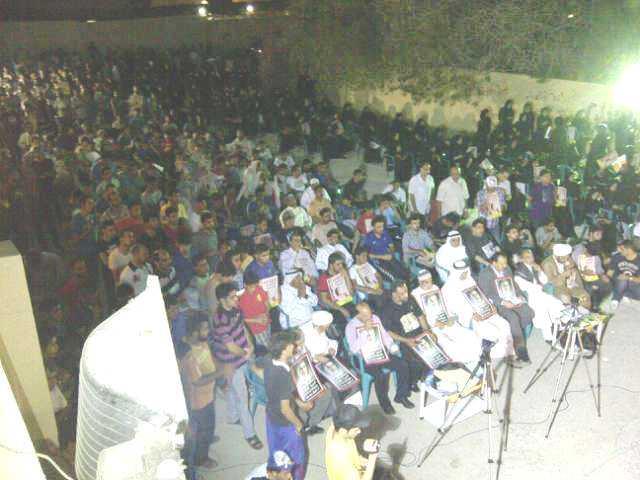
Massive show of solidarity outside Nabeel Rajab's home

Two weeks ago Sumaya Rajab, the wife of imprisoned Bahraini activist Nabeel Rajab, posted an open letter to U.S. President Barack Obama. Sentenced to three years in prison for "inciting" and participating in “illegal gatherings," Nabeel would appear before the court as a beacon of freedom and justice, a man who can beaten physically but not mentally. Sumaya would appeal to Obama with these very virtues: "Victimized people of Bahrain are calling upon the universal values and principles that United States is embracing."

The response: sit back and watch Rajab's cruel and unusual punishment.

Despite a continual rise in Bahrain's hostilities from February 2011’s initial democratic outbreak, both sides of Washington still doubt that they have much to gain from embracing the island's opposition. Confronting Iran and protecting Israel, shipping routes and oil supplies plays better than supporting a relatively small opposition in a foreign land. The Obama administration has downplayed Bahrain throughout the Arab revolutions, with considerable success at home, but the opposition universally agrees that U.S. policy is negatively affecting their struggle for human rights and political representation. Most GOP presidential candidates, sadly, would offer even less words of support and back them with the consent of force.

A month after Rajab was jailed on July 9th and held at the notorious Jaww prison, Washington could only muster a letter of support signed by two Senators and 17 Representatives - apparently leaving the other 98 and 418 on King Hamad bin Isa al-Khalifa's side.

The White House has been equally unhelpful throughout Rajab's numerous arrests and his campaign to raise awareness in Bahrain. By the time he arranged a series of media appearances to kick off the summer, Rajab had come to accept the immovability of U.S. policy after previously hoping that America's Fifth Fleet would loosen Washington's security bond with Manama. The head of Bahrain's Center For Human Rights (BCHR) had just watched Crown Prince Salman mingle with Vice President Joe Biden, Secretary of State Hillary Clinton and Secretary of Defense Leon Panetta as he languished in a jail cell. Rajab and his family have also been subjected to abuses at home, including night raids and tear gas assaults. When he was rearrested in July, the State Department waited two days before expressing "concern" - at the prompting of inquiring reporters - and refused to explicitly call for his immediate release.

The State Department then claimed that it had done so "from the beginning" after Rajab's sentencing, although no follow up can be found in the Department's own database. No further statements have been issued.

These isolated defenses are designed to float in a sea of silence, maintaining an obligatory level of interest to ward off criticism of inaction. Accordingly, Sumaya observes that the State Department "already expressed 'Worries' and 'Concerns' about Nabeel’s imprisonment but the government of Bahrain ignored all such 'Concerns.'" Her letter is almost too reasonable and inviting, given the situation of her family, but Sumaya wisely attempts to relate her cause to Obama and the founding ideals of America. With nowhere left to turn in Washington, she requests "your kind intervention to explicitly call for Nabeel Rajab’s immediate and unconditional 'release from prison' because Nabeel is a prisoner of conscience." However Obama has yet issue any personal reaction to Rajab's imprisonment or the abuse that Bahrain's government is subjecting him to, both before and after his sentencing.

Sumaya attempted to list the offenses following a one-hour visitation, which itself was reduced to 25 minutes: repeated personal inspections, limited clothing, isolation from other "political prisoners of conscience," solitary confinement in a 5x7 cell that allegedly contained a dead cat. Rajab's medical needs have also been ignored as part of the government's plan to break him down, but they will have to kill him to stop him. Sumaya "confirmed that in spite of all this suffering, Nabeel's psychological state is very strong and that he always raises the victory sign."

This inhumane episode repeated without any change last Tuesday when Bahrain's High Court of Appeals ruled against a selection of Bahrain's oppositional leadership. Many were sentenced to life for "plotting to overthrow the regime," a charge that sounds inherently autocratic, and those who weren't tried in absentee have endured treatment similar to Rajab's. Even more disturbing, six men were subjected to cooked-up charges of "having intelligence contact with foreign entities." Western ideals of due process have been thrown out the window during a prolonged appeals process, and Bahrain's opposition argues that the defendants shouldn't have been imprisoned in the first place. Their failed appeal also indicates the worst for Rajab, who is scheduled to hear his own appeal on September 10th (now delayed until the end of the month).

Abdullah Al-Khawaja, perhaps the most high-profile defendant, was acquitted of conspiracy and still imprisoned.

The monarchy's defense of Tuesday's outcome fleshed out its grotesque nature. Speaking after the verdict, Chief Prosecutor Wael Buali claimed that the defendants "received full medical care during their incarceration," contrary to their families' accounts. He further argued that all defendants received a fair trial and appeal, going so far as to "remind" them that they are "fully entitled to appeal their sentences." However Buali hopes that they stay locked up for good. Declaring the verdict to be a "victory for Bahrain's justice system," he believes that the case proved "that the defendants had ties with Hizbollah and Iran."

Clergyman Mohammed Habib Al-Saffaf, the one man who escaped this charge, illustrates the depth of the accusations at work. Identified as the mastermind behind several kidnappings and beatings, al-Saffaf was also accused but ultimately acquitted of maintaining ties with a terrorist organization. He had been rumored to arrange the welcoming party for "40 warships Iran was planning to send to Bahrain to support an attempted coup."

As for Rajab, no one can deny that he encouraged previous demonstrations and Friday's protests in Manama - his Twitter account pointed Bahrainis in the right direction. The monarchy's attempt to break his spirit and mobilization network is having as little an impact as Western statements of "concern." The State Department would release another statement after Tuesday's ruling only to disappear again, while other Western sources of power have similarly failed to match their belated words with actions. UN Secretary-General Ban Ki-moon's reaction encapsulated this futility by "reiterating the right to a fair trial" after a round of unfair trials had been finalized. Nor can King Hamad's monarchy afford to reverse course in the face of foreign pressure - Rajab, Al-Khawaja and other oppositional figures are being punished for domestic consumption.

Their release is a magnanimous gesture in the making, but one that is unlikely to be delivered.

The sum of Bahrain's latest developments underscore the existing deterioration of U.S. policy. Attempts to facilitate a new "national dialogue" will continue to fail so long as the island's repressive climate suffocates the opposition; the false expectations and broken promises generated by this strategy have already contributed to Bahrain's stalemate. Comparing the violence of Bahrain's government and protesters is similarly counterproductive and insulting to pro-democracy forces. Anything less than full agreement with the opposition will fail to halt the conflict's trajectory, but the Obama administration could lose the King and most of Washington's support in the process.

This dilemma leads to only one set of conclusions: either the administration isn't pushing hard enough to change the monarchy's behavior, or King Hamad's regime has become so authoritarian that U.S. policy hangs at the mercy of tyrants.

September 9, 2012

Information Warfare Rules the World

Information warfare rests for no day, but some days appear to bring an extraordinary pace of intelligence and propaganda. Sunday is one of them. Across the so-called "arc of instability” that Washington and al-Qaeda are competing to infiltrate, the two forces and their allies are engaged in open conflict outside the strict military sphere. All of these development will receive wider strategic analysis in the near future:

Haqqanis Vow Retaliation For "Terrorist" Label

Amid the heated battle over the Haqqani's "terrorist" designation, a move that also advances the threat of designating Pakistan as a state sponsor of terrorism, an urgent fragment of information has emerged in the fog of war. Citing a "senior member" of the group, the Associated Press reports that Sirajuddin Haqqani "wants to carry out 80 to 100 attacks on US forces in Afghanistan and 20 attacks on other Nato members." His motivation is attributed to Washington's political assault, not his younger brother's recent death-by-drone, but the Haqqanis' display of strength would presumably react to both factors.

The anonymous commander was also keen to emphasize the Taliban's consistent narrative that both groups are one and the same, fighting under the same banner in their own territory. Using their channels and the international media to carry messages to their solders, Sirajuddin has symbolically asked for permission to act from Mullah Omar in order to reinforce the Taliban's unity - a simple but effective tactic to counter Washington's actions. As part of the Haqqanis' media offensive, another "senior commander" told Reuters that the Obama administration has secretly contacted the group in conjunction with Mullah Omar's shura. He too declared the Afghan Taliban to be one network and rejected the possibility of the Haqqanis' exclusion.

”(US Secretary of State Hillary Rodham) Clinton should have the courage to tell the Americans about their contacts and even talks with us,” he said.

Perhaps the Obama administration intends to leverage its terrorist designation into a bargaining chip with the Haqqanis, but the odds of political resolution by 2015 remain stagnant.

Yemen, U.S. Scrub Civilian Casualties With AQAP

Last Sunday a U.S. drone strike in Raada, Yemen allegedly killed five militants traveling by vehicle. Soon afterward, local sources revealed that the barrage of Hellfire missiles had actually killed 14 civilians, including three women and three children. U.S. officials were predictably mum as they scrambled behind the scenes to collaborate their story with the Yemeni government, which often passes on the blame of civilian casualties.

"This was one of the very few times when our target was completely missed," a senior Yemeni Defense official admitted to CNN. "It was a mistake, but we hope it will not hurt our anti-terror efforts in the region."

Despite U.S. claims that drones create less tribal blowback than expected, local leaders and their supporters demanded a government explanation within 48 hours. Both governments have since justified the strike on the presence of local AQAP member Abdelrauf al-Dahab, who escaped the attack unharmed. al-Dahab, the brother of the man who led Raada's brief takeover in February, makes for a logical target in the war against AQAP, but the consequences are unacceptable from a counterinsurgency standpoint. That Tareq al-Dahab was legitimately eliminated by Yemen's tribal mechanisms contrasts vividly with errant U.S. missiles. The vast majority of Yemenis aren't opposed to the destruction of AQAP, so much as the unaccountable nature of U.S. counterterrorism and Washington's intrusive hegemony within the national government.

And they don't want "a new fleet of drones" flying over their country.

Suspicious Circumstances Surround Mali Executions

Already caught in a political struggle between itself, ECOWAS and the UNSC, the Mali government continues to damage a potential operation into the Islamic-held north before it begins. One of two events occurred Saturday night in the village of Diabaly. According to a Mali security official, 16 members of the Dawa sect refused to stop at a checkpoint and "after warning shots were fired were treated as enemies." The dead counted eight Malians and eight Mauritanians. Conversely, a local Mali police official and a relative of the victims speak of a horrific alternative: the group of men, including 12 Mauritanians, were "moderate" Islamists. Mohamed Bashir claims that two cousins died by execution "after soldiers arrested the preachers and then led into the darkness away from the village in the shooting."

A statement from Mauritania’s state media now confirms, ‘‘Mauritanian officials are in touch with Malian authorities in order to get more information on the circumstances of this affair and also to repatriate the bodies of the Mauritanians who were killed.’’

Recognizing the danger of a cover-up, the Mali government is gradually rolling back its story while refusing to acknowledge the execution. A statement has announced its "deep regret" and pledged an immediate investigation, "the results of which will be communicated to the public and the international community.’’ This swift reaction is admirable in a vacuum, but even northern Malians with no sympathy for the Islamist takeover may be affected by Diabaly. The three-headed network of Ansar Dine, the Movement of Oneness and Jihad in West Africa (MUJAO) and AQIM will certainly milk the execution to the last propaganda drop.

‘‘We do not recognize these words of condolences issued by Mali which has killed these innocent people,’’ said Oumar Ould Hamaha, a spokesman for Ansar Dine. ‘‘These preachers have nothing to do with jihad. They are moderate people, who were constantly preaching to us, to tell us to be more moderate in our actions. And if the Malian government has killed them in this barbaric fashion, we will seek revenge.’’

These types of visceral events magnify conflict lines and are capable of producing disproportionate effects in asymmetric warfare.

September 8, 2012

al-Shabaab Defections Inching Closer To Reality

For months the following rumor has been just that, but timing is beginning to push it into the realm of plausibility.

A slew of intelligence released by the Kenyan government is marching the African Union's Mission In Somalia (AMISOM) to the southern port of Kismayo, bringing its forces to the edge of the military and information battlefields. Kenyan troops are reportedly preparing their final advance on Kismayo and will enjoy significant air/naval cover as they encounter any resistance from al-Shabaab. To their south, Ugandan and Burundian units await orders to move out of their advance position at Harbole, located between Afmadow and Kismayo. This information has been offered freely with the intention of deterring an organized counterattack and broadcasting Kenya's achievements to the world, a tactic that is yielding success on both levels.

Government propaganda aside, independent and civilian reporting correspond to the account of Kenya Defense Forces spokesman Colonel Cyrus Oguna. Following last weekend's battles around Afmadow (Miido and ), al-Shabaab's local commanders had allegedly expected a pause in AMISOM's activities and found themselves surprised by the bloc's advance towards Kismayo. Losing two locals commander in an airstrike further disrupted the group's immediate decision-making, and the defection of 200+ fighters in Afmadow appears to have broken any semblance of resistance in Kismayo.

"We have information that the insurgents are fleeing towards the south by boat and by road. There is a lot of movement because they know that Kismayu must fall," Oguna said, who added that AMISOM is conducting aerial surveillance of their movements.

At this point an observer may begin to finally believe in the rumors that anticipate a split between al-Shabaab's nationalist and transnationlist leadership, which may or may not include a rebranding effort. Interestingly, two interlocking developments have been posited as the motivation behind a name change to Munadamat Ihyaul Somaliya. While Kenya's government attributes this possibility to al-Shabaab's military disarray, other sources claim that the leaking of Munadamat Ihyaul Somaliya is itself responsible for renewed hostilities between Sheikh Mukhtar Robow and Sheikh Moktar Ali Zubeyr Godane. Robow, al-Shabaab's leading nationalist personality, has been attempting to disconnect from Zubeyr's transnationlist agenda for several years, yet he still distrusts Zubeyr's efforts to rebrand al-Shabaab on his own terms.

Zubeyr's deputy, Abdullahi Yari, also stands accused of only distributing funds to al-Shabaab's foreign fighters, a common grievance.

Tensions are boiling after the two sides again failed to reach a consensus on the insurgency's future. Beyond its usual problems, Zubeyr's faction has grown even more suspicious of Robow and Sheikh Hassan Dahir Aweys in light of alleged contacts with the Somali National Army. The elder Aweys in particular is considered the most likely candidate to defect, having battled Zubeyr as an outright enemy before being coerced into joining al-Shabaab. He was likely left out of the State Department's "Rewards for Justice" program to keep him politically eligible, while Robow hopes that his clan ties will preserve his useful to Mogadishu.

Local analysts also suspect that Zubeyr "formally" merged with al-Qaeda in order to tarnish al-Shabaab's nationalist leadership, thereby disqualifying them from negotiating.

They may have to move fast if they truly expect to rid themselves of Zubeyr's authority, as each side is suspected of plotting assassinations against the other. Whatever they decide, Robow and Aweys will eventually be forced to choose between a rebranding campaign against the new government, and crossing over in exchange for favorable terms. Inactivity is not an option.

September 6, 2012

Another Sad Night For U.S. Foreign Policy


 He came, he saw, he whitewashed.

Nothing less could be expected President Barack Obama's acceptance speech on Thursday, from the soaring (and at times egotistical) rhetoric to the overemphasis on America's domestic policy. Nor should independent observers of U.S. foreign policy be surprised by what was and wasn't said. Formulating a reaction would be pointless if not for the inclusion of slight variations to his campaign speech:
  • In Afghanistan, the Taliban's momentum is suddenly "blunted" instead of "broken," unintentionally suggesting that the insurgency has acquired momentum in a matter of days. Obama now appears to have concretely defined the war's end in 2014, rather than pull back from previous statements, but the war will continue past this date. Whether or not Washington leaves a residual force - and America's generals can't be happy with Obama's campaign rhetoric - the Taliban cannot be expected to lay down their arms at a specified time. The end of U.S. involvement and the end of an asymmetric war are two different events.
  • His jibes against Mitt Romney would also pack more punch if he didn't spend the last four years dodging Afghanistan's war.
  • Al-Qaeda's path to defeat includes a stopover in northern Mali, where the group has taken control of a swath of territory the size of France. The Obama administration has decided to publicly ignore the situation due to the absence of a contingency, but blowback on the campaign trail isn't welcome either.
  • Nowhere to be found next to his unwavering commitment to Israel’s security are the Palestinians, who have been treated as an afterthought throughout Obama's first term. He would take office promising to engage the Israel-Palestinian conflict "from day one" and proceed to demand a two-state solution by the end of 2010 (then 2011, and now 2012). Obama's administration has devoted an extraordinary amount of time defending itself as pro-Israeli, alienating both Israelis and Palestinians while leaving the peace process dead in the water.
  • At the same time, Obama expects a unified world to face down the Iranian government's pursuit of nuclear weapons. Although the two issues aren't wholly dependent, an equitable solution to the Israeli-Palestinian conflict would strengthen the U.S. position towards Tehran and the Middle East in general. Both outcomes should be pursued with equal determination, not lopsided focus.
  • Daring to near the Arab revolutions for a brief moment, Obama declares that the "historic change sweeping across the Arab World must be defined not by the iron fist of a dictator or the hate of extremists, but by the hopes and aspirations of ordinary people who are reaching for the same rights that we celebrate today." Unfortunately Washington and Riyadh have teamed up to organize a systematic counterrevolution in the region, fueled by billions of petro dollars, military equipment and training, and media manipulation. Except for Libya, Washington initially chose the authoritarian side in Egypt, Yemen, Bahrain, Algeria and other states, and remains aligned up to the present. As usual Obama ignored Yemen, where an errant drone strike recently killed 13 innocents, and Bahrain, where a large number of the opposition's leadership has been unjustly imprisoned. Syria has descended into a mass of competing foreign interests - Eastern, Western and Arab - thus inhibiting an effective response to a complex war.
  • The U.S. counterrevolution will only accelerate during Obama's second term.
The Trench doesn't expect foreign policy to comprise 100% of a national address, but 5% of a presidential nomination speech is absurd. Economic factors shouldn't negate the discussion of foreign policy; Americans must be informed in the event that they choose not to be. Instead the Obama administration has preyed on widespread disinterest in U.S. foreign policy to maintain a low profile, sacrificing the nation's education for political points. This reluctance to engage foreign policy belies the "successful" platform that the Obama administration is supposedly eager to promote.

Afghanistan's "Green on Blue" Trend: Past Meets Future

Despite an upward trajectory since 2007, the strategic arms race that has manifested in Afghanistan's "Green on Blue" attacks may be entering its final phase. The Taliban's success in infiltrating Afghanistan's national security apparatus depends on a web of related factors, including the insurgency's own ingenuity and a vetting process that cannot catch every fish that slips through the nets. Since one factor cannot be changed externally, Kabul and NATO are necessary left with a renewed sense of urgency to close the routes of infiltration.

Army Lt. Gen. James L. Terry, commander of ISAF Joint Command, filled in selected information gaps on Wednesday when he videophoned in from Kabul. Along with the fact that 45 NATO service members have been killed by Afghans dressed in government uniforms, Terry told reporters the Taliban are believed to have initiated 25% of these attacks since 2007. In order to halt this rate before it snowballs, NATO is increasing the overall vigilance of its identification program, establishing an "anonymous insider threat reporting system," and "analyzing data on past insider attacks to determine trends and identify threat factors." This information is expected to yield "specific populations that we think are at risk.” On the public relations front, the Pentagon is forced to take both sides of the dilemma: concede the importance of every life and proper training before "staying the course."

“I sense these actions are driven by fear of an increasingly stronger and more capable Afghan national security force … [as the] insurgency is continuously degraded and discredited,” Terry said.

More likely, Afghanistan's army and police are perceived as the weakest and longest link in NATO's chain, forces that would be infiltrated whether the Taliban is degraded or not. The objective of infiltration during conventional and unconventional warfare doesn't change: affect the enemy nation and its allies' psyches. Equally likely, the grand scheme of infiltration was conceived before President Barack Obama decided to send another 55,000 troops to Afghanistan, when the post-9/11 Taliban had reached its peak. This strategy already formed an arm of the Taliban's overall campaign before becoming particularly handy in 2011 and 2012, after NATO saturated the southeastern countryside and forced the Taliban into less confrontational options. "Green on Blue" offers an ideal twist on suicide bombings: a time-stalling maneuver that inflicts a disproportionate amount of damage in relation to 100 NATO casualties spread out over five years.

Terry at one point remarks that an increase in attacks "may reflect the adaptive nature of an enemy whose bombing, assassination and intimidation campaigns are turning Afghanistan’s people against the insurgency. The reality is we're going to face this."

The greater threat to NATO comes from the Taliban attacking Afghans less often.

NATO's urgency to solve the problem - for many members are at risk domestically -  will tighten the vetting process, but a sustainable turning point can only come from within Kabul. Embarrassed by the security lapses and aware that Americans are blaming his ineptitude for the Taliban's plots and the actions of individual Afghans, President Hamid Karzai's administration has promoted "Green on Blue" to the top of its agenda and appears to have a workable strategy in hand. As a security precaution, Karzai ordered a top-to-bottom review at the district and provincial levels to identify future infiltrators with greater accuracy. Hundreds of suspected Afghans have already been taken into custody as a result, and Karzai also allocated new resources to the country's intelligence forces.

"Karzai sees this as a strategic threat so his government is committed from top to bottom," U.S. Gen. John R. Allen, the top commander of U.S. and NATO forces in Afghanistan, said on Wednesday. "Culturally, this really strikes at the heart of the Afghans and how ashamed they feel about it."

The most practical measure, however, is subtraction. Presidential spokesman Aimal Faizi explains that monthly recruitments over the past five years averaged 10,000, a rate calculated to increase Afghanistan's army from 100,000 to over 350,000. NATO and Kabul's need to rush the training cycle thus contributed to the eventual spike in "Green on Blue," but Faizi said that the coalition now has the luxury of slowing its pace to 4,000-5,000 per month. Halving the number of incoming recruits should greatly enhance the monitoring process going forward.

"The speedy process was the result of the need that we had to build up our security forces to the number that was required," Faizi said then. "But now we are close to that number so, in a way, we are not in a hurry. The insider attacks is a reason to also bring down this number (of new recruits being vetted each month) — to take more measures and be more careful in recruiting individuals."

Kabul and NATO's countermeasures are likely to slow the trend of "Green on Blue" by 2013. Many strategies and tactics, if left unchanged, can only succeed for so long against a skilled opponent, and the Taliban must have anticipated a reaction at some point. At the same time, infiltration is inherently difficult to prevent and Afghanistan's government will confront this problem after the last U.S. troop withdraws, either in 2014 or 2024. Worse still, a poor performance from the central government will provide an endless source of recruits.

The insurgency is presumably deep into the development of its next strategies. "Green on Blue" has already run its course against NATO and the long-term threat of infiltration is only beginning.

September 5, 2012

Bahrain Monarchy Teaches Lessons Of Inefficient Counterrevolution

In the aftermath of Nabeel Rajab's three-year prison sentence, The Trench observed that the Bahraini monarchy must want the island's democratic uprising to continue for a minimum of three years. "Minimum" being the operative word, because the monarchy evidently wants to set an indefinite date for the uprising's end. On Tuesday Bahrain's High Court of Appeals ruled against some of the country's highest-profile activists and delivered a range of lengthy prison terms, conceivably to crush the opposition.

Except the only way to "defeat" Bahrain's opposition - without losing King Hamad's crown in the process - is the institution of genuine democratic reforms at the parliamentary and judiciary levels.

The King's latest moves are so predictably unjust that their "shock" should only exist as a sheer force, like ice water, rather than as a result of false expectations. Some defendants have already endured horrific conditions in Jaww prison and other confinement centers as they await a protracted appeal process. Seven are being tried in absentee for "crimes" that either fail to exist, or are legitimized by the revolutionary situation at hand. The idea of due process is absent before and after the final verdict, systematically destroying any possibility of a fair trial. All opposition parties, human rights groups and activists of consequence have roundly denounced the rulings as a total violation of justice, along with many of Bahrain's Western allies (out of coercion, not free will).

According to state media, "The Ministry of Foreign Affairs of the Kingdom of Bahrain expresses its refusal of the statements related to the court sentences issued by the Supreme Appeals Court Tuesday, September 4, 2012 'in the case of "overturning of the government and communication with foreign entities along with the violation of constitutional laws.'"

As for the effects of Draconian sentencing, this act will produce the same popular backlash as Rajab's unjust imprisonment and further extend Bahrain's democratic uprising. Nothing short of mass slaughter inspires revolutionary action in the same manner as imprisoned leaders, who provide ideological hubs to rally the resistance around. In short, the quickest path to ending Bahrain's uprising involves freeing them and opening a convulsive negotiating process. The longest path unjustly imprisons and tortures them.

King Hamad is cunning enough to have stayed below the West's tolerance for this long, but the delusion of his inner circle cannot be permanently masked by tear gas and favorable media coverage. Tactical successes continue to be negated by strategic errors, ultimately playing into the weaker side of an asymmetric conflict, and the monarchy appears to be semi-sincere in its belief of invincibility. This overconfidence is partly responsible for Bahrain's current state of affairs, yet new examples crop up by the week. Overlooked in the aftermath of Rajab's sentencing, King Hamad's Eid-ul-Fitr address demonstrated just how defiant his regime is by speaking about the uprising in past tense. Revolutionaries mutate into "strife-mongers."

Now this pattern has resurfaced with laughable assistance from Prime Minister Khalifa bin Salman Al Khalifa, the King's hawkish uncle: "the kingdom has made remarkable political, economic, social and cultural strides regarding human rights, basic freedoms and civil liberties."

In conjunction with these hollow statements, the Secretary General of the Arab League arranged a high-level meeting to discuss the implementation of King Hamad's proposal "to create Arab court of human rights." The discussion was fruitful, according to state media, and again illustrates the hypocritical nature of Bahrain's counterrevolution. Throughout the Arab revolutions, Hamad and his royal circle have distanced their own plight as far away as possible, while eagerly entering the fray outside their borders. The King should fixate his attention on his own polluted courts before thinking about administering justice on an international level.

Given the cumulative sentencing of Bahrain's leading activists and the monarchy's corresponding rhetoric, Washington's response warrants a separate analysis that will be posted shortly. An Iranian-masked counterrevolution remains the driver of U.S. policy and, like the Kingdom of Saudi Arabia, may be an unalterable factor in the conflict. Even those who are unfamiliar with the situation should be able to perceive the superficial nature of the Obama administration's reaction:
We urge the Government of Bahrain to abide by its commitment to respect detainees’ right to due process and to transparent judicial proceedings, including fair trials and access to attorneys. It is important that verdicts are based on credible evidence and that judicial proceedings are conducted in full accordance with Bahraini law and Bahrain’s international legal obligations. We call on the Government of Bahrain to investigate all reports of torture, including those made by the defendants, as it has pledged to do, and to hold accountable those found responsible.

We continue to call on all parties, including the government, to contribute constructively to reconciliation, meaningful dialogue and reform that bring about change that is responsive to the aspirations of all Bahrainis. As we have said, Bahrain needs dialogue and negotiation to build a strong national consensus about its political future, strengthen its economic standing, and make it a more prosperous country and a more stable ally of the United States.
Such sweet words would sound refreshing if they were true, but no reporter bothered to question the State Department directly and the White House couldn't be less attentive publicly, thus disconnecting both governments from the island's reality. Whatever price Manama pays for its mistakes and crimes, Washington will take an equivalent loss.

September 4, 2012

4th-Generation Battle Rages Around Afmadow, Somalia

Balancing the inherent long-term demands of counterinsurgency with the expensive threat of mission creep presents a leading challenge in COIN. Another challenge, geared more towards the observer, is sorting battle lines and troop movements on both sides. Afmadow, Somalia rests at the intersection of both dilemmas. Three months ago Kenyan and Somali forces seized the town with minimal resistance from al-Shabaab, roughly seven months after three Kenyan battalions entered southern Somalia. Problematically, Nairobi has yet to move out of Afmadow despite setting a now-expired public goal to reach Kismayo by August's end.

The town, which lies some 70 miles from Kenya's border and 50 miles west of Kismayo, is caught between waste and potential.

Targeted as the main stopover to Kismayo, the larger of al-Shabaab's two remaining ports, Afmadow was conceived as the midway to Somalia's coast. The town sits along the Lagh Dara tributary of the Jubba River, making it a natural choke point between Somalia's mid-region and Kismayo. From here Kenyan forces planned to stage a pincer assault in coordination with a southern unit moving up from Ras Kamboni. The country's second rainy season helped put an end to a speedy advance on both fronts, inducing domestic concerns over Operation Linda Nchi's timing.  Nevertheless, Kenyan forces still maintain a heavy advantage against al-Shabaab and have no choice except to gradually progress through southern Somalia. Failure to consolidate all cleared territory, including Afmadow, would play into the insurgency's advantage by maintaining active rear-lines.

For months Kenyan officials have searched for the correct moment to move out of Afmadow and towards their final destination, but al-Shabaab's lingering presence ultimately obstructed their public statements. Now recent events suggest that something is about to give: al-Shabaab's fortifications or the African Union Mission In Somalia's (AMISOM) time-line. Seemingly consolidating Afmadow's final pockets of al-Shabaab's territory before moving out, AMSIOM and Somali government troops advanced into Agah Libah and the Birta Dheer district last Wednesday, reportedly under the air cover of Kenyan warplanes and assault helicopters. The pro-government Raskamboni Movement also participated in the operation, demonstrating the three-headed network that AMISOM and Mogadishu have cast across the south.

Two days later AMISOM forces met resistance upon entering Miido, located 10 miles south of Afmadow.

"This was a brave and important operation conducted by the AMISOM forces in lower Juba," Force commander Lieutenant General Andrew Gutti. "Securing the strategic town of Miido will allow the local community to rebuild their lives free from the terror and tyranny imposed by Alâ-ÂShabaab. I pay tribute to the bravery and commitment of all the soldiers involved in this operation. AMISOM is committed to protecting hard won security gains to ensure Somalia continues on the road to a sustainable peace."

Although al-Shabaab received the worst of both confrontations and cannot fight effectively against AMISOM's level of force, the insurgency appears to be mounting a conscious counteroffensive under the realization that Kismayo is next. No town taken by Kenyan forces has been initially defended, but the port could be the one spot that al-Shabaab decides is worth fighting for. If so, proper depth would begin a counteroffensive away from Kismayo in order to slow an advance towards the city. Interestingly, these battles have unfolded just as viciously in the media and on Twitter, offering at least one window into the minds of both sides.

"Afmadow remains in the full control and security of AMISOM troops," Gutti responded to opposing rumors. "Al-Shabaab has issued untrue and baseless propaganda suggesting otherwise. It is a desperate attempt by Al-Shabaab, misrepresenting the realities on the ground where AMISOM troops are providing security and stability to allow the local population to carry on with their normal lives, free from the fear, intimidation and violence propagated by Al-Shabaab."

In coordination with AMSIOM's statements, Somali spokesman Adan Ahmed Hersi announced that Kismayo "would be captured in the coming days." Meanwhile Sheikh Hasan Yaqub Ali, the spokesman of al-Shabaab’s administration in Kismayo, predicted that the port's capture is "just a dream." The final outcome will likely fall in between, but Kismayo's battle could be as large as advertised and might begin this month (the latest reports indicate an operation before September 20th's presidential election). A high level of force and determination is being directed towards the area and neither will have any more space or time to give at the coast. All Africa's conclusion included The Trench's: "some military analysts have stated that the battle for Kismayo could be dragged on for quite some time due to miscalculations by the allied forces that have been battling Al Shabaab in southern Somalia since October 2011."

Nairobi's military situation isn't necessary disadvantageous. The development of Somalia's new government and Kismayo's stability were bound to require more time than foreign capitals allocated, and Somalia cannot shake its friction over several years. The more AMISOM's mission creeps, though, the more room opens for unstable factors.

September 3, 2012

Obama Rides Massive Propaganda Wave Into Afghanistan

It stands to reason, in a politician's mind, that if you're going to lie about one war, you might as well lie about another.

Building on the pseudo momentum that President Barack Obama's campaign has created on foreign policy front - typical examples of stagecraft over statecraft - the White House wasted no time assailing presidential candidate Mitt Romney for excluding Afghanistan's war from his GOP nomination speech. The wave started to build after Thursday as the White House leapt on the error, but has since assumed a monstrous form that is almost certain to dominate Obama's own foreign policy statements at the Democratic National Convention.

“Gov. Romney had nothing to say about Afghanistan last week,” Obama told a weekend audience at Morningside College. “Didn’t mention it. Didn’t offer a plan in terms of how me might end the war or, if he’s not going to end it, he’s got to let people know.”

Some translation of this line is now absorbed into the bottom of Obama's campaign speech, and it could stick there all the way to November. Ironically, as he toils at his campaign's message on Labor Day, Obama has spent most of his term staying far away from Afghanistan's "right war." The White House probably wouldn't be taking the offensive if Romney didn't drop the war from his speech, opening a perfect opportunity for the DNC and the campaign's overall narrative in Afghanistan. Viewing the issue as too unpopular and politically irrelevant to focus on, Obama and his circle have consistently minimized the war as much as possible during every major address. Now the administration is pouncing on Romney's campaign fodder, judging the reward above the risk of highlighting an ailing war.

"I put forward a specific plan to bring our troops home from Afghanistan by the end of 2014," he said from Sioux City, Iowa. "We are in the process of doing that right now. And when I say I'm going to bring them home, you know they're going to come home."

This risk is currently being tamped down by a stalwart defense: specifically "breaking the Taliban's momentum." Even when conceding the possibly that the insurgency's past momentum has been halted, the situation isn't nearly as comforting as U.S. officials argue. The Taliban remains a potent guerrilla force of 17,000-22,000 full and part-time fighters (according to the Pentagon's own estimate), has diversified its network of networks across the region and will remain combat effective long after 2014. The insurgency was also wise to forfeit territory rather than confront superior-armed troops, and instead employ unconventional tactics in order to create friction between Kabul, Afghans, foreign capitals and their voters. Perhaps most importantly, given the significance of foreign sanctuaries in COIN, neither Washington nor Islamabad possess the capabilities to shut down Pakistan's havens.

Generally speaking, stalemate often equates to defeat for the stronger force and victory for the weaker. In fact the bulk of Obama's statements are directed towards leaving, a defeatist position masked by the implication of progress. Then again, stalemate may be all that NATO can aspire to at this point in a long, misguided war.

Another defense comes in the form of Romney's "endless war." The GOP candidate likely takes a more hawkish view of troop levels and their deployments, but Romney's plan probably isn't significantly longer than the present administration's long-term strategy. Yet the campaign has now established Romney's lack of definition opposite of Obama's withdrawal time-line, casting a stark black and white impression on the American populace. Despite criticizing Romney's ambiguity and touting his own "specific" plan, Obama's has yet to announce a withdrawal schedule for the remaining 66,000 troops that will still be fighting in 2013. Negotiations with the Taliban remain obscured by a thick fog that has more to do with their implausibility than diplomatic protocol in warfare; both parties are unwilling to accept the other's fundamental demands, ensuring the war's continuation after 2014.

Thus Obama has no choice except to resort to outright lies: "We are bringing our troops home from Afghanistan. And I've set a timetable. We will have them all out of there by 2014."

Only time and Afghanistan's next government will decide the fate of a US "residual force" in Afghanistan, but available evidence points to the affirmative. If all U.S. troops - pilots and Special Forces trainers/commandos - are evicted by December 2014, the decision will grate against Washington's desire for a long-term presence. On some level the administration must realize that Afghanistan will exceed Iraq's ongoing instability, a factor that appears to be driving the urgency behind Kabul's residual force. However Obama's eagerness to stretch the truth demonstrates how susceptible he is to playing politics with insurgency - a violation of COIN.

As a result of this obsession with point scoring, Obama may have already put undue stress on the campaign by appealing to the Taliban's propaganda machine. NATO officials are spending their energy warning the insurgents that they cannot out-wait the coalition, yet the President of America is now offering up a golden platter to feast from. The Taliban can't wait for the day that American troops are left alone in Afghanistan or when they've vacated the country, for this will be the day that their territorial ambitions spring back into life.

Unfortunately Romney's campaign is too inept and ill-positioned to counter with these observations and trigger a real debate on Afghanistan - something this country sorely needs!

September 1, 2012

Iraq War Continues Behind U.S. Smokescreen

A campaign event that "isn't campaign-related" offers the perfect venue to celebrate a promise that wasn't kept. Hoping to brandish his military credentials through domestic rather than foreign policy, President Barack Obama landed in El, Paso, Texas on Friday to discuss medical and psychological care with Iraq veterans and their families. Except the nobility of his latest executive order and promise to support America's veterans rests on a broken "commitment" to Iraqis.

Obama has annexed this promise to the bottom of his campaign speech, and within the context of "nation-building at home," because several thousand Iraqis have been killed since U.S. troops withdrew in December 2011.

Roughly two years after Obama announced the end of America's combat role at Fort Bliss, July 2012 registered the country's deadliest month since August 2010. Iraqi ministries recorded at least 325 casualties (241 civilians, 40 police and 44 soldiers) and another 697 wounded from terrorist attacks across the country. Of these shootings and bombings, 43 were specifically claimed by the Islamic State of Iraq (ISI), otherwise known as al-Qaeda's remnants. The group made no secret of its plan to go underground, mobilize, and remerge after the withdrawal, and has achieved success in this long-term plan. So how can the war be "over" when al-Qaeda, an entity that didn't exist in Iraq before U.S. troops arrived, is still fighting an asymmetric war against the country's people and security forces?

Friday's stagecraft was neither the first nor last time that Obama will exploit veterans to conceal Iraq's ongoing war. Picking another revealing day to address the Veterans of Foreign Wars (VFW), Obama would praise the warrior ethos that has flourished in Vietnam, Afghanistan and Iraq's wars as a wave of gunmen and suicide bombers tore a bloody streak across the country. An estimated 100+ casualties were one of many reminders that, even though U.S. combat operations have come to an end, Iraq's U.S.-initiated war has not. Fast forward to Fort Bliss and Obama still has nothing to offer beyond his promise of getting out - and criticism for well-meaning observers of U.S. policy.

"And so, two years ago, I was able to come here to Bliss and mark the end of our combat mission. And that night I told the American people that all our troops would be out of Iraq by the end of the following year. At the time, I know some folks didn’t believe me. They were skeptical. Some thought the end of combat was just word games and semantics, but I meant what I said."

2012’s chain of events demonstrates how disconnected, deceptive and inflexible America's public diplomacy has become. While no previous bombings or shootings have dissuaded the Obama administration from pushing ahead with its campaign rhetoric, one might reasonably expect a reduction in volume during a systematic flurry of terrorist attacks. Yet instead of amending Obama's speeches and the White House's media rollout, the administration has chosen politics over policy and forged ahead with high-profile presentations. Undaunted by Iraq's violence, Obama regularly boasts that he "pledged to end the war in Iraq honorably, and that’s what we’ve done."

This line has come to represent the entirely of his public diplomacy and treats Iraqis as afterthoughts.

Naturally, Obama and his circle rarely mention the country's spikes in violence or the escalating political crisis in Baghdad. Beyond the relativity of Iraq's darkest and bloodiest days, the administration employs a second tactic to obscure the war's continuation and minimize the erosion of U.S. policy. What's left of a national debate has been contorted by the withdrawal of U.S. forces, the number that "should have stayed" and the length of their deployment. Unable to define its own position, various members of the GOP have criticized the lack of a residual force as evidence that Obama doesn't listen to his commanders. In retaliation, the White House flipped a stumbling discourse on its head.

"Well, I understand that there are those who think we never should have ended the war in Iraq, that we should stay in Iraq, perhaps, for a second decade," spokesman Jay Carney told reporters before Obama spoke to the VFW. "The President simply disagrees with that. And the fact of the matter is that, as I said, thanks to the sacrifice and professionalism of U.S. military personnel, Iraq has significant numbers of security personnel who are engaged in and capable of providing security internally to their own country."

Yet the primary failure of U.S. policy has nothing to do with a residual force. This decision never fell to the administration, but died a premature death in Baghdad when Prime Minister Nouri al-Maliki chose to abstain from bringing the issue to vote. Too many political forces opposed the extension of America's presence to test the waters - he was more likely to be embarrassed and hence embarrass Washington. The idea of a long-term residual force, numbering somewhere around 10,000 and operating outside Iraqi law, was a fantasy from the beginning of its inception.

Aiding the growth of Iraq's democracy offers the only sustainable policy in the country. Although kinetic operations may have blunted al-Qaeda's reactivation after the main withdrawal, the ongoing presence of U.S. forces could have generated an equal or greater level of instability.

In accordance with the rough laws of counterinsurgency, current U.S. policy in Iraq is suffering from political mismanagement rather than military errors. Behind the country's security environment lies a fragmented political scene that threatens to collapse al-Maliki's government, and many problems intertwine with the administration's withdrawal. Foreshadowing Afghan President Hamid Karzai's suspect re-election in 2010, the White House would attempt to stay clear of Iraq's 2010 election before eventually casting its lot behind al-Maliki - eight months after the vote. The resulting Irbil Agreement, brokered with heavy U.S. input, was supposed to balance Iraq's power equation by creating a national security position for Ayad Allawi, whose Iraqiya List secured two more seats in the parliamentary election. However Allawi never received his consolation and al-Maliki maintains an unconstitutional hold on the Interior and Defense Ministries.

Iraqiya and other political blocs also accuse him of perverting the judiciary system.

Due to these factors and countless localized grievances, political warfare has engulfed Baghdad and diverted the country's full attention away from its internal enemies. Iraqiya would launch a partial boycott against al-Maliki in late 2011; soon afterwards, Vice President and Iraqiya member Tariq al-Hashimi was charged with organizing Sunni death squads. The Obama administration also poured fuel directly on the fire by inviting al-Maliki to the White House and praising his democratic leadership, a move that his opponents perceived as an undeserved vote of confidence. Another Iraqiya member, Vice Prime Minister Saleh al-Mutlaq, told CNN that he was "shocked" by Obama's choice of words and responded by calling al-Maliki a "dictator." 

He soon found himself facing the threat of a no-confidence vote.

Weeks later Allawi told CNN's Fareed Zakaria, "President Obama said very clearly that the United States have left Iraq as a stable and democratic country. It's neither stable nor democratic, frankly speaking. It's very - the terrorists are hitting again very severely. Al Qaeda is fully operational now in Iraq. We can see with the various explosions that are claiming the lives of innocent people every day, and we are seeing the unconstitutional behavior of the government."

Their message never got through. Instead of engaging Iraq's government on neutral terms, the Obama administration has allowed a political crisis to fester for months and continues to tacitly back al-Maliki's authority. Any questions are rerouted to a formulaic reply - all sides must work out their differences though dialogue - however al-Maliki's unconstitutional grip on power should not be open to debate. This passive stance has also aggravated the Kurds, driving them and Iraqiya into a loose alliance with Shia cleric Muqtada al-Sadr. 

The network is currently stalled on its next move and may be unwilling to pull the trigger on a no-confidence vote against al-Maliki (which entails a new election), but this stalemate is toxic to the country's rebuilding efforts. All the while Iran maintains a similar level of influence as Washington, having backed al-Maliki in tandem.

"Whether we like it or not the ongoing violence is just a reflection of the fragile political situation of Iraq," al-Hashimi told Al Jazeera at the end of July. "There's no doubt about it. There’s no stability. If the politicians are not thinking in one line; they don't have a unified vision to run the country, this means we’re leaving loopholes in our political system for terrorists to penetrate and to target innocent people."

Iraq's war did not end responsibly because it has yet to end. Equally disturbing is the high probability that Afghanistan will "end" in a similar fashion. This kind of conventional thinking has no place in counterinsurgency and long wars, only stump speeches and aircraft carriers.