May 15, 2012

Taliban Member Explains Internal Divisions Over Negotiating

Informative AP interview with Agha Jan Motasim, former head of the Quetta Shura’s political committee. Motasim was nearly assassinated in August 2011 for backing the Taliban's transition into a political movement, possibly by the same faction that claimed responsibility for Arsala Rahmani's killing:
In an exclusive and rare interview by a member of the so-called Quetta Shura, Motasim told The Associated Press Sunday that a majority of Taliban wants a peace settlement and that there are only "a few" hard-liners in the movement.

"There are two kinds of Taliban. The one type of Taliban who believes that the foreigners want to solve the problem but there is another group and they don't believe, and they are thinking that the foreigners only want to fight," he said by telephone. "I can tell you, though, that the majority of the Taliban and the Taliban leadership want a broad-based government for all Afghan people and an Islamic system like other Islamic countries."

But Motasim chastised the West, singling out the United States and Britain, for failing to bolster the moderates within the fundamentalist Islamic movement by refusing to recognize the Taliban as a political identity and backtracking on promises __ all of which he said strengthens the hard-liners and weakens moderates like himself.

He lamented Sunday's assassination in Kabul of Arsala Rahmani, a member of the Afghan government-appointed peace council who was active in trying to set up formal talks with insurgents. Rahmani served as deputy minister of higher education in the former Taliban regime but later reconciled with the current Afghan government.

"He was a nationalist. We respected him," Motasim said.

Motasim used his own stature to press for talks nearly three years before the United States began making overtures to the Taliban in late 2010. At the time, he was also chief of the Taliban political committee, a powerful position that he held until he was shot last August. He is still a member of the Taliban leadership council, the Quetta Shura, named after the Pakistani city of the same name.

His voice softened and he paused often as he reflected on the brutal shooting in the port city of Karachi, Pakistan, where he lived, while moving regularly in Afghanistan and Pakistan in areas that he refused to identify.

Several bullets shattered his body and he was hospitalized for many weeks. In the first days after the shooting, he wasn't expected to survive.

The AP spoke to Motasim from Turkey where he had gone for additional treatment. When speaking of his attackers, he referred to them as brothers and colleagues, saying they may have been Taliban hard-liners who opposed his moderate positions.

"My idea was I wanted a broad-based government, all political parties together and maybe some hard-liners among the Taliban in Afghanistan and in Pakistan didn't like to hear this and so they attacked me," he said. Some of the gunmen may have come from Afghanistan and some may have been from Pakistan's North Waziristan where militant groups have found sanctuary, Motasim said.
In the early minutes of the telephone conversation, Motasim was reluctant to talk politics, saying he had been told by his friends and colleagues to stay silent.

"I am not involved in any talks. I am only here for my treatment," he said.

But he gradually opened up, saying the Taliban have three main demands: They want all Afghan prisoners released from U.S.-run detention facilities at Guantanamo Bay and near Bagram Air Field north of the Afghan capital; the names of all Taliban currently on the United Nations sanctions blacklist removed; and recognition of the Taliban as a political party.

He said talks in Qatar ended earlier this year after the United States reneged on a promise to release five prisoners from Guantanamo Bay. "But those are just the famous ones," he said. "There are thousands more being held in Bagram and they are being held under the name of Taliban but they are innocent people, farmers and clerics."

The prisoner exchange issue is rife with sensitivity as the United States has sought to exchange American Army Sgt. Bowe Bergdahl, captured by the Taliban in 2009, for Afghan Taliban held in Guantanamo. It appears the prisoner exchange fell through after the Afghan authorities demanded the five prisoners be repatriated to Afghanistan, according to an Afghan official who asked not to be named because he was not authorized to brief the media. The five prisoners have demanded they be allowed to go to Qatar with their families.

Motasim said he wasn't told why the prisoners were not released but when they weren't the hard-liners among the Taliban took it as a sign that the United States was disingenuous, said Motasim, who acknowledged that the Taliban have set up an office in Qatar.

He said the office has no official recognition as a political headquarters of the Taliban, rather it has been veiled in secrecy and the American interlocutors are engaging with them as insurgents not political representatives of at least some Afghans. Motasim said most of the Taliban who were negotiating with the Americans are on the U.N. sanctions list.

The U.N. Security Council imposed sanctions against the Taliban in November 1999 for refusing to send Osama bin Laden to the United States or a third country for trial on terrorism charges in connection with the bombings of the U.S. embassies in Kenya and Tanzania in 1998. The sanctions — a travel ban, arms embargo and assets freeze — were later extended to al-Qaida. In July 2005, the council extended the sanctions again to cover affiliates and splinter groups of al-Qaida and the Taliban.

"They (the U.S.) have to give political independence to the Taliban," he said.

Looking ahead to next week's NATO summit in Chicago, Motasim said he had a message for participants.
 
"The decisions of NATO should be for the good of Afghanistan and should not call for more violence. It should call for an end to the fighting, an end to the raids and killings," he said. "Afghanistan is destroyed, the people are displaced, refugees, poor people are dying in their homes and also foreigners are dying here. It should end."

May 14, 2012

Propaganda Alert: The Gates & Rose Show

Various parts of the U.S. media cooked up a typical piece of non-news over the weekend when covering Robert's Gates's no-show at NBC's bin Laden special. Not to worry, the former Defense Secretary plans to tell (mostly) all of his side in a forthcoming book and sits down with friend Charlie Rose on Monday night. Gates's spin on the many facets of U.S. foreign policy and counterterrorism is not to be missed.

[Update: unless he cancels...]

May 12, 2012

Green On Blue: Afghanistan's Psychological Matrix

For the 16th time this year and second time in as many days, Afghans in government uniforms have turned their guns on NATO soldiers. The latest attack occurred in Helmand Province when two men "opened fire on British soldiers inside a joint military base in Nahre Saraj district," killing one and possibly two men. Depending on the source, between 42 and 52 "green on blue" attacks have been recorded since May 2007, claiming the lives of an estimated 70 NATO soldiers. This weekend's attacks raised 2012's count to 22, setting the insurgency on a new pace as 2014 approaches. 

More attacks have been rooted out before coming to fruition, according to Afghan officials. Zahir Azimy, a spokesman for the Defense Ministry, recently told reporters that "the enemy has made many efforts and if you look at the department's documents... many of them have been prevented in all units." 

Afghan and U.S. officials don't deny having a problem on their hands. Insurgent infiltration is expected during the construction of a national army and police force, especially when some candidates reside in Taliban territory. General Abdul Hameed, the senior army commander in Afghanistan's southern region, told Reuters by telephone, "Placing the rogues inside the army is well-planned by the enemies. The Taliban give them special training." One U.S. military officer tasked to the recruitment process separately told The New York Times, “There’s a major effort to turn Afghans once they’re already inside the security forces, as well as a push to infiltrate existing militants into the ranks." This psychological campaign employs "a range of tactics,” including cold-calling army cellphone lists and "paying relatives who are sympathetic to the insurgents." However the Pentagon is inclined to downplay the bulk of attacks as Taliban fabrications.

Hours after Friday's incident, Navy Capt. John Kirby (and deputy assistant secretary of defense for media operations), told reporters, “Based on the limited evidence that we have been able to collect, we believe that less than half, somewhere in the neighborhood of three to four out of every 10 [attacks] is inspired, or resourced, or planned or executed by the Taliban or Taliban sympathizers.” 

That leaves "the majority" to be classified as "individual acts of grievance." 

Kirby insists that the cause "doesn’t lessen the importance of it whether it’s an act of infiltration or not," but the Obama administration is pursuing this exact outcome. In Helmand's latest case, two provincial officials said the men joined the force over a year ago, but an ISAF statement resisted these "claims" in favor of "operational reports" that "indicate these were insurgents dressed in AUP uniforms and not actual AUP." U.S. counterclaims aren't wholly inaccurate. Some incidents are the independently-documented result of "heated arguments," while other "infiltrators" work on an ad hoc basis. Kirby distinguishes between a deliberate infiltration and “legitimate soldier or police officer [who] turned Taliban," but the source remains Taliban in nature. 

Throwing their own caution aside, Pentagon officials do their best to minimize the Taliban's effectiveness and public declarations of infiltrating the army. 

The personal effects of each incident are grossly outweighed by its political collateral. While all loss of life affects a circle of people on the deepest level, and U.S.-Afghan military relations cannot be disrupted by these attacks, friction can be found everywhere between green and blue. Clearly NATO and Kabul are prone to disagreement over the status of suspected infiltrators; General Hameed admits that the size of and accelerated demand for Afghanistan's security forces prevents absolute vetting of its ranks. One of the Taliban's secondary targets - the trust bonds between Afghan and NATO ground troops - has yet to unleash a widespread backlash in their ranks, but infiltrations are primarily designed to undermine NATO's public support for Kabul. 

Green on blue killings in late January would heighten the war's controversy in France, a situation that culminated in Nicolas Sarkozy's exit and the possible withdrawal of 3,600 French troops. Other European countries are susceptible to the same threat - Britain had its turn today. An American populace feeling rising opposition to a long-term presence in Afghanistan demands apologizes from Hamid Karzai for acts that he has no control over. Strategically, infiltration fits into the Taliban's wider unconventional operations of high-profile assassination and "spectacular attacks," wearing down NATO's overall strength without risking men and weapons to retake territory from numerically-superior forces. 

The Taliban realize that a limited number of infiltrations pays off big in the war for public opinion.

May 11, 2012

U.S. Weapons to Bahrain Back Online

After one false start, courtesy of Senator Ron Wyden's leak, the Obama administration has used the royal visit of Bahrain's Crown Prince to officially announce a resumption of U.S. arms transactions. Accompanying this decision is a misleading explanation of its rationale and a predictable defense of the monarchy's reforms:  
Today, the Administration informed Congress that for national security interests we have decided to release additional items and services for the Bahrain Defense Force, the Coast Guard, and the National Guard for the purpose of helping Bahrain maintain its external defense capabilities. Bahrain is an important security partner and ally in a region facing enormous challenges. Maintaining our and our partners’ ability to respond to these challenges is a critical component of our commitment to Gulf security.

We have made the decision to release additional items to Bahrain mindful of the fact that there are a number of serious unresolved human rights issues that the Government of Bahrain needs to address. We will continue to maintain the holds on the TOW missiles and Humvees that were notified to Congress last October. Certain additional items for the Bahrain Defense Force, as well as all items for the Ministry of the Interior, excepting the Coast Guard and units deployed in Afghanistan, will also remain on hold. The items that we are releasing are not used for crowd control.

While the Government of Bahrain has begun to take some important steps to implement the recommendations of the Bahrain Independent Commission of Inquiry report, the country is becoming increasingly polarized and much work remains to be done. We are concerned about excessive use of force and tear gas by police. At the same time, we are concerned by the almost daily use of violence by some protestors. We urge all sides to work together to end the violence and refrain from incitement of any kind, including attacks on peaceful protestors or on the Bahraini police. Going forward, we will continue to engage with Bahrain to encourage meaningful progress on human rights and reform.

The United States believes that addressing the underlying causes of last year’s unrest and undertaking meaningful political and institutional reforms are critical to Bahrain’s stability and the strength of our countries’ longstanding partnership. All Bahrainis have a significant stake in participating in dialogue that leads to reform, and we call on the Bahraini government and people to resolve their issues through discussion. We remain committed to supporting Bahrain in achieving progress in these areas.
The State Department briefly magnifies its own consequences before implying a false equality between the government's crackdown and oppositional resistance. However Bahrain is "becoming increasingly polarized and much work needs to be done" - starting with major revisions to U.S. policy. The tactic of withholding certain weapons is an immediate giveaway; none of the weapons are urgently needed to battle Iran and "holding" suggests that the rest will eventually be released. At a higher strategic level, the administration intentionally wants to flex its military support for Bahrain and publicly back its King. 

The star of Washington's political show isn't the weapons themselves, which U.S. officials insist cannot be used on protesters, but the notion of rewarding Bahrain's monarchy for its response to a democratic uprising. The Obama administration continues to steamroll all opposition to U.S. policy with mild criticism of the government, preparing the ground for its concern and condemnation of oppositional violence. By lumping the two sides together and urging them to "resolve their issues through discussion," the administration essentially leaves the opposition with nothing except the status quo. Leading activist Nabeel Rajab remains in jail. Meanwhile Crown Prince Salman bin Hamad Al Khalifa has met an assortment of high-ranking officials (Biden, Clinton, Panetta, Kerry, Lieberman) that the opposition cannot access. 

Ultimately U.S. weapons are no more than a political message to Iran, a message that echoes the monarchy's narrative and divides the island. The mere possibility of U.S. arms sales has reinforced anti-American sentiment and perpetuated the conflict, while insincere negotiations with the political opposition has fueled civil disobedience. In the bluntest of terms, the Obama administration is ordering asymmetric warfare in Bahrain to "not happen." 

That's not how asymmetry works.

May 10, 2012

Who Is Responsible For Syria's Shock Bombings?

The latest double-bombing in Syria released physical and political shockwaves through the international sphere. The first explosion was reported around 7:30 A.M. near the government's Palestine intelligence branch, and followed by a second attack on an aviation headquarters. Most of the casualties and wounded - 55 and 370, according to the Syrian government - are civilians caught up in a revolutionary struggle with no end in sight. With all sides pointing fingers at a list of subjects, what is being unanimously described as a hellish scene has sent the Syrian populace and international community into a new tailspin. 

Syria's Formal Opposition

Each powerful blast that strikes a Damascus suburb triggers a culpability race between Bashar al-Assad's regime and Syria's formal opposition. State media invariably wins each heat, on scene with cameras to broadcast row after row of gruesome images. Government condemnation of "terrorists" soon follows, leaving the opposition to catch up to a well-oiled propaganda machine. Oppositional sources did take credit for a recent IED attack on Syrian forces, which reportedly missed a UN team by 100 yards, but the Syrian National Council (SNC) and Free Syrian Army (FSA) have both rejected any involvement in Damascus's series of high-profile explosions. Ausama Monajed, the adviser to SNC Chairman Burhan Ghalioun, explained, "This is a government-planned attack, and we are used to provocations using these tactics." 

“These bombs are not the work of opposition fighters,” added Brigadier General Mustafa al-Sheikh, chief of the FSA's military council. 

Taking all known factors into consideration, Syria's internationally-recognized opposition has no strategic incentive to commit these bombings.

Actual Terrorists and Radicals

A more realistic non-government source is a rogue actor bent on destabilizing Syria out of personal interests. This actor must be sufficiently advanced to carry out a relatively sophisticated campaign, to pack cars with thousands of pounds of explosives and smuggle them into a tightly controlled capital. General al-Sheikh argues that, "no other parties in Syria... are technically capable of making such a huge explosion, except for the regime itself." He explicitly ruled out the possibility of foreign terrorism, claiming, "Not even al Qaeda can do that." Many oppositional figures and protesters are inclined to agree, however the presence of internal and external rogue forces cannot be rejected either. al-Qaeda has years of experience moving between the Syrian-Iraqi border, and the group is motivated to suck America into another regional war that could distract from intensifying U.S. operations against al-Qaeda's branches. 

One retired Lebanese army major general, Hisham Jaber, told Al Jazeera that he isn't, "accusing al-Qaeda, but everybody knows there are groups from al-Qaeda or similar or belong to it or they have the same objective and belief. We do estimate the number of those groups, who came from Libya, Yemen, north Lebanon and Iraq, at about 800-1000. These are well-indoctrinated and well trained." 

The situation becomes even murkier at this point. Bill Roggio, the editor of Long War Journal, suspects that one of two radical groups operating in Syria carried out the Damascus bombings. Scant information is available on the Al-Nusra Front to Protect the Levant. An alleged product of al-Assad's vicious crackdown on Homs, the Al-Nusra Front has vowed to avenge the killing of Syrian revolutionaries with their own justice. A rogue Islamic group would normally view its own style of justice as beyond the secular world's ethics, but this faction still needs assistance to orchestrate its attacks. That leaves al-Qaeda elements to multiply the force of local radicalized groups and the regime to let them slip past. 

Opposition members suspect Al Nusrah to be a government front, citing al-Assad's influence over foreign fighters during the U.S.-led invasion of Iraq. Others believe that the regime is ignoring advanced warnings in order to scapegoat Syria's revolutionary forces. Damascus has further twisted this possibility by concentrating on the arrival of foreign fighters, who aren't coming from Iraq but Libya, Tunisia, Lebanon, Turkey, Qatar and Saudi Arabia. Syria's Permanent Representative to the UN, Bashar al-Jafari, blamed Syria's unrest of these actors while praising the UN's observer mission. 

"Therefore, we are talking about facts that cannot be denied regarding the involvement of foreign fighters in the events in Syria which is a very serious issue." 

To be as clear as possible, these possibilities are not mutually exclusive and could overlap to form a complete picture of the situation. Yet the fog of war is too thick to believe the government's versions of events. Netwar's ad hoc complexities appear to have fused extremist and terrorist cells with Damascus, two or three independent networks working in simultaneous cooperation and opposition. 

Al-Assad's Regime

The series of bombings that have shook Damascus and Aleppo share many attributes: their pairing, selection of targets, time of day, on-site placement of state media and political timing with UN or Arab League missions. UN observers were immediately ferried to two craters to inspect the blast site, just as the Arab League's monitors toured a double car-bombing one day after their arrival. These incidents are then thrown back to the international community as proof of the opposition's terrorism - funded by Western and Gulf states. Rami Abdulrahman, head of the British-based Syrian Observatory For Human Rights, has recorded 849 deaths (628 civilians/insurgents and 190 government soldiers) since a partial ceasefire took effect on April 12th. During this time al-Assad's regime has tried to destroy Kofi Annan's plan while avoiding blame - once again "terrorists" are taking the fall. Damascus also expects the UN to confront the Saudis and Turks, an unrealistic demand intended to gunk up the international community's response. 

"The regime is behind this," says the SNC's Samir Nashar. "This is the only way for the regime to claim that what is happening in Syria is the work of terrorist gangs and that Al Qaida is expanding its presence in Syria." 

Forced to respond, the Obama administration and UN officials usually react by denouncing all forms of violence by either side, regardless of the motivation. The UN would fall head over heels into this trap on Thursday, issuing a sternly-worded statement and deploying its leadership (Secretary-General Ban Ki-moon, his predecessor Kofi Annan and Norwegian General Robert Mood) to the political fence. To its credit the Obama administration sidestepped al-Assad's plots by differentiating between Syria's revolutionaries and spoilers. "We do not believe this this kind of attack that you saw in Damascus is representative of the opposition," White House spokesman Jay Carey told reporters. "There are clearly extremist elements in Syria, as we have said all along, who are trying to take advantage of the chaos in that country, chaos brought about by Assad's brutal assault on his own people."

Problematically, Syrian state media is full of international condemnation loosely directed at Syria's opposition, including statements from the Obama administration and UN.

Whatever the case, no side stands to profit more from bombing government buildings than the government. This is al-Assad's plan to void Annan's ceasefire and pin its collapse on the opposition. Bombing one's people is irrational and inhumane, but al-Assad has no real connection to a large segment of "his people." His regime is willing to kill thousands of Syrian revolutionaries and sacrifice the same number of his own troops to remain in power. If Syria does collapse into open civil war between civilians, al-Assad would use all of his supporters as political and military bargaining chips against a foreign intervention. 

Why wouldn't he already be using them as pawns?

May 9, 2012

Bahraini Princes Toil To Foment Division

Seeking to maintain the aura of normality cultivated by his father, Bahraini Crown Prince Salman Bin Hamad Al Khalifa recently traveled to Washington for high-level consultations with the Obama administration. Journalists at the State Department attempted to probe Al Khalifa's agenda with Secretary Hillary Clinton, but they would run into the same buffer that keeps Bahrain's opposition at arms length. One reporter refused to accept the Department's readout, asking spokeswoman Victoria Nuland, "where do you stand on the pace of the Bahraini reforms? I mean, you still have this gentleman who’s on a hunger strike. There have been kind of small, incremental steps at reform, followed by a crackdown of protestors and journalists." 

"Well, I think we’ve spoken about this before, that with regard to the implementation of these recommendations of the Bahrain Independent Commission, they’ve made some progress but we want to see more progress," Nuland answered. "We’ve talked to them about that regularly. We have also talked about the Khawaja case and other cases of concern, and I would not be surprised if those came up again today." 

The only transparent aspect of Clinton's meeting is the unchanging nature of U.S. policy in Bahrain. If one were to string the administration's various statements together (the relatively few that exist), minor differences would be noticeable over the past 14 months of protests. Washington's copy-paste diplomacy suggests that no policy adjustments are coming over the horizon. The administration, like the Saudis, simply will not allow King Hamad Isa bin Al Khalifa's government to crumble amid the Arab revolutionary wave. There is no Plan B to backup the status quo - full support for the monarchy - and words of caution are offered with this outcome in mind. Observers of Clinton and the Prince's meeting didn't receive a real update and they don't need one. 

The two-faced nature of U.S. policy is available for all to see

"Secretary Clinton affirmed the long-standing commitment of the United States to a strong partnership with both the people and the Government of Bahrain. They discussed the full range of regional and bilateral issues, including the Bahraini Government’s ongoing efforts to implement the recommendations of the Bahrain Independent Commission of Inquiry (BICI). Secretary Clinton noted the steps already taken to implement the recommendations, but expressed that much work remains to fully address ongoing human rights issues, including individual cases. She encouraged the Bahraini Government to champion a clear process – in both word and action – that leads to meaningful institutional and political reforms that take into account the interests and aspirations of all Bahrainis."

The tone of the Prince's rhetoric can also be triangulated from past statements and the mindsets of other royal officials. Described as a "liberal's liberal," Crown Prince Salman acts with the unequivocal support of Western powers and is viewed as one avenue out of the crisis. He led the internal calls for reform, initiated supported a dialogue with the oppositional Al Wefaq and supposedly wants move long-standing Prime Minister Khalifa bin Sulman al-Khalifa out of power. However the Prince retains a hard line too, eventually turning against a "divided" Al Wefaq like the rest of Bahrain's royal family, and his comments on Bahrain's Grand Prix echoed the country's conservative premier. "Canceling the race just powers extremists," the Crown Prince argued. "Having it allows us to build bridges and celebrate our nation as an idea that's positive." 

Similarly, Prince Khalifa believes that Bahrain's movement, "in the modern world," is what "we call a 'terrorist group'... supported by Iran and Hezbollah. What we are facing is exactly what the Americans are facing with terrorism." He delivered the same message to Britain's ambassador as Clinton met with Salam. Combined with the King's own rejection of Bahrain's opposition and an unflinching crackdown on protesters, the monarchy displays no sincere desire to rectify the island's inequalities and injustices. Security and political reforms initiated by Bahrain's National Dialogue and Commission of Independent Inquiry (BICI), both eagerly supported by the Obama administration, are designed to appease the international community without loosening the monarchy's grip on power. Neither capital seems concerned that these maneuvers will extend the conflict so long as they preserve authority for the foreseeable future. 

Clinton also ignored the status of Nabeel Rajab, who is being held on charges of inciting violence and illegal protests. Bahrain's leading human rights activist expects no less. A frequent critic of the Obama administration, Rajab was shunned while receiving a humanitarian award in Washington and is viewed as a nuisance for championing a new Bahrain. "The regime is funded by Saudi Arabia and the United States and for these powers true democracy to be created destabilizes their interests."

May 8, 2012

Quarantining U.S. Propaganda Overflow In Yemen


A large amount of information and disinformation has been released from two events in Yemen. Following the death-by-drone of Fahd Mohammed Ahmed al-Quso, a midlevel player in al-Qaeda in the Arabian Peninsula (AQAP), the Obama administration approved the public release of a foiled bomb-making plot involving a double agent. The resulting mass of intel must be broken down and sorted in accordance with Yemen's environment. 

Another AQAP "Leader" Dead 

The current wave of U.S. propaganda wasted no time gathering momentum from the death of al-Quso, who was targeted on May 6th in Shabwah governorate (in al-Awlaki territory). Immediately billed as AQAP's "chief" or a "senior leader" by the U.S. media, al-Quso's killing trickled across cable news because of his minor role in the 2000 bombing of the U.S.S. Cole. What the Obama administration and U.S. media won't tell Americans is that al-Quso is no chief, leader or "senior" commander; he acted as one of several local organizers during the Cole's plotting, and the U.S. media openly reports that al-Quso overslept his assignment to tape the attack. He's one of many figures involved in AQAP's origins and current operations, rendering his death meaningless beyond American and Saudi justice. Just as AQAP has seized more territory and killed hundreds of Yemeni troops since Anwar al-Alwaki's death in September 2011, al-Quso's absence will go unnoticed on Yemen's battlefield and within AQAP's external operations. 

The same phenomenon has elevated AQAP's senior bomb maker, Ibrahim Hassan al-Asiri, whom the Obama administration has turned into an irreplaceable mastermind. al-Awlaki, al-Quso and al-Asiri have all been described as AQAP's chief of external operations in the U.S. media. 

Building on al-Quso's death, the White House has now released information on a foiled bomb plot involving a Saudi double agent (citing his safety as the reason for delay). The informant managed to infiltrate AQAP's ranks and volunteer for the job of detonating a U.S.-bound airplane with military-grade explosives, then turned the device over to Saudi and American officials in the United Arab Emirates (UAE). This development quickly exceeded the scale of al-Quso's death and is being hailed as a major security achievement for the Obama administration. According to The New York Times, the Saudi agent also "provided critical information that permitted the C.I.A. to direct the drone strike on Sunday that killed Fahd Mohammed Ahmed al-Quso." 

al-Quso's death and the foiled bombing illustrate how successful counterintelligence can fit within an unsuccessful counterinsurgency. 

The Obama Administration Drones On 

The strategic takeaway from the last 72 hours is only indirectly related to the widening scope of U.S. counterterrorism on the Arabian Peninsula. Expansion is a known fact; the Obama administration has spent its entire term increasing the number of military assets inside and around Yemen. Applying the systematic formula developed in Pakistan, personnel from Afghanistan (along with other parts of the region) are being shifted into the conflict to develop more actionable intelligence on ranking AQAP members. Yemen's semi-new government then concentrates on defending its bases from AQAP and reclaiming lost territory. 

The real upshot of two high-profile, low-context events is equally known but significant at the fourth-generation level. Armed with these "successes," the Obama administration is emboldened to intensify its policy and believes that it cannot be caught. Obama himself doesn't need to go near Yemen or explain U.S. policy to the American people. Shallow U.S. media coverage and a limited number of Yemeni observers provide another smokescreen for drone strikes and covert operations. By eliminating high-profile AQAP figures and thwarting a small number of external plots, the administration can sell its policy in Yemen (and the overall war against al-Qaeda) as an undeniable success - even though AQAP has grown its footprint throughout this time. 

On Tuesday Pentagon spokesman John Kirby said that Washington has "begun to reintroduce small numbers of trainers into Yemen," a claim he made numerous times during the revolution. U.S. officials would employ a similar line when confronted on the level of training to Saleh's personal guards, which had turned on protests instead of AQAP, but Washington's collective press corp rarely initiated this discussion. Yemeni officials also admit that U.S. personnel never left and that they traveled with government troops to Rada'a after AQAP militants briefly seized the city in January. 

"I mean, our counterterrorism cooperation, even through Yemen’s darkest days, frankly, continued, has continued," the State Department's Mark Toner told reporters while highlighting this cooperation.

This pseudo-development is being spun as a response to recent attacks on the Yemeni military - attacks that AQAP attributes to U.S. drone strikes. A vicious cycle of drone strikes creates new militants, sparking new clashes that demand more U.S. forces, which in turn create new militants. The presence of U.S. Special Forces has been and will remain integral to AQAP's own propaganda, yet the administration continues to feature its achievements as U.S. policy tumbles down an unstable path. White House spokesman Jay Carney assured inquiring reporters, "It is indicative of the kind of work that our intelligence and counterterrorism services are performing regularly to counter the threat posed by al Qaeda in general, and AQAP in particular." 

Battle of Two Cancers 

If paired with a full-spectrum strategy that respects Yemen's sovereignty and history, U.S. counterterrorism operations could deal a potentially irreparable amount of damage to AQAP. 

Unfortunately this strategy remains a theoretical prospect that is unlikely to see daylight under the Obama administration or a GOP president. Yemen's political, economic and social needs have yet to near or surpass Washington's military priorities; the presidential promotion of Saleh's former vice president, Abd Rabbuh Mansur al-Hadi, is meant to ensure the flow of U.S. counterterrorism. Political and economic reforms will eventually follow but they could also falter, and wise counterinsurgency would already be leading with these platforms. Even Yemenis that support Hadi and oppose AQAP fear an expansion of U.S. military operations, and expect American influence to bleed into Yemen's political affairs. The Obama administration funded Saleh's corrupt regime, trained his violent family members, sped up the construction of an internal drone base, held the GCC's signing ceremony in Saudi Arabia, organized a UN-sponsored referendum for Hadi and approved Saleh's immunity. 

Expecting Washington not to interfere with Yemen's future has no basis in reality. 

The fundamental problem of U.S. counterterrorism remains the overall effect of U.S. counterterrorism: both Washington and AQAP's leadership view Yemen as another Pakistan to manipulate. Both need instability to pursue their ends, which intersect due to mutual goals. For this reason John Brennan's latest defense of U.S. counterterrorism - "We're going to work with them to remove this cancer from Yemen" - is reflected back on America. Sana'a, Washington and Riyadh will be working for a long time with their current strategy.

May 7, 2012

Measuring French Aftershocks In Afghanistan

The cause of President Barack Obama's recent speech in Afghanistan is found nowhere in its lines and everywhere in between.

After highlighting the death of Osama bin Laden, the erosion of al-Qaeda's Pakistani core and the Taliban's "broken" momentum, Obama laid out a persistently vague strategy intended to appease both the left and right electorates. NATO's plan will transfer control of all provinces to Afghan security forces in 2014, the keystone step to shrinking America's military footprint, while leaving an undisclosed number of U.S. troops and bases in the country through 2024. Just like his attempt to split the electorate with a lite surge, Obama hopes to win supporters on both sides by giving them half of what they want. This strategy has paid dividends since the American populace is evenly divided over his handling of the war, but oppositional sentiments cannot be concealed so easily during counterinsurgency.

The latest polls suggest that two thirds of Americans oppose the Obama administration's new 10-year pact with Afghanistan's government. 53% of respondents told the latest Rasmussen report that they favor an immediate withdrawal of U.S. forces.

Now Obama faces a subdued version of his optimistic Chicago summit as he confronts these figures on an international scale. With France in need of an economic correction, an electorate that largely opposes its involvement in Afghanistan voted Socialist François Hollande into office on Sunday. Hollande's promise to withdraw by December 2012, coupled with a high-profile "green on blue" incident against four French soldiers, would force outgoing president Nicolas Sarkozy to accelerate Paris's deadline from 2014 to 2013. Until further notice, Hollande's advisors believe that the withdrawal of 3,600 troops and 1,200 vehicles (including 500 armored vehicles and 14 helicopters) can be completed within eight months.

He's also standing on a platform that cannot be readily assailed by NATO.

"The first duty of the president of the Republic is to bring together and link all citizens to communal action so as to face up to the challenges awaiting us, and there are many and they are heavy: First of all, to increase production in order to get the country out of the crisis, reducing our deficit in order to control debt, the preservation of our social model to ensure to all the same, equal access to public services."

Hollande's language isn't so different from Obama's weekly address on Afghanistan and the U.S. economy: "As we look towards that future, we must also focus on the type of nation our troops return to. This is why the President called on Congress to take the money we are no longer spending at war, use half of it to pay down our debt, and use the other half to rebuild America. It’s time for America to make the choices that ensure a strong middle class where everyone a fair shot, everyone does their fair share, and everyone plays by the same rules.”

Not coincidentally, NATO's reaction to Sarkozy's course adjustment is markedly similar to the statements directed at Hollande. First comes the pressure to walk NATO's timeline, which U.S. officials relayed to Sarkozy after he started to veer out of bounds in January. France's national decisions must be respected, so the argument goes, but "the alliance as a whole is working on 2014." The Obama administration wasted no time sending this message to Hollande: "President Obama noted that he will welcome President-elect Hollande to Camp David for the G-8 Summit and to Chicago for the NATO Summit later this month, and proposed that they meet beforehand at the White House." One can easily guess what direction this conversation will travel; for his part, Hollande revealed that he "meticulously" prepared for NATO's summit during the election and expects resistance from the alliance.

Next comes an unsurprised attitude designed to minimize the public perception of a fraying alliance. Some U.S., NATO and Afghan officials have already expressed skepticism that Hollande can keep his campaign promise, while others are downplaying France's significance. One senior NATO official said that the alliance's military planners "are paying attention to various nations and political situations all the time" - an awareness that focuses on and ignores international opinion in one statement. He insisted that NATO had prepared for Hollande's victory and that France's withdrawal would create minimal disturbances in Afghanistan's transitional plans.

Due to these factors and many others, the ramifications of Hollande's election are difficult to gauge with certainty. NATO officials may correctly assume that France's exit, like Canada's in 2011, will leave Afghanistan's battlefield in the same condition. U.S. troops remain the predominate force and only their shrinking numbers will affecf NATO's military capacity. Or Hollande could retreat from his promise and stray into 2013, negating any permanent friction. However Sarkozy's initial plan to withdraw by 2013 generated its own troubles - U.S. Defense Secretary Leon Panetta played into oppositional demands by speculating on the end "combat operations" - and Hollande's campaign promise appears too big to fail.

The worst-scenario is unlikely to develop, but it starts with the present situation. NATO's four largest contributors after America - Britain, Germany, France and Italy - have deployed roughly 22,000 out of 42,000 troops stationed in Afghanistan. All four countries share high disapproval figures that have been chronically mismanaged by their governments. A run on their numbers would cripple NATO's fighting force and potentially impair training missions with Afghans. Spain and Australia, two other anti-war hotspots, could also leave with another 3,000 troops. At this point the resentment within NATO could overtake its military collateral.

Hollande has worked to assuage the Obama administration's concerns in Afghanistan and pledged to minimize the danger to NATO allies, efforts that should contain any immediate military fallout. The psychological damage of a middle option appears probable: France's decision will influence some NATO members to accelerate their exits and add uncertainty to the war's overall transition. The Taliban will manipulate NATO withdrawal to their own propaganda ends and exploit any potential gaps in the north. NATO itself could experience exit pains as its command reallocates the burden of forces. Hollande speaks with the same admiration as Obama, telling reporters that he will "assert France's independence without making things difficult for Barack Obama."

The outcome of this meeting, though, won't be as clean as the administration's friendly invitation

May 6, 2012

Bahraini King Battles His Worst Enemies

Adam Rajab (front L, in black), son of arrested human rights activist Nabeel Rajab, leads an anti-government demonstration outside his father's home in Bani Jamra

The symbolism of politics and war leaves few moments to outright chance. Perhaps King Hamad bin Isa Al-Khalifa was marking the 11 months since his National Dialogue opened on June 2nd, 2011, or last Wednesday could be the day that he finalized the reforms based on that dialogue. A more plausible conclusion would view the King's latest speech as an attempt to build momentum after Bahrain's Grand Prix concluded without a stoppage. Some conspiratorial theories are no conspiracy either. Anticipating a showdown with the opposition's leading popular activist, the King must have felt an urgency to deflate large-scale protests with his olive branch. 

"This move proves the exercise by our people of remarkable dialogue and exchange of views with genuine patriotic intentions, within the constitutional institutions." 

King Hamad's embracing rhetoric is polarizing an island nation that cannot hide from its fundamental issues. Some of his loyalists express the need to crack down harder on the Shia opposition; Hamad has infrequently criticized Bahrain's street movement, preferring to let his royal officials tear down Al Wefaq and "the youth." As a result, the disconnect between Bahrain's monarchy and the political environment continues to expand and add fuel to the conflict. King Hamad's parliamentary reforms were hailed as "a new renaissance for Bahrain" and a "quantum leap forward," among other superlatives. "The constitutional amendments are the fruit of the National Consensus Dialogue," said GCC Secretary General Dr. Abdullatif bin Rashid Al-Zayani. 

Naturally Al Wefaq and its allies disagree. The group quit weeks into the process due to a variety of inequalities in the system, while Waad finished out before labeling the dialogue as a bust. Uninvited to the party, February 14 Youth Coalition branded the dialogue as a "fraud" and "media tool" that "aims to reduce the severity of popular and international pressures." The only fruit they smell is poisonous. Soon after King Hamad's speech, Al Wefaq held a press conference to reject his amendments and later posted videos of mass demonstrations on YouTube. "There is no way these amendments can reflect popular will," Khalil Marzouq, one of five members chosen to participate in the dialogue, told reporters on Friday.

Despite feeling the pressure to enact these reforms, King Hamad refuses to admit the totality of his island's unrest. He would use the International Day for Freedom of the Press to scold the international press, saying, "It is quite clear that Bahrain has been targeted by purposeful, willful campaigns in some foreign media that sought to distort true facts, instigate violence, sabotage, hatred and hostility among citizens in our united nation." No specific references are made - the King could have Iranian media or the New York Times in mind - but numerous press officials issued a similar response: stop barring journalists from acquiring visas. Regardless, the Bahrain described by foreign media doesn't veer too far from its ground conditions: Bahrain's Shia majority is protesting against a real and perceived disparity with the Sunni minority. They seek reforms that would give them greater representation in both chambers of parliament and limit the monarchy's control over them. 

These conditions are less exaggerated than the threat of an Iranian takeover. 

Equally fallacious is King Hamad's promise to protect freedom of expression and assembly, voided by regular crackdowns on Shia villages, anti-government protests and funerals. Human rights groups continue to publicize allegations of torture. Declaring that there should be no "ceiling to freedom and creativity" in Bahrain, he would argue that policemen need to defend themselves against violent youths, who in turn are funneled to the outskirts of society. What limits the average Bahraini from expressing their opinion, in the King's own words, are the "national and ethical responsibilities and observance of the people's unity and national interest." In even blunter words, one cannot protest against the monarchy in Bahrain. 

King Hamad's dual track of crowd control and shallow reforms is largely responsible for his island's civil disobedience and low-intensity violence, and Nabeel Rajab is currently detained because of this intolerance for dissent. After Bahrain's Interior Ministry issued a statement on his arrest warrant, the head of Bahrain's Center For Human Rights was arrested at Manama's airport following his arrival from Lebanon (where he met the representative of the UN High Commissioner for Human Rights). Some supporters and media personnel expressed surprise over Rajab's arrest because he was already due in court on May 6th to face two charges of organizing "illegal" protests. He has since been charged with "participating in illegal assembly and calling others to join," while a police investigation "revealed that the defendant's cyber incitement proved detrimental as they fueled rioting, road blocking, arsons, acts of sabotage targeting public and private properties." He's being held for seven days and is due in court on May 22nd. 

Aside from the backlash that immediately developed against his arrest, the government has many reasons to temporarily remove Rajab from political battlefield. Not only does he lead impromptu protests in Manama and reject any participation in a false dialogue, Rajab's influence online and with the international community visibly agitates King Hamad and his royal officials. Rajab's lawyer, Mohamed al-Jishi, told reporters that he had been arrested for insulting the Interior Ministry on Twitter. One government official threatened him via Twitter after a March interview with BBC's Hardtalk. WikiLeaks founder Julian Assange believes that his own interview with Rajab led to his arrest, but the activist has given dozens of similar interviews over the last 14 months.

He told Australia's SBS on Wednesday, "Politically, we are constricted and there is no dialogue with Bahraini regime whatsoever," once again undermining the King's version of the National Dialogue. Rajab also listed the opposition's basic demands: "We would like a government that is democratically chosen by the people instead of the pre-ordained selection of electoral circles in a biased fashion to suit the regime’s needs."

"We want true justice and economic rights for all. We cannot express our democratic vision while the government suppresses our freedom of speech." 

Although Rajab openly believes that the youth's combative actions are a reaction to the King's crackdown, he hasn't ordered or encouraged the use of sabotage or Molotovs. He simply believes that the monarchy is "hindering my rights work and my right of expression." Whatever the case, Rajab's arrest is a foolish act that offers minimal benefits to Bahrain's government. "Arresting Bahrain's predominant human rights activist is a clear violation of human rights," Al Wefaq posted on Twitter soon after his arrest, as well as a quick way to attract unwanted international attention. Selling a dialogue is impossible with Rajab held up in a cell and no oppositional figure (including Shia cleric Isa Qassim) has garnered such a loyal following in the streets. Organization efforts for mass demonstrations and online protests are already underway. 

The cumulative effect of King Hamad's latest actions have already extended the timeline of Bahrain's uprising and increased its polarization. Rajab is defiant - he was preparing to boycott his trial and rejected the court's legitimacy - articulate, unconnected to Iran and generally non-threatening to the West. The King continues to demonstrate that he is his own worst enemy, but the fearless Rajab is next on the list.

May 5, 2012

67 Long Days In Syria

At least two factors remain unchanged in Syria since Bashar al-Assad "agreed" to Kofi Annan's UN-sponsored ceasefire on April 12th: daily violence and international indecision. Instead of thousands, hundreds of Syrian lives have been lost during three weeks of conflict as Syrian snipers and artillery continue to patrol oppositional strongholds. The drop in intensity has left Western and Gulf officials to vacillate between cautious optimism and pessimism. Major General Robert Mood, the supervisor of an expanding UN observer mission, told Britain's Sky News on Thursday, "This is not easy and we are seeing - by the action, by explosions, by firing - that the ceasefire is really a shaky one. It's not holding." 

"But what we are also seeing on the ground is that where we have observers present, they have a calming effect and we're also seeing that those operating on the ground, they take advice from our observers." 

The Norwegian general's comments typify the double-sided rhetoric currently employed by al-Assad's international foes. U.S. officials have responded to the regime's systematic violence from a brief script, arguing that al-Assad has failed to abide by Annan's six-point plan but must be given more time to agree - at least until the UN‘s mission expires after its 90-day mandate. Directly before Syrian forces raided Aleppo University, killing seven people (six of them students) and arresting hundreds, the State Department's Mark Toner concluded, "So far, the Syrian regime has taken, really, almost no steps toward fulfilling the core commitments of the Annan proposal." 

"So we want to see an end to the violence," he told reporters, "we want to see the monitors in place, we want to see a robust mission in place that can look at all areas in Syria and provide that kind of presence." 

Due to their higher profile, the raids in Aleppo eclipsed the "normal" level of violence and dealt another blow to the UN's battered time-line. Rafif Jouejati, a spokeswoman for the networked Local Coordination Committees (LCC), warned that the regime is now shifting its attention to "campus dissenters" after "hammering farmers, villagers and professionals." The LCC counted 32 deaths on Thursday and 33 on Friday, figures that would push this week's toll near 100 if accurate. Needing to keep pace with the opposition's growing frustration, White House spokesman Jay Carney bent the administration's position when he told reporters, "It is certainly our hope that the Annan plan succeeds. We remain, based on the evidence, highly skeptical of Assad’s willingness to meet the conditions of that plan because he has so clearly failed to meet them thus far." 

However Western and UN officials continue to perch themselves on a dangerous edge that is Syria's semi-ceasefire. Addressing reporters on Friday in Geneva, Annan's spokesperson played up the potential of negotiations "conducted under the radar" between the Syrian government and oppositional military forces. Ahmad Fawzi also split the unstable violence by conceding, "there are days when things are progressing in a satisfactory manner, and there are days where we feel that it's a rough ride." Ultimately, though, "The Annan plan is on track… And a crisis that has been going on for more than a year is not going to be resolved in a day or a week." 

This hedged position is justified by some of Syria's factors and dismantled by others. Anticipating a tougher and costlier war than Libya's intervention, Western and Gulf countries legitimately fear al-Assad's well-equipped military and WMD stockpile. Last month U.S. General Martin Dempsey, chairman of the Joint Chiefs of Staff, told the House Armed Services Committee that the "main threat of intervention" is Syria's "proliferation or the potential proliferation of chemical and biological weapons. Turkey's Ahmet Uzumcu, Director-General of the Organization for the Prohibition of Chemical Weapons, recently briefed Reuters on this threat, predicting, “If those reports are correct it would really take a lot of resources and efforts to destroy, to eliminate, those stocks."

U.S. military officials expect al-Assad to pass off his cache to Hezbollah or even al-Qaeda - whoever causes the most trouble for America, the EU and their Gulf allies.

al-Assad's international enemies also must confront the possibility of Russian and Iranian intervention, and he would surely mobilize his remaining supporters if outside forces (land or air) violate their territory. Iraq's opposition to a military option could generate friction as well. On top of these contingencies, Western and Gulf states have yet to place their complete trust in the opposition's organization and agenda. In short, Western and Gulf countries are just as desperate to stall for more time as al-Assad's regime. 

Unfortunately the alternate scenario is similarly grim. Too often the U.S. government employs military force as diplomacy in a fourth-generation conflict; now the UN's power equation is failing due to a lack of force. The next 67 days could pass without significant political progress and dump the conflict into another cycle of escalating violence. In the meantime hundreds of Syrians will become casualties of war, thousands could be wounded or arrested, medical aid will flow below maximum levels and basic services will remain scarce. Western and Gulf capitals seek to avoid the fallout of regional warfare and ensuing blame through UN mediation, a sound theory, but the UN's roadmap could easily increase the pressure for this outcome. 

"If the regime’s intransigence continues," said Carney, "the international community is going to have to admit defeat and work to address the serious threat to peace and stability being perpetrated by the Assad regime. If that takes place, we will work with the Security Council, our counterparts on the Security Council, as well as outside the Council as needed - and that includes, obviously, with the “Friends of Syria,” the broader group of nations that support the Syrian people." 

Syria's National Council (SNC) has supported Annan's plan out of necessity, not because of any genuine confidence in the UN's mission. Although the intensity and scale of violence has declined since April 12th, government forces continue to circumvent their presence by firing before or after the arrival of UN personnel. Heavy weapons and tanks remain stationed inside or around urban areas, checkpoints obstruct daily movement through intimidation and some Syrians fear the repercussions of meeting UN observers. 300 total observers are also likely to be overwhelmed by the conflict's scale. Many parts of the opposition expect Annan's plan to collapse before al-Assad's regime and want to initiate the military/humanitarian phase that Carney alludes to. 

"There is no strong divergence among the members," SNC member Mohammed Al-Mazied Al-Turkaw told Arab News. "However, there are differences on adopting proper ways to remove the Syrian regime from power, some want international intervention while others do not. However, we all started believing that the international military intervention in Syria is necessary to force the Syrian president out. It is not enough to arm the free army." 

No matter the context, no one should confuse the failure of Annan's plan with "defeat." The word itself has no reason to be spoken, given that defeat is a state of mind, and the threat of UN or unilateral action is partially deflated by this thinking. Annan's plan was built to fail and thus cannot be viewed as a real casualty. As the situation stands, Western and Gulf states have drained a modest amount of blood from al-Assad's regime and set the political conditions for a military response. This time must be used to organize and understand long-term nature of insurgency, not continue to pursue a fatally flawed dialogue with al-Assad's regime.

An overarching strategic decision eventually must be made in order to avert Syria's worst-case scenarios. 

May 3, 2012

Letters From Abbottabad: Bin Ladin Sidelined?

This report is a study of 17 de-classified documents captured during the Abbottabad raid and released to the Combating Terrorism Center (CTC). They consist of electronic letters or draft letters, totaling 175 pages in the original Arabic and 197 pages in the English translation. The earliest is dated September 2006 and the latest April 2011.  These internal al-Qa`ida communications were authored by several  leaders, most prominently Usama bin Ladin.  In contrast to his public statements that focused on the injustice of those he believed to be the “enemies” of Muslims, namely corrupt “apostate” Muslim rulers and their Western “overseers,” the focus of Bin Ladin’s private letters is Muslims’ suffering at the hands of his jihadi “brothers”. He is at pain advising them to abort domestic attacks that cause Muslim civilian casualties and focus on the United States, “our desired goal.” Bin Ladin’s frustration with regional jihadi groups and his seeming inability to exercise control over their actions and public statements is the most compelling story to be told on the basis of the 17 de-classified documents. “Letters from Abbottabad” is an initial exploration and contextualization of 17 documents that will be the grist for future academic debate and discussion.
While each letter grants a deeper understanding of al-Qaeda's strategy and status, the presumed missive from bin Ladin to AQAP leader Nasir al-Wuhayshi offers insightful geopolitics on Yemen, Afghanistan, the Gulf and Africa. This letter appears to have blurred into the U.S. media's overall story - that bin Laden had lost control of his network - but deserves close examination as al-Qaeda decentralizes across multiple continents.

Analysis to be posted shortly.

May 2, 2012

Sadr's Second Attempt At Kingmaking

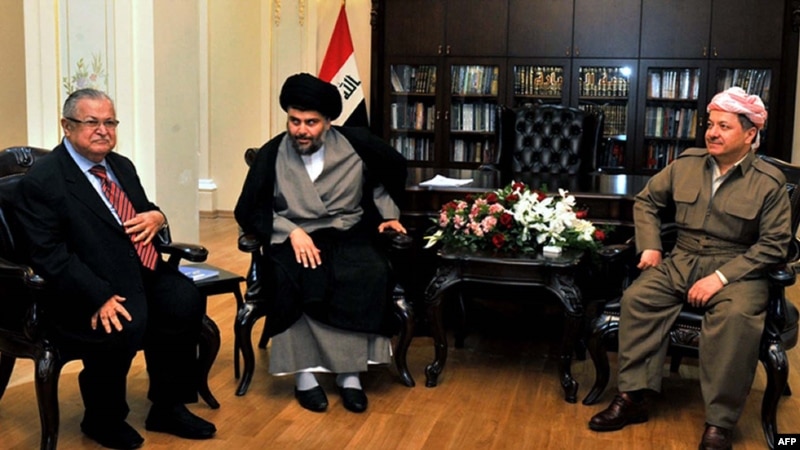
Muqtada al-Sadr meets with Iraqi President Jalal Talabani and Kurdish President Massud Barzani in Irbil.

The aftermath of the Bush administration's surge in Iraq left American observers with numerous COIN lessons and misconceptions to sort through. Among the general falsities, Shia cleric Muqtada al-Sadr had been put down and left for half-dead following a massive operation against his militia. Basra fell out of his control at the end of March 2008 and Iraqi forces raided the Baghdad enclave of Sadr City soon afterward, with both operations ending in a ceasefire ordered by al-Sadr. The Mahdi army was "disbanded" in August and the cleric relocated to Iran to accelerate his religious studies. 

U.S. military officials seized on Iraq's semi-independent gains as a notable sign of progress, but they knew (and feared) that al-Sadr would remain a force in Iraq's sphere of influence. Deriving political power from religious affiliation, public services and well-trained guerrillas, al-Sadr's "self-defense" militia completed its metamorphosis into a Hezbollah clone when his political party captured 39 parliamentary seats in March 2010. This victory allowed his military network to pressure U.S. troops out of the country without employing an abundance of force. Although his Promised Day Brigade threatened new attacks on U.S. troops if they didn't commit to a December 2011 exit, al-Sadr's leverage on Prime Minister Nouri al-Maliki played a more strategic role in upholding the Status of Forces Agreement (SOFA). 

The "fall" of Basra and al-Sadr City (still firmly under his control) marked the beginning of an upswing in al-Sadr's trajectory - the point that he wisely chose political power over military might. In doing so he kept both, and the 38-year old cleric is steadily positioning himself for a 21st century Iraq. 

President Jalal Talabani's office created the scene for al-Sadr's new power play over the weekend. Building on an ever-increasing wave of resentment against al-Maliki's style of governance, the premier's opponents arrayed in a show of force to push Iraq's political showdown closer to a resolution. Jalabani and al-Sadr were joined by Iraqiya chief Iyad Allawi, Sunni parliament speaker Osama al-Nujaifi and Massud Barzani, the president of the autonomous Kurdistan region. All parties have met resistance under al-Maliki's rule and, if they can formulate the correct power equation, possess the combined strength to roll back his authority. This level of coordination indicates that their recent information campaign is no coincidence - after "dictatorship, "marginalization" is the next buzzword on their list. 

"I have said it many times: the policy of exclusion and the policy of marginalization must end in Iraq," al-Sadr said. 

Similar language has been employed in recent days by other Iraqi officials. Speaking to the Associated Press before Irbil's summit, Barzani rejected al-Maliki's claim that the Kurds seek independence and warned that Iraq's unity is currently threatened by "dictatorship and authoritarian rule." From the Kurds' point of view, only al-Maliki's consolidation of power will drive them to consider seceding from the rest of the country. Rogue Vice President Tariq Hashimi also continued his individual crusade against al-Maliki and allegations of funding a Sunni death squad. Hashimi's remarks can easily be attributed to the charges he's facing, but he speaks no differently than the opposition's heavyweights: "Unfortunately Maliki is becoming the core of the problem." 

"If Maliki insists on his unacceptable marginalization policy and if he continues power consolidation which is no way acceptable, then definitely the majority of political entities is going to go for a vote of confidence." 

Intent on boosting his political capital and downsizing al-Maliki's power, al-Sadr has stepped into Baghdad's current gridlock with an "18-point plan" to implement 2010’s Irbil Agreement. Finalized after eight months of political wrestling, the agreement allowed al-Maliki to begin his second term as Prime Minister and eventually escape his obligations; the Interior Ministry remains under his control and Allawi never received his post atop a new security council. al-Sadr's plan also calls for good relations with Iraq's neighbors and the national distribution of wealth acquired from Iraqi oil exports. Yet the cleric stopped short of backing a new prime minister or another election, with his secretary general Dhia al-Assadi revealing only that, “Moqtada al-Sadr discussed a number of issues during his visit to the Kurdistan region, among them not renewing (the mandate of) Prime Minister Nuri al-Maliki.” 

al-Maliki's opponents wish to avoid another messy election as the country attempts to right itself in the wake of America's exit. They anticipate bearing responsibility for any chaos that would result from this scenario and prefer to back al-Maliki down through superior numbers, splitting the fruits of their labor. The upshot to external observers is that Baghdad's political warfare continues to pump out COIN lessons, notably "don't support an authoritarian figure" and "don't grow complacent following a military withdrawal." Having traveled to Washington at the invitation of Vice President Joe Biden, Barzani told the AFP that Iraqis expect more diplomatic support from America and questioned Washington's handling of al-Maliki. Unfortunately the White House has treated this sentiment with casual obliviousness. 

During the latest progress report on Afghanistan, one senior official assured reporters, "If you back and look at the strategic framework agreement with the Iraqis, again, it envisioned a broad-based partnership. And frankly, that's the agreement we have with the Iraqis and that's the basis of our relationship with Iraq today, as we've ended the war." 

 In addition to sponsoring a national reconciliation conference, the administration has repeatedly "reiterated support for a federal, democratic, pluralistic, united Iraq" since President Barack Obama fueled Baghdad's crisis in December 2011. However the conference fell through in April and the White House stubbornly remains in al-Maliki's corner, leading Barzani to remark, "Certainly, we have reservations about their policy and their attitude... We cannot sit and do nothing or try nothing to remedy the situation." 

Unless America wants its "enemies" to swoop in and play hero.

May 1, 2012

Obama Declares Undeclared Victory In Afghanistan

After going on the defensive for months, President Barack Obama has unleashed a comprehensive assault on the many opponents of the war in Afghanistan. One of his least discussed subjects, Obama was forced to surface in the aftermath of a Quran bonfire and a massacre committed by an over-deployed Army sergeant. He would sign a strategic agreement with President Hamid Karzai on Wednesday and use Osama bin Laden's death to launch this month's NATO summit in Chicago, where he will accelerate Washington's cautious victory lap.

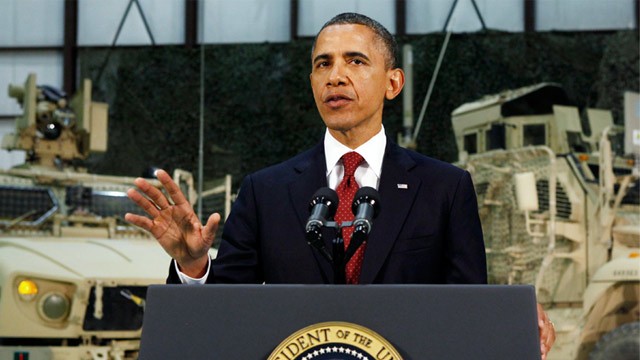
Obama's "surprise" visit to Bagram is anything but surprising, and the same goes for the contents of his speech. Composed entirely of Pentagon talking points, Obama's speech is filled with questionable statements and outright fallacies designed to continue the war after it "ends" in 2014. Instead of offering a realistic and thus more believable assessment, he turned to the skill that has always afforded him the most inner confidence - glorious rhetoric.

"My fellow Americans, we have travelled through more than a decade under the dark cloud of war. Yet here, in the pre-dawn darkness of Afghanistan, we can see the light of a new day on the horizon."

Governments aren't in the business of apologizing or admitting mistakes, but Obama may come to regret portions of his speech when Afghanistan's war grinds towards 2014 and beyond.
Over the last three years, the tide has turned. We broke the Taliban’s momentum. We’ve built strong Afghan security forces. We devastated al Qaeda’s leadership, taking out over 20 of their top 30 leaders. And one year ago, from a base here in Afghanistan, our troops launched the operation that killed Osama bin Laden. The goal that I set - to defeat al Qaeda and deny it a chance to rebuild - is now within our reach.
The death of bin Laden and erosion of al-Qaeda's core in Pakistan's tribal territories is self-evident. Together, NATO and Afghan forces have also killed or captured thousands of Taliban soldiers and field commanders, impacting their ability to retake territory lost to the coalition's saturation. Government education and health programs are improving the lives of Afghans after decades of perpetual conflict. Far less clear is the Taliban's permanent state of health. Although the insurgency has regressed from its high point in 2009 and early 2010, its ranks are still estimated between 15,000 and 25,000 foot soldiers. NATO attempts to "flip" Taliban yielded limited results; Mullah Omar possesses enough strength to initiate a territorial counteroffensive, but this suicidal strategy offers a minimal reward compared to the group's "spectacular" attacks. Multiple networks also reduce the damage inflicted upon the whole, and Afghanistan's government remains unable to fulfill the needs of many of its citizens.

Obama's surge slowed Taliban's momentum without irreparably breaking the insurgency's long-term capabilities. While U.S. and NATO casualties are gradually declining (93 as of April 30th), the insurgency is still on pace to match 2009's figure of 317 and could near this level in 2013. Plenty of Taliban will be hunting U.S. soldiers in 2014.
Within this framework, we’ll work with the Afghans to determine what support they need to accomplish two narrow security missions beyond 2014 - counter-terrorism and continued training. But we will not build permanent bases in this country, nor will we be patrolling its cities and mountains. That will be the job of the Afghan people. 
Not only is counter-terrorism one of the Washington's widest security missions, the Obama administration expects to leave thousands of Special Forces to conduct operations against the Taliban "and its affiliates." These forces must "patrol" Afghanistan in some form out of necessity; aerial recon is insufficient by itself. Drones could also remain active in the skies of post-2014 Afghanistan.
Fourth, we’re pursuing a negotiated peace. In coordination with the Afghan government, my administration has been in direct discussions with the Taliban. We’ve made it clear that they can be a part of this future if they break with al Qaeda, renounce violence and abide by Afghan laws. Many members of the Taliban - from foot soldiers to leaders - have indicated an interest in reconciliation. The path to peace is now set before them. Those who refuse to walk it will face strong Afghan security forces, backed by the United States and our allies. 
This statement is particularly misleading. First, backchannel negotiations between Washington and select Taliban figures were conducted without Karzai's input. Both sides are motivated by their distrust of Kabul and Karzai was later brought into the process after complaining in public and private. The negotiations themselves have progressed inches because neither side is willing to accept the other's terms. The Obama administration is demanding a conditional surrender where the Taliban gets nothing; U.S. troops will remain in the country past 2014, a direct violation of the Taliban's primary demand. Conversely, the Taliban view Karzai's government as illegitimate and will not lay down their arms so long as NATO soldiers patrol Afghanistan.

The absence of a political agreement would add an enormous amount of volatility to an already uncertain transitional period.
As we move forward, some people will ask why we need a firm timeline. The answer is clear: Our goal is not to build a country in America’s image, or to eradicate every vestige of the Taliban. These objectives would require many more years, many more dollars, and most importantly, many more American lives. Our goal is to destroy al Qaeda, and we are on a path to do exactly that. Afghans want to assert their sovereignty and build a lasting peace. That requires a clear timeline to wind down the war.
When defending his exit time-line against GOP critics, Obama contradicts himself by arguing that America's goal isn't to "eradicate every vestige of the Taliban." The odds of this scenario increase in the mud of political stalemate, and Obama openly warns Mullah Omar that he will face a strong U.S.-Afghan campaign if he refuses to surrender. U.S. statements that America cannot kill its way out of Afghanistan remain superficial.
Still, there will be difficult days ahead. The enormous sacrifices of our men and women are not over. But tonight, I’d like to tell you how we will complete our mission and end the war in Afghanistan. 
In other words, America and its allies haven't reached victory but will in the future. Obama concludes with a similar line, promising, "This time of war began in Afghanistan and this is where it will end." Naturally he would ignore an expanding (and failing) war in Yemen, where U.S. forces could maintain a significant presence in 2014, and various hotspots around Africa (Mauritania, Mali, Nigeria, Somalia). New conflict zones could open in the future.

Lesson learned from 9/11: how to engage more battlefields at the same time with less forces, costs, transparency and public attention.